
From my SubStack:
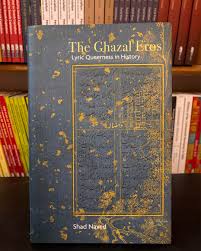
The Ghazal–a love lyric in Arabic, Persian, Ottoman Turkish and Urdu– has historically been defined as “talking with or about women”. For example, in his Persian dictionary compiled in eighteenth century Hindustan, Tek Chand Bahar defines the genre as follows: “Talk about women, or talking about making love with them or a poem that is said in praise of women”. However, as Shad Naved– a professor of literature and translation at Dr. B.R. Ambedkar University, Delhi– argues in his book The Ghazal Eros: Lyric Queerness in History (Tulika Books 2025), “the central role the ghazal played in the development of literature in Persian and Urdu during these six centuries is as a love lyric, in which men speak almost never about women but about other men and youthful boys–with the exception of Arabic, in which a strong current of love poetry about women written by male poets played an important role in the development of the ghazal” (Naved 9). Naved goes on to ask the crucial question: Why do the dictionaries lie?
For the purposes of this review, I will restrict my discussion to chapter one of Naved’s book–entitled “Sexual Orientation as Style”. It is this chapter which lays out the basis of Naved’s argument. Part Two of the book consists of three chapters that provide specific examples of lyric queerness in the Urdu ghazal. For example, chapter 2 focuses on the poet Mir Taqi Mir (1723-1810)–specifically on his poems dealing with “boy-love”. These detailed examples are outside the scope of my review.
Naved elaborates his argument as follows:
Queer studies, and more centrally queer history, therefore need to take seriously the historical elements of language and literature, if we are not to be trapped in a sexual orientation paradigm where heterosexuality and queerness are simply variations of an essence, thereby erasing the unequal relations between the two, and… an inequality in which queerness was the dominant term for a long time. If queerness is the historically correct name for the ghazal eros which most readers, critics and translators have silently heterosexualized, then it must be elaborated as a literary category shaped in concrete ways within history and not be derived as a natural variation of what is assumed to be the heterosexual bedrock of society and culture (27).
Naved discusses Altaf Hussain Hali (1837-1914)– the author of Muqaddammah-e-shir o shairi (introduction to poetry and poetics). Published in 1893, this was arguably the first book of literary criticism in Urdu. Hali contrasted “natural poetry” with the old ghazal tradition, writing in the Muqaddammah:
‘Natural poetry’ designates that poetry which in words and in meaning, in both senses, agrees with the ‘natural’, i.e. with the essential and the practical. To agree with the natural, in other words, means the poem’s words and their arrangement and combination, to the best of one’s ability, should agree with everyday speech of the language in which the poem is composed… to the extent the poem’s expression is needlessly distanced from ordinary speech and idiom, it would be considered ‘unnatural.’ At the level of meaning, agreeing with nature means the poem should refer to matters which usually happen or should happen in the world. So, the theme of a poem which goes contrary to this will have to be considered ‘unnatural’ (quoted in Naved 42)
Naved elaborates Hali’s definition as follows:
The ghazal, by these standards, is not natural poetry. And the most salient marker of it is its lyric queerness: verbally too artificial and archaic a convention or trope, and in terms of meaning it does not represent what happens in the world or what should happen in it because the poets and their words do not naturally correspond to each other, especially in the boy-love ghazal… Just as sexual orientation was first planted in social consciousness through the literary polemics against the old ghazal, the sense of the ‘unnatural’ too became attached to texts, authors and themes in vernacular literature that was on the verge of representing national culture for a world literature under colonial conditions… Nature, and therefore the unnatural too, does not have a moralistic or biologistic ring here, but a linguistic-historical one. If queerness does not sound familiar and real to speakers and readers of a language, this is largely due to its idealization in literature, an idealization that distances the literary language from its ‘natural’ basis in the common life of its speakers (Naved 43)
Naved concludes chapter one by writing:
… the studies in the rest of this book will show how lyric queerness directly conveys the ghazal’s relation to its times and social contexts. Earlier criticism has unnecessarily idealized the ghazal’s pose of lyrical unconcern and then read it as an allegory, when queerness, at distinct points in history brought to life a living connection between literary language and its historical world. Queerness, in my argument, is a term that shapes the erotic content of poetry, making it available for everyone–queers and non-queers alike–and it is as such that I proceed to use it in the rest of the argument (Naved 60).
As one would expect of a book that originated as a PhD dissertation, the writing is often abstruse and hard to follow for the lay reader. Thus, the audience for this book is primarily academics.
In conclusion, I would recommend The Ghazal Eros to those interested in Urdu poetry or in questions of gender and sexuality. Naved’s book sits at the intersection of comparative literature and queer theory and is an important contribution to the discourse.

.