
Precedent. Every Brown Pundits post, new ones included, must be at least 70 percent original to BP. Reposts from other sites are allowed, but the reposted portion must not exceed 30 percent of the post.
The Philippines has just recorded one of the fastest fertility declines in modern history, and almost nobody saw it coming.
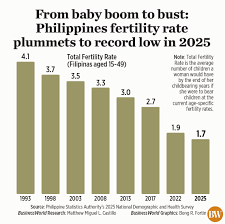
In 1993 the average Filipino woman had 4.1 children. By 1998 it was 3.9, by 2013 around 3.0, and by 2017 it was 2.7. Then it fell off a cliff. The 2025 National Demographic and Health Survey put the figure at 1.7, well below the 2.1 a population needs to replace itself. That is a 37 percent drop in about eight years, the steepest the country has ever recorded. In the early 1950s, Filipino women were having more than seven children each.
At 1.7 the Philippines is not yet as low as East Asia. It still sits above Japan at 1.2 and well above South Korea at 0.8. What unsettles demographers is not the level but the speed, and the direction, which is the same one every developed Asian society has already taken.
Why nobody expected it
None of this was expected here. The Philippines is the largest Catholic country in Asia and one of only two places on earth, alongside the Vatican, where divorce is still illegal. It has one of the highest teenage pregnancy rates in the region and a young population that was supposed to power Southeast Asian growth for decades. By every standard expectation it should have stayed high.
The ordinary part
Some of the decline is ordinary. Every developing country passes through the same demographic transition: when most people farm and many children die young, families have many; as medicine improves and people move to cities, children become a cost rather than an asset. The Philippines urbanised fast from the 1950s, Metro Manila taking in around a million migrants every five years, and fertility slid from seven to roughly three by 2013. That much it shares with Thailand, Vietnam and Indonesia.
Outcome of a no-divorce society
The collapse after 2013 is where the Asian Boss video reaches for reasons specific to the Philippines, and here a note of caution is needed. The video leans hard on relationships: men who cannot be trusted, women who stop trying, a dating market gone sour. That is part of the story, but it is told with more confidence than the evidence carries, and it crowds out causes a demographer would weigh just as heavily.
The first factor it names is the absence of divorce. A Filipino whose marriage fails has two options: legal separation, which bars remarriage, or annulment, which can cost over $10,000 and take two to four years, against a Manila minimum wage of about $11 a day. For most, neither is realistic, so men in failing marriages walk out and vanish. By 2024 there were over 15 million single parents, 95 percent of them mothers, and only about two thirds of young Filipinos had been raised by both parents. From this the video reasons that a generation of daughters learns early not to rely on men. It is a plausible chain, but a chain of inference, not a measured cause.
Schooling and work
Firmer ground is education and work. On the 2022 PISA tests, Filipino girls led boys by 14 points in maths and 35 in reading, and women have out-graduated men from college for over a decade. That edge met two booming sectors.
Outsourcing, which made the country the world’s call-centre capital by 2010, is about 54 percent female. Overseas work is bigger still: of 2.19 million Filipinos abroad in 2024, 57 percent were women, sending wages home as nurses, carers and domestic workers.
For the first time on a mass scale, Filipino women earned independently, and female-headed households are now roughly one in four. Wherever women gain schooling and income, fertility falls, with or without a divorce ban.
The weakest link
Social media is the video’s last factor, and its weakest. An old self-mocking phrase, NBSB, No Boyfriend Since Birth, flipped from an admission of failure into a badge of choice. But memes track changes in behaviour at least as often as they cause them, and a viral label is easier to film than the quiet facts beneath it: contraception, later marriage, the plain cost of a child in a city.
Old before rich
What makes the decline serious is timing. The Philippines is growing old before it has grown rich. It has no universal pension, a minimum wage of $11 a day, and by 2030 a rising weight of elderly to support. The outsourcing jobs that carried a generation are, by one estimate, 89 percent exposed to automation.
The last holdout
And here is the part the video never quite says. The Philippines is not an outlier. It is the last major Asian holdout to give way. China is near 1.0, South Korea 0.8, Japan 1.2, Thailand far below replacement, Vietnam recently under it. The same has happened across the subcontinent, under wholly different rules of marriage and family. India has dropped below replacement to 1.9. Bangladesh, poorer and more religious, is now there too. Sri Lanka and Nepal sit at the edge. Only Pakistan and Afghanistan still hold high. These countries share no divorce law, no meme, no dating culture. What they share is development: girls in school, women in work, children in cities. The Philippines was meant to be the exception that proved Catholic Asia could resist. It turned out to be the rule, only late. The question is no longer why the Filipino birth rate fell. It is why anyone expected it not to.
The video: Why Filipino Women Are Choosing to Stay Single Forever – Asian Boss
This is great news for the planet imo.
Great news for humans as well. Little by little we are going to be forced to confront the limitation of the infinite growth economic models that are treated as common sense as well as cultural defects that leads women to not want to seek out men.
And if AI turns out to be half as good as it is marketed to be having less people is not a bad thing. Even if it does not it suggests prosperity awaits those children who will.be born.
The only problem is the lack of pension and growing burden on the state but these are only problems countries like the Phillipines have 40 or so years to prepare for