

In May, Brown Pundits drew around sixty-one thousand visits, roughly two thousand a day and up about a third on the month. Thirty of those readers answered our survey, and while they agree on almost nothing, they are held together anyway by what they find interesting.
They are, on the same evidence, almost entirely male, forward-caste nearly to a person, and tilted in their politics.
The survey can only make sense against the size of our readership. In May, Brown Pundits drew about sixty-one thousand visits, close to two thousand a day, up roughly a third on April. Nearly half of that traffic came direct, readers typing the address or returning by habit rather than arriving from a search or a feed, and the average visit ran about a minute and a half across a little over two pages. The largest national audiences were in Canada, India and the United States.
| Brown Pundits, May 2026 | |
|---|---|
| Visits | ~61,000, up about a third on April |
| Per day | ~2,000 |
| Direct traffic | 49% |
| Average visit | ~1m 27s, 2.2 pages |
| Largest audiences | Canada, India, United States |
Against those sixty thousand, thirty people answered our survey before we closed the form. This is the devoted few who filled in a form asking their caste and their politics, not a census of the many who pass through.
The comments show who shouts; the survey shows who is here.
| Of the thirty who answered | |
|---|---|
| Men | 25+ |
| Aged 30 to 49 | 18 |
| Hold a Master’s or doctorate | 21 |
| Reading from outside South Asia | 17 |
| Hindu (five observant) | 18 |
| Muslim | 4 |
The one thing everyone wants
Begin with what unites a readership that unites on almost nothing else. Asked which subjects they want more of, twenty-six of thirty chose the history of the subcontinent. It appears on nearly every form, across every caste, faith, region and point of entry, the single universal in the data. Demography and genetics follow, then religion and civilisation, then geopolitics.
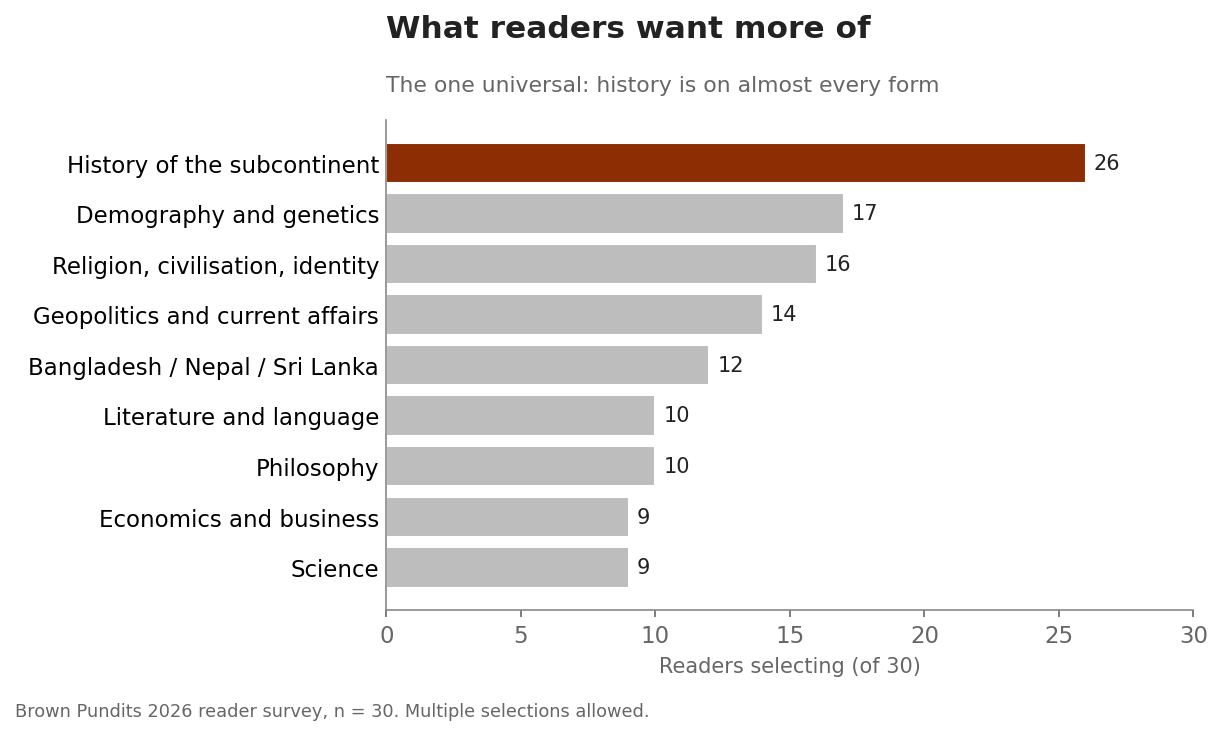
Everything else divides the room. History does not.
Plural in politics
On the questions that usually split South Asians, our readers split. Politically they cluster in four roughly equal blocks, centre-right, centre, centre-left and libertarian, with no dominant tribe among them. And yet a Brahmin doctorate in North America, an Ashraf Muslim, an Assamese atheist, a South Indian Christian, an Adivasi academic, and a non-South Asian who wandered in for the history, people who agree on almost nothing political, all reached for the same handful of subjects. The readership is not held together by what it concludes. It is held together by what it finds interesting.
Narrow in the body
It is also only half the picture, and we said we would give the other half plainly. The plurality is of opinion, not of person. More than twenty-five of the thirty respondents are men. On caste the room is narrower still: nineteen named a forward community, ten of them Brahmin, and not one respondent is OBC, Dalit or Scheduled Caste. Two are Adivasi. So the forum argues caste, fiercely and from every ideological corner, while being composed almost entirely of people from the top of the order it is arguing about. That does not make any single argument wrong. It does mean the room has an Elite-Patriarchical blind spot it cannot see from inside, and we would rather say so.
Caste predicts the line
The blind spot has a measurable shape. Score the views on Hindu nationalism from minus two, strongly opposed, to plus three, the lone extreme, and the averages sort cleanly by background.
| Group | Mean score on Hindu nationalism | n |
|---|---|---|
| Forward-caste Hindu (all) | +0.7 | 15 |
| of which Brahmin | +0.9 | 9 |
| Non-religious | −0.6 | 5 |
| Christian | −1.5 | 2 |
| Muslim | −1.5 | 4 |
Forward-caste Hindu identity, Brahmin most of all, is the cleanest predictor of sympathy; Muslim and Christian identity the cleanest predictor of opposition. The averages hide one exception worth naming, because it cuts against the lazy story. The single most extreme respondent, the one self-described “Extreme Hindutva,” is not a Brahmin but an Adivasi with a doctorate. Caste predicts the trend. It never predicts the person.
Two nationalisms, two shapes
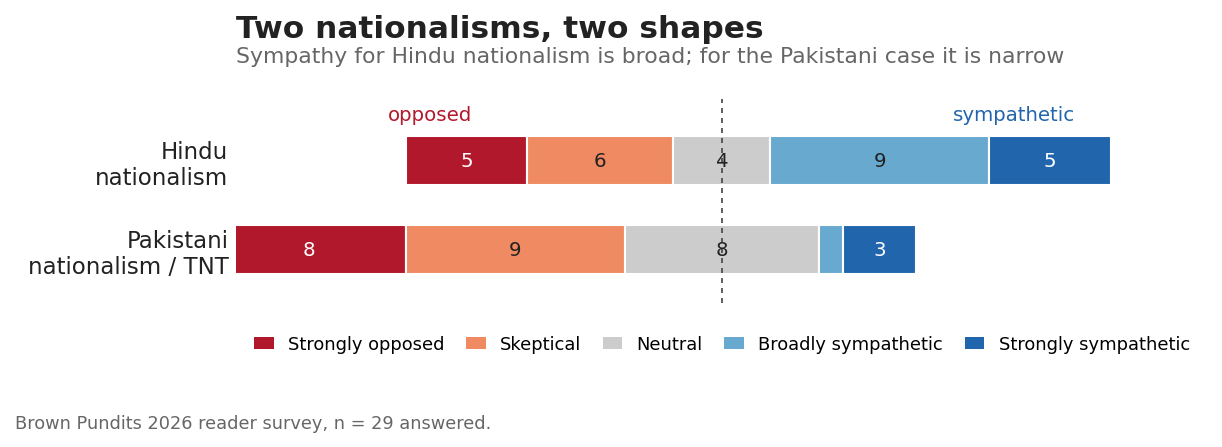
The sharpest finding is the asymmetry between the two nationalisms, and it conclusively settles Kabir’s Law; BP runs on a soft-Hindutva default.
Sympathy for Hindu nationalism is broad and diffuse, spread thinly across much of the readership: fourteen sympathetic against eleven critical. Support for the Pakistani case is narrow and concentrated: only four sympathetic, and the three who call themselves Pakistani nationalists are all Muslim, while opposition to the Two-Nation Theory comes from Hindus, Christians, atheists and agnostics alike. One side is a wide shallow pool, the other a small loud spring.
The marker is the degree, not the caste
Brahmins are the largest single named community, just under half of those who named one, and we will not pretend that is not an overrepresentation. But the stronger signal is educational. Twenty-one of thirty hold a Master’s or a doctorate, four in five a postgraduate or professional qualification, and that marker runs across every faith and caste where the caste marker does not. The readership looks less like a caste than like a faculty common room.
And one comfortable assumption dies here: the educated are not the moderate. Schooling and intensity of view correlate at essentially zero, and the most extreme respondent in the survey holds a doctorate. Here the degree buys depth of engagement, not coolness of temper.
A diaspora-led publication about the subcontinent
More than half of you, fifty-seven percent, read us from outside South Asia, with North America the largest single bloc. The May traffic agrees: the biggest national audiences sit in Canada, India and the United States, in that order.
The two halves ask for strikingly similar things, with one steady difference: those reading from inside the subcontinent lean harder toward geopolitics and the news of the day. On the deeper subjects, history and demography and civilisation, home and abroad want the same. If anything, the homeland reads a little more of the news; everyone reads the history.
What holds them
This is a readership that stays. More than three-quarters read at least weekly, ten of thirty daily. More than half have read for five years or more, several since the very beginning in 2014, and only three arrived in the last six months. One wrote to say he read BP from India until 2022, moved to Canada, and simply carried it with him. Retention like that is rare for an unpaid blog, and it is the strongest single signal in the survey.
The May traffic says the same from the outside: with nearly half of all visits arriving direct rather than from a search or a feed, this is a readership that comes back by habit, exactly what the tenure and frequency figures describe.
The tastes have a lineage, too. Most readers arrived years ago through Razib or Omar, and the two did not seed the same palate.
| Topic | Razib’s readers (13) | Omar’s readers (6) |
|---|---|---|
| Demography and genetics | 77% | 33% |
| Religion and identity | 46% | 33% |
| Under-covered countries | 46% | 17% |
| Caste and class | 15% | 0% |
| Geopolitics | 38% | 67% |
| Economics | 31% | 33% |
The geneticist’s readers still index toward demography and deep history; the Pakistan-and-affairs writer’s toward geopolitics. The cells are small, thirteen against six, so read the split as a strong hint rather than a proof. However they came, the point that matters is that they stayed.
The objection we keep
One reader, a doctorate-holder in Europe, used his comment box to call the flame wars tiresome and, more pointedly, to say that reading them leaves a person more polarised rather than closer to any middle ground.
We have argued the opposite: that the bridge, however ugly, beats the sealed room. We will not pretend this lands softly. It is the strongest objection to our whole case for why BP matters, and it comes from exactly the reader we most want to keep.
The survey cannot settle whether the contact here heals or hardens. It records only that one of our most engaged readers believes it hardens, and that we owe the possibility a hearing.
What the numbers say we are
So this is the portrait, both halves of it. The room is bound by temperament and not by tribe: a shared appetite for the subcontinent, for its history and its deep structures, held in common by people who agree on nothing else.
The room is also narrow and tilted: male, forward-caste, postgraduate, and leaning one way on the question it argues about most. Both are true, and the second does not cancel the first. The work that follows is plain enough.
We need the voices that did not answer because they are barely here to answer: women, resident Pakistanis, Indian Muslims, anyone from below the forward castes. A bridge with traffic in one direction is half a bridge. We have spent the season defending the bridge, and we still do. The survey only tells us, without flattery, who is standing on it, and who is not.
Traffic figures are third-party estimates for May 2026 and are approximate. Survey figures are drawn from thirty responses.
Thanks for running the survey and analyzing the results.
The results are certainly interesting. I feel vindicated that my gut feeling that there is a “soft-Hindutva” bias has been borne out by the data.
I’m not surprised by the lack of support for Pakistani nationalism. One would not expect Indians–of whatever political hue–to be sympathetic to the ideology of Pakistan or the TNT. Similarly, most Pakistanis are not sympathetic to Indian nationalism–even of the non-Hindutva variety.
The forum being overwhelmingly male and forward caste seem to me to be deeper issues. Perhaps there should be deeper effort to recruit female authors. My gut feeling is women are turned off by the very aggressive testosterone fueled arguments.
I do agree with the reader who said the flame wars leave one more polarized than closer to a middle ground. There are clearly two teams here– the “Saffroniate” and the “Crescentiate” and we have observed that–by and large– they cannot conduct a civilized conversation with each other. It’s a pity but reflects the real-world animosity between Indians and Pakistanis, Hindus and Muslims.
However, BP has certainly calmed down since the “ceasefires” were instituted. So let’s see how that goes and evaluate after a reasonable period.
Thanks for the reasoned comment; yes the ceasefires have been fairly effective and a pivot is required to sustain that engagement ..
30 is a fairly respectable number to draw inferences from ..
If you are referring to my comments in the open thread, I’d like to clarify (lest my comments be read as those of an NRI) that I live in India. I used to study and work in the US, but returned in the early 2010s. (I’ve spent all of two weeks in Europe in my entire life.)
no this was specific feedback left to us..
I’m sure this cohort has blind spots (what group doesn’t?), but I’d caution you from over-interpreting this data. Caste is a sticky thing in India, because our familial institutions are as strong as our cross-societal institutions are weak. But support for Hindutva has only grown over the decades where caste affiliations have weakened, especially in urban India. (I remember commenting about this a while ago, stating that Hindutva was now the default position of the Indian political class just as Nehruvian secularism had been until a generation ago.)
Support for Hindutva has increased not among Brahmins and other “forward castes” but among everyone else. I interpret this not as “Brahmins continue to dominate and suppress lower castes through the tool of Hindutva” but as “as family gets weaker and state/society stronger, there needs to be a binding factor among the people for whom caste holds less salience than it did for their ancestors. In today’s India, that’s Hindutva”. (And to reiterate my old comments, I say this as someone who holds an unfavorable opinion of Hindutva.)
If only anecdotally, my personal experience aligns. My TamBrahm in laws and their extended family hold BJP and Hindutva in very low regard whereas for my Jat family it is now the North star for guiding political discussions.
really TB’s ordinarily love BJP??
it will be interesting to see a post-Modi environment..
I don’t follow the Indian political circus in its day-to-day minutiae closely enough, but from a distance, it does seem the BJP is going to have a succession problem. I don’t think ‘Yogi’ is a viable national leadership option unless he successfully navigates and demonstrates a strong move to the ‘center’. Not impossible of course, but I’m skeptical.
In 5-7 years, I think the optimal outcome for the BJP is if leadership candidates from Bengal, or the South emerge. Are there any up and comers?