Storming the Red Zone…with human shields?

…..Imran
Khan’s terrible hunger for power is a frightening thing to see…his refusal to accept that system
can only be improved, not torn down……More than
convincing people of Nawaz Sharif being unfit to be Prime Minister, Imran has
made a more solid case for why he should never, ever be awarded that mantle….

….
We are outsiders…and this comment will probably give offense: Captain Sahib has gone completely bonkers. We agree with The Nation (Pakistan) editorial that Imran Khan should declare victory and go home.

It is bad enough that IK wears the mask of civil disobedience by urging his supporters to not pay taxes. Presently, just about 0.9% of Pakistan pays tax (he should know of this). How is such a step somehow enlightened?

But to encourage women and children to march to the Red Zone against the full might of the military…is insane. Add to this the crazy ultimatums. Nawaz Sharif has been asked to resign by Wednesday (Aug 20). What happens if he does not?
….

12:55am DawnNews reported sources as having said that the Pakistan Army has taken charge of the Interior Ministry’s control room. Former
Punjab law minister Rana Sanaullah however has rejected the reports,
saying that the Interior Ministry is still in charge of the control
room.


12:53am Amir Jamaat-i-Islami (JI) Sirajul Haq, while speaking to
DawNews said that both sides need to take a step back and resolve the
issues between them. He said that if the confrontation continues then it will be “Game over” for both sides.


12:33am ISPR spokesperson Asim Bajwa tweets: “Bldgs in red Zone r
symbol of State & being protected by Army, therefore sanctity of
these national symbols must be respected.
Situation requires
patience, wisdom & sagacity from all stakeholders to resolve
prevailing impasse through meaningful dialogue in larger national and
public interest.”


12:24am PTI chief Imran Khan said that he has given Prime Minister Nawaz Sharif till Wednesday evening to resign. “If Nawaz Sharif does not resign then we will enter into the PM House,” said the PTI chief.


12:14am “United States is keeping a close eye on political developments in Pakistan,” says State Department. “We
appeal to the PTI and PAT to pursue a non-violent approach
to resolve
the issue…Pakistani political parties should work out their
differences through dialogue,” the US State Department said.

……………………………………….
The Pakistan Tehreek-I-Insaf (PTI) has devised a dangerous strategy to march into the Red Zone and Constitutional Avenue.

PTI sources have said that women and children will be included in the march towards areas guarded by riot police, paramilitary forces, containers and barbed wire.

K-P
Minister Shaukat Yousafzai confirmed that women and children would
march in the second row, right behind key PTI legislators and Imran
Khan. The PTI Youth Wing would follow behind the women. When questioned
about the inclusion of women and children, Yousafzai said the march
would be peaceful, and the women and children were being placed in the
centre for their safety.

Abdul Qadir Baloch has termed the PTI’s
plan “inhuman”. He alleged that the PTI leadership was using the
children and women as a human shield. Speaking to media in front
of Parliament House, Baloch said including women and children in a
march – where violent clashes are expected – was unacceptable.

A PTI legislator on condition of anonymity said party members were clueless as to the logic behind Imran’s decisions. “He [Imran] is on his own. He doesn’t listen to anyone and party leaders are really annoyed, but they don’t know what to do”.
……

The numbers are dwindling, Imran’s buzz is wearing off, and really the
party at Serena Chowk has just been going on tediously long now. While
Tahir Ul Qadri restricts himself to speeches which magically change
meaning in translation, Imran can’t seem to make up his mind about what
he wants, or how to get it. Swinging from demanding an immediate
resignation, to one in seven days, then three days, until he finally
settled on two days, Imran Khan is trying even his followers’ patience.
Enough.
….

His latest call to civil disobedience is desperate, bordering
on manic. Having vastly overestimated his hand, perhaps Imran is hoping
to claw back some dignity in presenting the status quo as his great
victory. Incitement to sedition doesn’t really work in a country where
the state is already struggling to display it’s authority. 

….
A tiny sliver
of the population are taxpayers, and there’s nothing anyone seems to be
able to do about it. Will Imran be claiming this as his great miracle
in two days? Does he even know what date utility bills arrive? Does he
really think two days of people who don’t pay taxes, continuing to not
pay taxes is going to bring about any change at all? Enough.

……

Imran
Khan’s terrible hunger for power is a frightening thing to see. It is
troubling to see his refusal to accept that no matter how bad a system
is, that system can only be improved, not torn down like a pair of old
curtains. 

….
More than convincing people of Nawaz Sharif being unfit to be
Prime Minister, Imran has made a more solid case for why he should
never, ever be awarded that mantle. Planting misleading expectations,
leading people to violence, suffering from delusions of grandeur, Imran Khan’s behaviour is now simply embarrassing. 

………
He is doing the
government’s job for them: convincing the millions watching on TV that
they were wise to stay home. The PMLN are having a chuckle at the PTI’s
expense. And the opposition is shaking their head at the corpse of a
long march that Imran Khan is trying to whip life back into. 

….
A man
should know when he is beaten. Imran has not achieved what he came for,
nor will he. Any further adventures in Serena Chowk will further
undermine his already pitiful credibility, and are best avoided. The
sincerest advice anyone can give the PTI chief is: go home. Enough.

…….

Link (1): dangerous-game-pti-to-march-into-red-zone-with-women-children

Link (2): islamabad-march-imran-threatens-to-storm-pm-house-unless-nawaz-steps-down

Link (3): http://www.nation.com.pk/editorials/18-Aug-2014/go-home-imran
……

regards

Sunil Dutta: super-cop

..I’m a cop….If you don’t want to get hurt, don’t challenge me….don’t argue with me…..don’t say I’m a racist pig…..don’t threaten that you’ll sue me
and take away my badge…..don’t scream at me that you pay my salary……

…..

 
Sunil Dutta, a Professor of Homeland Security at Colorado Tech
University, has been an officer with the Los Angeles Police Department
for 17 years. The views presented here are his own and do not represent
the LAPD.

Education
  • M.A. Homeland Security, Naval Postgraduate School, United States Center for Homeland Defense and Security, Monterey, CA, (2012)


  • Ph.D. Plant Biology, University of California, Davis (1995)

  • M.S. Plant Physiology, University of Florida, Gainesville (1989)

  • B.S. Botany, Haryana Agricultural University, Hisar, India (1986)
Background 
…..Dr.
Sunil Dutta is a full time law enforcement professional working in Los
Angeles.  He has been with the LAPD for sixteen years.  His assignments
have included Watch Commander, Internal Affairs Investigator, patrol officer,
and Collision Investigator…..Prior
to joining the LAPD, Dutta was a scientist with a specialization in
biochemistry (host-pathogen interactions, plant hormones, carbohydrate
metabolism, and regulation of dormancy).  He is an amateur musician….

To
be honest, once we recovered from the shock (that was an Indian speaking??),
we
were ready to admit that Dr Dutta has penned an impressive op-ed. Based
on his bio, we guess that he hails from a Punjabi or Haryanvi background. He is
the “first” Indian-American law and order conservative that we
have ever heard from (or heard about). Also he is quite a sharp-spoken biologist (we
know a few of them).

As for the rest, yes…excellent advice…for (black, brown) young males in the USA. When we first learned to drive it was drummed into our rebellious heads (incidentally, by a black tutor) that in case the police ordered you to pull over, you must come to a stop….slow and easy (with hazard lights ON), keep your windows lowered, and your hands visibly placed on the wheel at all times. 
……….
If they ask you to step out, immediately comply, while keeping the hands held high. Under no circumstance, do you keep the hands in your pockets. Do not make any sudden movement. Never crack jokes, be courteous, always address the “racist pig” as “Officer.”  

The response to our indignant whys was an angry whisper: Brother….do you want to die?

No Officer Dutta, we do not want to die. And we respect you for doing a tough job. And yes – as you have admirably pointed out – if the police can afford military grade weapons they can stretch the budget to include a video camera. The absence of video is baffling, but then if you think twice….it all makes sense.
………..

A teenager is fatally shot by a police officer; the police are
accused of being bloodthirsty, trigger-happy murderers; riots erupt.
This, we are led to believe, is the way of things in America.
…..It is also a terrible calumny; cops are not
murderers.
 

……
No officer goes out in the field wishing to shoot anyone,
armed or unarmed. And while they’re unlikely to defend it quite as
loudly during a time of national angst like this one, people who work in
law enforcement know they are legally vested with the authority to
detain suspects — an authority that must sometimes be enforced.
Regardless of what happened with Mike Brown, in the overwhelming
majority of cases it is not the cops, but the people they stop, who can
prevent detentions from turning into tragedies.


….
Working the
street, I can’t even count how many times I withstood curses, screaming
tantrums, aggressive and menacing encroachments on my safety zone, and
outright challenges to my authority. In the vast majority of such
encounters, I was able to peacefully resolve the situation without using
force. Cops deploy their training and their intuition creatively, and I
wielded every trick in my arsenal, including verbal judo, humor,
warnings and ostentatious displays of the lethal (and nonlethal)
hardware resting in my duty belt. 

One time, for instance, my partner and
I faced a belligerent man who had doused his car with gallons of gas
and was about to create a firebomb at a busy mall filled with holiday
shoppers. The potential for serious harm to the bystanders would have
justified deadly force. Instead, I distracted him with a hook about his
family and loved ones, and he disengaged without hurting anyone. Every
day cops show similar restraint and resolve incidents that could easily
end up in serious injuries or worse.


…..
Sometimes, though, no amount
of persuasion or warnings work on a belligerent person; that’s when
cops have to use force, and the results can be tragic. We are still
learning what transpired between Officer Darren Wilson and Brown, but in
most cases it’s less ambiguous — and officers are rarely at fault. When
they use force, they are defending their, or the public’s, safety.


…..
Even
though it might sound harsh and impolitic, here is the bottom line: if
you don’t want to get shot, tased, pepper-sprayed, struck with a baton
or thrown to the ground, just do what I tell you. Don’t argue with me,
don’t call me names, don’t tell me that I can’t stop you, don’t say I’m a
racist pig, don’t threaten that you’ll sue me and take away my badge.
Don’t scream at me that you pay my salary, and don’t even think of aggressively walking towards me. Most field stops are complete in minutes. How difficult is it to cooperate for that long?

I know it is scary for people to be stopped by cops. I also
understand the anger and frustration if people believe they have been
stopped unjustly or without a reason. I am aware that corrupt and bully
cops exist. 

When it comes to police misconduct, I side with the ACLU:
Having worked as an internal affairs investigator, I know that some
officers engage in unprofessional and arrogant behavior; sometimes they
behave like criminals themselves. I also believe every cop should use a
body camera to record interactions with the community at all times. 

Every police car should have a video recorder. (This will prevent a
situation like Mike Brown’s shooting, about which conflicting and
self-serving statements allow people to believe what they want.)
And you
don’t have to submit to an illegal stop or search. You can refuse
consent to search your car or home if there’s no warrant (though a
pat-down is still allowed if there is cause for suspicion). Always ask
the officer whether you are under detention or are free to leave. Unless
the officer has a legal basis to stop and search you, he or she must
let you go. Finally, cops are legally prohibited from using excessive
force: The moment a suspect submits and stops resisting, the officers
must cease use of force.


But
if you believe (or know) that the cop stopping you is violating your
rights or is acting like a bully, I guarantee that the situation will
not become easier if you show your anger and resentment. Worse,
initiating a physical confrontation is a sure recipe for getting hurt.
Police are legally permitted to use deadly force when they assess a
serious threat to their or someone else’s life. 

Save your anger for
later, and channel it appropriately. Do what the officer tells you to
and it will end safely for both of you. We have a justice system in
which you are presumed innocent; if a cop can do his or her job
unmolested, that system can run its course. Later, you can ask for a
supervisor, lodge a complaint or contact civil rights organizations if
you believe your rights were violated. Feel free to sue the police! Just
don’t challenge a cop during a stop.


….’
An average person cannot
comprehend the risks and has no true understanding of a cop’s job.
Hollywood and television stereotypes of the police are cartoons in which
fearless super cops single-handedly defeat dozens of thugs, shooting
guns out of their hands. Real life is different. An average cop is
always concerned with his or her safety and tries to control every
encounter. That is how we are trained. 

While most citizens are courteous
and law abiding, the subset of people we generally interact with
everyday are not the genteel types. You don’t know what is in my mind
when I stop you. Did I just get a radio call of a shooting moments ago?
Am I looking for a murderer or an armed fugitive? For you, this might be
a “simple” traffic stop, for me each traffic stop is a potentially
dangerous encounter. Show some empathy for an officer’s safety concerns.
Don’t make our job more difficult than it already is.


….
Community
members deserve courtesy, respect and professionalism from their
officers. Every person stopped by a cop should feel safe instead of
feeling that their wellbeing is in jeopardy. Shouldn’t the community
members extend the same courtesy to their officers and project that the
officer’s safety is not threatened by their actions?

……..

Link: im-a-cop-if-you-dont-want-to-get-hurt-dont-challenge-me

…..

regards

First among equals (men)

…..During Ramzaan, we’d
call the Hindus and Christians over for aapam and curry…We shared our lives…..I sat up all night for Shivaratri…..Vilakkupara has a temple with Shiva  as
the pratishtham (presiding deity)…..all the festivities during Makara
Sankaranti, I was part of all that.
…. 
…….
We would guess that the purpose of a “First Men in India” list (see below) is for scoring in a “general knowledge” or GK exam. A mind numbing exercise, if there was one.


The madness of GK exams is highlighted in a famous 1970s Bong novel – Jana Aranya by Shankar (Mani Shankar Mukhopadhyay), later a memorable movie by Satyajit Ray. The goal is to short-list nine out of 27,000 graduates. One question relates to a name that is possibly an Indian river OR a (eponymous) ship with the India navy. The examinees are confused, this is a public sector organization (owned by the government) held exam, hence the examiners will prefer the ship as the correct answer!!!

Now all lists are limited to a fashion and so is “First Men in India.” It can be expanded (and cut short) in so many different ways. For example, we consider this of the utmost importance, that Abhinav Singh Bindra won the first individual gold medal in the Olympics (Beijing, 2008). If you have scored a once in a hundred year achievement, it deserves to be celebrated.
…….
A thing about the Nobel Prizes (post 1947). Amartya Sen chose not to relinquish his Indian citizenship but Har Gobind Khorana became an American citizen in 1966 (Nobel in 1968). He was mistreated by his colleagues and bureaucrats in India, but that is hardly news. India should introduce a dual citizenship to honor the memory of HGK!!!

Another thing: Khorana was born in Raipur near Lahore (1922, now called Kabirwala). We are genuinely curious to know if Pakistan has found the time and space to celebrate a Pakistan-born, Punjabi-Hindu Nobel (we know what happened to Abdus Salam).

The most curious (and pathetic) thing? Indians recognizes talent only after the folks have broken international barriers…on many occasions…after they have departed (or about to depart) from this world!!!

Thus the “son of Gandhi” Acharya Vinoba Bhave was the first Indian to win the Magsaysay award. was. He was awarded the Bharat Ratna posthumously in 1982. Sen got the Ratna after he won the Nobel. Ray was given the Ratna on his death-bed….following his life-time Oscar. Ravi Shankar (Robindra Shankar Chowdhury) was nominated for an Oscar (Gandhi, original music score) in 1982 and won the Ratna in 1999.

So…..how about the first “non-Hindus” then? India has the “first” Muslim president (and Sikh Prime Minister). Abdul Rehman (AR) Antulay was the “first” Muslim Chief Minister of Maharashtra (politically more significant than the President perhaps), but no Muslim PM yet (also none on the horizon).

Slumdog Millionaire (2009) helped score a number of Indian “firsts” – AR Rahman for original music score and song, Gulzar- song, and Resul Pookutty- sound mixing (along with Ian Tapp and Richard Pryke).   

The Saudi Gazette has this to say about the winners: Many commentators have noted that the three Indian Oscar winners (Pookutty, Rahman and Gulzar) are all Muslim. 


Well the commentators are right in one way…and also wrong. 
……….
(1) Sampooran Singh Kalra (Gulzar) was born a Sikh in Dina, Jhelum district, which is presently in Pakistan. Sad to say…hard-line Sikhs will dislike the fact that he is not a Kesh-Dhari (no turban, trims hair).

We are sure that Gulzar Sahib would not mind being called a muslim, but he is famous and there are many clans who would like to claim kinship…including (Hindu) Bongs. In support of such a claim we note the following: he speaks fluent Bong,  rose to fame under the baton of Bong directors (Bimal Roy, Hrishikesh Mukherjee), a soul mate of music director Rahul Dev Burman, married (separated) to actor-superstar Raakhee (Majumdar), with a daughter named Meghna (after the famous river in Bengal, now in Bangladesh).
…………
 
(2) AR Rahman was born RS Dileep Kumar, a Hindu (father: RK Shekhar and mother Kashturi, converted name Kareema). Rahman was introduced to Qadiri Islam
(Qadiri is a Sufi sect) when his younger sister was seriously ill in 1984. He converted to
Islam (his mother’s religion) with other members of his family in 1989
at age 23, changing his name from R. S. Dileep Kumar to Allah Rakha
Rahman (A. R. Rahman)
[ref. Wiki].

We are assured that the Saudi Gazaette would not view religious conversion with concern when it goes in one particular direction (then again Saudis may view Sufi practices as un-islamic). But just as a thought question, what if the conversion was in the opposite direction (and in a muslim country)?
………………

(3) The most interesting life-story is that of Resul “our home is the land of Om” Pookutty. 

The Pookutty-s are a Communist family from Villakku-para (Kollam district in south Kerala), but Resul was deeply influenced by his mother’s imagination of Islam which binds in so many ways to Hinduism and even Christianity. The Saudis would probably consider such behavior as borderline apostasy. This is similar to the polluted Islam of (then) East Pakistan that made Muslim Bengalis not quite pure enough in the eyes of their Western brothers.

……

That fabulous Oscar acceptance speech about Home being the Land of Om
How? (vulgar sub-text: You’re Muslim but you said that?).

That was not the occasion to thank my cat and dog. It was a chance to make a point to the watching world and I didn’t waste it.

I’m
an Indian first, before Muslim and Malayali. I grew up with Hindus and
Christians, went to school with them, I work with them. Religion never
came in the way and it doesn’t now.

You waded right into hardcore religion with that? When
it’s the thing in some urban circles to say, “Oh, I’m spiritual, not
religious,” and hide out in a feel-good fuzzy bandwidth of pretty
thoughts?


(Grins). My mother, Nabeeza Beevi, who died in early 2000, taught me that outlook. She was a devout Muslim who did namaaz
five times a day. Her Islam made her a woman with a great sense of
humanism and spirituality. She learnt her spirituality from religion.
During Ramzaan, we’d call the Hindus and Christians over for aapam and curry (and guess who did the grinding for the batter: me!). And for Easter, we’d be called for more aapam
and curry. We shared our lives. I sat up all night for Shivaratri, our
village, Vilakkupara, up in the timberlands of Kerala, has a temple with
Shiva  as the pratishtham (presiding deity). And all the
festivities during Makara Sankaranti (mid-January), I was part of all
that. Personally, I think it’s important to have a religious identity.
You can’t be afraid of religion. You have to deal with it, otherwise
look what happens.

How do you deal with it?

I did my first katha-prasangam (performance of
story-recitation) at our Shiva temple. My mother taught us the Quran (my
father was a Communist and his brother, PT Pookutty, was the first
Communist municipal councilor of Kayamkulam nearby). But my mother never
forced religion on us. I learnt that all South Indian Muslims were
Sunni in a very amusing way. Some years ago, a gentleman from Hyderabad
called my elder brother, Shamsuddin, with a marriage proposal for me. I
answered the phone and pretended to be my brother. When he asked if we
were Sunni or Shia, I didn’t know. I only knew the Quran. So I said,
“Shia!” in a wild guess. The man hung up at once. Only then did I
discover this.
– See more at: http://www.hindustantimes.com/comment/columnsothers/resul-on-religion/article1-408887.aspx#sthash.MYAmDUgO.dpuf

That fabulous Oscar acceptance speech about Home being the Land of Om
How? (vulgar sub-text: You’re Muslim but you said that?).

That was not the occasion to thank my cat and dog. It was a chance to make a point to the watching world and I didn’t waste it.

I’m
an Indian first, before Muslim and Malayali. I grew up with Hindus and
Christians, went to school with them, I work with them. Religion never
came in the way and it doesn’t now.

You waded right into hardcore religion with that? When
it’s the thing in some urban circles to say, “Oh, I’m spiritual, not
religious,” and hide out in a feel-good fuzzy bandwidth of pretty
thoughts?


(Grins). My mother, Nabeeza Beevi, who died in early 2000, taught me that outlook. She was a devout Muslim who did namaaz
five times a day. Her Islam made her a woman with a great sense of
humanism and spirituality. She learnt her spirituality from religion.
During Ramzaan, we’d call the Hindus and Christians over for aapam and curry (and guess who did the grinding for the batter: me!). And for Easter, we’d be called for more aapam
and curry. We shared our lives. I sat up all night for Shivaratri, our
village, Vilakkupara, up in the timberlands of Kerala, has a temple with
Shiva  as the pratishtham (presiding deity). And all the
festivities during Makara Sankaranti (mid-January), I was part of all
that. Personally, I think it’s important to have a religious identity.
You can’t be afraid of religion. You have to deal with it, otherwise
look what happens.

How do you deal with it?

I did my first katha-prasangam (performance of
story-recitation) at our Shiva temple. My mother taught us the Quran (my
father was a Communist and his brother, PT Pookutty, was the first
Communist municipal councilor of Kayamkulam nearby). But my mother never
forced religion on us. I learnt that all South Indian Muslims were
Sunni in a very amusing way. Some years ago, a gentleman from Hyderabad
called my elder brother, Shamsuddin, with a marriage proposal for me. I
answered the phone and pretended to be my brother. When he asked if we
were Sunni or Shia, I didn’t know. I only knew the Quran. So I said,
“Shia!” in a wild guess. The man hung up at once. Only then did I
discover this.
– See more at: http://www.hindustantimes.com/comment/columnsothers/resul-on-religion/article1-408887.aspx#sthash.MYAmDUgO.dpuf

That fabulous Oscar acceptance
speech about Home being the Land of Om
How? (vulgar sub-text: You’re Muslim but
you said that?).

That was not the occasion to thank
my cat and dog. It was a chance to make a point to the watching world and I
didn’t waste it.

I’m an Indian first, before Muslim and Malayali. I grew up with Hindus and
Christians, went to school with them, I work with them. Religion never came in
the way and it doesn’t now.

You waded right into hardcore
religion with that? When it’s the thing in some urban circles to say, “Oh, I’m
spiritual, not religious,” and hide out in a feel-good fuzzy bandwidth of
pretty thoughts?

My mother, Nabeeza Beevi, who died in early 2000, taught
me that outlook. She was a devout Muslim who did namaaz five times a
day. Her Islam made her a woman with a great sense of humanism and
spirituality. She learnt her spirituality from religion. 
During Ramzaan, we’d
call the Hindus and Christians over for aapam and curry (and guess who
did the grinding for the batter: me!). And for Easter, we’d be called for more aapam
and curry. We shared our lives. 
I sat up all night for Shivaratri, our village,
Vilakkupara, up in the timber lands of Kerala, has a temple with Shiva  as
the pratishtham (presiding deity). And all the festivities during Makara
Sankaranti (mid-January), I was part of all that.
 
Personally, I think it’s
important to have a religious identity. You can’t be afraid of religion. You
have to deal with it, otherwise look what happens.

How do you deal with it?

I did my first katha-prasangam
(performance of story-recitation) at our Shiva temple.
 
My mother taught us the
Quran (my father was a Communist and his brother, PT Pookutty, was the first
Communist municipal councilor of Kayamkulam nearby). But my mother never forced
religion on us. 
I learnt that all South Indian Muslims were Sunni in a very
amusing way. Some years ago, a gentleman from Hyderabad called my elder
brother, Shamsuddin, with a marriage proposal for me. I answered the phone and
pretended to be my brother. When he asked if we were Sunni or Shia, I didn’t
know. I only knew the Quran. So I said, “Shia!” in a wild guess. The man hung
up at once. Only then did I discover this. 
……

First Men in India

# Achievement Man
1 The first President of Indian Republic Dr. Rajendra Prasad
2 The first Prime Minister of free India Pandit Jawahar Lal Nehru
3 The first Indian to win Nobel Prize Rabindranath Tagore
4 The first President of Indian National Congress W. C. Banerjee
5 The first Muslim President of Indian National Congress Badruddin Tayyabji
6 The first Muslim President  Dr. Zakir Hussain
7 The first British Governor General  Lord William Bentinck
8 The first British Viceroy  Lord Canning
9 The first Governor General of free India Lord Mountbatten
10 The first and the last Indian to be Governor General of free India C. Rajgopalachari
11 The first man who introduced printing press in India James Hicky
12 The first Indian to join the I.C.S. Satyendra Nath Tagore
13 India’s first man in space Rakesh Sharma
14 The first Prime Minister who resigned without completing the full term Morarji Desai
15 The first Indian Commander – in – Chief  General Cariappa
16 The first Chief of the Army Staff Gen. Maharaj Rajendra Singhji
17 The first Indian member of the Viceroy’s executive council S. P. Sinha
18 The first President of India who died while in office Dr. Zakir Hussain
19 The first Prime Minister who did not face the Parliament Charan Singh
20 The first Field Marshal  S.H.F. Manekshaw
21 The first Indian to get Nobel prize in Physics C.V. Raman
22 The first Indian to receive Bharat Ratna award Dr. Radhakrishnan
23 The first Indian to cross English channel Mihir Sen
24 The first person to receive Jnanpith award Sri Shankar Kurup
25 The first Speaker of the Lok Sabha Ganesh Vasudeva Mavalankar
26 The first Vice – President of India Dr. Radhakrishnan
27 The first Education Minister Abul Kalam Azad
28 The first Home Minister  Sardar Vallabh Bhai Patel
29 The first Indian Air Chief Marshal S. Mukherjee
30 The first Indian Naval Chief Vice Admiral R. D. Katari
31 The first judge of International Court of Justice Dr. Nagendra Singh
32 The first person to receive Paramveer Chakra Major Somnath Sharma
33 The first person to reach Mt. Everest without oxygen Sherpa Anga Dorjee
34 The first Chief Election Commissioner Sukumar Sen
35 The first person to receive Magsaysay Award Acharya Vinoba Bhave
36 The first person of Indian origin to receive Nobel Prize in Medicine Hargovind Khurana
37 The first Chinese traveller to visit India Fa-Hein
38 The first person to receive Stalin Prize Saifuddin Kitchlu
39 The first person to resign from the central cabinet Shyama Prasad Mukherjee
40 The first foreigner to receive Bharat Ratna Khan Abdul Ghaffar Khan
41 The first person to receive Nobel Prize in Economics Amartya Sen
42 The first Chief Justice of Supreme Court Justice Hiralal J. Kania
 ………………………………..

…..

regards

Building Toilets not Really Useful?

Left, right, and toilets:

Most people in India defecate in the open. Most people worldwide who defecate in the open live in India. The diseases spread by open defecation kill hundreds of thousands of Indian children each year and stunt the physical and cognitive development of those who survive….The importance of removing faecal germs from children’s environments follows clearly from economists’ growing understanding of early-life human capital accumulation. Study after study is showing that exposure to disease and other health insults in the critical first months of life translate into quantitatively important lost productivity as adults (for a recent review, see Currie and Vogl, 2013). If children exposed to more open defecation grow up to be adults who earn less and pay less tax, open defecation is not only a health disaster but an economic one too.

Remember that 35% of Indian population is under 18. For this cohort time has nearly run out to make any meaningful intervention. So the “economic disaster” has largely already happened. The issue is reducing its severity and preventing its future occurrence.

Open defecation has been declining by only about one percentage point per year for a very long time. Intensifying business as usual is not enough…. 

First, even without our survey, it is clear that there are many developing countries that are much poorer than India where open defecation rates are low and falling fast. Only 4% of people in Bangladesh and a small fraction of people in sub-Saharan African countries such as Rwanda, Burundi, Malawi, Kenya and the Democratic Republic of Congo (DRC) defecate in the open. People in these countries do not buy the expensive latrines with enormous pits that people in India insist on. Instead, these other countries are eliminating open defecation by switching first to using simple pit latrines that most people in India could already afford to make—affordable latrines which would save infant lives and prevent the spread of disease. 

Second, we found that many people defecate in the open even though they live in a household with a working latrine—and we know the latrine is working because somebody is using it. Over 40% of households with a working latrine have at least one person who defecates in the open. This figure includes both privately constructed and government latrines, which are much less likely to be used. Most people living in households with a fully government constructed latrine defecate in the open—indeed, even most young women in their 20s do. In these cases, the problem is clearly not latrine access….

We find that two-thirds of new latrine recipients would defecate in the open, and that even if the government were to build a latrine for every rural household in these states, without changing anybody’s preferences, a majority of people would still be defecating in the open. 

In fact, this result reflects two optimistic assumptions—that existing latrine owners are not more likely to be latrine users for unobservable reasons, and that the government’s attempt to build a latrine for every household indeed translates into a latrine on the ground for every household. So, it is clear that mere latrine construction is simply not enough. Instead, the Swachh Bharat Mission must be built on promoting latrine use: building demand for latrines.

Caste, Religion and Open Defecation

India’s race to build toilets failing as villages don’t use them:

When nature calls, the 26-year-old single mother and her four children head toward the jungle next to their farm of red and pink roses, to a field of tall grass, flecked with petals, where the 7,000 people of her village go to defecate and exchange gossip. 

“Only dalits, the lowest Hindu caste, should be exposed to excrement in a closed space, or city-dwellers who don’t have space to go in the open,” said Sunita, who uses one name, as she washed clothes next to the concrete latrine. “Faeces don’t belong under the same roof as where we eat and sleep.”

Muslim mortality paradox and the importance of sanitation for children:

In India, Muslim children are substantially more likely than Hindu children to survive until their fifth birthday, despite Muslim parents being poorer and less educated on average than Hindu parents. The phenomenon has been documented by numerous researchers over the past 20 years, including most recently by Bhalotra et al. (2010)….Though it is by now well-known that a substantial fraction of India’s population defecates in the open, without the use of toilets or latrines, what is less well-known—at least to those residing outside of rural India—is that Hindus are substantially (40%) more likely than Muslims to do so…. 
Analysing the three most recent rounds of the government of India’s nationally representative survey data, the National Family Health Survey (NFHS) of India, we find Hindus are dramatically more likely than Muslims to openly defecate, meaning they self-report using a bush, field, or no facility rather than a latrine or toilet. In the three most recent waves of the NFHS, 67% of Hindu households report openly defecating, while only 42% of the relatively poorer Muslim households do so. This simple but dramatic fact is easily replicable using any Indian survey dataset that asks respondents about religion and waste disposal. 
To understand these high-level statistics in more depth, R.I.C.E. (Research Institute for Compassionate Economics) researchers in a separate study collected detailed information about behaviour and preferences towards defecation in rural northern India. This new dataset, online at squatreport.in, reveals that a substantial minority of Hindus who reside in household with a latrine still choose to defecate in the open: 25% of Hindus who own working latrines choose not to use them, compared with 10% of Muslims. Further, Hindus are more likely than Muslims to respond that open defecation away from the home is pure, while using a latrine near the home is not pure.

London- World City #1

……Beyond these traditional strengths, London
has become Europe’s top technology startup center……upward of 3,000 tech startups…..Google’s largest office outside Silicon Valley……

….
East or West….London is the best. Singapore (4), Hong Kong (6), and Dubai (7) are ranked ahead of Beijing (8, tie with Sydney) and Shanghai (19).  
Dubai ahead of Shanghai, really?

Frankfurt is the top rated city in Germany at a lowly #14. Mumbai (31) and Delhi (34) are the top-ranked cities in South Asia (in the future we may see Chennai and Bangalore on this list). Surprising to see Berlin (37) tied with Seattle and Tel Aviv.
……
In order to quantify cities’ global influence, we looked at eight
factors: the amount of foreign direct investment they have attracted;
the concentration of corporate headquarters; how many particular
business niches they dominate; air connectivity (ease of travel to other
global cities); strength of producer services; financial services;
technology and media power; and racial diversity. (Click here for
a more detailed description of our methodology.) 

……….
We found those factors
particularly important in identifying rising stars that, someday, might
challenge the current hegemony of our two top-ranked global cities,
London and New York.


Inertia and smart use of it is a key theme that emerged in our
evaluation of the top global cities. No city better exemplifies this
than London, which after more than a century of imperial decline still
ranks No. 1 in our survey.  

….
The United Kingdom may now be a second-rate
power, but the City’s unparalleled legacy as a global financial capital
still underpins its pre-eminence.


Ranked first in the world on the Z/Yen Group’s 2013 Global Financial
Centres Index, which we used for our list, London not only has a long
history as a dominant global financial hub, but its location outside the
United States and the eurozone keeps it away from unfriendly
regulators. Compared to New York, it is also time-zone advantaged for
doing business in Asia, and has the second best global air connections
of any city after Dubai, with nonstop flights at least three times a
week to 89% of global cities outside of its home region of Europe.


A preferred domicile for the global rich, London is not only the
historic capital of the English language, which contributes to its
status as a powerful media hub and major advertising center, but it’s
also the birthplace of the cultural, legal and business practices that
define global capitalism.

London hosts the headquarters of 68 companies
on the 2012 Forbes Global 2000 list and is a popular location for the
regional HQs of many multinationals. (Our HQ ranking component, in which
London ranks third, is based on GaWC’s 2012 Command and Control Index, which factors in company size and financial performance, as well as total number of Forbes Global 2k HQs).


Beyond these traditional strengths, London has become Europe’s top technology startup center, according to the Startup Genome project. The city has upward of 3,000 tech startup sas well as Google’s largest office outside Silicon Valley.

New York, which comes in a close second in our study (40 points to
London’s 42), is home to most of the world’s top investment banks and
hedge funds, and the stock trading volume on the city’s exchanges is more than 10 times that of London.


Like London, New York is a global leader in media and advertising,
the music industry (home to two of the big three labels), and also one
of the most important capitals of the fashion and luxury business. With
iconic landmarks galore, international visitors spend more money in New York each year than in any other city in the world.

Those Slowly Fading

London and New York are clearly the leaders but they are not the
hegemonic powers that they were throughout much of the 20thcentury, and
their main competitors are now largely from outside Europe. Paris may
rank third in our survey,
but it is way below New York and London by
virtually every critical measure, and the city’s future is not promising
given that France, and much of the EU, are mired in relative economic
stagnation.

China’s Global Cities


Hong Kong still enjoys greater freedom than the rest of China and
remains the largest financial center in the Asia-Pacific region, ranking
third in the world after London and New York. The vast majority of the
world’s major investment banks, asset managers, and insurance companies
maintain their Asia-Pacific headquarters in the former British colony.


But its preeminence is being threatened by Shanghai, traditionally
Hong Kong’s chief rival, and Beijing. We ranked China’s capital eighth,
ahead of Shanghai (19th). With the advantage of being the country’s
all-powerful political center, Beijing is the headquarters of most large
state-owned companies and is home to the country’s elite educational
institutions and its most innovative companies.


But right now the leading global city in East Asia is Singapore,
which ranks fourth on our list. With a relatively small population of
just over 5 million, Singapore’s basic infrastructure is among the best on the planet.
Like Hong Kong, it also benefits from a tradition of British governance
and law, one reason the World Bank ranked its business climate the
world’s best; China ranked 96th. Singapore’s justice system is ranked
10th in the world in The Rule of Law Index.


Global Capital of the Middle East

Much of what we see in the media about Middle Eastern cities are
scenes of destruction and chaos. Yet in a relatively quiet corner of the
Arabian Peninsula, Dubai is ascending, ranked seventh on our list. 

Its
globalization strategy hinges largely on its expanding airport, which
includes the world’s largest terminal and an even larger airport under
construction. It ranks first in the world in our air connectivity
ranking, with nonstop flights at least three times a week to 93% of
global cities outside of its home region.Its hub location and
business-friendly climate have made it a favorite for companies looking
to establish a Middle East headquarters or point of presence. As a
crossroads of humanity, Dubai is unparalleled among global cities for
its diversity: 86% of its residents are foreign born.


North America

Our rankings rewarded cities that are both ethnically diverse and, in
some cases, dominate a critical industry. This is what we refer to as a
“necessary city,” a place one must go to conduct business in a
particular field, or to service a particular region of the world.


This focus on the “necessary” city led to what will no doubt be a
controversial result: a 10th place ranking for the San Francisco Bay
Area,
on the strength of its central role in the tech industry, tied on
our list with Los Angeles and Toronto. The Bay Area did not even make
the top 20 in the 2014 A.T. Kearney rankings, which placed both Chicago and Los Angeles in the top 10.


Other North American cities with a growing global footprint include
10th ranked Toronto, tied with Los Angeles and Bay Area. Toronto, as the
economic capital of Canada, has becomes a focus for international
investment into that stable and resource rich country. It is also among
the most diverse cities on the planet — 46 % of its population is
foreign born.


Rising Stars

In North America up and comers include No. 14 Houston, with its
domination of the U.S. energy industry, a huge export sector and an
increasingly diverse population. The Washington, D.C., metro area ranks
16th, a testament to the capital’s growth as an aerospace and technology
center.


Overseas, other urban centers that could move up in the future
include No. 16 Seoul, Shanghai and No. 20 (tie) Abu Dhabi. But outside
of Dubai no other cities in our top 20 come from the developing world.
The Indian megacities Delhi and Mumbai rank in the low 30s along with
Johannesburg in South Africa. In Latin America, the place to watch is
No. 23 Sao Paulo.

………

No. 1: London


FDI Transactions (5-Year Avg.): 328
Forbes Global 2000 HQs: 68<
Air Connectivity:  89%*
Global Financial Centres Index Rank: 1


* The air connectivity score is the percentage of other global cities
outside the city’s region (e.g., for London, cities outside of Europe)
that can be reached nonstop a minimum of three times per week.


No. 2: New York


FDI Transactions (5-Year Avg.): 143
Forbes Global 2000 HQs: 82
Air Connectivity:  70%
GFCI Rank: 2


No. 3: Paris


FDI Transactions (5-Year Avg.): 129
Forbes Global 2000 HQs: 60
Air Connectivity:  81%
GFCI Rank: 29


No. 4: Singapore


FDI Transactions (5-Year Avg.): 359
Forbes Global 2000 HQs: N/A
Air Connectivity:  46%
GFCI Rank: 4


No. 5: Tokyo


FDI Transactions (5-Year Avg.): 83
Forbes Global 2000 HQs: 154
Air Connectivity:  59%
GFCI Rank: 5


No. 6: Hong Kong


FDI Transactions (5-Year Avg.): 234
Forbes Global 2000 HQs: 48
Air Connectivity:  57%
GFCI Rank: 3


No. 7: Dubai


FDI Transactions (5-Year Avg.): 245
Forbes Global 2000 HQs: N/A
Air Connectivity:  93%
GFCI Rank: 25


No. 8 (TIE): Beijing


FDI Transactions (5-Year Avg.): 142
Forbes Global 2000 HQs: 45
Air Connectivity:  65%
GFCI Rank: 59


No. 8 (TIE): Sydney


FDI Transactions (5-Year Avg.): 111
Forbes Global 2000 HQs: 21
Air Connectivity:  43%
GFCI Rank: 15


No. 10 (TIE): Los Angeles


FDI Transactions (5-Year Avg.): 35
Forbes Global 2000 HQs: N/A
Air Connectivity:  46%
GFCI Rank: N/A


No. 10 (TIE): San Francisco Bay Area


FDI Transactions (5-Year Avg.): 49
Forbes Global 2000 HQs: 17
Air Connectivity:  38%
GFCI Rank: 12


No. 10 (TIE): Toronto


FDI Transactions (5-Year Avg.): 60
Forbes Global 2000 HQs: 23
Air Connectivity:  49%
GFCI Rank: 11


Remaining Cities

City Region Rank
Zurich Europe
13
Frankfurt Europe
14
Houston North America
14
Amsterdam/Randstad Europe
16
Seoul Asia-Pacific
16
Washington Metropolitan Area North America
16
Shanghai Asia-Pacific
19
Abu Dhabi Middle East
20
Chicago North America
20
Moscow Europe
20
Boston North America
23
Brussels Europe
23
Dallas-Fort Worth North America
23
Madrid Europe
23
Melbourne Asia-Pacific
23
SĂŁo Paulo South America
23
Istanbul Middle East
29
Miami North America
29
Johannesburg Africa
31
Kuala Lumpur Asia-Pacific
31
Mumbai Asia-Pacific
31
Bangkok Asia-Pacific
34
Delhi Asia-Pacific
34
Geneva Europe
34
Atlanta North America
37
Berlin Europe
37
Seattle North America
37
Tel Aviv Middle East
37
Mexico City North America
41
Milan Europe
41
Montreal North America
41
Buenos Aires South America
44
Jakarta Asia-Pacific
44
Philadelphia North America
44
Cairo Middle East
47
Guangzhou Asia-Pacific
47
Ho Chi Minh City Asia-Pacific
47
Lagos Africa
47
Osaka Asia-Pacific
47

…..

Link: the-worlds-most-influential-cities

……

regards

Toilet Donation Services

A few questions and comments:
  
(a) Why did it take so long? Tata Consultancy Services has been a huge success story for some-time now and Jairam Ramesh has been talking about toilets before temples since a long time back.

The correct response to the above question is international humiliation after the rape and murder/honor killing of two young girls. In one sense this is not a bad thing, India (and Indians) are sensitive to world opinion (aka colonial mentality). That said, we (personally speaking) are still ashamed to look ourselves in the mirror.

(b) We do not wish to sound ungrateful, but it will not be enough for TCS to provide funding for toilets, what is imperative is paying for long-term maintenance contracts. India is known for building great stuff, but when it comes to maintenance there is a serious deficit.

(c) The 100 crore, 10,000 schools quantum must be scaled up rapidly to a million school-toilets initiative. Attach a primary health-care center. Work with NGOs to ensure that teachers are teaching and the children are meeting the minimum reading, riting and rithmetic standards. A mid-day meal must be guaranteed. In our opinion these steps are necessary (but not sufficient) for a slow climbing out from the bottom of the barrel.

(d) There is no reason why the states (especially the prosperous ones) are unable to come up with independent initiatives. Every little will help. The time for excuses is over.

(e) We recommend chanting (and acting on) of this mantra a thousand times daily, it will set your conscience free : donations for toilets before temples!!!
….
Country’s
largest software services firm Tata Consultancy Services (TCS) on
Monday said it has pledged Rs 100 crore toward financing hygienic
sanitation facilities for girl students across 10,000 schools. 
………………………


TCS will earmark a budget of Rs 100 crore to be spent on this
initiative, which will help children, especially girl students, to
participate in school education for a longer period of time and play a
larger economic role in their communities, TCS said in a statement.  

“We
firmly believe that achieving the mission of providing hygienic
sanitation for girl students will have a tangible impact on the level of
education achievement and development of India’s next generation,” TCS
CEO and managing director N Chandrasekaran said.

 Emphasizing
on the ‘dignity of women’, Prime Minister Narendra Modi had asked
parliamentarians and corporate sector to help build separate toilets for
girls in schools across the country by next year.

“I
want to start one work from today. There should be a toilet in all the
schools of our country. A separate toilet for girls…it is only then
our girls will not have to quit schools,” he had said during his
Independence Day address to the nation.

He added that the
corporate sector should give priority to building toilets in schools as
part of their corporate social responsibility initiatives. 

…..

……….

………..

regards

War-games on the border (shooting….but crying)

…..there wasn’t a single light…From the top of the mountain a light
blinked as if giving out a signal….Were there any
eyes focused upon us, wondering why we were standing so close to the
river so late at night?…any soldiers wondering whether they will be able to take us down in
one shot?
…….
……

…. 
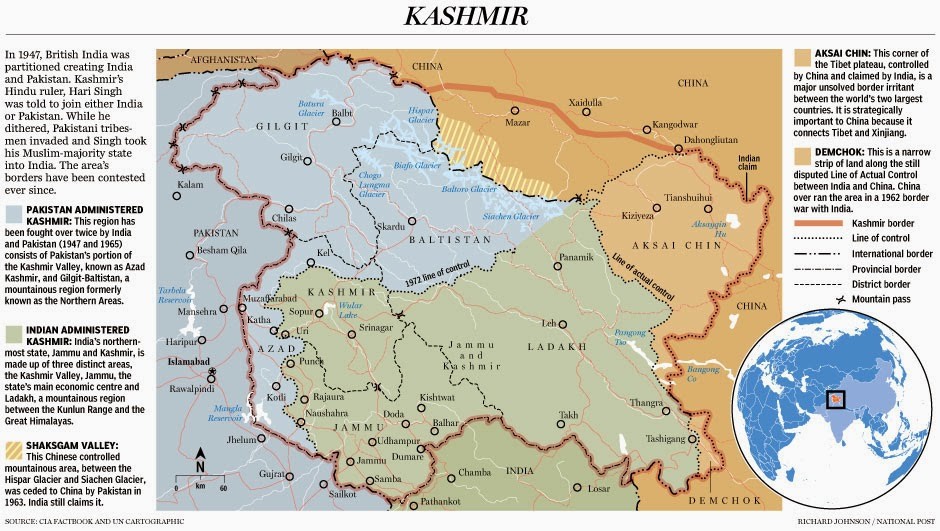
We have (mostly) unhappy feelings about the border wars on the Line of Control….the shootings, the torture, the be-headings. The (anti-Zionist, Jewish-American) Norman Finkelstein calls the mindset of liberal Jews who find themselves perched on the fence as: shooting…but crying. Well, we do not like being on the fence, and we do not want to shoot and we do not enjoy crying.

Thousands of civilians, militants and military people on both sides of the Line of Control (LoC) have died , some who are true believers, some who are only too happy to do their job and leave in time (and not in a casket), and the rest who live here and have no place to go…and are being driven slowly insane by the prolonged conflict (see below). And not to forget the shadow of the Bomb….there is no other border in the world which is as dangerous and deadly…..and also none as beautiful.
…….

….
We visited Kashmir when we were very young, but we will never visit the place again. There is no doubt that India (and Indians) are an oppressive force in the valley (on the lines of Gaza, Chechnya, Xinjiang…). When you feel hurt hearing the slogan: “Bhooka Nanga Hindustan, Jan Se Pyara Pakistan”…please reflect on what YOU would do if you lived in an occupied zone.

Of course Kashmiris are guilty of some unforgivable sins as well. If you are a Arundhati Roy fan, you may know that the India actually facilitated the expulsion/exile of the Pandits, in order to darken the (righteous) cause of Kashmiris.
……..
Following this theory, the fatwa issued daily from the mosque-speakers in 1989-1990: Hindus leave your homes, leave your women behind”……was actually Congress propaganda!!! And yes, the Pandits are also rotting away in refugee camps and are being driven slowly insane by the prolonged conflict. And, no, they will never see their native land again.

The Yazidis (called devil worshippers by the Iraqi islamists) are facing the same situation right now (propaganda by Zionist lobby??) – history repeating itself as tragedy.
…..
Between 80 and 100 men are believed to have been killed. Scores of women and girls were taken away in trucks, possibly to be sold off as slave-wives to IS fighters. 
…….
Is there some sort of global karmic equation that permits people to be oppressed and carry out oppression in equal measure? Shall we all die for our promised land and promised causes (we will all die anyway)?

In the sub-continent it would be nice enough if the bellicosity (on both sides) was toned down a bit. But then we realize that are only 960 years of fighting left (see quotation below) and it will be (approx) thirty generations going forward for peace to take hold (hopefully).
…………..
…..”So please, Mr. President and members of the Security Council, realize
the implications. The Pakistani nation is a brave nation. One of the
greatest British generals said that the best infantry fighters in the
world are the Pakistanis……We will fight…… We will fight for a thousand
years, if it comes to that
“……

………………………………


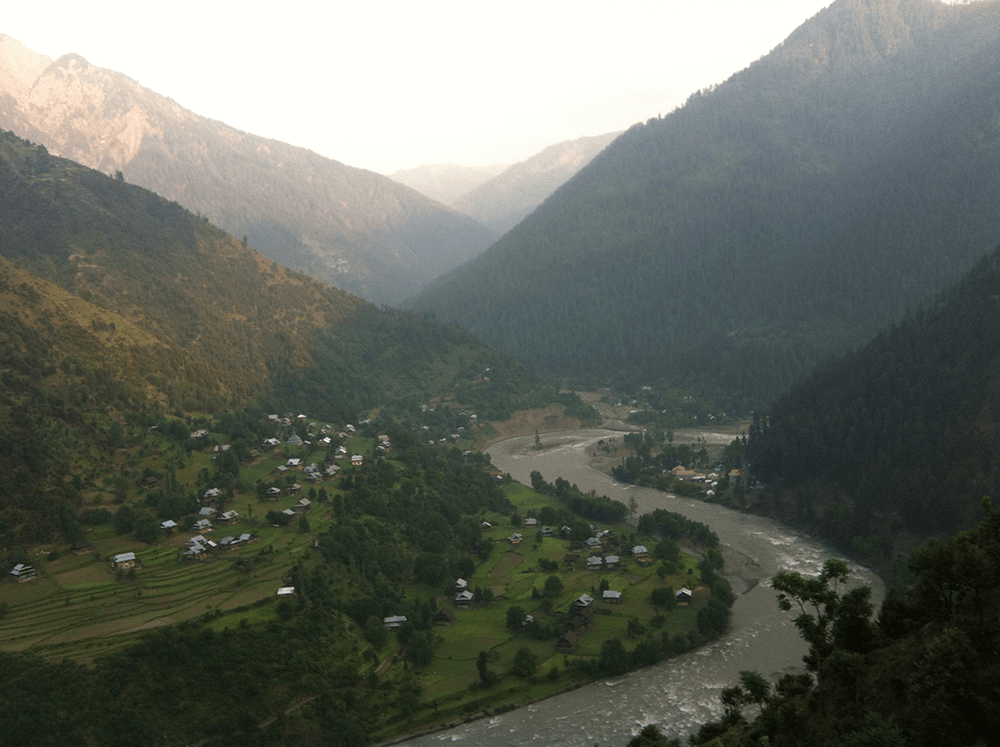
My wife and I stood under a starry night. We were here to celebrate our
first wedding anniversary. The breeze that the river brought with it
through the gorges was chilling. Beaten by the strong sun during the day
we couldn’t have imagined that the night would be so cold. The river
flew at our feet, its fast-paced torrents crashing against the rocks on
the riverbed.

The sound echoed through the valley. A dark
mountain stood in front of us. Earlier in the day, we had sat here
sitting under a tree, sipping our tea and marvelling at the beauty in
front of us. It was a gorgeous mountain, with flat notches cut into its
side to create fields for agriculture. A few wooden houses stood around
the plains and some villagers were working on the fields.

Then
there wasn’t a single light. From the top of the mountain a light
blinked every once in a while as if giving out a signal. Were there any
eyes focused upon us, wondering why we were standing so close to the
river so late in the night? Were there any soldiers eyeing us through
their scopes and wondering whether they will be able to take us down in
one shot?

For years, there has been peace here and no bullet has
crossed the river from either side but that does not mean that paranoia
doesn’t exist. They still look at us with suspicion and we do the same
to them. A few years ago we would have been shot for standing so close
to the Line of Control, we had been told.

The Mujahidin once used to cross from here.

I
tried imagining a trip into the Indian part of Kashmir. The first step
would be to cross this freezing water flowing with vengeance. The next
step would be to navigate through the jungles of Kashmir in the darkness
of the night, worried about the wild animals that live here and focused
on avoiding the Indian soldiers who patrolled these forests. Once
someone is caught, then start the tales of torture.

“Look at that
mountain,” said Awais, our host at a small guesthouse. It was a bright
day. Behind the mountain I could see the depth of a clear blue sky and a
few clouds. I tried following the direction of Awais’ finger carefully
and noticed the silhouette of a wire fence. Next to it there was a
wooden platform for the sentry.

“Is that India?” I asked my host.
“No. That’s Indian-occupied territory,” he replied. “That fence has
been raised by the Indian army in the past few years and a lot of hue
and cry was raised by the Pakistani government.”

“Is this where the Mujahidin used to cross over to Indian-occupied Kashmir?” I asked.

“Yes.
But they don’t any more. Ever since Musharraf made a deal with the
Indians, we have stopped sending Mujahidin from here. Earlier, they used
to cross the LoC from here and also Sharda, which is about two hours
north from here. This is why the Indian soldiers used to shoot here. You
and I would not have been able to sit here. 

Things were so bad that in
the night if someone as much as lit a cigarette he would be shot. This
road that brought you here from Muzaffarabad could not have been used.
In retaliation, of course, our Pakistani soldiers also used to fire.
This condition continued for a decade or so, from the early 1990s to
early 2000s. In those years about 3,000 people died from this region.
About 200 Mujahidin used to cross every night.”

“Did the Mujahidin also have their training camps here at Karen?”
“Yes.
But not any more. Now they only operate from Muzaffarabad and cross
over from Rawal Kot region [which is south of Muzaffarabad, while Karen
and Sharda are north of it]. Cross-LoC firing takes place in that region
only now. 

But you know there is a much bigger war coming and you should
brace yourself for that. That would be a war over water. The Indians
have constructed Kishenganga on this river on their side and soon there
would be water shortage in Pakistan.”
The Neelum River, which acts as the LoC in this part of the Neelum valley, is known as Kishenganga on the Indian side.


Later,
a mosque from across the river sounded the azaan, identifying the time
for prayer. No azaan followed from the Pakistani side but a few men and
women sitting around me decided to go and say their prayers. This was
once one village, Karen, now divided between two countries. Most of the
houses on the Indian side of the village are vacant.

The
inhabitants were made to leave during the time of insurgency, when
Mujahidin used to cross over from here. Most of these empty houses have
been taken over by Indian forces. The locals on the Pakistani side tell
me there are many Kashmiris from the Indian side of Karen who have now
come here too.

“Every Sunday, divided families gather on both
sides of the river and wave each other,” said Awais. I glanced at the
river and realise that given its width and noise, it would be impossible
to talk. Waving is all one could do. “During the winters, the river is
one-fourth of what it is right now. At that time, one can easily talk to
the person on the other side. There are many divided families here at
Karen. A mother would be here while the daughter would be there. So many
families.”

A poster next
to the army checkpoint depicted a picture of a young child with a leg
missing. There were pictures of an aircraft missile and a landmine next
to it. “Beware of the moves of the enemy,” it stated. The poster
cautioned children not to play with unidentified objects and to inform
army officials in case anyone comes across any.

The younger
officer at the army checkpoint returned my identity card. “Are there a
lot of unused missiles and landmines in this region?” I asked him. “Yes,
of course,” he said. “The enemy is right across.” The army checkpoint
was hidden by a concrete wall. A board here said that it was prohibited
to photograph the checkpoint. The cautionary poster was located on one
of the walls of the checkpoint. I wasn’t sure if the rule applied to the
poster as well. I did not want to find out.

Since our departure
from Muzaffarabad, this had been the fifth time that I had been stopped
by an army checkpoint. At every stop they entered my information into a
register, asked me where I was coming from and where I was heading. This
historical village of Karen, established some time in the tenth
century, has become a tourist destination since the ceasefire in this
region. It is about 80 km from Muzaffarabad, a journey that takes about
four hours on the treacherous mountainous road.

A few kilometres
north of the city of Muzaffarabad, the river Jhelum turned further west,
while the Neelum tok it place. The fast-moving river is a continuous
companion to a traveller on this road. As one heads further away from
the capital of Azad Kashmir, or Pakistan-administered Kashmir, the LoC
gets closer. Soon this narrow river remains the only thing that
separates the two arch-rivals, both armed with nuclear weapons and one
of the largest standing armies of the world.

Sometimes Indian
Kashmir recedes from the river and sometimes it touches the bank of the
river. While travelling on this road, my wife and I constantly tried to
figure out whether the mountain and the houses on the other side of the
river were still Pakistani or had become Indian.

About an hour
before Karen comes Athmuqam. After passing a checkpoint I slowed down
the car to catch a glimpse of the Indian town on the other side of the
river. There was a huge cricket ground with the Indian flag hoisted on
one side. A wooden bridge connected the two settlements flanking the
river. This is the point where Kashmiris are allowed to pass over to the
other country’s territory to see relatives who have been stranded by
the LoC. This is also the point where, it is rumoured, one can purchase
smuggled Indian whiskey by bribing the soldiers.


The
name of this part of the Neelum valley has been changed to Vigilant
valley. There are army boards and posters throughout the road stating
that. Here too there used to be regular firing between the two armies.

Standing
on the top of the mountain, it is hard to tell which peak is occupied
by India and which belongs to Pakistan. The river flows, unaware of the
raging battles above it. It snakes through the valley dividing
mountains, communities, villages and families on both sides of the LoC.

Standing
next to us was a young mentally challenged man. He had been following
us up this mountain. There are many here throughout the Neelum valley.
My wife, who was training to be a therapist, had reason to believe that
their condition is linked to the firing that ravaged this valley for
years.

We stopped at a tea shop and sat in a garden. From here,
we could see the village and the river below us. On both the sides the
army was camouflaged behind trees. Only the villagers were left
uncovered.

Mohsin, the shop vendor, was born in 1988, a year
before the escalation of insurgency in Kashmir valley on the Indian
side. “There were hardly any local Kashmir Mujahidin being trained in
the camps,” he told me as he made tea for us. “There used to be a few
from the Indian side. Then there were Pathans, Punjabis, Chechnyians,
etc.” Everyone knew where these camps were.

But that did not mean
that sympathy for Kashmir’s liberation did not exist in Pakistani
Kashmir. They supported the insurgents. Sometimes, if the Mujahidin were
traveling with too many bags, the locals would help them cross the LoC.
That’s what Mohsin told me.

“There used to be regular firing
here from both the sides but that did not affect life here at the
village,” claimed Mohsin. “They never used to fire at the village. They
would only fire at army posts. If they wanted to attack the village
would they have left us stay here? Look at us. We are completely
exposed. As children, the firing used to be a sport for us.

“We
would hide in corners and see the armies firing at each other from
across the mountains. It was very exciting for us. This road that you
came by was not open for business but there were other roads that
connected us with Muzaffarabad and Pakistan. That road could only be
travelled on jeeps but the villagers used to travel regularly on them.”

“Would our soldiers fire on Indian villages across the LoC?” I asked him.“They can never do that. That is Pakistan as well. There are Muslims living there.”

“I was told that about 3,000 people died here due to cross LoC firing?”“That’s not true. At most only four to five people have died due to the firing. Here they like to count as shaheed even those who died after falling off a mountain.”

Once
again I took out my identity card and handed it over to an army sentry
standing at the entrance. “How far is the LoC from here?” “I don’t
know.” 

“In what direction is the LoC from here?”“I don’t know.”

We
climbed the ancient set of stairs to reach the ancient university of
Sharda. A board here stated that this was once an ancient Buddhist
university.
It is a lonely structure standing in the midst of a
protective wall. There is an army unit deposited under the university. I
was forbidden from taking any photographs of the army unit.

“The
mountain behind this mountain belongs to the Indians,” said our waiter
as we sat down next to the river after visiting the temple. “Here too
there used to be firing. The Indian soldiers used to fire into our
territory including our villages. We had no other option but to
retaliate.”
“Did we attack their villages?” I asked him.

“How could we? Those are, after all, our own villages.”

(Haroon Khalid is the author of A White Trail: A Journey into the Heart of Pakistan’s Religious Minorities; Westland, 2013)

….

Link (1): A-journey-along-the-Line-of-Control-in-Pakistan

Link (2): kurds-abandoned-the-yazidis-when-isis-attacked

Link (3): Bhuttos_farewell_speech_to_the_Security_Council

….

regards

Immigration (good face, sad face)

…..Remittances
from India….key role in making Scotland the most industrialised
country by the mid-19th century….Dundee
and Paisley were transformed by their trade in jute and textiles with
India….a man has died after 35 people found in a shipping container….survivors from the Indian subcontinent….staff alerted by
“screaming and banging” from inside…


….
The “trade” between India and the United Kingdom in the colonial period was an euphemism for brutal exploitation. Indian manufacturing was destroyed by unfair tariffs in the UK. Thus “trade” consisted of India exporting raw materials (cotton, jute) at dirt prices and to buy English-Scottish finished goods (gunny bags, clothes) at high prices.

For thousands of years, India was known far and near as the promised land. First came the plundering armies, the missionaries followed, and not far behind were the “flood” of job-seeking immigrants. It was the promises of the Indian empire holdings (East India Company) that encouraged Scotland to forge and continue with a union pact with England (01 May 1707). Now that the charms of a captive foreign market is gone, Scotland finds the centuries old bonds to be an irritant (Scotland votes for partition-independence on September 18, 2014).
………

…..
The good face of colonialism we know: British gave us a sense of nationality (which was useful in the fight for freedom, many Scots played an important role), they taught us the first principles of democracy (which we are still learning to master) and all that.

….
The sad face of colonialism….it is now considered bad form to speak about it. The Victorian Holocausts which knocked off large percentages of the population is a good place to start. If there is any one event that stands out that would be the Bengal famine of 1943 when 4.3 million people perished. While Indian merchants certainly stocked grains and contributed to the problems in supply, it was a British administration  that was responsible in a direct (as well as indirect) manner.

Now the bowl has upturned and immigrants plan to leave India for the West…anyhow.  Their desperation is such that they do not care that they may end up losing their lives.
…….
The good picture of Indians migrating to the West and living out the American (or Canadian, Australian…) dream is well viewed. There is a sad picture as well which mostly stays underground unless there is a explosion and then we discover the mess.

Surprisingly it is not just Indians (and other poor people) who are desperate to leave. As many as 58 citizens of the newly minted superpower also died trying to cross over to the UK from Zeebrugge in June. How come the Chinese (both poor and the super affluent) are fleeing their country? This almost never happens, people do not just up and quit the lands of opportunity….unless the Chinese know something about their country that we outsiders do not know about (see below).
…..

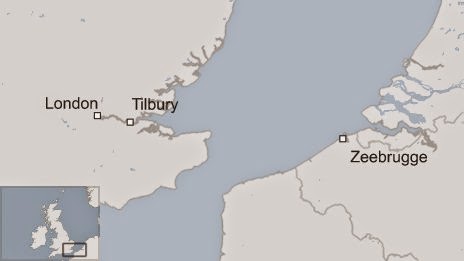
A man has died after 35 people – including children – were found in a shipping container at Tilbury Docks. The survivors – believed to be from the Indian subcontinent –
are said to be recovering “fairly quickly in most cases” at nearby
hospitals.


They were discovered after a freighter arrived from Zeebrugge, Belgium at about 06:00 BST and was being unloaded. Essex Police have launched a homicide investigation and officers are being assisted by their Belgian counterparts.

Supt Trevor Roe said staff at the docks were alerted to the container by “screaming and banging” from inside. He said about 50 other containers on
the freighter, called the Norstream, had been searched and no other
people were discovered inside.

Speaking at a press conference, Mr Roe told journalists the
survivors were being held under immigration powers and would be taken to
an immigration reception centre near Tilbury. He said they would eventually be interviewed through interpreters.

Belgian police say they believe the lorry which delivered the
container in Zeebrugge has been identified through CCTV footage. They
do not, however, have information yet about where it originated from.
Mr Roe said the police investigation would look into “the
gangs or whoever may be involved in this conspiracy to bring these
people in this way over to this country”.


It is not known where the container, one of 64 aboard the
P&O vessel, originated. Mr Roe also said he did not know where the
survivors had been going.

 
At Basildon hospital police vans were parked in between rows of ambulances in a clash of high-visibility stripes and chevrons. At the dropping-off zone in front of the entrance, patients
came and went, glancing up at the news helicopter circling overhead.

Most were aware of the high-security patients being treated
in a cordoned-off section of the accident and emergency unit; the
atmosphere became more relaxed when it became clear that their
conditions were primarily dehydration and hypothermia, and nothing more
serious or contagious.


Immigration and security minister James Brokenshire said the
incident was “a reminder of the often devastating human consequences of
illegal migration”. He said: “We know that criminal gangs are involved in what
amounts to a brutal trade in human lives. We also know that illegal
migration is a Europe-wide issue.

“That is why we work closely and collaboratively with law
enforcement and port authorities, in neighboring countries, to target
criminal networks and ensure that the organised gangs behind trafficking
and people smuggling can’t operate with impunity.”


The East of England Ambulance service, which was called to the
docks at 06:37 BST, sent seven ambulances, two rapid response cars, two
doctors and a hazardous area response team to the scene.


Assistant Chief Officer Daniel Gore from the ambulance
service said none of the people being treated in hospital was thought to
have life-threatening conditions.


Part of Basildon Hospital, where 18 people from the container were taken for treatment, was taped off earlier. On its website, the hospital said its accident and emergency department was “responding to a major incident”.

Seven patients were taken to Southend Hospital while nine were taken to the Royal London Hospital, Whitechapel. South Basildon and East Thurrock MP Stephen Metcalfe described the incident as “tragic”. Mr Metcalfe told the BBC: “The fact that so many people
appear to have traveled so far and are so desperate to get into the UK –
either on their own or being trafficked is really very sad.”


The Conservative MP said it was important “to get to the root
causes of what is motivating people to go to such extreme lengths to
travel from other parts of the world to get into the UK” as well as
tackle people trafficking.


The container was loaded on to the P&O freighter at about 21:30 BST on Friday at Zeebrugge.


A P&O spokeswoman said the Norstream, which had been
scheduled to leave Zeebrugge at 22:00 BST on Friday, was also carrying
72 trailers and five lorries and their drivers.


Public Health England said it was not currently involved and had not been notified of there being any Ebola risk. Essex Ambulance said decontamination units had been set up at
the docks as a precaution, not because of any specific concerns it had. A spokeswoman for the port declined to comment on the incident as it “was a matter for the police and Border Force”.


The ship was sailing on a new service linking Tilbury and Zeebrugge which has only been operational since earlier this month, according to parent company Forth Ports.  

According to the UK Border Force, the number of “clandestine
illegal entry attempts” by people to enter the country via ports in
Belgium and France increased last year to 18,000 from about 11,000 in
the previous 12 months.

The Freight Transport Association said it was “quite unusual”
for stowaways to be found in containers, with most cases involving
people attempting to enter the UK on lorries.


In June 2000, the bodies of 58 Chinese people were found in
the back of a lorry smuggling them into Dover on a ferry from Zeebrugge.
They had died of suffocation.

…..
  
India’s special place in Scottish history is partly a legacy from the
union of Scotland with England in 1707 to create the United Kingdom.
Under the deal, Scotland’s landed families gained access to the East
India Company, and gradually become its dominant force.

Scots
flooded into India as “writers” , traders, engineers, missionaries, tea
and indigo planters, jute traders and teachers. According to Professor
Tom Devine, author of The Scottish Empire, by 1771 almost half of the
East India Company’s writers were Scots, and by 1813, some 19 of
Calcutta’s private merchant houses were dominated by Scots.

Remittances
from India played a key role in making Scotland the most industrialized
country in the world by the mid-19th century, and cities like Dundee
and Paisley were transformed by their trade in jute and textiles with
India.

……

Even when the emperors did their utmost to
keep them at home, the Chinese ventured overseas in search of knowledge,
fortune and adventure. Manchu Qing rulers thought those who left must
be criminals or conspirators and once forced the entire coastal
population of southern China to move at least 10 miles inland.

But
even that didn’t put an end to wanderlust. Sailing junks ferried
merchants to Manila on monsoon winds to trade silk and porcelain for
silver. And in the 19th century, steamships carried armies of “coolies”
(as they were then called) to the mines and plantations of the European
empires.

Today, China’s borders are wide
open. Almost anybody who wants a passport can get one. And Chinese
nationals are leaving in vast waves: Last year, more than 100 million
outbound travelers crossed the frontiers.

Most
are tourists who come home. But rapidly growing numbers are college
students and the wealthy, and many of them stay away for good. A survey
by the Shanghai research firm Hurun Report shows that 64% of China’s
rich—defined as those with assets of more than $1.6 million—are either
emigrating or planning to.

To be sure,
the departure of China’s brightest and best for study and work isn’t a
fresh phenomenon. China’s communist revolution was led, after all, by
intellectuals schooled in Europe.
What’s new is that they are planning
to leave the country in its ascendancy. More and more talented Chinese
are looking at the upward trajectory of this emerging superpower and
deciding, nevertheless, that they’re better off elsewhere.

……

Link (1): bbc.com/uk-england-28817688

Link (2): Indias-Scottish-heritage-remembered-in-renovation-of-Calcutta

Link (3): online.wsj.com/articles/the-great-chinese-exodus-1408120906

…..

regards

First time for a woman (2)

.….“We don’t care if you have to give away Kashmir..Kashmir de do,
kuchh bhi de do, hamare logon ko ghar wapas lao”
…..Jaswant Singh made bold to suggest ….nation’s interest….we could not
be seen to be giving in to the hijackers…..That fetched him abuse and rebuke…“Bhaand me jaaye desh aur bhaand me jaaye desh ka hit. (To hell with the country and national interest)”……

…..
For people who believe in true equality for women, it must be accepted that the laws will also equally apply. There is no reason why women will be any less intelligent or resourceful than men, it follows that they may be just as ruthless and cruel. And yes, women can be serial killers, nothing surprising about that. While we do not believe in the death penalty, the Indian people AND the leadership both believe in this form of retributive justice (and path for closure for the victims).
……..

…..

Once if it is proven beyond reasonable doubt that you have harmed children, we have no sympathy to spare. Put these people behind bars and throw away the keys….for life. We oppose death penalty since there is a chance that the convicted person has been falsely implicated.
…..

….
One exception that troubles our conscience is how we should deal with terrorists. If we jail them, there may be attempts to free  them by taking innocent people hostages (see below). In a democracy you really do not have a choice…as the Head of the Nation, you cannot look scores of families in the eye and tell them that their loved sons, daughters, brothers, sisters will not be coming home in order to preserve some abstract national interest.  

That memorable slogan from 1999…..to hell with the country and the national interest…there is no arguing with that sentiment in good faith…what if it was YOUR daughter who was kidnapped by the terrorists? By the same token, who cares if a terrorist is killed…to hell with your principles...or would YOU rather be the one talking to the widow of Squadron Leader Ahuja?
……

Two
Kolhapur women, who were sentenced to death in 2001 for kidnapping 13
children and killing nine of them, may become the first women ever to be
hanged in India.

……..


President Pranab Mukherjee late last month
rejected Renuka Kiran Shinde and her sister Seema Mohan Gavit’s mercy
petitions.
The buffer period before their hanging – time taken by the
state home department to inform all concerned after receiving the note
from Rashtrapati Bhavan – ends on Saturday.


The number of
people executed in India since Independence is a matter of dispute.
Government statistics claim that only 52 people have been executed since
independence. However, research by the People’s Union for Civil
Liberties indicates that the actual number of executions is in fact much
higher, as they have located records of 1,422 executions in the decade
from 1953 to 1963 alone. However, there is no record of any woman’s
execution.

Renuka and Seema, who partnered their mother
Anjanabai Gavit to kidnap the kids and push them into begging and killed
some of them after they stopped being productive, are currently lodged
at the Yerwada jail in Pune. Anjanabai passed away during the trial, and
the sisters’ father Kiran Shinde turned approver and was acquitted.

Desk officer Deepak Jadiye of the home department
said no objections have been received yet on the Kolapur sisters’
hanging. “We have informed the two convicts, their relatives, the legal
remedial cells of the Supreme Court and also the district court about
the rejection (of their mercy plea),” he said.

While awarding
the death sentence to the sisters in 2001, Judge G L Yedke in Kolhapur
had described the nine kids’ murders as ‘the most heinous’, and observed
that the two sisters seemed to have enjoyed killing the children.

……

The Indian Airlines flight from Kathmandu to New Delhi, designated IC
814, with 178 passengers and 11 crew members on board, was hijacked on
Christmas eve, 1999, a short while after it took-off from Tribhuvan
International Airport; by then, the aircraft had entered Indian
airspace. Nine years later to the day, with an entire generation coming
of age, it would be in order to recall some facts and place others on
record.


….
In 1999 I was serving as an aide to Prime Minister Atal Bihari
Vajpayee in the PMO, and I still have vivid memories of the tumultuous
week between Christmas eve and New Year’s eve. Mr Vajpayee had gone out
of Delhi on an official tour; I had accompanied him along with other
officials of the PMO. …

The hijacking of IC 814 occurred while we were
returning to Delhi in one of the two Indian Air Force Boeings which, in
those days, were used by the Prime Minister for travel within the
country.


….
Curiously, the initial information about IC 814 being hijacked, of
which the IAF was believed to have been aware, was not communicated to
the pilot of the Prime Minister’s aircraft. As a result, Mr Vajpayee and
his aides remained unaware of the hijacking till reaching Delhi. This
caused some amount of controversy later.


It was not possible for anybody else to have contacted us while we
were in midair. It’s strange but true that the Prime Minister of India
would be incommunicado while on a flight because neither the ageing IAF
Boeings nor the Air India Jumbos, used for official travel abroad, had
satellite phone facilities.


….
By the time our aircraft landed in Delhi, it was around 7:00 pm, a
full hour and 40 minutes since the hijacking of IC 814. After
disembarking from the aircraft in the VIP bay of Palam Technical Area,
we were surprised to find National Security Adviser Brajesh Mishra
waiting at the foot of the ladder. He led Mr Vajpayee aside and gave him
the news. They got into the Prime Minister’s car and it sped out of the
Technical Area. Some of us followed Mr. Vajpayee to Race Course Road,
as was the normal routine.


….
On our way to the Prime Minister’s residence, colleagues in the PMO
provided us with the basic details. The Kathmandu-Delhi flight had been
commandeered by five hijackers (later identified as Ibrahim Athar,
resident of Bahawalpur, Shahid Akhtar Sayed, Gulshan Iqbal, resident of
Karachi, Sunny Ahmed Qazi, resident of Defence Area, Karachi, Mistri
Zahoor Ibrahim, resident of Akhtar Colony, Karachi, and Shakir, resident
of Sukkur City) at 5:20 pm; there were 189 passengers and crew members
on board; and that the aircraft was heading towards Lahore.


….
At the Prime Minister’s residence, senior Ministers and Secretaries
had already been summoned for an emergency meeting. Mr Mishra left for
the crisis control room that had been set up at Rajiv Bhavan. In between
meetings, Mr Vajpayee instructed his personal staff to cancel all
celebrations planned for December 25, his birthday. The Cabinet
Committee on Security met late into the night as our long vigil began.


….
Meanwhile, we were informed that the pilot of IC 814 had been denied
permission to land at Lahore airport. With fuel running low, he was
heading for Amritsar. Officials at Raja Sansi Airport were immediately
alerted and told to prevent the plane from taking off after it had
landed there.
 

The hijacked plane landed at Amritsar and remained parked on the
tarmac for nearly 45 minutes.
The hijackers demanded that the aircraft
be refuelled. The airport officials ran around like so many headless
chickens, totally clueless about what was to be done in a crisis
situation.


…..
Desperate calls were made to the officials at Raja Sansi Airport to
somehow stall the refueling and prevent the plane from taking off. The
officials just failed to respond with alacrity. At one point, an
exasperated Jaswant Singh, if memory serves me right, grabbed the phone
and pleaded with an official, “Just drive a heavy vehicle, a fuel truck
or a road roller or whatever you have, onto the runway and park it
there.” But all this was to no avail.


…..
The National Security Guards, whose job it is to deal with hostage
situations, were alerted immediately after news first came in of IC 814
being hijacked; they were reportedly asked to stand by for any
emergency. The Home Ministry was again alerted when it became obvious
that after being denied permission to land at Lahore, the pilot was
heading towards Amritsar.


….
Yet, despite IC 814 remaining parked at Amritsar for three-quarters
of an hour, the NSG commandos failed to reach the aircraft. There are
two versions as to why the NSG didn’t show up: First, they were waiting
for an aircraft to ferry them from Delhi to Amritsar; second, they were
caught in a traffic jam between Manesar and Delhi airport. The real
story was never known!


…..
The hijackers, anticipating commando action, first stabbed a
passenger, Rupin Katyal (he had gone to Kathmandu with his newly wedded
wife for their honeymoon; had they not extended their stay by a couple
of days, they wouldn’t have been on the ill-fated flight) to show that
they meant business, and then forced the pilot to take off from
Amritsar. With almost empty fuel tanks, the pilot had no other option
but to make another attempt to land at Lahore airport. Once again he was
denied permission and all the lights, including those on the runway,
were switched off. He nonetheless went ahead and landed at Lahore
airport, showing remarkable skill and courage.


…..
Mr Jaswant Singh spoke to the Pakistani Foreign Minister and pleaded
with him to prevent the aircraft from taking off again. But the
Pakistanis would have nothing of it (they wanted to distance themselves
from the hijacking so that they could claim later that there was no
Pakistan connection) and wanted IC 814 off their soil and out of their
airspace as soon as possible. So, they refuelled the aircraft after
which the hijackers forced the pilot to head for Dubai.


….
At Dubai, too, officials were reluctant to allow the aircraft to
land. It required all the persuasive skills of Mr Jaswant Singh and our
then Ambassador to UAE, Mr KC Singh, to secure landing permission. There
was some negotiation with the hijackers through UAE officials and they
allowed 13 women and 11 children to disembark. Rupin Katyal had by then
bled to death. His body was offloaded. His widow remained a hostage till
the end.


….
On the morning of December 25, the aircraft left Dubai and headed
towards Afghanistan. It landed at Kandahar Airport, which had one
serviceable runway, a sort of ATC and a couple of shanties. The rest of
the airport was in a shambles, without power and water supply, a trophy
commemorating the Taliban’s rule.


….
On Christmas eve, after news of the hijacking broke, there was
stunned all-round silence. But by noon on December 25, orchestrated
protests outside the Prime Minister’s residence began, with women
beating their chests and tearing their clothes. The crowd swelled by the
hour as the day progressed.


….
Ms Brinda Karat came to
commiserate with the relatives of the hostages who were camping outside
the main gate of 7, Race Course Road. In fact, she became a regular
visitor over the next few days. There was a steady
clamour that the Government should pay any price to bring the hostages
back home, safe and sound. This continued till December 30.


…..
One evening, the Prime Minister asked his staff to let the families
come in so that they could be told about the Government’s efforts to
secure the hostages’ release. By then negotiations had begun and Mullah
Omar had got into the act through his ‘Foreign Minister’, Muttavakil.
The hijackers wanted 36 terrorists, held in various Indian jails, to be
freed or else they would blow up the aircraft with the hostages.


…..
No senior Minister in the CCS was willing to meet the families. Mr
Jaswant Singh volunteered to do so. He asked me to accompany him to the
canopy under which the families had gathered. Once there, we were
literally mobbed. He tried to explain the situation but was shouted
down.


……
“We want our relatives back. What
difference does it make to us what you have to give the hijackers?” a
man shouted. “We don’t care if you have to give away Kashmir,” a
woman screamed and others took up the refrain, chanting: “Kashmir de do,
kuchh bhi de do, hamare logon ko ghar wapas lao.” Another woman sobbed,
“Mera beta
 hai mera beta
” and made a great show of fainting of grief.


…..
To his credit, Mr Jaswant Singh made bold to suggest that the
Government had to keep the nation’s interest in mind, that we could not
be seen to be giving in to the hijackers, or words to that effect, in
chaste Hindi. That fetched him abuse and rebuke. “Bhaand me jaaye desh aur bhaand me jaaye desh ka hit. (To hell with the country and national interest),” many
in the crowd shouted back. Stumped by the response, Mr Jaswant Singh
could merely promise that the Government would do everything possible.


…..
I do not remember the exact date, but sometime during the crisis, Mr
Jaswant Singh was asked to hold a Press conference to brief the media.
While the briefing was on at the Press Information Bureau hall in
Shastri Bhavan, some families of the hostages barged in and started
shouting slogans. They were led by one Sanjiv Chibber, who, I was later
told, was a ‘noted surgeon’: He claimed six of his relatives were among
the hostages.


…..
Dr Chibber wanted all 36 terrorists named by the hijackers to be
released immediately. He reminded everybody in the hall that in the past
terrorists had been released from prison to secure the freedom of Ms
Rubayya Sayeed, daughter of Mufti Mohammed Sayeed, while he was Home
Minister in VP Singh’s Government. “Why
can’t you release the terrorists now when our relatives are being held
hostage?” he demanded. And then we heard the familiar refrain: “Give
away Kashmir, give them anything they want, we don’t give a damn.”


…..
On another evening, there was a surprise visitor at the PMO: The
widow of Squadron Leader Ajay Ahuja, whose plane was shot down during
the Kargil war. She insisted that she should be taken to meet the
relatives of the hostages. At Race Course Road, she spoke to
mediapersons and the hostages’ relatives, explaining why India must not
be seen giving in to the hijackers, that it was a question of national
honour, and gave her own example of fortitude in the face of adversity.


……
“She has become a widow, now she wants others to become widows. Who
is she to lecture us? Yeh kahan se aayi?” someone shouted from the
crowd. Others heckled her. The young widow stood her ground, displaying
great dignity and courage. As the mood turned increasingly ugly, she had
to be led away. Similar appeals were made by others who had lost their
sons, husbands and fathers in the Kargil war that summer. Col Virendra
Thapar, whose son Lt Vijayant Thapar was martyred in the war, made a
fervent appeal for people to stand united against the hijackers. It fell
on deaf ears.


…..
The media made out that the overwhelming majority of Indians were
with the relatives of the hostages and shared their view that no price
was too big to secure the hostages’ freedom. The Congress kept on slyly
insisting, “We are with the Government and will support whatever it does
for a resolution of the crisis and to ensure the safety of the
hostages. But the Government must explain its failure.” Harkishen Singh
Surjeet and other Opposition politicians issued similar ambiguous
statements.


……
By December 28, the Government’s negotiators had struck a deal with
the hijackers: They would free the hostages in exchange of three dreaded
terrorists — Maulana Masood Azhar, Mushtaq Ahmed Zargar and Ahmed Omar
Sheikh — facing various charges of terrorism.


…..
The CCS met frequently, several times a day, and discussed the entire
process threadbare. The Home Minister, the Defence Minister and the
Foreign Minister, apart from the National Security Adviser and the Prime
Minister, were present at every meeting. The deal was further
fine-tuned, the Home Ministry completed the necessary paper work, and
two Indian Airlines aircraft were placed on standby to ferry the
terrorists to Kandahar and fetch the hostages.


…….
On December 31, the two aircraft left Delhi airport early in the
morning. Mr Jaswant Singh was on board one of them. Did his ministerial
colleagues know that he would travel to Kandahar? More important, was
the Prime Minister aware of it? The answer is both yes and no.


…..
Mr Jaswant Singh had mentioned his decision to go to Kandahar to
personally oversee the release of hostages and to ensure there was no
last-minute problem. He was honour-bound to do so, he is believed to
have said, since he had promised the relatives of the hostages that no
harm would come their way. It is possible that nobody thought he was
serious about his plan. It is equally possible that others turned on him
when the ‘popular mood’ and the Congress turned against the Government
for its ‘abject surrender’.


……
On New Year’s eve, the hostages were flown back to Delhi. By New
Year’s day, the Government was under attack for giving in to the
hijackers’ demand! Since then, this ‘shameful surrender’ is held against
the NDA and Mr Jaswant Singh is painted as the villain of the piece.


……
Could the Kandahar episode have ended any other way? Were an Indian
aircraft to be hijacked again, would we respond any differently? Not
really. As a nation we do not have the guts to stand up to terrorism. We
cannot take hits and suffer casualties. We start counting our dead even
before a battle has been won or lost. We make a great show of honouring
those who die on the battlefield and lionise brave hearts of history,
but we do not want our children to follow in their footsteps.


…..
We are, if truth be told, a nation of cowards who don’t have the
courage to admit their weakness but are happy to blame a well-meaning
politician who, perhaps, takes his regimental motto of ‘Izzat aur Iqbal’
rather too seriously.


…..
  
Home Minister P Chidambaram said on Thursday that there is no set formula for dealing with terrorists.

……..
When asked if India should have a policy not to negotiate with
terrorists, he said that while this worked in principle, in reality,
when the human element came into play, he was unsure of how he would
deal with the crisis.


….
“I do not know how I would have reacted if 150 families came to my
door and pleaded that their loved ones in that aircraft must be saved.
It is easy to criticise but if one is in that position, it is a very
difficult decision,” he said at the NDTV’s Indian of the Year Awards
function in New Delhi on Wednesday night.


….
The NDA government’s decision to release dreaded terrorists in
exchange for hostages in the Kandahar hijack 10 years ago had come under
attack from several quarters but Home Minister P Chidambaram is “not
sure” saying it is a “very difficult” decision.


….
The decision of the Vajpayee government to release three dreaded
terrorists including Jaish-e-Mohammad (JeM) chief Masood Azhar in
December, 1999 received a lot of flak from various political parties
including the Congress, more so because the then external affairs
minister Jaswant Singh accompanied them (terrorists) to Kandahar.


…..
Azhar’s name has subsequently figured in the December 2001 terror
attack on Parliament and the attack outside Jammu and Kashmir Assembly
in Srinagar in the same month. 

 
….

Link (1): http://Two-sisters-from-Maharashtras-Kolhapur-may-become-the-first-women-to-be-hanged-in-India

Link (2): http://kanchangupta.blogspot.in/2009/03/when-indians-let-down-india.html

Link (3): http://www.ndtv.com/article/india/the-hijacking-of-indian-airlines-flight-ic-814-7755

…..

regards

Brown Pundits