Uber means Freedom in English, Tamizh, Sanskrit…

….The fare wasn’t set by
distance or time, but by zones, which encouraged the drivers to drive
fast…….the not-unpleasant sensation
of feeling your cheeks ripple with G-forces as he shot down the Dupont
Circle tunnel like someone testing a rocket car on the Salt Flats of
Utah…..the occasional moments of weightlessness when you hit a bump….you were doing 50 mph in a car whose shock absorbers
didn’t, and whose brakes probably wouldn’t…..


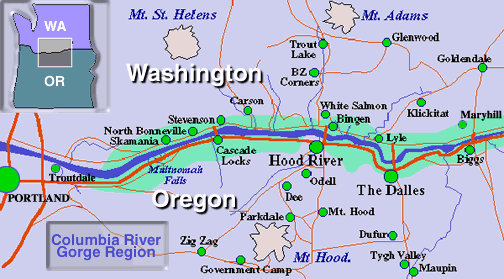
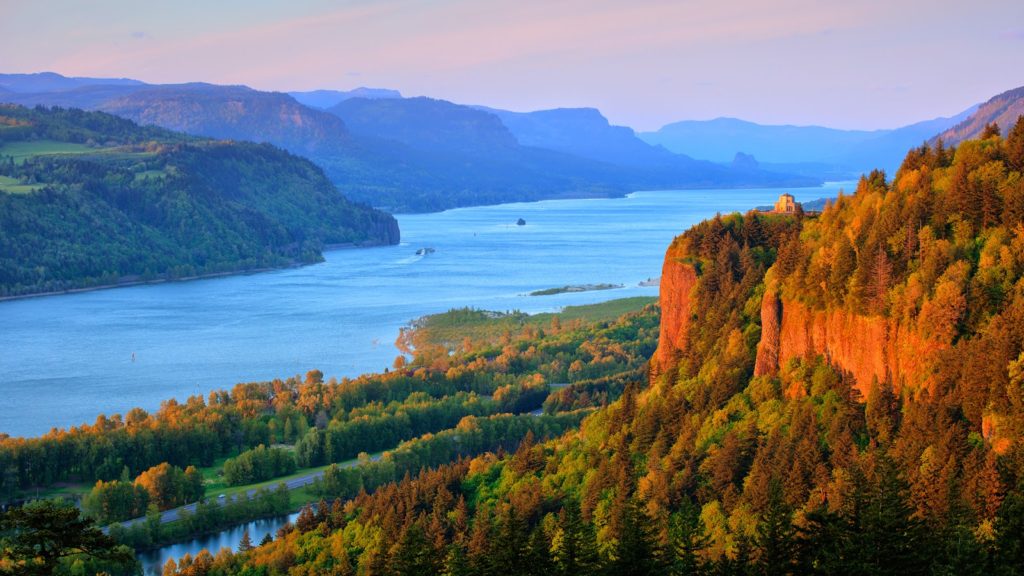
When we were younger, we would just rent a car at the airport…one way if necessary. We remember driving from Boise, Idaho to Portland, Oregon in a Hertzmobile (after having missed a flight…long story) and getting stuck in the Columbia River Gorge near Multonomah Falls at mid-night, in the middle of torrential winter rains- we did not realize that there are no gas stations in the Gorge!!! Our friend had to execute a dramatic mid-night rescue plan using an old-fashioned funnel and bucket.
….
Of course Uber does not allow you to travel from Boise to Portland (not yet), though we are sure some freckle-faced teenager is writing an app for that as we speak. In the mean-time, as James Lileks explains –  there is a new sense of freedom in Los Angeles and New York….but unfortunately, not in Berlin (North Korea)… erm German Democratic Republic….The mobile taxi app Uber has been banned in Berlin by the city’s State Department of Civil and Regulatory Affairs.….the authority said it had banned the app on passenger safety grounds
and threatened the firm with a 25,000 euro (ÂŁ20,000) fine for ignoring
the order
. Uber….Zindaaaaaaaaabad.
…..

………..

Many people on the right have embraced Uber, the company that lets you
call a ride from your smartphone instead of standing on the corner with
your hand up looking like a statue of Lenin leading the proletariat to
the Future, or maybe to that tapas place downtown.
 

This confuses people
who regard conservatives as dumb apes who poke Shiny New Things with a
stick and screech in alarm. How can they support Uber? It’s a Cool
Thing, and they’re all middle-aged dorks in polyester plaid shorts and
black socks with sandals who like to “get down” to bands that sing about
pickup trucks, or they’re pale evil men who wear three-piece suits to
bed and drift off to sleep fantasizing that they’re slapping the
birth-control pills out of the hands of poor women. 

Uber is good, Uber
is an app, for heaven’s sake — how can these cretins possibly be on its
side? It’s like finding that all the kale in the country is fertilized
by Koch products.

Jalopnik, a popular site about cars, explains the reason with a willfully stupid Internet coinage: Uber Is the New GOP Darling Because Freedom.


It helps if you imagine Stephen Colbert saying it, I suppose.
Freedom: the word is supposed to make you roll your eyes, just like
“liberty” — one of those things we’re supposedly losing Because
Liberals. What we’re usually protesting is our inability to be racist,
homophobic trolls who think the country started going downhill when the
Statue of Liberty wasn’t a white male holding up a rifle instead of a
torch.

….
The article says: “A recent (pro-Uber) petition launched on the GOP
site hits all the Republican talking points — ‘unions’, ‘strangling
regulations’ and of course ‘liberal government bureaucrats’ — as a way
to illustrate how big government and a unionized workforce are killing
our freedoms.”

….
Someone else’s convictions are always talking points.

…..
As for Uber itself, well, let’s take a look at the wonderful world of
cars-for-hire. When I lived in D.C. in the 90s, I took a lot of cabs.
Now and then you’d get a spotless ride with a courteous older driver who
knew every street and alley. When I say “now and then” it was in the
sense of “now and then, there’s a presidential election.”

…..
For the most part, the cabs had seats that felt like the thin
battered beds of a hot-sheet motel and a sweat-and-barf perma-funk that
made you roll down the windows in January. The fare wasn’t set by
distance or time, but by zones, which encouraged the drivers to drive
fast. 

….
While this made for speedy trips, and the not-unpleasant sensation
of feeling your cheeks ripple with G-forces as he shot down the Dupont
Circle tunnel like someone testing a rocket car on the Salt Flats of
Utah, the occasional moments of weightlessness when you hit a bump
reminded you that you were doing 50 mph in a car whose shock absorbers
didn’t, and whose brakes probably wouldn’t.

….
When I moved back to Minneapolis I had no occasion to take the cab,
except for trips back from the airport. The cars weren’t exactly new;
when you looked at the fleet idling in the bays, it made you think,
“this is what Havana would look like if Castro took over in 1982.” The
drivers were usually unfamiliar with the city, which seems to violate
the Law of Cabbies, somehow. You sit in the back like a human Tom-Tom
unit, giving turn-by-turn directions. When you’re finally home, and it’s
time to settle, you get out a credit card — which causes the driver to
sigh, because he has to get out an imprint machine and rack up the card
like it’s the Four Seasons in 1962 and you’re paying with a Diner’s
Club.

…..
On a trip to L.A. earlier this year I called a cab to get me to the
Minneapolis airport. I stood outside the house with a suitcase. I
watched the cab drive past; I ran after it waving my arms as if it was
the last helicopter out of Erbil. Once inside, I looked around for
anything long and sharp that might help squeegee off the cooties. The
driver took a route that always backs up at rush hour, and the meter
ticked away the escalating price. When we got to the airport I was
delighted to find the car had a credit-card reader, but it didn’t work.

….
From the L.A. hotel to the airport, I finally tried Uber. The dot on
my screen showed where the car was. When it arrived, the driver popped
the trunk and offered me water. What? Water? The most I ever expected
from a cab was a vinegar-soaked rag on a stick. The interior of the car
was pristine; I was offered my choice of music selection; I was stunned
to find there wasn’t a motorized shoe-shine unit under the seats and a
tanning lamp. With hesitation I engaged in conversation with the driver —
 the Cabbie Convo is the worst form of parachute journalism, and if
this guy was actually useful or fascinating I could never use it.

…..
But I will, because it was. He had run a few franchise sandwich
shops, and they’d gone under. One died because the real-estate market
crashed and emptied out the neighborhood; the other suffered from the
marketing incompetence of the parent company, which soured the brand and
drove the franchise owners to penury and despair. Now he was doing
this. Did he want to do this? Eh, it’s a living.

…..
At the end no money was exchanged. The app did that. No receipt was
required. The app did that. I was asked to rate the driver, and gave him
the best possible rating. Most excellent cab ride of my life — probably
because it wasn’t a cab at all. 

…..
So that’s why conservatives like Uber! We can pretend it didn’t cost
anything, and can judge those who have failed in the marketplace and
been driven down the economic ladder. It has nothing to do with breaking
up a monopoly with a new idea, or getting around the burdensome rules
that prevent an entrepreneur from entering a locked-up market, or
letting a superior service force the old model to improve its game. (The
local cab company did come up with an app, and while it let you make a
reservation, it warned you that this wasn’t a guarantee a cab would
actually show up. Other than that, a straight-up Uber-killer.)

…..
No, it can’t be about any of that. If the Right wants to free public
schools from their century-old model, it’s just about hating unions.
(Because Freedom.) If they object to the impact of the minimum wage,
it’s just about hating workers. (Because Freedom.) If they object to the
unsustainable drain of Social Security, it’s because they hate the old;
if they object to socialized medicine it’s because they hate the sick;
if they object to making nuns pay for late-term abortion it’s because
they hate women.


If they hate taxis and want an alternative, well, because Freedom.

Whoa! At least they got that one right.

…….

Link (1): http://www.nationalreview.com

Link (2): http://www.bbc.com
…..

regards
Dravida asmita (pride), Brahman pita (father)

…..Surya Narayana Sastri was born in a Brahmin family. He graduated in Tamil..Head of Department for Tamil at the Madras Christian
College….He was one of the early pure Tamil activists…..changed Surya Narayana Sastri to its pure Tamil form….Parithi Maal Kalaignyar: Surya – Parithi (sun), Narayanan – Maal (God Vishnu), Sastri –
Kalaignyar (artist or scholar)…..

….

….
By now we are familiar with the concept of Brahmin leadership of the extreme left. Even the Maoist Central Politburo – the high command charting the revolutionary waves-  is populated by super-castes (only one tribal member).

It is the usually the sons of the privileged who are (as Omar would say) at the vanguard of the revolution (Bong version: Jomidar-er chele Naxal – the son of the Zamindar is a Naxalite). You need to be a top dog to recognize that your own skin has just the right texture for making shoes for the poor. …… 

Remember, Osama Bin Laden, the other revolutionary hero? He was from an affluent background as well (middle son of a middle wife…hence deprived of father’s love…and it shows).

We were most surprised to find out
that the man who pioneered the Tamizh as a classical language movement
(higher, better, wider than Sanskrit) was actually a Brahmin. Dravida Sastri (as he was known) was such a
fanatic (used in a positive sense) that he changed his Sanskrit-derived
name  to a pure Tamizh one. In present day terminology he would be called a self-hating Brahmin…just like Dr Norman Gary Finkelstein is considered a self-hating Jew.

Since then many a famous Dravida leader have followed in the foot-steps of Dravid Sastri. Thus Dakhsina Murthy became Karuna-Nidhi. And now the Dravida movement is being ably led by the one and only ‘Puratchi Thalaivi’ (‘Revolutionary Leader’) ….an Iyengar (highest possible caste) named Jaya-Lalithaa (extra “A” at the end due to “sanskrit-hindu” astrological reasons, similar to why all Ekta Kapoor productions are initialled “K”). 

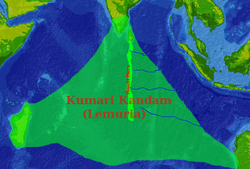
Sastri also pioneered/popularized the concept of Kumari Nadu, the cradle of (Tamizh) civilization – referred to by others as Lemuria (see below) – which is now sunk into the great depths of the Indian Ocean and has left no trace behind (just like that Malaysian plane).
  
……
We have an age-old (unsolved) puzzle for you, which will help you to discover your inner Dravida-man (or for the Tam-Brahms- your self-hating persona). 
Is Ginger Sanskrit-origin or …..is it Dravidian?

From the Online Etymology Dictionary:

ginger (n.) mid-14c., from Old English gingifer, from Medieval Latin gingiber, from Latin zingiberi, from Greek zingiberis, from Prakrit (Middle Indic) singabera, from Sanskrit srngaveram, from srngam “horn” + vera-
“body,” so called from the shape of its root. But this may be Sanskrit
folk etymology, and the word may be from an ancient Dravidian name that
also produced the Malayalam name for the spice, inchi-ver, from inchi “root.” 
 
The ancient Dravidian name is presumably Tamizh. So…we are curious to know the exact Tamizh word…after all inchi-ver may well be apabhramsa for srnga-veram as well. Just saying.

…….
[ref. Wiki] Parithimar Kalaignar (born V. G. Suryanarayana Sastri, born August 11, 1870 – d. November 2, 1903), a Professor of Tamil at the Madras Christian College was the first person to campaign for the recognition of Tamil as a classical language.
 
Suryanarayana Sastri was born at Tirupparankunram in a Brahmin family. He graduated in Tamil and was soon employed as a Professor
of Tamil in the Madras Christian College. In 1895, Suryanarayana Sastri
rose to become the Head of Department for Tamil at the Madras Christian
College. 

 
He was one of the early pure Tamil activists. He changed his name
Suryanarayana Sastri to its pure Tamil form ParithiMaal Kalaignyar
(Surya – Parithi (sun), Narayanan – Maal (God Vishnu), Sastri –
Kalaignyar (artist or scholar))

When the Madras
University proposed to exclude Tamil from its syllabus, Parithimar Kalaignar
vehemently protested against the proposal forcing the authorities to drop the
move. In 1902, he proposed that Tamil be designated as a “classical
language” thereby becoming the first person to make such a petition. 

Parithimar Kalignar is also known as Dravida Sastri

Parithimar
Kalaignar was also the first to use the Tamil name Kumarinadu for the
mythical lost-land of Lemuria. 

Paritihimar Kalaignar died in 1903 due
to tuberculosis
at the age of 33.


Parithimar Kalaignar is regarded as an inspiration for Tamil enthusiasts as Maraimalai
Adigal and the Tanittamil Iyakkam.


In 2006, the Government of Tamil Nadu declared Parithimar Kalaignar’s house
in his native village of Vilacheri as a memorial and sanctioned a sum of rupees
15 lakh towards nationalizing his books.
On August 17, 2007, postage stamps were issued in memory of Saint Vallalar,
Parithimar Kalaignar and Maraimalai Adigal.

On December 13, 2006, the Tamil Nadu Chief Minister, M.
Karunanidhi extended an amount of Rs. 15 lakh to the Tamil scholar’s
descendants.

……………………

[ref. Wiki] Lemuria is the name of a hypothetical “lost land”
variously located in the Indian and Pacific
Oceans. The concept’s 19th-century origins lie in attempts to account for
discontinuities in biogeography; however, the concept of Lemuria has been
rendered obsolete by modern theories of plate
tectonics. Although sunken continents do exist â€“ like Zealandia in the Pacific as well as Mauritia
and the Kerguelen Plateau in the Indian Ocean â€“
there is no known geological formation under the Indian or Pacific Oceans that
corresponds to the hypothetical Lemuria.


Though Lemuria is no longer considered a valid scientific hypothesis, it has
been adopted by writers involved in the occult, as well as
some Tamil writers of India. Accounts of
Lemuria differ, but all share a common belief that a continent
existed in ancient times and sank beneath the ocean as a result of a
geological, often cataclysmic, change, such as pole shift.

Some Tamil writers such as Devaneya
Pavanar have tried to associate Lemuria with Kumari
Kandam, a legendary sunken landmass mentioned in the Tamil literature,
claiming that it was the cradle of civilization
.

……………………….. 

 
regards  

Smart People Saw It Coming

Sending a message:

Raman was so enraged by the government’s science policies, that sometime in the 1960s, apparently, he took a hammer and smashed his Bharat Ratna to pieces. Raman was surprised to find slivers of platinum fall out. The scientist promptly used them in his experiments. Thus proving that national honours aren’t entirely without utility.


Kerala says no to Vande Mataram

…..A private school in south Kerala removed Vande Mataram from Independence
Day programme after a religious outfit allegedly threatened management……
The school also dropped the namaste
gesture from a dance number performed during
Independence Day celebrations, inviting sharp criticism from various
quarters….

….
Vande Mataram (not) singing is a perennial favorite, this movie is re-released every time the extremists (on both sides) need a bite from the original apple and to boost morale.

To summarize, muslims (and assorted other communities) have objections in singing Vande Mataram because it hurts religious sensibilities. The idea is that the song propagates worship of the mother (and mother-land, mother Goddess….) and muslims pray only to Allah.  

However we should note that there is no general agreement on this point and many muslims find nothing objectionable in singing Vande Mataram: the song (as they see it) is a salute to the mother-land….in the version popularized by AR Rahman….it is Vande Mataram….Ma Tujhe Salaam.

Let us be crystal clear on this point – no single individual can be forced to sing a song (the Supreme Court agrees). This is true even if it is the national anthem (Jana Gana Mana). But to jump from there to a ban on singing Vande Mataram and saying Namaste is a step too far.
…………
If your (muslim) child attends an (school) assembly, she can be advised to stand respectfully while others sing (this is a normal thing in any school assembly, many students do not bother to sing, some do not know the words, let alone the meaning….). If it is a school function, the child can request to be excused from that particular assignment (there is lot of flexibility- many children across many programs).  If you want not even a shadow of doubt to cross your mind, then simply request your child to stay home for the day (Independence day, Republic day,…).  

Yes, all such rules may well appear to be a burden on your child. But then nobody said that standing up for your principles should be easy-peasy. Indeed it would be a good place to reflect if burdening your child with super-tough principles (say for example, no chocolates for pure vegetarian Hindus) is also the right thing to do (as we see it parental rights are not absolute).

Vande Mataram is the national song and hence a national symbol (of equal importance to the anthem, lest we forget). Forget about the background (Ananda Math by Bankim Chandra Chattopadhyay was the source book) and controversy around the novel (describes the  rebellion of sanyasis or monks against oppressive muslim rulers), that was all duly considered during the extended debate on the song.

Only the first two paragraphs of the original Vande Mataram are considered as the body of the “national song” version. This was specifically done in order to take muslim sensitivities on board. No less than Maulana Abul Kalam Azad (whose patriotism for India and devotion to Islam cannot be questioned, we hope) informed the debate and was satisfied with the compromise.

Now we have SDPI (Social Democratic Party of India) thugs threatening a Kollam school to drop Vande Mataram and also not to say Namaste. Well, how to put it politely, this sort of arm twisting will only invite retaliation (from the extremists of the other side).

We are (as many times noted before) unqualified to give religious advice. However as we understand it, muslims are advised to follow the local sensitivities of the land in which they live. It is unfortunate that very few Hindus now live in Pakistan but we are sure that they would try to honor the blasphemy rules (written) and the public fasting rules (unwritten). And if they do not…well we know what would happen…right?

The response to the above point is two-fold, both of which deserve careful scrutiny. First, thank god that Muslims have a homeland where they can be free from Hindu persecution. That answer is only a partial tuth. The cross-migration doors were open only for a few years after partition (I). After partition (II) the option of migrating to Pakistan was not even available for a few hundred thousand desperate Bihari refugees in Bangladesh. So, for all practical purposes, the left behind muslims are without a home-land and at risk of persecution from Hindus and Bengali nationalists.

To their credit, the pre-partition muslim leadership did consider this eventuality…well not quite. During deliberations on the impact of partition they made it clear that there would be Sikhs and Hindus in Pakistan and Muslims in India both requiring protection from the majority population. As they saw it, this was a good enough insurance policy….because if you touch a Muslim in India, a Hindu gets hurt in Pakistan.

Take the example of Israel (yes we know it is Satan and all that). Many a scholar has pointed out the similarities between Israel and Pakistan. However, there is one major (and startling) difference. Israel will always welcome Jews to come back home, even some very strange Jews such as Manipuri and Mizo tribes-people (the lost tribes). That is not the case for Pakistan.

The leadership perhaps never imagined that one day Pakistan would be empty of all minorities such that such a rough and ready logic of the streets will not work anymore. They probably never imagined that muslims will be harmed by other muslims in Pakistan…but that is another story. The insurance policy has been declared as null and void and the insurance company has been declared bankrupt. This is a point on which serious reflection is required, not idle gloating.

The second response is that India (as determined by her founding fathers) is a secular republic, home for all people, not just Hindus. The freedom to practice religion is guaranteed in the constitution. And that is a perfectly fine response at an individual level, a muslim today may well find Vande Mataram (the national song version) offensive (disregarding the wisdom of Maulana Azad). However freedoms are not absolute, indeed freedom of speech is curtailed by the rule that no one can use speech to hurt communities (say for example, by committing blasphemy). 

Why was Salman Rushdie banned from even speaking at the Jaipur Lit Fest? This is not secularism, it is self-convictions (no doubt sincerely held) forced on others by threatening extra-constitutional measures.  If we just let the thugs win, in the long run, it will be Hindu thugs who will prevail in India. That is a very unpleasant prospect for the truly secular folks…and even the not-so-ideological aam admi.

What happened in the Kerala school was not people following their conscience but instead group thuggery by the Social Democratic Party of India (SDPI). No, they are not communists, rather they are part of an umbrella of extremist groups such as the Popular Front of India (PFI), which cut off the hands of a college teacher (TJ Joseph) for having committed blasphemy (in reaction, his son was beaten up by the police and his wife committed suicide by hanging). To add insult to injury the (Christian) college terminated his job!!! 

This is what the Hindu and Outlook had to say on this matter of muslim extremism in Kerala:
…………………….
The Hindu: “Freedom of expression has increasingly come
under attack from religious fanatics in democratic and secular India and
it is the duty of society and the political system to intervene more
effectively to defend those who are targeted even if they express
unpopular views”. 


“The act of
a gang that cut off the hand of a college teacher, by wielding an axe
on a thoroughfare in Kerala in broad daylight, had Talibanism writ all
over it.
This act of barbarism, however, points to the rise of
blood-thirst driven by religious fundamentalism that certain fringe
elements may be seeking to impose on the State. That it was a planned
operation carried out with brutal intent adds to the shock.”.


LittĂ©rateur M.N. Karasseri, himself a retired professor and someone who keeps tabs on Muslim politics, noted in an Outlook article, “The Muslim youth today are looking for idealism and adventure. They are being misguided by the proponents of Maududism
that espouses a do-or-die battle for ensuring hukumathe ilahi (the rule
of Allah). The SDPI (Socialist Democratic Party of India), Jamaat (Jamaat e Islami Hind)
and several other outfits subscribe to this philosophy.
If the rest of
society does not realise the inherent danger, more Taliban-model
reprisals will follow.”


Progressive Muslim writer Hameed Chennamangaloor says in an The Economic Times
article, “the circumstances are ideal for fanatics to convince their
community members here that the problems their community faces in Iraq
or Afghanistan are their own problems.
The fact is that the problems of
even the Muslims in Kerala are quite different from their community
members in northern states. Some of these groups have more funds than
even mainline political parties like the Congress or the CPM, and can
hire any number of hands”
.
……………..

There are two problems with the thugs-r-us phenomena. For the sins committed by some stupid thugs in Kerala, muslims outside Kerala may pay a price (at the hand of other stupid thugs). Second, even the fort of Malappuram may not be that robust. One day, two years ago, when we were driving around in Mangalore (a few hundred km to the north), we were amazed to see countless saffron flags in a district that has significant muslim population.  

If it comes to a fist-fight we somehow doubt that the Christians in Kerala (and others) will stand with Islamist outfits (which are cut from the same cloth as the Islamic Caliphate that is stomping on all Christian communities in Syria and Northern Iraq). This would then continue the ghetto-ization of muslims (which is exactly what the extremists want). And no good will come from this.

……
A private school in south Kerala removed Vande Mataram from Independence
Day programme after a religious outfit allegedly threatened its
management saying some of the words in the song were against the
religious belief of a section of the community.
The school also dropped the namaste
gesture from a dance number performed during
Independence Day celebrations, inviting sharp criticism from various
quarters.


Initially TKM Centenary School in Kollam, 65km south of
Thiruvananthpuram, had planned a dance fusion with Vande Mataram playing
in the background. But it was replaced with an orchestra after workers
of the Social Democratic Party of India (SDPI) threatened to disrupt the
programme.


….
The national song was dropped after several rounds of rehearsals.


When the issue snowballed into a raging controversy, school management denied any external pressure.

“Since
there were even three-year-old children, we made some changes in the
dance programme to ensure they are not stressed. It has nothing to do
with external pressure,” said administrator of the school, K Abdul
Majeed. However he did not elaborate how ‘Vande Mataram’ and ‘namaste’
put some pressure on children.

Various student outfits later took out protest marches to the school
seeking strict action against the management and the principal.


However, the SDPI justified the changes in the programme.

“We approached the school management after a number of parents
complained that some words in Vande Matraam and the gesture namaste were
against their religious belief. We only requested the school to respect
their sentiment,” said SDPI leader AK Salahuddin.


Police said they received a complaint and started an investigation in this regard.

School principal Latha Alexander was unavailable for comments.

…..

Link: http://www.hindustantimes.com/

….
regards

Communal cuisine

I went to somebody’s house the other day of an interfaith couple. I was offered beef and I was rather surprised by that, even if both parties were irreligious I would have thought that beef would be as eschewed as pork.

I doubt that the children of the marriage (though nominally spiritual not religious) would be fed pork at home though they were happily served beef.
Since my engagement I’ve pretty much stayed away from beef since even though my fiancĂ©e is an atheist I know she really doesn’t take to beef. It’s the same hangup that I have towards pork products even though I consume them (in the back and dark atavistic recesses of my mind it’s still an unclean meat). 

Purna Swaraj ka matlab kya?

…..He spoke about violence against women, saying his head hung in
shame to see incidents of rape and sexual assault…..”After all, a person who is raping is somebody’s son. As parents have
we asked our sons where he is going? We need to take responsibility to
bring our sons who have deviated from the right path”…….

….
The Prime Minister in his independence day speech made an important appeal to all Indian parents: please take care of your boys so that they do not grow up to hurt girls. He also talked about the curse of communal violence. He should have been more specific about how Hindutva-vadis are violating Hindu codes of behavior. Also on many occasions girls are killed by their own families, whether in the womb or when in (un-authorized) love.

The PM should have simply said: Girls are
goddesses. If you touch them, harm them in any way, your health, wealth, happiness,
education, dignity….even your daily roti will be yours no more.

But this is not a day for quibbling. It is a good start. We need to see if fine words will turn into determined actions. The first and most important step would be to ensure that the girls go to school and stay in school.
…………….
The call for Purna Swaraj (total freedom) was made on January 26, 1930 (ironically in Lahore). Today in 2014, we need to re-state the demand for total freedom once more. 

Purna Swaraj will only come when all our girls are able to walk with their face uncovered and their head held high. When they can marry a boy of their choice regardless of caste, creed or religion. When they can choose not to marry at all, or walk away from a marriage. When they can choose when to have a baby (and how many and what gender). When they can inherit the same wealth as their brothers. When they are not killed for dowry. When it is recognized that the lady in the house must eat properly. When they get equal opportunities for education and work. When they can lead pujas and cremate their fathers…..


Both men and women have equal rights and responsibilities towards society. However nature is not fair. Women bear the heavy burden of bearing children. Men must take up the grave responsibility of bringing up the children such that we live in a more equal, more just society.

….

Laxmi is an acid attack
survivor. Assailed when she was 15, Laxmi’s PIL in the Supreme Court led
to a directive for regulation of acid sales and greater compensation
for survivors. Today, the 24-year-old, awarded the International Women
of Courage felicitation from US first lady Michelle Obama, is an
activist with the Stop Acid Attacks campaign. Laxmi discusses social
changes around survivors, how hurtful remarks are decreasing — and what
independence means to her:

What progress has occurred since the Supreme Court directive on regulating acid sales?
There’s practically no improvement — even when the court mandated one
can’t sell acid without a licence, there’s very little regulation on
this. We started a campaign where volunteers secretly filmed buying
acid. They got it easily.

But awareness has increased. There are fewer problems for survivors
in getting jobs. Last year, two women got government jobs, albeit after a
struggle.

Earlier, one heard nasty comments from people — but things have
changed. Now people respect us — some even want to get pictures clicked
with us.

Women have begun to speak out — and speaking up changes things.
Today, acid attack survivors are getting married or are in
relationships. I’m in a relationship too — everyone knows about it! I’m
happy Alok Dixit, founder of Stop Acid Attacks campaign, recognised me
for who i am rather than my face.

Did you endure hurtful remarks?
Yes, almost whenever I’d go out. It would be common for someone to point at me and laugh.
I’d cross people on the street who’d say, ‘She looks smart from behind — but like a monster from the front.’
When I applied for jobs, I was turned away. I was told my face would scare clients.

A spurned stalker attacked you — what happened?
Well, he attacked at 10.30 in the morning with a big crowd around. No
one came forward to help. I kept asking for my father. I even rammed
into a couple of cars.

Then someone realised what was happening and poured water on me. One
man called the police, took me to hospital and became an eyewitness in
the case. I remember my skin melting and dripping off while i was being
transported. I had 45% burns. The doctors weren’t hopeful of my
surviving.

The police were really helpful though. That evening, the police station was overflowing with suspects rounded up.
Eventually, the police zeroed in on the attacker.

Rejected men often attack women — why do other acid attacks happen?
Women get attacked for not having a male child. One woman had five
daughters. Her husband threw acid on her while she was pregnant because
she refused a sex determination test.

There are property disputes, domestic spats and rape cases where rapists force the victim to drink acid.

What do interactions with survivors teach?
When i first met such girls, i was shaken to the core — I realised I
wasn’t the only one. We draw strength from each other. We spread legal
and medical information. Meeting other survivors also makes us angry —
that anger helps.

What does independence mean to you?
Well, I celebrated Independence Day in school. We’d sing patriotic
songs and take pledges — but these should mean something, right? These
are not just words.

Women are not treated equally in our country. I feel men and women
should have the same kind of freedoms in India to do the same things —
freedom to wear their choice of clothes or anything else. That is independence.

….

Link (1): https://in.news.yahoo.com/modi-vows-fix-government-muddle-031403024.html

Link(2): http://equal-freedoms-for-men-and-women-thats-independence-laxmi

….

regards

The neo-Marxist historians of India

…..my first academic
job at the Centre for Studies in Social Sciences, Kolkata…..a friend sent me a petition on the plight of Tamils….he hoped
some of my colleagues would sign……a senior
historian said: “As Marxists, the question
you and I should be asking is whether taking up ethnic issues would
deviate attention from the ongoing class struggle in Sri Lanka”
….

…..
The times they are a changing. Yes, top scholars such as Sanjay Subrahmanyam and Tirthankar Roy hail from a (mostly) Marxist (also super-caste) background. But as Ramchandra Guha explains, their scholarship is rigorous and their viewpoint is post-ideological. Most importantly, they make history reading enjoyable.

What is of great interest is Guha’s reflections on the social science studies community (and its evolution) in India. The pre-eminence of Marxists (liberal muslims amongst them) was due to political patronage from the Congress. Now that the Saffron Parivar plans to get in the history (re-)writing business, our suggestion (plea) will be to encourage strong scholarship (even if the lens used is a different one). Weak ideologues will end up embarrassing the ideology. What then?
……
In October 1984, I got my first academic
job at the Centre for Studies in Social Sciences in Kolkata (then
Calcutta). A week after I joined, a friend from Chennai (then Madras)
sent me a petition on the plight of Tamils in Sri Lanka, which he hoped
some of my colleagues would sign. The first person I asked was a senior
historian of Northeast India, whose work I knew but with whom I had not
yet spoken. He read the petition, and said: “As Marxists, the question
you and I should be asking is whether taking up ethnic issues would
deviate attention from the ongoing class struggle in Sri Lanka.”

My colleague
was known to be a member of the Communist Party of India (Marxist). Yet
I was struck by the way in which he took it for granted that I must be a
party man too. Although this was our first meeting, he immediately
assumed that any new entrant to the Centre must, like him and almost all
the other members of the faculty, be a Marxist as well.

In the
1980s, Marxism occupied a dominant place in the best institutes of
historical research in India. There were three reasons for this. One was
intellectual, the fact that Marxism had challenged the conventional
emphasis on kings, empires and wars by writing well-researched histories
of peasants and workers instead. Indian history-writing was shaped by
British exemplars, among them such great names as E.P. Thompson and Eric
Hobsbawm, Marxist pioneers of what was known as ‘history from below’.

The second
reason for Marxism’s pre-eminence was ideological. In the 1960s and
1970s, anti-colonial movements in Asia and Africa were led by Communist
parties. Figures such as Ho Chi Minh and Samora Machel were icons in
India (as in much of the Third World). These fighters for national
freedom were supported by Soviet Russia and Communist China, but opposed
by the United States of America and the capitalist world more
generally. To be a Marxist while the Cold War raged, therefore, was to
be seen as identifying with poor and oppressed people everywhere.

The third
reason why there were so many Marxist historians in India was that they
had access to State patronage. In 1969, the Congress split, and was
reduced to a minority in the Lok Sabha. To continue in office, Prime
Minister Indira Gandhi sought, and got, the support of MPs of the
Communist Party of India. At the same time, several former Communists
joined the Congress and were rewarded with cabinet positions. Now the
ruling party began leaning strongly to the left in economic policy — as
in the nationalization of banks, mines and oil companies —and in foreign
policy, as in India’s ‘Treaty of Friendship’ with the Soviet Union.

In 1969,
before the Congress and Mrs Gandhi had turned so sharply to the left,
the government of India had established the Indian Council of Social
Science Research. The ICSSR was meant to promote research on the
profound social and economic transformations taking place in the
country. The Council funded some first-rate institutions, such as the
Institute of Economic Growth in Delhi, the Gokhale Institute of Politics
and Economics in Pune, and the Centre for Development Studies in
Trivandrum.

History is
both a social science and a branch of literature. In theory, historical
research should also have been within the ICSSR’s brief. However, in
1972, the government established an Indian Council of Historical
Research instead. The education minister at the time, Nurul Hasan, was
himself a historian. Those who promoted and ran the ICHR were, in
personal terms, close to Professor Hasan. In ideological terms, they
were Marxists or fellow-travellers.

The two men
responsible for establishing the ICSSR were the economist, D.R. Gadgil,
and the educationist, J.P. Naik.
Both were outstanding scholars, but
neither was a Marxist. They were true liberals who promoted high-quality
research regardless of ideology or personal connections. The ICHR, on
the other hand, was from the beginning dominated by left-wing historians
who favoured themselves and their friends in the distribution of funds
for research, travel, and translation.

The control
of Marxists over the ICHR weakened slightly in the 1980s, but was then
re-established when Arjun Singh became education minister in 1991. He
was persuaded that the Ramjanmabhoomi campaign could best be opposed by
the State sponsoring ‘secular’ and ‘scientific’ history. Marxist
historians flocked to his call, accepting projects and appointments
within the minister’s favour.

In 1998, the
Bharatiya Janata Party came to power. The new education minister, Murli
Manohar Joshi, was an ideologist of the right rather than left. Under
him, the ICHR was handed over to academics charged with, among other
things, diminishing the contributions of socialists to the freedom
movement and discovering the origins of the river Saraswati.

In courting Marxist historians, Arjun Singh took inspiration from Nurul Hasan. In promoting Hindutva
scholars, the current HRD minister is following in the tracks of M.M.
Joshi. Hence the recent appointment of Y. Sudershan Rao as chairman of
the ICHR. 
I had never heard of Professor Rao before, and, nor, it
appears, have most other historians. Since he belongs to Andhra Pradesh,
I asked some historians in that state what they knew. They described
Professor Rao as a “non-descript scholar who does not have any academic
or intellectual pretensions”, but was known to be close to the Rashtriya
Swayamsevak Sangh. They added that despite his ideological bias and
lack of scholarly distinction, he was an amiable and friendly man.

His personal
charm notwithstanding, Professor Rao has not published a major book,
nor a single scholarly essay in a professional journal. However, he has
made known his belief in the essential goodness of the caste system, and
the essential historicity of the Ramayan and the Mahabharat. These may be among the reasons why he has been appointed chairman of the ICHR.

The Marxists
who once ran the ICHR were partisan and nepotistic, but also
professionally competent. The thought of Karl Marx — as distinct from
the practice of Communist parties — provides a distinct analytical
framework for understanding how human societies change and evolve. This
privileges the role of technology and of social conflict between
economic classes. Marxist historiography is a legitimate model of
intellectual enquiry, albeit one which — with its insistence on
materialist explanations — is of limited use when examining the role of
culture and ideas, the influence of nature and natural processes, and
the exercise of power and authority.

A
sophisticated intellectual culture should have room for able right-wing
scholars too. In the US, conservative historians such as Niall Ferguson
are both credible and prominent. Their work celebrates the stabilizing
role of family and community, and argues that technological dynamism and
respect for individual rights are not evenly distributed across
cultures. And where Marxist historians chastise capitalists for
exploiting workers, right-wing historians celebrate them for creating
jobs and generating wealth.

Why are there no Indian equivalents of Niall Ferguson? This is because the right-wing here is identified with Hindutva,
a belief system which privileges myth and dogma over research and
analysis. And no serious historian can be expected to assume a priori
that Ram was a real character, that Hindus are the true and original
inhabitants of India, that Muslims and Christians are foreigners, and
that all that the British did in India was necessarily evil.

Contrary to
what is sometimes claimed in the press, there are many fine historians
in India. From my own generation of scholars, I can strongly recommend —
to student and lay reader alike — the work of Upinder Singh on ancient
India, of Nayanjot Lahiri on the history of archaeology, of Vijaya
Ramaswamy
on the bhakti movement, of Sanjay Subrahmanyam on the
early history of European expansion, of Chetan Singh on the decline of
the Mughal State, of Sumit Guha on the social history of Western India,
of Seema Alavi on the social history of medicine, of Niraja Gopal Jayal
on the history of citizenship, of Tirthankar Roy on the economic
consequences of colonialism, of Mahesh Rangarajan on the history of
forests and wildlife, and of A.R. Venkatachalapathy on South Indian
cultural history.

The scholars
named in the preceding paragraph have all written excellent books, on
different themes and periods, in different stylistic registers.They have
all read Karl Marx and digested his ideas. At the same time, they are
not limited or constrained by his approach.They have been inspired by
other thinkers, other models, in their reconstructions of human life and
social behaviour.

Like their
counterparts outside India, these scholars bring to the writing of
history both primary research and the analytical insights of cognate
disciplines such as anthropology, political theory, and linguistics.
Their personal or political ideology is secondary (if not irrelevant) to
their work, whose robustness rests rather on depth of research and
subtlety of argument.

In the 42
years since the ICHR was founded, the historical profession has moved
on. The economic and technological determinism of Marxism, once so
appealing, has been found wanting in pushing the frontiers of research.
If the HRD minister wanted a professional, non-partisan (and
non-Marxist) scholar to head the ICHR, she had a wide field to choose
from. But it appears that the minister wanted not a capable or respected
historian, but a captive ideologue. And she has got one.

……

Link: http://www.telegraphindia.com/opinion/

…..

regards

What will the White House say?

….An
online petition urging Obama administration to cancel White House
invitation to Prime Minister Narendra Modi for 2002 Massacre of Muslims
has gathered over one lakh signatures, a minimum requirement for
eliciting an official response…..

….
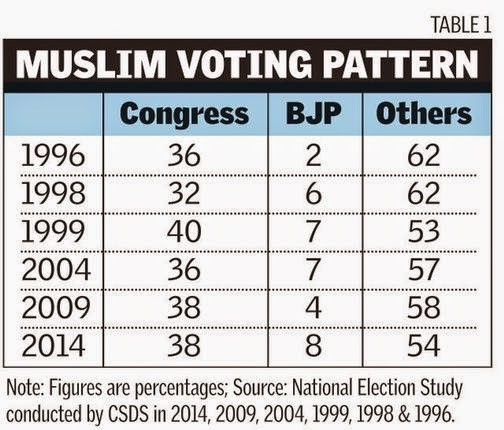
Most likely the official response would be that we (USA) respect the verdict of the (Indian) people, hundreds of millions of them, amongst which there are people from all faiths and communities. That an unprecedented 8% of muslims voted  for the BJP (true). That the BJP got more votes (25% for BJP, 33% for BJP led coalition) from scheduled castes (Dalits) than the Congress and the highest profile party (BSP) of the Dalits (true). That the BJP got more scheduled tribes (Adivasis) votes than anybody else (true).
……

…….
The actual problem is deeper (and more sinister). Out of the 87 Lok Sabha seats (16% of total seats) where Muslims are over 20 per cent of the
population, the BJP won 42 as opposed to just 15 seats in 2009. That the
voice of 15 per cent of the country’s population could be rendered
ineffective expresses a paradox present in our democracy. 

Even that is not quite the full picture. The BJP probably got a huge chunk of Shia votes (and Bohra, Ahmadi, Ismaili and other minority Islamic sects) based on the enemy of my enemy is my friend principle. In Lucknow and in Varanasi (the constituency of the Leader) the Shia vote may have played a significant role in boosting the vote margin (Rahul Gandhi was discredited in part because his winning margin went down).  

What we are really talking about is the disenfranchisement of the Sunnis of India. While Gujarat is important, Ashrafs and Brahmins (as cultural leaders) must find a formula for co-existence. We are not qualified to offer wisdom to the religious but here are a few suggestions for a Hindu-Muslim Co-existence Code.
………..
A multi-faith leadership team to declare Ram as an Imam and Mohammad as an avatar of Vishnu. A truth and reconciliation commission which will (among other things) establish a common standard for commemorating historical events (our heroes are NOT their villains…etc.). A zero-tolerance policy against communal violence and a rapid rehabilitation program for past victims. A guest worker program so that South Asians can travel across borders without harassment. A time-limited embargo on conversion (and re-conversion), ban on pork and beef consumption in public places, honoring noise pollution standards when conducting religious ceremonies, reforming personal laws so as to meet the no discrimination against women standard.  

Since we are unable to enforce secularism in the public place (like France) we must have a big-tent religious movement…perhaps by co-opting the Hindutva movement. The easiest way is to infiltrate and create pressure groups within the BJP. The idea is not that far-fetched.  

The principal Sikh political-religious outfit (Akali Dal led by Parkash Singh Badal) has been a long term ally of the BJP. The present BJP president Amitbhai Anilchandra Shah is a Jain. The BJP has partnered with the Buddhists in Ladakh and neo-Buddhists in Maharashtra. The Parsi industrialists (Tata, Godrej,..) have strongly backed the BJP. Even the Christian denominations in Kerala and Goa have not been averse to bonding with the BJP.  

As always, it is the two nation theory that continues to divide the two main communities and it is past time that we do something about this. It is very important that we do so.
…….
There are a few other problems that needs to be highlighted as well in the upcoming high stakes morality game. In the recent (not-concluded) Gaza war, the ammunition for the Israeli Defense Force was provided by the USA and the missile defense barrier – the Iron Dome – was paid for (in large part) by the Americans. America stands alone in its diplomatic defense of Israel’s actions. The number of muslims killed in Gaza 2014 is about the same as that of Gujarat 2002 (the head-count does not include the drone led civilian deaths that expanded greatly under Obama). Will there now be a petition to ban Obama from meeting with himself?

Also this is assuming that muslims killed by non-muslims is a special case of grievance. Muslims have killed other muslims, the wrong type of muslims in the past, with American arms, ammunition and full-throated diplomatic support. Gary Bass has written about Archer Blood (American counsel general in Dhaka) and the Blood telegrams that provide direct evidence of America’s collusion in the genocide in Bangladesh, in support of which Nixon had dispatched the USS Enterprise to the Bay of Bengal (see below). Why is this not considered as the “father” of Gaza? Where is the petition for war crimes trials against Kissinger and others? If there is a expiry date for victims then we should be told.

Polling by Pew shows the long-term impact of long-distance thuggery. Today it is America (not India) that is considered as the greatest threat/enemy by the Sunni world. This includes Pakistan which has promised to wage a thousand year war with India. Even moderate islamic countries like Indonesia claim that USA is the greatest threat (as well as the biggest ally). Only Bangladeshis “love” USA and “hate” India – driven by fear of the big brother next door.

We have no objections to petitions (they help in raising awareness) but what the Gujarati Muslims (and all other riot victims and displaced citizens of India) really need is justice in time. If the state is unable or unwilling to help the non-state actors must come forward. Some progress has been made but it is never enough, plus there are more and more new victims spread all around the country.

The long-term solution to improving community relations is less polarization based on a true secular agenda. That is usually the job of the left, but somehow the left has lost its ability to persuade the people. Unless the left is re-vitalized, the rightists forces on all sides of the fence will dominate. The divisions will grow and the killings will continue unabated. 
……….

An
online petition urging Obama administration to cancel White House
invitation to Prime Minister Narendra Modi for 2002 Massacre of Muslims
has gathered over one lakh signatures, a minimum requirement for
eliciting an official response.

The petition was launched on
July 21 by US based rights group Sikh For Justice (SFJ) after US invited
Indian PM for a Summit at White House effectively reversing the 2005
ban on Modi’s entry and visa to United States imposed by Bush
administration. Obama’s invitation was followed by Secretary Kerry’s
visit to India who said US looked towards productive and fruitful
summit.

SFJ used Facebook to garner gross root support from the
Americans and 100,000 threshold was achieved a week before the White
House deadline of August 20. “The overwhelming response to the petition
indicates that strong anti-Modi sentiments exist among the American,”
said SFJ legal advisor Gurpatwant Singh Pannun.

Reasoning why
Obama should cancel summit with Modi, the petition cites New York Times
April 16, 2014 report stating “mobs of Hindus rampaged, raped, looted
and killed in a spasm of violence that raged for more than two months.
Mothers were skewered, children set afire and fathers hacked to pieces.
About 1,000 people, mostly Muslims, were killed. Some 20,000 Muslim
homes and businesses and 360 places of worship are destroyed, and
roughly 150,000 people were displaced”.

Pannun said that now
the petition had crossed the required threshold and now Obama
administration would have to answer the Americans as to why a leader,
who was earlier treated as human rights violator, was being hosted at
White House. Obama’s invitation to Indian PM is a deliberate violation
of US laws which prohibit entry of officials like Modi who have
committed gross human rights violations, added Pannun.

……..

[ref. Wiki] The Task force was to be headed by USS Enterprise, at the time and still the largest aircraft carrier in the world. In addition, it consisted of amphibious assault carrier USS Tripoli (LPH-10), carrying a 200 strong Marine battalion and twenty five assault helicopters; The three guided missile escorts USS King, USS Decatur, and USS Parsons; four gun destroyers USS Bausell (DD-845), USS Orleck (DD-886), USS McKean (DD-784) and USS Anderson; one ammo ship USS Haleakala (AE-25); and a nuclear attack submarine. 

The Enterprise was assigned by the Central authority, while the other ships were assigned by local commanders. Enterprise was at this time at the Tonkin Gulf area. Recovering her airborne aircraft and transferring personnel who were required to stay to the USS Constellation (CV-64), she prepared to head off. The task force was delayed while the support ships refueled, it held off East of Singapore, and was ordered into the Indian ocean on 14 December crossed Malacca straits on the nights of 13–14 December and entered the Bay of Bengal on the morning of 15 December The group was required to proceed slowly, averaging a speed of 15 knots, both to conserve fuel as well as to allow advance information on its heading.
….

Link: http://Online-petition-urging-US-to-cancel-invitation-to-Modi-crosses-one-lakh-signatures

……

regards

Brown Pundits