The Second Republic: back-story, future thoughts

…how bad things are between Washington and Delhi…this reluctant partnership might be best left to wither…scant evidence of being the man who will
shake up the economy……scuttling of a WTO deal…..calls into question……ardor for free trade……

……
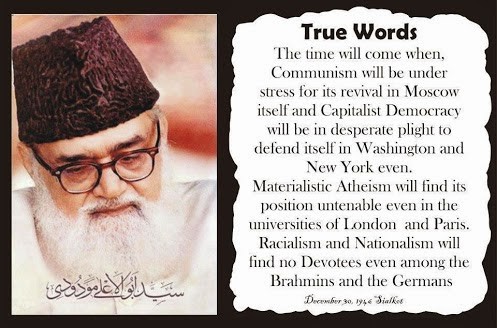
This is a strange truth that no fiction can beat. The person who correctly visualized the future amidst the hellish fog that was Partition(I) was an Islamist philosopher-king named Abul Ala Maududi.
…….
….
A lot of truth and wisdom in the above quotation…except for one thing. What would the future hold for Islam and muslims (especially those in South Asia), which in those glorious post-partition days held the promise to sweep out capitalism, communism, “materialistic atheism,” racialism and nationalism?  

An honest analysis would point out that Maududi had the right instincts (partition will divide and weaken muslims) but the wrong principles (unite muslims by killing other muslims).
……..

Maududi was born in 1903 in Aurangabad, a city named after Aurangzeb, who was famous for his not-so-soft heart towards the majority of his citizens. Indeed, when the two nation theory talks eloquently about their villains being our heroes, Aurangzeb is Exhibit (A).

Hindus (left-liberals) hate the Last of the Great Badshahs and would like to believe that his actions destroyed the “secular” Mughal Empire. Hindus (conservatives) hate him and would like to dial back the clock to the Arab invasion of Sindh.

Muslims OTOH venerate Sultan Alamgir for having (violently) corrected the apostasies of his ancestors. They would like to believe that the green flag was planted across al-Hind for good, only to be undone by the treachery of a single (bengali) muslim: Mir Jafar.

Maududi opposed the formation of Pakistan because he instinctively understood that the power base for muslims in South Asia would be divided. However he was an exception. Muslims were a minority and out of power for 200 years, but they sincerely believed (and so did everybody else) in the one Muslim = 10 Hindus equation (Sikhs were a different story).
…….
The magic lines floated in the air: “Sylhet nilam vote-er jorey, Cachar nebo lathir jorey” – we muslims have won Sylhet district (Bangladesh), through elections and we will win Cachar district (Asom) using force. When the partition was formalized the confident leaders of Pakistan reassured the troops noting that muslims will be kings in Pakistan and king-makers in India. The confidence that comes from a hard battle won through a mix of votes and force seemed to settle all doubts.

Still Maududi worried about the division. One possible reason: his beloved home-land, Hyderabad (a princely state ruled by the Nizam) was unlikely to be a part of Pakistan and would be surrounded by the enemy on all sides. He may have worried about the unreliability of “impure” bengalis, of the possibility of millions of Mirjafars. He certainly worried about the un-islamic character (as he saw it) of  the man leading the charge for partition.  

Nevertheless Maududi had a change of heart and was confident enough to launch the first muslim-on-muslim riots in Pakistan in 1953. He was sentenced to death for his role in killing Ahmadis but the order was reversed. When this happened, the fate of Pakistan as a homeland for all muslims in South Asia was doomed.

If Muslims were out of power for 200 years, Hindus were under the colonial boot for a 1000 years. Plus there was the primacy of caste, there was really never one Hindu nation, just a thousand squabbling tribes. The only way to unite them was through careful inculcation of hate against muslims (not a difficult job, muslims helped out as well) and to create a fear factor around mad, bad Pakistan (not a difficult job, Pakistan helped out as well).

And so it is that finally in 2014, the nightmare that Maududi had envisioned, finally came into existence. The second republic is now born, there will be no muslim armies marching to take over the Red Fort.
………………………………………
These are early days but there are a few emerging clues as to the how the born-again nation will react (and reach out) to the world. Indeed the alarm bells have started ringing in unexpected places, while sworn enemies have remained quiet. What to make of all this?

What is quite clear is that the Hindu Desh wants to be friends with the family (Nepal, Bhutan, and…Sri Lanka…very tricky that one). They would even not mind breaking bread with the enemy (the Islamic nations in South Asia). We are talking of sincere, we do not want to be big brother, courteous hand of friendship, not the contemptuous, we are way bigger than you aloof attitude of the Congress wallahs. How can this be possible?

Well it is certainly not an unprecedented thing to have happened. Indo-Pak relations for example, have been generally more cordial when (on rare occasions) the Hindu Brotherhood has been at the high table. Thus Atal Bihari Vajpayee is rated highly by Pakistanis. The fire-breathing LK Advani went on a praise Jinnah tour, while Jaswat Singh came out with a Nehru villain book. Due to the curious nature of the politics of the sub-continent, Nehru the secularist is a villain for both conservative Hindus and Muslims – TNT version 2.0!!! The last screw in the coffin will be turned when Gujaratis of today will bow before Sardar Patel and say bye to Gandhi.

The consequence(s) of all this will be clear in due time, but some fictions have become facts on the ground. India is now officially declared to be a Hindu-first and Hindi-first nation. The only feeble resistance to this will come from Tamil Nadu, Kerala and Bengal (which form part of the un-India in this model) and the Kashmir valley and a few North-Eastern states. Asom, Punjab and Telengana- deeply disturbed spots all at some time or other- are now very much part of the national narrative.
…………………………
India already has open borders with Nepal and Bhutan, what is a (still remote) possibility now is an open border with Bangladesh. Only Modi can achieve this miracle. It is already the case that 10 million Bangla migrants are settled in India, and cattle-beef and food stuff goes the other way. The Hindus will at some point of time completely migrate out of Bangla, this will in turn help reduce tensions. Now the only people who will get killed are bengali muslims….in India (by Hindus, Sikhs, Tribals,…) and in Bangla (by other muslims).

The road to peace with Pakistan goes through Kashmir. The indications are that the original package will be revived: self-rule (but not independence) and a new twist: Union Territory for Pandits. Pakistan may agree to this, even if Kashmiris see a future Israel-Palestine play (they would be correct). But given the realities, Kashmiris may have no choice but to obey. A deciding factor will be China, it is doubtful that Pakistan Army will not raise objections if Beijing advises to the contrary. China is seriously bothered by the insurgencies in Xinjiang and will like to shut down all islamist adventures in the neighborhood.
…………………………………….
What about the USA and the West? Well….they are the last in the queue and they are very upset indeed. Modi will drive a hard bargain in the political sphere. He is a serious student of history and will not be caught sleeping while the opposition gets to champion the cause of the “little farmer.” He will use the carrot of defense sector privatization (49% FDI) and the opening of the insurance market (if he can get the Congress to go along in the Rajya Sabha). Before any Indian markets are opened, he will insist on a generous visa regime from USA and Europe. That may be a non-starter due to domestic complusions in those countries (excepting Germany).  

The expectation is that among the big powers Germany, China, France, Russia and Japan will be the new close friends….just because they can give India what she wants…energy, technology, and soft loans. 

It is unclear what is that special trick that will click it for India-USA (and India-UK). American technology is considered high cost and Americans do not like to share (unlike Russia and France). More H1-Bs may be the answer, but it is easier perhaps to persuade Google and IBM to move more of  their operations to India (shocking if true: one third of Apple techies are Indian).
…………………….

…..Should We Just Forget
About India?

Here’s how bad things are between
Washington and New Delhi these days: It’s news that Kerry even made the trip.
Why this reluctant partnership might be best left to wither.

So low is the bar in U.S.-India
relations right now that the best thing that can be said about John Kerry’s
two-day hop-over to New Delhi was that he went there at all. A relationship
that burst into true blossom under George W. Bush, one that held for many
Americans the promise of a mold-breaking alliance for the 21st century, lies
shabbily dormant. Indeed, the only memorable episode in Kerry’s visit was his
scolding by India’s foreign minister, Sushma Swaraj, for the NSA’s spying on
her political party.


….
Should America care? India has little or nothing to contribute to American
efforts to tackle the crises in Gaza, Ukraine, Syria, and Iraq. It is a reluctant
partner, at best, in Washington’s efforts to rein in Iran and will have no
truck with the West in any showdown with Vladimir Putin and Russia. Its incessant push for permanent membership of the United
Nations Security Council, while understandable for a country that is the
world’s second-most populous, isn’t exactly in America’s interests: New Delhi
and Washington frequently find themselves on different sides of votes on U.N.
resolutions.


….
The two countries converge in their legitimate fears of Chinese aggression
and expansion in Asia, but even here, India has been loath to embrace any
formal alliance that would act as a check on Beijing, for fear of provoking the
Chinese into military incursions into Indian territory that New Delhi is
shamefully unprepared to counter. Besides, in recent weeks, India has been
party to the setting up of a BRICS Bank, with Brazil, Russia, China, and South
Africa. 

….
This institution was conceived as a way to break America’s global
financial hegemony—a word beloved in bureaucratic Delhi, where America is still
regarded with a suspicion that is as potent as it is irrational.
 

….
The BRICS Bank
looks, for all its founding rhetoric, like a platform for Chinese hegemony
instead. Once more, China appears to have taken India for a ride. But that is
another story.


….
India offers America nothing of concrete strategic value that Washington
cannot, currently, live without. Not only does it balk at an alliance of any
kind, its political and intellectual elites are wedded still to nonalignment,
that antediluvian credo from the years of the Cold War. 

…..
Intellectual worthies
in New Delhi have cooked up something called “Non-alignment 2.0,” by which
“India must remain true to its aspiration of creating a new and alternative
universality.” For those masochists who want to acquaint themselves better with
this Cold War mummy come to life, I suggest a visit to this website. It will swiftly become clear
that there is no room in this starry-eyed arrangement for a compact with
Washington.


….
Forget matters strategic, you may say; banish from your head all thoughts of
a military or security handshake. What about economics? Doesn’t India matter to
America as a market, a place for wise and profitable investment? Here again,
Americans must resign themselves, for the moment, to disappointment.


….
For all Narendra Modi’s free-market rhetoric in the run-up to the
elections, for all the assurances given to investors in back rooms, he has
offered scant evidence, in his two months in power, of being the man who will
shake up the Indian economy and make his country a more rational place in which
to do business. His national budget was only marginally less squishy and Fabian
than other, recent Indian budgets, and Thursday’s capricious scuttling by India
of a World Trade Organization deal that would have vastly streamlined the global
trade system calls into question Modi’s professed ardor for free trade.


…..
American private enterprise has always tread cautiously in India, and there
is every indication that it will have to continue to tiptoe its way through,
around, and over the cactus grove of Indian regulations. 

…..
The job of the Obama
administration (and that of a likely Hillary administration) will be to
persuade India to change its ways. That will be immensely difficult if Mr. Modi
continues to backtrack on economic reform. (Why is he doing so? Is it his
belief that, having won an emphatic but contentious election, he needs to
“buy” social harmony by embracing the sops and subsidies he inherited from the
previous quasi-socialist government of Manmohan Singh?)


….
So, as things stand, America gets neither strategic comfort nor a fair
economic opportunity from India. Perhaps it’s time for Washington to shrug its
shoulders and move on, leaving a warmer relationship with India to a time when
Indians have made up their muddled minds about the kind of country theirs is—or
ought to be.

……
Prime Minister Narendra Modi’s two-day visit to Nepal, which
commenced yesterday, highlights yet again his government’s focus on
India’s immediate neighbourhood. Having made Bhutan his maiden foreign
port of call after assuming office, Modi is the first Indian PM to
undertake a bilateral Nepal visit since I K Gujral in 1997. 

….
Despite deep cultural bonds, over the years suspicion and distrust have
come to tarnish the bilateral relationship. Modi would do well to
address the criticism that New Delhi’s engagement with Kathmandu has
been marked by inequality and interference.


….
Generosity ought to be the pillar of India’s
outreach to Nepal and other Saarc neighbours. This would help dispel the
perception among the latter that New Delhi harbours a big-brotherly
attitude when it comes to dealing them. A vibrant Saarc combined with
the gains made at the recent Brics summit will hold India in good stead
in an increasingly multi-polar world defined by dynamic geopolitics.


….
Having said that, it would be imprudent for New Delhi to focus solely
on relations with its neighbours or other emerging economies at the
cost of ties with the West. India needs technology and investments from
the EU and US to kick-start its economy and tackle unemployment.
Moreover, terrorism is an international scourge New Delhi can’t tackle
alone. Hence, it simply can’t burn bridges with the West. 

……
In this
regard, the collapse of WTO discussions last week hurts India’s
reputation. India has been identified as the country that undermined a
settled deal — which it had committed to support last December in Bali.


………
A perception that India is an unreliable partner can make potential
western allies hesitant to commit political and financial capital to
nurture a strategic relationship. This is the last thing Modi needs as
he attempts to revamp India-US ties at his meeting with President Obama
later this year. New Delhi must strive for a golden mean and maintain a
balance between its relationship with the West and greater South-South
cooperation. This will raise India’s profile at the international high
table.

 ……………………………….

Each
time an election verdict is analysed, it is easy and convenient to
describe it as a new beginning. This is always true because any process
of winning and losing, of choosing and rejecting, inevitably involves
fresh starts.

Some elections also indicate a closure. While the Lok Sabha election
of 2014 is certainly a beginning — though exactly what it has begun is
something we will really and realistically figure out only in the coming
years — we do know what it has ended. It has brought to a close a
20-year cycle of politics that has dominated one-and-a-half generations
of Indians.

In the early 1990s, three social trends came to capture political
imagination in India. There was the BJP’s ascent on the back of
Hindutva, of Hindu anger, prejudice and assertion.

There was the Mandal project that symbolised the political
empowerment of the OBCs, particularly in north India, a phenomenon later
extended to Dalit pride by Mayawati and the BSP. Finally, there was
liberalisation and economic reform, the explosion of expectations and
the politics of growth. Mandir, Mandal and Market: So often in the
1990s, political assessments in India resorted to that lazy phrase.

Narendra Modi’s dramatic rise to power in 2014 and the impressive
mandate he has won have made that three-way split and that careful
separating of one motivation from another completely redundant. He is a
Hindu leader and mascot. He is an OBC from a traditionally
underprivileged caste background.

He is also the most passionate advocate of market-based
solutions, of enterprise and of the energies of the citizen — as opposed
to the eviscerating qualities of statism — that mass politics in India
has seen in a long, long time.

There is no point arguing whether Modi would be Right-wing or
capitalist in a western economic context, and whether he agrees with
every semicolon of Milton Friedman and every paragraph of Margaret
Thatcher. He doesn’t; but he shares their essential instincts and buys
into their broader logic much more than any other mainstream and
electable political leader in India today.

While Modi has made those abstruse debates about an ideological
battle between three (or more) ideas of India seem silly if not
irrelevant, what has he actually introduced and brought to the table?
The principal appeal of Modi in contemporary India is not religion or
caste or even hyper-nationalism.

It is class. The narrative of a self-made man, of the son of a
father who sold tea at a railway station and a mother who went house to
house washing dishes to pay school fees for her children, is a
compelling and extraordinarily powerful one.

The Congress leadership and the media completely missed how the
Modi narrative was resonating with the people. Mani Shankar Aiyar’s
puerile comment that the Congress would open a tea stall for Modi came
to showcase his party’s — and his peer group’s — complete alienation
from a certain popular urge and aspiration.

Aiyar saw it as a clever-clever line; the message it sent was one
of an unfeeling elite, happy to mock lesser citizens. It made being a
chaiwallah a badge of honour for Modi.

It established him as the underdog — a role he plays best, and
has played in successive elections in Gujarat, even while being chief
minister.

If this election was about Modi capitalising on a class revolt,
that expression has to be understood. The reference here is not to class
in a Marxian sense.

It is simply to primarily young, small town, semi-urban people —
or even rural folk, exposed to or associated with city life and the city
economy — usually from non-English speaking backgrounds. They are
hungry to learn the language, though — not to read Milton and join the
Anglosphere but simply to get a job.

They are too well-off to be satisfied by the rural employment
guarantee programme but too poor to be genuinely middle class. They see
themselves as socially underprivileged and perceive their progress to be
thwarted by an elite that has shut the gates and framed complicated,
impossible rules for entry — for professional advance as much as
political office — that usher in only the initiated. Remarkably
hamhanded in their politics, the Congress and the UPA allowed themselves
to be seen as the embodiment of this elite.

Modi’s voters make for a complex set of emotions.

There is undeniable ambition here, completely justified for
talented people who have simply not been given the opportunities they
deserve. There is also a degree of resentment and an anger, sometimes
overdone. Yet, it is equally true that this cohort, this middle India,
represents a far greater section of the Indian population than the
narrow apex of the pyramid that surrounds the Nehru-Gandhi family,
constitutes its reference points and writes its policies and legislation
in chambers in Delhi.

In that sense, this class divide is not between Bharat and India — it is between Delhi and the rest of the country.

Such a binary has caused upheaval in other societies as well. In
several countries of Africa and Asia, the first generation of genteel
post-colonial leaders and elites usually gave way to more angular native
(or nativist) politicians who grasped popular hopes and fears more
easily simply because they had lived these themselves. India has been
lucky and has landed on its feet. It has accomplished a similar change
through the voting machine.

Where other second-generation leaders of post-colonial societies
can be populist and even dictatorial, Modi is cut of a different cloth.

He has been schooled in Indian democracy and sculpted by a decade
of tests in governance and storms in politics. These have made him an
economic change-agent, not an economic waster; these have made him
authoritative, but not authoritarian. Fifty years after Jawaharlal Nehru
died, in the very month, Narendra Modi may as well have inaugurated
India’s second Republic. – See more at:
http://www.hindustantimes.com/comment/analysis/modi-may-be-inaugurating-india-s-second-republic/article1-1220071.aspx#sthash.HQizgfEB.dpuf

In the early 1990s, three social
trends came to capture political imagination in India. There was the BJP’s
ascent on the back of Hindutva, of Hindu anger, prejudice and assertion.

There was the Mandal project that
symbolised the political empowerment of the OBCs, particularly in north India,
a phenomenon later extended to Dalit pride by Mayawati and the BSP. 

….
Finally,
there was liberalisation and economic reform, the explosion of expectations and
the politics of growth. Mandir, Mandal and Market: So often in the 1990s,
political assessments in India resorted to that lazy phrase.

Narendra Modi’s dramatic rise to
power in 2014 and the impressive mandate he has won have made that three-way
split and that careful separating of one motivation from another completely
redundant. He is a Hindu leader and mascot. He is an OBC from a traditionally
underprivileged caste background.

He is also the most passionate
advocate of market-based solutions, of enterprise and of the energies of the
citizen — as opposed to the eviscerating qualities of statism — that mass
politics in India has seen in a long, long time.

There is no point arguing whether
Modi would be Right-wing or capitalist in a western economic context, and
whether he agrees with every semicolon of Milton Friedman and every paragraph
of Margaret Thatcher. He doesn’t; but he shares their essential instincts and
buys into their broader logic much more than any other mainstream and electable
political leader in India today.

While Modi has made those abstruse
debates about an ideological battle between three (or more) ideas of India seem
silly if not irrelevant, what has he actually introduced and brought to the
table? The principal appeal of Modi in contemporary India is not religion or
caste or even hyper-nationalism.

It is class. The narrative of a
self-made man, of the son of a father who sold tea at a railway station and a
mother who went house to house washing dishes to pay school fees for her
children, is a compelling and extraordinarily powerful one.


If this election was about Modi
capitalising on a class revolt, that expression has to be understood. The
reference here is not to class in a Marxian sense.

It is simply to primarily young,
small town, semi-urban people — or even rural folk, exposed to or associated
with city life and the city economy — usually from non-English speaking
backgrounds. They are hungry to learn the language, though — not to read Milton
and join the Anglosphere but simply to get a job.

They are too well-off to be
satisfied by the rural employment guarantee programme but too poor to be
genuinely middle class. They see themselves as socially underprivileged and
perceive their progress to be thwarted by an elite that has shut the gates and
framed complicated, impossible rules for entry — for professional advance as
much as political office — that usher in only the initiated. Remarkably
hamhanded in their politics, the Congress and the UPA allowed themselves to be
seen as the embodiment of this elite.

Modi’s voters make for a complex set
of emotions.

There is undeniable ambition here,
completely justified for talented people who have simply not been given the
opportunities they deserve. There is also a degree of resentment and an anger,
sometimes overdone. Yet, it is equally true that this cohort, this middle
India, represents a far greater section of the Indian population than the
narrow apex of the pyramid that surrounds the Nehru-Gandhi family, constitutes
its reference points and writes its policies and legislation in chambers in
Delhi.

……
Link(1):  john-kerry-just-visited-but-should-we-just-forget-about-india

Link(2): modis-focus-on-indias-neighbours-is-welcome-but-he-must-not-ignore-the-west/

Link (3): modi-may-be-inaugurating-india-s-second-republic
……..

regards

The Yellow River turns Red

…..breaking the levees and
diverting the river south into an older channel, he could effectively
cut off the rail route to Zhengzhou…..Previous military destruction of the levees had
helped armies in A.D. 1129 and 1642
……the decision took a great civilian toll and had only
moderate military success….Official estimates….800,000 Chinese died…..

……

….
It is only in recent times (and even then only amongst a few Chinese and Western academics and opinion makers) that the complete monstrosity of Mao’s actions have been discussed and appreciated. We would speculate that a majority of the academic left world-wide would still back Mao, if a bit less enthusiastically than in the past. The logic is presumably that as a Great Nation builder he had to do what he had to do. 

Arundhati Roy is quite the patron saint on the left (against evil american domination) and in the ummah (against evil Hindu domination) and can be used as a benchmark. She has published several articles deploring the fact that China has deviated from the true path as promised by the People’s Party and is now capitalist in all but name. But as far as the “excesses” or “mistakes” committed during the Cultural Revolution and the Great Leap Forward is concerned, she is curiously (and unusually) silent.

To the best of our knowledge AR reserves none of the vitriol for Mao and his merry band of followers, that she habitually displays towards Gandhi and Gandhians. To take one memorable and recent example, AR wants all the institutions (and roads, ships, bridges,…) named after Gandhi to be erased (metaphorically) because Gandhi was casteist. We have never heard any appeal from her that Mao’s names also similarly be deleted from (Indian) history books. And given her deep admiration for Mao wannabe and genocide loving Charu Majumdar, we doubt any such appeal will be forthcoming.

Then there is the middle-class, right of center population in India (and we expect in other post-colonial nations). On many occasions, we have been taken aback by the full-on admiration of Mao and his methods.
…………

India, in the opinion of such elites, would have already been a great country (like China) if we just had the fortitude to eliminate a few hundred millions of the (undeserving) poor. In contrast, Mao killed only 45 million. As they say of true believers, if you gave these people a free hand, they would out-Mao the Great Man himself.

Indeed, given the undiluted admiration that both the Indian Left and the Right feel for Mao (and their mutual disdain for Gandhi), we feel it would be appropriate to re-badge all the Gandhi-shrines as Mao-memorials. If nothing else this would privilege honesty over humbug (as AR would say).

The question that remains unresolved in our mind is this: was Mao really such an unique monster, or is the Han Chinese gene predisposed towards genocide (so to speak). Is it the case that they would willfully use genocide as part of state-craft (and war-craft)? If this is true, it would be very bad news for the Uighurs and the Tibetans today. They may as well go out and commit mass suicide tomorrow (the Chinese authorities would be glad to pay for all expenses).

To be sure, many generals would not think much about sacrificing a few thousand villages in order to get a decisive advantage in a war against a dreaded enemy. But, even while following a scorched-earth strategy we doubt that they would kill off all the villagers as well. And this is not just a one-off case. This strategy has been supposedly acted upon many times going back a thousand years. Perhaps the well informed military historians on this forum can point to other nations who have carried forward this glorious tradition of care-free elimination of millions of their own people.
……….
 
The Huang He (Yellow River) has been called “China’s Sorrow.” The
name pays tribute to the millions killed by the river’s churning, muddy
waters in a long history of dramatic diversions and massive floods. 

….
One
of the most notable recent events in the river’s troubled history
occurred in June 1938, when the Nationalist Chinese Army diverted the
river to block invading Japanese troops. In both number of deaths and
geographic scale, this event was the largest act of environmental
warfare in modern history.


 ….
The story of the diversion begins with the railroads, says Steven
Dutch, a geologist at the University of Wisconsin at Green Bay. In July
1937, Japan moved troops into China and began seizing power in the
northern territories, beginning the Second Sino-Japanese War. 

…..
By June of
the next year, Japanese troops had moved inland from occupied Shanghai
to Nanjing, Xuzhou and Kaifeng. Though many maps of the invasion show
Japanese control was widespread across these regions, Dutch says that
Japanese effective control was mostly along the rail corridor. In other
areas, Japanese power was less homogenous, interrupted by large areas
controlled by Chinese troops, guerilla groups or bandits.


….
After Kaifeng, the next stop along the railroad was Zhengzhou, Dutch
says. This was the last major rail station before the Japanese could
move south and attack Wuhan — the most important city politically and
militarily in central China. Chinese General Chiang Kai-shek desperately
needed to end Japan’s deadly march inland. And so the Chinese military
turned to the deadliest force within reach — the Huang He.


……….
The Huang He flows east out of the Chinese highlands across a plateau
of loess, or fine sediment, just northwest of Kaifeng. From this point,
the river meanders across a huge, flat alluvial fan. To the north and
south of the current channel stretch the long fingers of older abandoned
river channels, now empty or filled with smaller rivers. 


The Huang He
has flowed in at least nine different channels in the last 2,000 years,
on both sides of the Shandong Peninsula. For scale, Dutch says, imagine
the Mississippi River shifting back and forth between western Texas and
the Florida panhandle.


………
The enormous annual sediment load of the Huang He (providing the
characteristic yellow color of the Yellow River) has complicated human
efforts to control the river’s course through levees. These structures
have been raised higher and higher to keep pace with the bottom of the
river as it rises from sediment fill. 

…..
As a result, by the summer of
1938, the river reach between Kaifeng and Zhengzhou flowed significantly
above the surrounding land. This, combined with its position at the top
of the alluvial fan, made the river here extremely favorable for
diversion.


……..
General Chiang Kai-shek knew that by breaking the levees and
diverting the river south into an older channel, he could effectively
cut off the Japanese rail route to Zhengzhou, Dutch says. This strategy
was not entirely new. Previous military destruction of the levees had
helped armies in the area in A.D. 1129 and 1642. The Chinese hoped that a
similar strategy would turn the military conflict in their favor and
protect the heartland of China from the Japanese.


……..
Unfortunately, the decision took a great civilian toll and had only
moderate military success. Official Chinese estimates suggest that
nearly 800,000 Chinese civilians died. Even more were forced to flee
from their homes. Militarily, the Japanese suffered only minor losses of
troops and materials. 

……..
Although the Chinese did gain time to relocate
their wartime capital — which had been moved to Wuhan after the fall of
Nanjing earlier in the invasion — within three months, Wuhan fell under
Japanese control.


………
Though little detailed information on the effects of the flooding is
available, similar events suggest the kind of destruction the people
living near the Huang He probably experienced in 1938, Dutch says. As
the enormous volume of the Huang He rushed down into one of the smaller,
quieter rivers occupying the old channel, the riverbanks could do
little to hold the waters from spilling out into the broad floodplain,
destroying crops and killing thousands in its path. Once the worst of
the flooding subsided, waterborne diseases likely added more fatalities.


……….
Dutch suggests that one way to put the number of deaths in
perspective is population density. The fatalities were significant, but
this is understandable considering the huge number of people living in
areas impacted by the flood. Even though China had four times fewer
people in 1938 than live there today, the at-risk population was still
huge — nearly 15 million.


………
“Big floods are a fact of life in China,” Dutch notes, and
considering that there are now more people than ever in the region, it’s
easy to wonder whether a similar disaster awaits them today. But an
event such as the 1938 flood is less likely today, he says. Twenty-first
century geologists and disaster management officials in China have a
much better understanding of river dynamics and the impact of floods.
China also has a better infrastructure for issuing warnings, initiating
rescue operations and supporting relief efforts. Additionally, the
fatalities in 1938 were higher because the disaster occurred during war,
when the country’s infrastructure was already unstable.


……………
One thing is certain: Human intervention cannot forever halt the
natural cycle of river change on the Huang He. Dutch says that although
the Chinese system of levees may work fine for the near future, “no
levee will hold the river in one place indefinitely.”

…..

Link: http://www.earthmagazine.org/article/benchmarks-diverting-huang-he-river

…..

regards 

Clipping nails (wings) in Su-Varna-Bhumi

….replay of
the aftermath of the 2006 coup…military has already prepared its transition…..provisional
constitution drafted by the junta…military will re-install their colleagues in the
Democrat Party — “The Party of the Army”….Somchai Srisuthiyakorn, a member of the Election Commission told European diplomats only “moral” people will be
allowed to win the elections…..

….
[Ref. Wiki] The signature of King Mongkut (r. 1851 – 1868) reads SPPM (Somdet Phra Poramenthra Maha) Mongkut King of Siam, giving it official status until 23 June 1939 when it was changed to Thailand. Thailand was renamed Siam from 1945 to 11 May 1949, after which it again reverted to Thailand.

Siam has been referred to in Indian texts as Shyam (Shyam means dark, also another name of Krishna) Desh (country). Similarly Burma is Brahma (Desh) and Cambodia is Kamboja (Desh).

Su (good, pure) + Varna (color) = Suvarna (Sanskrit) is Gold (Sona is the apavramsh word in common usage in North India). Bhumi (Sanskrit) is land or country.

In this Golden Land the sights and sounds are ultra-modern (but as they say with a touch of tradition) as the first-time visitor steps out of the Bangkok airport which is named Suvarna-bhumi (what else?).

The state of the society does not seem to be quite so golden…there have been twelve prominent coups since 1932 [ref. Wiki], and close to 30 successful/attempted coups as noted by experts (see Prof Paul Chambers quote below).
…….
1) June 24, 1932: The Khana Ratsadon party overthrows the absolute monarchy of King Prajadhipok.
2) June 20, 1933: Phraya Phahon Phonphayuhasena overthrows Phraya Manopakorn Nititada.
3) November 7, 1947: Phin Choonhavan overthrows Thawal Thamrong Navaswadhi.
4) November 29, 1951: Military overthrows 1949 constitution and reverts to 1932 constitution.
5) September 21, 1957: Sarit Thanarat overthrows Plaek Pibulsongkram
6) October 20, 1958: Self-coup of Sarit Thanarat
7) November 18, 1971: Self-coup of Thanom Kittikachorn
8) October 6, 1976: Sangad Chaloryu overthrows Seni Pramoj
9) October 20, 1977: Kriangsak Chomanan overthrows Tanin Kraivixien
10) February 24, 1991: Sunthorn Kongsompong overthrows Chatichai Choonhavan
11) September 19, 2006: Sonthi Boonyaratglin overthrows Thaksin Shinawatra
12) May 22, 2014: Prayuth Chan-ocha overthrows Niwatthamrong Boonsongpaisan

Referring to Wiki, there are fortunate few countries to experience this many coups. Taking (10) as the (arbitrary) cut-off number we have only (A) Afghanistan, (B) Bolivia, (C) China, (H) Haiti, and…. (S) Switzerland!!!  There is not a single country which can match Thailand’s record with 1932 as the (arbitrary) cut-off date.

In comparison, we have the relatively mild record of Pakistan and Bangladesh in South Asia (most surprisingly Wiki does not refer to the Emergency – self coup – declared by Indira Gandhi 1975-1977, why so?)

Bangla:
1) August 15, 1975: Khondaker Mostaq Ahmad overthrows Sheikh Mujibur Rahman
2) November 3, 1975: Khaled Mosharraf overthrows the government set up by the August coup
3) November 7, 1975: Soldiers from the Bangladesh army overthrew and killed Khaled Mosharraf just a few days after he took power
4) May 30, 1981: Soldiers led by Major General Abul Manzoor assassinate the president Ziaur Rahman.
5) March 24, 1982: Hussain Muhammad Ershad overthrows A. F. M. Ahsanuddin Chowdhury

Pakistan:
April 17, 1953 by Ghulam Mohammad against Khawaja Nazimuddin
October 27, 1958 by Field Marshal Ayub Khan against Iskander Mirza
March 25, 1969 by General Yahya Khan against Ayub Khan
July 4, 1977 by General Muhammad Zia-ul-Haq against Zulfikar Ali Bhutto
Failed coup against Benazir Bhutto in 1995
October 12, 1999 by General Pervez Musharraf against Nawaz Sharif

Of course it must be also true that TRUTH lies in the eyes of the beholder (and the information minder). The current coup was actually not a coup…as decided by the military. Even better, they changed their mind a few days later!!! Nevertheless, something is deeply wrong in the land of Buddha and full of wise, sweet people (this is meant sincerely).

To us outsiders, the whole exercise represents a form of clipping….nails or wings….depending on your point of view. If the people power gets to be too vociferous or if they dare make unsuitable demands or if the leadership is not “moral” enough, then the military will step in again and again and wield its magic clippers. It is just as brutal as any other military dictatorship but of late an effort has been made to put lipstick on the pig (aka charm offensive).

Indo-China is following the Chinese path of prosperity…no doubt about that. One prominent exception, and a very admirable one is Indonesia which just rejected a military stooge and elected a man of the masses. Congratulations!!!
……………..

This post was originally published on Tuesday, after the Thai
military first announced martial law, under the title “Thailand’s army
says this definitely isn’t a coup. Here are 11 times it definitely was.”
Given the news that on Thursday, the Thai military publicly declared a coup, we have decided to republish it.

On Tuesday, Thailand’s military announced that the country was under martial law, and the government was reportedly not informed beforehand. Armed troops entered private television stations in Bangkok and surrounded the national police headquarters.


So, is this a coup? Not at all, a military spokesperson told the Associated Press. “This is definitely not a coup,” an army official said.


You
can forgive people for some skepticism, though, given Thailand’s modern
history. Since the Siamese revolution of 1932, which overthrew the
absolute monarchy of King Prajadhipok, Thailand has had a truly
exceptionally large number of coups.  

Paul Chambers, a professor at
Chiang Mai University’s Institute for South-East Asian Affairs, says
there have been almost 30 coup attempts (whether successful or
unsuccessful) since 1912.


“What sets this event off from previous
coups is an attempt to make it appear much more under the law,”
Chambers wrote in an e-mail to The Post. “But this is only a superficial
bit of semantics.”

……

In recent weeks, the
military junta in Thailand has been working hard on rehabilitating its
image. A battalion of soft-spoken diplomats has been dispatched on an
international charm offensive, lecturing policymakers and journalists on
their good intentions and popular support. Just don’t ask them to prove
it in an election.

Their efforts are aimed at promoting a distorted understanding of
events — an exercise that the United States and Europe seem all too
willing to accept. They want the world to believe that the May 22, 2014,
military coup is somehow a “normal” feature of Thailand’s political
culture, and as such, the junta should get a free pass.

If things continue along this path, we are due to have a replay of
the aftermath of the 2006 coup. At the time, Western governments
eventually gave their support to the military’s plan to introduce a new
constitution that severely watered down representation and allowed them
to keep appointees permanently entrenched in the Constitutional Court
and Senate. It’s little wonder why the situation has culminated in
violence and repression once again several years later, and undoubtedly
what will happen if they remain unchallenged in 2014.

The military has already prepared its transition. A provisional
constitution drafted by the junta will be introduced containing less
than 50 sections. A cabinet will be formed in September as well as a
250-member “reform council,” all filled with people exclusively
handpicked by the coup, which will then be followed by an election where
the military will be able to re-install their colleagues in the
Democrat Party — otherwise known as “The Party of the Army.”

Somchai Srisuthiyakorn, a member of the Election Commission, has
already chillingly told European diplomats only “moral” people will be
allowed to win the elections.

The recent revelation that planning for this coup began four years
ago, with close coordination between the accused murderer former Deputy
Prime Minister Suthep Thaugsuban (and former Democrat Party member) and
General Prayuth Chan-ocha, should raise major red flags. This coup
wasn’t a last resort or necessity to solve political deadlock — it was a
premeditated, calculated agenda to steal control of the instruments of
power and demolish a popularly elected government.

What must be understood about Thailand’s seemingly endless cycle of
coups and repression is that this is not necessarily a political
struggle, but a struggle against history. There is an unstoppable and
growing political awakening taking place that is crashing up against
traditional elites who view their fellow citizens as feudal serfs.

Since 1932, Thailand has never seen a period of true political
stability due to this struggle. In her excellent book “Revolution
Interrupted,” the academic Tyrell Haberkorn describes Thailand’s history
as occasional periods of silence punctuated by violent cycles of coups
and repression. The protagonists may change, but the role of the Thai
Army is always the same.

Today we are in a silent period, where opposition to the coup has
been frozen through threats, intimidation, interrogations and show
trials. There are credible rumors of atrocities taking place far from
the public eye, while right in the center of Bangkok people have
reportedly been arrested for reading Orwell, holding sandwiches and carrying signs with slogans such as “Long live USA.” 

Such wildly repressive behavior is what we have come to expect from
the people who brought us the 1976 Thammasat University massacre and the
2010 Bangkok massacre. These acts of unaccountable violence and
repression by the military are likely to continue, as no member of the
Army has ever suffered a loss of “prestige” for toppling an elected
government or ordering troops to fire upon protesters.

How we react to the Thai coup matters. As the Australian academic
Nicholas Farrelly has argued, the actions of the U.S. government in
response to Thailand’s past coups has guaranteed “any stigma associated
with military government never overwhelmed international acceptance.”

It’s time for a new approach. The junta’s transition plan must be
rejected and understood for what it is: a blatant attempt by one
minority to dominate the majority. The soldiers must be told to return
to the barracks and stay there. The U.S. government as well as the
European Union must demand an immediate handover to an independent
civilian administration that is capable of overseeing free and fair
elections, leading to a new constitution by the people through elected
representatives, not coup-appointed figures.

Most important, targeted sanctions must be immediately applied
against members of the Thai army to restrict their travel privileges and
freeze their bank accounts, as well as those of the businesses and
corporations that sponsored the overthrow of the government. These
individuals committed a grave crime, and it is time they be treated as
criminals.

The reason why we no longer see regular military coups in places like
Africa and Latin America is because it has become internationally
unacceptable. There’s no reason to expect any less from Thailand,
especially given the tide of history.


Robert Amsterdam serves as international counsel to the Organization of Free Thais for Human Rights and Democracy. He is a Canadian international lawyer and founding partner with Dean Peroff of the law firm Amsterdam & Peroff, with offices in Toronto, Washington and London. Amsterdam was born in 1956 in White Plains, New York, and moved to Ottawa, Canada at a young age where he grew up as a Canadian citizen. Amsterdam was awarded a B.A. from Carleton University (Ottawa, Canada) in 1975 and a LL.B. from Queen’s University (Kingston, Canada) in 1978. Amsterdam is currently based in London, United Kingdom.
…..

Link: http://www.washingtonpost.com/blogs/worldviews/wp/2014/05/20/thailands-army-says-this-definitely-isnt-a-coup-heres-11-times-it-definitely-was/

……

regards

Life and Death in Gaza

Israel’s attack on Gaza and the resulting mass slaughter of
civilians – especially children – has elicited a flood of opinion everywhere in
the world. Though there are many who have supported Israel’s actions, most of
the commentary has reflected the natural outrage of people everywhere. It is
hard to analyze rationally when babies are dying in their mothers’ arms and
ambulances carrying the injured are being bombed. Humanity itself seems to be
under attack. And yet, it is also true that we are where we are in part because
rational analysis has too often been superseded by emotional choices. The
consequences of this on the Palestinian side have been analyzed very eloquently
by Omar Ali in a recent
article
on Brown Pundits. I will focus on two other parties in this matter –
Israel, and the so-called “Muslim World”.
One of the greatest luxuries one can have in any conflict is
to choose one’s opponent. It is not a choice available in most cases, but
Israel has that luxury when it comes to the Palestinians, for reasons that are
too obvious to need discussion. It can choose the moderate, accommodating
Palestinian Authority (PA) led by Abu Mazen and Salam Fayyad, or the hard-line,
militant Hamas. Almost all Israeli actions over the last few years seem
calculated to humiliate the former, thereby elevating the latter by default.
Perhaps, it can be argued, the plan was to delegitimize both – the PA by the
encroachment of settlements and refusal to negotiate, and Hamas by turning Gaza
into an impoverished hell-hole. If so, the plan has only half-worked. Hamas has
managed to periodically recharge its “reputation” by firing rockets into Israel
and, most importantly, engaging in combat with the IDF during a series of invasions
(2008, 2012 and now 2014): Every time Israel invades, hundreds of innocent
people die and Hamas emerges strengthened by having “stood up” to Israel, thus
frustrating Israeli attempts to diminish it. A more cynical reading of the
situation – and I plead maximal cynicism when it comes to international affairs
– is that Israel’s current government actually understands this dynamic very
well, and plays along with it for strategic reasons. Making Hamas the face of
the Palestinian cause and turning the purveyors of ineffectual rockets into Arab
“heroes” fits well into the right-wing narrative of Likud and its allies.
Palestinians cheering for Hamas are easily portrayed as irredeemable
anti-Semites out to annihilate Israel, and, as an added bonus, the periodic
conflicts often force the normally moderate PA to move towards Hamas – at least
temporarily – for political reasons, making the demonization of all
Palestinians even easier. It seems like a good strategy, but in fact, it is a
disastrous one for two reasons.
First, it eats away at one the greatest assets Israel has –
critical thinking. One thing that has enabled Israel to adapt and succeed
in its difficult environment is its tradition of messy, contentious, skeptical
argument within the society at large – a kind of intellectual dynamism that has
made its politics both chaotic and flexible. Now, under the systematic
influence of right-wing strategy, that diversity of thinking is being replaced
by a frighteningly uniform and blind nationalism based on an “us-versus-them”
attitude with de-humanization
of the other side
. Though there are still islands of critical
thinking
in Israeli society, once a process of mindless de-humanization gathers
steam, it seldom leads to anything good, and the de-humanizers often end up
de-humanizing themselves.
Second, empowering Hamas indirectly enhances the prestige of
Islamist movements as champions of Muslim causes and undermines whatever traces
of secular humanism may remain in most Muslim societies. It is neither in
Israel’s interest, nor in that of Europe or the US, to have this happen –
though it may well be in the interest of military-industrial complexes on all
sides. Which brings me to the attitude of the Muslim world.
Deploring and rejecting Israel’s actions in Gaza is natural,
and not
confined to Muslims
by any means. All too often, however, condemnation of
Israel has turned into glorification of Hamas. Nothing could be more dangerous
or counter-productive. Not only is Hamas following a strategy that exacts an
unnecessarily high cost in Palestinian suffering, it is part of a larger
movement – revivalist Islam – that represents the single greatest threat to
Muslim societies everywhere. When I see Pakistani friends who despise the
Taliban and want to “bomb them into the stone age” celebrating Hamas as brave
champions of freedom, I find it perplexing. If Hamas had the opportunity to implement
its desired state, it would be far closer to what the Taliban want than to a
secular democracy. Of course, there are differences. Unlike the Taliban and
ISIS, Hamas (and Hezbollah) are not nihilists. They have a “positive” agenda
too, and much more sophisticated political strategies. They are more akin to the
Jamaat-e-Islami and the Muslim Brotherhood – but these groups are all on the
same spectrum. Over the last few years, countries like Pakistan and Iraq have
suffered terribly at the hands of Islamist extremists, and many people –
including most liberals – advocate tactics against these groups that are not
very different than what Israel is applying in Gaza today. In part, this
reflects the widely-held (and justified) view that the Palesitinians are
seeking their freedom, while the Taliban and ISIS are just seeking power.
However, we would do well to remember that Hamas is also seeking power along
with freedom, and that its power will not be used in ways that many of those
cheering it on today would find acceptable.
Another thing to keep in mind is that selective outrage is
usually ineffective. Israeli bombs have killed almost two thousand Palestinians,
which is a terrible toll – especially horrific because of the high number of civilians killed. But Bashar al-Assad has killed
more than a hundred thousand people
! People are being massacred almost
every day in Pakistan and Iraq for belonging to the wrong sect or religion.
The innocent girls kidnapped by Boko Haramis in Nigeria are still
missing
, with even more abductions since. Militants are on the rampage in
Libya, the Central African Republic, and in various other parts of Africa,
often in the name of Islam. These too deserve an equal measure of outrage –
unless, of course, one finds being killed by Jews worse than being killed by
Muslims. Say it ain’t so.
On the Israeli-Palestinian issue, unfortunately, we seem to
be trapped in a nightmare. Unless one of the parties changes its stance
radically, we are likely to see escalating cycles of violence, initially with
mutually facilitated radicalization, and eventually reaching mutually assured
destruction. And while most of the deaths will no doubt occur on the
Palestinian side, Israel would do well to remember that there are ways of dying
other than losing one’s life.

Bangla ferry goes down (again)

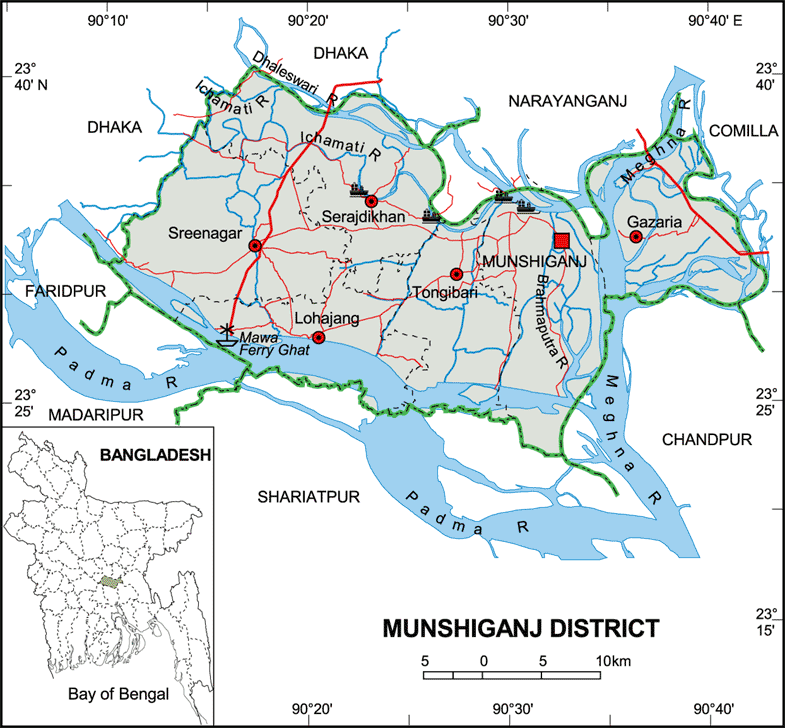
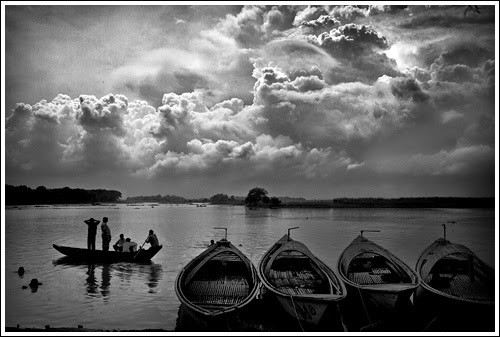
So….about 100-150 dead in Munshiganj district (30 km south of Dhaka) off Mawa Ferry Ghat on the Padma river. 
…………..

….
This is two months since the last disaster. One year after disaster struck at (near) the same spot. Three quick thoughts that we deem to be fit for sharing.
……..

……
1) In Bangladesh, waterways are basically roadways. Thus one can rationalize the ferry deaths as just the same as horrific road accident deaths in other countries (including India). But the sinking reports always look very similar: boat was overcrowded, river was rough..etc.

Bangla should be heavily investing in “water traffic control”- sensor networks, for example, which provide early warning to boats to pull over if travel conditions are poor. Sensor networks have been used extensively on Indian railways (for landslide monitoring for example in the Western Ghats- Konkan Railway) and we can point to the many advantages of such installations (low cost, reliable).

As far as overcrowding goes this must be regulated. All it requires (we imagine) are surprise inspections by traffic inspectors and immediate impounding of the vehicle (and fixed jail terms) if there is evidence of overcrowding.
…..
2) Where is the outrage? Every few months go by and one more ferry sinks, are human beings counted so cheaply? Bangla politics is really screwed up because of the bitter, battling Begums  but surely some disasters should lead  to a national unity moment? There would be some one, one would imagine, in a nation brimming with 160 million proud people (and millions in diaspora), who would put their hands up and say “never again.”

3) We often wonder what is the motivation for (religious minded) terrorists to kill us? As it is in South Asia countless people die enough un-planned deaths through acts of God, is there really any room for additional planned deaths delivered by HIS agents?

Such a state of affairs should evoke deep compassion (and self-reflection). Focus (if you must) on why God chooses to punish us with these terrible thunder-bolts.  

But it seems people would rather prefer violence as the path to un-settle “settled facts.” The numerous partitions stand testimony to our resolve to solve problems to which there are no permanent solutions excepting mass genocide or ethnic cleansing.

We really should learn to say “never again”….if we were smart enough that is…or if our leadership had any foresight. Too bad, WE are not smart enough, and THEY are as blind, willfully so.
……
A ferry with
about 200 passengers aboard capsized on Monday in the river Padma
southwest of Dhaka and rescue teams took about half of them to safety,
the chief of the district administration said.


Mohammad Saiful Hasan
Badal, Deputy Commissioner of Munshiganj district, said about 100
passengers had been rescued from the vessel, identified as the MV
Pinak-6. No deaths had yet been reported.

Teams
from the Bangladesh Inland Water Transport Authority, fire brigade and
the army were engaged in the rescue operation about 30 km (18 miles)
southwest of Dhaka.

“Most
of the passengers were coming back to the city from home after
celebrating Eid-al Fitr,” Saiful told Reuters, referring to the festival
marking the end of the Ramadan fasting month.

A
similar capsize occurred in May, when 54 bodies were recovered from a
vessel that went down with around 200 people on board. Low-lying
Bangladesh, with extensive inland waterways and slack safety standards,
has an appalling record of ferry accidents, with casualties sometimes
running into the hundreds.

Overcrowding is a common factor in many of the accidents and each time the government vows to toughen regulations.

In March 2012, a ferry sank near the same spot, killing at least 145 people.
…..

Link: http://www.theguardian.com/world/2014/aug/04/bangladesh-ferry-capsizes-250-passengers

……

regards

These girls are so good….

We had a friend in school…Fred Seiferth. Freddie was a bit too sure about himself (as are most americans). He would say things like: “I am so good that at times I scare myself.” Nice chap and fond memories of a traditional wedding ceremony in a village church near Buffalo, New York.
………

………..
Well….how about Dipika Pallikal and Joshna Chinappa? They are so good (also admittedly film-star looks)…they must be scaring the heck out of their opponents…and themselves. They just created history by winning a gold medal in squash doubles in the Commonwealth Games in Glasgow. Unfortunately the mixed doubles pair of Dipika and Saurav Ghoshal did not make it to the podium.
………….
[ref. Wiki] Dipika Rebecca Pallikal (born 1991) in a Malayali Syrian Christian family to Sanjiv and Susan Pallikal from Kerala,
India. She played her first international tournament in London when she
was in her sixth grade, and to date, she has won the German Open, Dutch
Open, French Open, Australian Open, Scottish Open on the European
Junior Squash Circuit.

[ref. Wiki] Joshna Chinappa (born 1986) is a squash player based in India. Joshna was the first Indian to win the British
Squash Championship title in 2003 in the under 19 category and was also
the youngest Indian women’s national champion. Joshna Chinappa is the
first beneficiary of Mittal Champions Trust. A trainee of the Indian Squash Academy (erstwhile ICL academy), Chennai, Joshna was ranked 19th in the world in March 2014.

Speaking of film-star looks we have this quotation from the lady
…….
Squash star Dipika
Pallikal has received offers for acting in Bollywood films, but she’s
not interested.

Soon after she and Joshna Chinappa won their
doubles match against Nicol David and Wee Wern of Malaysia on Wednesday,
the 22-year-old former model made it clear that she is not keen on
acting.
“No, not at all,” she said on the possibility of appearing in Bollywood films. 

“Obviously I have got offers and stuff but I don’t think my fiance will allow me.”

Dipika got engaged to cricketer Dinesh Karthik last year. 
……………………..

We are (slightly) conflicted about this. The first thought is Bollywood…yeww!! Then again, fellow Malayali Vidya Balan (did we say we are a fan?) has shown the pathway for successful women-centric films.

But this thing about “dont think my fiance will allow me”…..obviously marriage involves compromise and Syrian Christians are known to be rather conservative as a community (there is nothing wrong with being conservative).

In an ideal world – there should be no boundaries for girls. We are (obviously) very far away from that point. These girls are the leaders of the next generation. They are fearless and they inspire us with their attitude towards life. They should be a bit more conscious about the sister-hood that still needs support from society in order to keep breaking those boundaries. Just saying.
……………….

regards

Shame on you: (fellow) Bongs

….”I am surely surprised that people in Kolkata known for their
righteous stand have chosen to remain silent…..I have gotten used to this….There were not many voices to
come out when I was thrown of my home – Kolkata”……
so long as the Mamata
Banerjee continues to accede to the whims of
religious fanatics, her return to the city is not possible….
….

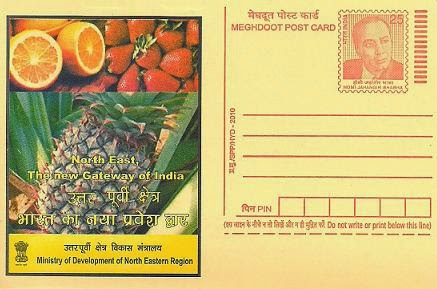
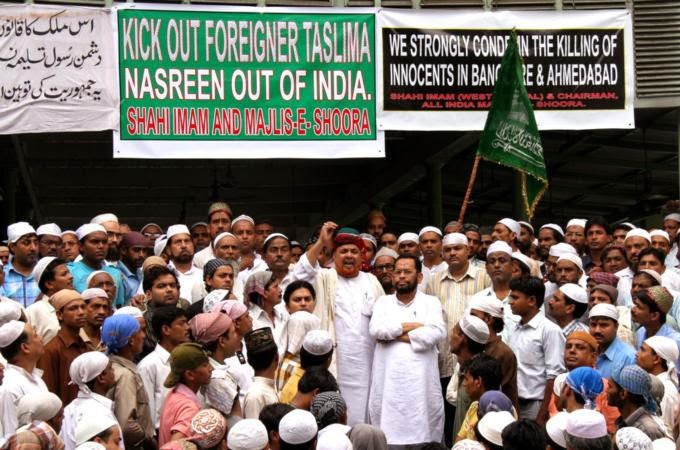
Why is Taslima Nasreen universally referred to as a “controversial author” by the Main Stream Media ? Answers on a Meghdoot Post-card please (yes you are permitted to write below the line).
…..

….
As we see it, secularism is a much abused concept in India, even if we take it in the sense of equal opportunity for all religions in the public square. Thus as a secularist it is not enough that we are opposed to BJP, we must support a secular Congress which is allied with anti-secular Muslim League (Kerala). This is presumably because….why (certainly not the lesser of two evils)?
….

 
Thus in its Indian avatar, secularism is a sword to keep the Hindu Brotherhood away from power. If the H-B wins, the fear is that it will take control of official levers to build an alternate power base which will then attempt to exclude the left-liberal opinion-makers from the public square. By manipulating public opinion in this manner H-B will (in the long run) replace the secular Congress as the natural ruling party of India…we mean Hindustan…..erm…Bharat-Varsha.

…..


We agree that parties/leaders who take advantage of communal politics should be banned from participating in politics, we disagree that a one-sided approach be termed secular. Neither do we agree that such an approach has served India well and is presently fit for purpose.
…..

….
Indeed to the extent this strategy boosts conservative muslim power and suppresses muslim womens’ rights (by taking active measures such as over-turning Supreme Court judgements) it can even be termed as a “war on women” (H-B is unable to claim high moral ground because its constituent members feel that rape accusations are made because they are “fashionable”).
……………..

 
We also feel that “secular politics” is a cynical attempt to foist dynastic politics on India by people who are staunch believers in caste-ist politics. Ideally we would like to see a left-centered and right-centered cadre based (not caste based) party. We believe India is (ever so slightly) headed in this direction at the federal level, due to the subtle workings of the first past the post system.

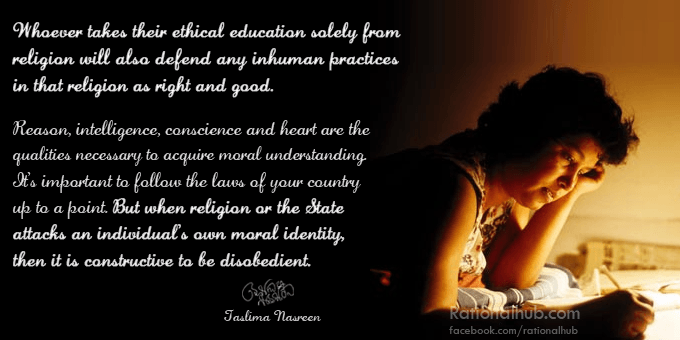
To give an example of how ugly is secular politics, just one name will suffice: Taslima Nasreen. It is passing strange that our left-liberal journalists and thinkers (many of them women, bongs, and bong women) have no time for her. We would say that TN is the Ayan Hirsi Ali of South Asia, except that Taslima really does not even have any friends in India. Not even the Hindu Brotherhood would protect her from Muslim thugs.

And why are conservative muslims so upset with TN? There are (as usual) some vague accusations of having hurt sentiments and having darkened the name of the Prophet. The “secular” govt in Bangladesh has maintained her state of exile from her homeland. But the main reason why the mullahs are after her is surely this- she exposed how they discriminate against Hindus in Bangladesh.

While we can understand why the Muslim Brotherhood in South Asia would unite in their hatred against this woman, it is less clear why Indian secularists (especially fellow bongs) would not be concerned with what she has to say and the fact that she is being burdened with death threats. 

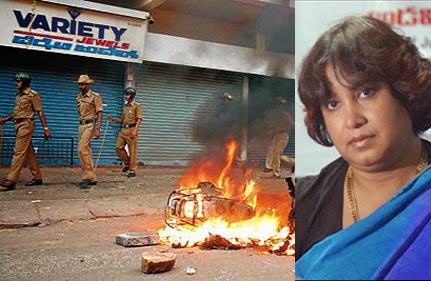
Unless of course the thinking is that any talk about Hindu discrimination in Bangladesh will boost the case of Hindutva politics in India. Thus the fate of millions of Hindus can be ignored in the name of secularism. While the assault on one individual (Taslima in Hyderabad) and preventing her a livelihood (canceling her TV show in Kolkata) are shameful acts, the other is a much more serious charge.

The moral of  the story: if you are planning to be a secular opinion maker, you need to highlight the anti-secular victimization of Salman Rushdie, MF Husain, Wendy Doniger, and Taslima Nasreen. From where we stand, it is clear that conservatives of all shades are using liberal laws as well as threat of violence to shut down legitimate speech. This must be denounced by left-liberals in an even-handed manner. And if you feel that your hatred of the Hindu Brotherhood (justified) leads you into an alliance (even if de-facto) with the Muslim Brotherhood (justified as a political strategy but not as a moral one in our book) then have the courage to say so openly. And do us all a favor: do not call yourself secular.
………………


Kolkata: Seeking long-term extension of her residence permit,
controversial author Taslima Nasreen Saturday met Union Home Minister
Rajnath Singh.

Nasreen had expressed her anguish after the government Wednesday refused
her a one-year visa giving instead a temporary permission to stay in
India for two months.


“I met Singh today (Saturday) and he assured me that my stay in India
will be extended. I gave him my book ‘Wo Andhere Din’ (Those Dark Days)
and in return he said my dark days are over,” Nasreen told IANS.


Following her outburst on a social networking site, support for her
has been pouring from various quarters with Press Council of India
Chairperson and former Supreme Court judge Markandey Katju demanding
permanent visa for the 52-year-old who has been living in exile since
1994.


Nasreen, however, expressed her surprise over intellectuals from Kolkata – her “home” remaining silent on the issue. “I am surely surprised that people in Kolkata known for their
righteous stand have chosen to remain silent. But at the same time I
must admit I have gotten used to this. There were not many voices to
come out when I was thrown of my home – Kolkata,” she said.

Exiled from Bangladesh in 1994 for “hurting religious sentiments”
with her novel “Lajja”, Nasreen took refuge in the city in 2004. But
after violent protests in the city November 2007, the erstwhile Left
Front government whisked her away to New Delhi where she has been living
since then.


Eager to come back to Kolkata, Nasreen said so long as the Mamata
Banerjee government in the state continues to accede to the whims of
religious fanatics, her return to the city is not possible.


“By banning my tele-serial Dusahobas, this government denied me a
slice of livelihood. I have been repeatedly writing to Mamata Banerjee
expressing my wish to come back to Kolkata, but so long as she continues
to listen to the fanatics my return will never be possible, she added.


She said “Dusahobas” a story of three sisters and their triumph over
the injustices meted out by the patriarchal society, would have been a
source of inspiration at a time when crime against women was on the rise
in the state.


Following protests by minority religious groups, the TV serial was refused telecast.
……

Link: https://in.news.yahoo.com/taslima-meets-rajnath-assured-visa-extension-120005201.html

…..

regards 

Facebook freedom index

…..FB per capita (users/population): Canada (17/35), UK (30/64), USA (147/318), Argentina (16/43), France (22/66), Indonesia (63/202), Mexico (36/120), Italy
(18/61),
Brazil
(69/252), Germany (22/81), Japan (17/127),
India (115/1250)..Absentees: China (1366), Pakistan
(188), Nigeria (178), Bangladesh (156), Russia (146), Philippines (100),
Vietnam (90), Ethiopia (88), Egypt (87), Iran (78), Turkey (77), Thailand (64),
South Africa (54), South Korea (50)…..

….
We have taken the top 15 nations (ranking for total users) in 2013 and re-ordered them by dividing through with the population (2014). This data from April 2013 is already old, there is every indication that Facebook use is exploding, especially in the developing world (with exceptions). Also it is clear that on pure per capita terms India would not rank (yet), while Australia (we presume) would.
……..

…. 
Americans – short-hand for free people who are (1) conscious of their
rights, (2) have unreasonable expectations from the government, and (3) unwilling to pay taxes for the same – are dialing 911 to report Facebook outage(s)- note link below. Thus temporary denial of access to social media has been elevated to a life-threatening emergency. A sign of things to come, if one was needed at all.

….
We are not overtly fond of social media tools. In our opinion, it brings the global community to your door-step (good) but equally it drives the person next door far away from you (bad). We observe that children are spending too much time indoors. It appears that people (especially young people) are losing their inclination/ability to make small talk or to prevent their eyes drifting to an electronic screen in a social gathering. Finally, FB culture is a global (american, western) culture. It is another way that the local culture will be driven to extinction.

That said, it is a truism that we have to accept change in order to survive. This we believe – access to social media is a new-age freedom that must be protected and even championed. How else will you know what the world is thinking right now and the impact of such thinking? You CAN be brain-washed and become a jihadist, but you will also get disillusioned by jihadist thinking soon enough (we hope). If you have the minimum needs met with respect to roti, kaapda, makaan (as well as bijli, sadak, pani), then the next important thing (we believe) is access to Face Book. Most importantly (for us), without Facebook there would be no Brown Pundits.
……
Did we mention that Jews are very big in the tech-world? Why raise such a controversial issue right in the middle of the Gaza war? Simply to point out that govt will use any reason to deny social media freedoms to their citizens (see below). Ironically, it is social media that is reporting on the excesses committed by the Israeli Defense Forces (with the aid of American ammunition).
…..

So on to the FB usage data and what useful conclusions can be drawn (please feel free to add….and subtract): 

First, we consider the first world. The Anglo-Nats really really love FB – penetration is
close to 50%. OTOH, in non-Anglo countries like  France, Italy, and
Germany, the love is a bit tepid.

Now consider India. We expect urban
India (approx 400 mil) to catch up with the rest of the
world at some point in the (not too distant) future. We may also conclude
that social media freedom exists only for a tiny section of rural India
(68.7% of population in 2011 – approx 850 mil – ref. World Bank).
With
improvement in internet access and electricity, we expect the rural
population to catch up with their urban cousins as well in the long run (perhaps in a few
decades).

There are problems which need to be sorted out with the Indian IT Act 66(A) as documented by The Center for Internet and Society (CIS – see link below):  
Section 66A which punishes persons for sending offensive messages is
overly broad, and is patently in violation of Art. 19(1)(a) of our
Constitution. The fact that some information is “grossly offensive”
(s.66A(a)) or that it causes “annoyance” or “inconvenience” while being
known to be false (s.66A(c)) cannot be a reason for curbing the freedom
of speech unless it is directly related to decency or morality, public
order, or defamation (or any of the four other grounds listed in Art.
19(2)).

However, it is promising to note that Indian courts have generally taken a dim view of censorship. It is a different matter that in a number of cases, violent elements are unleashed (or cynically speaking, violent behavior is promised or anticipated) in order to suppress lawful behavior. 

The truly interesting countries are the ones which are absent or ranked low on the list…for not so obvious reasons. Why are Philippines (just
turned 100 mil on July 27, 2014- congratulations!!!!), South Korea, and
Thailand- modern countries all – missing? Why is FB
penetration in Japan so pathetic (marginally above India)?

In Latin America, why is Argentina ranked higher than Mexico, which is so much more “American” in its ways. What is the reason for Brazil to fall behind ARG/MEX?

And closer home,
how about Pakistan and Bangladesh? We know of periodic social media bans
in Pak but this is not the case for Bangla.  

Still we feel that (in the long
run), Bangla will look more like Indonesia, while Pak will be aligned
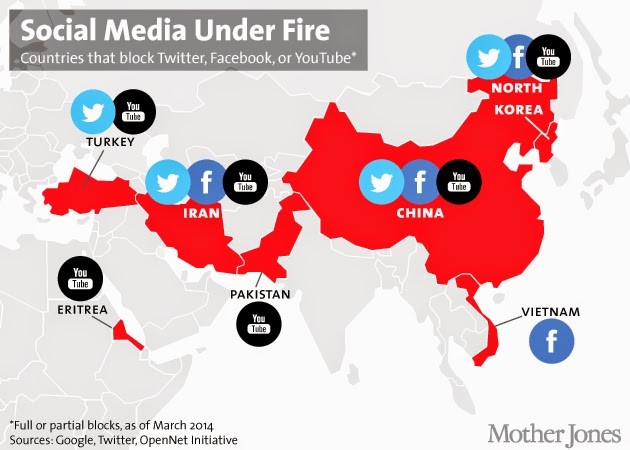
with Turkey and Iran in having restricted access to social media. 

Finally, people argue that Chinese are able to access the internet using digital
subterfuges but in our opinion, it does makes a difference if you have to
watch over your shoulder all the time.
 
…..
Iranians are no longer able to use the free text messaging service WhatsApp, JTA reports,
because the app was recently bought by Facebook, which is run by Mark
Zuckerberg, who is Jewish.
 

That’s right: Iran banned the app, which
allows users to communicate via text message without having to purchase a
dedicated SMS plan, because it is owned by a company whose CEO is, as
they put it, is an “American Zionist.”


“The reason for this is the assumption of WhatsApp by
the Facebook founder Mark Zuckerberg, who is an American Zionist,” said
Abdolsamad Khorramabadi, head of the country’s secretary of the
Committee for Determining Criminal Web Content, Fox News reported Sunday.


The move would make more sense, though, if Facebook was also banned in Iran.
But since it’s not, this arbitrary ban is largely meaningless, serving
only to prevent the citizens of Iran from saving money while they group
text. 


It’s especially nonsensical considering how much of a presence on
social media—Facebook included—Iranian President Hassan Rouhani has built up since taking office in 2013. He tweets regularly,
and updates his Facebook profile with pictures and messages. The ban on
WhatsApp, then, seems wholly inconsistent, and almost entirely random.

It’s not the first Jewish-tinged attack on Facebook since the social
networking behemoth bought WhatsApp in February. A German newspaper published a cartoon depicting the ‘Facebook Octopus’—a hook-nosed Zuckerberg with tentacles pulling the WhatsApp logo into his reach


…..

According
to LA County Sheriff sergeant Burton Brink, they received “several”
calls from dissatisfied Facebook users seeking a solution to the error
message they faced while logging into Facebook.
Frustrated, Brink wrote a message on Twitter: “Facebook is not a Law
Enforcement issue, please do not call us about it being down, we do not
know when FB will be back up!”
Brink explained it was done to prevent more people from calling about the problem.
“We get phone calls all the time, whether it be Facebook going down,” Brink was quoted as saying in a Fortune report.
– See more at:
http://www.mid-day.com/articles/facebook-users-in-the-us-dial-911-over-outage-cops-frown/15500152#sthash.BNsmJ7ea.dpuf
According
to LA County Sheriff sergeant Burton Brink, they received “several”
calls from dissatisfied Facebook users seeking a solution to the error
message they faced while logging into Facebook.
Frustrated, Brink wrote a message on Twitter: “Facebook is not a Law
Enforcement issue, please do not call us about it being down, we do not
know when FB will be back up!”
Brink explained it was done to prevent more people from calling about the problem.
“We get phone calls all the time, whether it be Facebook going down,” Brink was quoted as saying in a Fortune report.
– See more at:
http://www.mid-day.com/articles/facebook-users-in-the-us-dial-911-over-outage-cops-frown/15500152#sthash.BNsmJ7ea.dpuf

According to LA County Sheriff
sergeant Burton Brink, they received “several” calls from dissatisfied Facebook
users seeking a solution to the error message they faced while logging into
Facebook.

Frustrated, Brink wrote a message on
Twitter: “Facebook is not a Law Enforcement issue, please do not call us about
it being down, we do not know when FB will be back up!”

Brink explained it was done to
prevent more people from calling about the problem.

“We get phone calls all the time,
whether it be Facebook going down,” Brink was quoted as saying in a
Fortune report.

……
 
Link (1): http://www.statista.com/statistics/268136/top-15-countries-based-on-number-of-facebook-users/

Link (2): http://www.motherjones.com/politics/2014/03/turkey-facebook-youtube-twitter-blocked 

Link (3): http://www.mid-day.com/articles/facebook-users-in-the-us-dial-911-over-outage-cops-frown

Link (4): http://www.tabletmag.com/scroll/171601/iran-bans-whatsapp-because-mark-zuckerberg-is-jewish

Link (5): http://cis-india.org/internet-governance/blog/breaking-down-section-66-a-of-the-it-act

…..

regards

Gaza and the outrage of millions

I do not follow the Palestinian-Israeli conflict very closely, but of course, given the high visibility of this issue, I am not completely ignorant of it either and do have opinions about it. Ever since the current war started, my Facebook and Twitter feeds have been aflame with outrage at Israeli actions and support for the Palestinians. I have posted a post (basically saying there is no end in sight) and a few comments here and there, but generally stayed out of it. This (relative) lack of outrage has outraged some of my friends and forced me to think about it a bit more. So here goes:

First, about my relative lack of outrage: I plead old age. I am so old, I remember when i was outraged at Nixon’s Christmas bombing of Hanoi (I was a child, but I was a precocious child in that way, in a very politically aware household). I was outraged at the genocide in East Pakistan a few years after it happened (how I missed being outraged at that in 1971 is a long story). I remember being outraged when the CIA sent terrorists to blow up stuff in Nicaragua and when right wing death squads nailed nuns to the table in El-Salvador. I was outraged at the first Iraq war (and marched in Washington to oppose it, then went to a bar and saw zero coverage of that HUGE march on TV) and approaching old age, at the second. If that looks like a leftish list of outrages, its because (like all Westernized Desis) I grew up in a Leftist milieu when it came to being outraged. But I compensated in my old age. I have since become retrospectively outraged at Lenin, Stalin, Mao and Pol Pot, among others. I was even mildly outraged by our (Pakistan’s) close allies the Sri Lankan army, and their tactics in their elimination of the Tamil Tigers. But the point is, I have discovered by now that the outcome of these things is rarely determined by the number of people outraged. In actual wars, especially wars where the opposing parties look at it as a fight to the death, its usually a matter of who can fight better and longer and who has the deadlier weapons.

In short, if there is no middle ground, then the conflict (no matter who is at fault, or who did what to get here) will, NECESSARILY, be settled by the battle-axe. Any settlement by the battle-axe means more Palestinian suffering than Israeli suffering because Israel has the better axes. Supporters of Palestine (and I continue to believe that I am one, since I think a two-state solution on near 1967 borders is the most humane solution and complete defeat of either party involves too much human suffering) should keep this in mind before they valorize an armed resistance in which they themselves take absolutely no bodily risks. Israel must stop bombarding Gaza and killing civilians as collective punishment, but Hamas must also stop firing rockets and getting civilians killed. Even if we believe that the moral burden of those civilian deaths rests on the killers, not on Hamas, the price is too damned high. Moral victory at that price is not worth it.

Cheer leading that victory from 10,000 miles away on Twitter or Facebook is easy. But the price for those dying and suffering is too high. Should Hamas then accept blockade and lack of recognition and x and y?…yes and no. They must not act as if they can FIGHT their way past these restrictions because clearly they cannot. Then they should get out of the way and let more Gandhian alternatives try to improve the life of Palestinians instead of using them as cannon fodder. By not accepting X or Y, what exactly have they achieved? Has the blockade ended? has the suffering stopped? If the tactics you are using are only getting your own kids killed, then the tactics are not working. Honor and admiration from countless millions backslapping each other in their drawing rooms is not enough of a reward or achievement.

Almost all my friends disagree with me on this, but then, like me, they are safely away from the kill zone….also, many of them have had nasty words for Abbas (Abu Mazen). Well, he has not achieved what he wanted, but the West Bank Palestinians are still better off than the ones in Gaza. Their kids are not being slaughtered in the hundreds and they have the chance to resist non-violently and make their case to the world AND TO ISRAEL. Of course it is possible that (as most of my friends claim) Israel  is really not interested in making an honorable peace. But since the Palestinians do not have (and will not have in the foreseeable future) ANY way to militarily defeat Israel, their options are rather limited. Distant cheerleaders with nothing to lose are encouraging them to commit suicide so that we can all have dead heroes to admire. I dont think thats a good idea for Gazans.

Those protest demonstrations in Western capitals? I saw bigger ones before the Gulf war. What happened next is well known.

PS: What about my disproportionate attention to Pakistani Jihadists, ISIS and suchlike? I think its semi-rational. They have killed friends of mine already> they may kill more in the days to come. Their actions affect people I know personally. Its selfish, but its (sort of) rational.

Brown Pundits