Force-feeding: path to hell

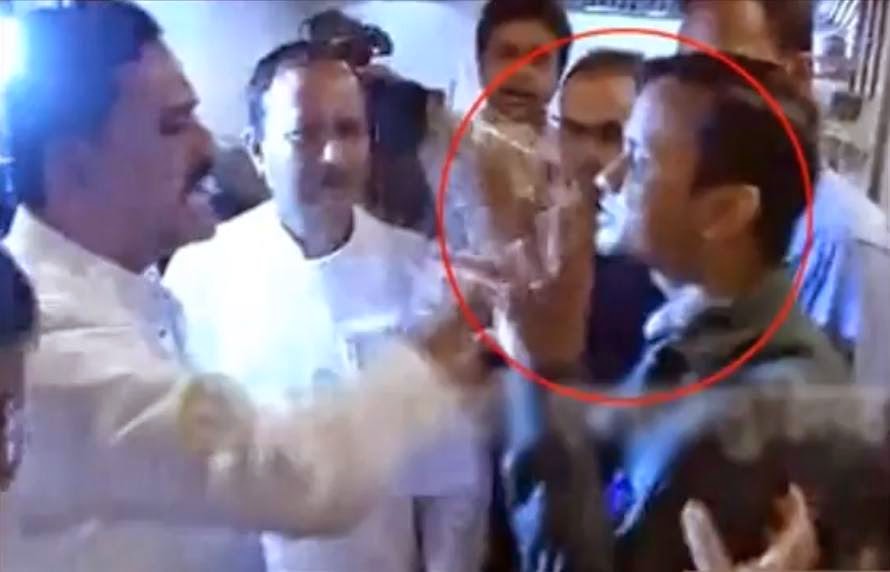
…..Rajan Vichare in a fit of rage tried to
thrust a roti in the mouth of the employee…..Vichare claimed that he did not do anything….footage was aired on TV channels….”I did not know the person’s name, caste or community”……Vichare later said, “I came to know
that the employee was a Muslim only after seeing TV footage and I regret
it”…..

……….
The moral of the story: you felt insulted, so you feel free to insult others.

We frequently interact with a muslim girl and her (muslim) boyfriend. The girl is fasting but the boy does not. (they also do not have any visible ID marks – hijab, skullcap). Being forgetful, we would often cry out “enough working, what shall we do for lunch?” She would always smilingly point at BF and tell us to go ahead and enjoy the biryani. We feel guilty and we apologize. But then we also have Hindus (both genders) who fast on particular days or have a restricted diet (vegetarian). While they assure us that it is OK for us to have non-veg food in their presence it feels rude and we try to avoid it.

What happened in Maharashtra Sadan was most likely a genuine mistake made in the heat of the moment but the burden of explanation is with the perpetrators. Even if a Hindu had been fasting, it would be a grave violation to force a chapati down his throat. The point is – it will not be enough to say sorry, we did not know he was a Muslim.

Yes, we get that all sorts of people do not like non-violence as a policy (because it signifies weakness). In that case however one should be fully prepared to accept the consequences of violent actions which cause serious harm. Many times it happens that (powerful) people abuse and get away scot-free by sorting out the “mis-understanding”. Justice must happen here, must happen in a visible way, and must happen in a timely manner. No excuses.
……….
A group of around 11 Shiv Sena MPs, apparently angry over not being
served Maharashtrian food, allegedly forced a Muslim catering superviser
who was fasting for Ramzan to eat a chapati at the new Maharashtra
Sadan in Delhi last week.

…..


Within hours, IRCTC, the Indian Railways subsidiary that was catering
for the Sadan, stopped all operations in protest, and complained in
writing to the Maharashtra Resident Commissioner, saying the employee,
Arshad Zubair S, had been “deeply pained and hurt
 as religious
sentiments are attached”.


The Resident Commissioner subsequently apologised to IRCTC and
Arshad, and asked to “meet him personally (to) convey the sentiments of
our government”.


….
The Maharashtra government has said it is examining the matter, and
has promised “appropriate action”. The MPs have said that they were
“insulted” at the Sadan, but claimed that the allegations against them
were “wrong”.


….
In an email sent to Resident Commissioner Bipin Mallick on July 17,
IRCTC Deputy GM Shankar Malhotra wrote: “Today there was a meeting of
12-15 MPs at New Maharashtra Sadan in the Press Conference Hall in which
they were complaining about the services of Electrical, civil,
housekeeping, catering, etc. which they are facing from the last several
months in the premises of Maharashtra Sadan.


“The entire delegation along with the electronic media and Manager,
Maharashtra Sadan, walked inside the public dining hall and started
throwing chafing dish covers in the buffet area. They also issued
physical threats to the kitchen and service staff while using highly
objectionable language. 

The specific incident happened with the Resident
Manager/IRCTC, Sh. Arshad who was forced to consume full chapati whilst
he was having fast on the eve of Ramzan. The concerned has been deeply
pained and hurt on this account as religious sentiments are attached.”


….
Malhotra said that the MPs “demanded [a] Maharashtrian caterer in the
NMS [New Maharashtra Sadan]. It may be noted that this is not the first
time that such an incident has happened. We have received no support
from the NMS management in this regard.”


….
In his complaint, which was forwarded to Mallick, Arshad said, “All
the guests along with media reporters and staffs of Maharashtra Sadan
got into kitchen where I was getting the orders prepared. They caught me
and put the chapati into my mouth. I was wearing a formal uniform set
as prescribed by IRCTC and everybody in the panel also knew my name as
‘Arshad’ as I was wearing the name tag. Even then they inserted chapati
in my mouth which caused my fast to break on the eve of Ramzan. I was
hurt with the thing they have done as religious sentiments are
concerned.”


….
Soon after the incident, IRCTC pulled out of work at the Sadan
because of “instances of manhandling of staff, use of abusive language,
discriminatory actions with regional and religious biases and veiled
threats towards the personnel of IRCTC as well as the service provider”.
The canteen at the Sadan is currently shut.


Mallick, the Resident Commissioner, sent a letter of apology to IRCTC, expressing “his shock” at the incident.


….
“I can understand the pain and the agony of your Resident Manager,
Mr. Arshad who was forced to do something against his religious belief.
On behalf of my state government, I convey sincere apology to Mr. Arshad
for the indignation caused to him by a few Hon’ble MPs while he was
performing his duties and rendering services for our government. I would
like to meet him personally and convey the sentiments of our
government,” Mallick said in the letter, which has been accessed by The
Indian Express.


….
The Maharashtra Chief Secretary has been apprised of the incident.
The letter sent to him names 11 Shiv Sena MPs: Sanjay Raut (Rajya
Sabha), Anandrao Adsul (Amravati), Rajan Vichare (Thane), Arvind Sawant
(Mumbai-South), Hemant Godse (Nashik), Krupal Tumane (Ramtek), Ravindra
Gaikwad (Osmanabad), Vinayak Raut (Ratnagiri-Sindhudurg), Shivaji
Adhalrao Patil (Shirur), Rahul Shewale (Mumbai-South Central) and
Shrikant Shinde (Kalyan).


….
When contacted by The Indian Express, Chief Secretary J Saharia said,
“There are allegations like this. We are examining the whole issue and
appropriate action will be taken.”


MP Sanjay Raut said, “These are wrong allegations, someone is doing
mischief. There are many problems with Maharashtra Sadan that have come
up, but I don’t even stay there.”


….
An incident report filed by the manager of the Sadan said “the mob”,
which included the MPs’ supporters and members of the media, damaged the
Resident Commissioner’s office.


….
“The mob threatened to break the glass door of RC’s chamber in New
Maharashtra Sadan, forced an employee to open the door, occupied the
cabin and started shouting slogans etc. Thereafter, the mob broke the
wall clock in RC’s cabin and wrote ‘Jai Maharashtra’ on the wall,” the
report said.


Mumbai-South MP Arvind Sawant said, “I have been living there for the
past two months, and have faced nothing but insults. There are so many
rooms here for MLAs, Ministers of State and Secretaries, but all the MPs
from Maharashtra have been boxed into tiny rooms. All of this, even as 4
MPs from Uttar Pradesh have larger rooms. Is this not an insult?”


….
Sawant added, “The food at the Sadan is terrible. It is run by the
Railways people who know nothing about Maharashtrian food. If you go to
Andhra Bhawan, you are served Andhra food, but here Railways people make
the food. They even gave stale water. 

….
We wanted to sort these issues
out amicably, and did not come with the intention of committing
violence. But even on that day, the Resident Commissioner refused to
meet us, and after a lot of delay, said that he had gone to receive the
Chief Secretary at the airport. Is that not an insult? No tod phod
happened at all, but we have been provoked in a sustained manner. Nobody
was manhandled, but if you keep abusing, will someone not slap?

…..

Link: http://indianexpress.com/article/india/maharashtra/sena-mps-force-fasting-muslim-staffer-to-eat-chapati-maharashtra-sadan-says-sorry/99/

…..

regards

Orwell in Burma-2

…..the shooting of the elephant…..The
owner was furious, but he was only an Indian and could do nothing….legally I had done the right thing, for a mad elephant has to
be killed if its owner fails to control it…

….Among the
Europeans opinion was divided. The older men said I was right, the
younger men said it was a damn shame to shoot an elephant for killing a
coolie, because an elephant was worth more than any damn Coringhee
coolie…

….I often wondered whether any of the others
grasped that I had done it solely to avoid looking a fool……

…………………
George Orwell has a fascinating account of how imperialism corrupts people, both the ruler and the ruled.
It is a good thing to remember while we see imperialism coming back in a big way-  ranging from let us have some clean fun with elegant women (soft- Thailand) to let us stone women to death (harsh- Iraqi Caliphate).

In Moulmein, in lower Burma, I was hated by large numbers of people –
the only time in my life that I have been important enough for this to
happen to me. I was sub-divisional police officer of the town, and in an
aimless, petty kind of way anti-European feeling was very bitter. 

No
one had the guts to raise a riot, but if a European woman went through
the bazaars alone somebody would probably spit betel juice over her
dress. As a police officer I was an obvious target and was baited
whenever it seemed safe to do so. When a nimble Burman tripped me up on
the football field and the referee (another Burman) looked the other
way, the crowd yelled with hideous laughter. This happened more than
once. In the end the sneering yellow faces of young men that met me
everywhere, the insults hooted after me when I was at a safe distance,
got badly on my nerves. 

The young Buddhist priests were the worst of
all. There were several thousands of them in the town and none of them
seemed to have anything to do except stand on street corners and jeer at
Europeans.

All this was perplexing and upsetting. For at that
time I had already made up my mind that imperialism was an evil thing
and the sooner I chucked up my job and got out of it the better.
Theoretically – and secretly, of course – I was all for the Burmese and
all against their oppressors, the British. 

As for the job I was doing, I
hated it more bitterly than I can perhaps make clear. In a job like
that you see the dirty work of Empire at close quarters. The wretched
prisoners huddling in the stinking cages of the lock-ups, the grey,
cowed faces of the long-term convicts, the scarred buttocks of the men
who had been Bogged with bamboos – all these oppressed me with an
intolerable sense of guilt. But I could get nothing into perspective. I
was young and ill-educated and I had had to think out my problems in the
utter silence that is imposed on every Englishman in the East. 

I did
not even know that the British Empire is dying, still less did I know
that it is a great deal better than the younger empires that are going
to supplant it. All I knew was that I was stuck between my hatred of the
empire I served and my rage against the evil-spirited little beasts who
tried to make my job impossible.
 

With one part of my mind I thought of
the British Raj as an unbreakable tyranny, as something clamped down, in
saecula saeculorum, upon the will of prostrate peoples; with another
part I thought that the greatest joy in the world would be to drive a
bayonet into a Buddhist priest’s guts. Feelings like these are the
normal by-products of imperialism; ask any Anglo-Indian official, if you
can catch him off duty.

One day something happened which in a
roundabout way was enlightening. It was a tiny incident in itself, but
it gave me a better glimpse than I had had before of the real nature of
imperialism – the real motives for which despotic governments act. Early
one morning the sub-inspector at a police station the other end of the
town rang me up on the phone and said that an elephant was ravaging the
bazaar. Would I please come and do something about it? I did not know
what I could do, but I wanted to see what was happening and I got on to a
pony and started out. I took my rifle, an old 44 Winchester and much
too small to kill an elephant, but I thought the noise might be useful
in terrorem. 

Various Burmans stopped me on the way and told me about the
elephant’s doings. It was not, of course, a wild elephant, but a tame
one which had gone “must.” It had been chained up, as tame elephants
always are when their attack of “must” is due, but on the previous night
it had broken its chain and escaped. Its mahout, the only person who
could manage it when it was in that state, had set out in pursuit, but
had taken the wrong direction and was now twelve hours’ journey away,
and in the morning the elephant had suddenly reappeared in the town. The
Burmese population had no weapons and were quite helpless against it.
It had already destroyed somebody’s bamboo hut, killed a cow and raided
some fruit-stalls and devoured the stock; also it had met the municipal
rubbish van and, when the driver jumped out and took to his heels, had
turned the van over and inflicted violences upon it.

The Burmese
sub-inspector and some Indian constables were waiting for me in the
quarter where the elephant had been seen. It was a very poor quarter, a
labyrinth of squalid bamboo huts, thatched with palmleaf, winding all
over a steep hillside. I remember that it was a cloudy, stuffy morning
at the beginning of the rains. We began questioning the people as to
where the elephant had gone and, as usual, failed to get any definite
information. That is invariably the case in the East; a story always
sounds clear enough at a distance, but the nearer you get to the scene
of events the vaguer it becomes. Some of the people said that the
elephant had gone in one direction, some said that he had gone in
another, some professed not even to have heard of any elephant. 

I had
almost made up my mind that the whole story was a pack of lies, when we
heard yells a little distance away. There was a loud, scandalized cry of
“Go away, child! Go away this instant!” and an old woman with a switch
in her hand came round the corner of a hut, violently shooing away a
crowd of naked children. Some more women followed, clicking their
tongues and exclaiming; evidently there was something that the children
ought not to have seen. 

I rounded the hut and saw a man’s dead body
sprawling in the mud. He was an Indian, a black Dravidian coolie, almost
naked, and he could not have been dead many minutes. The people said
that the elephant had come suddenly upon him round the corner of the
hut, caught him with its trunk, put its foot on his back and ground him
into the earth.
 

This was the rainy season and the ground was soft, and
his face had scored a trench a foot deep and a couple of yards long. He
was lying on his belly with arms crucified and head sharply twisted to
one side. His face was coated with mud, the eyes wide open, the teeth
bared and grinning with an expression of unendurable agony. (Never tell
me, by the way, that the dead look peaceful. Most of the corpses I have
seen looked devilish.) The friction of the great beast’s foot had
stripped the skin from his back as neatly as one skins a rabbit. As soon
as I saw the dead man I sent an orderly to a friend’s house nearby to
borrow an elephant rifle. I had already sent back the pony, not wanting
it to go mad with fright and throw me if it smelt the elephant.

The
orderly came back in a few minutes with a rifle and five cartridges,
and meanwhile some Burmans had arrived and told us that the elephant was
in the paddy fields below, only a few hundred yards away. As I started
forward practically the whole population of the quarter flocked out of
the houses and followed me. They had seen the rifle and were all
shouting excitedly that I was going to shoot the elephant. They had not
shown much interest in the elephant when he was merely ravaging their
homes, but it was different now that he was going to be shot. It was a
bit of fun to them, as it would be to an English crowd; besides they
wanted the meat. It made me vaguely uneasy. 

I had no intention of
shooting the elephant – I had merely sent for the rifle to defend myself
if necessary – and it is always unnerving to have a crowd following
you. I marched down the hill, looking and feeling a fool, with the rifle
over my shoulder and an ever-growing army of people jostling at my
heels. At the bottom, when you got away from the huts, there was a
metalled road and beyond that a miry waste of paddy fields a thousand
yards across, not yet ploughed but soggy from the first rains and dotted
with coarse grass. The elephant was standing eight yards from the road,
his left side towards us. He took not the slightest notice of the
crowd’s approach. He was tearing up bunches of grass, beating them
against his knees to clean them and stuffing them into his mouth.

I
had halted on the road. As soon as I saw the elephant I knew with
perfect certainty that I ought not to shoot him. It is a serious matter
to shoot a working elephant – it is comparable to destroying a huge and
costly piece of machinery – and obviously one ought not to do it if it
can possibly be avoided. And at that distance, peacefully eating, the
elephant looked no more dangerous than a cow. I thought then and I think
now that his attack of “must” was already passing off; in which case he
would merely wander harmlessly about until the mahout came back and
caught him. Moreover, I did not in the least want to shoot him. I
decided that I would watch him for a little while to make sure that he
did not turn savage again, and then go home.

But at that moment I
glanced round at the crowd that had followed me. It was an immense
crowd, two thousand at the least and growing every minute. It blocked
the road for a long distance on either side. I looked at the sea of
yellow faces above the garish clothes-faces all happy and excited over
this bit of fun, all certain that the elephant was going to be shot.
They were watching me as they would watch a conjurer about to perform a
trick. They did not like me, but with the magical rifle in my hands I
was momentarily worth watching. And suddenly I realized that I should
have to shoot the elephant after all. The people expected it of me and I
had got to do it; I could feel their two thousand wills pressing me
forward, irresistibly. 

And it was at this moment, as I stood there with
the rifle in my hands, that I first grasped the hollowness, the futility
of the white man’s dominion in the East.  

Here was I, the white man with
his gun, standing in front of the unarmed native crowd – seemingly the
leading actor of the piece; but in reality I was only an absurd puppet
pushed to and fro by the will of those yellow faces behind. I perceived
in this moment that when the white man turns tyrant it is his own
freedom that he destroys. He becomes a sort of hollow, posing dummy, the
conventionalized figure of a sahib.
For it is the condition of his rule
that he shall spend his life in trying to impress the “natives,” and so
in every crisis he has got to do what the “natives” expect of him. He
wears a mask, and his face grows to fit it. 

I had got to shoot the
elephant. I had committed myself to doing it when I sent for the rifle. A
sahib has got to act like a sahib; he has got to appear resolute, to
know his own mind and do definite things. To come all that way, rifle in
hand, with two thousand people marching at my heels, and then to trail
feebly away, having done nothing – no, that was impossible. The crowd
would laugh at me. And my whole life, every white man’s life in the
East, was one long struggle not to be laughed at.

But I did not
want to shoot the elephant. I watched him beating his bunch of grass
against his knees, with that preoccupied grandmotherly air that
elephants have. It seemed to me that it would be murder to shoot him. At
that age I was not squeamish about killing animals, but I had never
shot an elephant and never wanted to. (Somehow it always seems worse to
kill a large animal.) 

Besides, there was the beast’s owner to be
considered. Alive, the elephant was worth at least a hundred pounds;
dead, he would only be worth the value of his tusks, five pounds,
possibly. But I had got to act quickly. I turned to some
experienced-looking Burmans who had been there when we arrived, and
asked them how the elephant had been behaving. They all said the same
thing: he took no notice of you if you left him alone, but he might
charge if you went too close to him.

It was perfectly clear to me
what I ought to do. I ought to walk up to within, say, twenty-five
yards of the elephant and test his behavior. If he charged, I could
shoot; if he took no notice of me, it would be safe to leave him until
the mahout came back. But also I knew that I was going to do no such
thing. I was a poor shot with a rifle and the ground was soft mud into
which one would sink at every step. 

If the elephant charged and I missed
him, I should have about as much chance as a toad under a steam-roller.
But even then I was not thinking particularly of my own skin, only of
the watchful yellow faces behind. For at that moment, with the crowd
watching me, I was not afraid in the ordinary sense, as I would have
been if I had been alone. A white man mustn’t be frightened in front of
“natives”; and so, in general, he isn’t frightened. The sole thought in
my mind was that if anything went wrong those two thousand Burmans would
see me pursued, caught, trampled on and reduced to a grinning corpse
like that Indian up the hill. And if that happened it was quite probable
that some of them would laugh. That would never do.

There was
only one alternative. I shoved the cartridges into the magazine and lay
down on the road to get a better aim. The crowd grew very still, and a
deep, low, happy sigh, as of people who see the theatre curtain go up at
last, breathed from innumerable throats. They were going to have their
bit of fun after all. The rifle was a beautiful German thing with
cross-hair sights. I did not then know that in shooting an elephant one
would shoot to cut an imaginary bar running from ear-hole to ear-hole. I
ought, therefore, as the elephant was sideways on, to have aimed
straight at his ear-hole, actually I aimed several inches in front of
this, thinking the brain would be further forward.

When I pulled
the trigger I did not hear the bang or feel the kick – one never does
when a shot goes home – but I heard the devilish roar of glee that went
up from the crowd. In that instant, in too short a time, one would have
thought, even for the bullet to get there, a mysterious, terrible change
had come over the elephant. He neither stirred nor fell, but every line
of his body had altered. He looked suddenly stricken, shrunken,
immensely old, as though the frightful impact of the bullet had
paralysed him without knocking him down. 

At last, after what seemed a
long time – it might have been five seconds, I dare say – he sagged
flabbily to his knees. His mouth slobbered. An enormous senility seemed
to have settled upon him. One could have imagined him thousands of years
old. I fired again into the same spot. At the second shot he did not
collapse but climbed with desperate slowness to his feet and stood
weakly upright, with legs sagging and head drooping. I fired a third
time. That was the shot that did for him. You could see the agony of it
jolt his whole body and knock the last remnant of strength from his
legs. But in falling he seemed for a moment to rise, for as his hind
legs collapsed beneath him he seemed to tower upward like a huge rock
toppling, his trunk reaching skyward like a tree. He trumpeted, for the
first and only time. And then down he came, his belly towards me, with a
crash that seemed to shake the ground even where I lay.

I got
up. The Burmans were already racing past me across the mud. It was
obvious that the elephant would never rise again, but he was not dead.
He was breathing very rhythmically with long rattling gasps, his great
mound of a side painfully rising and falling. His mouth was wide open – I
could see far down into caverns of pale pink throat. I waited a long
time for him to die, but his breathing did not weaken. 

Finally I fired
my two remaining shots into the spot where I thought his heart must be.
The thick blood welled out of him like red velvet, but still he did not
die. His body did not even jerk when the shots hit him, the tortured
breathing continued without a pause. He was dying, very slowly and in
great agony, but in some world remote from me where not even a bullet
could damage him further. I felt that I had got to put an end to that
dreadful noise. It seemed dreadful to see the great beast Lying there,
powerless to move and yet powerless to die, and not even to be able to
finish him. I sent back for my small rifle and poured shot after shot
into his heart and down his throat. They seemed to make no impression.
The tortured gasps continued as steadily as the ticking of a clock.

In
the end I could not stand it any longer and went away. I heard later
that it took him half an hour to die. Burmans were bringing dash and
baskets even before I left, and I was told they had stripped his body
almost to the bones by the afternoon.

Afterwards, of course,
there were endless discussions about the shooting of the elephant. The
owner was furious, but he was only an Indian and could do nothing.
Besides, legally I had done the right thing, for a mad elephant has to
be killed, like a mad dog, if its owner fails to control it. 

Among the
Europeans opinion was divided. The older men said I was right, the
younger men said it was a damn shame to shoot an elephant for killing a
coolie, because an elephant was worth more than any damn Coringhee
coolie. And afterwards I was very glad that the coolie had been killed;
it put me legally in the right and it gave me a sufficient pretext for
shooting the elephant. I often wondered whether any of the others
grasped that I had done it solely to avoid looking a fool.

……….

Link: http://www.online-literature.com/orwell/887/

…….

regards

7 for 74

“There are good bowlers, and there are poor bowlers. Then there’s 500 feet of crap, and then there’s Ishant Sharma”..….
….”Behind every successful batsman there is a Kamran Akmal, but in front of them is Ishant Sharma”…..

(Turkish Czar) Recep Tayyip Erdogan once noted that – “The minarets are our bayonets, the domes our helmets, the mosques our barracks and the faithful our army.” Of course he was too modest to say this but we suspect some of his followers/fans may have worship-fully cried out – “Erdogan is our Caliph.”

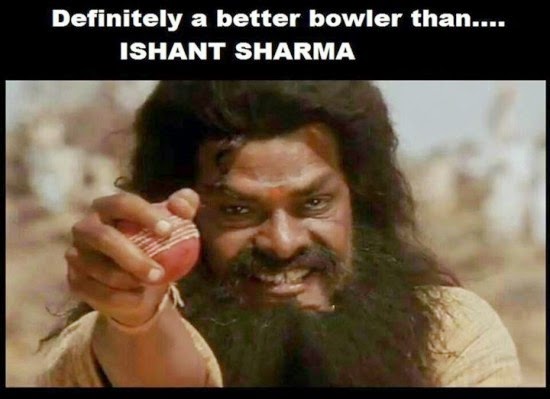
India is not blessed with too much military or ideological prowess (thankfully) but there is one indestructible weapon: the short ball from Ishant Sharma. The missile when launched will not be intercepted by any agency, not even the Iron Dome. The only problem is when the missile mis-directs and destroys its own. 

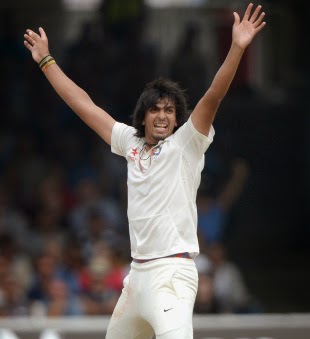
Still when you wait 28 years to win a test match at the Lord’s (and 3 years presently without an overseas test victory) you have to give the Ishant Sharma jokes a rest (temporarily).  The next test is at the Rose Bowl (Southampton) in 5 days. May the best side win!!!
………..

“LOL is Ishant Sharma’s middle name.”

Bangalore, 2007.
India have made 626. Pakistan are 96 overs into their innings and every
batsman has made a double-figure score. There have already been three
hundreds and a double-hundred. A teen, more like a young boy, with more
hair than any human needs and an extremely prominent Adam’s apple, comes
on to bowl.

A ball from a good length jumps up and makes Faisal Iqbal’s forward
defence look idiotic. It flies off the gloves to a deepish short leg. It
is one of five wickets in the innings for a 19-year old bowling on the
many remains of deceased seamers who went before him.


India had found their missing link.

“Ishant Sharma is God’s answer to BCCI’s wrongdoings.”

‘Why does Ishant Sharma keep getting picked?’ It’s one of the most asked
questions to people who have just admitted they are cricket
journalists. You cannot escape that when you have played over 50 Tests
and average more than 35.

Indian fans, when they were taking a break from abusing Rohit Sharma,
would whip the Ishant boy all over social media. Tall for nothing.
Over-rated. Slow. Can’t keep his foot behind the line. Can’t move the
ball away from right-handers. Falls apart under pressure. Google
suggests Ishant-Sharma jokes as its third search suggestion.

It’s also not a shock to see why he is still around. He’s tall. He’s
fast. He gets natural movement. He can reverse swing the ball. They
don’t grow on trees in India, or really, anywhere. If he uses all these
things right, he’s a match-winner.
 
He’s also a match loser. Ishant
isn’t as fast as Johnson, or as tall as Morne Morkel. On a bad day, he
is a fast-medium bowler with a no-ball problem and average control.
Potential is a powerful aphrodisiac.

“Behind every successful batsman there is a Kamran Akmal, but in front of them is Ishant Sharma.”

A typical good Ishant delivery is angled in at the right-hander. The
good ones swing further in and carry above the stumps to the keeper with
a bit of heat on it. Akmal missed one such delivery like this. And
Ishant decided to tell him about it. Loudly.

The scene looks bad because Ishant is screaming over Akmal, who is about
a foot and three inches of hair shorter. Not to mention sledging a guy
with an ODI batting average of 26 is like picking on the kid who isn’t
allowed to use scissors in class. Ishant has to be removed from the
situation.

Against Australia, Ishant decided to sledge David Warner at the WACA
during the innings where Warner swung and connected with India’s head.
Warner came back with verbal aggression and they had to be separated.
But not before Warner said, “You’re kidding yourself, you are a bad
bowler”.

A short poor ball from Ishant is cut by Root. India are sure it is out.
Ishant is more sure. He’s surer than sure. He stands a few feet from
Root and discusses it with him. And discusses it. And discusses.
Eventually the two have to be removed. Replays show Ishant may not have
been right. Although I doubt any replay could have changed his mind.

It’s not even just small aggressive batsmen that Ishant likes. During a
piece of glacier-like fielding from Zaheer Khan, Ishant used a term that
suggested an incestuous relationship after watching the ageing seamer
allow an extra run.

Ishant has the anger.

“There are good bowlers, and there are poor bowlers. Then there’s 500 feet of crap, and then there’s Ishant Sharma.”


Australia need 44 from 18.


47.1 A wide half-volley. Four.

47.2 A short ball. Six.
47.3 A straight half-volley. Six.
47.4 A short ball. Two.
47.5 A short ball. Six.


“47.6 I Sharma to Faulkner, SIX, SIX MORE, what on earth? Ishant Sharma
had his critics before this game, there aren’t going to be many people
backing him after this, short once more, another pull, right off the
middle off the bat, and that sails into the crowd once more, crowd not
sure whether to be gobsmacked by this hitting from Faulkner or be
thrilled by this sensational turnaround, that’s Faulkner’s 50 as well”


Australia win with three balls to spare.

“Dear single guys, if a girl gives you as many chances as Dhoni has given Ishant Sharma, marry her.”

Ishant’s last Test started with him cutting down New Zealand’s top
order. He bowled quick. The ball moved. And Ishant took 6 for 51.
There were sexy short balls and tricky straight balls. It was lovely and
New Zealand had no answer to it. It was the sort of performance that
should have justified the selectors faith in him.

The next innings in the same game, Ishant bowled 45 overs, took no
wickets and went for 164 runs. It doesn’t seem to matter how good or bad
Ishant is, Ishant remains.

“Dhoni isn’t India’s greatest finisher, Ishant Sharma is.” 

The 50th over at Trent Bridge
started with a no-ball. Ishant bowls a lot of no balls. Ishant is
known for no balls. Then Ishant bowled a fast, reverse-swinging ball
that tailed in and smashed into Sam Robson’s pads. Ishant does bowl
reverse-swinging balls that tail in and smash into pads. Ishant is known
for reverse-swinging balls that tail in and smash into pads. Ishant
aggressively sent off Robson. Ishant often does aggressive send-offs.
Ishant is known for aggressive send-offs. 
Ishant then bowled a short,
slow long-hop that Ian Bell smacked for four. Ishant bowls a lot of
short, slow long-hops that get smacked for four. Ishant is known for
short, slow long-hops that get smacked for four. Ishant bowls a ball
drifting down leg side. Ishant bowls a lot of balls drifting down leg
side. Ishant is known for drifting the ball down the leg side.


That was one over. That was Ishant’s career.

“It was Ishant Sharma’s stunning form that made MS Dhoni take up bowling”.

A highlight package of Ishant’s best work looks as good as anything.
Balls flying off a length. Quick swinging balls. Fast short balls. The
hair, the necklace, the stare, the aggression. This is a fast bowler;
you can smell it through the screen.

Ishant’s best delivery is a short of a length ball that angles in, tails
further in and bounces quite well to the keeper. It’s a sexy ball, but
it’s not that likely to get you out. An edge will probably be an inside
edge that flies past the keeper. His height means the ball goes over the
stumps. It’s essentially a theatre ball for people to “oh” and “ah”
about. In the end, it’s a tragedy delivery. It’s the unlucky Ishant
ball.

Ishant was once clocked at 152kph, but his wrist doesn’t stay behind the
ball like it did that summer. 
Sometimes his head falls away as well. If
you can get the ball to reverse in, you should also have the attributes
to conventionally swing the ball out. Somehow Ishant doesn’t. He’s
flawed. And he’s a rhythm bowler, which is often code for – he can be
good, or really rubbish.

“RT if you can bowl better than Ishant Sharma!”

Australians have a different view of Ishant. They saw the young kid on
his first tour bowl very good, and on occasion, very quick. This is
despite the fact he only averages 44 against Australia, has an average
of 73 in Australia and only has a best of 3 for 115 in Australia. It’s
because of how many times Ishant dismissed Ricky Ponting.

In 2008, Ishant took Ponting’s wicket five times in Tests. Five times.
Ishant had the pace and bounce, and when combined with a bowler who
naturally moved the ball in, it was something Ponting never did well
against. Here was a teenager doing it. Over, and over, and over again.

Somehow this guy had made a master look like an awkward teen. They had
switched places. It wasn’t just the wickets that he took, but how silly
Ponting looked in them. His bat splayed weirdly. His balance leaving
him. He was always late. He was always trying to survive. At the other
end he would be Ponting, at Ishant’s end he was the soon-to-be-massacred
bunny.

Ponting eventually overcame it, and was only ever dismissed twice more
in Tests by Ishant. By then though, the bunny stuff had stuck. And so
it should. How many bowlers in Ponting’s career dominated him for a
minute, let alone a year?

If you couldn’t get excited with Ishant at that stage, you were really fighting against basic human instincts.

“Newton’s third law modified: For every N Srinivasan, there is an equal and opposite Ishant Sharma.”

In the tour game in Leicestershire before Trent Bridge, Ishant conceded
64 runs in nine overs. He took two wickets, but even his mother would
find it hard to justify that spell. It was made worse by the fact that
his team-mates never took any of the Leicestershire players for more
than five an over.

Today, in his last seven overs, Ishant took five wickets for 27 runs. He
did it with five short balls. He did it with pace. He did it with
energy. He did it with passion. He did it with all his flaws. He did it.
He will forever be the bowler who bowled India to victory at Lord’s.

If you allow me to walk you through the third wall for a moment, you may
notice that there are some “jokes” in quotations throughout this piece.
When you google Ishant Sharma, ‘Ishant Sharma jokes’ is the third
result. 
There are many, many, many websites with lists of these jokes.
There is much history to make fun of. Little of it can be realistically
defended.

Ishant’s age at the moment is 25. Ishant is much maligned. Ishant is
unlucky. Ishant is a bad bowler. Ishant is a 25-year old Indian quick
who just took 7 for 74 at Lord’s to win a Test.


Today the joke was on England.

……..

Link: http://www.espncricinfo.com/england-v-india-2014/content/story/762919.html

…….

regards

Bathuk-Amma (festival of flowers)

“Its been a long hard journey since my
comeback to tennis from my third surgery when my career seemed to be
over.. It is a very satisfying feeling to have bounced back…and to be ranked top-5…”

……….
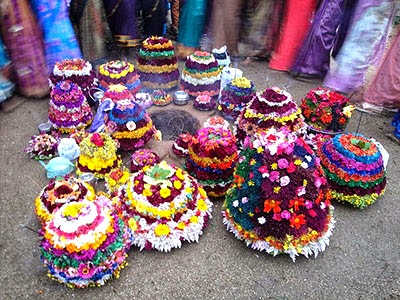
Bathukamma is a celebration of women (see below), a festival of flowers in the honor of Mother Goddess. 

While America awaits a Madam President in 2016, new-born Telengana has just been blessed with a Madam Ambassador, a living Goddess. 

She has rare talent (and beauty), and we feel she will serve her native land just as well as her native game. 
Our request to Sania Amma – kindly consider gifting the 1CR ($160,000) fee for the empowerment of women of Telengana. That would be an answer to so many prayers.
………
[ref. Wiki] Bathukamma is a flower festival unique to Telangana. It is celebrated for nine days during Durga Navratri.
It starts on the day of Mahalaya Amavasya and the 9-day festivities
will culminate on “Saddula Bathukamma” or “Pedda Bathukamma” festival on
Ashwayuja Ashtami, popularly known as Durgashtami which is two days
before Dussehra. 

Bathukamma is followed by Boddemma,
which is a 7-day festival. Boddemma festival that marks the ending of
Varsha Ruthu whereas Bathukamma festival indicates the beginning of
Sarad Ruthu.


….
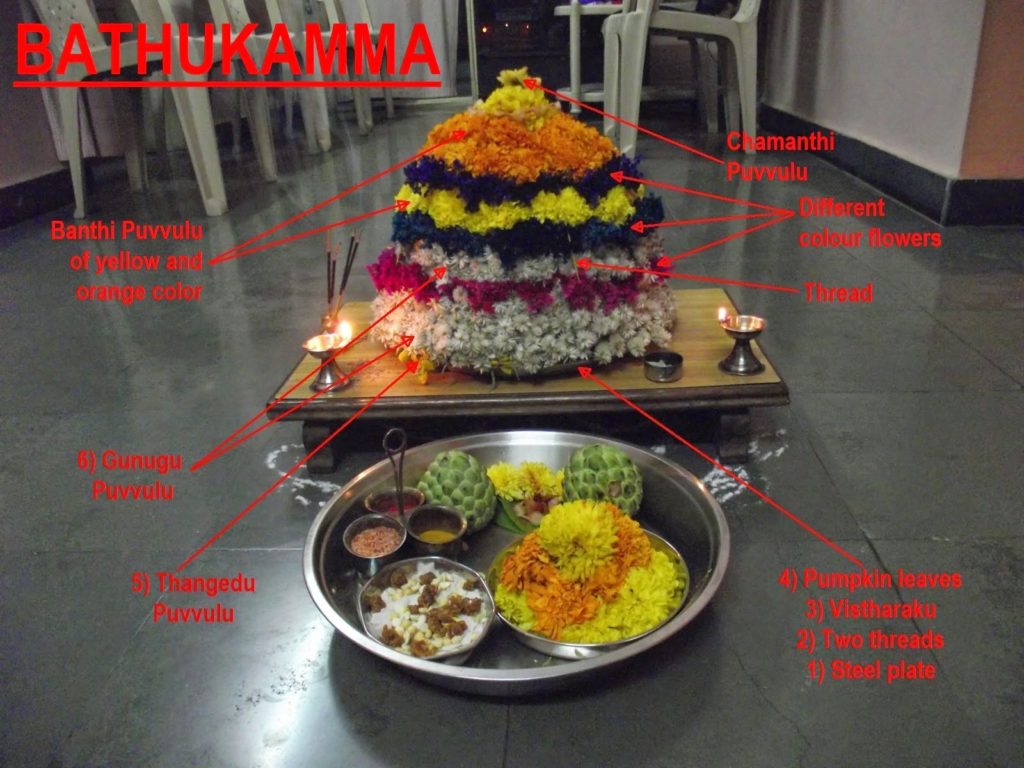
Bathukamma represents cultural spirit of Telangana. Bathukamma is a
beautiful flower stack, arranged with different unique seasonal flowers
most of them with medicinal value, in seven concentric layers in the
shape of potter’s clay like a cone. 

….
In Telugu, ‘Bathukamma’ means
‘Mother Goddess Come Alive’ and Goddess Maha Gauri-‘Life Giver’ is
worshipped in the form of Bathukamma – the patron goddess of womanhood
(Maha Gauri Devi).


….
It is the festival for feminine felicitation. On this special
occasion women dress up in the traditional sari combining it with jewels
and other accessories. Teenage Girls wear Langa-Oni/Half-Sarees/Lehenga
Choli combining it with jewels in order to bring out the traditional
grace of the attire.

………
 Indian tennis star Sania Mirza was on Tuesday appointed ‘Brand Ambassador’ of Telangana. She will promote the new “state’s interests” in India and abroad,
according to industrial infrastructure corporation managing director
Jayesh Rajan.

Chief minister K Chandrasekhar Rao handed over a
letter of appointment and also a cheque of Rs one crore to 27-year-old
Sania
at an interaction session with industrialists here. “Telangana is proud of Sania who is a true Hyderabadi. She’s now ranked
number five in international tennis and we wish she becomes the number
one,” the chief minister said on the occasion.

……..   
  Indian
tennis ace Sania Mirza achieved a career-best rank of number five in
the world as the new WTA doubles chart was released on Monday.

Sania, who turned a pro in 2003 and overcame a career-threatening wrist
injury in between, has entered the top-five for the first time in her
career. Sania and her Zimbabwean partner Cara Black could not
go deep in the just concluded Wimbledon championships, but a second
round appearance fetched her crucial 130 ranking points, enough to push
her in the top-5.

“Its been a long hard journey since my
comeback to tennis from my third surgery when my career seemed to be
over.. It is a very satisfying feeling to have bounced back from those
despairing times and to be ranked in the top-5 of the world today,”
Sania said.

Her father and coach Imran Mirza said, “I’ve always
believed Sania had the potential to be a top-5 player. I’m happy she
has overcome heavy odds to justify her promise.”

……….

Link (1): http://timesofindia.indiatimes.com/india/Sania-Mirza-appointed-brand-ambassador-of-Telangana/articleshow/38854265.cms

Link (2): http://timesofindia.indiatimes.com/sports/tennis/top-stories/Sania-Mirza-enters-top-5-for-first-time-in-her-career/articleshow/37947942.cms

……….

regards

The Marwaris

….Marwaris..as bankers and financiers to the great Mughal dynasty…..Historically
the managers of India’s premodern “bazaar economy” and the book-keepers
and funders of kings, the Marwaris were slowly drawn into the world
powers’ battles for control of Indian trade…..Between 1718 and 1730, the
East India Company took an average credit of Rs. 4 lakh per year from Jagat Seth….

15 Lakhs rupees line of credit from Jagat Seth to the French East India company in 1757!!!! 
Does anybody know how much money that is today?? No doubt we all want to be Marwaris (dream on).
………………..
There are perhaps few international forums which are free from commentary reflecting on the unscrupulous nature of Jews, how they actually “control the world” with 30 (billion) pieces of silver.

It is high time that people got to know the businessmen (baniya) community from India. The hatred that a Jew attracts on a global scale will look and sound familiar to a Marwari in South Asia. Everyone hates them, especially the (pseudo) intellectual super-caste folks from Bengal and the South, who dominate Indian media.

The typical sentiment that we have heard and read about in countless novels, plays, and movies is as follows. Our land was the golden land. Gradually it got tainted with  the arrival of the Marwaris. They sucked the country dry. They preyed on our innocent women. They have no morals and ethics, all they know is the value of money. They are also religious nut-jobs who will deny non-vegetarians a roof over their heads. All the politicians are in bed with  them. The old glory will return only when we finish them all off, when we can make shoes for the poor with the skin of the baniyas.
…….
As anyone who has ever studied business in India knows, the country
does not offer a level playing field for new entrepreneurs. Not only
does the large, if slowly crumbling, scaffolding of India’s socialist
heyday allow government and encrusted special dispensations of various
kinds to inhibit competition, but there also seems to be a deeply
ingrained bias among Indians themselves about who is capable of doing
business and who is not.

And who can blame them? For at least two millennia, the “jati,” or caste
system — the form of social stratification, and indeed suffocation,
unique to Hinduism and India — has regulated society into different
orders of mainly hereditary occupations. According to this vastly
influential scheme, which allocates kingship to the so-called warrior
castes and religious authority to the priestly castes, business is best
done by the mercantile castes, and best scorned by the high or middle
castes. When the outsider demands proof of how genes, or a combination
of genes and culture, can make for such a head start in the very adult,
secular, learnable activities of trade and commerce, the answer is often
sounded: “You don’t want to compete against a Marwari!”

They seem
to have a point. The most ubiquitous of the mercantile castes, the
Marwaris have a certain mystique in India for their legendary ability to
make and manage money. As Thomas Timberg, author of a recent monograph on the Marwaris,
shows, the Marwaris have for hundreds of years served as merchants,
bankers, venture capitalists, speculators and brokers, the managers of
both trust and risk in the Indian economy.

Although
entrepreneurial aspirations have skyrocketed in India since
liberalization in 1991, evidence of the old caste-based structure
continue to show on surveys of wealth creation. According to the Bloomberg Billionaires
list of the world’s richest people, three of the nine richest Indians
are Marwaris. The combined wealth of Lakshmi Mittal, Kumar Mangalam
Birla, and Savitri Jindal is nearly $35 billion.

A group more
dispersed and more enduring than even the great business families such
as the Rothschilds or the Rockefellers, and enabled by social structure
and history as much as dynasty and accumulated wealth, the Marwaris are
an interesting example of an indigenous capitalism pursued, one might say, in a partly collectivist spirit, an essential case study of the relationship of capitalism to culture and social organization.

The
Marwaris, though far-flung today across India and the world, trace
their roots to the harsh desert region around Marwar, in modern-day
Rajasthan in western India. The term “Marwaris” is in fact not a caste
name but an ethnic catchall for various merchant castes from the region.
According to Timberg’s survey, the influence of the Marwaris began to
spread outside their traditional domicile around the 16th century, when
they emigrated in significant numbers to places as far east as Calcutta
(today, Kolkata) and Dhaka (today the capital of Bangladesh) as bankers and financiers to the great Mughal dynasty.

Historically
the managers of India’s premodern “bazaar economy” and the bookkeepers
and funders of kings, the Marwaris were slowly drawn into the world
powers’ battles for control of Indian trade. “Between 1718 and 1730, the
East India Company took an average credit of Rs. 4 lakh per year from
the Jagat Seth firm,” Timberg writes of one of the earliest diasporic
Marwari “great firms.” “As late as 1757 they were lending Rs. 4 lakh per
year to the Dutch East India Company and 15 lakh to the French East
India Company.”

The firm lent to all comers who seemed
creditworthy. Slowly, as British power in India became not just
commercial but also political, many Marwari traders linked up with the
empire as its local commercial face, becoming commodity brokers in the
vast new colonial businesses of tea, opium and jute or agents for
British companies. (Some things don’t change. When the first-ever
McDonald’s opened in India, in Bombay in 1995 — where I ate my first
burger — it was no surprise that the store was being run in partnership
with Amit Jatia, a vegetarian Marwari.)

Later, when the first stock exchange in India — indeed, Asia — was established in Bombay
in the second half of the 19th century, many Marwaris were quick to
jump into what, until very recently, seemed to the more financially
conservative sections of Indian society to be just another form of
gambling, making and losing vast fortunes in their willingness to take
risks. The pan-Indian Marwari network made the financiers in their midst
also bankers of a sort, able to supply and redeem an indigenous bill of
exchange called the hundi and eliminating the risks of cash
transactions.

Socially conservative and tightly knit, the
prosperous Marwaris often served as a school of apprenticeship to clan
members from more modest backgrounds, many of whom eventually branched
out on their own: a kind of Marwar School of Business. Perhaps it’s only
in the last three decades or so that the principle of “Education can wait. Business can’t” has been abandoned by the great karta, or head of the Marwaris.

As
the Marwari ways became widely recognized — financial nous, thrift,
clan solidarity, appetite for risk, social conservatism, involvement in
both religious and secular philanthropy — so too did their mystique.
This subtly reinforced both the stereotype of the grasping Marwari and the occupational-specialization theory of caste,
as well as the larger social consensus that man’s life is embedded in
the rules and values of his own community, not nation or even
self-expression. Looking back at the entries in logbooks and account
books of past centuries, we learn so much about the grain of the Indian
past.

In post-liberalization, as the allure of a new pan-Indian
corporate “MBA culture” distinct from the old
community-and-apprenticeship way of thinking about business has taken
hold, the prospect of a life in entrepreneurship
has for the first time become widely dispersed across Indian society.
The question now being asked of the Marwaris, especially their large
pool of family-owned firms of the brick-and-mortar variety, is: Can they
continue to hold their own in the economy of the 21st century?

Paradoxically,
this challenge has been accompanied by an upswing in social status.
“The Marwari has never quite earned the respect from Indian society that
he has yearned for,” wrote the Indian corporate guru and business
historian Gurcharan Das.
That is now changing rapidly as Indian values become more
unapologetically materialist. Perhaps now we all want to be Marwaris.

…..

Link: http://www.bloombergview.com/articles/2014-07-20/mba-culture-crushes-caste-in-india

…..

regards

The Lord of the Lord’s

…..Jadeja strolls his way
to his Test best and his first fifty. Upon reaching there he gets into a
sword dance, his bat brandishing like a naked sword. He is the king,
the warrior king, Lord’s his subjects, watching in awe, standing up to
applaud…..

…………….

Everything that you know to be true is false.

a) 26/11/2012 Mumbai: England plays India on a turning wicket (as per “request” from Captain Mahindra Singh “Cool” Dhoni).
b) 21/07/2014 London: India plays England on a green-top full of pace and swing (as per “request” from Captain Alistair Cook).

You know that India wins (a) and England wins (b). Utterly, butterly, completely wrong. 

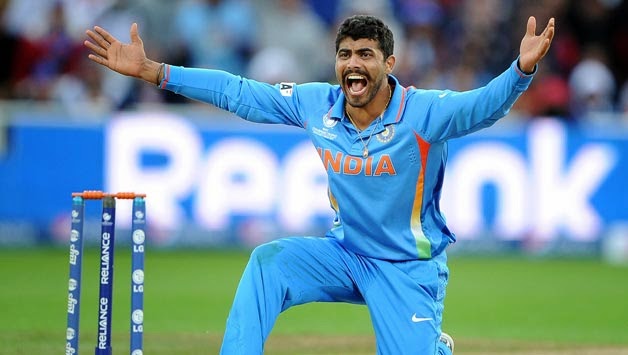
The heroes for the historic win for India at Lords are (1) Ishant “bouncer” Sharma (ho ho ho), (2) Cheteshwar Pujara- the new Rahul Dravid, (3) dark horse, Ajinkya Ranade, (4) all-rounder par excellence, Bhuvneshwar Kumar (5) Mr Reliable, Murali Vijay, and yes…the destroyer Ravi Jadeja.

India
(2nd innings bat)
342-10
(103.1)
Runs
Balls
4s
6s
SR
Murali Vijay
c Prior b Anderson
95
247
11
0
38.46
Shikhar Dhawan
c Root b Stokes
31
45
4
0
68.89
Cheteshwar Pujara
c Prior b Plunkett
43
83
7
0
51.81
Ravindra Jadeja
c Cook b Stokes
68
57
9
0
119.30
Bhuvneshwar Kumar
c Bell b Stokes
52
71
8
0
73.24
India
(2nd innings bowl)
O
M
R
W
Nb
Wd
RPO
Bhuvneshwar Kumar
16
7
21
0
0
0
1.31
Mohammed Shami
11
3
33
1
0
0
3.00
Ishant Sharma
23
6
74
7
2
0
3.22
Ravindra Jadeja
32.2
7
53
1
0
0
1.64
He wears gloves with fluorescent lines to Lord’s. He could play in a
singlet and denim shorts at Wimbledon…..
Within the first 10-15 minutes at the wicket, he has played awkwardly in
front of his body, he has charged at quick bowlers, he has looked
hopeless playing straight balls across the line, he has called for
ridiculous singles, he has charged down against spin and played a worse
shot than his predecessor did and perished doing, he looks like he does
not belong yet when you look at the scoreboard he is 23 off 20.


These are not any 23 off 20. These are 23 off 20 in a tense Test on a
pitch that has done a bit throughout the Test. These are 23 off 20 from a
time when India are effectively 179 for 6, in the middle of what looks
like a collapse, and with new ball around the corner.


You can see why he is so annoying to the opposition. A man who clearly
has no business batting at Test level, but the ticker he has in
abundance. Shane Warne on commentary talks about how he loves adversity. 
The Indian fans in the crowd go with a chant that has become a bit of a
cult: “Ooooo Raavi Jadeja, ooooo Raavi Jadeja.” A chant so catchy, the
man himself has amended his Twitter handle to reflect it.


Get out of the way, Ravindrasinh Anirudhsinh Jadeja is taking over Lord’s.


England, in response, are going helter skelter. They do not like
disorder; you cannot get on a bus here without an Oyster card and simply
pay in cash. Jadeja with the bat in hand is anything but order. He is
India’s Jaad In The Box. This is incredibly high-risk strategy. He can
easily nick off, get hurt, run out, get caught at mid-on, or even trip
over so awkwardly in his charging at the fast bowlers. 
This strategy is not for everyone, but for Jadeja it is life as usual.
Back home, at his farmhouse in Jamnagar, he resides with his Doberman
Rocky and four horses. He rides them without a saddle, forget knee caps
or a helmet. Flashy cars, look-at-me sunglasses, RJ or Ravi inscribed on
most of his belongings, he is a bit of a king, a warrior king,
befitting the name Jadeja. He does not like the pedigree Arabian horses
you get in England. He does not like James Anderson either. Anderson does not like him. They could both be banned for the next Test.  


So when Anderson comes out to bat on day three, the Raavi Jadeja
chant goes up in the stands. MS Dhoni yields to the demands and brings
Jadeja on. Anderson reverse-sweeps first ball, a shot that has brought
him runs at Trent Bridge. This pitch is different, though. The ball
bounces a little extra, and Anderson is caught at first slip.


A day later, the new ball is taken, Jadeja is batting like Jadeja does,
and England call upon Anderson, who removes the amazingly disciplined M
Vijay just short of a century. There has been no effect on Jadeja,
though. The second ball he faces from Anderson he dances down and
swings, gets a big inside edge that goes in the air, and just out of the
reach of square leg. Anderson responds with a short ball, but this time
Jadeja is in the crease and defends.


In the next over, bowled by Stuart Broad, Jadeja moves a touch across,
plays across the line, is nearly lbw and nearly caught off the leading
edge to the same ball, but that still does not pull him back. He gets a
shortish ball, into the hips, around middle and leg, but because he is
moving across, he can tuck it fine for four.

If they bowl short, he pulls in front of square, with no pretence of
elegance and so hard as if the ball is an object to be hated. In the
next over he charges at Anderson again, without warning or rhyme nor,
and somehow – not off the middle of the bat – drives him through cover
for four. Two balls later an inside edge saves him from being plumb lbw. 

Anderson is in his ear, he is mock-clapping Jadeja from mid-off as Broad
runs in to bowl from the Nursery End. He then lofts Broad back over his
head, his first correct and elegant shot. And follows it with a pull.
The piÚce de résistance comes when he punches Anderson off the back
foot, through point, for a get-out-of-my-face four. He is already 40 off
29. The lead is now 236. India already have a fighting total, and
England are demoralised.


The field has spread, singles are available, and Jadeja strolls his way
to his Test best and his first fifty. Upon reaching there he gets into a
sword dance, his bat brandishing like a naked sword. He is the king,
the warrior king, Lord’s his subjects, watching in awe, standing up to
applaud. Those who laughed at him once laugh with him now.


Jadeja has not always been the king. He is as working class as it gets
when he bowls. Bowling ball after ball on the same spot hoping for some
natural variation with no pretence of being the spinner today’s Jim
Laker would conjure when dreaming of paradise. If MS Dhoni asks him to
switch to round the wicket, he switches round; if the captain wants
over, he goes over. 
In the field he chases after every ball in a manner
you would not associate with royalty. In the nets he painstakingly bats
for longer than any other batsman. One extra throwdown, one extra hit,
anything to do to become valuable to the team.


If the batsman represents the flashy royalty he has now become, Jadeja
the bowler and the fielder are the real Jadeja. He was not always this
rich. He used to go to cricket, away from home, with only Rs 10 in his
pocket. Forget exotic pets and feeding them and providing a playground,
the young Jadeja did not know where his next meal would come from. 

Jadeja gets out for 68, his job as royalty is done. Twenty minutes
later, the working-class hero is back on the field. As early as the
seventh over of the innings, his captain calls upon him. 
The first ball
slides in, hits Sam Robson on the pad, and appeals. The bat is awfully
close to the pad, the batsman seems to have been hit outside the line of
off, but Kumar Dharmasena raises his finger after long internal
deliberation. Replays show the ball has hit the pad fractionally before
hitting the bat, Hawk Eye says a smidgeon of the ball is inside the line
when it makes contact with pad, and that Dharmasena is right.


This is Jadeja’s day. Just give in. Resistance is futile. Go into the
stands, or out in the streets, and sing, “Ooooo Raavi Jadeja.”
……
…..
regards

Humpty Sharma ki Dulhania

My fiancĂ©e was in the mood to watch Bollywood and I happily obliged. Even though my brothers are married to desis, both sister in laws are born abroad. Only mine is an Indian (with her mother’s relatives spread over Gujarat and her dather’s in the South & abroad; the great Sindhi-NRI diaspora at work). 

Anyway back to my point that I watched the film and it was pretty decent; they could have made it better with a subtle (yet effective plot twist). It was reasonably dark (and erotic, welcome to modern India) for a Bollywood film but I remember reading that apparently the more licentious & libertine the society the less libido which makes sense (people won’t pay to get an orgasm, they pay for the build up to the said effect).
Alia Bhatt is fast capturing the Kareena Kapoor market of feisty Punjabi heroines (this movie seems like a remake of jab we met) but other than that Bollywoods ongoing sophistication and canny lay testament as to why it’s such an effective global counterweight to Hollywood in certain parts of the world (then again Filipino soaps are popular in Kampala). 
Good on India for leading on soft culture.

Kipat Barzel

…..human
element in the operation of Iron Dome: Some crews are better than
others, and training and experience count…..American missile-defense crews get little live-fire training…..U.S. military should rethink the way it trains its missile-defense
troops…..

A valuable overview of missile defense.

To the horror of peace activists everywhere (torture never works!!, missile defense never works!!!) the Iron Dome works. However this is a cautionary tale. The Israeli Defense Force (IDF) says that it needs 13-15 Iron Domes for full coverage, only nine are operational. Expense is probably not an issue, we will put on our best “Jews own the world” hat and assume that there will be a fair good number of billionaires willing to pony up for an Iron Dome with their name inscribed on it.

But it may also be the case that Israel does not take the threats too seriously and is using Hamas as a punching bag. Hamas no doubt deserves every bit of the bitter medicine but the problem is that the leaders (and even troops) are hiding in deep tunnels, while the civilians are bearing the brunt of this brutal war.

So….. if Israel has perfected missile defense, Hamas has also perfected missile offense. While Israel has attacked Gaza with tanks, Hamas has a few nifty (30m deep!!!) tunnels which are being used to launch surprise attacks inside Israel. Both sides gain from the ability to keep the water boiling at the right temperature (following what a famous Pakistani general had once said).

Worldwide muslims are living under varying degree of occupations by non-muslim powers in Kashmir, Xinjiang, Palestine and Chechnya (there are less prominent ones as well). Of course many more muslims are living under the domination of muslim dictators and tyrants. It gives us no pleasure to say that the first set seem to be better off than the second one. It is a false choice really, all muslims should be free to pray and fast (and not pray and fast as well) and get on with their lives.
………………………
Between the fall of the Jewish Commonwealth to the Romans in the first
century A.D. and the founding of Israel in 1948, Jews were remarkably
easy to kill. Not anymore.


Today, thanks to an innovative missile-defense system called Iron Dome (in Hebrew Kipat Barzel),
it’s harder than ever. Yet when it was first proposed, many Israeli
defense experts (and one way or another most Israelis consider
themselves defense experts) were reluctant to support the idea of a
defensive response to rocket attacks from Gaza and Lebanon.

….
Throughout the history of warfare there has been conflict between
those who believe in the strength of a defensive posture and those who
put their faith in the attack. Aside from the proponents of the nuclear
doctrine known as Mutual Assured Destruction, no one has ever seriously
claimed that an exclusively offensive or defensive strategy is viable.
Some military organizations have traditionally put more emphasis on
defense and others on offense.

….
Israel, because of its small size, has always preferred to fight
offensively. If there is going to be a war, let it happen on the other
guy’s territory. This made sense in the 1950s and ’60s. In 1973,
however, the IDF’s lightly fortified positions in the Golan Heights and
on the east bank of the Suez Canal were overwhelmed in the initial Arab
surprise attack.

….
This led to the delusion that the Bar Lev line in Sinai was somehow
an Israeli version of France’s disastrous Maginot Line at the beginning
of World War II. In fact, it was a set of positions built during the War
of Attrition (1968–70) to protect Israeli soldiers from Egyptian
artillery fire, and hadn’t been intended as a line of defense capable of
repelling a full-blown attack. The costly success of the IDF’s
offensive across the canal and the drive on Damascus in the north
convinced Israel’s military leaders that their attack-centered doctrine
was the correct one; it just needed better tanks.

….
In spite of this doctrine’s failure to work as planned during the
Lebanon war that began in 1982, Israel’s leaders remained committed to
an offensive-minded strategy. However, they knew that their enemies were
beginning to equip themselves with long-range missiles. Indeed, Egypt
had used a few early-model Scuds during the Yom Kippur War.

….
Thus, when the Reagan administration offered Israel the chance to
take part in the Strategic Defense Initiative (SDI) missile-defense
program in 1983, a small faction inside the IDF leaped at the chance.

….
Gradually Israeli leaders came to recognize that missile defense was
just as important as other forms of air power. Thanks in part to U.S.
funding, the Arrow missile-defense system was built and deployed along
with a limited number of Patriot-missile batteries. Israelis had long
been used to having bomb shelters in their homes and neighborhoods, and
they came to accept missile defenses as just another form of homeland
protection.

….
During the 1991 Gulf War, Saddam Hussein’s forces fired 42 modified
Scuds at Israel. The ensuing controversy over the effectiveness of the
Israeli and U.S. Patriot units that were hastily activated and deployed
in response taught both America and Israel some valuable lessons. 

….
For
one, education and preparation count. The Israeli Patriot crews were
barely halfway through their training when the crisis broke out. Neither
Israel nor the U.S. Army had enough experience with these weapons to
understand how to effectively integrate them into a large-scale
defensive scheme. ….

The U.S. Patriot units did not arrive in Israel until
the war was already underway, and their improvised deployment has
generally been regarded as a failure.

….
Another problem was that space-based sensors on America’s Defense
Support Program early-warning satellites, which provided critical alerts
every time the Iraqis launched a Scud, were not directly hooked into
Israel’s air-defense system. 

….
The satellites were designed to give early
warning of a Soviet nuclear strike, and their ability to detect Iraqi
missile launches was an unplanned side benefit. The Israelis learned the
hard way that they would need a complex, sophisticated, and extremely
fast-acting sensor system if they were to make missile defense work.

….
When the Second Gulf War broke out in 2003, Israel had deployed the
early version of its Arrow defense missile. It also had integrated
improved Patriot batteries and had developed an advanced
command-and-control organization to provide it with a multi-layered
national missile-defense system.


Yet when Hezbollah fired thousands of rockets at northern Israel
during the 2006 Second Lebanon War, existing missile defenses did little
or nothing to stop this attack. For some unknown reason, Israel was
unwilling or unable to obtain the American Centurion short-range
missile-defense system (based on the U.S. Navy’s Phalanx anti-missile
gun). Additionally, the proposed Nautilus chemical-laser system was seen
by experts as both too expensive and too easily overwhelmed, since it
could only fire seven or eight shots before it needed to be refueled.

….
Meanwhile, the Israeli defense firm Rafael was developing the concept
that would lead to Iron Dome. It would be based on Israel’s
longstanding expertise in radars and especially on the AESA (Active
Electronically Scanned Array) type radar. This technology uses dozens of
small transmit–receive modules to scan for targets. It does not need
any sort of mechanical sweeping apparatus, and its power output can be
easily adjusted to concentrate on any given part of the sky. 

….
Israel had
first developed such radars as replacements for the older systems that
equipped its F-15s and F-16s.


Iron Dome uses a Multi Mode Radar (MMR) to detect and track enemy
rockets. If the rockets are going to land in an uninhabited zone, the
system does nothing; if the projectile is going to hit a neighborhood or
an area that has been designated as “protected” it will launch one or
sometimes two “Tamir” interceptor missiles in order to destroy the
incoming weapon.

….
Its rate of success, which the IDF claims is in the 85 to 90 percent
range has been challenged by, among others, Theodore Postol of MIT, a
longstanding, hardcore opponent of U.S. missile defense. …

The details of
the system’s effectiveness are closely held, but in its performance
against the improved “Grad” and other rockets that Hamas has been using,
the results speak for themselves.

….
The system is by no means perfect. When a rocket is hit, it does not
disintegrate into nothingness. Debris from both the missile and the
rocket fall to Earth and this debris can sometimes do damage, but this
is minimal compared to the damage a live warhead would do.

…..
Back in 2012 I wrote a piece
for the Gatestone Institute making the argument that the economics of
Iron Dome are not as bad for Israel as some people claim. Since then,
the price of the Tamir interceptor missiles has probably gone down
thanks to improved manufacturing techniques and the larger quantity of
weapons being built.

…..
Three points about the system are significant for Americans. First,
while the U.S. has been financing a great deal of Iron Dome’s
development and manufacturing, our military seems reluctant to take
advantage of the weapon’s availability. Second, the system is
continuously being improved; as with every military system there is a
constant need to update the hardware and software, and, thanks to Hamas,
the Israelis have a great deal of live-fire data on which to base their
upgrades. 

…..
The third, not always evident, point is that there is a human
element in the operation of Iron Dome: Some crews are better than
others, and training and experience count. The technology by itself can
only go so far. American missile-defense crews get little, if any,
live-fire training. Simulators have their limits. In light of this, the
U.S. military should rethink the way it trains its missile-defense
troops.

…..
According to recent reports, Israel now has at least nine Iron Dome
units in operation. The IDF has said in the past that they need a total
of 13 to 15 units to cover the whole country. As production for Israel
winds down, the U.S. would be wise to consider buying a few units of its
own for use in South Korea and in places like Bagram Air Force Base in
Afghanistan. After all, the Taliban often use rockets similar to those
used by Hamas. We should expect that future enemies will use similar
weapons against similar targets. If an Iron Dome were to prevent the
destruction of a single U.S. C-17 transport plane, it would pay for
itself several times over.

…..
The U.S. is already scheduled to begin producing components for Iron
Dome, and there is no reason why it could not manufacture an
increasingly large part of the system. Rockets such as the Grad have
been an important part of the arsenal of insurgents in low-intensity
conflict, and are also an important weapon in more conventional warfare.
As time goes on, Iron Dome or weapons systems like it will be
integrated into the arsenals of all the major powers.

…..

Link: http://www.nationalreview.com/node/382931/

……

regards

Iraq, an old post

From Dr Hamid Hussein. And old post that is still relevant
Things in the middle east are going from bad to worse….
btw, ISIS has officially stoned a woman to death in Syria. I am surprised it took them so long. Some things have an iconic status in Jihadi circles: cutting off the hands of a thief (check, ISIS has done that, in public), whipping someone for drinking alcohol (so mundane that its probably been done but not reported) and stoning a woman to death. Nothing puts the fear of God into people like watching a woman (in a shroud) being stoned to death by a mob of baying humans. 
Omar 
July 16, 2014
Dear All;
I don’t know why but many interested in the subject asked about changing dynamics of Iraq conflict in view of recent advances of ISIS, Shia militia response and maneuvers of Kurds.  Utter barbarity and carnage and that also in the most holy Islamic month of Ramadan with indiscriminate killing, mass executions (ISIS executed close to 200 Shia air force recruits and soldiers and Shia militiamen responded by executing almost 200 Sunni prisoners) and demolishing of mosques and mausoleums by ISIS is tragic but general apathy among Muslims is truly mind boggling.  Overwhelming majority is totally oblivious to the cancer eating away the body politic of Muslims. 
Frankly, I have nothing more to add but refer them to an old piece written in 2006 before the surge.  The question asked at that time was Sunni-Shia violence in Iraq and Kurdish context as well as impact of U.S. troops on the equation.  I was personally against the surge of American troops and thought that it may give a tactical respite but not change the long term instability emanating from Iraq.  I was proven wrong and surge achieved a major success although jury is still out about what was the major contributing factor.  There is still debate in U.S. military community about this.  U.S. mistakes were compounded by failure of Iraqi government to adjust the course regarding Sunnis and crisis in Syria ultimately unraveled the whole thing.  Now a long and very painful road will be travelled by all Iraqis and I fear more china will break in the process. We have seen this horror show before in 2006-07 and it is not for the faint hearted.
Hamid

Shia-Sunni Conflict and Kurds
There are several theories and perspectives about the complex web of violence in Iraq which is rapidly expanding and with every day getting more brutal.  There are several dimensions but two most important are U.S. operations and how they have evolved over three years and increased assertion of Iraqi players.  I’ll briefly review both of them. From outset, one should be very clear that the spectrum in Iraq is very complex and constantly evolving.  Local, regional and international players are in a contest of musical chairs where friends and foes shift like the shifting sands of the desert. 
In mid 2003, violence started to gradually escalate in Iraq with very unique characteristics.  First, it was almost exclusively Sunni in nature, second after the disbanding of Iraqi army, new security apparatus (National Guards, police including its commando units, paramilitary units, army) is predominantly Shia and Kurd.  From operational point of view, U.S. forces were content that Shia and Kurd soldiers whose communities have most to gain from changed order will be genuine partners of U.S. troops in fighting insurgents (mainly Sunnis).  Kurds were enthusiastic for the fight while Shia response was more lukewarm.  In addition, with increasing violence, U.S. started to operate ‘hunter-killer’ teams which need good intelligence off course from local Iraqis.  This invariably changed the dynamics of the conflict and further widened the gulf between Iraqi communities.  In the violence ridden Sunni areas, patrolling of Iraqi security forces (dominated by Shia and Kurd) was invariably going to inflame passions on both sides.  Two examples will show the complexity.  In 2005, continued violence against Shia pilgrims near a town on the road from Baghdad to Najaf prompted dispatch of a crack Shia battalion ‘Karrar Brigade’ to the town.  These soldiers very quickly earned the hatred of the population by their abuse.  U.S. had to fire the commander and embed U.S. soldiers to keep an eye on Shia soldiers.  In Fallujah, after the pacification Shia and Kurd dominant security forces took control of the city.  City police is predominantly Sunni.  Recently, Sunni police went on strike protesting high handedness of Iraqi soldiers.  
Indiscriminate slaughter of Shia civilians by Sunni insurgents resulted in next wave of violence where Shia militias and security personnel went after Sunnis.  Summary executions, torture and disappearances at the hands of Shia militias alarmed U.S. which is now trying to win back Sunni sympathies.  Even most staunch Sunni opponents of U.S. occupation got a rude awakening when they faced the brunt of Shia vengeance.  Now they see U.S. troops as a safety valve to prevent wholesale slaughter or forced migration of Sunnis from Iraq.  In many places (especially urban areas), local Sunni leaders have reached an agreement that if Iraqi forces are accompanied by U.S. troops then they will not fire but if Iraqi forces come alone they will be fired upon.  U.S. is also encouraging Sunnis to join security apparatus.  However, increased incentives to Sunnis are unnerving Shia.  U.S. ambassador Zalmay Khalilzad was welcomed by Shia but now he is seen as a Sunni who is helping Sunnis to regain some political and military power (Zal was fondly called Abu Ali by Shia when he came.  Now they call him Abu Omar.  Those who know the Shia-Sunni rift can very easily understand the meaning of this seemingly benign comment).  Shia now see that continued U.S. presence can reverse some of Shia gains of last three years.  They are resisting U.S. overtures of compromise with some Sunni insurgent groups and increased Sunni representation in security forces.  They have increased their demands of transfer of security responsibilities to Iraqi forces.  The process has started in south of the country.  We may now see some change in the nature of violence.  Sunnis may even go after some foreign fighters to prove their credentials to U.S. while Shia militias tacitly approving limited attacks on U.S. forces.  Many operational decisions made by U.S. in the last three years contributed to the widening of gulf between Iraqi communities.  Having said that there was no other option for U.S.  Shia and Kurds were their allies and without these steps, they could not continue their mission. 
Shia-Sunni conflict in Iraq is neither a myth nor manufactured by outsiders.  Off course, in view of a very complex situation, others may use it to further their objectives, but there is a deep divide with very painful history.  This has historical, doctrinal, philosophical, political and economical dimensions and these are not limited to Iraq.  While the difference between two communities have existed for centuries, two major developments in last 2 decades have sharpened the dividing line.  First, there is total silence among Sunni majority about historical and contemporary discrimination, repression and outright violence against Shia.  Adding fuel to the fire is the rise of ‘salafi’ (a puritan and stricter version of the literalist school) trend among Sunni communities.  Extremist and terrorist entities are predominantly ‘salafi’, which very liberally use their doctrine against Shia and responsible for acts of horrific violence against Shia all over the world.   Second very important factor is the fact that Shia have changed their status from a passive minority to an assertive community demanding their right place in societies where they are minorities.  Political empowerment of Shia is a relatively new phenomenon and they are now refusing to take any more abuse whether it is from non-Muslims or their Muslim brothers.  In the context of Iraq, when insurgents changed tactics and started wholesale slaughter of Shia (both security personnel and civilians), it changed the dynamics of the conflict.  Shia clerics were able to keep things in check for a while but continued violence was too much.  Shia retaliated with a vengeance and embarked on a sustained campaign of wholesale executions of Sunnis.  In fact, rapid rise of popularity graph of Moqtada al-Sadr is partly due to his revenge attacks on Sunnis.  He has very shrewdly used this instrument of violence against Sunnis as an important part of his message that he is the only one who can protect Shia community.  He is telling Shia that all powerful U.S. military, Iraqi forces and quietist Ayatollah’s hunkered down in Najaf cannot provide them security.  His Mahdi militia is the answer to ‘break the Sunni nose’.  Shia response has been quite broad.  Badr and Mahdi militias are at the forefront of this campaign; however tactics of both are a bit different.  Badr has started their log of retaliation starting from 1980s.  It started target assassination of former Iraqi air force pilots (accused of indiscriminate bombing of Iranian cities during Iran-Iraq war).  Former mid and high level members of Baath party (both Sunni and some Shia) have been targeted by both Badr and Mahdi militias.  The catalogue of retaliation for recent outrages against Sunnis started on a wholesale scale after the February 2006 bombing of Shia shrine at Samara.  Mahdi militia is at the forefront of this campaign which is quite diverse and much more brutal.  Sunni youth and clerics are the main target in addition to confiscation of Sunni mosques.  These Sunni opponents are dubbed ‘wahhabis’, ‘salafis’ and ‘takfiris’.  Mahdi militia members are different in the sense that they have got the permission to kill ‘wahhabis’ and to confiscate their belongings.  In addition, they obtain confessions under torture; a kind of mini-inquisition of their own.  Even a cursory look at the doctrinal shift of extremists on both sides in their own words and publications provides sufficient evidence that the hatred has gone much deeper.  Two examples of the thought process; one Sunni and one Shia give a glimpse of the coming fratricidal wars;
‘The problem is that American crimes are only a hundredth of the crimes committed by the militias.  It’s like one hair compared to all the other hairs on a camel’.  Omar al-Jabouri, human rights officer of Iraqi Islamic Party, July 2006
‘Wash away your sins and be forgiven with the blood of a Sunni’.      A Shia militiaman, July 2006
Kurdish Angle
If the Arabs of Iraq do not have the courage to come to terms with the terrible past that we have had and make right those terrible injustices that befell my people, I would have extreme difficulty convincing the doubters in Suleimanyiya’s bazaar that Iraq is our future.          Barham Salih 2005
It is no secret that Kurds want independence.  Any step towards weakening of central Iraqi state is a step forward to their cherished goal of independence.  If one looks at the Kurdish narrative, who can blame them for that.  We all know, what was done to Kurds in Iraq.  If they have concluded that a centralized state of Iraq with a strong army is a recipe for genocide, at least I can fully understand it.  It is also true that a number of Kurds see deepening Sunni-Shia divide in Iraq as a positive step which can speed up the process of their own independence.  However, this does not automatically translate that Kurds have their hand in this cookie jar also.  Kurds are a significant component of Iraqi security apparatus including Special Forces.  Israel is also helping Kurds in security sector and Israeli trainers are also training Kurdish Special Forces.  Kurds as part of security apparatus participate in operations against insurgents (mainly Sunnis) which invariably increase ethnic tensions.  This component of violence is quite clear, however the current graph of indiscriminate violence against both Sunnis and Shia is way beyond Kurdish capabilities and its dynamics are different.  One cannot rule out also some intrigues by Kurdish leadership; however a careful analysis of the nature of violence makes it very unlikely that Kurds are directly participating or contributing to Shia-Sunni violence.  My conclusion is based on evaluation of not only historical context but current dynamics and close scrutiny of the violence between two communities.  Many Sunni operations against Shia civilians have been clearly suicide operations.  Evidence overwhelmingly supports the conclusion that bombings in mosques, funerals and public places where Shia gather have been predominantly suicide bombings.  Insurgent communiquĂ©s, web announcements and videos claim these achievements.  Shia revenge has also been quite public with no ambiguity.  Shia militias rocketed Sunni mosques in broad day light.  They took control of many mosques and flags were planted on minarets.  Sunnis have been dragged from their homes and cars and buses on main roads and executed publicly.  In one case, after a suicide bombing, Mahdi militiamen arrested a Sunni in the vicinity, charged him guilty on the spot as ‘wahhabi’ based on the evidence that his trousers was above ankles which was a conclusive proof that he was a ‘wahhabi’, sentenced him to death and even invited passerby’s to take a shot at him.  All this done in public and death sentence carried out in minutes.  There are dozens of such examples involving both security forces and militias.  It is very hard for me to believe that Kurds will be sending suicide bombers to Shia places or killing Sunni in a Shia dominant neighborhood in a broad day light.  I think that Shia-Sunni conflict has taken a momentum of its own and no help is needed from outside.   If continued bloodletting between Shia-Sunni helps someone, be it an Iraqi such as Kurd or any outsider, this does not prove that the particular party is actually orchestrating the whole event.  Such kind of violence is usually the result of a cancerous condition in the body politic with long history and not simply manipulation by witch doctors.  A saner advice to both Kurds and Arabs is summarized by someone in following words;
I cannot blame a Kurd for feeling anger.  But I can plead with him to contain his anger, because angry people often do stupid things, and they can end up hurting themselves.  Arabs, on the other hand, must acknowledge the injustice that has been done to the Kurds.  By acknowledging the injustice, you take the poison out of the system.
                  Samir Shkair Sumaide, Iraqi ambassador to U.N. 2005
Game in Iraq has long past the goal post of whether U.S. troops will stay or leave.  Many uninvited guests (non-state actors, Iraqi players and regional states) have crashed into the party.   We Americans now look like shocked apprentice sorcerers who are stunned by the power of the demons we helped to unleash let alone able to control them.  In such situations, usually Wisdom of Solomon is needed but alas we have only chest thumping monkeys on the stage.  God help us.  However, last time when I checked, I was told that God has already left the Middle East.  He has left it to the people to solve their problems.  Civil societies of Muslim countries especially in the Middle East have to urgently address this issue.  Clerics, academia, intelligentsia, government and non-government organizations have to ponder on these crucial issues to prevent fracture of their societies rather than engaging in rhetorical and meaningless debates.  Off course, political issues such as Israeli-Palestinian conflict, Muslim minority problem in Kashmir or Chechnya need to be solved, however they should remember that the demon is not outside, it is inside.  They desperately need to exorcise this demon.  Voices of common people are drowned in the noise of violence;
‘I spent thirty five years of my life going from war to war.  Now my hopes are for my children.  We lost our future.  We’re looking for the future of our children’.  Shadha Mohammad Ali, an Iraqi housewife, January 2005
Regards,
Hamid Hussain
July 26, 2006
Brown Pundits