Tibeto-Burmans, Munda, and Bengalis


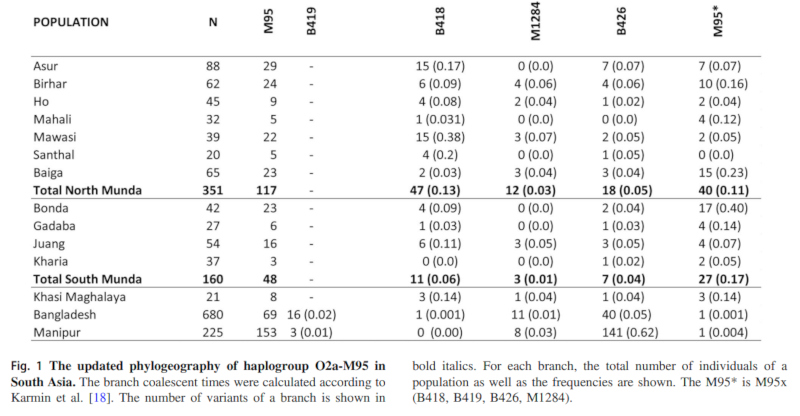
I’m pretty sure I posted this Chaubey lab work as a preprint, but it’s now a published paper. For those who can’t understand the table, it illustrates a big difference between Tibeto-Burmans and Munda. The samples from Bangladesh look to be generic Bangladeshis, the 10% frequency for O2a seems to match the other data I’ve seen for East Bengalis.

This confirms that the East Asian admixture into Bengalis was not Munda. And, the Tibeto-Burmans of the nTibeortheast have no assimilated Munda ancestry. I think it does lend more credence to the idea that the Munda arrived in the Indian subcontinent across the Bay of Bengal, landing in Odisha, rather than from the northeast.

Open Thread – 10/17/2020

The thread is open. Three new podcasts this week in case you aren’t subscribed. Sometimes I get overwhelmed with things and I just can’t be bothere with detailed show notes.

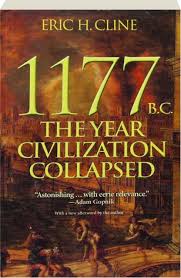
As I mentioned before I’m recording interviews for a new podcast I’m starting up separate from the others I run. I’m just throwing them on Patreon for now. Today I recorded an interview with the author of 1177 B.C.: The Year Civilization Collapsed. Looking at the tracks…he’s a very good talker!

I really recommend the book, it’s pretty well written. He also talks about his follow-up book, in terms of when we can expect and what it’s about.

Also, I may start trashing stupid comments now and then. Just to keep you guys “honest.”

The rise of Indicus!

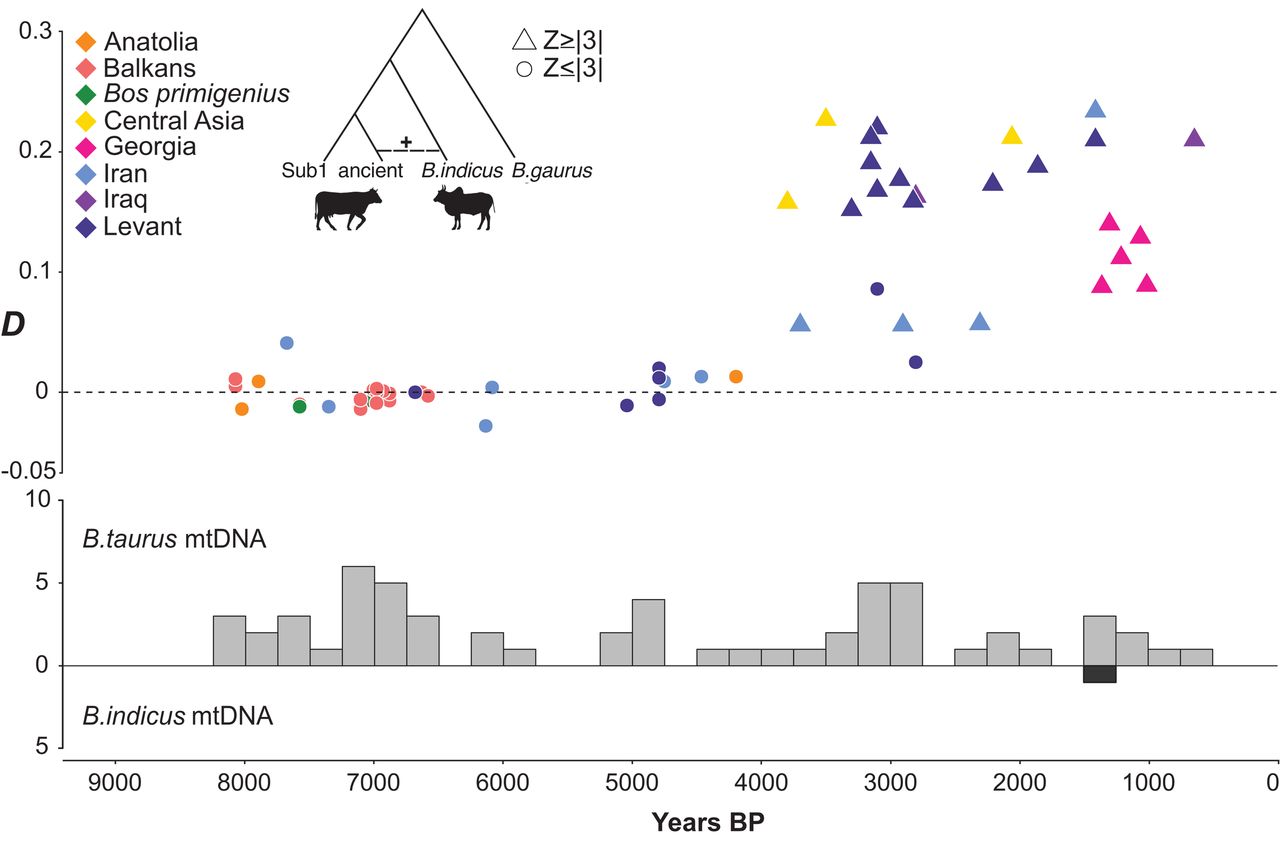
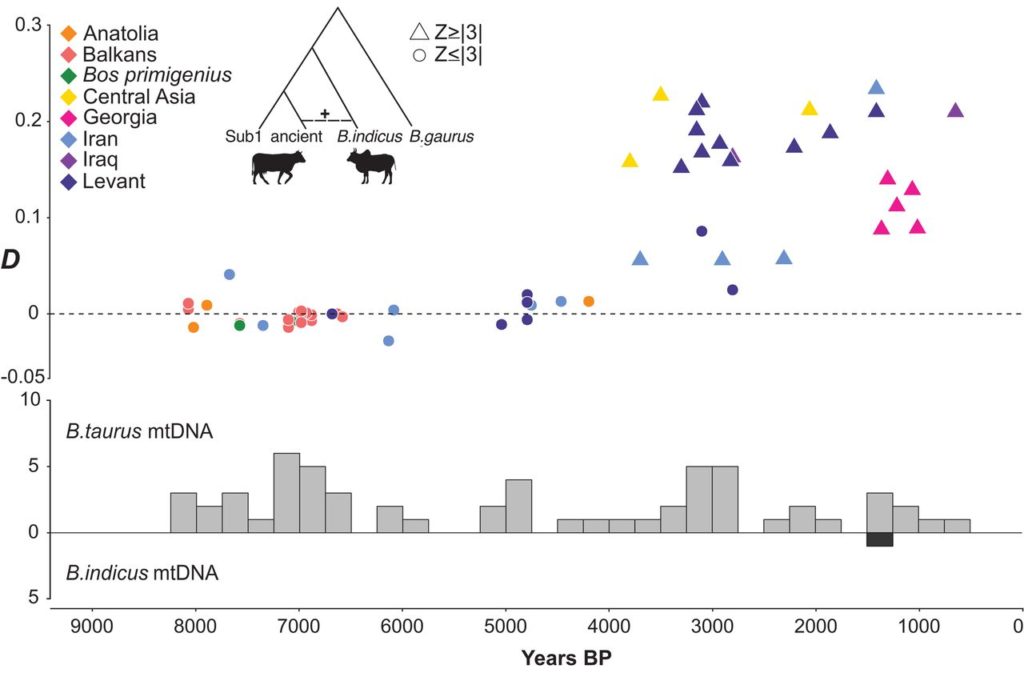
A few years ago an ancient DNA paper on cattle was published, Ancient cattle genomics, origins, and rapid turnover in the Fertile Crescent. It’s a pretty good paper with interesting results. The paper confirmed pretty strikingly that there was a punctuated and massive expansion of indicus ancestry across the Near East between 3,500 and 4,000 years ago.

The interesting aspect of cattle is that there are really two species that intermix. Using mtDNA researchers estimate indicus and taurus diverged 300,000 to 2,000,000 years ago. But the main thing you have to remember is cattle generations are about 20% as long as human generations. So 300,000 cattle years are equivalent to 1.5 million human years. And, for technical reasons (smaller effective population size) one should probably assume mtDNA underestimates the divergence.
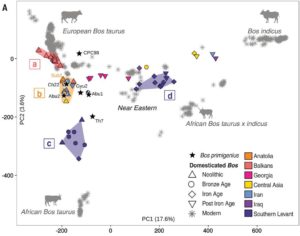
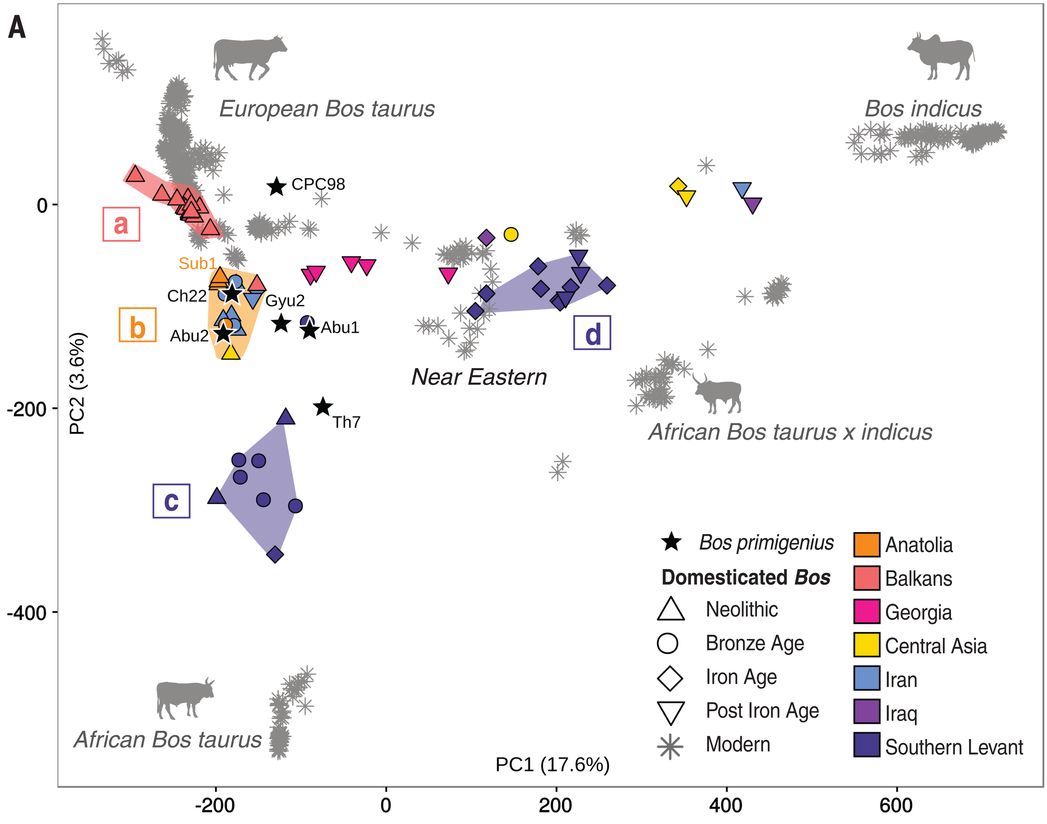
Ancient cattle from the Near East are all taurus. The PCA plot shows that most of the variance is on PC 1 which separates indicus and taurus (a secondary dimension is PC 2, between African and Near Eastern/European lineages). The figure at the top of this post shows that there is a massive jump in genome-wide indicus ancestry across the Near East between 2000 and 1500 BC. As the authors note this can’t be diffusion; the jump is too sudden and sweeping.

So what happened during this period? As noted in the paper: Bronze Age civilization almost collapsed around ~2000 BC. More concretely, after 2000 BC is when we see evidence of Indo-Europeans in the Near East. The Indo-Aryan Mittani show up in Mesopotamia in ~1600 BC. The Indo-European Hittites, the Nesa, are known from Anatolia a bit earlier.

This is also the period that small, but detectable, levels of “steppe” ancestry show up in some ancient samples.

Before this paper, I would have leaned to the position that the Mittani Indo-Aryans migrated directly from the Sintashta homeland without much contact with Indian Indo-Aryans. These data are too suggestive of a widespread zone of expanding agro-pastoralists that existed between western South Asia and the Near East between 2000 BC and 1500 BC.

One of the things we know from the barbarian period during the Fall of Rome is that barbarian groups had strong channels of information flow. For example, a group of Saxons arrived with the Lombards in Italy in the second half of the 6th century. But, through various channels, these Saxon warriors learned that their co-ethnics had established dominance in what was to become England, and there are texts which allude to the reality that they decamped and crossed the Alps, presumably on the way to what was going to be England. The point here is that there was a “Saxon international.”

Aside from the Mittani the evidence of Indo-Aryans in the Near East is tenuous, though some of the Kassites of Babylonia may have had Indo-European affinities. There is not nearly as strong a genetic imprint of steppe in the Fertile Crescent as in Northwest India. The Hittites were very different from Indo-Aryans, who seem to have the closest relationship to the Slavic language family.

The indicus breed is adapted to tropical dry climates. It seems plausible that the Indo-Aryan international facilitated the spread of this breed in the centuries before 1500 BC.

Their Muslim Problem—And Ours


Every now and then there is a controversy on Indian-Twitter which bleeds over into my timeline that I have to notice.

Some quick observations:

– There are those who lambast the critics of this ad. Many of the critics are low-IQ vulgarians. So the criticism is not without foundation. But, most of the responses dodge the gendered nature of the objection. The fact is that in Islam it is understood that Muslim men can marry non-Muslim women. It is also tolerated for Christians and Jews to retain their religion after marriage. The children are considered Muslim. This practice in a patriarchal society was seen as a boon to the Islamic nation.

The advertisement plays into this Islamic trope. The converse of this is that most interpretations of sharia ban the marriage of Muslim women to non-Muslim men. Again, the rationale for this is straightforward: the children inherit the religion of the father, and therefore the children are lost to Islam. If the supporters of the beauty of the advertisement of interfaith marriage believe in this custom, then they should support more speech. In particular, they should support an advertisement where a Hindu man marries a Muslim woman in a Hindu ceremony to show that there is nothing wrong with this act so long as the people consent freely.

Continue reading Their Muslim Problem—And Ours

Climate change is a development problem

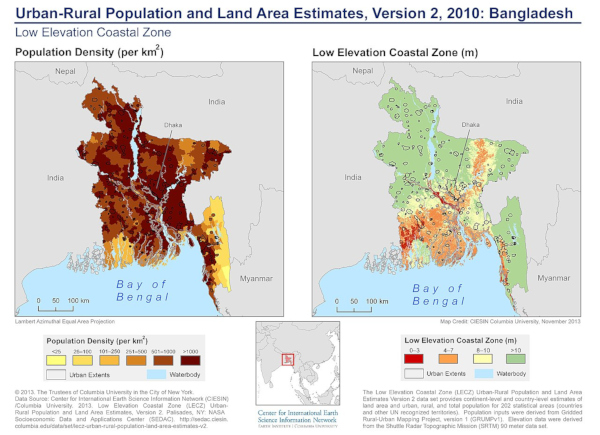
In the comments below there is some mention of the problems that Bangladesh will face due to increases in global sea level. The hypothesis is that there will be a mass migration to India as Bangladeshis flee low-level zones which are going to be inundated. I don’t think this is capturing the real issue: if millions of Bangladeshis are still subsistence farmers on marginal maritime zones then there has been a massive development failure.

Even extreme sea-level scenarios by 2100 posit a 2.5-meter rise, which means only a small proportion of the territory of Bangladesh would be inundated. If by 2100 Bangladesh is not a predominantly urban society after 80 years of economic development from 2020, there are much deeper structural problems to deal with than climate change.

Development and wealth change the downsides of risk a great deal. The 1970 Bhola cyclone caused hundreds of thousands of deaths. Something that is unlikely to be replicated in the region for various reasons (e.g., information technology and coordination are far better!).

I’ve been paying attention to climate change since the late 1980s. As someone whose family is from Bangladesh I have been very worried…my image in 1990 was of peasants fleeing inundated paddies. But things have changed a great deal. In 2020 nearly 40 percent of Bangladeshis live in cities. By 2100 a substantial majority should…

Beyond the Bangladeshi basket-case

Coronavirus has been an economic disaster all across South Asia. But, beyond that, there are changes that have occurred before the pandemic and will continue after. For example, Bangladesh’s per capita GDP now higher than eastern and northeastern India:

Bangladesh’s per capita gross domestic product (GDP) is now higher than most Indian states in eastern and northeastern India, with the exception of small hill states such as Mizoram and Sikkim. According to the data from the International Monetary Fund (IMF), Bangladesh’s per capita GDP was $1,905 in 2019, against West Bengal’s $1,566 in 2018-19 (FY19) — economically the most developed state in eastern India.

Bangladesh is not really comparable to India, which is a diversified economy that is more than an order of magnitude larger. But, it is comparable to West Bengal. On economic matters, I am broadly sympathetic to right-liberal economics, so I’ll spare you my interpretation of what’s going on.

Noakhali rape victim video

Bangladesh: Protests Erupt Over Rape Case:

Protests in Bangladesh erupted this week after a video of a group of men attacking, stripping, and sexually assaulting a woman went viral, Human Rights Watch said today. Protesters called for the resignation of Home Minister Asaduzzaman Khan Kamal over the government’s failure to address an alarming rise in sexual violence against women and girls.

Noakhali Gang Rape Victim: Delwar raped her several times before:

Our Noakhali correspondent’s personal office is in a computer market in Maizdee Old Bus Stand area. Over the last two days he has witnessed how the video spread over the whole market. It was played and replayed in public on computer screens as everyone crowded to perceive first-hand the horror inflicted on the woman.

“Bhaiya, do you have the video? I had it but it got deleted… I wanted to show it to someone,” said a computer businessman, approaching our correspondent, who declined to entertain the request.

Snippets of conversation overheard on the street also attest to how widespread the video has become. Two elderly men out on their evening stroll complained to each other, “The video keeps popping up on my mobile phone. This is so awkward, especially in front of the wife and kids…”

So perhaps a naive question: why are people sharing this video??? Every few years I hear about a gang-rape video coming out of MENA and South Asia, spreading virally. Why do people want to see this? It’s like sharing a video of a murder..

Open Thread – 10/10/2020

Some cool podcasts will be posted soon. Already posted two on the Patron page, including a very cool one where Mukunda and Jahanarra talk to Michael Fortner. A professor at CUNY, Fortner is the author of Black Silent Majority: The Rockefeller Drug Laws and the Politics of Punishment.

I’ve also posted a podcast with Devang Mehta on what’s wrong with science, and how to fix it (also, some advice for Indians who might want to get into the world of Western academic science).

Also, I will probably post a few previews of a new podcast I’m starting (solo) for patrons. This is going to be part of my new substack newsletter. This weekend I’ll be talking to an old friend from grad school who snapped and turned against wokism last week (he was involved with BLM since 2015, and I just got off the phone with him and he told me things he’s seen in BLM up until this summer left him very jaded, suspicious, and skeptical).

China, strong government, free society, India, weak government, strong society

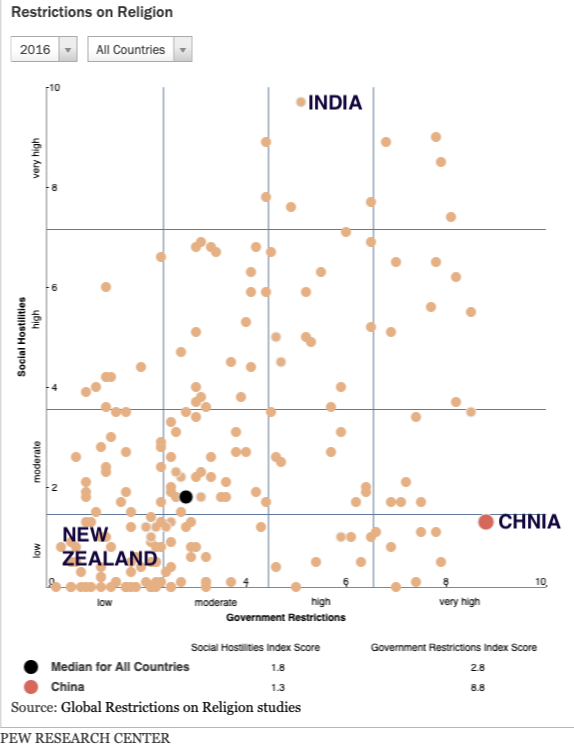
In our discussion on the podcast, Abhinav talked about China and India in relation to society vs. government. I stumbled on this chart from Pew that illustrates it.

China’s government controls religion much more than India’s government. But on a personal level, the Chinese have much more freedom in their religious identity. Indians are simply not equipped to understand how religion does not have corporate power as an identity in the same way in East Asia, which means the stakes for individual religious experimentation are far lower.

Brown Pundits