
Category: Uncategorized
Vivek Ramaswamy and Hinduism
Vivek Ramaswamy Leans Into His Hindu Faith to Court Christian Voters:
Swami Vivekananda, who represented Hinduism at the Parliament of the World’s Religions in Chicago in 1893, took pains to depict his faith as monotheistic, in contrast to the stereotypes of its followers as “heathen” polytheists. Although the faith has many deities, they are generally subordinate to one ultimate “reality.” Many Hindus and scholars say its theology is too complex to be described as either wholly monotheistic or wholly polytheistic.
“The polytheism hurdle is the first thing that has to be addressed” for many American Christian audiences, Mr. Altman said. He sees Mr. Ramaswamy’s pitch against “wokeism” as a way to counter stereotypes associating Hinduism with hippies, yoga and vegetarianism.
Ren Mukherjee on affirmation action’s end
I recorded this interview a while back, but we just assumed the case would go down as it did, so it’s totally relevant…
Also, episode #2 of the IBW: Muslims vs. LGBTQIA+.
People of lower castes have bad personalities
Making the Elite: Top Jobs, Disparities, and Solutions:
How do socioeconomically unequal screening practices impact access to elite firms and what policies might reduce inequality? Using personnel data from elite U.S. and European multinational corporations recruiting from an elite Indian college, I show that caste disparities in hiring do not arise in many job search stages, including: applications, application reading, written aptitude tests, large group debates that assess socio-emotional skills, and job choices. Rather, disparities arise in the final round, comprising non-technical personal interviews that screen on family background, neighborhood, and “cultural fit.” These characteristics are plausibly weakly correlated with productivity (at the interview round) but strongly correlated with caste. Employer willingness to pay for an advantaged caste is as large as that for a full standard deviation increase in college GPA. A hiring subsidy that eliminates the caste penalty would be more cost-effective in diversifying elite hiring than equalizing the caste distribution of pre-college test scores or enforcing hiring quotas.
No big surprise.
Open Thread – 06/14/2023 – Brown Pundits
More Sikhs in Canada than India proportionally
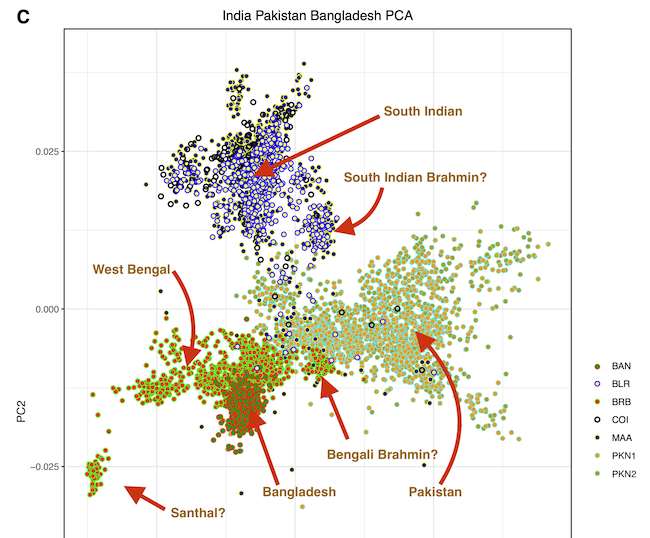
Population structure in South Asian – Genomes Asian 1K paper
The full version of this paper is out, South Asian medical cohorts reveal strong founder effects and high rates of homozygosity. It’s not the best for understanding population structure because they focus on within South Asia variation, but it does seem to confirm that among Bengalis there is a cline from west to east, irrespective of religion (see the discussion where they note that Muslims in the west cluster with westerners). I found a PCA in the supplements where I added some explanatory notes. It’s really hard to parse their figures because they really didn’t care, and the Genomes Asia Consortium doesn’t release their data… (their browser sucks)
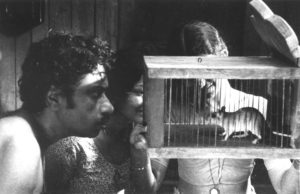
History and Evolution of Malayalam Cinema
Arun talks to Maneesh on the history and evolution of Malayalam cinema.
What makes Malayalam cinema different from Tamil and Telegu cinema, the influence of communism on its early years and how the OTT phenomenon is helping a generation of film makers take Malayalam cinema to a new audience.
1IndiI. A Hindu Business Line article, which, while trying to explain why South Indian cinema has box office muscle also shows an excellent visualisation that explains the limitation of Kerala’s screen real estate
2. An Economic times article lamenting the lopsided economics of Malayalam cinema
3. Whitepaper from Kannur University talking about the conscious role of Communism in shaping Malayalam cinema
4. Screenwriter Joh Paul talks about the environment of early Malayalam cinema of the 50s
Modinomics: Why India is Rising
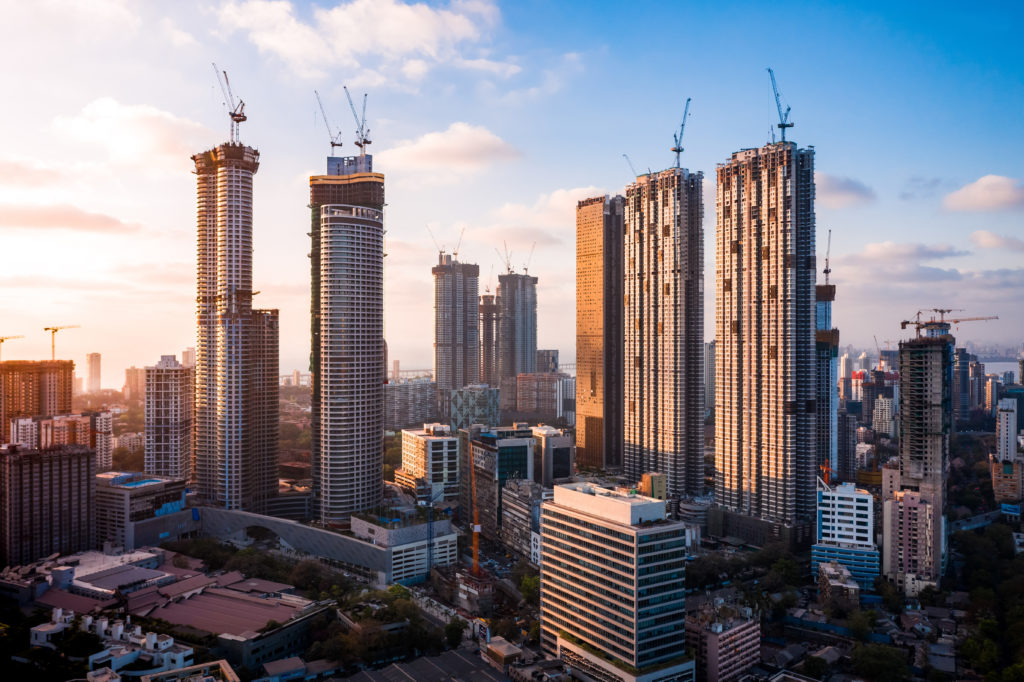
India is changing. For years the BJP has been banging drums, tolling bells, and blowing conches to signal a New India. A mammoth mandate in 2019 was an early smoke signal for the fire that had erupted in the Indian market, but now a flurry of foreign praise answers the call of the drums, bells, and conches previously labeled as empty and enemy propaganda. Ironically, the newly found foreign admirers just a few years back cried wolf as they predicted India to turn into a hellscape due to what they saw as economic mismanagement, not listening to “experts,” religious tensions, some random picture they saw on the internet, or any other reason a comprador elite would pass on from the home country. What changed?
There are plenty of articles about India’s rise, but very few about why. The reason for this is that they would have to associate with someone untouchable in their ivory towers. The government primarily responsible for this rise is not only the arch-nemesis of the narrators of India to the West but also has a terribly difficult time presenting their case in a manner that doesn’t involve frothing at the mouth. There have been many mistakes made along the way. There are many critiques worth their weight. But one has to start acknowledging that something special is occurring in India. Let’s explore why.
On Centenarian Kissinger
Author’s Note: This is not an academic or objective essay; rather a personalised opinion on the soon-to-be centenarian former secretary of state.
On one occasion, a joke was made on television about how Fidel Castro survived attempts to have him removed by US presidents as well as the downfall of USSR, who served as his main supporter. In 2023, a soon-to-be centenarian Dr. Henry Kissinger would be grinning and telling Castro’s soul to, as they say, “Hold his beer.” If the AI generator were asked to picturise “American foreign policy”, it would not be shocking if Henry Kissinger’s portrait or painting appeared.
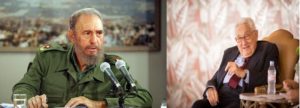
For decades, he was open and honest about his opinions on American foreign policy based on the pursuit of both national interest and power. In his own words: “A country that demands moral perfection of itself as a test of its foreign policy will achieve neither perfection nor security.” Kissinger has proven to be rich ground for historians and publishers. Along with business books about him as a deal-maker, there are also personality studies, tell-alls from former coworkers, and collections of his quotes.
Simultaneously, Kissinger had long been criticised by many as a ruthless realist. The critics would often quote Kissinger’s own words “when policy becomes excessively moralistic it may turn quixotic or dangerous”. Those words don’t seem all that offensive in retrospect after seeing so-called American moralist decisions made in places like Libya, Syria, Iraq, and Afghanistan. The critics would respond by citing Bangladesh and Chile as examples of how Kissinger was no better.
Weimar-Chile Connection
For the last few years, Kissinger seems to no longer arouse widespread contempt. Instead, some individuals have since expressed some sympathy for him, tying Kissinger’s ruthlessness to his status as a former resident of Weimar Germany. Born Heinz Kissinger on May 27, 1923, to an Orthodox Jewish school teacher in Fürth, Bavaria. In 1938, shortly before Kristallnacht, Kissinger and his family escaped to America, as did several German Jewish families. Continue reading On Centenarian Kissinger