
Every few years, India loses a cricket match to Pakistan and some Indian Muslims celebrate the victory (most openly and aggressively in Srinagar, but it can also happen to a small extent in Muslim localities elsewhere)
A Glance at the AIT, OIT, Rig Veda..

I am neither a scholar of the Vedas, nor a learned Hindu, so this is not an expert view or an insider’s view. These are impressions; I mean to learn, not to teach. Perhaps we can learn some things together, so please add comments, criticisms and links to articles.
The Vedas are among the oldest extant books in the world and there are four of them. The Rig Veda is the oldest of the four and can be said to be the most important (the other three are in some ways derivative, consisting in large part of rearrangements, commentaries and instructions regarding the proper interpretation and usage of the Rig Veda). It was composed (at least in its final form) in the Northwest of India in the region known as Sapta Sindhu, the land of the seven rivers (for the most part, what is now Pakistani and Indian Punjab) but it almost certainly includes older layers that refer to events, experiences, beliefs and Gods that date from times and places before the Indo-European migrants arrived in India.
One of the earliest Indo-European sacred books has been preserved with great care and fidelity and remains available to us today. This book is the Rig Veda (there are 3 other Vedas which are more or less derivatives or appendages of the Rig Veda). The original Sanskrit text is available to us today, but is of course not accessible for me. I have to rely on translations; translations have been made into several European languages, beginning in the 19th century (Schopenhauer thought the availability of a window into these ancient texts to Europeans should count as the greatest advantage of the 19th century over past centuries!). An English translation by British Indologist Ralph Griffith (who lived most of his life in India, was the principal of Benares college in the Hindu holy city of Benares, and is buried in South India) is available online in its entirety at this site: http://www.sacred-texts.com/hin/rigveda/index.htmand . A more recent and scholarly translation is now available but is very expensive. I read a more or less random selection of these hymns. My initial impressions follow. I look forward to reading more, and to suggestions for the same.
The Rig Veda consists of 10 books or Mandalas, of varying length. These hymns give us a window (and probably the most complete and most ancient window we have) into the Indo-European world that played such a huge role in the creation of the present cultures of much of Eurasia..their heroic age, so to speak.
In the original Sanskrit, the hymns are arranged in stanzas and follow particular rules of rhyme and meter (hear a sample at the end of this review). They are meant to be sung in particular religious rituals, mostly sacrifices to the Gods. The ten books were not all composed at the same time, or by the same authors and there are differences in style and subject. The tenth book in particular is different from the others and is more didactic and philosophical and is thought to be the last to be composed (and was composed by persons well acquainted with the earlier books). There are three hymns about creation in the tenth book and one of them has a certain skeptical and questioning tone that has made it the best known piece from the Rig Veda, frequently anthologized and quoted. I am reproducing it in full here, but also adding the two others that follow it, to give a more complete flavor of the original context:
HYMN CXXIX. Creation
THEN was not non-existent nor existent: there was no realm of air, no sky beyond it.
What covered in, and where? and what gave shelter? Was water there, unfathomed depth of water?
2 Death was not then, nor was there aught immortal: no sign was there, the day’s and night’s divider.
That One Thing, breathless, breathed by its own nature: apart from it was nothing whatsoever.
3 Darkness there was: at first concealed in darkness this All was indiscriminated chaos.
All that existed then was void and form less: by the great power of Warmth was born that Unit.
4 Thereafter rose Desire in the beginning, Desire, the primal seed and germ of Spirit.
Sages who searched with their heart’s thought discovered the existent’s kinship in the non-existent.
5 Transversely was their severing line extended: what was above it then, and what below it?
There were begetters, there were mighty forces, free action here and energy up yonder
6 Who verily knows and who can here declare it, whence it was born and whence comes this creation?
The Gods are later than this world’s production. Who knows then whence it first came into being?
7 He, the first origin of this creation, whether he formed it all or did not form it,
Whose eye controls this world in highest heaven, he verily knows it, or perhaps he knows not.
HYMN CXXX. Creation.
THE sacrifice drawn out with threads on every side, stretched by a hundred sacred ministers and one,
This do these Fathers weave who hitherward are come: they sit beside the warp and cry, Weave forth, weave back.
2 The Man extends it and the Man unbinds it: even to this vault of heaven hath he outspun, it.
These pegs are fastened to the seat of worship: they made the Sāma-hymns their weaving shuttles.
3 What were the rule, the order and the model? What were the wooden fender and the butter?
What were the hymn, the chant, the recitation, when to the God all Deities paid worship?
4 Closely was Gāyatrī conjoined with Agni, and closely Savitar combined with Usnih.
Brilliant with Ukthas, Soma joined Anustup: Bṛhaspati’s voice by Brhati was aided.
5 Virāj adhered to Varuṇa and Mitra: here Triṣṭup day by day was Indra’s portion.
Jagatī entered all the Gods together: so by this knowledge men were raised to Ṛṣis.
6 So by this knowledge men were raised to Ṛṣis, when ancient sacrifice sprang up, our Fathers.
With the mind’s eye I think that I behold them who first performed this sacrificial worship.
7 They who were versed in ritual and metre, in hymns and rules, were the Seven Godlike Ṛṣis.
Viewing the path of those of old, the sages have taken up the reins like chariot-drivers.
HYMN CXC. Creation.
FROM Fervour kindled to its height Eternal Law and Truth were born:
Thence was the Night produced, and thence the billowy flood of sea arose.
2 From that same billowy flood of sea the Year was afterwards produced,
Ordainer of the days nights, Lord over all who close the eye.
3 Dhātar, the great Creator, then formed in due order Sun and Moon.
He formed in order Heaven and Earth, the regions of the air, and light.
The hymns of the ten books (as long in total as the poems of Homer) tell of a people who worship many Gods, with a few being mentioned very frequently, including Agni, Indra, Varuna and Soma. The hymns speak repeatedly of great warriors, with “beauteous horses and of kine, In thousands”, who indulge in lots of soma drinking and fort-breaking.. These warriors hoped to win ” wealth, renowned and ample, in brave sons, troops of slaves, far-famed for horses”. They also had priests who wanted the warriors to be generous with gifts (including mead). And they gambled, and got into trouble because of it:
The following hymn is fascinating, but also a rarity in being unusually didactic:
HYMN XXXIV. Dice, Etc.
“1. SPRUNG from tall trees on windy heights, these rollers transport me as they turn upon the table.
Dearer to me the die that never slumbers than the deep draught of Mujavan’s own Soma.
2 She never vexed me nor was angry with me, but to my friends and me was ever gracious.
For the die’s sake, whose single point is final, mine own devoted wife I alienated.
3 My wife holds me aloof, her mother hates me: the wretched man finds none to give him comfort.
As of a costly horse grown old and feeble, I find not any profit of the gamester.
4 Others caress the wife of him whose riches the die hath coveted, that rapid courser:
Of him speak father, mother, brothers saying, We know him not: bind him and take him with you.
5 When I resolve to play with these no longer, my friends depart from me and leave me lonely.
When the brown dice, thrown on the board, have rattled, like a fond girl I seek the place of meeting.
6 The gamester seeks the gambling-house, and wonders, his body all afire, Shall I be lucky?
Still do the dice extend his eager longing, staking his gains against his adversary.
7 Dice, verily, are armed with goads and driving-hooks, deceiving and tormenting, causing grievous woe.
They give frail gifts and then destroy the man who wins, thickly anointed with the player’s fairest good.
8 Merrily sports their troop, the three-and-fifty, like Savitar the God whose ways are faithful.
They bend not even to the mighty’s anger: the King himself pays homage and reveres them.
9 Downward they roll, and then spring quickly upward, and, handless, force the man with hands to serve them.
Cast on the board, like lumps of magic charcoal, though cold themselves they burn the heart to ashes.
10 The gambler’s wife is left forlorn and wretched: the mother mourns the son who wanders homeless.
In constant fear, in debt, and seeking riches, he goes by night unto the home of others.
11 Sad is the gambler when he sees a matron, another’s wife, and his well-ordered dwelling.
He yokes the brown steeds in the early morning, and when the fire is cold sinks down an outcast.
12 To the great captain of your mighty army, who hath become the host’s imperial leader,
To him I show my ten extended fingers: I speak the truth. No wealth am I withholding.
13 Play not with dice: no, cultivate thy corn-land. Enjoy the gain, and deem that wealth sufficient.
There are thy cattle there thy wife, O gambler. So this good Savitar himself hath told me.
14 Make me your friend: show us some little mercy. Assail us not with your terrific fierceness.
Appeased be your malignity and anger, and let the brown dice snare some other captive.”
There are also occasionally names of rivers, astronomical observations, names of animals and plants that may point to where the composers were living and what was going on around them. …One thing is clear, a lot of fighting was going on. So naturally, there are hymns to weapons, including this one which not only mentions bows and arrows, but also the coiled arm-guard that would protect an archer from the friction of the bowstring:
From Book 6 HYMN LXXV. Weapons of War
He lays his blows upon their backs, he deals his blows upon their thighs.
Thou, Whip, who urgest horses, drive sagacious horses in the fray.
14 It compasses the arm with serpent windings, fending away the friction of the bowstring:
So may the Brace, well-skilled in all its duties, guard manfully the man from every quarter.
15 Now to the Shaft with venom smeared, tipped with deer-horn, with iron mouth,
Celestial, of Parjanya’s seed, be this great adoration paid.
16 Loosed from the Bowstring fly away, thou Arrow, sharpened by our prayer.
Go to the foemen, strike them home, and let not one be left alive.
17 There where the flights of Arrows fall like boys whose locks are yet unshorn.
Even there may Brahmaṇaspati, and Aditi protect us well, protect us well through all our days.
18 Thy vital parts I cover with thine Armour: with immortality King Soma clothe thee.
Varuṇa give thee what is more than ample, and in thy triumph may the Gods be joyful.
19 Whoso would kill us, whether he be a strange foe or one of us,
Book 9 is unique in being entirely devoted one diety: Soma. The identity of Soma remains disputed to this day, but it was clearly the juice of a plant and was much admired for its ability to give vigor in battle and clarity in thought. The following extracts give a flavor of these hymns:
HYMN XXIII. Soma Pavamana.
1. SWIFT Soma drops have been effused in streams of meath, the gladdening drink,
For sacred lore of every kind.
2 Hither to newer. resting-place the ancient Living Ones are come.
They made the Sun that he might shine.
3 O Pavamana, bring to us the unsacrificing foeman’s wealth,
And give us food with progeny.
4 The living Somas being cleansed diffuse exhilarating drink,
Turned to the vat which drips with meath.
5 Soma gows on intelligent, possessing sap and mighty strength,
Brave Hero who repels the curse.
6 For Indra, Soma! thou art cleansed, a feast-companion for the Gods:
1ndu, thou fain wilt win us strength
7 When he had drunken draughts of this, Indra smote down resistless foes:
Yea, smote them, and shall smite them still.
From HYMN XXX. Soma Pavamana.
Pour on us, Soma, with thy stream manconquering might which many crave,
Accompanied with hero sons.
4 Hither hath Pavamana flowed, Soma flowed hither in a stream,
To settle in the vats of wood.
5 To waters with the stones they drive thee tawny-hued, most rich in sweets,
O Indu, to be Indra’s drink.
6 For Indra, for the Thunderer press the Soma very rich in sweets,
Lovely, inspiriting, for strength.
With a little effort, you can imagine an HBO series about these people (and it would be worth watching).
The underlying philosophy is pagan and heroic and may not strike many of us as particularly deep, though I guess that someone like Christopher Beckwith (who writes about central Asian history with great feeling) would say this IS a deep philosophy, even an attractive one.
And of course these are, after all, hymns that are meant to be recited. Their very sound is supposed to have quasi-magical properties. Their addressees are higher beings who can bestow favors or withdraw them. This level of usefulness is meaningless to a modern secular person, but even a modern secularized Hindu may feel the recitation creates a psychological connection to his or her people, to their language and sounds, and to their traditions and community values. .. Just like reciting the Quran and hearing it being recited provides some psychosocial connection/rootedness/whatever to an Arab (or a wannabe Arab for that matter) and (magical or placebo) benefits to the true believer.
All of which is not without consequences.
It seems to me that Shinto and Japanese cultural traditions may be a good example of what a successful and relatively intact pagan religion of this type might look like today. Modern Hinduism may be too much of a “wounded civilization” to be a good model of what the original Indo-European religion could have evolved into…the ways of the ancients are now buried under centuries of dust, reinvention, editing, myth-making, mixing and plain old monotheist beating-down. But who knows, those wandering warrior pagans may have their day again..
The closing hymn of book 10: HYMN CXCI. Agni.
1. THOU, mighty Agni, gatherest up all that is precious for thy friend.
Bring us all treasures as thou art enkindled in libation’s place
2 Assemble, speak together: let your minds be all of one accord,
As ancient Gods unanimous sit down to their appointed share.
3 The place is common, common the assembly, common the mind, so be their thought united.
A common purpose do I lay before you, and worship with your general oblation.
4 One and the same be your resolve, and be your minds of one accord.
United be the thoughts of all that all may happily agree.
All in all, worth downloading on Kindle for free.
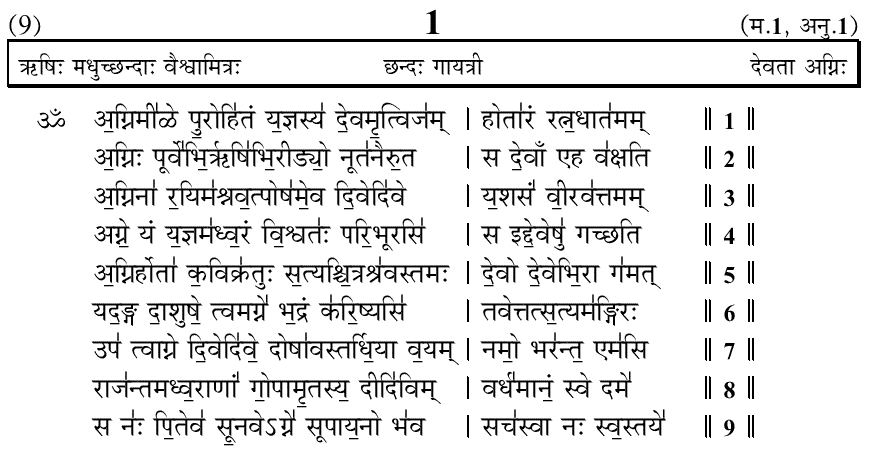
What it sounds like..
And looks like when written (which was actively discouraged for a very long time; it was supposed to be recited and memorized, not written down)
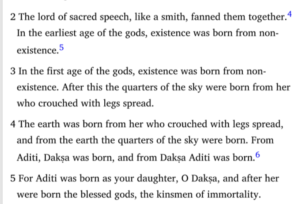
1. LET US with tuneful skill proclaim these generations of the Gods,
That one may see them when these hymns are chanted in a future age.
2 These Brahmaṇaspati produced with blast and smelting, like a Smith,
Existence, in an earlier age of Gods, from Non-existence sprang.
3 Existence, in the earliest age of Gods, from Non-existence sprang.
Thereafter were the regions born. This sprang from the Productive Power.
4 Earth sprang from the Productive Power the regions from the earth were born.
Dakṣa was born of Aditi, and Aditi was Dakṣa’s Child.
5 For Aditi, O Dakṣa, she who is thy Daughter, was brought forth.
After her were the blessed Gods born sharers of immortal life.
6 When ye, O Gods, in yonder deep closeclasping one another stood,
Thence, as of dancers, from your feet a thickening cloud of dust arose.
7 When, O ye Gods, like Yatis, ye caused all existing things to grow,
Then ye brought Sūrya forward who was lying hidden in the sea.
8 Eight are the Sons of Adid who from her body sprang to life.
With seven she went to meet the Gods she cast Martanda far away.
9 So with her Seven Sons Aditi went forth to meet the earlier age.
She brought Martanda thitherward to spring to life and die again.
Doniger version
Islamist Terrorism versus Western Civ. Some Random Thoughts
The latest Islamist-terrorist atrocity hit the city of Brussels. The attackers no doubt think they are about to meet their 72 virgins. I have nothing new to say about this, but am posting excerpts from two previous posts (one written after the Paris attacks, the second after the San Bernadino attack) that may shed some light on SOME of the cultural and religious issues in this war. I do want to add that I while I think cultural issues are critical in the long run, they matter far less in the short term than policing, spying, arrests and retaliation. Wars tend to do that: they concentrate matters and short term immediate action is what counts most. Intellectuals who specialize in history and philosophy may matter more in the long term, but once war has begun, it’s “action this day”. This distinction is not news, but it does sometimes get lost.
And I would add that I do not believe the “Eurabia” BS either. Even Sweden will not become Muslim. Muslims will assimilate into Europe, or will face fascism, expulsion and worse. And I will go out on a limb and even predict that England will neither become Islamic, nor resort to naked fascism (it has a culture strong enough to survive/avoid both). Maybe this is true of most European countries. We will see. But the “Eurabia” paranoia is just slightly less silly than the Islamicate dream of an Islamicized Europe.
The following post is an unedited mishmash at places, but you will get the point.
- Is ISIS Islamic?
Short Answer: Yes
For a “secular observer”, this is a no-brainer. The secular (and even more so, religious) outsider obviously does not believe in any particular version of Islam as the one true faith, etc etc. To them, Islam is (or should be) whatever any Muslim claims as his religion (this obviously means that for any such observer there is no one Islam, there are many Islams). To such an observer (if he or she is well-informed), Islam is a religion that started in Arabia, took up very notable strands from Rome (aka Byzantium), Persia, Judaism, etc and evolved into many different schools and sects. An exceptionally well-informed observer could indeed comment that ISIS does not replicate the dominant Sunni theology of the Ummayads or the Abbasids and has more in common with the relatively small Kharijite tradition, but even so, it would be the height of “Whitesplaining” for, say, professor Juan Cole to step in and deign to tell Syrian and Iraqi Muslims in ISIS that they are doing it wrong and their Islam is not “real Islam”. The appropriate answer (and this is exactly the answer many different Jihadist groups have given) is “WE know what Islam is and you dont have to come down from Michigan to tell us what our religion should look like”. To sum up: well-informed outsiders can indeed note that ISIS is more like this, less like that; not representative of ALL Muslims (who is?), not representative of all Muslim states, not typical of all Islamist movements, etc. But for Bush or Blair to announce that ISIS is not really Islamic carries no weight. Islamic is what Islamists think is Islamic. THEY disagree among themselves, giving rise to many different Islams, Some represent bigger groups and larger sects, some are small cults, but all are Islamic.
For the believing Muslim, the answer depends on what sect/group/tendency they believe in. If their sect/tendency regards extremely vicious and extremely literalist Islamists as unislamic, more power to them. But some of them do indeed regard ISIS as Islamic (as is obvious from the thousands of Muslims (including neo-converts) who have flocked to the banner of ISIS in recent years. Others regard them as mostly Islamic, but occasionally doing things that a good Muslim would not do. This group is not trivial in numbers. Finally, countless others hold no firm opinion, but waiver between admiration of some acts and total opposition to others. Humans have complicated loyalties and psychologies. Would it surprise anyone (or at least, anyone not educated in the current Western postmodern left-liberal “tradition”) that a Palestinian or a Turk or a Pakistani may hold internally contradictory views on ISIS; sometimes admiring their deep faith and readiness to fight for Islam, even against overwhelming odds, other times cursing them for their cruelties, and last but not least, at other times worrying about what ISIS’ actions may do to his or her job prospects, visa status or college prospects. We are all human.
My own view: ALL of Islamic history is characterized by a struggle between three political-theolgoical camps that all appeared fairly early in the rise of the Arab empire and the Islamic religion (the two, empire and religion were obviously intertwined and interdependent):
- Sunnis. Those who thought the rising Arab empire was best led by the consensus of the elite, with a tendency to rally around whoever had managed to fight his way to the top, provided he paid lip service to religion, patronized the rising ulama class and (most important) kept his eyes on the ball as far as managing and growing the empire was concerned. While Sunni clerics developed what seems to be a theory of politics (who is a just ruler? who has the right to rule? what do the people owe their ruler? etc.) on closer inspection it turns out to be pretty much divorced from actual politics. Rulers and their courts had more in common with past Roman, Persian and Central Asian traditions than anything specifically Islamic. Rulers usually grabbed power by force, then tried to pass it on to their children rather than some ideal “just ruler”. Dynasties rose and fell with little concern for theological rules. No “Muslim church” acquired a tenth of the influence of the Roman Catholic church. This tradition is not ISIS-like in detail, but it also paid lip service to ideals that ISIS can and does fling in the face of “court clerics” who happily go along with whoever happens to be the ruler (from King Hassan to Hussain to Salman..and even Sisi). Sunni tradition is not ISIS, but it trains and teaches children using ideals that ISIS may aspire to more strongly than the Sunni rulers themselves. This hypocrisy-crisis is a recurrent feature of modern Islamicate politics. And it is the reason why “moderate Muslims” (aka mainstream Sunnis) regularly fall prey to “Wahabism”. They are not falling prey to a new religion, they are falling prey to a more distilled and internally consistent version of what they have been taught is indeed their own religion. Classical Sunni ideals overlap with modern Jihadist ideology, their true-believers tend to find Wahabism attractive.
- Shias. Those who felt there was something special about the family of the prophet and in particular, the family of Ali and developed theologies that included varying combinations of the charismatic Imamate and its heritage of revolt against Sunni authority. Since Shias are a majority in only a few places, (most important, Iran) and their history includes long periods of conflict with mainstream Sunni rule, they are more or less immune to the appeal of Sunni revivalists, whether they are the milder Maudoodi types or the harsher ISIS types. They have set up their own theocracy in Iran (much more effectively so than any Sunni revivalist has managed to do) but they are not ISIS. For the purposes of this post (i.e. for outsiders who dont have to live in Iran), they are “objectively liberal”.
- Khwarij.The Khwarij insisted that neither the elite, nor the family of the prophet had a special right to rule. Only the most pious, the most thoroughly “Islamic” person could do that. Muslims who committed major sins or failed to meet their standard of Islamic fervor were as much the enemy as any infidel. Even more so in fact. The Khwarij were always small in number and they were repeatedly defeated by both Shia and Sunni rulers, but their tendency has never completely gone away. Something within Islamic tradition keeps them alive. Mainstream Sunnis frequently pay only lip service to Jihad and the harshest punishments of shariah law (particularly in modern times), but these ideals are present in their theology. This theology that was rarely an impediment to statecraft and its priorities in the actual golden age of Islamic imperium, but it still paid lip service to those ideals. In fact, the more divorced it was from actual politics, the more it could fly off into discussions about the ideal ruler,the ideal law and the ideal Jihad, all un-encumbered by any contact with reality. But ideals can effect some people. True believers arise, and in times of anarchy and state collapse, they may be the lowest common denominator, providing a framework around which the asabiya of Islam can cohere and in which the community can see hope for a return to a commonly-imagined (though mostly imaginary) golden age.
Groups like the Wahabis, Lashkar e Tayaba, the Taliban and ISIS are simply combining the waters of 1 and 3, usually with more 3 than 1. But they are NOT relying on some new ideology invented out of whole cloth by Wahab or some other evil Saudi. They are (in their own mind and in the mind of many idealistic Muslims) simply purifying actually existing Sunnism (with its tendency to compromise with realities).
In fact, even reformers who have some mainstream cred can drink quite a bit from #3 in this age of Western domination (perhaps to be replaced soon with mixed Chinese AND Western domination, but still with no Islamic empire in sight); see Maudoodi, Syed Qutb and others. Not as far from ISIS as you may wish.
Just as an aside: What about Sufism? In many cases Sufis can simply be described as mainstream Sunnis with mystical or humanistic instincts; trying to get the most good out of religion while leaving out most of the imperialist and legalistic baggage. In some cases, they may be more akin to a secret society (like the Freemasons), influencing much from behind the scenes, but by definition, it is not really easy to disentangle myth (and self-promotion) from shadowy reality in this scenario. In other cases, they may think of themselves as the perennial philosophy, operating within Islam as it operates in all true religions. And in some cases, they are hardline Sunni Jihadists with a “master and novice” framework added to it, rallying the troops for holy war and conversion of the infidels. Take your pick. But do remember that Sufism is not really a sect with any single reasonably well-defined theology.
This post is not really qualified to go too deeply into what religion (any religion) may mean (and may do) to those struck by epiphanies on the road to Damascus. That whole issue is alluded to here by the always erudite Tanner Greer. Hopefully, he will have more to say in a longer post soon.
- Does Islamist Terrorism have anything to do with Islam?
In light of the above, one answer would be: of course not. There IS no one thing called Islam. There are many Islams. And most of them are not terrorist. Case closed.
But, again in the light of the above, one may also say that mainstream Sunni Islam is remarkably uniform in its theology and its ideals. The vast majority of the world’s Muslims are Sunnis. Within Sunni Islam, there are four recognized schools of law. In principle, the vast majority of Sunnis honor and respect these schools and their doctors. The vast majority has no idea what is IN those schools or in the writings of their doctors, but they honor them and idealize them. It is very common for educated Muslims to own a book or two of fiqh and hadith. Rarely read, but always honored. A small minority of highly westernized postmodern Muslims believe that those medieval books and their authors are no longer valid for us and Islam (like modern Christianity) is more or less “spiritual” and can (or should) be whatever a believer sincerely thinks it is. Even these postmodern Muslims frequently believe that the Quran is the inerrant, literal word of God, but given that most classical Islamic theology is not lifted straight out of the Quran, they feel they can safely reject aspects of classical theology that are no longer fashionable. That they have usually not read the Quran makes this kind of cherry-picking even easier. But as numerous public opinion polls have repeatedly shown, most Sunni Muslims do not share this postmodern view of their religion. Whatever they may do in practice (and they frequently do exactly what adherents of all other religions are doing in similar econcomic and political circumstances; the much-mentioned “Muslims who just want to have a sandwich and send their kids to good schools”), they do believe that Islam is more than just an identity token. They believe it is “a complete code of life” and if enforced in its true letter and spirit, it holds the possibility of reversing all our communal ills. And what is that letter, if not that spirit? it is the books of Shariah written by medieval Sunni theologians. Books that were composed in the midst of a warlike expanding empire by confident intellectuals of a dominant creed. Books that idealize holy war (not “inner struggle”, Karen Armstrong notwithstanding) and a society where Muslims rule and non-Muslims know their (inferior) place in society. Books that idealize pious rulers and the enforcement of shariah law (stonings and amputations included). Books that idealize martyrdom and war against the infidels. Books that prime some of them to fall for preachers who preach purity and a true Islamic state. Only some of them. But that is enough. A convert from France felt strongly enough about this to sacrifice his own life in a suicide mission that aimed to kill random innocent Frenchmen. Well, not innocent in his eyes any longer.
So yes, classical Sunni Islam tends to prime some people for joining Jihadist organizations (whether ISIS or LET or Islamic Jihad or any other of an alphabet soup of Jihadi groups) and committing atrocities with a good conscience. See the ten young men who went to Mumbai on the first “Mumbai-style attack”; what motivated them to go on that suicide mission? Nothing to do with Islam? I think is hard to say that with a straight face..
Unless you happen to be in the postmodern Western liberal elite, in which case you may suffer from what Tanner Greer calls “the limits of liberal education in the 21st century, far better at teaching platitudes than exploring the depths of the human condition; and the inability of secular elites to understand religion and the religious masses who earnestly believe in them…”
- George Bush/Western colonialism/imperialism is responsible for this attack.
Short answer: Yes.
Long answer: Yes, But.
It is true that the rise of Western power and the defeat of the Ottomans in the first world war created the modern middle east. And it is a staple Western left-liberal talking point (picked up and used by Islamists and by other imperial powers like Russia as needed) that British and French imperialists created the modern Middle East via the Sykes-Picot agreement and messed it up, leading to all or most current problems. This is obviously not true in any strong sense. Britain and France did not look at some blank piece of paper and convert it into the modern Middle East. They grabbed and missed opportunities galore (as did the Turks, who chose the losing side in world war one when they may not have had to do any such thing), worked around existing populations and structures (many of them Imperial Ottoman in origin), argued and tried to double-cross each other before and after Sykes-Picot, were resisted by new forces, adjusted to the results of world wars and local wars, and so on..in short, history happened; not just two people meeting and making up what they wanted and determining all that has happened since then. But let us leave details for another day. Let us use Sykes-Picot as short hand for the modern post World War II Middle Eastern system of nation-states that arose after the brief British and French colonial interlude, primarily (but not always) under the control of local elites groomed or put in place by those two powers.
These elites ruled what were formally (if not very deeply), “Westphalian” nation-states on the “European model”. What that means and why that is so bad (or such an improvement) over past models is another debate we can leave for another day. But the modern Middle East came into being. The states that were created were like most postcolonial states, a mixture of past divisions and new creations, some of them more arbitrary and artificial than others (Pakistani nationalists, take a bow).
Israel was the obvious outlier. With a more Westernized/modern population and with a direct (and at least temporarily, mostly sympathetic) connection to the Western world, it was an order of magnitude more capable (in terms of knowledge, organization, sophistication, ability to fight) than it’s unfortunate neighbors and it’s own aboriginal inhabitants. Even though the physical infrastructure of the state (and the weapons it was able to acquire) were not (at least initially) much superior to those of its enemies, the software was so much better that they were able to whip larger opponents with some regularity. Even so, an order of magnitude is still only an order of magnitude. It may have reached or exceeded the limits of it’s superiority by now. Or it may not. In a battle, it does not matter who is absolutely good at fighting, just who is relatively better. In purely military terms, the Israeli advantage may yet grow; and if present trends accelerate and the Sunni-Shia-Wahabi-Whatever shit totally hits the fan, they may well annex some more territory. History can be cruel. Vae Victis and all that. But moving on..
What about the Arab states of the region?
- Iraq has splintered after the American invasion and is unlikely to see peace in the immediate future. Some sort of three way division seemed possible, but with ISIS taking over the role of “Sunni resistance”, enough Sunnis may prefer cohabitation with Shias, so maybe the split is not totally final. On the other hand, with Saudi Arabia and the Gulf states still interested in fighting Shia-Iranian domination, anti-Shia forces may still get enough weapons and money to keep fighting for a very long time. The safest bet is “more of the same”. But whatever happens, in the near future it will not be able to contend for regional hegemon, that much is given.
- Syria has totally crashed and burned. Neither the Assad regime nor its various opponents(including irreconcilable Sunni-Jihadists) are in a position to win completelyanytime soon. Continuing violence seems to be the near and medium-term future.
- Yemen is in flames and has now been invaded by a multi-national coalition led by Saudi Arabia (ostensibly in support of the last “elected” government of the state). Conquering North Yemen has never been an easy prospect and great powers from Rome to the Ottomanshave tried and failed to impose their authority over the whole country. The British took control ofAden (all they really wanted) and managed the surrounding tribes with bribes and punitive policing, but never controlled the whole country. The Egyptian adventure in the 1960s ended up being “Egypt’s Vietnam”, so the chances that the Saudis will prevail completely are pretty much nil. Stil, in the near-term it is likely that the people of Yemen will pay the heaviest price, not the people or the elites of Saudi Arabia. Yemen is broken and no policy, no matter how sensible (a faint possibility in any case) will put it together again in the foreseeable future.
For some White or Desi (as in Indian-ish) Leftists, this is time to say “I told you so”. Some of them have reacted to these implosions with barely disguised glee, celebrating the collapse of the borders and states they had always decried as a colonial imposition, and throwing in formula appeals for a “revolutionary” or “pro-people” program to build a new future, blah blah blah. We can ignore this lot. Other Leftists (especially those with family and friends in the region, who do not have the luxury of simply enjoying being “right” about Sykes-Picot) are more confused. They know there is no leftist hegemon or potential hegemon in view that has a reasonable chance of building a new peace out of this chaos, and they have too much local knowledge to blithely generate fantasy stories about the heroic Syrian regime, or the Yemeni rebels for that matter. Between Asad and Sisi and ISIS, who is one to root for? Many of them will likely end up rooting for the existing “Sykes-Picot” states and forget the dream of erasing those hated borders? But still, that order was neo-colonial and will not return to status quo ante even if many people wish it were so. As the colonial and neo-colonial order fades, what will replace it (in the region as a whole)? With little local knowledge it is not for me to attempt a detailed prediction, but even with limited knowledge, we can say this much: as in any region, the power that imposes order will have to possess sufficient solidarity and ideological clarity to be able to ensure the loyalty of their own core and to compel the loyalty of a critical mass of those they incorporate into their system of rule. What ideal and what asabiya will provide that glue and that motivation in the middle east?
Sunni Islam is one obvious contender (Arab nationalism was another, but seems to have lost out. Marxism was never a serious contender, smaller ethnic nationalisms will save some). Western intervention has destroyed some states, but not provided an alternative (and really cannot provide an alternative). The result, in Syria and Libya and Sunni Iraq is chaos. In that chaos, ISIS has risen to power in parts of Syria and Iraq. And it has been attacked by many powers. Among them, France and Hezbollah and Russia. And all three have been hit by atrocities against soft targets in response.
Even if one does not believe conspiracy theories about the CIA and Mossad creating or helping ISIS (I don’t), one can easily say that ham-handed/short-sighted Western intervention in Iraq and Syria created the conditions that allowed ISIS to rise. They also created or supported many of the grievances (real and imagined) that local Muslims find humiliating and unjust (again, whether the anger is all justified or not, it hardly matters, this is how it feels to many people). So yes, Bush and imperialism do share the blame. But not necessarily in the total and exculpatory way the postmodern Left imagines.
Second, and equally important: the Saudi Royal family is not the source of religious ideology in Saudi Arabia. They allied with this religious movement to gain power, but at crucial points, they have been willing to go against the wishes of their Wahabi base. It is the people of Najd (the wahabi heartland, so to speak) and specially their religious scholars, who are the real fanatics in Saudi Arabia. A democratic Saudi Arabia would likely be more Wahabist than the royal family.
Incidentally the main oil reserves are located in the (relatively small) Shia region of Saudi Arabia. This region became part of Saudi Arabia by conquest (not by imperialist manipulation or “Sykes-Picot”; Brown people have agency, their leaders can conquer people too). American companies (invited in by Al Saud because he, quite rationally, feared the British imperialists more) found oil there. Soon the world war accelerated oil demand and the US became an ally of the Saudi Royal family, which it remains to this day. For a long time, the US ignored and sometimes (most egregiously, in Afghanistan and Pakistan) actively encouraged the export of Jihadist Islam from Saudi Arabia. This was short-sighted and morally wrong, but it was based on a serious under-estimation of the potential of jihadism as an ideology, as well as a prioritization of anti-communism over good sense. But contrary to Eurocentric Left-wing propaganda, Saudi support for pan-Islamic causes was not primarily initiated by the US. It was the “push” of their own religious motivation plus the “pull” of demand for pan-Islamism in newly minted “Islamic” countries like Pakistan that drove most of this effort .
In any case, the US has not actively encouraging this process after 9-11. The Saudi Royal family has also slowly (too slowly for most of us) moved away from unrestrained support for the most extreme international Jihadists, but continues to support many Islamic causes worldwide (not just Wahabi causes, but mainstream Sunni causes that it hopes to co-opt) and continues to support “moderate Sunni Jihadis” in their regional war against Shia Iran and its allies. And of course, they continue to impose ISIS-like punishments (cutting off hands and feet, beheading etc) for crimes including the crime of apostasy (all of which are a standard part of mainstream Sunni Shariah, and that therefore have the theoretical, but not always the practical, approval of mainstream Sunnis). This causes many liberals in the West (and elsewhere) to insist that the US should break its alliance with Saudi Arabia and even bomb them. But what happens then? Will they become less jihadist or more? And who gets the oil? Iran? Russia? China?
The point is this: if there is a quick and direct way to weaken Saudi power and the hardline shariah-based Islam they encourage, it requires taking the oil away from them (since oil wealth is the source of their power). This can be done. The local population is historically Shia. Maybe Iran can capture the oilfields and set up a Shia-client state and defend it against Saudi attack? Or Russia Or China can do this job? Or the US can do it itself; but such a grab would be a naked imperialist military intervention, and it would surely require shooting any Wahabi who shows up in the oil-region. There is no pretty way to do it. If the US just breaks off relations, the Saudis will look for a new protector. Pakistan, China, maybe even Russia could be tempted. But Jihadism does not come solely (or now, even mostly) from the US alliance, and will not go away if that alliance breaks. It likely can be moderated if the Royal family is pressured, but it will be moderated against the wishes of the people of Saudi Arabia, not on their behalf. And it will be moderated by an authoritarian regime willing to use torture and violence to impose its will on a hardline Islamic population (at least in the Najdi heartland). If all this is not clear, then the appeals to “break off our alliance” are just liberal posturing and virtue-signaling, not real policy.
By the way, any such invasion and occupation to impose liberalism and good 21st century behavior would also invite the ire of all pro-Shariah-true-believer Sunnis in the world. Prepare for that too. Otherwise, the Royal family is the best bet in Saudi Arabia and that is simply the ugly unpalatable truth.
The alternative to a bad situation is sometimes worse. Shit happens. There is no universal framework of liberal democracy (or socialism, or whatever you regard as ideal) and human rights that exists a priori in all places, only waiting for the overlay of imperialism or neoliberalism to be removed to allow universal peace and tranquility to break out. Everything is hard work. Institutions take time. Ideologies matter. Humans are humans everywhere, but they do not live in the same history and the same circumstances. Within the limits of what can be done with human biology, much can vary. And sometimes, things fall apart.
Even when they don’t fall apart, one can easily see that not everyone is happy in liberal democracies. In fact, some of their best intellectuals are the most unhappy, and are willing to entertain almost any movement that threatens to overthrow this sorry scheme of things entire…Some of us may fear what will follow if the revolution actually happens, but all of us can agree that the revolutionary dream has support. In the Middle East, this dream may take Islamicate forms. No surprise.
- What next? Spontaneous Jihad Syndrome?
Any Muslim can become radicalized and fall victim to spontaneous jihad syndrome at any time.
This is the right-wing fringe’s mirror-image of the liberal belief that Islam never causes jihad and all of it can be explained by “inequality” or “Sykes-Picot” or some such story. Both mirror-images are clearly false. The real situation is that we can look at the Muslims of the world and see several disparate groups; Shias, Ismailis and Ahmedis are outside the Sunni Jihadist universe and so are not going to spontaneously take up arms in the war between shariah-based Islam and other civilizations. They are all relatively small minorities, but they are the most obvious examples of “Muslims who will not get radicalized and join the Sunni Jihad, foreign policy, Israel, Sykes-Picot and Picketty notwithstanding. These supposedly powerful motives for hating America will not cause these groups to go postal. There is a lesson in there somewhere.
Coming to Sunni Muslims, we have a very large number are “moderate Muslims”, which is shorthand for Muslims who were not brought up in shariah-compliant households and who do not practice that kind of Islam. Their numbers vary from country to country, but one can say with a lot of confidence that they are not spontaneous jihad material either. They can covert, but it is a slow process, it is observable and even preventable (if they are kept away from hardline preachers). Then there are the shariah-compliant Muslims who believe that the Shariah’s orders for Jihad are meant for very specific situations where a Sunni state has declared Jihad and those situations (fortunately) do not exist. So they get on with life in all parts of the world. Many of them are model citizens because they avoid intoxicants, deal honestly and follow the law. A very tiny fraction of them may “radicalize” but most will not. The same applies to converts. So yes, about these (small) groups one may say “they can radicalize” , but very rarely. And even then, there are warning signs and it is never an overnight process. Finally, there are the true-believer Jihadists. They have obvious links with Jihadist schools, groups and teachers. They are small in number and they are not hard for the community to identify, if is so chooses. And they are indeed high risk. Liberals see none of them, right-wingers see too many. Both are wrong.
I guess what I am saying is that notions of Muslim hordes just waiting for a chance to attack are far outside the bounds of reality. Common sense can actually be a guide here. There is no need to throw the baby out with the bathwater and equally there is no need to be willfully blind to warning signs. Biased agenda pushers on BOTH sides of this debate have obscured common sense options. And while Liberals may underestimate or misrepresent the threat from radical Muslims, conservatives frequently generalize the threat to all Muslims.
Last but not the least, all nutcases cannot be stopped beforehand. Some surprises will always happen in a large and complex society . There is no risk-free society, with or without Muslims. But this is not World-War Three. Not in the United States. In parts of Europe the proportion of jihadists is likely higher (for various reasons, including racism and multiculturalist liberalism). Meanwhile, in the core of the Muslim world itself, all bets are off. There is no well-articulated theology of liberal Sunnism. Other organizing ideologies (like Marxism and pan-Arab nationalism) have manifestly failed. The authoritarian regimes that exist are (for now) the only game in town. These authoritarian elites, who disproportionately benefit from the modern world, impose their will using a combination of force, persuasion and foreign support. But they lack a deep legitimating ideology. This crisis of ideology is extremely serious, and it may devour some of those countries (though the survival of Jordan is a good example of the fact that even the most arbitrary modern states have more strength than we sometimes imagine). Those Muslim states that are further away from the Arab heartland (and the Israeli-Palestinian conflict) may do better. They can frequently rely on other identities to maintain the legitimacy of their states and new Islams can arise in them with time. But even they will not be compltely free of Jihadist conflict. No state is completely free of conflict of course, and many conflicts unrelated to Islam or Jihad could easily kill millions and destroy whole countries. But predominantly Islamic countries do have the added burden of the conflict of Classical Islamic ideals with modern civilization (not just Western civilization), and it will take time to resolve this conflict.
Hold on tight.
Do read Tanner Greer’s post about the limitations of the Western liberal worldview when it comes to Islam, or any religion for that matter.
Excerpt: The truth is that most faiths, though of course not all, possess a concept something like what the Christian Church Fathers called metanoia — usually translated as “repentance” but more properly the transformation of the soul. It is visible in the tales of Paul, Raskolnikov, and Malcolm X. It is not “people get[ting] out of [religions] what they bring into them.” Quite the opposite: it is people getting out of religion what they never had before. Max Fisher of Vox does not misunderstand this because he lacks a grasp of faith: he misunderstands this because he does not grasp the nature of man. He possesses a graduate degree in international security issues from the Johns Hopkins University, writes for a major publication, is a go-to for White House narrative promulgation, and he lacks this most basic element of the liberal education.
This is not to condemn him as any sort of unusual creature. He is not the exception. He is the rule. Our elites are well credentialed: but the danger they pose to us lies in the dismaying truth that they are not wise. Worse, they are not even smart.
Also See this from Razib Khan for another angle.
Excerpt:
The power of the Islamic State derives in part from the fact that it inverts the moral order of the world. Some of its soldiers are clear psychopaths, as the most violent and brutal of international jihadis have been drawn to the Islamic State (as opposed to Al Qaeda, which is more pragmatic!). But a substantial number believe in its utopian vision of an Islamic society constructed upon narrow lines. A positive vision of a few evil goals, rather than a grand quantity of small evil pleasures. The Islamic State ushers in an evil new order, it does not unleash unbridled chaos. Though its self-conception that it is resurrecting the first decades of Islam is self-delusion in my opinion, it is still a vision which can entice some in the Islamic international.
I do not think that the Islamic State is here to stay. I believe it will be gone within the next five years, torn apart by its own contradictions and its rebellion against normal human conventions, traditions, and instincts. But that does not mean it is not going to cause misery for many on its way down. The irony is that the iconoclastic Islamic State may as well be worshiping the idols conjured in the most fervid of Christian evangelical apocalyptic literature, because they shall tear the land end to end and leave it in a thousand pieces, a material sacrifice to their god. They live under the illusion that they are building utopia, but they are coming to destroy an imperfect world and leave hell in its wake.
* The modern Salafis are just the latest in a particular extreme of Sunni belief, which goes back to individuals such as Ibn Taymiyyah.
And Shadi Hamid’s excellent post from 2014: The roots of the Islamic State’s appeal.
Excerpts:
Islam is distinctive in how it relates to politics. This isn’t necessarily bad or good. It just is. Comparing it with other religions helps illuminate what makes it so. For example, Indian Prime Minister Narendra Modi and his ruling BJP may be Hindu nationalists, but the ideological distance between them and the secular Congress Party isn’t as great as it may seem. In part, this is because traditional Hindu kingship—with its fiercely inegalitarian vision of a caste-based social order—is simply less relevant to modern, mass politics and largely incompatible with democratic decision-making. As Cook writes in his new book Ancient Religions, Modern Politics, “Christians have no law to restore while Hindus do have one but show little interest in restoring it.” Muslims, on the other hand, not only have a law but also one that is taken seriously by large majorities throughout the Middle East.
…
..If ISIS and what will surely be a growing number of imitators are to be defeated, then statehood—and, more importantly, states that are inclusive and accountable to their own people—are essential. The state-centric order in the Arab world, for all its artificiality and arbitrariness, is preferable to ungoverned chaos and permanently contested borders. But for the Westphalian system to survive in the region, Islam, or even Islamism, may be needed to legitimate it. To drive even the more pragmatic, participatory variants of Islamism out of the state system would be to doom weak, failing states and strong, brittle ones alike to a long, destructive cycle of civil conflict and political violence.
Last but not the least, from Ali Minai, unreal Islam.
Which brings us back to the issue of “real Islam”. As someone in love with the cultural traditions of Islam and as a diligent student of its history, I agree that the acts of the jihadis do not represent the vast majority of Muslims today or in history. Humans are a violent species and Muslims have contributed their share, but it is completely asinine to think that Muslims have been, historically, any more violent than other groups. However, it is equally absurd to deny that the ideology underlying jihadism draws upon mainstream Islamic beliefs and is, therefore, undeniably a form of “real Islam” – albeit of a very extreme form. It is more accurate to say that this extremism is “not the only Islam”, and, by historical standards, it is a version very different from what the vast majority of Muslims have practiced. That’s why groups espousing such puritanical and rigid attitudes were traditionally called “khawarij” – the alienated ones. At the same time, Muslims should acknowledge that they have not constructed the logical and theoretical framework within which extremism can be rejected formally. If anything, the opposite has happened in the last century, with increasingly literalist attitudes gaining strength for political reasons. And that is the core problem: A literal reading of even moderate Muslim beliefs can, and does, lead to behaviors incompatible with modern society. Like Christians, Jews, Hindus and others, Muslims have to turn towards a less literal, more inspirational and humanistic reading of their sacred traditions, drawing from them principles that can stand the test of time rather than literal, ahistorical prescriptions. This does not require the invention of a “new Islam”, or the imposition of an “official Islam” by states. Nor does it require a rewriting of Muslim sacred texts any more than the Enlightenment needed a rewriting of the Old Testament – Thomas Jefferson notwithstanding. What is needed is a change of attitude, of how people relate to the texts and traditions. Strong strands of humanism, compassion, diversity of ideas and acceptance of differences already exist within the Islamic tradition – among Sufis, among poets, and even among scholars. The trick is to rediscover, re-emphasize and reinterpret them for our times. And even as we wring our hands in despair, brave individuals within Muslim societies are trying to ignite just such a change at great risk to their lives. The least we can do is to add our voices to theirs.
Oh, and Razib Khan on the poverty of multicultural discourse: Excerpts
The problem with the bleeding over of academic “discourse” into the public forum is that it obfuscates real discussion, and often has had a chilling effect upon attempts at moral or ethical clarity. Unlike the individual above I am skeptical of moral or ethical truth in a deep ontological sense. But I have opinions on the proper order of things on a more human scale of existence. You don’t have to reject the wrongness of a thing if you reject the idea that that thing is wrong is some deep Platonic sense. I can, in some cases will, make the argument for why some form of the Western liberal democratic order is superior to most other forms of arranging human affairs, despite being a skeptic of what I perceive to be its egalitarian excesses. I can, and in some cases will, make the argument for why legal sexual equality is also the preferred state of human affairs. But to have this discussion I have to be forthright about my norms and presuppositions, and not apologize for them. They are what they are, and the views of those who disagree are what they are.
An academic discourse tends to totally muddy a clear and crisp discussion. The reality is that most Egyptians have barbaric attitudes on a whole host of questions (e.g., ~80 percent of Egyptians favor the death penalty for apostasy from Islam). It was not surprising at all that the majority of the Egyptian electorate supported parties with reactionary cultural political planks; because the classification of these views as “reactionary” only makes sense if you use as your point of reference the Westernized social and economic elite. The majority of Egyptians have never been part of this world, and for them upward mobility has been accompanied by a greater self-consciousness of their Islamic identity.
This reality is not comforting to many, and so there has been an evasion of this. If we accept, for example, the hegemonic superiority of sexual equality, should we not impose the right arrangement upon those who oppress women? This is a serious question, but the fear of engaging in “dangerous” analysis in the “discourse” allows us to sidestep this question. Rather, by minimizing the concrete realities of cultural difference and the depths of their origin, Egyptians are easily transformed into Czechs in 1989 with browner skins and a Muslim affiliation. This is a totally false equivalence. As Eastern Europeans go the Czech population is atypical in its secularism and historical commitment to liberal democracy (one could argue the weakness of the Catholic church goes as far back as the Hussite rebellion and the later suppression of Protestantism by the Habsburgs). While other post-World War I polities switched toward authoritarianism in the inter-war period, the Czechs retained a liberal democratic orientation until the Nazi German invasion. After the collapse of Communism they reverted back to this state. Notably, extreme nationalist parties with anti-democratic tendencies have come to the fore in most post-Communist states, but not so in the Czech Republic.
The irony here is that an academic position which espouses the deep incommensurability of different societies and cultures in terms of their values, rendering inter-cultural analysis or critique suspect, has resulted in the domain of practical discussion a tendency to recast inter-cultural differences of deep import into deviations or artificialities imposed from the outside. In this particular case that artificiality is the Egyptian military, but in most cases it is Western colonialism, which has an almost demonic power to reshape and disfigure postcolonial societies, which lack all internal agency or direction. This is simply not the true state of affairs. The paradoxical fact is that there is commensurability across very different cultures. You can understand, analyze, and critique other societies, if imperfectly. For example, I can understand, and even agree with, some of the criticisms of Western society by Salafist radicals for its materialism and excessive focus on proximate hedonism. The Salafists are not aliens, but rather one comprehensible expression of human cultural types. But that does not deny that I find their vision of human flourishing abhorrent. I understand it, therefore I reject it.
And my own comment on the multiculti question:
“One angle (not the most important one, but I think its there) could be that while many casual adherents and self-satisfied groupthink nurtured “thinkers” are just mindlessly repeating the party line there ARE a number of people who are seriously committed to what they imagine is a worldwide organized movement to overthrow the existing system (including the system in which they work and draw a salary or get grants). i.e. they may know that a lot of their bullshit is bullshit, but its useful bullshit in a higher cause. It undermines the dominant civilization and its armies and bankers (or so they think..I think the actual contribution of Tariq Ali or even the far more scholarly Vijay Prashad to bringing down Western civ is negligible compared to the contribution of wall street bankers). but there IS a hardcore of calculation and conscious propaganda mixed into the postcolonial bullshit…
Once war has been undertaken, no peace is made by pretending there is no war.
—- Duryodhana (the Mahabharata)
“With two thousand years of examples behind us, we have no excuses when fighting for not fighting well.” T. E. Lawrence
Everyone has a plan ’till they get punched in the mouth.
Mike Tyson
The Saudi Factor..

Islam comes into it just as british are brought into it to explain harmful effects of colonialism to understand the relative under development. Europe succeeded because of 3 things, science, printing and freedom to criticize, India was the pre eminent place for new math and astronomy, it allowed freedom to criticize, atheists existed in India till the coming of Islam. Ramanuja , was the second greatest theologian in last 1500 yrs possibly and he stood against caste discrimination and so did many others in past 1000 years. Without Islam to worry about, people would have possibly be worried about these issues instead. Atheists existed in India for longer period than entire history of christianity thus far or the entire peak period of greeko roman civilization. To understand the influence of Islam, one only needs to wonder, what would have happened to western civilization had it been occupied, its universities destroyed, oxford and Cambridge being replaced with taj mahal and qutb minar. It was knowledge that changed the west and it would have been knowledge that would have changed India too, and knowledge production under Islam in India was bad.
Ambedkar himself admired ramanuja , advaita . He said in his annhilation of caste ” no foreign ideology is necessary…” . So, no, he didnt see Hinduism as without hope. As for moral development in India is concerned, Coming of Islam was a big factor in all round under development altogether. There are many more people in Hinduism who stood up on issues of caste and they were allowed to criticise religion in its entirety. Ambedkar was made chairman of constitution by Gandhi and congress whom he criticised a lot. He visited and praised rss in its service as well. One cant say that of Islam. Islam kills its critics. so, no, I dont hold the same degree of hope for thee. As for borg, that is more apt for christianity and islam. It is not Hinduism that seeks converts.
Not all Aryans are Indians, though most Indians have Aryan ancestry
x
The Problem with Mishra and Roy
The Problem With M/s Mishra & Roy


Mail

Print

Share
Pankaj Mishra and Arundhati Roy have both spoken by now about the election results in India and if you are a Modi voter, you are likely not too happy with their views. I would like to suggest that if you are not a Modi voter, you should also be a bit unhappy at how much attention these particular writers get as “the voice of the Left/Liberal/Secular side of India”. I really think that far too many highly educated South Asian people read Pankaj Mishra, Arundhati Roy and their ilk.
Obviously, I also believe far too many people in the Western elite read them, but at least their admiration is more understandable. They need native informants who can reinforce their preconceived notions and if these native informants helpfully repeat the Western Left’s own pet theories back to them, so much the better. That is not my main concern today.
I am concerned that too many good, intelligent Desi people who want to make a positive contribution to their societies and whose elite status puts them in a position to do so are lost to useful causes because they have been enthralled by fashionable writers like Pankaj Mishra, Arundhati Roy and Tariq Ali (heretofore shortened to Pankajism, with any internal disagreements between various factions of the People’s Front of Judea being ignored).
The opportunity cost of this mish-mash of Marxism-Leninism, postmodernism, “postcolonial theory”, environmentalism and emotional massage (not necessarily in that order) is not trivial for liberals and leftists in the Indian subcontinent. It’s worth noting that there is no significant market for Pankajism in China or Korea for advice about their own societies, though they may use it as an anti-imperialist propaganda tool should the need arise; a fact that may have a tiny bearing on some of the difference between China and India.
I believe the damage extends beyond self-identified liberals and leftists; variants of Pankajism are so widely circulated within the English speaking elites of the world that they seep into our arguments and discussions without any explicit acknowledgement or awareness of their presence.
What I present below is not a systematic theses (though it is, among other things, an appeal to someone more academically inclined to write exactly such a thesis) but a conversation starter:
1. There are some people who have what they regard as a Marxist-Leninist worldview. This post is NOT about them. Whether they are right or wrong (and I now think the notion of a violent “people’s revolution” is wrong in some very fundamental ways), there is a certain internal logic to their choices.
They do not expect electoral politics and social democratic reformist parties to deliver the change they desire, though they may participate in such politics and support such parties as a tactical matter (for that matter they may also support right wing parties if the revolutionary situation so demands).
They are also very clear about the role of propaganda in revolutionary politics and therefore may consciously take positions that appear simplistic or even silly to pedantic observers, in the interest of the greater revolutionary cause.
Their choices, their methods and their aims are all open to criticism, but they make some sort of internally consistent sense within their own worldview. In so far as their worldview fails to fit the facts of the world, they have to invent epicycles and equants to fit facts to theory, but that is not the topic today. IF you are a believer in “old fashioned Marxist-Leninist revolution” and regard “bourgeois politics” as a fraud, then this post is not about you.
2. But most of the left-leaning or liberal members of the South Asian educated elite (and a significant percentage of the educated elite in India and Pakistan are left leaning and/or liberal, at least in theory; just look around you) are not self-identified revolutionary socialists.
I deliberately picked on Pankaj Mishra and Arundhati Roy because both seem to fall in this category (if they are committed “hardcore Marxists” then they have done a very good job of obfuscating this fact).
Tariq Ali may appear to be a different case (he seems to have been consciously Marxist-Leninist and “revolutionary” at some point), but for all practical purposes, he has joined the Pankajists by now; relying on mindless repetition of slogans and formulas and recycled scraps of conversation to manage his brand.
If you consider him a Marxist-Leninist (or if he does so himself), you may mentally delete him from this argument.
3. The Pankajists are not revolutionaries, though they likerevolutionaries and occasionally fantasize about walking with the comrades (but somehow always make sure to get back to their pads in London or Delhi for dinner).
They are not avowedly Marxist, though they admire Marx; they strongly disapprove of capitalists and corporations, but they have never said they would like to hang the last capitalist with the entrails of the last priest.
So are they then social democrats? Perish the thought. They would not be caught dead in a reformist social democratic party.
4. They hate how Westernization is destroying traditional cultures, but every single position they have ever held was first advocated by someone in the West (and 99% were never formulated in this form by anyone in the traditional cultures they apparently prefer to “Westernization”).
In fact most of their “social positions” (gay rights, feminism, etc) were anathema to the “traditional cultures” they want to protect and utterly transform at the same time. They are totally Eurocentric (in that their discourse and its obsessions are borrowed whole from completely Western sources), but simultaneously fetishize the need to be “anti-European” and “authentic”.
Here it is important to note that most of their most cherished prejudices actually arose in the context of the great 20th century Marxist-Leninist revolutionary struggle. e.g. the valorization of revolution and of “people’s war”, the suspicion of reformist parties and bourgeois democracy, the yearning for utopia, and the feeling that only root and branch overthrow of capitalism will deliver it. These are all positions that arose (in some reasonably sane sequence) from hardcore Marxist-Leninist parties and their revolutionary program (good or not is a separate issue), but that continue to rattle around unexamined in the heads of the Pankajists.
The Pankajists also find the “Hindu Right” and its fascist claptrap and its admiration of “strength” and machismo alarming, but Pankaj (for example) admires Jamaluddin Afghani and his fantasies of Muslim power and its conquering warriors so much, he promoted him as one of the great thinkers of Asia in his last book. This too is a recurring pattern. Strong men and their cults are awful and alarming, but also become heroic and admirable when an “anti-Western” gloss can be put on them, especially if they are not Hindus. i.e. For Hindus, the approved anti-Western heroes must not be Rightists, but this second requirement is dropped for other peoples.
They are proudly progressive, but they also cringe at the notion of “progress”. They are among the world’s biggest users of modern technology, but also among its most vocal (and scientifically clueless) critics. Picking up that the global environment is under threat (a very modern scientific notion if there ever was one), they have also added some ritualistic sound bites about modernity and its destruction of our beloved planet (with poor people as the heroes who are bravely standing up for the planet). All of this is partly true (everything they say is partly true, that is part of the problem) but as usual their condemnations are data free and falsification-proof. They are also incapable of suggesting any solution other than slogans and hot air.
Finally, Pankajists purportedly abhor generalization, stereotyping and demagoguery, but when it comes to people on the Right (and by their definition, anyone who tolerates capitalism or thinks it may work in any setting is “Right wing”) all these dislikes fly out of the window. They generalize, stereotype, distort and demonize with a vengeance.
You get the picture…there are emotionally satisfying and fashionable sound bites that sound like they are saying something profound, until you pay closer attention and most of the meaning seems to evaporate.
My contention is that what remains after that evaporation is pretty much what any reasonable “bourgeois” reformist social democrat would say.
Pankaj and Roy add no value at all to that discourse. And they take away far too much with sloganeering, snide remarks, exaggeration and hot air.
5. This confused mish-mash is then read by “us people” as “analysis”. Instead of getting new insights into what is going on and what is to be done, we come out by the same door as in we went; we come out with our opinions seemingly validated by someone who uses a lot of big words and sprinkles his “analysis” with quotes from serious books.
We then discuss this “analysis” with friends who also read Pankaj and Arundhati in their spare time. Everyone is happy, but I am going to make the not-so-bold claim that you would learn more by reading The Economist, and you would be harmed less by it.
6. Pankajism as cocktail party chatter is not a big deal. After all, we have a human need to interact with other humans and talk about our world, and if this is the discourse of our subculture, so be it. But then the gobbledygook makes its way beyond those who only need it for idle entertainment. Real journalists, activists and political workers read it and it helps, in some small way, to further fog up the glasses of all of them. The parts that are useful are exactly the parts you could pick up from any of a number of well informed and less hysterical observers (if you don’t like the Economist, try Mark Tully). What Pankajism adds is exactly what we do not need: lazy dismissal of serious solutions, analysis uncontaminated by any scientific and objective data, and snide dismissal of bourgeois politics.
7. If and when (and the “when” is rather frequent) reality A fails to correspond with theory A, Pankajists, like Marxists, also have to come up with newer and more complicated epicycles to save the appearances; and we then have to waste endless time learning the latest epicycles and arguing about them.
All of this while people in India (and to a lesser and more imperfect extent, even in Pakistan) already have a reasonably good constitution and, incompetent and corrupt, but improvable institutions. There are large political parties that attract mass support and participation. There are academics and researchers, analysts and thinkers, creative artists and brilliant inventors, and yes, even sincere conservatives and well-meaning right-wingers.
I think it may be possible to make things better, even if it is not possible to make them perfect. “People’s Revolution” (which did not turn out well in any country since it was valorized in 1917 as the way to cut the Gordian knot of society and transform night into day in one heroic bound) is not the only choice or even the most reasonable choice.
Strengthening the imperfect middle is a procedure that is vastly superior to both Left and Right wing fantasies of utopian transformation. The system that exists is probably not irreparably broken and can still avoid falling into fascist dictatorship or complete anarchy, but my point is that even if they system is unfixable and South Asia is due for huge, violent revolution, these people are not the best guide to it.
Look, for example at the extremely long article produced by Pankaj on the Indian elections. This is the opening paragraph:
In A Suitable Boy, Vikram Seth writes with affection of a placid India’s first general election in 1951, and the egalitarian spirit it momentarily bestowed on an electorate deeply riven by class and caste: “the great washed and unwashed public, sceptical and gullible”, but all “endowed with universal adult suffrage.
Well, was that good? Or bad? Or neither? Were things better then, than they are now? There is also a hint that universal adult suffrage was a bit of a fraud even then. That seems to be the implication, but in typical Pankaj style, this is never really said outright (that may bring up uncomfortable questions of fact). I doubt if any two readers can come up with the same explanation of what he means; which is usually a good sign that nothing has been said.
There follows a description of why Modi and the RSS are such a threat to India. This is a topic on which many sensible things can be said and he says many of them, but even here (where he is on firmer ground, in that there are really disturbing questions to be asked and answered) the urge to go with propaganda and sound bites is very strong. And the secret of Modi’s success remains unclear.
We learn that development has been a disaster, but that people seem to want more of it. If it has been so bad, why do they want more of it? Because they lack agency and are gullible fools led by the capitalist media? If people do not know what is good for them, and they have to be told the facts by a very small coterie of Western educated elite intellectuals, then what does this tell us about “the people”? And about Western education?
Supporters will say Pankaj has raised questions about Indian democracy and especially about Modi and the right-wing BJP that need to be asked. And indeed, he has. But here is my point: the good parts of his article are straightforward liberal democratic values. Mass murder and state-sponsored pogroms are wrong in the eyes of any mainstream liberal order. If an elected official connived in, or encouraged, mass murder, then this is wrong in the eyes of the law and in the context of routine bourgeois politics. That politics does provide mechanisms to counter such things, though the mechanisms do not always work (what does?).
But these liberal democratic values are the very values Pankaj holds in not-so-secret contempt and undermines with every snide remark. It may well be that “a western ideal of liberal democracy and capitalism” Is not going to survive in India. But the problem is that Pankaj is not even sure he likes that ideal in the first place. In fact, he frequently writes as if he does not. But he is always sufficiently vague to maintain deniability. There is always an escape hatch. He never said it cannot work. But he never really said it can either…
To say “I want a more people friendly democracy” is to say very little. What exactly is it that needs to change and how in order to fix this model? These are big questions. They are being argued over and fought out in debates all over the world. I am not belittling the questions or the very real debate about them. But I am saying that Pankajism has little or nothing to contribute to this debate.
Read him critically and it soon becomes clear that he doesn’t even know the questions very well, much less the answers… But he always sounds like he is saying something deep. And by doing so, he and his ilk have beguiled an entire generation of elite Westernized Indians (and Pakistanis, and others) into undermining and undervaluing the very mechanisms that they actually need to fix and improve. It has been a great disservice.
By the way, the people of India have now disappointed Pankaj so much (because 31% of them voted for the BJP? Is that all it takes to destroy India?) that he went and dug up a quote from Ambedkar about the Indian people being “essentially undemocratic”. I can absolutely guarantee that if someone on the right were to say that Indians are essentially undemocratic, all hell would break loose in Mishraland.
See this paragraph:
In many ways, Modi and his rabble – tycoons, neo-Hindu techies, and outright fanatics— are perfect mascots for the changes that have transformed India since the early 1990s: the liberalisation of the country’s economy, and the destruction by Modi’s compatriots of the 16th-century Babri mosque in Ayodhya. Long before the killings in Gujarat, Indian security forces enjoyed what amounted to a licence to kill, torture and rape in the border regions of Kashmir and the north-east; a similar infrastructure of repression was installed in central India after forest-dwelling tribal peoples revolted against the nexus of mining corporations and the state. The government’s plan to spy on internet and phone connections makes the NSA’s surveillance look highly responsible. Muslims have been imprisoned for years without trial on the flimsiest suspicion of “terrorism”; one of them, a Kashmiri, who had only circumstantial evidence against him, was rushed to the gallows last year, denied even the customary last meeting with his kin, in order to satisfy, as the supreme court put it, “the collective conscience of the people”.
Many of these things have indeed happened (most of them NOT funded by corporations or conducted by the BJP incidentally) but their significance, their context and, most critically, the prognosis for India, are all subtly distorted. Mishra is not wrong, he is not even wrong. To try and take apart this paragraph would take up so much brainpower that it is much better not to read it in the first place. There are other writers (on the Left and on the Right) who are not just repeating fashionable sound bites. Read them and start an argument with them. Pankajism is not worth the time and effort. There is no there there…
PS: I admit that this article has been high on assertions and low on evidence. But I did read Pankaj Mishra’s last (bestselling) book and wrote a sort of rolling review while I was reading it. It is very long and very messy (I never edited it), but it will give you a bit of an idea of where I am coming from. You can check it out at this link: Pankaj Mishra’s tendentious little book
PPS: My own first reaction on the Indian elections is also at Brownpundits. Congratulations India.
This is a slightly edited version of what I first published at3quarksdaily.com
competition of different tribal dogmas/worldview
We can divide the different belief structures by three traits, openness to exploration of ideas, attitudes to internal differences, attitude towards external entities . And we can trace the evolution of different belief structures and how they influenced the world and have been influenced by the world.
Review: The Holocaust, A New History

Historian Laurence Rees has spent a lifetime studying the Holocaust, and it shows in this book. The book is a very readable (and horrifying) retelling that starts from post WWI Germany and details all the steps in the somewhat haphazard but ultimately effective process that led to the most horrifying mass murder in history. It was not necessarily the largest genocide in history (estimates and definitions vary, so it hard to say with certainty) but he makes case (and I think it is a very reasonable case) that many aspects of this particular genocide are truly unique and extremely terrifying (and I am including even larger crimes, such as the Arab and European slave trades, in this comparison). Anyhow, readers can (and surely, will) make up their own mind about the relative horror of this particular crime, but if they read this book, they will at least learn the full extent of it.
He starts with the currents of antisemitism that circulated in 1920 Germany (many of them were pan-European, some were even of Anglo-American origin) and the process by which Hitler rose to power. The book makes clear that while anti-antisemitism was commonplace, most Germans were not thinking of systematic genocide; but some violent, socipathic and/or evil people were, and they gradually coalesced around Hitler and got the chance to put their various demonic ideas into practice using the resources of a modern state.
He also makes clear that there was no single point at which the process was set in motion. There was never one clear directive or one single individual charged with a clear mission to exterminate all Jews, or other “undesirables” (while Jew-hatred formed the central pillar of Nazi thought, Hitler and his minions had many other targets, including mentally and physically disabled Aryan Germans). A general urge to “purify” the Reich of Jews was built into Nazi policy, but it was put into practice gradually and with uneven application, with much variation in intensity, priority and methods.
Many concentration camps with extremely harsh conditions and cruel punishments were already in place in the early years of Nazi rule, but systematic extermination started after the war was underway. I did not know (or had forgotten) that the first use of gas to kill people was by physicians who used carbon monoxide to kill disabled patients in a room where it was piped in via specially constructed pipes (the patients were stripped before being sent to the room “for showers”). This was developed because killing them individually by lethal injection or other means was too slow and was traumatizing for the Nazi physicians doing the killing; distance from the actual act of killing was needed. Disabled children already herded into facilities were taken from the dining room of a children’s hospital “for consultation” (some crying and resisting) and never returned. A fact noticed by some of the other children there and remembered years later with horror. And so it goes.
The various instances throughout the thirties where other Western countries resisted Jewish immigration and turned away Jewish refugees are all detailed, as is the everyday antisemitism of leaders from Canada to Poland. When Hitler mooted the possibility of Germany and its eastern neighbors all coordinating a plan to send all the Jews elsewhere (“the colonies” in this case), the Polish ambassador even told Hitler that “if he finds such a way we will erect to him a beautiful monument in Warsaw”. British reluctance to accept refugees or to allow refugees to go to Palestine is detailed; Neville Chamberlain put it this way “it is of immense importance that Britain should have the Muslim world with us”, consequently “if we must offend one side, let us offend the Jews rather than the Arabs” (a multi-year resistance to Jewish immigration to Palestine for which the British get no credit from the Arabs today, incidentally). In the end, the Nazis could claim with some justification that “no one wants to have them”, though it must be kept in mind that no one then had any idea of exactly how far the Nazis were about to go.
The cooperation of various conquered nations (and the silence, if not the active connivance, of the Pope) in rounding up their Jews is discussed and as expected, the details vary. For example, the occupied and semi-occupied civil services in Holland and France deported more Jews than the German’s axis ally, Italy. In fact, in some ways they did a more thorough job than their compatriots in more old-fashioned antisemitic countries such as Romania, Hungary and Bulgaria; though in some cases this may be due less to humane instincts and more to early awareness that Germany could lose the war. Some, of course, went further than others, with Slovaks rounded up Jews with alacrity and Croatians even doing their own enthusiastic Jew-killing; incidentally, the Croats shocked even the SS by their shockingly brutal treatment of helpless Serbian civilians.
The role of the Germans themselves is discussed in great detail, making it clear that all of them certainly did not know what was going on, and almost none of them had the whole picture, but far too many knew a lot and actively participated. In the course of the book, Lees also offers the original suggestion (original to me at least) that Himmler and company began to let other senior German officials know more about the ongoing holocaust in 1943 as a way of stiffening their spines as the war turned against Germany. By letting them know what crimes they were part of, Himmler was also letting them know that “we are all in this together”, and after such crimes defeat is not an easy option to consider. Still, this did not stop Himmler himself, in 1945, from trying to make excuses for the holocaust (in brief “the war made us do it” or “the allies, by not taking the Jews off our hands”) and to try to make peace by handing over the few remaining Jews in his control.
But luckily for the image of the human race, there are also a few counter-examples. The Danes saved almost all their Jews; part of the “credit” may go to the Nazi in charge, who let them get away without trying too hard to stop them (Lees speculates that he may have seen that the war is going badly and taken his own precautions against the future, or may just have felt that his job was making Denmark “Jew-Free”; so what if they disappeared from Denmark only to reappear in Sweden), but even in countries where most were killed, there were thousands of individual acts of heroism and humanity. The Poles have had some bad press after the war for the various antisemitic acts and utterances of Polish leaders and common citizens, but Lees points out that in the midst of horrendous suffering, reprisals and punishments, about 90,0000 Poles risked their own lives to hide 28,000 Jews in Warsaw over the course of the war (11,500 of them survived). Even in Berlin itself, 1700 Jews managed to survive by hiding with Good Germans, who took almost unimaginable risks (and some very material sacrifices, given the severe food shortages at the end) to hide them through 6 years of war. Last but not the least, in the Greek island of Zakynthos, when asked to produce a list of their Jews, the local mayor and bishop handed over a paper with only two names on it: their own. All 275 Jews on the island were hidden in non-Jewish homes and survived.
And on this faint, but heroic positive note, I think I should end this review.
A must-read book.
8 likes