
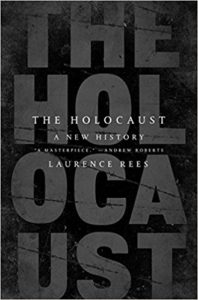
Review: The Holocaust, A New History

Historian Laurence Rees has spent a lifetime studying the Holocaust, and it shows in this book. The book is a very readable (and horrifying) retelling that starts from post WWI Germany and details all the steps in the somewhat haphazard but ultimately effective process that led to the most horrifying mass murder in history. It was not necessarily the largest genocide in history (estimates and definitions vary, so it hard to say with certainty) but he makes case (and I think it is a very reasonable case) that many aspects of this particular genocide are truly unique and extremely terrifying (and I am including even larger crimes, such as the Arab and European slave trades, in this comparison). Anyhow, readers can (and surely, will) make up their own mind about the relative horror of this particular crime, but if they read this book, they will at least learn the full extent of it.
He starts with the currents of antisemitism that circulated in 1920 Germany (many of them were pan-European, some were even of Anglo-American origin) and the process by which Hitler rose to power. The book makes clear that while anti-antisemitism was commonplace, most Germans were not thinking of systematic genocide; but some violent, socipathic and/or evil people were, and they gradually coalesced around Hitler and got the chance to put their various demonic ideas into practice using the resources of a modern state.
He also makes clear that there was no single point at which the process was set in motion. There was never one clear directive or one single individual charged with a clear mission to exterminate all Jews, or other “undesirables” (while Jew-hatred formed the central pillar of Nazi thought, Hitler and his minions had many other targets, including mentally and physically disabled Aryan Germans). A general urge to “purify” the Reich of Jews was built into Nazi policy, but it was put into practice gradually and with uneven application, with much variation in intensity, priority and methods.
Many concentration camps with extremely harsh conditions and cruel punishments were already in place in the early years of Nazi rule, but systematic extermination started after the war was underway. I did not know (or had forgotten) that the first use of gas to kill people was by physicians who used carbon monoxide to kill disabled patients in a room where it was piped in via specially constructed pipes (the patients were stripped before being sent to the room “for showers”). This was developed because killing them individually by lethal injection or other means was too slow and was traumatizing for the Nazi physicians doing the killing; distance from the actual act of killing was needed. Disabled children already herded into facilities were taken from the dining room of a children’s hospital “for consultation” (some crying and resisting) and never returned. A fact noticed by some of the other children there and remembered years later with horror. And so it goes.
The various instances throughout the thirties where other Western countries resisted Jewish immigration and turned away Jewish refugees are all detailed, as is the everyday antisemitism of leaders from Canada to Poland. When Hitler mooted the possibility of Germany and its eastern neighbors all coordinating a plan to send all the Jews elsewhere (“the colonies” in this case), the Polish ambassador even told Hitler that “if he finds such a way we will erect to him a beautiful monument in Warsaw”. British reluctance to accept refugees or to allow refugees to go to Palestine is detailed; Neville Chamberlain put it this way “it is of immense importance that Britain should have the Muslim world with us”, consequently “if we must offend one side, let us offend the Jews rather than the Arabs” (a multi-year resistance to Jewish immigration to Palestine for which the British get no credit from the Arabs today, incidentally). In the end, the Nazis could claim with some justification that “no one wants to have them”, though it must be kept in mind that no one then had any idea of exactly how far the Nazis were about to go.
The cooperation of various conquered nations (and the silence, if not the active connivance, of the Pope) in rounding up their Jews is discussed and as expected, the details vary. For example, the occupied and semi-occupied civil services in Holland and France deported more Jews than the German’s axis ally, Italy. In fact, in some ways they did a more thorough job than their compatriots in more old-fashioned antisemitic countries such as Romania, Hungary and Bulgaria; though in some cases this may be due less to humane instincts and more to early awareness that Germany could lose the war. Some, of course, went further than others, with Slovaks rounded up Jews with alacrity and Croatians even doing their own enthusiastic Jew-killing; incidentally, the Croats shocked even the SS by their shockingly brutal treatment of helpless Serbian civilians.
The role of the Germans themselves is discussed in great detail, making it clear that all of them certainly did not know what was going on, and almost none of them had the whole picture, but far too many knew a lot and actively participated. In the course of the book, Lees also offers the original suggestion (original to me at least) that Himmler and company began to let other senior German officials know more about the ongoing holocaust in 1943 as a way of stiffening their spines as the war turned against Germany. By letting them know what crimes they were part of, Himmler was also letting them know that “we are all in this together”, and after such crimes defeat is not an easy option to consider. Still, this did not stop Himmler himself, in 1945, from trying to make excuses for the holocaust (in brief “the war made us do it” or “the allies, by not taking the Jews off our hands”) and to try to make peace by handing over the few remaining Jews in his control.
But luckily for the image of the human race, there are also a few counter-examples. The Danes saved almost all their Jews; part of the “credit” may go to the Nazi in charge, who let them get away without trying too hard to stop them (Lees speculates that he may have seen that the war is going badly and taken his own precautions against the future, or may just have felt that his job was making Denmark “Jew-Free”; so what if they disappeared from Denmark only to reappear in Sweden), but even in countries where most were killed, there were thousands of individual acts of heroism and humanity. The Poles have had some bad press after the war for the various antisemitic acts and utterances of Polish leaders and common citizens, but Lees points out that in the midst of horrendous suffering, reprisals and punishments, about 90,0000 Poles risked their own lives to hide 28,000 Jews in Warsaw over the course of the war (11,500 of them survived). Even in Berlin itself, 1700 Jews managed to survive by hiding with Good Germans, who took almost unimaginable risks (and some very material sacrifices, given the severe food shortages at the end) to hide them through 6 years of war. Last but not the least, in the Greek island of Zakynthos, when asked to produce a list of their Jews, the local mayor and bishop handed over a paper with only two names on it: their own. All 275 Jews on the island were hidden in non-Jewish homes and survived.
And on this faint, but heroic positive note, I think I should end this review.
A must-read book.
8 likes

100 Years of Marxist Revolution..


https://www.nytimes.com/2017/10/19/books/review/victor-sebestyen-lenin-biography.html

https://www.nytimes.com/2017/10/16/books/review/martin-amis-lenin-russian-revolution.html?_r=0


http://www.tabletmag.com/jewish-arts-and-culture/books/247342/sickening-cost-of-lenins-revolution

https://www.nytimes.com/2017/10/26/books/review/12-new-books-we-recommend-this-week.html?_r=0

http://reason.com/archives/2017/11/01/communism-turns-100


You are right that the Marxists of the early 20th century can be excused to some degree because the results of Marxist revolution had not been seen at that point. Those who sympathized with arguments like Edmund Burke’s argument against the French revolution were already opposed to it (as, obviously, were those whose privileges or perks were directly threatened by it) but that line of argument is dense and/or subtle and there are equally dense and subtle arguments against it (in theory), so yes, it is understandable that many good and intelligent people could be tempted by it then, but we expect their descendants to know better now.
This HAS happened to some extent. It is not as widely popular an alternative as it was in the 1930s. But even after it has been repeatedly tried and has repeatedly failed, the fact that so many good and intelligent people are STILL tempted by it may have more to do with the fact that it also aligns with some deeply rooted quirks of human nature. i.e. like other religions, it is fated to remain a part of our social life. It appeals to enough of our nobler AND baser instincts to remain an attractive meme; not for everyone. But for enough people. Something like that.
The same could, of course, be said for other persistent ideologies. The rise of a particular ideology to dominance may be contingent, but baseline persistence is more or less guaranteed.
Not a very original observation.


The Official Future Is Dead! Long Live the Official Future!


http://www.telegraph.co.uk/news/2017/10/29/100-years-100-million-deaths-later-communism-still-has-converts/


t

when your cousin and head of NDTV which has a very left position and is married to sister of brinda karat, top left leader and chooses to not give you space, that is revealing as to how far gone they themselves think of her. Excursion trips to maoist camps who were declared by congress lead upa 1 govt( which was allied to the biggest block of left who engage with democracy in parliament) prime minister manmohan singh as “single biggest internal threat”, and whose stated position is to overthrow democracy and you are sympathetic to them, that tells everything. And yes, occasionally people do celebrate killings of Indian soldiers by maoists.

https://www.ndtv.com/india-news/dantewada-aftershocks-at-jnu-415103

https://timesofindia.indiatimes.com/india/Pitched-battle-over-peoples-war-at-JNU/articleshow/5783093.cms

It might be ok for people to ally but it is foolish to not recognize the true nature of ally. My point regarding kashmir was that violence there had to do with guns that did come from across border and not killing of political activists of rival political parties purely for sake of power as it was in west bengal or in kerala. Kashmir isnt about political violence, west bengal is. There is no army posted there. The fact that the biggest internal security threat are maoists and the worst political violence was in west bengal controlled by left reveals to its nature. There should be endless volumes of literature on their violence, but if the academies themselves are covered by left ideologues as JNU among others are, who will call it out?.

HH is better than roy. There is no comparison on this. He isnt supporting or sympathizing a murderous gang of people whose stated objective is to overthrow of pakistan govt itself and throw out democracy.He didnt go to their camps and write propaganda piece in support of them. Condone their violent murders by their kangaroo system of justice where victims have no say. This is the more sinister element of left, they use democracy itself against it. Your understanding of “left” is very poor if you dont know of the nature of left in India and their history of violence and thereby your assessment of roy stands invalid.

Islamism: Contested Perspectives on Political Islam” Edited by Richard C. Martin and Abbas Barzegar

atire and bursting the bubble of religion should be an option, else it all becomes tribal. everyone will start counting the increasing numbers and demographic change all the time. everyone will start picking sides all the time.tribalism will increasingly become dominant as though there were no option .

we should consider the harm we are avoiding, the good that can be done. a fundamentalist group might very well complain against others including fellow religious people. what might be ok for liberal believers might very well be bad for fundamentalist believers.And in multi religious society, there is much competition on all fronts including competition by competing fundamentalist groups. For example blasphemy laws came into India first due to article 295 A, introduced by british in aftermath of ilm ud din assassinating the publisher of ranglia rasool which was done in retaliation for muslims calling Hindu goddess sita as prostitute. The result was that the publisher was assassinated, the murderer ilm ud din was given death sentence, he was defended in court by Jinnah, the founder of pakistan. His funeral attracted over 10,000 muslims and supposedly his funeral prayer was lead by Iqbal, the ideological founder of pakistan, soon, blasphemy law was introduced. Later after Independence. Nehru introduced the first amendment in article 19 (2) regarding freespeech. These two laws among others have been used to silence opponents. Consequence has been that Hindus too have begun to use these laws to try to silence. Its a show of power, a way to put people in their place.

There were no blasphemy laws in Indian history before, Therefore there are many stories that speak of ill of certain actions of the gods. Rival believers of different gods make up stories of ill action of other gods and as a result people abandon the belief in those gods to other gods or become buddhists or jains or atheists etc.

https://defence.pk/pdf/threads/jinnahs-only-lost-case-defending-the-killer-of-a-blasphemer-ghazi-ilm-deen-r-h.87158

Apparently it was the only case Jinnah lost. And he fought the case under request of Iqbal.

What I will agree though is on blasphemy for the sake of it or to intentionally keep taunting people. It is plain rude and a disgusting behavior. being sensitive to others is fine.

I think I would perhaps be correct in claiming India has the largest body of oral knowledge created, preserved and transmitted than any thing else in the world. Jainism, buddhism,atheism owe their origins to vedic speculations being preserved and their debating /speculating culture. Philosophical speculation is just not possible without memory being preserved in some way, it just wasnt true for anyone else except for vedic people. So, i disagree on this issue. As for Indus valley, there seem to be aspects of goddess worship of some kind and associated human sacrifice. Many cults of human sacrifice continued with Goddess worship, kali for example.

Brihadaranyaka upanishad, for example is quoted by both carvakas and Buddha himself. It is probably the most ancient upanishad, it asks the interesting question as to what survives after death, speculation is from, atman, to karma, idea of all things going back to their source, earth element to earth, water element to water, it compares the answer to what survives after a plant is uprooted, so if one qualifies question with God, what survives after death then one ends up with most of the spectrum of beliefs that come from India.

atheism- no God,no cosmic karma,no atman
ajivika- No God, no karmic force, no atman, naturalistic force, fate
sankhya- (ancient sankhya is unknown now, latest sankhya has similar model to david chalmers(they really deserve credit, this theory has been brought back independently by david chalmers), ofcourse there are differences, but one can bracket sankhya with david chalmers somewhat. consciouesness, matter being origin for everything else including intelligence.
buddhism- no God, karma cosmic force, no atman
jainism- no God, karma cosmic force, atman yes
advaita- No God, karma cosmic force,atman yes
other hindu schools have God, karma,atman etc combination of things.

There are other reasons to believe this, upanishads record sense objects, sense organs and knowing through them, this is reflective of later buddhism, One of Buddha teachers was a person who taught him an ancient form of sankhya. Buddha himself is to have spoken of different groups of vedic teachers to be authentic than others. In absense of memory preserving culture I do not know how can any of these ideas could have been speculated , recorded and preserved for generations growing into a community. This isnt possible, it might be a case that the people were from non vedic social back grounds were taking parts of vedic,Upanishads principles bit by bit as they saw fit and then have own schools but the ideas do seem to come only from vedic system of knowledge. Again, in order to have any worthwhile philosophical speculation of any kind one must first possess an ability to remember and pass it along for generations. This ability was possessed by vedic system

Not exactly, partly true, later shunga dynasty supported buddhism as well. One has to look at the same sources that , the first state sanctioned genocide on basis of religion infact happened under Ashoka . so it was ashoka who used violence, then new empire that displaced them also used violence and since buddhist sangha was associated with mauryan empire a lot, they too suffered probably, but then again, the next generation also supported buddhism. Later period of attack by mihirakula was defeated by other hindu kings who were praised by buddhists in their writings. Infact, ambedkar writes buddhism disappeared because of coming of Islam.

“There can be no doubt that the fall of Buddhism in India was due to the invasions of the Musalmans. Islam came out as the enemy of the ‘But’. The word ‘But’ as everybody knows, is the Arabic word and means an idol. Thus the origin of the word indicates that in the Moslem mind idol worship had come to be identified with the Religion of the Buddha. To the Muslims, they were one and the same thing. The mission to break the idols thus became the mission to destroy Buddhism. Islam destroyed Buddhism not only in India but wherever it went. Before Islam came into being Buddhism was the religion of Bactria, Parthia, Afghanistan, Gandhar, and Chinese Turkestan, as it was of the whole of Asia.”

decline of buddhism

Brown Pundits