The Crime of Being a Dalit

RAJKOT: A 23-year-old youth was bludgeoned to death near Palara Central Jail in Bhuj on Tuesday night. Police said the murder was the result of a love affair. Police said the victim, identified as Jaideep Garwa, a Dalit resident of Kotai village of Bhuj taluka was in love with a woman from the Muslim community.

Youth murdered over love affair

For the sake of balance. South Asia is a complex and crazy place perhaps it would be better at BP if we all (including myself) took a breather and assess a broader positive outlook.

The Crime of being a Muslim

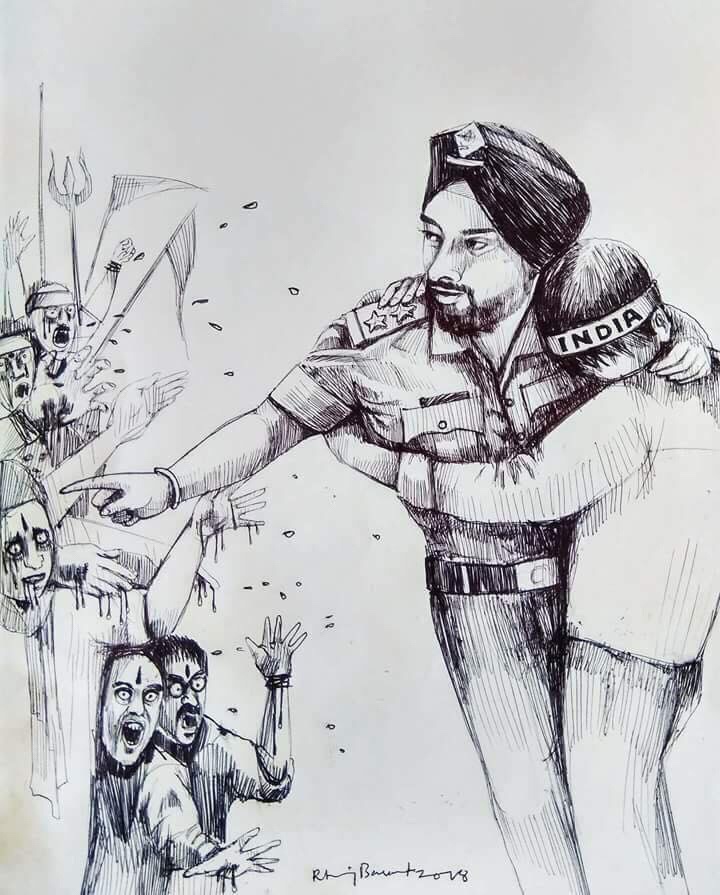
Last week a Sikh police officer in India saved a Muslim man from being lynched by a mob, merely for standing near a temple with a Hindu girl.

This is a poignant illustration on that, by student Umar Khalid.

He wrote: “Salute, Gagandeep. You stood up against not just some local hooligans. You were effectively standing up against the forces of hate who are right now ruling our country, and ripping apart its social fabric!”

Sunny Hundal

Brown Pundits 2018 Reader Survey

I created a SurveyMonkey poll. Check it out….

(after you are done, you can check out the results)

Create your own user feedback survey

Economic Modernization in Late British India: Hindu-Muslim Differences

I. The Question of Why India’s Muslims Are Poorer than Its Hindus India’s Muslim minority—as of the early twenty-first century, around 12% of its ethnically and religiously diverse population—lags behind the country’s Hindu majority economically. The average household income for Muslims is 76.6%, and per capita income 72.4%, of the corresponding figure for Hindus. In rural areas, the typical Muslim-owned farm is only 41.1% as large as the typical Hindu-owned farm. Muslims have relatively lower labor participation rates and higher unemployment rates in both cities and the countryside ðShariff and Azam 2004, vii; figs. 12, 15, 16, 18; tables 6, 7Þ. The 2011 Forbes list of the 100 richest Indians includes just three Muslims.1 The underperformance of Muslims is particularly striking in the management of its private companies. Shortly after India gained independence from Britain in 1947, only one of India’s 80 largest publicly traded companies had a Muslim at its helm ðGovernment of India 1955Þ. A half century later, in 1997, just one of India’s 50 largest business groups was headed by a Muslim ðTripathi and Mehta 1990, 340–42Þ. 2 In describing the economic performance of Muslims in independent India, Omar Khalidi ð2006, 88Þ infers from such statistics that Muslims “lack the ability to organize and plan enterprises on modern lines.”

My reading of the paper is that Muslim inheritance law (which divides the estates more or less equally) prevented capital accumulation to the same extent as Hindu family law. Essentially the Hindu joint family concept was very similar (structurally) to the joint-stock corporation; allowing mercantile Hindu families (especially in Western India) to rapidly accumulate capital and also move on to professional management sectors (as Sereno mentions in the previous post; privilege encompasses both financial, educational and social capital).

Furthermore Islam’s prohibition on credit made the waqf’s (essentially Islamic family trusts) less liquid and unable to allow Muslim families to fully take advantage of the assets that they controlled.

After the jump I’ve excerpted two paragraphs from the paper that touch on both the above points.

The four non-conforming Muslim castes (Khojas, Memons, Bohras and Ghiarasis – the last I had never heard of) were the only ones who maintained their pre-conversion Hindu family practises (Dina Wadia argued that the Quaid’s family estate should be divided as per Hindu law owing to his Khoja origins).

Continue reading Economic Modernization in Late British India: Hindu-Muslim Differences

Political Engineering in Pakistan. The Military View

From our regular contributor, Dr Hamid Hussain

Following piece about recent clouds on Pakistan’s scene was mainly for non-Pakistani audience as many questions/confusions came my way. 

 This is an attempt to understand the view from barracks although I strongly oppose such moves from military.  This is first of two part. Second part will deal with modus operandi.

 Hamid

Political Engineering – View from the Barracks

Hamid Hussain

In July 2017, disqualification of Pakistan’s Prime Minister Mian Nawaz Sharif by Supreme Court again opened the debate about the role of country’s powerful army.  This was one of the most politicized decision of country’s Supreme Court.  In April 2017, Supreme Court not only ordered formation of a Joint Investigation Team (JIT) but went ahead and nominated its members.  It included a serving Brigadier Kamran Khurshid of Military Intelligence (MI) and a retired Brigadier Nauman Saeed of Inter-Services Intelligence (ISI). Supreme Court disqualified Sharif based on JIT investigation.  In the aftermath of Sharif disqualification, many political changes including change of provincial government in Baluchistan achieved by defection of several members, defeat of government’s nominee for Senate chairman position and defection of many politicians from ruling political party Pakistan Muslim League (Nawaz) (PML-N) to rival Pakistan Terek-e-Insaaf (PTI) were alleged to be orchestrated by the army brass.

Continue reading Political Engineering in Pakistan. The Military View

English Lit and Science, 70’s Sri Lanka

This is a lot of reminiscing, and hopefully some  guidance for young people who read this blog.

I think I am a Science guy, and became IT/Finance guy in my 50’s.
I loved Chemistry, specially Organic Chemistry, Benzene Rings and all that. By the age of 14  (O/L) I wanted to be a Chemical Oceanographer.  I had a cousin (Ranjan Perumal) who was one of the early divers in SL.  Arthur C Clarke and Mike Wilson (Siva  Kalki) were some of the first modern divers in Sri Lanka.  Mike Wilson became a hermit, my cousin Ranjan is an Evangelical Pastor, in my opinion a real Christian (or people person).

Anyway, back to Science and English Literature.   In year 8 (age 12)  we had to chose between Science and Arts.  For O/L (year 9 and 10 in 70’s) we had to do 8 subjects.  English, Sinhala/Tamil, Math and Divinity (religion).  The smart Buddhists and Hindus did non RC (Roman Catholic) Christianity.  It was easy, almost like Geography/History. No necessity to remember stanzas.

So for O/L  (age 14) my optional subject was English Lit. I did Macbeth, Emma (Jane Austen) and some book of poetry.  Vaguely recall John Dunne (?) and Ozymandias.  Rubaiyat of Omar Khayyam, I had read a few years before bcos my father had it on his bookshelf.

To be honest Shakespeare did not rock my boat, possibly bcos my father liked it too much.  Emma was not OK either, though a few years later I read Pride and Prejudice and liked it.
Vanity Fair by Thackeray (?), Moonstone by Wilkie Collins.

The punch line, I was an alcoholic/heavy smoker by the age of 12-14. I worked around my Protestant work ethic parents.

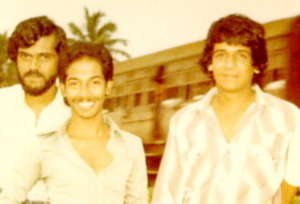
Photo below, I am the guy in the middle with the big grin, probably when I was 22. My classmate on right of me in photo Lakshan Amarasinghe  (RIP), long dead (1998).  On left of me Dayananda Kapuduwa.  A another drinking pal.  In the US married to an First American.  He paid  for 3 of my US Grad Uni Application fees (about USD 25 in 1987).  And the other 3 applications by my maternal cousin, Ranjans Sister.

I was not much different in size/looks when I got into the US.  The Uni guys were cool, but not at my level of alcoholism.   So hooked up with some eastern Long Island red necks.  Greg Linka, Jim, Kevin, Isaiah Brown (the Jamaican guy), give a shout if you see this.   I would drink these six footers under the table.  Then I lost funding and stopped drinking  for 10 years.
Anyways, there has to be some moral to the whole story.
So
a) a goal in life, and the goals can change
b) A privileged background. Many/somebody to step in and help upto a reasonable screw up.  More important than a)



Books on Indian history without recency bias

One of the problems with Indian history is that a lot of the books are strongly biased toward the Muslim and colonial periods. There are numerous reasons for this. People are interested in the Muslim and colonial periods for nationalist and anti-nationalist reasons, if that makes any sense.

But some of it is simply source availability of. When I am curious about the period between the Han dynasty and the Sui-Tang I’ll pick up a book like China between Empires: The Northern and Southern Dynasties. In contrast The Gupta Empire is an out of print monograph.

Because at some point the Rakhigarhi DNA results will be coming out I want to do some more reading on ancient and medieval (using those epochs loosely in the South Asian context) history, but so much of it is archaeological because of the thin historiographical tradition in South Asia.

Do readers have suggestions?

(Please calibrate to my level of knowledge. I’ve already read Early India)

Kargil War

This topic comes up every once in a while on twitter, so I am reposting an old post with a few new links and videos added at the end.. The main point is simple: Musharraf and a few of his cronies (Javed Hasan, General Aziz, General Mahmood), without having thought it through, conducted a foolish operation in Kargil that cost hundreds of lives on both sides and set back (perhaps destroyed forever) the chances of peace between India and Pakistan (set in motion by Vajpayee’s historic bus journey to Lahore). The operation was not only a strategic disaster, it was a tactical disaster..

First, some links with details about the operations: Continue reading Kargil War

3 questions about BP readers

I liked sbakkurum’s bio and it set me wondering about our readers/regular handles..

(1.) are you male or female?

(1b.) Do we have female commentators or do we have female readers?

(2.) is Kabir the only commentator with a liberal arts education?

(2b.) is anyone not a STEMMIE?

(3.) are you desi?

(3b.) what is ur ethnic origin?

(3c.) if you are Hindu; are you Upper Caste?

(3d.) If not are you Dalit or identify as a historically backward/oppressed caste?

(Bonus) how are you privileged in a South Asian context? How are you privileged (or not) in a Western context? How do you check your privilege?

Brown Pundits