Evolution of societies: A Perspective

It is hard to try to understand evolution of societies, there are many factors, all the way from geography to genetics to culture, language,religion. so feel free to disagree to this.

I would try to place 4 factors to see the differences between societies.

1.Diversity of thought/ideas, freedom for disagreement

2. Scaling, reinforcement or social conformity, the ability to bring large numbers of people to act or to have greater cohesion . Asabiya would fall into this category

3. incentive system,law & order.

4. external factors,threat of other groups,geography.

Of course, for even these ideas, we could go further back to ask why did these traits evolve in some places and not in others and so on. However, I do value these first 3 factors as they are what would constitute internal engine for societies to modulate themselves. The fourth being external threats and how that interaction plays out.

My view is to look at what societies can possibly do of their human resources. It makes sense to talk from the point of view of agency , of what can one possibly do to transform a society at a reference point A to another reference point B. Much as basic physics is study of dynamics of matter over time, basic social sciences should be about dynamics of societies over time as well.

What kinds of interventions can transform societies from a reference point A to reference point B. And is it reversible?

From the point of view of political agents of these societies, all they can possibly do is to either change their ideas about some views, bring conformity in large numbers of people,change incentive system, law & order.

Now that we have these in place, we can look at evolution of societies. Here Christianity began under the influence of polytheists, it gained institutions from Romans in the west, its common law, its ideas in science, philosophy, politics, all of these ideas were mined in due course of time, before that though it also brought conformity.

So Christianity had traits of diversity of ideas embedded in its early history, it also had better incentive system in place, copyright laws, patent laws , institutions of learning, these I believe brought them a decisive advantage. For it provided them a certain kind of knowledge of future possibilities for change in both society ,economy, sciences, one weaving into another and this was helped by profit motive and recognition/fame. Newton and Leibniz famously fought for credit, Galileo apparently sued his student. I am not sure of earlier periods where preeminent scientists and thinkers of a culture were suing each other for having stolen each others work , literary or scientific/mathematical/technological works.

These were given a fillip with peace of Westphalia, due to religious wars in Europe, the scale of violence and lack of outright victory of one group over the other side meant that christian conformity of one sect came to an end. This religious pluralism inside Christianity perhaps gave about a period of relative peace which helped bring the age of enlightenment in Europe into being as the old truths were now being replaced with new ideas of nature. Descartes,Newton,Hobbes,Locke were some of the people who published their works in the period. The total sum of interactions, publications, ideas and most importantly the incentive system propelled the society from the old and into the new and the bold . Also the beginnings of colonial expansion was perhaps enough incentive for religious peace in Europe and exploration outside for profit .There were other fish to fry.

I think the wars of religion placed a very important role, it meant Europe now had to simply accept heresy(Protestantism). While other societies had some of these traits, the totality of all these traits were not there, is not there even now in many societies.

Imagine the Catholics winning out decisively against protestants , then perhaps it would have the strength to decisively close the new avenues of research as a potential threat for formation of new heresies. Again, the position of dominant power could have changed this. Or if say the threat of Islam was felt very strongly in Europe, would they have then been willing to value rationalism over faith?. Here I am invoking the 4th factor of external threat. The questions that must matter are what factors can tilt societies from one mode of development to another?.  How must those internal and external incentives be tweaked, how does the internal structure of society align with this?. Is there too much diversity that society essentially is fragmented?. Or is the conformity to dogmas has a momentum that it cannot allow for freedom of speech?.

And if one were to value the peace of Westphalia as having played an important role in change of Christianity, One suspects the initiative of reform inside Islam, when plurality is not accepted within Islam itself,to expect them to be tolerable of other religious people seems strange.

A replication of what happened in Europe would entail them confronted by futility of war of social conquest within themselves first,to confront the cognitive dissonance of finding oneself in fruitless violence among themselves. I am not confident that cognitive dissonance can be elicited if Muslims were at war with non Muslims though. And what would the cost be for them to abandon excessive zealotry.

While India had religious pluralism, it didnt have universities, development in science, the printing press, incentive system for literature or sciences /technology.

Islam did not for various reasons including geography either have this pluralism or the incentive system. One Idea I have picked up from the following article on consciousness is the idea of counterfactual depth.

https://aeon.co/essays/consciousness-is-not-a-thing-but-a-process-of-inference


If action depends upon inference, then systems must be able to make inferences about the consequences of their actions. You can’t pick what to do unless you can make a guess about the probable outcome. However, there’s an important twist here. A creature cannot infer the consequences of its actions unless it possesses a model of its future. It needs to know what to expect if it does this as opposed to that. For example, I need to know (or subconsciously model) how my sensations will change if I look to the left, to the right or, indeed, close my eyes. But the sensory evidence for the consequences of an action is not available until it is executed, thanks to the relentless forward movement of time.

As a result of the arrow of time, systems that can grasp the impact of their future actions must necessarily have a temporal thickness. They must have internal models of themselves and the world that allow them to make predictions about things that have not and might not actually happen. Such models can be thicker and thinner, deeper or shallower, depending on how far forward they predict, as well as how far back they postdict, that is, whether they can capture how things might have ended up if they had acted differently. Systems with deeper temporal structures will be better at inferring the counterfactual consequences of their actions. The neuroscientist Anil Seth calls this counterfactual depth.

So if a system has a thick temporal model, what actions will it infer or select? The answer is simple: it will minimise the expected surprise following an action. The proof follows by reductio ad absurdum from what we already know: existence itself entails minimising surprise and self-evidencing. How do systems minimise expected surprises, in practice? First, they act in order to reduce uncertainties, that is, to avoid possible surprises in the future (such as being cold, hungry or dead). Nearly all our behaviour can be understood in terms of such uncertainty-minimising drives – from the reflexive withdrawal from noxious stimuli (such as dropping a hot plate) to epistemic foraging for salient visual information when watching television or driving. Second, the actions of such systems upon the world appear to be endowed with a purpose, which is the purpose of minimising not-yet-actual, but possible, surprises.

We might call this kind of system an agent or a self: something that engages in proactive, purposeful inference about its own future, based on a thick model of time.”

So, the age of enlightenment brought about a new consciousness in Europe, A kind of counterfactual depth unlike other among others. What all these developments did is increase progressive agnosticism. To entertain ideas different from one’s own is to for a moment engage in cognitive dissonance leading to certain kind of agnosticism by stealth. Progress therefore has been thorough this agnosticism by stealth reinforced many times over by mercantilism. To Imagine is to change. However, asabiya is also important, one cannot become agnostic to the point that societies become internally divided and are unable to bring the scale of numbers and pressure to bring about a transformation.
 

Persian & Ranjit Singh

When Ranjit Singh established a sovereign Punjabi kingdom in 1799, he did make serious efforts to encourage the teaching of Punjabi. According to some accounts, he ensured that every household was supplied with a free qaida, a primer of Punjabi language. As a result, there was massive increase in literacy, especially female literacy, in Punjab. One estimate, perhaps an exaggeration, suggests that there was nearly 100 per cent literacy by the end of the Punjabi kingdom in 1849. However, even Ranjit Singh did not give the official status to Punjabi in spite of it being a highly developed literary language. The Persian language continued to be the language of the court and official administration. Since no formal explanation of this contradictory approach by Ranjit Singh to Punjabi language — promoting its use but not giving it an official status — is available, we can merely speculate that it could be due to sheer administrative convenience that the use of Persian continued for official purposes.

From: When future of Punjabi language was secured

10 Indians who have made a global marki

Happy Valentine’s Day from Paris. My wife, Lady V, made a list of 10 Indians who have made a global impact. I wrote it down to share it on BP. It’s actually 13 but who’s counting:

1. L N Mittal – one of the richest men in UK/ Europe / Kalpana Chawla (only Indian woman to go into space)

2. Shah Rukh Khan/Amitabh Bachan/ MF Husain – global icons

3. Mukesh Ambani – richest man in Asia

4. Satya Nadella – Microsoft chief

5. Sundar Pichai – Google Chief

6. Indra Nooyi – Pepsi co

7. C V Raman / Nobel winner

8. Venky Ramakrishna – Nobel winner

9. Arundhati Roy – Booker Prize winner

10. Amartya sen – Nobel economics prize winner

Her submission for global Pakis are:

1. Nargis Mavawalla

2. Malala Yousufzai (I added Malala to this list)

3. Benazir Bhutto

All three of course are women; I would have added Imran Khan but does he have a global reach?

For some reason Pakistanis don’t scale the same peaks as Indians do..

Ps:

Kabir’s additions:

4. Edhi; humanitarian extraordinaire

5. Asma Jehangir; notes human rights lawyer

6. Abdus Salam: Nobel (physics) peace prize

Counter factual

Let’s assume that throughout history; the typical South Asian is a Shudra peasant from UP.

Would the welfare of this hypothetical individual have been better off today if:

(1.) there had been no British rule; i.e the Mughals & other powers (Sikh, Maratha, Hyderabad) scrape through to the modern age. No English language & no railways.

(2.) there had been no Turkish incursion; India remained under Hindu & indigenous rule through to the present day. No Islam, no Taj & no biryani.

(3.) finally if Ashoka had successful imposed Buddhism throughout the Sub-continent and replaced Hinduism & the attendant caste system. No Vedas, no caste.

Of course virtually all Pakistanis would settle on number 1, Hindutva on number 2 but number 3 is the one that really intrigues me; maybe the dwindling Nehruvians would have agreed to that?

In the end Gandhi’s composite approach; to somehow try and blend all histories in a vaguely Saffron-lite mix won out but since 90% of Brown Pundit discussion goes back to these forks in history (especially the Muslim one), it’s interesting to contemplate it from a different angle.

The Coming Information Apocalypse..

“What happens when anyone can make it appear as if anything has happened, regardless of whether or not it did?” technologist Aviv Ovadya warns/asks in this interesting journey through the existing and coming technologies for manipulating words, images, networks and people..

Aviv says:

Alarmism can be good — you should be alarmist about this stuff,” Ovadya said one January afternoon before calmly outlining a deeply unsettling projection about the next two decades of fake news, artificial intelligence–assisted misinformation campaigns, and propaganda. “We are so screwed it’s beyond what most of us can imagine,” he said. “We were utterly screwed a year and a half ago and we’re even more screwed now. And depending how far you look into the future it just gets worse.”

That future, according to Ovadya, will arrive with a slew of slick, easy-to-use, and eventually seamless technological tools for manipulating perception and falsifying reality, for which terms have already been coined — “reality apathy,” “automated laser phishing,” and “human puppets.

He then describes how rapidly the technologies for manipulating images, mining personal information and using AI to tailor messages specifically to each user are developing.  And he fears that:

fast-developing tools powered by artificial intelligence, machine learning, and augmented reality tech could be hijacked and used by bad actors to imitate humans and wage an information war”

Of course they will. And the technology development will not stop just because it can be put to scary uses. I cannot think of an example from history where technological development was stopped because X “enlightened individuals” predicted it would be destabilizing. (Aviv is not saying that either, I just wanted to get that out of the way). So eventually everyone will be playing with these tools, and so? Didn’t everyone start using print and then radio, and then TV and then the internet? Maybe it made it possible to coordinate people in larger numbers towards common ends (not necessarily good ones, but I mean the game of politics did not change to some new game, it just ramped up a level), but the numbers coordinated by religion/culture in the past were not trivial either, just slower moving .. The question is this: is there a point where quantitative change becomes qualitative? and what does that mean? What will be radically different? Leaders? followers? patsies? useful idiots?

This is not a rhetorical question, I am really curious what people think will change and what will not.

By the way, i read that while he was waiting for Stalin to shoot him, Bukharin was reading philosophy and this was the question that stumped him; the question of quantitative change versus qualitative change..

The Sun that Rose From the Earth

Shamsur Rahman Faruqi’s The Sun That Rose From the Earth: Insights into the world of Urdu poetry in the Late Mughal Era

By Kabir Altaf

South Asians continue to be fascinated by the Mughal period.  Whether one sees this period as the origin of North India’s high culture (the view of most Pakistanis and partisans of the Islamicate culture) or as hundreds of years of slavery under the Muslims (the view of the Hindu Right), it is clear that the Mughals remain central to India’s history and to the country’s conception of itself.   This period was also the time when there was a great flourishing of the arts, including music and poetry. For example, it was during the reign of Muhammad Shah “Rangila” (r. 1719-1748) that khayal gaiyki—presently the main style of classical vocal music in North India—was developed. Some scholars also state that it was in Muhammad Shah’s time that Urdu replaced Persian as the language of the Mughal court.   What is without question is that the 18th and 19th centuries were when Urdu poetry reached its heights and when the works of authors such as Mir Taqi Mir (1723-1810) and Mirza Ghalib (1797-1869) were created.

It is the lives and works of these poets which forms the core of Shamsur Rahman Faruqi’s collection of novellas, The Sun That Rose From The Earth—the author’s own translation into English of his Urdu work Savaar aur Doosre Afsane.  The three major stories–“Bright Star, Lone Splendour”, “In Such Meetings and Partings, Ultimately” and “The Sun That Rose from the Earth”—are about Ghalib, Mir, and Mushafi respectively.  Faruqi is known as the “grand old man of Urdu literature” and received the Padma Shri from the Government of India in 2009.  His novellas reflect his vast knowledge of Urdu poetry and the culture that produced it.

“In Such Meetings and Partings, Ultimately” is one the longest stories in the book and revolves around Mir Taqi Mir’s romance with Nurus Saadat, a courtesan from Isfahan.  The title comes from one of Mir’s verses from his first divan (1752), which Faruqi translates as follows: “In such meetings and partings, ultimately/ Lives are lost. There is no end to Love/And Beauty never relents.” The story ranges from Armenia—where Nurus Saadat’s mother, Labiba Khanam, is orphaned and becomes a courtesan, to Isfahan, and finally to Delhi, where Mir meets Nurus Saadat.  Since she is a courtesan and is contracted to another, her meetings with Mir must remain secret.  She is also dying of consumption and eventually she pushes Mir away so that he will not have to deal with the grief of her death.

Faruqi is a master at physical description and at describing people’s clothes (which reveals his immense knowledge about the cultural details of the period). Here is his introduction of Mir: “He was twenty-two, twenty-three years of age, tall but slim. His wrists were strong and broad, his eyes, red with sleeplessness—or was it drink?—were still commanding, full of character, though it could be seen that they could twinkle with humour when the occasion demanded. His beard was not long or dense…”  This physical description is followed by a paragraph on Mir’s clothes, which begins: “He had a short, light, full-sleeved tunic on his upper body. It was called nima, or angarkha, depending on the style. The nima was worn waistcoat fashion. The fabric was woolen, russet coloured. It was called banat, but it was not of the best quality and its russet was now fading somewhat. Under the nima he wore a long woolen tunic. His trousers were of Aurangabadi mashru…” (Faruqi 250).  Though such long descriptions tend to slow down the narrative pace, they are invaluable for giving one a sense of the period.

Another noteworthy aspect that Faruqi gets across is that it was not only Muslims who were involved in the creation of Urdu poetry.   One of Mir’s close friends is Rai Kishan Chand Ikhlas, an Urdu poet in his own right.  Similarly, the narrator of the story about Mushafi is Darbari Mal Vafa, whose father, Kanji Mal Saba, was a Persian poet and a student of Mushafi’s. The fact that Hindus are shown as being involved in the creation of Urdu and Persian poetry gives the lie to the modern Hindutva version of history that the religious majority was deeply oppressed under “Muslim” (really Mughal) rule.  Faruqi’s book is thus an essential corrective to the revisionist myths of today’s India.

The book is filled with Persian and Urdu verses, though these suffer from being sometimes awkwardly translated into English.  However, this is my limitation as a reviewer of being unable to fluently read the Urdu version of Faruqi’s book. Probably, the verses would have more power there. In the English version, they sometimes get in the way of advancing the plot.

Overall, The Sun That Rose From The Earth provides a fascinating look at Delhi at the beginning of the long Mughal decline. It is a must-read for those with an interest in Urdu poetry and culture.

Kabir Altaf received a B.A. in Dramatic Literature from George Washington University. He has studied Hindustani Classical Vocal and is currently teaching Music History at the Lahore University of Management Sciences (LUMS)

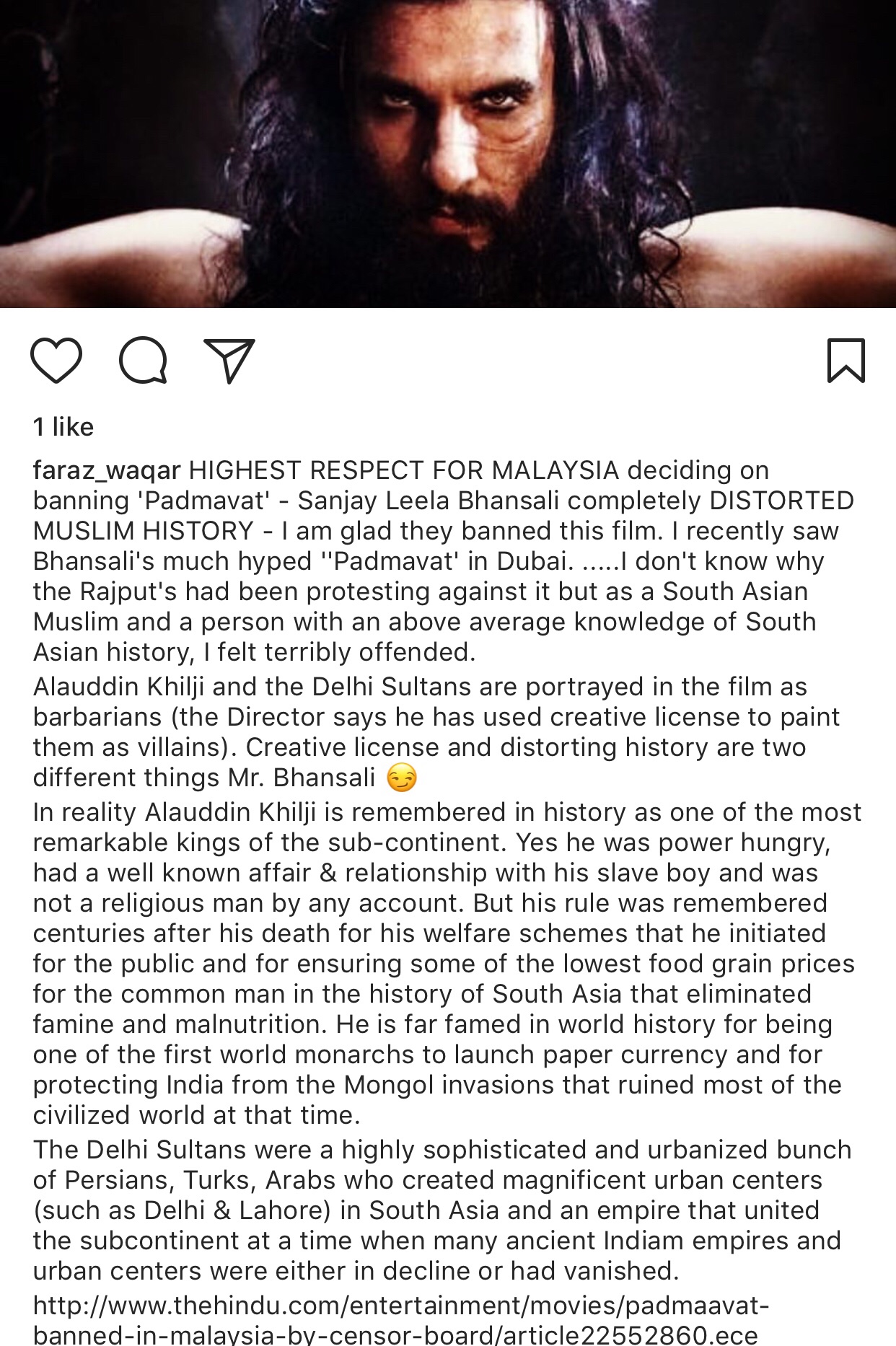
Padmavat banned in Malaysia

I thought I would share this important comment on Alauddin Khilji in light of the Padmavat defamation. I haven’t seen it yet though but I’ve heard it’s very anti-Alauddin..

Review: The House of Government


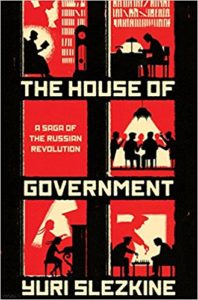
Yuri Slezkine is a Russian-American historian (he is also technically Portuguese-American, since he first emigrated from Russia to Portugal and then came to the US with a Portuguese passport) who has written a number of interesting books, and “The House of Government; a Saga of the Russian Revolution” is his latest and greatest offering.  At over 1000 pages, it is not a lightweight book, literally or metaphorically. What he does is follow the lives of a large number of Bolshevik revolutionaries, from their origins as young rebels (they were almost all very young; very few were over 40 when they took over the largest country in the world) to the heady days of the Bolshevik revolution, to the civil war that followed, the first compromise (the NEP), the second and more serious attempt at “true communism” (the five year plan), the terrible violence and suffering of collectivization,  the victory of communism under Stalin, the insane purge and auto-annihilation that followed that victory, the second world war, the desiccation and death of revolutionary ideology, and, perhaps most strikingly, the coming of age of the next generation without any sincere transfer of the purported official ideology, leading to the final, inevitable collapse of the entire experiment.

Continue reading Review: The House of Government

Paki Elites & where they live

I could be wrong but Pakistan’s elites are in the following cities:

Islamabad is the home to the political & bureaucratic elite. Very chaste and crisp Urdu and a real redoubt of the Pakistani government. I spent alot of time in this city when growing up but have found to be a Talibanised version of an English village (I jest but not by much). The main ethnicities are Punjabis, who are thoroughly Urdufied and Pakistanised and Pathans, who are the exotic minority in the city with their colourful language & weird accents.

Pindi (Rawal) is the ugly older sister of Islamabad but of course is where the military is based and so would probably be where all the military elite (which is the shadow government of the country) is based.

Lahore is the home to the economic elite, after all Punjab is the largest and most influential state. It is no Karachi however and is far more regional than cosmopolitan. It has a rough macho culture and can be a bit crude & crass. However as one of Pakistan’s oldest and most prestigious cities it has considerable sway. Punjabi language & ethnicity has obviously a strong sway here as the common tongue mixed in with Urdu of course.

Pakistan’s greatest city (& my personal favorite) is of course Karachi. It may not necessarily have the moneyed but the social trendsetters are here . Predominantly drawn from Pakistan’s once dominant elite (the Urdu-speakers are sort of like the Wasps in Pakistan, a faded elite) who go to certain schools (well only one, KGS), study abroad, live in Defence & Clifton and have a rather hedonistic approach to life (not in the manic way as upper-crust Lahoris but in a more studied & sophisticated way). The living room arbiters of the cultural life of the nation; English-speakers with Muhajir heritage (of course most of these families have intermarried with the locals etc). Love-hate relationship with India and very confused about Pakistan in general; believe that they are the last continuance of the Mughal decadence of Delhite culture. I may be projecting my own love of Karachi here but it really is the Queen of East; the last redoubt of Urdustan.

Much as I like New Delhi (I much prefer New Delhi to Lahore & my truest roots are there since my late grandmother was born in Karol Bagh) it’s not very inspiring to see the Muslims clustered in ghettos like cattle waiting to be slaughtered. Ghalib would probably find Karachi, more than Delhi, to be a more familiar city..

Fair & Lovely

These are K-Jo’s children that he had by surrogacy. They are obviously very cute and beautiful and I’m very happy for him (I’m a huge supporter of surrogacy).

However it seems that they were fertilised with a white egg donor and while I don’t comment on personal choices; I don’t see why he couldn’t have chosen someone of his own race.

What I find strange about Hindutva is that they hate us (the Mughals & their Muslim spawn in India) but are so ambivalent/ almost slavish towards white people.

Classic example of divide & rule; as much as I believe in desi solidarity if a Pakistani or Persian had done such a thing I would not have approved. If one has no pride in one’s colour or heritage then what’s the point

Don’t get me wrong there is nothing wrong in falling in love with people of different races and have children with them; that’s a very beautiful thing. However to go out of one’s way and pull a Michael Jackson; to try and have super-Aryan children, strikes me as a complex too many.

Furthermore Karan has the onus of being one of the most emulated individuals in India and by somehow sending out the impression that white is right is not healthy for a society that is already ridden with colour complex. Roohi & Yash would have been just as lovely in a darker shade of brown..

Brown Pundits