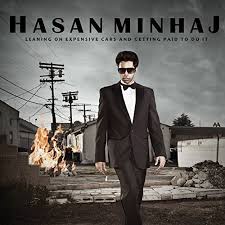
Hasan Minhaj and Aziz Ansari: your race defines you and it doesn’t

Today I watched Homecoming King, a comedy show by Hasan Minhaj. Honestly I wasn’t going to watch it, because Minhaj’s political schtick at The Daily Show was not geared toward someone like me. That is, it’s funny to laugh along with him, but it is much easier if you agree with him politically. To me this is a major contrast with Aziz Ansari, who probably shares most of the politics of Minhaj, but who does not seem to foreground it as much.

Some of this is happenstance. Minhaj blew up on The Daily Show, which focused on politics with a liberal slant. Ansari became more well known through episodic television. That’s going to impact the sort of comedy they put out there.

But after watching Minhaj outside of The Daily Show context, and comparing his routine to Aziz Ansari’s (I’ve also watched much of Master of None), I think it is notable how differently they come off despite the likelihood that on the fundamentals they probably agree about much in American society. In short, Minhaj’s experience and recollection of racism seems much more raw to me than Ansari, who seems to have taken it more in stride.

I was encouraged to watch Homecoming King  in part because Minhaj grew up in Davis, California. I lived there for five years and one of my closest friends during my undergraduate years is a Davis native. In fact I went to her wedding in Davis during Minhaj’s senior year in high school. The centerpiece of Homecoming King happens to be about an event before prom which involved racism of a subtle but hurtful form that traumatized him in a very deep fashion. He’s talked about this incident extensively so you can Google it. But it colors all of Homecoming King.

But there are some differences between Ansari and Minhaj which I think require highlighting. Ansari is 5’6 feet tall, while Minhaj is 6’0 feet tall. Ansari is also darker-skinned, and I think I can say he is less conventionally attractive than Minhaj (readers who are attracted to men can correct me here). Finally, Minhaj grew up in very liberal Davis, California, situated between the Bay Area and Sacramento. Ansari grew up in a small town in South Carolina. I suspect that Ansari probably faced more racism than Mihnaj when he was growing up if I had to bet.

And yet of the two Aziz Ansari seems to be less deeply impacted by the banal ubiquity of white American racism. He acknowledges that it exists, sometimes in a pointed fashion. But he does not seem to let it define him.

In  Homecoming King Minhaj’s trauma from his abortive relationship with a white girlfriend scars him so much that he says he could not date white girls after that. I’m sure Ansari has experienced some level of racism against him on the dating scene. Especially in the South where when he was growing up interracial relationships were probably more taboo than in Davis. It comes up a few times in Master of None, but it’s not defining in any way. He keeps on trying to find someone he can connect with no matter their race, even if “on paper” they should be out of reach for a short dark-skinned guy.

Finally, this is a minor thing, but Ansari is more explicitly disconnected from his Muslim background. He has stated he is an atheist to the media. One episode of Master of None involves him eating pork in front of his parents. Minhaj in contrast seems to own his Muslim identity much more (albeit, of a very liberal cultural variety).

Rather than being exemplars of young brown men in the United States, the subtle differences between Ansari and Minhaj show that there isn’t one way to be brown, and that we aren’t impacted in the same way by how society views us. Like Minhaj I went to high school where I was the only brown kid. Also, like Minhaj I was called Saddam Hussein. Unlike Minhaj my town was overwhelmingly conservative, while his was overwhelmingly liberal. While my town was over 90 percent white (actually more than 95 percent when I went to high school since I’m about 10 years older than Minhaj), his was about 70 percent white. What was the difference between us? A lot of it comes down to personality.

Some liberals of a minority background feel besieged by the white majority. In contrast, many of us who are more conservative accept racism is part of life, but move on, and don’t believe it is as determinative as liberals assert. Much of this comes down to personality differences, rather than race differences. Minhaj and Ansari are both successful politically liberal Indian American comedians from a Muslim background. But how they experienced American society and present themselves still differs because they are still individuals with all the differences that entails.
Indian genetics, part n of many

I put up close to definitive piece for me in relation to South Asian historical population genetics. At least until new research is published. I did leave out some stuff about my own vague thoughts…but I think the takeover of Hattian and Hurrian cultures by the Nesha (Hittites) and Haryannu (Mitanni) have something to teach us….

Indian genetics, the never-ending argument

I am at this point somewhat fatigued by Indian population genetics. The real results are going to be ancient DNA, and I’m waiting on that. But people keep asking me about an article in Swarajya, Genetics Might Be Settling The Aryan Migration Debate, But Not How Left-Liberals Believe.
First, the article attacks me as being racist. This is not true. The reality is that the people who attack me on the Left would probably attack magazines like Swarajya as highly “problematic” and “Islamophobic.” They would label Hindu nationalism as a Nazi derivative ideology. People should be careful the sort of allies they make, if you dance with snakes they will bite you in the end. Much of the media lies about me, and the Left constantly attacks me. I’m OK with that because I do believe that the day will come with all the ledgers will be balanced. The Far Left is an enemy of civilization of all stripes. I welcome being labeled an enemy of barbarians. My small readership, which is of diverse ideologies and professions, is aware of who I am and what I am, and that is sufficient. Either truth or power will be the ultimate arbiter of justice.

With that out of the way, there this one thing about the piece that I think is important to highlight:

To my surprise, it turned out that that Joseph had contacted Chaubey and sought his opinion for his article. Chaubey further told me he was shocked by the drift of the article that appeared eventually, and was extremely disappointed at the spin Joseph had placed on his work, and that his opinions seemed to have been selectively omitted by Joseph – a fact he let Joseph know immediately after the article was published, but to no avail.

Indeed, this itself would suggest there are very eminent geneticists who do not regard it as settled that the R1a may have entered the subcontinent from outside. Chaubey himself is one such, and is not very pleased that Joseph has not accurately presented the divergent views of scholars on the question, choosing, instead to present it as done and dusted.

I do wish Tony Joseph had quoted Gyaneshwer Chaubey’s response, and I’d like to know his opinions. Science benefits from skepticism. Unfortunately though the equivocation of science is not optimal for journalism, so oftentimes things are presented in a more stark and clear manner than perhaps is warranted. I’ve been in this position myself, when journalists are just looking for a quote that aligns with their own views. It’s frustrating.

There are many aspects of the Swarajya piece I could point out as somewhat weak. For example:

The genetic data at present resolution shows that the R1a branch present in India is a cousin clade of branches present in Europe, Central Asia, Middle East and the Caucasus; it had a common ancestry with these regions which is more than 6000 years old, but to argue that the Indian R1a branch has resulted from a migration from Central Asia, it should be derived from the Central Asian branch, which is not the case, as Chaubey pointed out.

The Srubna culture, the Scythians, and the people of the Altai today, all bear the “Indian” branch of R1a. First, these substantially post-date 6000 years ago. I think that that is likely due to the fact that South Asian R1a1a-Z93 and that of the Sbruna descend from a common ancestor. But in any case, the nature of the phylogeny of Z93 indicates rapid expansion and very little phylogenetic distance between the branches. Something happened 4-5,000 years ago. One could imagine simultaneous expansions in India and Central Asia/Eastern Europe. Or, one could imagine an expansion from a common ancestor around that time. The latter seems more parsimonious.

Additionally, while South Asians share ancestry with people in West Asia and Eastern Europe, these groups do not have distinctive South Asian (Ancestral South Indian) ancestry. This should weight out probabilities as to the direction of migration.

Second, I read some of the papers linked to in the article, such as Shared and Unique Components of Human Population Structure and Genome-Wide Signals of Positive Selection in South Asia and Y-chromosomal sequences of diverse Indian populations and the ancestry of the Andamanese. The first paper has good data, but I’ve always been confused by the interpretations. For example:

A few studies on mtDNA and Y-chromosome variation have interpreted their results in favor of the hypothesis,70–72 whereas others have found no genetic evidence to support it.3,6,73,74 However, any nonmarginal migration from Central Asia to South Asia should have also introduced readily apparent signals of East Asian ancestry into India (see Figure 2B). Because this ancestry component is absent from the region, we have to conclude that if such a dispersal event nevertheless took place, it occurred before the East Asian ancestry component reached Central Asia. The demographic history of Central Asia is, however, complex, and although it has been shown that demic diffusion coupled with influx of Turkic speakers during historical times has shaped the genetic makeup of Uzbeks75 (see also the double share of k7 yellow component in Uzbeks as compared to Turkmens and Tajiks in Figure 2B), it is not clear what was the extent of East Asian ancestry in Central Asian populations prior to these events.

Actually the historical and ancient DNA evidence both point to the fact that East Asian ancestry arrived in the last two thousand years. The spread of the first Gokturk Empire, and then the documented shift in the centuries around 1000 A.D. from Iranian to Turkic in what was Turan, signals the shift toward an East Asian genetic influx. Alexander the Great and other Greeks ventured into Central Asia. The people were described as Iranian looking (when Europeans encountered Turkic people like Khazars they did note their distinctive physical appearance).

We have ancient DNA from the Altai, and those individuals initially seemed overwhelmingly West Eurasian. Now that we have Scythian ancient DNA we see that they mixed with East Asians only on the far east of their range.

The second paper is very confused (or confusing):

The time divergence between Indian and European Y-chromosomes, based on the closest neighbour analysis, shows two different distinctive divergence times for J2 and R1a, suggesting that the European ancestry in India is much older (>10 kya) than what would be expected from a recent migration of Indo-European populations into India (~4 to 5 kya). Also the proportions suggest the effect might be less strong than generally assumed for the Indo-European migration. Interestingly, the ANI ancestry was recently suggested to be a mix of ancestries from early farmers of western Iran and people of the Bronze Age Eurasian steppe (Lazaridis et al. 2016). Our results agree with this suggestion. In addition, we also show that the divergence time of this ancestry is different, suggesting a different time to enter India.

Lazaridis et al. accept a mass migration from the steppe. In fact, the migration is to such a magnitude that I’m even skeptical. Also, there couldn’t have been a European migration to South Asia during the Pleistocene because Europeans as we understand them genetically did not exist then!!!

I assume that many of the dates of coalescence are sensitive to parameter conditions. Additionally, they admit limitations to their sampling.

Ultimately the final story will be more complex than we can imagine. R1a is too widespread to be explained by a simple Indo-Aryan migration in my opinion. But we can’t get to these genuine conundrums if we keep having to rebut ideologically motivated salvos.

Related: Ancient herders from the Pontic-Caspian steppe crashed into India: no ifs or buts. I wish David would be a touch more equivocal. But I have to admit, if the model fits, at some point you have to quit.

Indian media is finally reporting on the Aryan migration into South Asia

For various ideological reasons in India there has been a strong resistance to the idea that Aryans came from outside of South Asia. When David Reich’s Reconstructing Indian Population History was published 2009 the Indian media had a weird response. For example, Aryan-Dravidian divide a myth: Study.

Though Reich’s paper was equivocal, it was clear to me that it was likely going to be the launching point for a resurrection of the Aryan migration theory. Now Tony Joseph in The Hindu has published a pretty good survey of the literature, How genetics is settling the Aryan migration debate. Nothing new for readers of this weblog, but he some good quotes:

The avalanche of new data has been so overwhelming that many scientists who were either sceptical or neutral about significant Bronze Age migrations into India have changed their opinions. Dr. Underhill himself is one of them. In a 2010 paper, for example, he had written that there was evidence “against substantial patrilineal gene flow from East Europe to Asia, including to India” in the last five or six millennia. Today, Dr. Underhill says there is no comparison between the kind of data available in 2010 and now. “Then, it was like looking into a darkened room from the outside through a keyhole with a little torch in hand; you could see some corners but not all, and not the whole picture. With whole genome sequencing, we can now see nearly the entire room, in clearer light.”

In relation to online debates I have had Indian interlocutors tell me flat out that they believe in the papers published between 2005 and 2010. It is nice to get the scientists who actually published this work now admit that new results overturn the older theories.

Note: I am going to refer to this as a migration, because “invasion” seems to connote too much specificity as to how it happened. But I have a difficult time imagining that it was a peaceful process.

Book Review: The Silk Roads

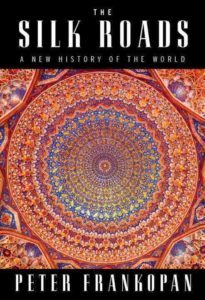
This is a frustrating, though still useful, book. Historian Peter Frankopan’s title claims this is “a new history of the world”. He then proposes that what the world needs is to reorient its focus from Europe to “the silk roads”, vaguely defined by him as “the region between East and West.. from the Eastern shores of the Black Sea and the Mediterranean to the Himalayas”. This almost certainly reflects the fact that the core of this region happens to his particular area of interest (Turkey, Persia, Central Asia and Russia) as a historian. Having made this decision, he has to force the rest of the story to keep coming back to this region, to somehow keep his argument afloat. My recurring thought on reading this book was that all this is unnecessary. He could have written a history of the region without pretending that this was the REAL history of the world, and it would have worked fine. Or he could have attempted a history of the world and not bothered with this tendentious framing. But he insists on doing both, and it causes endless (and needless) irritation. Continue reading Book Review: The Silk Roads

Aamir Khan’s Dangal Takes China by Storm

Pakistani academic and ex-diplomat Aamir Khan is an old friend, and he recently wrote a piece on why Dangal is such a hit in China.
What do you think?

Excerpt:

But why did the Chinese fall in love with this movie? Firstly, no country in the world is more sensitive, even obsessed about the achievement of its children than China. The gaokao or university entrance examinations are a case in point. Mothers actually take their offspring to nearby hotels so that the child does not have to travel. They even block adjoining roads so that horn-noise does not distract the examinees. No amount of funds is enough and no level of effort is satisfactory to prepare these children for the future. The movie catches this collective nerve perfectly.
For Chinese viewers, even the slim-fat Aamir Khan reflects control over one’s body. That this is achieved through sheer hard discipline is both magical and achievable. Like China’s own success

At the same time, many Chinese children are being spoilt by the 4-2-1 syndrome. This refers to four grandparents, two parents and one grandchild — the latter has neither siblings nor first cousins. All six parents and grandparents spend money to pamper the “little emperors”. Thus when Aamir Khan cuts his daughters’ hair so that they can fight better, or makes them run for miles, this fits perfectly into the Chinese parental mental grooves. Fed up with Korean soaps, featuring feminized males with long nails, plucked eye-brows and rose-petal lips, Chinese parents have taken their children in droves to Dangal not only to motivate them but also to shame them.

Then, the movie itself is a metaphor for China. Like the future champions but now-penurious village girls who cannot afford to eat even chicken, China has overcome incredible odds to rise from poverty in 1978 to become a politically-stable economic juggernaut that is proud to assume international leadership. Dangal is China itself. No sky is high enough for the Chinese spirit. For Chinese viewers, even the slim-fat Aamir Khan reflects control over one’s body, achieved through sheer hard discipline is both magical and achievable. Like China’s own success.

The last days of pre-ancient DNA Indian population genomics

If anyone wants to know about the population genetics of South Asia, I recommend three papers (all are open access):

Genetic Evidence for Recent Population Mixture in India

A genetic chronology for the Indian Subcontinent points to heavily sex-biased dispersals

The promise of disease gene discovery in South Asia

In the near future ancient DNA will do for South Asia what has been done for Europe, and to a lesser extent the Near East. It will pull back our veil of ignorance. But until then we have genomic inference from larger data sets with a greater number of markers. What can we say now?

– The 2009 work that modern South Asians are broadly a compound of two streams of the out of Africa populations is correct. One is much like other West Eurasians. Another is distantly related to other East Eurasians, with possible affinities to Paleolithic Southeast Asian hunter-gatherers.

– The West Eurasian ancestry of South Asians, the “Ancestral North Indians” (ANI), does likely seem to be a mixture at minimum between two groups. One element is related to the eastern farmers who first adopted agriculture on the slopes of the Zagros ~10,000 year ago. Another stream is closely related to the Yamna people who flourished on the Eurasian steppe north of the Black Sea ~5,000 years ago.

– The Munda peoples seem to have a distinct Southeast Asian component that ties them with other Austro-Asiatic peoples. Their migration was almost certainly tied to the Neolithic migration of rice farmers. They are likely not the primal aboriginals of South Asia.

– The R1a1a-Z93 Y chromosomal lineage found across much of South Asia, and especially the higher castes and the north, increased in frequency within the last 4,000 years. It is almost certainly exogenous to South Asia; ancient DNA from the steppe finds the Z93 in Iranic peoples, but no Indian ancestry in these groups.

As I said, ancient DNA will clarify lots of things. I expect that to happen in the next few years.

India = Nigeria + Italy in terms of fertility


The map above shows the most recent district level fertility rates in India. It is immediately clear why comparing India to Pakistan and Bangladesh (let alone Nepal, Sri Lanka, or Bhutan) is a major error.

In some of the northern regions of the Hindi-speaking “cow belt” as well as the lightly populated Northeast the total fertility rate is similar to what you find in Nigeria, between 5 and 6 children per woman. For comparison the TFR for Saudi Arabia is 2.75. For Bangladesh it is 2.20 and for Pakistan it is 3.6. In contrast, much of the South, Punjab, and West Bengal have below replacement fertility.

Here is 2017 data by state:

State/UT Fertility rate 2017
Sikkim 1.2
Andaman & Nicobar 1.5
Chandigarh 1.6
Kerala 1.6
Punjab 1.6
Puduchery 1.7
Goa 1.7
Daman & Diu 1.7
Tripura 1.7
Delhi 1.7
Tamil Nadu 1.7
Karnataka 1.8
Andhra Pradesh 1.8
Lakshadweep 1.8
West Bengal 1.8
Telangana 1.8
Maharashtra 1.9
Himachal Pradesh 1.9
Gujarat 2
Jammu and Kashmir 2
Arunachal Pradesh 2.1
Haryana 2.1
Uttarakhand 2.1
Odisha 2.1
Chhattisgarh 2.2
Assam 2.2
 India 2.2
Mizoram 2.3
Dadra Nagar Haveli 2.3
Madhya Pradesh 2.3
Rajasthan 2.4
Manipur 2.6
Jharkhand 2.6
Uttar Pradesh 2.7
Nagaland 2.7
Meghalaya 3
Bihar 3.4

Six Days of War. June 1967 and the Making of the Modern Middle East

Today was the 50th anniversary of the 1967 war. What follows is a review I wrote last year of Michael Oren’s book about the 1967 war. I am posting it today to commemorate the anniversary, and to think about what has changed, and what has not, about the equation between the “Muslim world” and its more modern competitors.

To the extent that it existed, this sense of the Muslim world being one of several “competitors” in a war of civilizations  existed mostly in the Muslim world in the last 100 years; and even there, mostly in the minds of religious fanatics such as Maudoodi or Sayyed Qutb or modern Islamists such as the Indian Islamist Mohammed Iqbal.  Most Western, Chinese or Japanese thinkers were unlikely to have something called “The Muslim World” on their list of civilizations competing in the modern world. This has certainly changed in recent time, with at least the Right wing of Western Civ and (and to a lesser extent, of Chinese and Japanese Civ) becoming almost hysterical about the threat posed by Islam. But has the balance of power changed? and if it has, has it changed enough? I think today’s drama in the GCC (among many things) indicates that the balance on the ground has not changed by much. The Muslim world is richer, and some countries (Turkey, Pakistan, Egypt, Iran, Indonesia) are more powerful than they were in 1967; Pakistan is even a nuclear power (and in the minds of many of its own citizens, if not all its power brokers, an “Islamic nuclear power”), but in many other ways the dreams of May 1967 were the high point of (delusional) confidence in the Muslim core region. In that year, many, perhaps most, in the Muslim street were eager to believe that their armies could, if given the opportunity, annihilate the “Zionist entity”. Which is why so many spent the first few hours of the war celebrating what their leaders were describing as “great successes”; that reaction seems unlikely today. If there were a new war, and Arab radio stations claimed the Israelis were losing, most people would not believe it, even if the Israelis really WERE losing.
Anyway, on to the review. And don’t miss the documentary at the end.

Review Continue reading Six Days of War. June 1967 and the Making of the Modern Middle East

Brown Pundits