In the near future ancient DNA will do for South Asia what has been done for Europe, and to a lesser extent the Near East. It will pull back our veil of ignorance. But until then we have genomic inference from larger data sets with a greater number of markers. What can we say now?
– The 2009 work that modern South Asians are broadly a compound of two streams of the out of Africa populations is correct. One is much like other West Eurasians. Another is distantly related to other East Eurasians, with possible affinities to Paleolithic Southeast Asian hunter-gatherers.
– The West Eurasian ancestry of South Asians, the “Ancestral North Indians” (ANI), does likely seem to be a mixture at minimum between two groups. One element is related to the eastern farmers who first adopted agriculture on the slopes of the Zagros ~10,000 year ago. Another stream is closely related to the Yamna people who flourished on the Eurasian steppe north of the Black Sea ~5,000 years ago.
– The Munda peoples seem to have a distinct Southeast Asian component that ties them with other Austro-Asiatic peoples. Their migration was almost certainly tied to the Neolithic migration of rice farmers. They are likely not the primal aboriginals of South Asia.
– The R1a1a-Z93 Y chromosomal lineage found across much of South Asia, and especially the higher castes and the north, increased in frequency within the last 4,000 years. It is almost certainly exogenous to South Asia; ancient DNA from the steppe finds the Z93 in Iranic peoples, but no Indian ancestry in these groups.
As I said, ancient DNA will clarify lots of things. I expect that to happen in the next few years.
The map above shows the most recent district level fertility rates in India. It is immediately clear why comparing India to Pakistan and Bangladesh (let alone Nepal, Sri Lanka, or Bhutan) is a major error.
In some of the northern regions of the Hindi-speaking “cow belt” as well as the lightly populated Northeast the total fertility rate is similar to what you find in Nigeria, between 5 and 6 children per woman. For comparison the TFR for Saudi Arabia is 2.75. For Bangladesh it is 2.20 and for Pakistan it is 3.6. In contrast, much of the South, Punjab, and West Bengal have below replacement fertility.
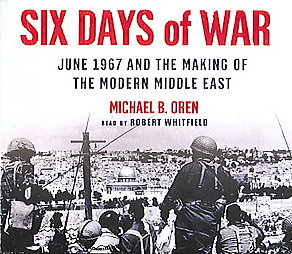
Omar Ali · June 6, 2017 · Comments Off on Six Days of War. June 1967 and the Making of the Modern Middle East
Today was the 50th anniversary of the 1967 war. What follows is a review I wrote last year of Michael Oren’s book about the 1967 war. I am posting it today to commemorate the anniversary, and to think about what has changed, and what has not, about the equation between the “Muslim world” and its more modern competitors.
To the extent that it existed, this sense of the Muslim world being one of several “competitors” in a war of civilizations existed mostly in the Muslim world in the last 100 years; and even there, mostly in the minds of religious fanatics such as Maudoodi or Sayyed Qutb or modern Islamists such as the Indian Islamist Mohammed Iqbal. Most Western, Chinese or Japanese thinkers were unlikely to have something called “The Muslim World” on their list of civilizations competing in the modern world. This has certainly changed in recent time, with at least the Right wing of Western Civ and (and to a lesser extent, of Chinese and Japanese Civ) becoming almost hysterical about the threat posed by Islam. But has the balance of power changed? and if it has, has it changed enough? I think today’s drama in the GCC (among many things) indicates that the balance on the ground has not changed by much. The Muslim world is richer, and some countries (Turkey, Pakistan, Egypt, Iran, Indonesia) are more powerful than they were in 1967; Pakistan is even a nuclear power (and in the minds of many of its own citizens, if not all its power brokers, an “Islamic nuclear power”), but in many other ways the dreams of May 1967 were the high point of (delusional) confidence in the Muslim core region. In that year, many, perhaps most, in the Muslim street were eager to believe that their armies could, if given the opportunity, annihilate the “Zionist entity”. Which is why so many spent the first few hours of the war celebrating what their leaders were describing as “great successes”; that reaction seems unlikely today. If there were a new war, and Arab radio stations claimed the Israelis were losing, most people would not believe it, even if the Israelis really WERE losing.
Anyway, on to the review. And don’t miss the documentary at the end.
The aspect that people like Khan are not emphasizing when they talk about violence having nothing to do with Islam is that most people are not Muslims, and most people (in the West) do not know Muslims in their personal life. So terrorist acts are quite salient as a representation of the religion when that’s the only time it comes to mind in a visceral sense.
This may not be fair to practitioners, but this is how human cognition works. As an analogy, there is a lot of diversity and range of experience for what it means to be an evangelical white Protestant. But for many young secular liberals the salient aspect of this religious movement is its attitude toward abortion and gays. All the charitable giving, or the incredible personal experience of redemption and reform of white evangelical Protestants, is not relevant in a broader social context to most people because these are two policy positions which are salient and distinctive.
Obviously for most Muslims their religion pervades their life, and most of their associations with the religion have to do with family and community. But non-Muslims are not generally part of this world, so it is not a major element of their perception of the religion in a concrete sense. So one strategy for disassociating Islam and violence would be further integration, so that more and more non-Muslims can experience the whole range of the religion. And yet even here it isn’t as if Muslim experiences are distinctive from other religions.
This does not address the elephant in room: Islam today as a religious civilization is in ferment and change, and a non-trivial element does engage in violent habitually, against other Muslims as well as non-Muslims.
Consider the lives of Hindus and Christians in Pakistan. The majority of Pakistanis would not condone attacks upon these communities, but a motivated minority of the Muslim majority are clearly targeting this two groups for persecution. From the perspective of non-Muslims in Pakistan it is the actions of the minority who are violent toward them that really matters, because their lives are on the line.
There are so simple answers here. Though in the public realm stylized simplicity dominates. That too is a human cognitive bias….
A commenter below who probably scores OK on an IQ test left a note which is worth responding to.
First, “If this was a Christian or Muslim emigrant to US who wanted to marry within religion.” In the original postI focused on marrying within subcaste for a reason. It’s generally socially acceptable to marry within religion for ideological reasons in American society. I’m not talking about within-religion marriage because that’s considerably more exogamous than what Ravi Patel was talking about. So the whole thrust of this element of the response either consciously misreads (malicious) what I’m saying, or, does not read in the first place (stupid).
Also, this is Brown Pundits. I think a tendency for Hasidic Jewish sects to in-marry is not optimal for individuals or society…but this is not a blog focused on Judaism.
Next, “Two, you link jati affiliation to hindu-muslim violence.” No I don’t. Please note that I don’t like it when readers engage in “close reading.” Because that’s usually an excuse to impute. I do think that a certain sort of jati-based endogamy is part of a cultural context where communal violence has also emerged. Left-wing Indian American commenters bring up these connections, often obnoxiously in my opinion. But this film was aimed at non-South Asians. So I just wanted to bring up what the obnoxious Indian Lefty would bring up just so that the contrast between Ravi’s liberal West LA lifestyle with a very regressive set of values even in the modern Indian middle class milieu would be more stark (it actually makes the documentary more powerful).
Finally:
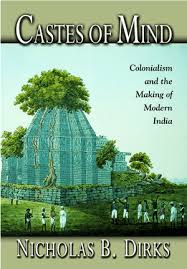
Finally, on Nicholas Dirks, he like others notices the standard story of jatis classifying into 4 varnas is not correct. He mentions local accounts which are very different. But this was noticed by colonial anthropologists in the 19th century itself. See quote by CF Margath on Page 39 here, https://www.academia.edu/25376339/The_Impossibility_of_Refuting_or_Confirming_the_Arguments_about_the_Caste_System ,
But instead of noticing that the current theory is wrong, and doesnt correspond to the phenomena on the ground, they come with notions like ‘Hinduism’ and ‘caste-system’ where constructed in the colonial era. The fact that many Indians repeat these ideas can be used to support that they were constructed in the 19th century. But mostly, this talk is incoherent. Most people are not able to name 4 varnas and are dimly aware of groups beyond their local region, but would repeat textbook, newspaper accounts which in turn is based on 19th century scholarship.
I read the Dirks’ book about 15 years ago. It is a good and persuasive book, and certainly many aspects are true. But the last 15 years of genetics and genomics has confirmed in fact that broadly speaking varna maps onto real patterns which are at least 2,000 years ago. That is, genetic affinities and relatedness exist on a spectrum that maps very well onto varna spectrum, beyond Brahmins and Dalits.
Dirks’ work, and others who emphasize constructionism, capture elements of the truth (e.g., Bengali Kayastha genetic profiles [my maternal grandfather’s family background for what it’s worth] seem a lot like other non-Brahmin Bengalis I’ve seen, so the recent “elevation” of this caste is plausible). But taking it to heart totally misleads people have the depth and nature of caste and jati in the South Asian context.
If you’re not a geneticist you’ll probably not understand the papers above, which is fine. But don’t expect your ignorant comments to be posted on my threads.
Stupidity and ignorance are obviously forgivable sins. The latter is even fixable. But misreadings with the aim of bolstering a rhetorical position are really unforgivable, because they’re a waste of everyone’s time.
Note: I should add that other contributors are more liberal than I am. So I will try not to ban people, though I may just delete comments a lot if I think they fall into one of the three above categories.
Omar Ali · June 5, 2017 · Comments Off on The First Rule of Realism is..
Colonel Yingling (formerly with McMaster in Iraq) has written a superb piece in “Foreign Policy”. Obviously there is a lot going on and I want to blog soon, but have been busy, so I just wanted to put this out there for comments..
Excerpt:
As in Athens, the destruction is as much moral as political. Words have ceased to convey their ordinary meanings; alternative facts, fake news and pseudo-science are sufficient substitutes for the genuine articles.
Unsophisticated observers mistakenly believe that Realism is the glorification of brute force, and that Trump’s foreign policy is a manifestation of realist principles. Careful readers of Thucydides know that the’ glorification of brute force makes more enemies than friends. America’s enemies will recognize that they need not fear an administration prone to empty bluster abroad and scandal at home. Of greater concern, America’s friends may calculate they cannot trust an administration that discards the work of decades so casually.
..In Washington, President Trump is rapidly dismantling the system of mutual obligations that produced the longest period of great power peace in the nation-state era. He publicly glorifies brute force, unaware or uninterested in the dangers of destroying the liberal international system that FDR and his successors created. Thucydides’ lessons were meant to last forever, but cannot be easily distilled into 140 characters. Nevertheless, the least informed president in American history might benefit from adopting the Durden Doctrine: The first rule of Realism is you don’t talk about Realism.
A few months ago I happened to watch the film Meet the Patels. Though you do meet all the “Patels”, the film centers around the love life, or lack thereof, of the actor Ravi Patel.
Filmed by his sister, the documentary predates Patel’s current modest fame by many years (he has a small recurring role in Aziz Ansari’s Master of None). As his life has changed in many ways, perhaps his views and outlook have too. The comments I’m making in this post are not about Ravi Patel, but rather about the views he expressed many years ago in this documentary at a particular point in his life, and how it reflects a thread of South Asian American nostalgia and romanticism of our cultural roots.
Like many young Indian Americans Patel and his sister grew up between worlds. Their parents arrived in the United States among the very first wave of Indian immigrants, which today makes them somewhat unique, as there has been a huge migration since the 1990s from India due to the H-1B visa program. At one point the matriarch of the small American Patel clan bemoans how Americanized her children are compared to many other Indian Americans, who arrived later, when various South Asian American communities were more mature.
But Ravi and his sister are not entirely Americanized. Or they weren’t. Both avoided the conventional dating rituals of American life deep into their 20s, and as of filming Meet the Patels Ravi had had only one girlfriend, Audrey. Attractive, and depicted as level-headed and kind, on paper Audrey seems to have been the perfect girlfriend. But there was a major problem with her biodata: Audrey is a white American.
Eventually Ravi broke up with Audrey because of his confusions as to what he wanted in his life, and whether she belonged in it. Did he want what all his friends had? The American dream of love and marriage. Or, did he want what his parents had? An Indian arranged marriage with commonalities of culture.
But there is more to the Patels than just an Indian arranged marriage. Ravi Patel’s parents want him to marry someone from the same subcaste of Patels from the region of Gujarat that they come from. This is entirely typical of Indian culture. But it is rather peculiar in an American context. Though in some ways Ravi finds this all strange, some part of him also entertains the idea that his parents have a mutual comfort, a cultural identity, which he envies. At one point he goes back to Gujarat to a celebration of his people, his subcaste of Patels, and he looks around at wonderment at the safety and security of being among his his kith and kin. A sense of belong clearly has come over him.
As far back as Herodotus Indian society seems to have been characterized by caste. Genetically the castes, and more precisely jatis, are very distinct. And their persistence on the Indian scene suggest some level of functional utility.
Realistically Ravi could never recreate what he felt in Gujarat in the United States because such a community does not truly exist. Yes, there is kinship among Patels, as recounted by stories about Ravi and his family on the road, staying at Indian owned motels. But in the United States the Patels are a Diaspora, an archipelago of families scattered across the 50 states.
The romantic notions that Ravi airs in Meet the Patels about group solidarity, and cultural affinity of the sort his parents have, would seem creepy and disturbing if you posited it in the context of an upper middle class WASP from New England. But the strong group cohesion evident among the Patels of Gujarat, and many Indian communities, also generates as a byproduct the sort of exclusion illustrated in the 1970 film Love Story.
And the exclusionary tendencies of middle class Gujaratis is reflected in part on the social-political nature of the state of Gujarat. It is in this state that the current prime minister of India, a tribune of lower middle class Hindu nationalism, grew up, and originally came to power and prominence. It is in this state in the early 2000s that communal riots occurred, and accusations of organized genocide against Muslims have been leveled.
The connections between liberal Democratic Indian Americans and right-wing Hindu nationalism in India have been extensively discussed. That is not what I am getting at. Meet the Patels is not a political film, it is a personal one. There is no reason that Ravi should address political topics in the documentary, and much of what I am saying here would be implicit to any South Asian watching Meet the Patels. But to many Americans these darker realities would not be visible or implied in the cultural practices which Ravi admires.
The attitudes expressed in Meet the Patels is no different from pining for the “good old days.” The reality is that the old days were often not so good. Or they weren’t how you remembered them. And just as some people pine for the days of yore, others romanticize the “homeland”, where everyone was your uncle, and the aunties took care of you when your mother was a way. But this world is in many ways fundamentally regressive and constrained, and the benefits of communal responsibility are often correlated with inter-communal tension and conflict.
Again, there is no reason that Meet the Patels should have gone into this. But I wanted to put into the record what was unsaid so that those who see in it purely a charming inter-cultural story comprehend the other dilemmas latent within the narrative.
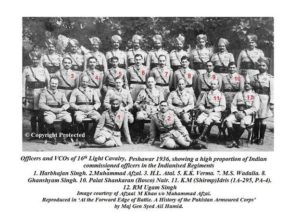
Corrected Officer List: Sitting on ground Left to Right: Lieutenant Harbhajan Singh (1) and Lieutenant Muhammad Afzal (2).
First Row Seated: Left to Right: Captain Khalid Jan, Captain Hira Lal Atal, Second-in-Command (2IC) Major Basil Holmes, DSO, Commanding Officer Lieutenant Colonel A. H. Williams, MC (with dog in his lap), Major Faiz Muhammad Khan, Captain K. M. Idris (11), Risaldar Major Ugam Singh (12).
First Row Standing: Left to Right: Unidentified VCO, Lieutenant Inder Sen Chopra (3), Lieutenant Enait Habibullah (4), Lieutenant K. K. Verma (5), Captain S. D. Verma (6), Captain M. S. Wadalia (7), Lieutenant Ghanshyam Singh (8), Lieutenant J. K. Majumdar (9), Lieutenant P. S. Nair (10) and unidentified VCO.
16th Light Cavalry was one of the first cavalry regiment of the Indian army that was Indianized. 7th Light Cavalry was the second cavalry regiment that was Indianized and later 3rd Cavalry was also earmarked for Indianization. Disproportionately, large number of future senior cavalry officers of Indian and Pakistani armies belonged to these three Indianized cavalry regiments. They were the founding fathers of armored corps of Indian and Pakistan armies.
King Commissioned Indian Officers (KCIOs) were graduates of Sandhurst and Indian Commissioned Officers (ICOs) were trained at Indian Military Academy (IMA) at Dehra Dun. During the war, Indian officers were commissioned as Emergency Commissioned Officers (ECOs) after only six months of training. The picture is circa 1936, therefore most Indian officers are KCIOs and only two ICOs as first IMA batch known as ‘pioneers’ was commissioned in December 1934. Both are from the first IMA course.
Major Basil Holmes: In this 1936 picture, he was Second-in-Command (2IC) of the regiment. He was an Australian and served with Australian army during First World War. He was ADC to his father Major General William Holmes who was killed by a shell in France during a tour. He won Distinguished Service Order (DSO) in First World War. After the war, he transferred to Indian army and after a career of twenty one years in India, retired as Colonel and went back to Australia. Continue reading 16th Light Cavalry. A historic picture and an anecdote from Kashmir
Brown Pundits Archive · May 22, 2017 · Comments Off on India-Pakistan people’s peace resolution: Throwing a pebble in the pond
Peace activists from India and Pakistan have circulated a resolution to support efforts for a durable peace between India and Pakistan. The full text of the resolution can be found at this link. The preamble states:
“In the 70 years since independence and Partition, the people of India and Pakistan have seen too many conflicts and the loss of many valuable lives. Enough of the distrust and tensions. Those who suffer particularly are ordinary people denied visas and those in the conflict zones, especially women and children as well as fishermen who get routinely rounded up and arrested for violating the maritime boundary. We condemn all forms of violence regardless of its objectives. Deeply concerned at the current rise in animosity and antagonism between India and Pakistan, we urge both governments and their security establishments to take all steps possible towards improving relations..“
The resolution has been signed by hundreds of prominent activists, journalists, intellectuals and peace-lovers from all over the world. Whenever such resolutions are circulated, they tend to get pigeon-holed as Leftist or Liberal and while popular within those domains, they are derided as fairy-tales by those who like to think of themselves as more “realistic”. I would submit that this is unfortunate.. I think all realists should support the DEMAND for peace. While there are powerful lobbies that are genuinely un-interested in peace (and would PREFER to settle matters by force) on both sides (the situation is not necessarily symmetrical, as I have pointed out in the past, the Indian establishment, and even their Right Wing, is willing to make peace on current borders, Pakistan is the anti-status quo state), “realists” do not support war in principle, they support it because they think “the other side leaves us no choice”. I submit that those who believe this shouldhave no problem with such a resolution: to ask for peace is not the same as asking for surrender. In the cold war, both Russia and the US made it a point to stress that THEY wanted peace, it was the other side that was not cooperating sincerely. I would appeal to all my “realist” friends to get with the program and at least do this much: joint the demand for peace. Put the onus for it’s failure on the other country. Don’t be the one asking for war as the preferred step.
Who knows, It may even work.
?
From Dr Hamid Hussain (received as PDF and converted, kindly excuse any formatting issues)
AN ANGLO–AFGHAN–INDIANDYNASTY
THE STORY OF THE WARBURTONS
Hamid Hussain
The story of the Warburtons began with a love affair in the middle of a war, that spanned two cultures and led to the founding of a distinguished and flamboyant dynasty spanning several generations.
Robert Warburton, the founder of this extraordinary family, was born 8 March in Garryhinch , Ireland . He joined the Bengal Artillery in 1831 , was commissioned in the 6th Regiment of that distinguished formation, later moving to the 5th Regiment. The Warburton’s story begins with the First Afghan War of 1839-42. When the deposed Afghan ruler Shah Shuja recovered his throne with British and Indian bayonets, Warburton raised and commanded the ‘ King’s Own Artillery ‘ in the shah’s army.
Once the British were ensconced in Kabul, Warburton met and fell in love with Shah Jahan Begum. Shah Jahan Begum, who was born in 1813, was the daughter of Adul Rahim Khan, a Popalzai Durrani noble. She was married to Sardar Faiz Talab Khan. Who served at the court of Amir Dost Muhammad Khan, and they had a son in 1840. Later that year, she fell in love with Warburton, and after securing divorce, she married the English officer in November 1840 . The couple was married according to Muslim law; the ceremony was conducted by Qazi Fatehullah. The Mahar, a dowry promise d by the groom, was the astounding sum of 600,000 Rupees. Guests at the marriage included Sir Alexander Burnes, Lt. John Leigh Stuart and Lt. Charles Howard Jenkins. Three Muslim officers, Subedars Abdullah Khan, Mir Haji and Sirdar Khan, signed as witnesses to the union.
The young couple had little time to enjoy their new happiness. The British position in Afghanistan began to deteriorate, and the army was driven from Kabul and destroyed as it struggled southwards. Warburton was handed over as hostage to one of the Afghan insurgent leaders, Mohammad Akbar Khan, in December 1841 along with five other officers: Capts. Airey, Conolly, Drummond, Walsh and Webb.
Warburton along with a number of other English hostages was sent north to Bamian when an East India Company relief force retook Kabul. Saleh Muhammad Khan commanded the force detailed to escort the prisoners to Bamian. Saleh had an exciting career. He was Subedar of the 6th Regiment of Shah Shuja’s infantry, which had been commanded by Captain Perin Hopkins, who was killed in Jalalabad in January 1842. When the British were driven from Kabul, Saleh Muhammad deserted with his company to Dost Muhammad. A short time later an English prisoner, George Lawrence (brother of Henry and John), called Muhammad by his name and old rank. Saleh Muhammad replied: “Lawrence Sahib, I am a general now, so you must now style me “General'”.
As the returning EIC forces drove back the Afghans, Saleh Muhammad again switched sides when his English prisoners made an offer he could not refuse. He was guarantee a pension for life of a thousand rupees a month with an additional 20,000 rupees to be paid as soon as the prisoners reached Kabul. The next morning, Saleh Muhammad raised a ‘flag of defiance’ above the fort announcing his revolt against Akbar Khan. It was perfectly in line with Afghan tradition. The freed English officers promptly set up a new governor of Bamian district, and two Hazara chiefs tendered their allegiance to the new administration. But the British withdrew from Afghanistan shortly thereafter and Dost Muhammad Khan returned to power’.
Robert Warburton returned to India after his release. He was commanding the 19th brigade of the Royal Artillery at Peshawar where he died in November 1863 at the age of 51. He is buried at the Christian cemetery near Tehkal Bala in Peshawar.
Saleh Muhammad followed the British to India, and settled in Ludhiana. a city that had become a favoured refuge for Afghans lucky enough to keep their heads after losing in one or other of the bloody power games on the chessboard of Afghan politics. In 1857, he raised and commanded a mounted contingent to aid the British when their rule was challenged by the revolt of the Bengal army. The force consisted of some 130 Afghans, Punjabi Muslim and Sikhs. It was later incorporated into Skinner’s Horse, and his brother Fateh Muhammad was appointed Risaldar.
Warburton and his Afghan bride had a son who was also named Robert. He was born in a Ghilzai fort between Jagdullak and Gandamak when his mother was on the run from Afghan insurgents after the British retreated from Kabul. A number of Afghan women had married British officers. and they were a special target for the insurgents. In one case, an eighteen year old Afghan girl who had married a British officer was burned alive and the throats of all her servants were slit. Shah Jahan Begum was sheltered by relatives and well-wishers in various
towns, villages and hamlets. Finally, she escaped in disguise and reached
Peshawar in 1843, where she was joined by her two sons.
Robert’s early education was at a school in Mussoorrie before he was sent to England and entered Kensington Grammar school. He attended Woolwich and was commissioned in the Royal Artillery in December 1861. He served with F Battery of the 19th Artillery Brigade, which his father had commanded. He also served with the 21st Punjab Infantry in the Abyssinia campaign in 1868 and the 15 Ludhiana Sikhs before transferring to the Political Department.
He was Assistant Commissioner of Peshawar and Mardan before being appointed Political Officer of the Khyber in 1879. During the Second Afghan War, Warburton serve as political officer of the Jalalabad Valley Field Force. He was fluent in Pushtu and Persian and his linguistic skills and Afghan heritage gave him a special status when dealing with tribesmen.
The Khyber Jazailchis were raised byCapt. Gilbert Gaisford in 1878 as a paramilitary force to police the famous pass. Warburton later took over the force. His right hand man was the legendary
Honorary Colonel Muhammad Aslam Khan. Aslam was from the royal Saddozai family of Afghanistan. He started his career as risaldar with the 5th Bengal Cavalry in the I857 mutiny.
The two men transformed the force into the famous Khyber Rifles. Regular troops were withdrawn, and the Khyber Rifles became the guardians of the pass. Under its watchful eye, law and order in large swathes around the Khyber was far superior to that in many settled areas. When Warburton left his post on May I0, 1897 due to ill-health, hundreds of Afridis crowded the platform of Peshawar railway station to say goodbye to a man they regarded as a friend. In the autumn of 1897, there was a general uprising among the Khyber tribes, and Warburton was recalled. He had complete faith in the Afridis and traveled around the Khyber accompanied by just four orderlies of the Khyber Rifles.
When British forces entered the Afridi heartland in the Tirah, and burned the tribesmen’s homes as retribution, Warburton told a group of old Afridis that it was beyond his power to prevent the destruction. With tears in their eyes, the grey beards of the Afridi jirga or council replied. “Never mind, Sahib, whatever happens we are earnestly praying that you may not be injured in this campaign Warburton died in England and is buried in Brompton Cemetery in London.
Robert Warburton ‘s daughter, Marie, married Lt. Col. James Richard Birch of the Cheshire Regiment. Their son, Lt. Col. James Robert Birch joined his father’s regiment. In 1933, thirty-five years after Warburton’s retirement, a huge crowd of Afridis showed up at Landi Kotal railway station just before the arrival of a troop train carrying the Ist Battalion of the Cheshire Regiment. The tribesmen had heard that Warburton’s grandson was an officer in the battalion and had come to see him.
The famous exploits of Robert Warburton on the North West Frontier were matched by the career of his Afghan step-brother. Shah Jahan Begum’s son by her first marriage, Jahan Dad Khan, was adopted by the first Robert Warburton. The boy was baptized John Paul Warburton, and educated at the Roman Catholic school at Agra. He joined the Punjab Police in 1864, and during a long career served at Kamal, Ludhiana, Muzzaffargarh and Ambala, eventually retiring as Deputy Inspector General (DIG) of Railway Police. After leaving British service, he served as Inspector General of Patiala State Police.
John Warburton became a legend for his remarkable detective work and relentless pursuit of robbers. Locals, struggling with pronouncing his name, called him “Button Sahib’. He was given many difficult cases because he spoke Pushtu and Persian and possessed an innate understanding of local attitudes and customs. In one case, a band of Pathan thieves repeatedly evaded capture. The case was assigned to ‘Button Sahib’ and he arrested most the gang members and broke up the ring.
Like his step-father, John Warburton was smitten by love in unusual circumstances. ln 1863, while out exercising one morning, he saw a young woman being attacked by a mad dog. He intervened and rescued her. The woman was Mary Meakins. a beautiful 21-year-old widow with three children She had married Ensign William Philip Meakins at the age of fourteen. Meakins had died of cholera, and Mary was Iiving with her parents. John married Mary at Ludhiana, where he lived with his mother, who was attended by her own retinue of Afghan servants. The Afghan widow was proud of her royal lineage, and made sure that everybody understood her station.
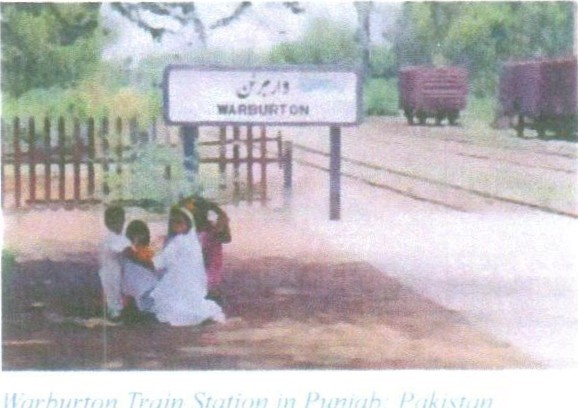
In later years, John was allotted land near Lahore for his services, and the town that grew up in the area was named Warburton. He built a house and a garden there. Later, a railway station was constructed for the town bearing the name Warburton. After retirement, he lived at Gilbert House in the hill station of Kasauli. He was out riding in October 1919 when he fell from his horse; a broken rib punctured his lung and he later died. Edmund Candler wrote an obituary hailing the former police man, saying: ·’he went through life with a brave heart and clean hands”.
John had two sons (Robert and Arthur, and four daughters (Durani, Lizzie, Minna and Muriel). His son Arthur served with the Burma Police. His grandson Julian Durani Warbrton ( 1894-1936) a!so joined the Punjab PoIice, where he had a distinguished career, winning the King’s Police medal and the OBE. He died at the young age of 41 . His wife Lucy Farrant joined the Intelligence Bureau as a cipher officer.
The Warburtons, with their Anglo-Indian heritage. illustrate how the barriers of race could sometimes be overcome in British India. Few Anglo-Indian families achieved so much.
* * *
Further reading:
Colonel Sir Robert
Warburton. Eighteen years in Khyber 1879-1898 (Lahore: Sang-e- meel
Publications 2007, Reprint of 1900 Edition)
G. D. Martineau. Controller
of Devils: A Life of John Paul Warburton. C.J.E. of The Punjab Police (Privately Published)
Hamid Hussain.
The Romance of Soldiering – Experience
of Colonial India. Defence
Journal, October 2002
Wing Commander® Sardar Ahmad Shah Jan
Saddozai. Saddozai: Saddozai
Kings & Vaziers
of Afghanistan (Peshawar: Public
Arts Press), 2007