A Trip to Pakistan

A heartfelt post consisting only of pictures and Urdu verses from Dr Hamid Hussain (about his latest trip to Pakistan). 
My recent trip to Pakistan was in the aftermath of the December tragedy in Peshawar.  More painful at personal level as it is my hometown but I and many had no illusions and though hoping against all hopes that this may be the last whole sale slaughter but we knew in our hearts that this is not yet the drop scene of the horror movie.  Surely, the ever enterprising militants showed up again and mowed down several Shia praying in a mosque in Hayatabad where brother and cousins of a very dear friend narrowly escaped death.   During my trip, many in different cities in Pakistan were kind enough to share their fears, anger and hopes with me and I’m thankful.  Sometimes few short verses give more meaning to feelings than lengthy explanations but off course it is only for Urdu readers. 
Regards,
Hamid
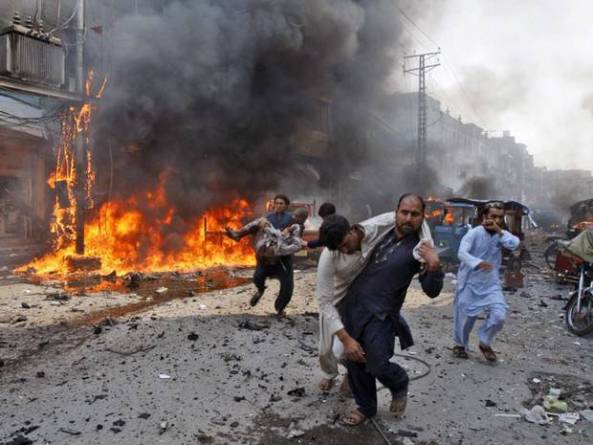
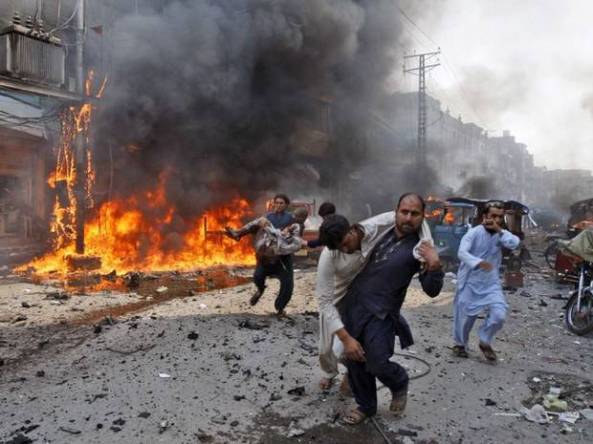
November 2009. Over ninety People killed in bombing of a crowded bazaar in Peshawar.
http://i.dawn.com/archives/2010/Website%20Metropolitan/81blast-608.jpg
زمیں سے آیے ھیں یا آسماں سے آیے ھیں
عزاب شھر پہ جانے کھاں سے آیے ھیں

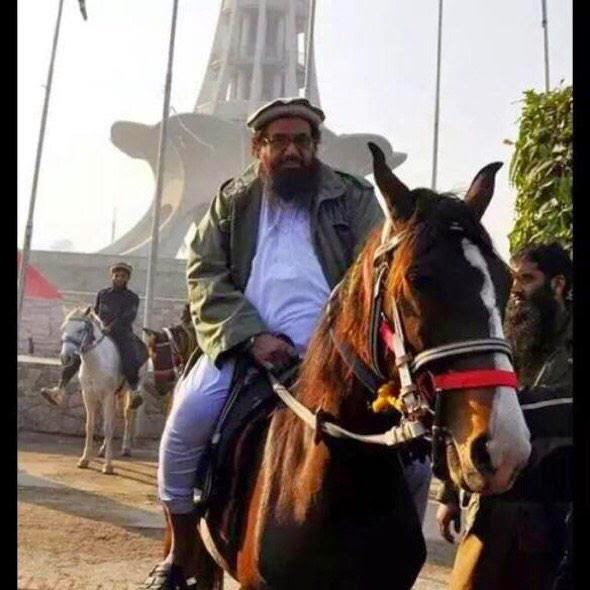
Fazlullah: Leader of Pakistani Taliban.
http://i1.tribune.com.pk/wp-content/uploads/2014/11/796877-MullahFazlullah-1416915303-971-640x480.JPG
حکم دے رکھا ھے شھروں کی تباھی کے لیے
کوی قانون نھیں ضل الھی کے لیے
Taliban Leaders
http://i.ytimg.com/vi/HTFT5KxExN0/hqdefault.jpg
لوگ ٹوٹ جاتے ھیں ایک گھر بنانے میں
تم ترس نھیں کھاتے بستیاں جلٓانے میں
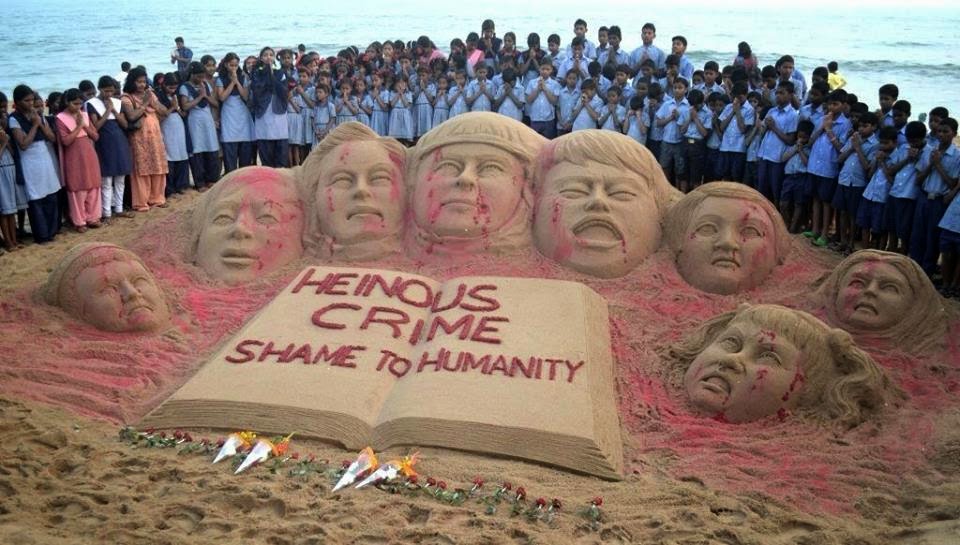
December 2014.  Pictures of some of the children killed in an attack on a school in Peshawar. 133 children and 16 members of school staff were killed.
http://www.independent.co.uk/incoming/article9931279.ece/alternates/w460/peshawar-victims.jpg
کب اٹھاے گا خدا حشر خدا ھی جانے
آدمی روز یھاں حشر اٹھا دیتا ھے
December 2014.  Family members mourning one of the victims of the school attack in Peshawar.
http://si.wsj.net/public/resources/images/BN-GA879_1216pa_M_20141216140555.jpg
اک صف ماتم بچھی ھے کوچہ و بٓازار میں
نوحہ خوانی ھو رھی ھے قصہ خوانی کی جگہ
December 2014.  Pakistani political leaders at a meeting after the tragedy of Peshawar.
http://i1.tribune.com.pk/wp-content/uploads/2014/12/808763-NawazPID-1418854179-848-640x480.jpg
وہ سبھی لوگ معاون تھے میرے قاتل کے
جن کو منصف نے بلایا ھے گواھی کے لیے
Leaders of religious parties of Pakistan.
http://cache2.asset-cache.net/gc/459933396-leaders-of-pakistani-religious-parties-raise-gettyimages.jpg?v=1&c=IWSAsset&k=2&d=GkZZ8bf5zL1ZiijUmxa7QZnVjXHr%2FeENur9RN7N5%2BDHhkmwZQK8LzxlT3CzvJ3FX
بشر مجبور اھل  مصلحت پر رحم آتا ھے
کے يے بیمار ذھنوں کو بھی چارہ گر بتاتے ھیں
November 2014.  Civilians killed in a suicide attack in Paktika Province in Afghanistan and laments by Afghans as well as many pakistanis questioning pakistan’s support for some Afghan militants.  For a decade they had been warning, pleading and begging Pakistan.
http://gdb.voanews.com/62BF73D1-7584-4B73-938D-5FF779E99B6F_cx0_cy5_cw0_mw1024_s_n_r1.jpg
وہ دھشتوں کو ھوا دے رھا ھے بستی میں
اسے بتٓاو یے تمھید ھے اجڑنے کی
March 2013.  A mob destroys 150 houses of Christian minority in Lahore
http://www.thenewstribe.com/wp-content/uploads/2013/03/Badami-Bagh-tragedy.jpg
رحمت سید لولاک پہ کامل ایماں
امت سید لولاک سے خوف آتا ھے
May 2010. Ninety four Ahmadis killed in attack on their mosque in Lahore.  Members of the community standing over freshly dug graves with names of the deceased in their hands.
<p>Members of the Ahmadi Muslim community hold the names of victims as they stand over their graves in Chenab Nagar, in Punjab's Chiniot District, on May 29, 2010.</p>
دل ھي تھے ھم دکھے ھوے تم نے  دکھا لیٓا تو کٰیا
خود بھی تو  بے اماں ھوے ھم کو ستا لیا   تو کٰیا
February 2013. Preparation of graves of Hazara Shia killed in Quetta.
http://www.hrw.org/sites/default/files/media/images/photographs/2013_pakistan_balochistan_PRESSER.jpg
ھمی کو قاتل کھے گی دنیا ھمارا ھی قتل عام ھو گا
ھمیں کنویئں کھودتے پھریں گے ھمیں پے پانی حرام ھو گا
 September 2008.  Marriott Hotel bombing in Islamabad, killing over 60 people.
http://express.com.pk/images/NP_LHE/20080922/Sub_Images/1100487791-1.jpg
کتنے خوش طبع ھیں إس شھردل آذار کے لوگ
موج خوں سر سے گزر جاتی ھے تب پوچھتے ھیں
Karachi: A city held hostage by political, ethnic, sectarian & criminal mafias.
http://amarguriro.com/wp-content/uploads/2012/04/protest.jpg
ھجرت کے چراغوں سے سجا رکھا تا جس کو
اس شھر کراچی میں تماشا بھی ھمیں ھیں
Baluch Rebels
http://s1.reutersmedia.net/resources/r/?m=02&d=20120905&t=2&i=649503315&w=&fh=&fw=&ll=700&pl=378&r=CBRE8840EWS00
ھم کسی اور کے ھو جائییں تو حیرت کیسی
تم نے جو زخم دئے ھیں انھیں بھرنا بھی تو ھے
Leaders of religious parties of Pakistan.
http://i.dawn.com/2012/02/difaa-i-pakistan-543.jpg
کسے سجدہ کرو آخر کسے أپنا خدا ماںو
کے ھر پتھر یھی کھتا ھے مجھ کو دیوتا ماںو
February 2013.  Pakistan Army Chief General Raheel Sharif chairing Corps Commander’s conference.
http://i1.tribune.com.pk/wp-content/uploads/2015/02/832055-CorpsCommandermeetingINP-1422972825-691-640x480.jpg
جو اندھیرا میری تقدیر نے پھیلایا ھے
إس میں شامل تیری زلفوں کی گٹھا بھی کچھ ھے
PTI Leadership standing with Mr. Munawar Hassan and Mr. Shaikh Rashid
https://encrypted-tbn3.gstatic.com/images?q=tbn:ANd9GcQ3Z2m2m3xSzb2fyR9DRxgcPGvFd16qAvjqVmzk3vitj7bQM5tq
دائروں
میں چلںے سے
 دائرے
تو بڑھتے ھیں
فاصلے نھیں  گٹھتے
آرزوئیں جلتی ھیں
منزلیں تمنا کی ساتھ
  ساتھ چلتی ھیں
صبح دم ستاروں کی تیز جھلملاھٹ کو
روشںی کی آمد کا پیش باب کھتے ھیں
إک کرن جو ملتی ھے آفتاب  کھتے ھیں
دائرہ بدلنے کو
انقلاب کھتے ھیں
Family member holding picture of one of the victims of Peshawar school attack.
https://news-images.vice.com/images/2015/02/08/families-of-peshawar-massacre-victims-demand-justice-during-emotional-protest-body-image-1423415453.jpg?resize=1000:*
ھزار دکھ مجھے دینا مگر خیال رھے
مرے خدایا مرا حوصلہ بحال رھے
August 2013.  Coffins of police officers killed in attack when they were attending the funeral of a fellow officer in Quetta.
Image result for attack on the funeral prayer of police officers quetta
ھوا کے ظلم سے بجھنا قبول ھے لیکن
ھوا کے حکم سے جلنا ھمیں قبول نھیں
Pakistan:
http://www.propertiesinpakistan.pk/wp-content/uploads/2011/08/pakistan-flag.jpg
یار مقتل سے بہر حال گزرنا ہو گا
بچ گۓ ہم تو کسی اور کو مرنا ہو گا
ٹال دینے سے کہاں مسئلہ حل ہوتا ہے
اک نہ اک دن تو کوئ فیصلۂ کرنا ہو گا
اگلی نسلوں کو تباہی سے بچانے کے لۂے
جو بھی کرنا ھے اسی نسل کو کرنا ہو گا
Indian school children holding candles in memory of school children killed in attack in Pesahwar.
http://gallery.oneindia.com/ph-big/2014/12/school-children-pray-during-a-candle-light-vigil-for-victims-of-a-taliban-attack-on-a-school_141880681170.jpg
محبت ایسا دریا ھے
کے بارش روٹھ بھی جائے
تو پانی کم نھیں ھو تا

End of the Muslim Brotherhood

This is an old post and I would probably change some things now (and in fact, will change some things soon once I do a new post) But this was lost when the old Brownpundits crashed and I wanted to recover it. So here it is
Posted on October 7, 2013 by omar

Hussein Ibish has written an article on the decline and (impending?) fall of the Muslim Brotherhood.

Reports of their death may be exaggerated, but surely the “Islamist political party” project is not doing well in most places. Turkey will be cited as an immediate counter-example, but I think AKP just hasn’t had the chance to really become too “Islamic” yet. If and when they do (and pressure to do so is bound to come from within, unless the project falls apart so badly in the middle east that Turkey gets away without trying it), they will find themselves in trouble as well.

The problem (in over-simplified form):

Modern states and modern politics (not just all the complex debates about how power should be exercised, who exercises it, who decides who exercises it, the theories around it; but also the actual institutions and mechanisms that evolved) arose first and foremost in Europe. There are surely things about that evolution that are contingent and could have been different elsewhere, but there are also many very fundamental features of modern life (modern levels of knowledge, modern industry and organization, modern understanding of human biology, psychology, sociology etc) that will still hold no matter where they develop on this planet. This is an extremely dense and imposing edifice. You cannot reject it and be modern in ways most people do seem to want to be modern (I have NEVER met an Islamist who did not want an air-force). Some non-western countries have already managed that knowledge transfer (e.g. Japan, South Korea), others are getting there (China), others hope to get there someday (India?) but Muslims are notable for wanting to get there while remaining medieval in terms of theology, law and politics. And not just at the fringes. Fringes are fringes everywhere. But in the Islamicate world, this dream is mainstream.

Why? maybe because while no serious theory of politics developed in Islamicate religious thought (Ibn Khaldun is not religious literature), some dreams/fantasies of an idealized “Islamic state” were allowed to percolate. The deal was that the ulama would throw this dream around at each other and leave actual ruling to the rulers (who in practice were always and everywhere guided by existing Byzantine, Persian and Central Asian models and by “mirrors for princes” kind of literature, not by the dreamworld of the “rightly guided caliphs”). Every Islamicate empire down to the late Ottomans ruled in the name of Islam, but they did so using institutions and methods that were typically West-Asian/Central-Asian in origin. And then the Europeans took off (literally by 1903 but earlier metaphorically) and that whole world crashed and burned.

And out of this wreckage, somebody dug up the old stories of the rightly guided caliphs; It seems to me that early fantasists (like Allama Iqbal) took it for granted that a lot of this is just propaganda and we all need propaganda, so “ek hi suf mein khaRey ho gaey Mahmood o Ayaz” (a famous verse of Iqbal, describing how Sultan Mahmood and his “slave” Ayaz could pray in one row; the wonders of Islam, that sort of thing) but they fully expected reality to be much closer to London than it was to Medina (witness his approval of the Grand Turkish assembly). To them, it was more like Chinese or Japanese reformers creating their own version of what worked and getting out from under the imperialist thumb. I am sure Iqbal did not expect to be the leading poet of the Pakistani Taliban! But over time, stories frequently repeated can come to be seen as the truth. Islamist parties want to create powerful, modern Islamic states. But the stories they are using are more Islamic than modern. Far more so than the early reformers perhaps realized. The result is that every party is all the time in danger of becoming hostage to those espousing primitive notions of Shariah law and medieval political ideas. It turns out that pretending to have “our own unique genius” was much easier than actually having any genius that could get the job done. Human nature being what it is, the easy path was taken.

A small role was also played by well-meaning Western supporters, who wished to help the “lesser races” out of their misery and raise their “self-esteem”, and piled it on thick. With validation coming from Westerners, some in the Westoxicated Muslim elites had little difficulty believing “our indigenous tradition, our glorious heritage” and so on.

And last but not the least, some of the brightest minds of our generation chose to be ruined by postcolonialism instead of opting for more wholesome pursuits like sex, drugs and rock and roll. Today, the Leftist intelligentsia (otherwise the natural opponents of the Islamist parties) in Muslim countries is so heavily contaminated with Western academic claptrap that some can be found cheering on the Islamists as signs of welcome “resistance to the dominant narrative”. OK, maybe this is not true of Arab countries, I dont know. It seems to be prevalent in a certain Western educated, upper-class Pakistani and Indian context though.

The results do not look pleasant.

PS: On Islamicate empires, my background view:

Islamicate empires (the dominant form of political organization in the middle east and South Asia since the advent of Islam) had a near-total separation religion and state. The empires were run as West Asian empires, mostly (almost totally) an evolution of previous imperial patterns in that region. The religion evolved within these empires, but had practically nothing to say about politics. Religion was part and parcel OF the empires, but religious doctrine provided practically NO guidance to the political process. The political process used religion but was neither derived from it, nor bound by it .

Islamic theology accepted practically ANY ruler as long the rulers were Muslims. An imaginary idealized Islamic state was discussed at times but had little to no connection with actual power politics, contemporary OR past.

Empires governed loosely and interfered little with the everyday religious rituals of the ruled, especially outside the urban core. The rulers were interested in collecting taxes and continuing to rule. Most of the ruled gave as little as possible in taxes and had as little as possible to do with their rulers. This is not a specifically Islamic pattern, but it was almost universal in Islamicate empires.

As a result, Muslim religious literature developed no serious political thought. “mirrors of princes” and pre-Muslim (or not-specifically Muslim) traditions guided actual politics, not some notion of “Islamic state”.

PPS: some misconceptions are coming up repeatedly:

1. That I am referring to ALL muslims. Not so. I am talking about Islamist parties, which are NOT a majority in most Muslim countries, but are mainstream in most. There is also the matter of the Islamist parties getting a certain authenticity cachet in the eyes of Western observers looking for “Muslim representatives” in the multiculturalist universe.

2. That this is about whether the Egyptian military or the Morroccan king are making X or Y correct choice. No, its not about them. Its a broader generalization; the MODE of failure may vary. But failure of the Islamist political project is inevitable…not because there can be no such project in principle, but because the project as it has actually developed in the 20th century is based on the twin illusions of “the ideal Islamic state” and “Islamic political science”…neither of which actually existed in history.

The signs when you become white

(1.) you actually start becoming punctual

(2.) your schedule runs months into advance
(3.) you stop socialising nearly as much
(4.) you start saying Christ inadvertently
(5.) when you and your other half are the only dark-haired (let alone dark-skinned) people in the room
(6.) your friends are based on shared hobbies
(7.) your social calendar revolves around societies
(8.) you would never dream to drop into other people’s homes as you used to
(9.) seeing people once a year is more than enough to sustain a friendship
(10.) Christmas becomes a BIG thing and you start thinking about bona fide Easter Eggs lol.
Bonus 11:
(11.) your ethnic identity becomes a very valuable tool to differentiate yourself from the white bread upper middle class, who are very homogenous & metropolitan at times.

Is Islam a Religion of the Book?

Razib put up an interesting post on this topic on his blog . I think his point is that no religion is a “religion of the book”. People make the religion and they remake it as time demands. Messily and unpredictably in many cases, but still, it moves. And in this sense, Islam is no more fixed in stone by what is written or not written in it’s text (or texts) than any other religion.

Someone then commented (and I urge you to read the post and the comments, and the hyperlinks, they are all relevant and make this post clearer) as follows:

“Well, if you take the Old Testament and Koran at face value, the OT is more violent. The interesting question is then why Islam ends up being more violent than Judaism or Christianity, and for that I agree you have to thank subsequent tradition and reinterpretation of the violence in the text. It appears that for whatever reason Islam has carried out less of this kind of reinterpretation, so what was originally a less violent founding text ends up causing more violence because it is being interpreted much more literally.”

I replied there, and then thought I would put that reply up as a new post here because I want to see what people think of this quick and off-the-cuff comment. THEN, I can maybe improve it in a final new post this weekend. So, without further ado, my comment:

There is an easier explanation. Islam the religion we know today (classical Islam of the four Sunni schools and it’s Shia counterparts) developed in the womb of the Arab empire. It is evident that it provided a unifying ideology and a theological justification for that empire (and in the case of various Shia sects, varying degrees of resistance or revolt against that empire), but at the very least, they grew and formed together; one was not the later product of the fully formed other. Being the religion of a (very successful and impressive) imperialist project, it’s “official” mature Sunni version obviously has a military-supremacist feel to it.

Whether the text canonized as “foundational document” does or does not fully explain the imperialism and supremacism is a red herring. The Quran is a fairly long book, but to an outsider it should be immediately obvious that you can create MANY different Islams around that book and if you did it all over again, NONE of them have to look like classical Sunni Islam. The details of Sunni Islam (who gets to rule, what daily life is supposed to look like, how non-Muslims should be treated, etc) are not some sort of direct and unambiguous reading of the Quran. Even the 5 daily prayers are not specified in the Quran. The schools of classical Sunni Islam are supposedly based on the Quran and hadith, but the Quran and the hadiths are clearly cherry picked and manipulated (and in the case of the hadiths, frequently just invented) based on the perceived needs of the empire, the ulama, the individual commentators, human nature, economics, whatever (insert favorite element here).
So in principle, we should be able to make new Islams as needed (and some of us have indeed done so over the centuries…the Ismailis being one extreme example) and I am sure many of us will do that in the days to come as well. The Reza Aslan types are right about that (though i seriously doubt that HE can make anything lasting). In fact, in terms of practice, millions of Muslims have already “invented new Islams”. Just as a random example, most contemporary Muslims do not have concubines and do not buy and sell slaves (and find the thought of doing so shocking). They take oaths of loyalty to all sorts of “un-Islamic” states and most of them turn out to be loyal at least to the same degree as their other fellow citizens of various hedonistic modern states. And so on and so forth.
What sets them apart is their inability (until now) to publicly and comfortably articulate a theological framework that rejects medieval (aka no longer fashionable) elements of classical Sunni Islam. And this is especially a problem in Muslim majority countries. What stops them? I think apostasy and blasphemy laws (and the broader memes that uphold those laws) play a big role. King Hussein or Benazir Bhutto or even Rouhani may have private thoughts about changing X or Y inconvenient parts, but to speak up would be to invite accusations of blasphemy and apostasy. So they fudge and do one thing while paying lip service to another. Unfortunately, this means the upholders of classical Islam (and ISIS and the Wahabis are not as far from the mainstream Sunni Ulama in theory as is sometimes portrayed, though clearly they are pretty far in practice) have the edge in debates in the public sphere. This IS a serious problem. But the internet has made it very hard to keep inconvenient thoughts out of view. So there will be much churning. Eventually, some countries will emerge out of it better than others.
ISIS itself will not. Of course, in principle, anything is possible. But we can still make predictions based on whatever model we have in our head. Like most predictions in social science and history, they will not be mathematical and precise and our confidence in them (or our ability to convince others, even when others accept most of our premises) will not be akin to the predictions of mathematics or physics. But for whatever it’s worth, I don’t think ISIS will settle into some semi-comfortable equilibrium. They will only destory and create chaos. And eventually they will be destroyed, though it is possible (maybe even likely) that large parts of Syria, Iraq and North Africa could become like Somalia. Too messy, too violent and too poor to be worth the effort of colonizing even by intact nearby states. But probably not forever. The real estate is too valuable and eventually someone will bring order to it. Probably using more force and cruder methods than liberal modern intellectuals are comfortable with.

Indian Troops in East Africa

As usual, a post from Hamid Hussein, this time about the British Indian army in East Africa, with some comments about “all Muslim regiments’ and neo-orientalist claptrap about the Pakhtoons and the British. Enjoy. 
Omar 
Major ® Agha H. Amin; an authority on history of subcontinent armies sent a reminder about 129th Baluchistan Infantry in E. Africa.  Few questions about Indian soldiers in E. Africa in Great War as well as some ancillary long forgotten aspects of military archeology came my way and following was the outcome.  Only for those interested in military history of the region.
Indian Soldiers in East Africa in Great War
“We are too much inclined to think of war as a matter of combats, demanding above all things physical courage.  It is really a matter of fasting and thirsting; of toiling and waking; of lacking and enduring; which demands above all things moral courage”.   Sir John Fortescue
East Africa is a forgotten chapter of Great War.  Several Indian battalions served in East Africa.  British East Africa is now Kenya and German East Africa is now Tanzania, Rawanda and Burundi.  German army in East Africa was calledSchutztruppe.  Indian Expeditionary Force (IEF) – C commanded by Brigadier ‘Jimmie’ Stewart arrived in September 1914.  This force was predominantly from state forces with about half battalion strength each from Rampur, Kapurthala, Bharatpur and Jind state forces.  Only one regular Indian battalion 29th Punjabis was part of the force.  Indian Expeditionary Force (IEF) – B under the command of Major General Aitken consisted of 27th Bangalore Brigade (2ndLancashire, 101st Grenadiers, 98th Infantry and 63rd Palamcottah Light Infantry – four companies of Madrassi Muslims, two Tamils and two Christian Madrassi companies) and Imperial Service Brigade (Gwalior Rifles, 2nd and 3rd Kashmir Rifles).  This was followed by battalions re-deployed from European and Egyptian theatres as well as.  As usual unsung heroes of the theatre are pioneers, railway volunteers and sappers and miners who were superb in the most trying conditions.

 In general, troops deployed from European theatres had performed well but suffered horrendous casualties and turnover of recruits and officers was very rapid.  The role of state forces was essentially ceremonial and they were neither armed nor trained for war.  Each state contingent was different from other and they had never even paraded together let alone trained for any significant military maneuver.  Most of the area was unmapped but Indian units didn’t get maps where they were available.  During the whole campaign, troops were on half ration.  Harsh weather, terrain, mosquitoes, flies, fleas, fever, malaria, dysentery and man eaters and alligators took more toll on all soldiers than enemy’s bullets.  Despite all these difficulties, Indian soldiers performed very well and discipline of Indian troops was exemplary.  Discipline of Indian troops was much superior to others especially South African soldiers when a number of times they were busy looting the towns. 
Most of white troops went out of action due to disease.  British political officers proved to be superior in linking up with local communities and raising African infantry.  New battalions of King’s African Rifles (KAR), Hausa Regiments and a Nigerian Brigade were now effective British force commanded by Brigadier F. H. Cunliffe in addition to Indian troops.  Germans lost about one third of their force to sickness but still had about 14,000 natives and 2000 European soldiers.  Local African soldiers called Askaris trained and led by German officers also performed very well.   
Disproportionately, large number of Pathans in different units served in E. Africa.  Having said all this, it should be remembered that Indians made only a very small part of the force operating in E. Africa and majority of troops of all arms were South African (infantry, cavalry and artillery).  South Africans had initially a very low opinion of Indian troops referring to them as ‘coolies’ but after seeing them in action had great respect for them.  Union Jack flying over Kibata belonged to 1/2 KAR and was a frequent target of German soldiers and gunners. After the battle 1/2 KAR presented this flag to 129th Baluchistan Infantry. 
129th Duke of Connaught’s Own (DCO) Baluchistan Infantry (now 11 Baloch of Pakistan army): This battalion came to East Africa from the killing fields of France.  This battalion has the distinction of being first in two aspects; first British officer casualty of Great War (Captain Vincent) and first Indian winner of Victoria Cross Sepoy Khudadad Khan). It narrowly missed being first Indian battalion to lock horns with Germans when their comrade of 57th Wilde’s Rifles became first Indians to fire at Germans. 
On the eve of Great War, infantry battalions were organized as four double companies (total 8 companies).  It was an all Muslim battalion and had six Pathan companies – all trans-frontier (three Mahsud, one Mohmand and two Afridis; Adam Khel Jowaki) and two Punjabi Muslim companies.  One double company of 127th Queen Mary’s Own Baluchistan Infantry was attached to bring up the battalion to war establishment (desertion of trans-frontier Pathans from some regiments resulted in discontinuation of their recruitment.  This is a whole separate subject and I have been working on it for some time so I may dwell on it sometime in future). Battalion suffered heavy casualties in France with repeated replenishments from sister as well as other battalions (Mahsud and Wazir Pathans from 124th Duchess of Connaught’s Own Baluchistan Infantry, Orakzai Pathans and Baluchis of 127th Baluchistan Infantry).  Only 4 British and 5 Indian officers and less than two dozen sepoys of original contingent were unhurt after a year of service in France.  It left for E. Africa under the command of Lt. Colonel H. Hulseberg DSO of 127th Baluchistan Infantry and spent one year in E. Africa (January 1916 – January 1917). 
Indian component of Ist East African Division consisted of 129th Baluchistan Infantry and 29th Punjabis (they were part of 2nd East African Brigade.  Later 40th Pathans joined the brigade).  Later, in a battle when CO of 29th Punjabis Lt. Colonel H. A. Vallings was killed and Adjutant wounded, soldiers were lost.  Later 30 soldiers of 29th Punjabis were court martialled for leaving battle with self inflicting hand wounds. 
From 1914 to 1918, four and a half thousand men of honor served the battalion’s colors with over three thousand and five hundred casualties.  Many lie buried in hallowed grounds all over the globe.  Many indomitable men of the battalion belonging to different ethnicities like Subedar Kambir Khan; a Baluch, Subedar Sarbiland; a Pathan and Jamadar Fateh Haider; a Punjabi Muslim and long list of Indian Order of Merit (IOM) winners are now just names on the forgotten pages of history.  Naik Alim Khan (127th attached) during a scouting patrol spotted a five men German picket and this superb marksman killed four of them and the fifth survived only by fleeing.  The ultimate compliment a regiment can get is what its adversary thinks about the soldiers.  German Commander Lettow-Vorbeck said about the regiment that “… the 129th Baluchis …..  Were without a doubt very good”.  A memorial in memory of contributions of all Baluchistan Infantry regiments in first world war at Frere Hall in Karachi is a tribute to sacrifices of many such men of honor.
130th King George’s Own Baluchistan Infantry (now 12 Baloch of Pakistan army): The deployment of 130thBaluchistan Infantry in E. Africa is interesting.  At the start of war, when battalion was in Calcutta getting ready to be deployed overseas, a Mahsud sepoy attacked battalion’s second-in-command Major Norman Ruthven Anderson who later died of his wounds.  Battalion was sent to Burma where two Pathan companies mutinied.  200 soldiers were court martialled and two soldiers executed.  British commander in East Africa Major General Richard Wapshare specifically requested deployment of 130th to East Africa.  I’m puzzled by why he specifically asked for the battalion. Battalion received double company of 46th Punjabis and it arrived under the command of Lt. Colonel P. H. Dyke (later Lt. Colonel C. U. Price) in February 1915 to become part of Ist East African Brigade (130th Baluchistan Infantry, 3rd Kings African Rifles, 2nd Loyal Lancashire and 2nd Rhodesia Regiment) commanded by Brigadier Wilfred Malleson of 2ndEast African Division commanded by General Michael Tighe.  Battalion participated in the battle of Latema. 
40th Pathan (now 16 Punjab of Pakistan army):  On the eve of Great War, battalion was in China and arrived in France in April 1915 and fought under Jullundur Brigade.  Battalion was decimated in the killing fields of France in the Second Battle of Ypres losing most of its officers.  It arrived in E. Africa in January 1916 under the command of Lt. Colonel Henry Tendyll.  40th Pathan was originally an all Pathan Muslim battalion (in 1901 the composition was changed with one company Orakzai, half company each of Afridis and Yusufzais, one company of Punjabi Muslims and one company of Dogras). That diluted to some extent the flavor of the original élan as well other naughtiness.  Battalion was nick named ‘Forty Thieves’ as whenever stationed at a cantonment things will mysteriously disappear and CO earned the nick name of ‘Ali Baba’.  Battalion’s marching tune was Pushtu song ‘Zakhmi Dil’ played on dhol andsurnai with strong homosexual connotations.  This song was later adopted by pipe bands of Ist and 2nd Battalions of Seaforth Highlanders.  Any officer commanding 700 young men living together in close quarters has to deal with many naughty souls but Commanding Officer of a battalion with significant number of Pathans had his hands full with many intricate issues such as how to deal with two young sepoys insisting to be put together at night for sentry duty, a young recruit putting a bullet through a randy old Subedar for undue advances or keeping a close tab on home furloughs to make sure that two soldiers with blood feud in their village are not sent home at the same time else one will not return.  
57th Wilde’s Rifles (Now 9 Frontier Force of Pakistan army): This battalion went to France in 1914 with four companies instead of eight.  Class composition was one company each of Sikh, Dogra, Pathan (Afridis) and Punjabi Muslims.  After a year in the killing fields of France, battalion went to Egypt for six months before landing in East Africa in July 1916.  Commanding officer was Lt. Colonel Thomas Willans DSO.  Battalion was part of 2nd East African Brigade.  Pathan Subedar Arsala Khan Afridi winner of MC and IOM in France (already IOM winner in 1908 Mohmand expedition) also served in E. Africa where he was wounded.  He earned an OBI for service in E. Africa and became Subedar Major of the battalion. 
57th landed in E. Africa with 11 British officers, 21 Indian officers and around 850 men.  Merely two months later, only 3 British officers and 180 men were fit for service.  An amazing incident happened here.  No: 2 Pathan company commander was Major James Buller.  During an attack on entrenched German position, he shot at German company commander Lieutenant von Ruckteschel but bullet went through the hat.  Ruckteschel fired back severely wounding Buller.  Buller was captured and sent to German hospital in Dar ul Salam where he was nursed back to health by a kind nurse who was wife of Ruckteschel.  Later, Ruckteschel’s leg was shattered by a shell.  Battalion returned to India in October 1917 leaving behind about 35 comrades buried in E. Africa but were proud owners of the German Imperial flag that flew on Governor’s House of German East Africa.  Another irony of the times is the story of Havaldar Salim Khan.  He survived the killing fields of France, German bullets and shells, malaria, snakes, alligators and man eaters in East Africa, won an IOM for a daring attack on a German machine gun position capturing it but killed by fellow Zakha Khel tribesmen when he was going on his well earned pension in 1921.
One squadron of 17th Cavalry:  This squadron reached E. Africa in February 1915.  17th Cavalry (later in 1922 amalgamated with another all Muslim cavalry regiment 37th Horse to form 15th Lancers) was another all Muslim regiment consisting of two squadrons of trans-frontier Pathans and two squadrons of Punjabi Muslims.  The squadron sent to E. Africa was a composite 120 men Pathan squadron (60 from A and 60 from B Pathan Squadrons) commanded by Major R. C. Barry-Smith.  Indian officers were Risaldar Usman Khan and Risaldar Sajid Gul.  Squadron became orphan when two of the three British officers of the contingent were killed in an ambush until replacements came from India.  Many horses were lost due to harsh climate and horse illness.  After two years, squadron returned to India leaving twenty comrades buried in E. Africa.
Colonel Paul Emil von Lettow-Vorbeck: He was commander of German forces in E. Africa.  There is no doubt that he was head and shoulders above all his British rivals in the theatre.  He was master of planning, logistic details, tactics and almost always one step ahead of his British foes.  For four years, he fought, feigned, disappeared, re-appeared and engaged his rivals in a lengthy retreat and in the process kept a large number of troops under British command entangled.  However, inter-war German writings raised him to a mythical level which is not accurate.  His success was partly due to inept British military leadership in the theatre but then he who takes advantage of foe’s mistakes is the man who wins.  First German victory at Tanga using conventional strategy clouded Lettow-Vorbeck’s judgment and he didn’t change his strategy despite changing circumstances.  He assumed that another victory like Tanga would end the campaign in his favor despite two alternatives offered by his subordinates (Captain Max Wintgens and Captain Heinrich Naumann advised for guerrilla warfare campaign by deep raids which they had successfully applied and Captain Max Looff’s suggestion about positional strategy to take advantage of the terrain and concentrate dwindling German forces in selected areas).  Lettow-Vorbeck continued on his own path that ultimately destroyed his forces and when finally he realized it was too late.  All this however doesn’t diminish his achievements. 
He was student of Chief of German General Staff Graf Alfred von Schlieffen; master of maneuver warfare.  He was banished to remote E. Africa because he was not much liked by General Staff due to his personality as well as his dogmatic adherence to conventional warfare.  The last act of maverick Lettow-Vorbeck during his retreat was another brilliant maneuver surprising the 900 strong Portuguese contingent under Major Pinto on his heels.  He re-crossed the river, made a swift encircling march and after a brief sharp encounter, 700 Portuguese surrendered and provided Lettow-Vorbeck much needed supplies especially ammunition. Clothing his men in Portuguese uniforms and armed with foe’s arms, he captured Fort Naguri.  Lettow-Vorbeck was uncompromising to the extent of ruthlessness and expected one hundred percent effort from his subordinates.  After an encounter, he sat on judgment of one of his subordinates Major Fischer and after announcing that Fischer has not tried hard enough to block enemy’s advance handed him revolver.  Fischer dutifully took revolver from his commander went away and shot himself.  South African commander General Jan Smuts acknowledged his foe by stating that “The enemy’s stubborn defense of his last colony is a tribute to the military qualities of Von Lettow”.  (John Nesselhuf’s master’s thesis on the subject is a very good analysis looking at the alternative view of Lettow-Vorbeck).
I found Edmund Dane’s British Campaigns in Africa and the Pacific 1914-18 and Ross Anderson’s Forgotten Front: The East African Campaign 1914-1918 good comprehensive review of the E. African campaign. 
·       Above narrative clearly demolishes at least one myth prevalent in Pakistan especially among army officers that there were no all Muslim regiments in Indian army.  At different time periods there have been several all Muslim regiments and I think Major ® Agha H. Amin has given a detailed account a while ago.  A similar myth is about Pathan being anti-British where hostility of a segment of trans-frontier Pathans is generalized.  They ignore the simple fact that trans-frontier Pathans generally didn’t accept central authority whether Mughal or even their own kin i.e. Pathan rulers of Afghanistan.  They flocked in droves to serve East India Company and later British Crown all over the globe as well as acted as game keepers in their own hinterlands joining scouts.  Pathans were way over represented in Indian army compared to their population.  Numbers of Afridis and Mahsuds is simply astounding. I’m currently working on Pushtun recruitment in British Indian army during Great War.  There were whole companies of Yusfuzais, Khattaks, Mohmands, Orakzais, Mahsuds and Afridis who bravely fought under Union Jack for the pig eating Queen (later King).  Pondering over the Khyber Agency political agent’s files at Peshawar archives of that era I found long lists of many who gave up the ghost in the killing fields of Europe, Mesopotemia, Middle East and Africa.  What is the lesson from this page of history? When properly trained and led by first rate officers even alien who shared nothing with their soldiers and look at the results.  Zakha Khel Afridis of Khyber Rifles with only four years of service were steady as a rock even against their own kin in a battle.  In 1897, when whole frontier was aflame and sole British officer of Khyber Rifles was not allowed to go back to Landi Kotal to join his soldiers, one indomitable Subedar Mursil fought to his last breath in a situation where one son was with him while two sons were with the tribesmen attacking his post.  Compare it to what happened recently.  Poorly trained and horribly led scouts would not fight even for their own homes and hearths. Even in the darkest days of the Empire, a scout would risk his life despite severe wounds to bring back his rifle with his head held high let alone think about surrender.  And here you have dozens including regular troops surrendering without firing a shot or deserting.  Officers who should have been court martialled for their acts of omission and commission were promoted and given prized appointment ensuring that rot went all the way up the chain of command.  Things have improved a lot but still there is lot of room for improvement.  At Moschi in E. Africa, a Mahsud sepoy hardly out of his boyhood was hit with two bullets in his left arm.  When Company Commander ordered the company to rise and reinforce the firing line, he saw the bleeding Mahsud and telling him to report to hospital.  Cocky Mahsud refused telling his Company Commander that ‘you have two arms, you take my rifle and I have one arm, I’ll take your revolver.  We will both go to the perimeter’.  In 1930, only three resolute British and three Indian Scout officers (one Swati, one Afridi and one Khattak) lead their men to defend the Sararogha fort against a large lashkar.  Everyone knew that government was here to stay and not going to run away no matter what is the challenge and the result was that a strange combination of an outlaw, a Khassadar Subedar, a local Mahsud Malik and a retired Subedar Major Mir Badshah Khan stood as a rock against heavy odds and prevailed. (this incident is described in detail by Charles Chenevix Trench in his great work The Frontier Scouts).  In 2008, the same fort was lost to militants due to strategic myopia, pathetic indifference at all levels and due to the fact that men with lot of brass on their shoulders but with feet of clay were at the helm of affairs.  In 1888, the death of only two British officers and four soldiers of 5th Gurkha Rifles moved the whole government machinery and Black Mountain expedition was launched.  Resoluteness of government was for everyone to see and the result was that 300 Afridi volunteers of Khyber Rifles joined the fray.  Over a century later, dozens of soldiers were abducted and beheaded, two and three star officers were killed in major cities and nobody seem to be in any hurry.  No surprise that chair lift operators (Mullah Fazlullah) and bus conductors (Mangal Bagh) made a mockery of state authority.  The wages of such incompetence are the tragedies that militants are slaughtering children in schools and blowing dozens in attacks on mosques. Now Pakistan will need a lot of blood and treasure to reverse the rot. 
·       Indomitable Baluch fought for the alien sovereign with pride hundred years ago and hundred years later his alienation from the state of Pakistan is almost complete.  Wisdom of Solomon and patience of Job will be needed to bring him back into the national fold but some in high temples thought that dumping Baluch bodies will keep the nation together.  They forgot that we have seen this movie before and it ends very badly.
Hamid Hussain
February 2, 2015

Caste “privilege”, the Americal Dalit speaks

Over at The Aerogram there is an interesting piece up, Caste Privilege 101: A Primer for the Privileged. The main downside of the piece is that it is standard post-colonial “social justice warrior” claptrap. Unless you buy into the premises a lot of the rhetoric falls flat. You can really write a regular expression to just “search & replace”, and it could be about another set of people. Really the post just leverages pretty generic ideas about race privilege, and interpolates them into a South Asian context.

But the good part is that it is interesting that the experiences of low caste South Asians is highlighted. There simply aren’t that many in the Diaspora…or are there? Perhaps they “pass” as this woman and her family have done? And it is a nice reality check to note that what many South Asians consider normative South Asian behavior and folkways are actually just representative of a relative thin and elite strata of Indian cultures. It is also quite sweet and delicious when the authors suggest that many South Asian Americans with names like Iyer and Mukherjee who play the part of “oppressed person of color,” despite a customary elite family background, and impeccable educational qualifications and a high income, are oblivious to the structures of privilege in which they partake while excoriating white society.

The major issue I have is that in the process of lecturing (and frankly hectoring) higher caste Indians the authors express their own narrow viewpoints. For example, when talking about religious differences between low castes and higher castes, they excise Muslims out of the equation. As Muslims are about 1/3 of the South Asian population this seems an important lacunae, and as we all know there are caste and caste-like structures within Islam too, some of which have been imported from Hinduism (e.g., “Muslim Dalits”).

Finally, a lot of the generalizations about upper caste Indians seems to be bullshit. American born Indian Americans intermarry at nearly a 50% clip. I really don’t think that caste matters that much when they (we) are marrying people of other races at a very high rate. The fact is that no matter if you are a fair skinned Pandit or a dark skinned Nadar in this country you’re a “sand nigger.” Next to that all the caste posturing looks like a farce.

Victimhood, Desi Post-Marxists, Social Justice, Racism and other random thoughts

Just some random thoughts trigerred by a question that Razib asked and a post on FB.
The question:

Why are all South Asian American websites so Left?
Any thoughts? It’s a consistent tendency that explicitly South Asian (de facto Indian) websites tend to have a Left inflection. This means that they’re soaked in critical race theory assumptions, but also genuflect to broader Left liberal concerns and priorities (e.g., “black lives matter” or the boycott of Israel). My hypothesis is that it’s a selection bias in the type of people who set up these websites, and read these websites. Though the average South Asian American is a liberal Democrat, they’re not that political, and too busy to know much about “intersectionality.” There are conservative South Asian Americans in the public intellectual space, but they are people like Avik Roy or Reihan Salam, whose focus is rarely on South Asians (though Reihan brings up his Bangladeshi background now and then).”


I think (and I think Razib would agree) that not ALL South Asian websites have a Left inflection. For example, I am sure there are a number affiliated with Hindutvadis/RajivMalhotra types that are explicitly anti-Left wing. And I am sure there are a number affiliated with various Muslim groups that are in their own world, impossible to classify as left or right, just not-WEIRD.  But that being said, there IS a very distinct leftward tilt in the highly educated westernized South Asian crowd. Since this is exactly the crowd one finds in universities and “serious” media and arguing in “intellectual” blogs and so on, their visibility is far beyond their actual numbers. And it is not just about visibility. Most people (in some sense, almost ALL people) get their views and opinions ready-made from a relatively small group of opinion-makers. The extraordinary dominance of some (not all; some process of meme-selection does go on) left wing tropes in this highly educated and influential group therefore translates into wide (mostly uncritical and superficial) acceptance of many of these tropes within the larger South Asian community.
Which then brings us back to why? I have a few thoughts:

1. Victimhood bonus. I really think this is the single most powerful motivator. Many highly educated Indians (and Pakistanis, Bangladeshis, etc) come from an elite background and any reasonably consistent left wing analysis would have them feeling guilty about their position back home. But suddenly, here in Columbia university, you can get to play victim at no cost (and with some benefits..especially if you stay in the humanities, in which case career choices and peer groups will reinforce and support that choice). It is a VERY tempting offer and only the most churlish and obstinately pig-headed can pass it up. Racialicious is delicious. And this bonus is on offer from the Left, not the Right. That fork in the road and the choice to be made are therefore completely clear and impossible to resist.

2. Marxism from back home. Marxism was really the default ideology of the first anti-colonial generation in Asia and Africa. In some places, where real Marxist revolutionaries tried armed violent revolution and got put down (as in Malaysia) or were pre-emptively slaughtered by CIA-supported generals (Indonesia) the situation was more muddled, but in the Indian subcontinent the educated elite was highly influenced by Marxism. Most of us brought that vague left wing symnpathy with us to the West (it was not very deep. But then, it never is, anywhere; most left wing parties have 3 ideologues who actually try to read Capital, the rest are lucky if they can read the manifesto) and therefore naturally gravitated to the left in the West. The Left in the West had meanwhile moved on to post-Marxist pomo poco bullshit and that actually proved more attractive to most elite-origin desis than the more “economist” and organized revolutionary Marxism of the old days. No need to be poor, no need to be hunted by the FBI, and all the benefits of being on the right side of history. Who could resist?

3. Racism. Obviously there really IS a substratum of race conciousness and of explicit, or now mostly implicit,  racial superiority in European and North American civilization. This is owned and massively condemned by the new Left (in fact, it has almost become the default organizing principle of the new Left, in place of proletarian revolution) and denied or (on the fringes these days) owned and honored by the Right. The choice is clear.

4. Ignorance. Never underestimate the ignorance of the educated human specimen. Since, unlike our working class fellow immigrants, we are mostly ignorant and simultaneously proud of our vast erudition, there is little chance we can spot blind spots, misrepresentation or total muckups in the Left wing post-marxist world after we move into it. We read the correct books, follow the correct opinion makers and become more and more ignorant and more and more proud of our vast knowledge. The clear choice is then reinforced. No surprise.

5. Truth. And last (and maybe least, or am I being too harsh?) there are elements of truth in the left wing position. The fetishization of individualism and guns and whatnot on the Right in America for example is just not very appealing. Environmentalism, healthcare, education, social justice, tolerance…on so many things the claim is that the left has the humane, reasonable and progressive position. And this claim has enough truth in it to keep the left the default setting for most educated immigrants. There is a “thinking right” and there are great inconsistences and even idiocies in the actual details of the “Left” once you get into it, but once you step ashore on the left side of the beach, you rarely even get to see those… So you keep going. Something like that.

Finally, and at a tangent to this whole business. The young people so tragically shot in N. Carolina. Some of our friends were naturally concerned that this reflects a new level of Islamophobia in this country. I had posted a link to a story about lynchings in the deep South (a century ago, things have changed a lot, even in the South) and a good friend commented that now they are lynching Muslims. My first muddled thoughts were (as usual? I am beginning to suspect I am sometimes just contrarian for the sake of being contrarian? maybe so) to deny that this is a lynching. I am copying my FB comments here without editing (you can figure out the context pretty easily) just to get thoughts from other better informed (and perhaps wiser) commentators:

Me: The “Muslim Lynching” in N Carolina, while a huge tragedy for those three good people and their grieving families, was NOT a lynching at all. That was my point. Actually this thought first came to me several years ago in LA. I was at an award ceremony for a (good) South Asian social work organization and some of the speakers were laying it on about their struggle against oppression and racism. I happened to be sitting next to a Black lady and after I told her that I did not think our experience had ANYTHING in common with the Black experience, she felt permitted to open up…and she did. She said she was happy to work in solidarity with people like us, but for us to somehow claim victimhood in the same ranks as Black Americans was, frankly, very very irritating to her. I agreed with her completely and we parted in perfect harmony 🙂 . Since then, I have had other reasons to get irritated by the “social justice warrior” types and have had occasion to think that Neitzsche (PBUH) may have had a bit of a point about such things. As a non-aristocrat (and unlike you, not much of a Roman General at heart 😉 ) I am not exactly pining for the return of aristocratic values, but I cannot help the occasional thought that White people who write for “The Nation” and whine about White supremacy and the poor huddled masses of Brown people being fooled by their superiors are, in some sense, in the happy position of whining about being so bloody superior..and of course, there are other more substantive problems with the whole identity politics run amuck thing.. .anyway, I am not sure it reflects well on us….this thought needs more serious elaboration and is liable to massive misunderstanding, so I will leave it here, but no, I dont think Carolina was ANYTHING like a lynching. It’s not a lynching when the local community goes around trying to be nice to the lynched..

To which a friend responded:
It’s a terrible tragedy what happened in NC. I’m sure the victims’ faith had something to do with it, but it’s also important to realize that it’s extremely hard to demand an understanding and compassionate attitude from the non-Muslim US public when the later has been witnessing unimaginable scenes of carnage running on a daily basis from the Muslim quarters of the world—beheading, burning people alive, rape, and plunder, being done systematically and in keeping with the ideological framework of Islam. I believe this was a random act of terror and doesn’t represent the mainstream American attitude. Comparing this tragedy by invoking lynching of black people is disingenuous or rather simplistic. In these trying times one has to be mindful that If only 10% of the Muslims are to be the extremists type, the number is higher than this, we are talking about 150 million strong diehard army which is glad to slay and get slain in their march to subjugate the entire world to their god, as per their holy book, surah 9111. It’s a staggering number indeed that’s diffused globally, and not to mention a good 50% of their sympathizers, the useful idiots, the clueless moderates. Eventually if moderate Muslims don’t accept this as a reality they are the ones who will be the next victims, either at the hands of the extremists or the hate crimes that’s bound to shoot up in the wake of atrocities which are too many to count. Islam has the crisis of ideology, an ideology that is intertwined with Muslims identity. Ultimately, it’s a crisis of Muslim identity. It’s not looking good for a very long time to come.


Me:
  I will take the opposite tack and suggest that the “fear of Muslims” and their impending clash with civilization is itself exaggerated. I think IS type atrocities will mostly occur in Muslim countries. Most European Muslim tourists-killers going to IS will get blown up by barrel bombs and go on to meet their houri quota rather soon. Few will make it back to explode in Europe and VERY FEW will make it to America (two oceans and Canada, alhamdolillah). Neither the terrorist campaign nor the backlash will be as huge as we sometimes fear. Or at least, that is my guess for today. Tomorrow, I may be in a different frame of mind…

 Him: Technically you are correct. Omar Ali. But humans are not that objective when it comes to matters pertaining to faith and scenes of daily brutality committed in the name of religion. Perception is what matters in these situations.

Me: My thought was that we may see those scenes and think about them more than the average American. Most people have already classified “those barbarians” as barbarians. But then they have a life to live and I dont find most Americans obsessing about it…Maybe I am wrong, but that is how it seems right now.

HimThose ‘barbarians’ carry a black flag inscribed with the first kalimah. Images like these make it very easy for the mind to associate.

Me: again, my thought was that the kalima and so on are more OUR crisis and OUR problem. Hardly worth notice for most Americans…

I have to run, but what do you think??

Why are all South Asian American websites so Left?

Any thoughts? It’s a consistent tendency that explicitly South Asian (de facto Indian) websites tend to have a Left inflection. This means that they’re soaked in critical race theory assumptions, but also genuflect to broader Left liberal concerns and priorities (e.g., “black lives matter” or the boycott of Israel). My hypothesis is that it’s a selection bias in the type of people who set up these websites, and read these websites. Though the average South Asian American is a liberal Democrat, they’re not that political, and too busy to know much about “intersectionality.” There are conservative South Asian Americans in the public intellectual space, but they are people like Avik Roy or Reihan Salam, whose focus is rarely on South Asians (though Reihan brings up his Bangladeshi background now and then).

Colonialism has a lot to answer for.

Hello from Phnom Penh.

It’s interesting to note that in SE Asia the country that has thrived throughout is the one that kept its independence (however nominal), the Kingdom of Siam (Thailand).

Shia-killing in Pakistan: Background and Predictions

In the latest gruesome attack on the Shia community in Pakistan a suicide bomber blew himself up in a crowded ImambaRa (Shia mosque) and killed over 60 people, including several young children. People are still picking up pieces of their loved ones (literally, see video here if you dare). Who are these killers? how do they convince young people (some reports say the killer in this case was a young man  named Abubakr) to go and blow themselves up in a crowd of civilians? For some background, see below.
image
One question i have not been able to resolve: what is the PROXIMATE cause of individual attacks like these? do the LEJ leaders send bombers to blow up people randomly? or do they have specific tactical objectives? by tactical objective I mean things like “release person X or we kill a lot of people” or “pay us X or we blow up shit”…things like that? Will some knowledgeable people from Pakistan comment? Thanks

On to the background: the following is a slightly edited version of an older post on 3quarksdaily. I have added a few words at the very end about how the response of the state looks ineffectual.

Shias (mostly Twelver Shias, but also including smaller groups of Ismailis and Dawoodi Bohras, etc.) make up between 5 and 25% of Pakistan’s population. The exact number is not known because the census does not count them separately and pro and anti-Shia groups routinely exaggerate or downgrade the number of Shias in Pakistan (thus the most militant Sunni group, the Sipah e Sahaba, routinely uses the figure of 2% Shia, which is too low, while Shias sometimes claim they are 30% of the Muslim population, which is probably too high).

Historically Shias were not a “minority group” in Pakistan, in the sense in which modern identity politics talks about “minorities” (a definition that, includes some sense of being oppressed/marginalized by the majority). Shias were part and parcel of the Pakistan movement and a central component of the ruling elite. The “great leader” himself was at least nominally Shia. He was not a conventionally observant Muslim (e.g. he regularly drank alcohol and may have eaten pork) and was for the most part a fairly typical upper-class “Brown sahib”, English in dress and manners, but Indian in origin.


He was born Ismaili Khoja but switched to the more mainstream Twelver Shia sect; a conversion that he attested to in a written affidavit in court. According to Jinnah-scholar Yasser Latif Hamdani, his conversion was due to the Khoja Ismaili sect excommunicating his sisters when they married non-Khojas.

Clearly his position as a Shia was not a significant problem for him as he led the Muslim League’s movement for a separate Muslim state in India. Twelver Shias were well integrated into the Muslim elite, and in opposition to Hindus they were all fellow Muslims. The question of whether Jinnah was Shia or Sunni was occasionally asked but Jinnah always parried it with the fatuous stock reply “was the holy prophet Shia or Sunni?” This irrelevant (and in some ways, irreverent) reply generally worked because theologial fine print was not a priority for the (superficially) Anglicized North Indian Muslim elite. Their Muslim identity distinguished them from Hindus and especially in North India, it was mixed with a certain anti-Indian racism, the assumption being that they themselves were Afghans, Turks, Persians, or even Arabs, and were superior to the locals. This sense of superiority was racial and extended to poorer Muslims who were clearly local converts. One consequence of this attitude being the fact that North Indian Muslims who became prosperous frequently acquired retroactive Turko-Afghan origins. But foreshadowing the problems that would come later as the ideology of Pakistan matured, a Shia-Sunni distinction did arise when Jinnah died;  while his sister arranged a hurried Shia funeral inside the house,  the state arranged a larger Sunni funeral (led by an anti-shia Sunni cleric) in public.

This event and his own studied avoidance of any specifically Shia observance in his life, has led to claims by anti-Shia activists that Jinnah was in fact Sunni. But years later, a court did get to rule on this issue and the court ruled that he was Shia (property was involved). Incidentally, by the time his sister died in 1967, matters had become uglier in Pakistan and even an orderly Sunni funeral was not easily arranged.

Having used Islam to separate themselves from their Hindu and Sikh neighbors, the ruling Pakistani elite might occasionally use it to strengthen the spirit of Jihad in Kashmir or carry out other nation-building projects, but they rarely saw it as a potential problem. When the “objectives resolution” was passed to impose an “Islamic” color on Pakistan’s future constitution (“Sovereignty over the entire universe belongs to Allah Almighty alone and the authority which He has delegated to the state of Pakistan, through its people for being exercised within the limits prescribed by Him is a sacred trust.”) only one Muslim member voted against it (that one rebel being the left-wing Mian Ifikharuddin). But it would be wrong to imagine that ALL those who voted for the objectives resolution wanted shariah law in Pakistan. Most of them probably imagined some mildly Islamicate laws but having grown up as members of the pro-British North Indian elite in British-ruled India, they took it for granted that most laws and the basic administrative structure of Pakistan would remain British-colonial, with some harmless Islamic color being added where needed. Most of the push for sharia law came mullahs and from neo-fascist Islamists of the Jamat e Islami and neither group was strongly represented in the ruling elite. Most of these mullahs, as well as the Jamat e Islami, had strongly opposed Jinnah’s project on the logical grounds that no one as ignorant of Islam as Jinnah could possibly create an Islamic state. But they soon realized that this pork-eating, whisky drinking Shia had created the perfect laboratory for their Islamist project and they were quick to move in and try to take ownership.


Jinnah and some of the other Westernized Muslims in the Muslim League (like their later descendant Imran Khan) do seem to have had the vague notion that a true Islamic state was a sort of social-democratic welfare state that was first introduced into the world by the Caliph Omar and then taken by the Swedes to Europe (see here for details regarding this belief). Some others thought Pakistan would be a secular Westminster- style democracy, but one dominated by Muslims rather than Hindus (to which they added the common belief that Muslims are “inherently democratic” while Hindus are “caste-ridden”, an ahistorical belief shared by many Western-educated Hindu liberals btw).

But the mullahs knew better. An Islamic state must have Islamic laws. And these laws are not going to be created de novo by some Westernized Muslims impressed by Scandinavian Social Democracy; they already exist. They were developed over hundreds of years, mostly between the 8th and 12th centuries CE. And they are serious business. Very deep questions of legitimacy, authority and sources were debated by the people who created those laws. Part of the Shia-Sunni dispute has to do with exactly these questions of authority and legitimacy. As long as a state is British or Indian or ethno-nationalist, these debates are mostly history; if and when there is an Islamic renaissance these debates will be part of the historical tradition from which this rennaissance will build it’s new enlightenment. When that happens there will no doubt be people who will cite these 10th century laws as “the basis of our modern Islamic civilization” the same way some people insist the ten commandments are the basis of all Western laws, but that rennaissance and that level of development has yet to occur in any Islamic country. Outside of Saudi Arabia, what we have right now is Western/colonial legal codes and state institutions with a smattering of “sharia punishments” thrown in for effect. But if you have created a state with no real basis except Islamic solidarity it doesn’t take long to start wondering how and when the state will actually become Islamic. And once you start down that path, you have to specify which Islamic law? Or you have to do the hard work of inventing a whole new set. The “new set” option is a step too far for the limited intellectual resources available to the Pakistani elite (and involves fighting past the apostasy and blasphemy roadblocks), so we are back to arguing about which school of classical Islam to follow.

General Zia, who understood these matters better than the average Pakistani liberal, took his theology seriously. He favored hardcore Sunni schools of thought, though his exact allegiances are by no means clear. He also understood the importance of Saudi Arabia as a source of cash, and that may have played a role in his decisions (e.g.a senior official in his govt later claimed that he introduced the Islamic law of cutting off the hands of thieves purely in order to get short-term Saudi favor). In any case, he introduced a series of “Islamic laws” one of which made it compulsory for all Muslims to pay Zakat (poor tax) to the state. Shia jurisprudence regarded this as a personal matter rather than a state matter and a very large number of Shias organized to demand that they be excluded from this law. This Shia movement was given some support by Iran (a message from Khomeini was read out to the largest gathering in Islamabad), a fact that has allowed some apologists to claim that all later problems are part of some sort of proxy war between Iran and Saudi Arabia (a claim that is thoroughly debunked here). While the Shias won that round and were exempted from Zakat, a line had been drawn that has continued to become darker and bloodier with time.

At ground level a lot of this was not due to any single organized conspiracy but involved the confluence of several factors: Islamization put the question of “whose Islam” on the table; Zia’s personal leanings led to support for anti-Shia factions; Saudi Arabia inserted Wahabi-Salafi propaganda into the mix; The Shia response to the Zakat law and open (even if mostly symbolic) support from Iran helped opponents to label them Iranian agents; and modernization and modern education themselves led to a preference for modern (and fascist) versions of Islam in preference to Indian folk Islam with its “superstitious”, it’s heavy Indian coloring of  rituals and folk beliefs and it’s striking multicultural colorfulness.

Newly rich Saudi and Gulf individuals wished to promote “true Islam” in Pakistan. Many individuals in Pakistan wished to be paid by Gulf and Saudi millionaires to do the same. While the actual madrassa cannon-fodder came mostly from poor families, the policy the promoted the same came from middle class military officers and their civilian collaborators. Modern education and economics had prepared the minds of many middle class Pakistanis (including many whose families were traditionally Barelvi Sunni) to accept Maudoodi-type “back-to-basics” modern Islamism. Just like traditional folk Hinduism was rejected by Arya Samajis and other Hindu reformers, educated middle class Muslims in Pakistan were ready to reject folk Islam and strive for modernized purity. Thus,in predominantly Barelvi Pakistan, the majority of the new madrassas set up all over the country and paid for by Gulf money turned out to be hardline Deobandi, Ahle hadith and Wahhabi in sectarian orientation.

It is worth repeating that the Anti-Shia polemic was not paramount in the minds of many of the geniuses who promoted these policies. In fact, many in the Pakistani middle class still have no clear idea of where the anti-Shia polemic is coming from. It was not part of our education. While Shias were a minority sect, their version of Karbala and the martyrdom of Husain was widely accepted and reverence for Ali and the house of Ali was part of most Sufi orders. Shia symbolism had spread well beyond the Shias and become part of the cultural heritage of educated Sunnis in South Asia (or maybe, as Jaun Elya points out here, a lot of what is now typically “Shia” had it’s origin within Sunnis, things not necessarily always being divided in exactly the same boxes in which they are divided today). Certainly there were Ahle hadith and Wahhabi mullahs in Pakistan who were frankly anti-Shia, but even they tended to stay away from any direct criticism of Imam Hussein and his family. That this kind of reverence is not a universal feature of the Muslim word is not something that is even vaguely known to most Pakistani or Indian middle class Sunnis. That in Indonesia and Malaysia there is practically no sense of Moharram as a month of universal mourning is a surprise; that the Saudi Wahhabis have a well-developed anti-Shia polemic that brands the Shias as heretics, Jewvish agents and frank enemies of Islam was poorly understood.

But the fact is the Saudi Wahhabis and their fellow travelers DO have such a story. When I first heard the Saudi version (from a Pakistani doctor who had converted to Saudi Islam and ran a “study circle” in our residential camp in Saudi Arabia) it was a bit of a shock. It took a while for me to realize that his version of history was completely mainstream in Saudi Arabia. In this version, Islam (basically a military conquest enterprise from day one) was spreading rapidly on its way to conquer the world, until a Jew named Ibne Saba helped to create a fitna (the first civil war) that sabotaged this first attempt at world conquest. This fitna is now known as the Shia sect and they have been sabotaging Islam ever since. I paraphrase of course, but this is not too far from what any pious Saudi or Gulf millionaire believes. It is therefore no surprise that they spend good money to teach Pakistanis these “truths” and some of them go on to support killers who take the next step and start physically eliminating Shias.

A second and only locally important economic factor was the fact that there were some prominent Shia landlords and power-brokers in Southern Punjab. Anti-Shia polemics combined in those parts with what the Marxists gleefully call “class issues” to give it something of the color of a hardline Sunni revolt against the local Shia elite in these areas.

But the third and most critical component of this perfect storm was the state policy of Jihad or “strategic depth”. The Afghan Jihad that effectively destroyed Afghanistan may have been a CIA project, but from day one it was supported and then hijacked by local actors who had priorities of their own. Cynical Saudis saw it as a way to send away religious zealots to “jihad camp”; Pious Saudis saw it as a way to spread true Islam to the benighted heathens; and GHQ saw it as a golden opportunity to get “strategic depth” in Afghanistan, to be translated later into conquest of Kashmir and projection of power (perhaps even an empire!) in Central Asia.

As a result, the ISI got oodles of cash from the CIA and the Saudis (every American dollar was matched dollar for dollar by the Saudis) and had complete autonomy in who they handed it out to. They handed it out to the most hardline Islamist groups they could find. And the Saudis paid for the madrassas where hardline Islam was to be taught to future suicide bombers. That it included a healthy dose of anti-Shia propaganda was part of the package. Even today, many Pakistanis who have not been directly involved in jihad and anti-jihad have no idea of the kind of ideological poison that was being injected into Pakistan’s Madrassa and Jihad underworld starting in the 1980s and accelerating through the 1990s under state patronage; and continuing even as the state itself became at least partially ambivalent about the cause. One visit to this site and others like it should help to put things in perspective.

Very early on, some of the anti-Shia groups started targeting Shias within Pakistan. Jhang in central Punjab was an early battleground, as were Gilgit, Kohistan and Parachinar. Zia’s regime is known to have actively helped set up the Anjuman e Sipah Sahaba (ASS), the primary anti-Shia militant group, probably as a way of getting political leverage against uppity Shias. Like many other inventions of general Zia (MQM being the most famous) the puppets soon escaped from state control (while continuing to receive help and protection from factions within the state). Ultra-militant offshoots of the ASS (offshoot or deniable-militant-arm, take your pick) like the Lashkar e Jhangvi (LEJ) had launched open war on all Pakistani Shiites by the 1990s. The state made some intermitten efforts to rein them in (most notably in Nawaz Sharif’s second tenure) , but since the same militants were linked by common donors and patrons to other militants that were considered “good” by the state (as in Kashmir Jihadists, Taliban, etc.) and because their “legal” front organizations were friends of the Saudis and of the “good Jihad” factories, this crackdown was always ineffectual and remains so to this day.

The level of violence has steadily accelerated over time. To get an overview of the violence, see here. This has now reached the point where I personally know well-established Shia doctors who abandoned their life in Karachi and escaped to the US because someone across the hall was shot dead in broad daylight because of his sect. In 2012, over 300 Shias were killed or injured in attacks during the holy month of Moharram. Since 2001, nearly a thousand Shia Hazaras have been murdered in Quetta city and its environs and over 3000 injured. In events that evoke the horrors of partition and 1971, Shias were taken down from buses in Kohistan and identified either using their names (there are some typically Shia names, though overlap occurs) or the scars of self-flagellation many Shias have on their backs. They were then shot in cold blood. The term “Shia genocide” has been used and several op-eds have appeared in which prominent writers are asking where this will end.


Predictions:  So where will this end? Prediction is where the pundit rubber meets the road, so here goes:

1. The state will make something of an effort to stop this madness. Shias are still not seen as outsiders by most educated Pakistani Sunnis. When middle class Pakistanis say “this cannot be the work of a Muslim” they are being sincere, even if they are not being accurate.
But if the state makes a greater effort to rein in the most hardcore Sunni militants, it will be forced to confront the “good jihadis” who are frequently linked to the same networks. This confrontation will eventually happen, but between now and “eventually” lies much confusion and bloodshed.

2. The Jihadist community will feel the pressure and the division between those who are willing to suspend domestic operations and those who no longer feel ISI has the cause of Jihadist Islam at heart will sharpen. The second group will be targeted by the state and will respond with more indiscriminate anti-Shia attacks. Just as in Iraq, jihadist gangs will blow up random innocent Shias whenever they want to make a point of any kind. Things (purely in terms of numbers killed) will get much worse before they get better. As the state opts out of Jihad (a difficult process, but one that is almost inevitable, the alternatives being extremely unpleasant) the killings will greatly accelerate and will continue for many years before order is re-established. The worst is definitely yet to come. This will naturally mean an accelerating Shia brain drain, but given the numbers that are there, total emigration is not an option. Many will remain and some will undoubtedly become very prominent in the anti-terrorist effort (and some will, unfortunately, become special targets for that reason).

3. IF the state is unable to opt out of Jihadist policies (no more “good jihadis” in Kashmir and Afghanistan and “bad jihadis” within Pakistan) then what? I don’t think even the strategists who want this outcome have thought it through. The economic and political consequences will be horrendous and as conditions deteriorate the weak, corrupt, semi-democratic state will have to give way to a Sunni “purity coup”. Though this may briefly stabilize matters it will eventually end with terrible regional war and the likely breakup of Pakistan. . Since that is a choice that almost no one wants (not India, not the US, not China, though perhaps Afghanistan wouldn’t mind) there will surely be a great deal of multinational effort to prevent such an eventuality. If it does happen, the future may look very different from the recent past (btw, a little explanation of the scenario building in that last link is here).
Sadly, the Tariq Ali type overseas/Westernized-elite Left will play no sensible role in any of this. If we do (God forbid) get to the nationalist-Sunni-coup phase; Pankaj Mishra may find something positive in it (“strength” and the willingness to stand up against imperialism being a high priority for him) but events will not fit into that semi-positive framework for too long.

Addendum: A friend raised the objection that the state may well be trying it’s best. It is just not a very effective state,so they cannot stop the killers. I don’t think we can accept that argument. This is not what “trying your best” looks like and Pakistan in any case is not Nigeria. It is an order of magnitude more capable as a state. It can do much more it if wanted to. For example, in response to any terrorist movement one expects the state to launch a massive propaganda effort against them. All the PR resources of the state (and the resources of the Pakistani state are very potent in this case, see the PR around Kashmir, against Baloch separatism or even the anti-drone campaign that can be turned on or off as needed) are mobilized to identify and demonize the enemy. Has there ever been such an effort against the Lashkar e Jhangvi? much less against their legal fronts and fellow travelers? And in law enforcement, leads are pursued to the end, sympathizers are caught in the dragnet, people are given the message that it is unsafe to support the terrorist program. Has than happened anywhere in Pakistan?  Forget about a broad campaign, even in the case of specific attacks there is limited and very hazy information about the investigation and it’s findings. Who planned it? who carried it out? what was their motivation? who has been caught and who is still at large? in many cases, the local police may know a lot of these things a few months down the line, but how much gets communicated to the public? Since very little organized propaganda effort is mounted by the state, the field is open for every conspiracy theory under the sun.
This is not the best the state can do…

btw, the cartoons and the painting are the work of the highly talented Pakistani cartoonist and artist sabir nazar. http://pinterest.com/laiq/sabir-nazar-cartoons/

Obaidullah Aleem wrote this in 1971, it sound like he wrote it for today.

Brown Pundits