Women who “risk it all” for freedom

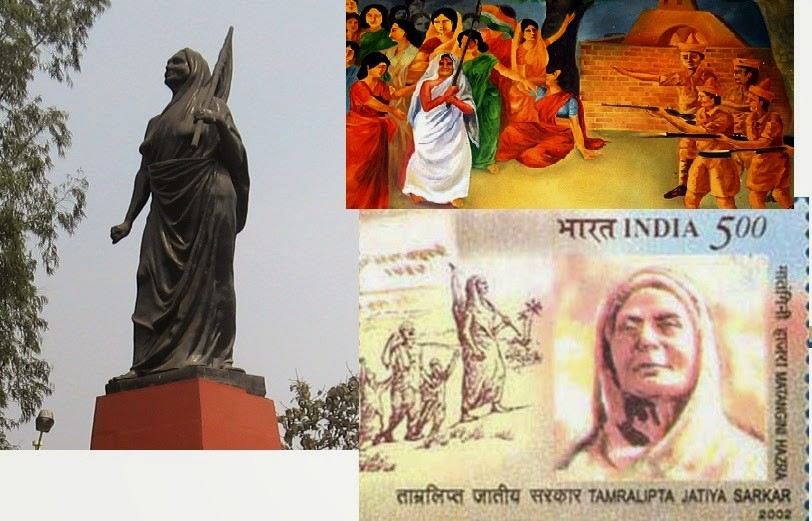
Matangini
led one procession from the north….even
after the firing commenced, she continued to advance with the tri-colour
flag, leaving all the volunteers behind…..The police shot her three
times. She continued marching despite wounds to the forehead and both
hands…..

We all luv Helly Luv. She is a Kurd who wants to “risk it all” and dedicate herself towards total freedom for the Kurd nation.

….
This reminds us that while there are mostly men on the front-lines of un-freedom around the world, there has been no dearth of proud women who have risked it all for total freedom.

 ….
On August 1942 (actually September) Gandhi gave the call for the British to Quit India. He also said that this time it is “karenge yeh marenge” (do or die). Matangini Hazra was already a well known freedom fighter. At 73 years of age she used to be lovingly called : Gandhi-Buri (old lady who is a Gandhi). On 29th September, 1942, Matangini marched at the head of a group of (unarmed) women to the Tamluk police station in Bengal and was shot dead point blank by the police. Gives a new meaning to “risk it all.”

We salute Helly Luv and we wish all the best to her and hope Kurdistan becomes a free nation that also does not compromise on freedom of its citizens. And we salute Matangini Hazra and all other women who died so that their fellow countrymen will live free.
 ……………….
Kurdish pop singer Helly Luv says she will not be put off by death
threats from Iraqi Islamist militants since release of her first music
video but, drawing on its title, insists she will ‘Risk It All’ to help a
push for an independent Kurdistan.

Iraqi-born Luv, 25, has seen
her video rack up more than 2.5 million views on YouTube since its
release in February; but she has faced criticism for what some see as
provocative imagery in the clip accompanying the modern mix of dance,
hip-hop and traditional Middle Eastern music.


Luv’s mother was a Kurdish ‘peshmerga’ fighter before the family emigrated during the Iran-Iraq War..Luv recently visited Kurdish peshmerga forces that have been involved in skirmishes with the Islamic State. Photos
on her Facebook page show her wearing an old-style peshmerga uniform,
red and black scarf and aviator sunglasses, standing before ranks of
black-uniformed Kurdish troops.

By email she said she had been
close to Mosul, the Iraqi power base of the Islamic State, which lies
just 10 km from territory controlled by forces of the Kurdish Regional
Government.

“I wanted my first single to be ‘Risk It All’ to let people know that’s what I represent,” Luv said.

As
a baby, Luv spent nine months in a refugee camp in Turkey before her
family emigrated to Finland. She moved to Los Angeles at 18 to pursue a
music career and after struggling for several years was picked up by
LA-based independent label G2 Music.

…….
 [ref. Wiki] Matangini Hazra’s ….was born in the small village of Hogla, near Tamluk in 1869, and that because she was the daughter of a poor peasant, she did not receive a formal education.. She was married early and became widowed at the age of eighteen without bearing any offspring.  

….A notable feature of the freedom struggle in Midnapore was the participation of women. In 1932, she took part in the Non-Cooperation Movement and was arrested for breaking the Salt Act. She was promptly released, but protested for the abolition of the tax. Arrested again, she was incarcerated for six months at Baharampur. After being released, she became an active member of the Indian National Congress and took to spinning her own Khadi. In 1933, she attended the subdivisional Congress conference at Serampore and was injured in the ensuing baton charge by the police.


As part of the Quit India Movement, members of the Congress planned to take over the various police stations of Midnapore district and other government offices.
This was to be a step in overthrowing the British government in the
district and establishing an independent Indian state. 

Matangini Hazra,
who was 73 years at the time, led a procession of six thousand
supporters, mostly women volunteers, with the purpose of taking over the
Tamluk police station.
When the procession reached the outskirts of the town, they were ordered to disband under Section 144 of the Indian Penal Code by the Crown police. 

As she stepped forward, Matangini Hazra was shot once. Apparently, she had stepped forward and appealed to the police not to open fire at the crowd.


The Biplabi newspaper of the parallel Tamluk National Government commented:


“ Matangini
led one procession from the north of the criminal court building; even
after the firing commenced, she continued to advance with the tri-colour
flag, leaving all the volunteers behind. The police shot her three
times. She continued marching despite wounds to the forehead and both
hands.
”


As she was repeatedly shot, she kept chanting Vande Mataram, “hail to the Motherland”. She died with the flag of the Indian National Congress held high and still flying.

The parallel Tamluk government incited open rebellion by praising her
“martyrdom for her country” and was able to function for two more
years, until it was disbanded in 1944, at Gandhi’s request.


….
India earned Independence in 1947 and numerous schools, colonies, and
streets were named after Matangini Hazra. The first statue of a woman
put up in Kolkata, in independent India, was Hazra’s in 1977. A statue now stands at the spot where she was killed in Tamluk. In 2002, as part of a series of postage stamps
commemorating sixty years of the Quit India Movement and the formation
of the Tamluk National Government, the Department of Posts of India
issued a five rupee postage stamp with Matangini Hazra’s likeness. Hazra Road in South Kolkata is named after her.

……….

Link: http://www.dawn.com/news/1119499/kurdish-pop-star-ready-to-risk-it-all-for-independence/

……..

regards

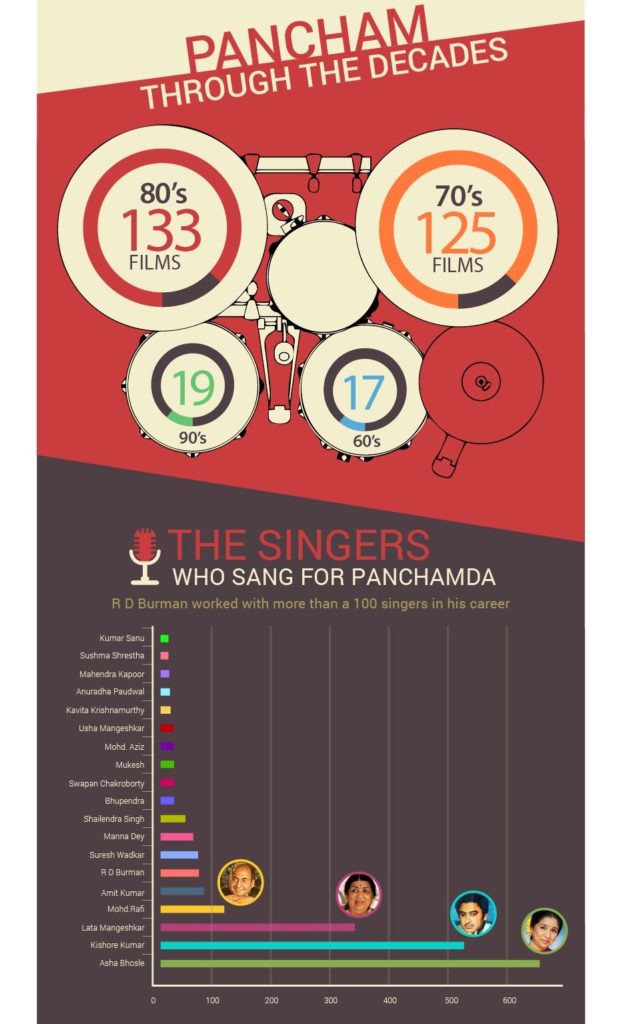
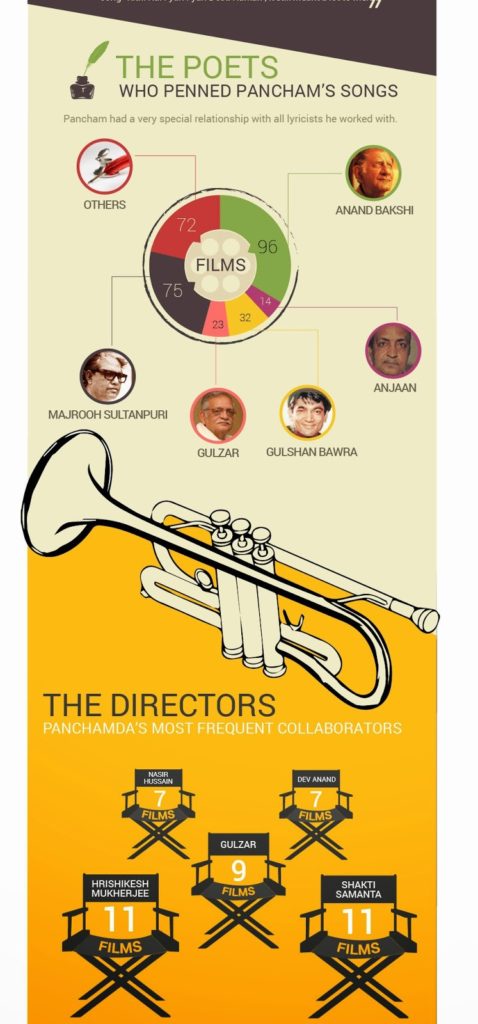
The rise and fall of RD Burman

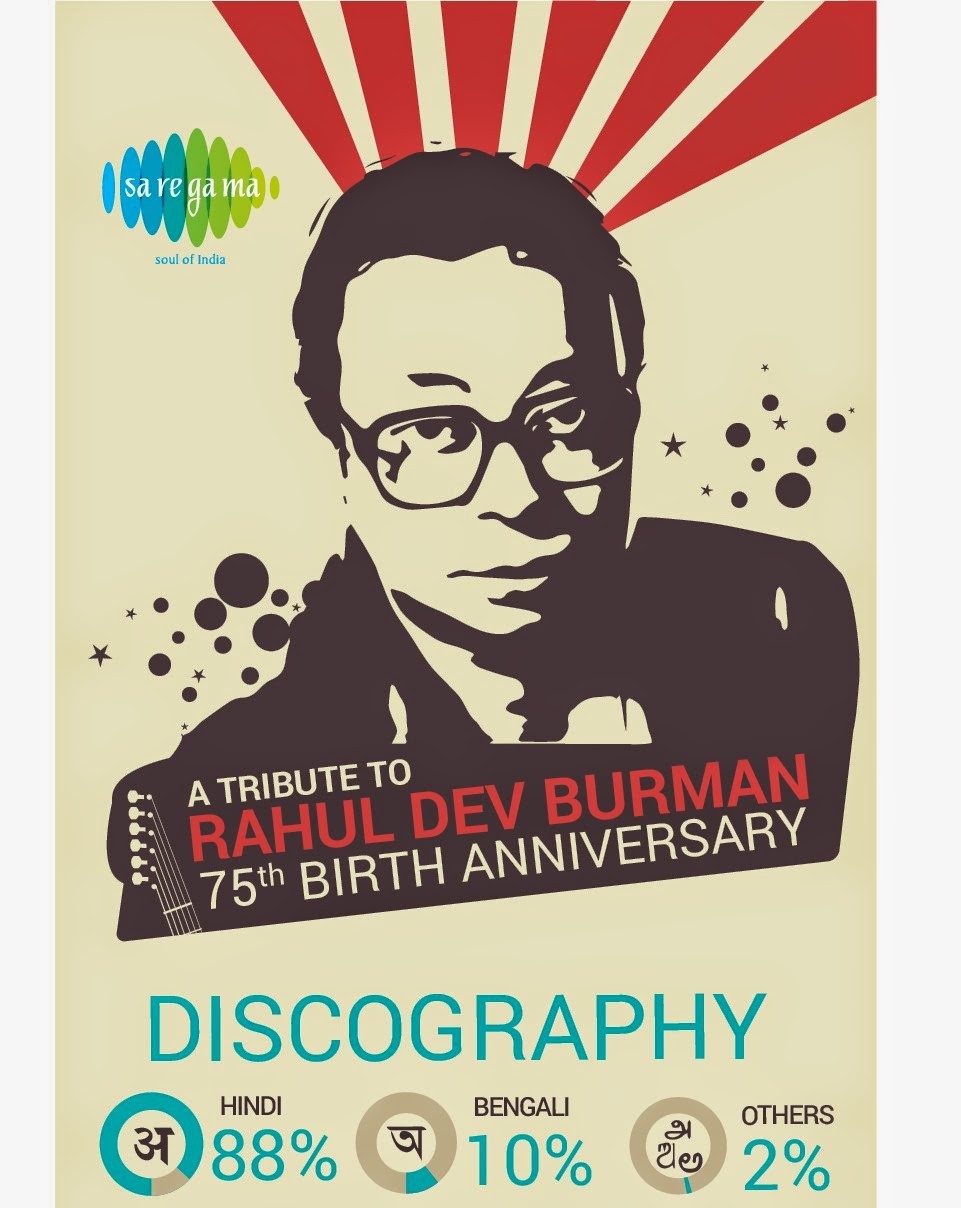
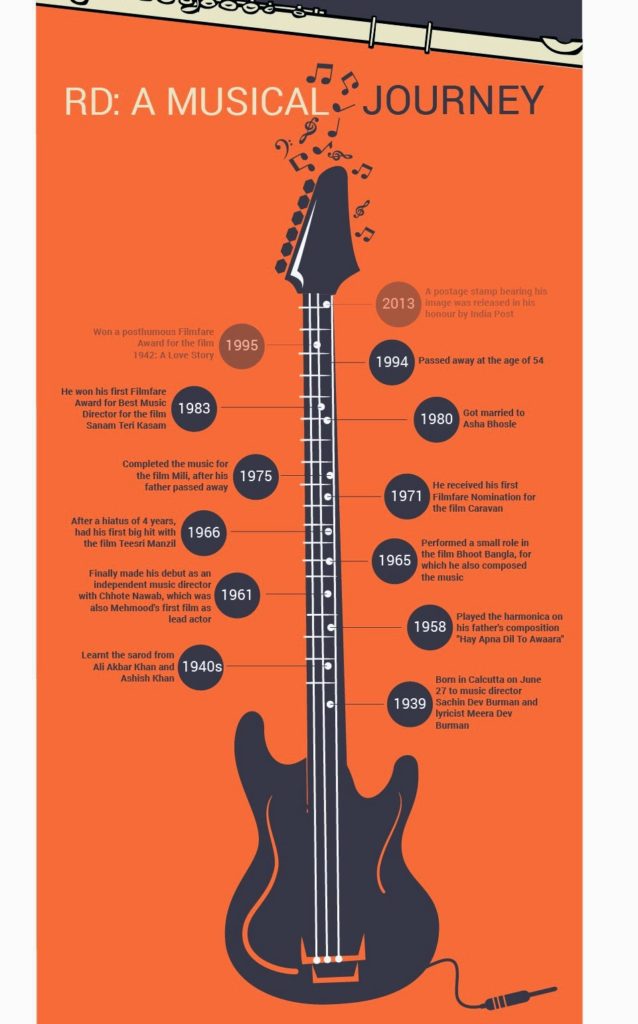
We have some nice info-graphics courtesy SaReGaMa (fun fact: RD was known as
Pa or Pancham).
For those who do not know, RD Burman (and papa
SD Burman) were music directors connected to Bengal and Bombay. 

If you
are not too snobbish about watching bollywood movies try Chalti Ka Naam
Gaadi (1958, music: SDB; assistant: RDB) and Golmal (1979, music: RDB).
You will not
regret your time spent.
……………..

………………………
 [ref. Wiki] Childhood: RD Burman was born on 27th June 1939 to Bollywood composer-singer Sachin Dev Burman and his lyricist wife Meera Dev Burman (nĂŠe Dasgupta), in Calcutta.
Initially, he was nicknamed Tublu by his maternal grandmother although
he later became known by the nickname of Pancham. 

…..
According to some
stories, he was nicknamed as Pancham because, as a child, whenever he cried, it sounded in the fifth note (Pa) of the Indian musical scale. The word Pancham means five (or fifth) in Bengali,
his mother’s native language, as well as the language of court of the
royal family to which his father belongs. Another theory says that the
baby was nicknamed Pancham because he could cry in five different notes.
Yet another version is that when the veteran Indian actor Ashok Kumar saw a newborn Rahul uttering the syllable Pa repeatedly, he nicknamed the boy Pancham.


…..
RD Burman received his early education at the St Xavier’s School in Kolkata. His father SD Burman was a noted music director in Bollywood, the Mumbai-based Hindi film industry. When he was nine years old, RD Burman composed his first song, Aye meri topi palat ke aa, which his father used in the film Funtoosh (1956). The tune of the song Sar jo tera chakraaye was also composed by him as a child; his father included it in the soundtrack of Guru Dutt’s Pyaasa (1957).
...
Early days: In Mumbai, RD Burman was trained by Ustad Ali Akbar Khan (sarod) and Samta Prasad (tabla). He also considered Salil Chowdhury as his guru. He served as an assistant to his father, and often played harmonica in his orchestras. Some of the notable films in which RD Burman is credited as the music assistant include Chalti Ka Naam Gaadi (1958), Kaagaz Ke Phool (1959), Tere Ghar Ke Samne (1963), Bandini (1963), Guide (1965) and Teen Devian (1965). RD Burman also played mouth organ for his father’s hit composition Hai Apna Dil to Aawara which was featured in the movie Solva Saal (1958).


In 1959, RD Burman signed up as a music director for the film Raaz, directed by Guru Dutt’s assistant Niranjan. However, the film was never completed. RD Burman’s first released film as an independent music director was Chhote Nawab (1961). When the noted Bollywood comedian Mehmood decided to produce Chhote Nawab,
he first approached RD Burman’s father Sachin Dev Burman for the music.
However, SD Burman turned down the offer, saying that he did not have
any free dates. At this meeting, Mehmood noticed Rahul playing tabla, and signed him up as the music director for Chhote Nawab. RD Burman later developed a close association with Mehmood, and did a cameo (apart from composing the music) in Mehmood’s Bhoot Bangla (1965).


Burman’s first hit movie as a film music director was Teesri Manzil (1966). Burman gave credit to lyricist Majrooh Sultanpuri for recommending him to Nasir Hussain, the producer and writer of the film. Vijay Anand also said that he had arranged a music session for Burman before Nasir Hussain. ….
Teesri Manzil had six songs, all of which were written by Majrooh Sultanpuri, and sung by Mohammed Rafi. Four of these were duets with Asha Bhosle,
whom Burman later married. Nasir Hussain went on to sign RD Burman and
lyricist Majrooh Sultanpuri for six of his films including Baharon Ke Sapne (1967), Pyar Ka Mausam (1969) and Yaadon Ki Baaraat (1973). Burman’s score for Padosan (1968) was well received. Meanwhile, he continued to work as his father’s assistant for movies like Jewel Thief (1967) and Prem Pujari (1970).

Glory Days: The superhit Kishore Kumar song Mere Sapnon ki Raani from Aradhana (1969), though credited to his father, is rumoured to have been RD Burman’s composition. Kora Kagaz tha Yeh Man Mera from the same film was also his tune.
It is believed that when SD Burman fell ill during the recording of the
film’s music, RD Burman took over and completed the music. He was
credited as an associate composer for the film.


…….
In the 1970s, RD Burman became highly popular with the Kishore Kumar songs in Rajesh Khanna-starrer movies. Kati Patang (1970), a musical hit, was the beginning of a series of the 1970s films directed by Shakti Samanta of Aradhana fame. Its songs Yeh Shaam Mastani and Yeh Jo Mohabbat Hai,
sung by Kishore Kumar,
became instant hits. Apart from Kishore Kumar,
RD Burman also composed several of the popular songs sung by Mohammed Rafi, Asha Bhosle and Lata Mangeshkar.


In 1970, RD Burman composed the music for Dev Anand’s Hare Rama Hare Krishna (1971). The Asha Bhosle song Dum Maro Dum from this film proved to be a seminal rock number in the Hindi film music. The filmmaker Dev Anand did not include the complete version of Dum Maro Dum in the movie, because he was worried that the song would overshadow the film. 

In the same year, RD Burman composed the music for Amar Prem. The Lata Mangeshkar song Raina Beeti Jaaye from this soundtrack is regarded as a classical music gem in Hindi film music.
……
The long night with a few stars: During the second half of the 1980s, RD Burman was overshadowed by Bappi Lahiri and other disco music composers. Many filmmakers stopped patronizing him, as films featuring his compositions flopped at the box office one after the other. Nasir Hussain, who had signed him up for every single of his productions since Teesri Manzil (1966), did not sign him up for Qayamat Se Qayamat Tak (1988). 

….
In the year 1986, RD Burman composed the songs of Ijaazat: this score is regarded as one of his best scores. However, the film belong to the Parallel Cinema (art film) category, so it did not stop the decline of RD Burman’s commercial film career. All the four songs in Ijaazat
were sung by Asha Bhosle and written by Gulzar. RD Burman was greatly
appreciated by the critics for setting the non-rhyming lyrics of the
song Mera Kuchh Saamaan to the music.  

While both Asha Bhosle (Best Female Playback) and Gulzar (Best Lyrics) received National Awards for the score, RD Burman received none.

….
RD Burman suffered from a heart attack in 1988, and in 1989, Burman underwent a heart bypass surgery at Princess Grace Hospital in London. During this period, he composed many tunes, which were never released. He composed music for Vidhu Vinod Chopra’s movie Parinda in 1989. 
…..
Death 4 January 1994: Thenmavin Kombath, a Malayalam film by Priyadarshan was the last film he signed, but he died before he could score for the film. The music of 1942: A Love Story (1994) was released after his death, and was highly successful. It posthumously won him the third and last of his Filmfare Awards. As per Lata Mangeshkar he died too young & too unhappy.
………………….

regards

When a fine is not fine

We do not quite comprehend the rules but is it fine to ask a man to pay a fine when he has already received a death sentence? It seems somewhat excessive.

Also we doubt that there is data, but the number of muslims accused under blasphemy law are considerable and may even exceed that of non-muslims.

Finally this happy detail which comes up every time: so far, no death sentence for blasphemy has been actually carried out by the state. We feel that this statement must be accompanied by the honest disclosure that the moment an accusation is made the man is as good as dead. People will march up to the police station and kill him and will walk away without breaking a sweat. And if someone is lucky not to get killed, it is permanent incarceration for him. That is the choice: a life sentence or a death sentence.
……………
A sessions court on Monday handed down the death sentence and
imposed a fine of Rs100,000 on a blasphemy accused after charges were
proved against him.

…………..

Additional sessions court Judge Naveed Iqbal issued the ruling in the case.

The
accused, Zulfikar, was ‘caught red-handed’ while writing blasphemous
remarks on the walls of Afghan Park in Lahore’s Islampura area in 2008.

He was booked under blasphemy charges on a complaint filed by area residents.
The area residents had also claimed that the man used derogatory language at the time of the azaan (call for prayer).


Though Pakistan has never carried out the death penalty for
blasphemy, it is one of the countries to have the most people jailed
over its blasphemy laws.

Blasphemy is a highly sensitive issue in
Pakistan, where 97 per cent of the 180 million population is Muslim and
the law, with a lack of procedural safeguards, has contributed to an
alarming number of mob attacks and vigilante violence over the issue.

Pakistan in the past has urged the United Nations to make blasphemy an internationally recognised offense.
……

Link: http://www.dawn.com/news/1119169/blasphemy-accused-sentenced-to-death

……

regards

Leaving the Left Behind

Professor Jamal Naqvi, one of the stalwarts of the Pakistani Left, recently wrote a book about leaving the Left behind. it has caused a stir..

Story of a Pakistani communist

In defense of Jamal Naqvi

Extracts: The fact is that Leaving the Left behind is the first book in Pakistan that confronts fundamentalism and defies the dogma of the left. Naqvi, who dominated the policymaking body of the left for the most part of the 1970s and 80s, has spared no one with his characteristic crisp and sharp wit….


The left now cannot insist on shallow economic ideals. Pursuing a social, cultural renaissance and working to promote liberal democracy in the country might redeem some of its lost pride. Capital is neither an ideology nor a system of faith. Confronting it with an ideology by assuming rigid sets of economic archetypes coupled with an absolute path of development is not a great idea to follow…

Story of a Pakistani communist
http://tns.thenews.com.pk/story-of-jamal-naqvi-pakistani-communist/#.U8VgIJRdV8E

Extracts from this review:
His autobiographical account has been published recently under the title Leaving the Left Behind, which is self-explanatory. If someone wants to know more, he can read the subtitle “An autobiographical tale of political disillusionment that took the life’s momentum away from the myopic politics of the Right and the Left to the enlightened concept of Right and Wrong”…..


With nine chapters and two appendices in this 264 page volume, the 81 year old Jamal Naqvi has shared all that he had to with his comrades. You may not agree with him but it is important to acknowledge this wise effort. We hope our elders in the movement would follow his example and give us a chance to read more about our common past.

Elegy for a comrade who lost his way

I come now to what is the central issue in the book (and provides its title, Leaving the Left Behind). A subsidiary issue is the standpoint he adopted after leaving the Left behind. I do not wish to say much about his new standpoint, but for the benefit of those who will not read the book I will make a brief mention. On the new standpoint that he now adopted, Naqvi writes: ‘I was always a democrat [but] my actions were not in conformity with my  beliefs, and standing between the two was an ideology [Communism, Marxism] that put blinkers on my eyes…’ (p.180). The new vision that he now saw on his road to Damascus was that of abandoning ‘the myopic politics of Left and Right’ for ‘the enlightened concept of Right and Wrong’ [front cover blurb]. Note that Naqvi’s ‘democracy’ without Left and Right is in fact nothing but democracy without politics; and he treats Right and Wrong as universal concepts so that that what is ‘right’ (or ‘wrong’) for the oppressor is also ‘right’ (or ‘wrong’) for the oppressed. Sadly, Naqvi has retreated into a world of abstractions. …


…To return to the question, is capitalism a fair and just system?  Marx never talked about fairness and justice of a political and economic system. What he thought of capitalism was stated plainly in the Communist Manifesto. Capitalism is a highly productive system. ‘The bourgeoisie cannot exist without constantly revolutionising the instruments of production.’ At the same time, for the capitalist labour is and will always remain a cost of production which it must try to minimise in order to maximise his profit. Class conflict is inherent in the system. 

IA Rahman’s review of the book

Professor Naqvi does himself much wrong when he declares his life “an utter waste.” One hopes he is not referring to any failure to realise a personal ambition — that would be contrary to the creed he followed for decades. He should be happy with what the Left in Pakistan achieved despite being a target of tyrannical rulers, the contributions it made in reinforcing the peoples’ commitment to democracy, federalism, civil liberties, rights of women, labour and religious minorities. On a personal level, he should be happy to have fulfilled his duties as “a hard core family man,” something Nazeer Abbasi, Hasan Nasir and scores of other party workers and sympathisers could not even dream of.


In the next edition, the professor may explain what is meant by taking “life’s momentum away from the myopic politics of Right and Left to the enlightened concept of Right and Wrong,” because those practicing the politics of the Left believe that they uphold the concept of “right” (an end to inequities) and reject “wrong” (the exploitation of the underprivileged).

I wrote an off-the-cuff comment of my own on this discussion on facebook and apologize in advance for the lack of intellectual depth and rigor (That would take more time and effort than I am capable of right now, but I look forward to enlightening comments from more qualified people)…
in liberal democracies (and even in relatively liberal dictatorships), leftists are the personality type that is anti-authoritarian, pro-humanist, progressive and pro-reason. That does not mean they are always humane, progressive or reasonable, but those are their instinctive sympathies. Marxism (especially as developed by Leninist parties…and that was the default position for a century, even among those who thought they repudiated Leninism) channeled these worthy instincts into disastrous and atrocious byways for a century. In an another hundred years, it will be seen as one of the great disasters of human history…its appeal to certain emotions (mostly negative emotions, like envy, jealousy, fake self-esteem, lazy dogmatism, etc) ensured its popularity and it provided generations of intellectuals with the illusion that they (in many, not all, cases; lazy, incompetent, personally vindictive and small-minded people) were the lonely heroes of history, struggling to overthrow the tyranny of evil men. That was another of the poisonous gifts of this ideological current. The worst, of course, was the fate of those societies where this current (usually in combination with an unusually incompetent and venal ruling elite) reached critical mass and managed an actual revolution. In EVERY case (except maybe Cuba, where the corrupt elite collapsed with such little bloodshed that the worst excesses did not play out) it led to horrendous suffering and disastrous dictatorships and cultural setbacks from which many countries have yet to recover…..


which is not to say that “Leftists” did not do anything good. far from it, all positive movements of the last 100 years (anti-colonialism, anti-racism, feminism, prisoner’s rights, gay rights, human rights, etc etc) had leftist support. But that support worked best when it was in countries where the “left’ was in no position to actually cause a revolution….

My friend Ajit immediately wrote: Omar, as an ex-Communist myself, I would have to differ with you on your characterization of the left as “anti-authoritarian” (hah. try joining an actual left organization), “humane” (really ? You must be talking about the coffeehouse intellectuals – even those become decidedly non-humane when some inconvenient truths are brought up) and pro-reason. (Actually being truly pro-reason is a quality vanishinhly few humans possess, so this cant be held against the left alone.)

To which i responded: I was indeed talking about coffee-house intellectuals and about a lot of ordinary people who gravitate leftwards..not so much about actual party workers. 
In defence of Jamal Naqvi

Geography trumps all – Israel's descent into Middle Easterness

https://m.facebook.com/story.php?story_fbid=10204209227297029&id=1417549275

The above video (I hope it’s accessible) demonstrates the extent to which the region is shaping Israel.
Arguably Israel’s high birth rate is a function of its neighborhood. If the Arab birth rate had collapsed (as it is in the process of doing so) a decade or so earlier there wouldn’t have been the paranoia about raising Jewish birth rates.
The arrest of the young American Jew (who probably hasn’t worn a Kippah more than a few times in his life) is highlighting the stark contradiction & power of American liberalism. The West helps us forget the parochial elements of belonging to a tribe and Premier Netanyahu seems intent on Greater Israel in the Middle East rather than a more compact Meditterranean littoral.

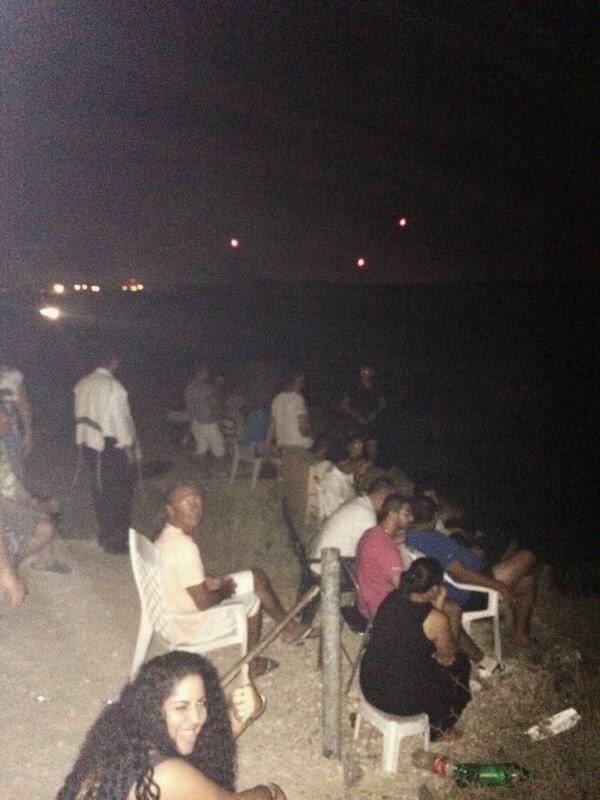
Popcorn + missiles = funtimes

…a kind of “cinema”
on the hilltop outside Sderot…“Clapping when blasts are heard.”…..more than 50 people who had
transformed the hill into something “most closely resembling the front
row of a reality war theatre”…..people were seen taking popcorn up onto the hill with their chairs, and that they sat cheerfully smoking hookahs….

We are aware that there are no saints in war. It is just mindlessly brutal and it brutalizes ordinary citizens who are not involved in the fighting. Still the imagery manages to shock us. What have we become? Is there no common humanity left anymore??

Having said that the muslim world (if there is such a term) needs to think long and deep about how it treats minorities. There is now no home left for millions of Christians in the Middle East proper. Everywhere else, the intolerance meter is always dialed to maximum. Why?

Meanwhile, Israelis, Indians, Chinese, Russians, Burmese, Sri Lankans…are also treating their muslim citizens shamefully. Both sides claim that the “other” has been the first mover in crime. This eye-for-eye set-up is not helping anyone.

If we step back and look at the big picture, the (relatively speaking) safe-home(s) today for muslims is any number of non-muslim lands. In South Asia and elsewhere more muslims are being killed by other muslims than non-muslims. 

We all know what is wrong with the “Sderot Cinema.” But does anybody know why things have gone wrong in Aleppo, Mosul, and so many other places? How will we fix things so that people can co-exist peacefully? We need answers now. It is too easy to blame others. If the muslim world takes the lead in offering solutions, we are sure the whole world will sit up, take notice and lend a hand. 

This is not blaming the victim…it is a request for the leaders and the people to take responsibility and a call for action. And the most urgent requirement for action is at home.
….
An image that appears to show a group of Israelis on a hilltop
cheering and applauding as they watch the deadly aerial bombardment of
Gaza has caused international outrage after it was shared by thousands
on Twitter.


Taken by the Middle East correspondent for a Danish newspaper, the
picture shows rows of people sitting on plastic chairs looking out over
the Gaza Strip as rockets and explosions light up the night sky.

Allan
Sørensen, who posted the image, wrote that it showed a kind of “cinema”
on the hilltop outside the Israeli town of Sderot, and a caption added:
“Clapping when blasts are heard.”

Sørensen’s newspaper, the Kristeligt Dagblad,
reported that the gathering involved more than 50 people who had
transformed the hill into something “most closely resembling the front
row of a reality war theatre”.

It said that people were seen taking popcorn up onto the hill with their chairs, and that they sat cheerfully smoking hookahs.

“We are here to see Israel destroy Hamas,” said Eli Chone, a 22-year-old American who lives in Israel.

Sørensen’s
tweet was met with anger by fellow Twitter users. One user wrote: “If
this is true then God help us all. What’s become of the human race?”

Another said: “This is the most gruesome image I’ve seen the last few days.”

Further images have since emerged showing larger crowds on subsequent
days – suggesting that the so-called “Sderot cinema” was far from a
one-off. They showed groups standing and pointing out to the horizon,
and one had even brought a sofa up onto the hilltop.

…………….

Link: http://www.independent.co.uk/news/world/middle-east/israelgaza-conflict-sderot-cinema-image-shows-israelis-with-popcorn-and-chairs-cheering-as-missiles-strike-palestinian-targets-9602704.html

……..

regards

Saeed: Pak and India are one nation!!!!

….Saeed….said she did not understand why India and
Pakistan were considered different nations….so much of
similarity between the two countries…..both countries were
indeed one nation….

No, no…not THAT Saeed…..it is Sanam Saeed from Zindagi Gulzar Hai.

BTW, India and Pakistan…one nation…gosh, those are fighting words!!!! Only a British (West) born actor can say such incendiary stuff. Hopefully her career does not suffer from plain-speaking, at any event she can migrate to India (we hope).

The big question in our mind….is the saree is un-islamic or not? General Zia-ul-Haque was the foremost proponent of this theory. But we imagine it has become conventional wisdom now amongst the more deeply faithful across South Asia and even amongst expat populations. 
Our keywords “saree un-islamic” brought up this intriguing thread.

Enquiry: my husband and i married in love marriage, we are both british born asians, he is half pakistani and indian, while i am bengali….
My husband is very religious, and even though before marriage i did not
wear hijab, he asked me to wear one after marriage and i happily did so….

But he is a bit more
extreme when it comes to things like clothing, he does not like me
wearing sari which is very commen in bengali culture for us women to
wear. he thinks the revealing flesh around the midriff is haram.
 

i have
explained to him that i can conceal such an area with my sari (which is
what most bengali girls do anyway) and i have even demonstrated it to
him, but he still says it is not right and does not permit me to wear
one outside of our home.
 

Response: In regards to wearing a saree, i have a few bengali neighbours and most
of the women folk wear sarees especially on Eid and other formal
occassions and it is clear to me that it is not appropriate for a women
to be wearing outside and around non mahrams even if the waist is
covered because it is still worn fitted to the body so the bodily
definitions can be seen and it is also of bright colours etc.

When you are around your husband and mahram members of your family then
it is fine but when non mahrams are around and when going out then one
should be very careful and wear full hijaab and jilbaab.
…..It is a good thing that a husband wants to protect his wife from the
evil gazes of other men. You should be happy that your husband only
wants your beauty for his eyes and not the eyes of other men.

…………….


Pakistani model and actor Sanam Saeed said she was glad that
Pakistani shows were having a positive impact on people in India – which
was the same effect they had on people in Pakistan.

In an interview with the Times of India,
Saeed, who was has been associated with Pakistan’s entertainment
industry in various avatars, said she did not understand why India and
Pakistan were considered different nations when there was so much of
similarity between the two countries stressing that both countries were
indeed one nation.

The 29-year-old was grateful and happy that Zindagi Gulzar Hai,
the drama where she enacted the role of a girl from the lower
middle-class, was the first serial which broke the ice across the
borders in recent times.

“India uses Bollywood, rather cinema, to
tell its stories. It is one of the largest filmmaking nations in the
world and so your talents get to tell stories about politics, love and
drama through films. In Pakistan, our medium is the small screen.

“We
don’t make many films, and hardly have theatres. A majority of people
seek entertainment while sitting at home and TV gives it to them, so we
excel on that part,” Sanam said.

The British-born actor, who
shifted to Karachi at the age of six, also said that she selected roles
which showcased a woman’s struggle.

Elaborating on how the people
in Pakistan only had TV as a form of entertainment, she said she tried
to do shows which had inspirational value and enacted characters that
could be role models for young girls and help change people’s
perspective.

…….


Link (1): http://www.ummah.com/forum/showthread.php?271646-im-very-confused-about-my-husband

Link (2):  http://www.dawn.com/news/1119376/im-glad-pakistani-shows-have-a-positive-impact-on-india-sanam-saeed
……

regards

Burma and Imperial Britain

Their relationship with the British Empire is that of slave and master….Is
the master good or bad? That is not the question…his control is despotic and….self-interested….

As we all know, Arundhati Roy is considered as one of the leading (if not the leading) thinkers of the world. If Obama can be gifted the golden gong then we do not see why she should not be considered as well.

As it so happens, Imperial Britain also suffered heavily at the hands of a Roy-like figure, one Mr E.A. Blair (also a Nobel winner, but for literature). 

Here is Blair’s take on British exploitation of Burma. The background is very much relevant to India as well. We found it to be an interesting read. Enjoy.  
……
British politics in Burma is the same as in India.

Industrially speaking, India was deliberately kept in ignorance.
She
only produces basic necessities, made by hand. The Indians would be
incapable, for example, of making a motor-car, a rifle, a clock, an
electric-light bulb etc. They would be incapable of building or sailing
an ocean-going vessel.

At the same time they have learnt in their
dealings with Westerners to depend on certain machine-made articles. So
the products of English factories find an important outlet in a country
incapable of manufacturing them herself.

Foreign competition is
prevented by an insuperable barrier of prohibitive customs tariffs. And
so the English factory-owners, with nothing to fear, control the markets
absolutely and reap exorbitant profits.

……

How a Nation Is Exploited – The British Empire in Burma

Following
the recent troubles in India, we have asked our contributor, Mr E. A.
Blair, whose investigations on ‘The Plight of the British Worker’ have
already appeared in these pages, to tell us something of the unrest
which has been fermenting in the sub-continent for some years, and which
is threatening to spread to English Indo-China.

Burma lies between India and China. Ethnologically it belongs to Indo-China.
It
is three times the size of England and Wales, with a population of
about fourteen million, of whom roughly nine million are Burmese.

The
rest is made up of countless Mongol tribes who have emigrated at
various periods from the steppes of Central Asia, and Indians who have
arrived since the English occupation.

The Burmese are Buddhists; the tribesmen worship various pagan gods.

To
be able to talk in their own language to the people of such diverse
origins living in Burma, you would need to know a hundred and twenty
different languages and dialects.

This country, the population of
which is one-tenth as dense as that of England, is one of the richest in
the world. It abounds in natural resources which are only just
beginning to be exploited.

There are tin, tungsten, jade and rubies, and these are the least of its mineral materials.
At this moment it produces five per cent of the world’s petroleum, and its reserves are far from exhausted.

But the greatest source of wealth-and that which feeds between eighty and ninety per cent of the population-is the paddy fields.
Rice is grown everywhere in the basin of the Irawaddy, which flows through Burma from north to south.
In the south, in the huge delta where the Irawaddy brings down tons of alluvial mud every year, the soil is immensely fertile.
The harvests, which are remarkable in both quality and quantity, enable Burma to export rice to India, Europe, even to America.
Moreover, variations in temperature are less frequent and sharp than in India.
Thanks
to abundant rainfall, especially in the south, drought is unknown, and
the heat is never excessive. The climate as a whole can thus be
considered one of the healthiest to be found in the tropics.

If we
add that the Burmese countryside is exceptionally beautiful, with broad
rivers, high mountains, eternally green forests, brightly coloured
flowers, exotic fruits, the phrase ‘earthly paradise’ naturally springs
to mind.

So it is hardly surprising that the English tried for a long time to gain possession of it.

In
1820 they seized a vast expanse of territory. This operation was
repeated in 1852, and finally in 1882 the Union Jack flew over almost
all the country.
 

Certain mountainous districts in the north,
inhabited by small savage tribes, had until recently escaped the
clutches of the British, but it is more and more likely that they will
meet the same fate as the rest of the country, thanks to the process
euphemistically known as ‘peaceful penetration’, which means, in plain
English, ‘peaceful annexation’.

In this article I do not seek to
praise or blame this manifestation of British imperialism; let us simply
note it is a logical result of any imperialist policy.

It will be
much more profitable to examine the good and bad sides of British
administration in Burma from an economic and a political standpoint.

* * * * * * * * * * * * * * * *

Let us turn first to politics.
The
government of all the Indian provinces under the control of the British
Empire is of necessity despotic, because only the threat of force can
subdue a population of several million subjects.

But this despotism is latent. It hides behind a mask of democracy.

The
great maxim of the English in governing an oriental race is ‘never get
something done by a European when an Oriental can do it’. In other
words, supreme power remains with the British authorities, but the minor
civil servants who have to carry out day-to-day administration and who
must come into contact with the people in the course of their duties are
recruited locally.

In Burma, for example, the lower grade
magistrates, all policemen up to the rank of inspector, members of the
postal service, government employees, village elders etc. are Burmese.

Recently,
to appease public opinion and put a stop to nationalist agitation which
was beginning to cause concern, it was even decided to accept the
candidature of educated natives for several important posts.

The system of employing natives as civil servants has three advantages.
First, natives will accept lower salaries than Europeans.
Secondly,
they have a better idea of the workings of their fellow countrymen’s
minds, and this helps them to settle legal disputes more easily.

Thirdly, it is to their own advantage to show their loyalty to a government which provides their livelihood.
And
so peace is maintained by ensuring the close collaboration of the
educated or semi-educated classes, where discontent might otherwise
produce rebel leaders.

Nevertheless the British control the
country. Of course, Burma, like each of the Indian provinces, has a
parliament-always the show of democracy-but in reality its parliament
has very little power.

Nothing of any consequence lies within its
jurisdiction. Most of the members are puppets of the government, which
is not above using them to nip in the bud any Bill which seems untimely.

In
addition, each province has a Governor, appointed by the English, who
has at his disposal a veto just as absolute as that of the President of
the United States to oppose any proposal which displeases him.

Yet although the British government is, as we have shown, essentially despotic, it is by no means unpopular.
The
English are building roads and canals-in their own interest, of course,
but the Burmese benefit from them-they set up hospitals, open schools,
and see to the maintenance of law and order.

And after all, the Burmese are mere peasants, occupied in cultivating the land.
They have not yet reached that stage of intellectual development which makes for nationalists.
Their
village is their universe, and as long as they are left in peace to
cultivate their fields, they do not care whether their masters are black
or white.

A proof of this political apathy on the part of the
people of Burma is the fact that the only British military forces in the
country are two English infantry battalions and around ten battalions
of Indian infantry and mounted police. Thus twelve thousand armed men, mostly Indians, are enough to subdue a population of fourteen million.

The
most dangerous enemies of the government are the young men of the
educated classes. If these classes were more numerous and were really
educated, they could perhaps raise the revolutionary banner. But they
are not.

The reason is firstly that, as we have seen, the majority of the Burmese are peasants.
Secondly,
the British government is at pains to give the people only summary
instruction, which is almost useless, merely sufficient to produce
messengers, low-grade civil servants, petty lawyers’ clerks and other
white-collar workers.

Care is taken to avoid technical and
industrial training. This rule, observed throughout India, aims to stop
India from becoming an industrial country capable of competing with
England.

It is true to say that in general, any really educated
Burmese was educated in England, and belongs as a result to the small
class of the well-to-do.

So, because there are no educated classes, public opinion, which could press for rebellion against England, is non-existent.
* * * * * * * * * * * * * * * *

Let
us now consider the economic question. Here again we find the Burmese
in general too ignorant to have a clear understanding of the way in
which they are being treated and, as a result, too ignorant to show the
least resentment.

Besides, for the moment they have not suffered much economic damage.

It
is true that the British seized the mines and the oil wells. It is true
that they control timber production. It is true that all sorts of
middlemen, brokers, millers, exporters, have made colossal fortunes from
rice without the producer-that is the peasant-getting a thing out of
it.

It is also true that the get-rich-quick businessmen who made
their pile from rice, petrol etc. are not contributing as they should be
to the well-being of the country, and that their money, instead of
swelling local revenues in the form of taxes, is sent abroad to be spent
in England.

If we are honest, it is true that the British are robbing and pilfering Burma quite shamelessly.

But
we must stress that the Burmese hardly notice it for the moment. Their
country is so rich, their population so scattered, their needs, like
those of all Orientals, so slight that they are not conscious of being
exploited.

The peasant cultivating his patch of ground lives more
or less as his ancestors did in Marco Polo’s day. If he wishes, he can
buy virgin land for a reasonable price.

He certainly leads an arduous existence, but he is on the whole free from care.
Hunger and unemployment are for him meaningless words. There is work and food for everyone. Why worry needlessly?

But,
and this is the important point, the Burmese will begin to suffer when a
large part of the richness of their country has declined.

Although
Burma has developed to a certain extent since the war, already the
peasant there is poorer than he was twenty years ago.

He is beginning to feel the weight of land taxation, for which he is not compensated by the increased yield of his harvests.
The worker’s wages have not kept up with the cost of living.

The
reason is that the British government has allowed free entry into Burma
for veritable hordes of Indians, who, coming from a land where they
were literally dying of hunger, work for next to nothing and are, as a
result, fearsome rivals for the Burmese.

Add to this a rapid rise
in population growth-at the last census the population registered an
increase of ten million in ten years-it is easy to see that sooner or
later, as happens in all overpopulated countries, the Burmese will be
dispossessed of their lands, reduced to a state of semislavery in the
service of capitalism, and will have to endure unemployment into the
bargain.

They will then discover what they hardly suspect today,
that the oil wells, the mines, the milling industry, the sale and
cultivation of rice are all controlled by the British.

They will also realise their own industrial incompetence in a world where industry dominates.
* * * * * * * * * * * * * * * *

British politics in Burma is the same as in India.

Industrially speaking, India was deliberately kept in ignorance.
She
only produces basic necessities, made by hand. The Indians would be
incapable, for example, of making a motor-car, a rifle, a clock, an
electric-light bulb etc. They would be incapable of building or sailing
an ocean-going vessel.

At the same time they have learnt in their
dealings with Westerners to depend on certain machine-made articles. So
the products of English factories find an important outlet in a country
incapable of manufacturing them herself.

Foreign competition is
prevented by an insuperable barrier of prohibitive customs tariffs. And
so the English factory-owners, with nothing to fear, control the markets
absolutely and reap exorbitant profits.

We said that the Burmese
have not yet suffered too much, but this is because they have remained,
on the whole, an agricultural nation.

Yet for them as for all
Orientals, contact with Europeans has created the demand, unknown to
their fathers, for the products of modern industry. 

As a result, the
British are stealing from Burma in two ways:

In the first place,
they pillage her natural resources; secondly, they grant themselves the
exclusive right to sell here the manufactured products she now needs.

And
the Burmese are thus drawn into the system of industrial capitalism,
with any hope of becoming capitalist industrialists themselves.

Moreover
the Burmese, like all the other peoples of India, remain under the rule
of the British Empire for purely military considerations. For they are
in effect incapable of building ships, manufacturing guns or any other
arms necessary for modern warfare, and, as things now stand, if the
English were to give up India, it would only result in a change of
master. The country would simply be invaded and exploited by some other
Power.

British domination in India rests essentially on exchanging
military protection for a commercial monopoly, but, as we have tried to
show, the bargain is to the advantage of the English whose control
reaches into every domain.

* * * * * * * * * * * * * * * *

To sum up, if Burma derives some incidental benefit from the English, she must pay dearly for it.

Up
till now the English have refrained from oppressing the native people
too much because there has been no need. The Burmese are still at the
beginning of a period of transition which will transform them from
agricultural peasants to workers in the service of the manufacturing
industries.

Their situation could be compared with that of any
people of eighteenth-century Europe, apart from the fact that the
capital, construction materials, knowledge and power necessary for their
commerce and industry belong exclusively to foreigners.

So they
are under the protection of a despotism which defends them for its own
ends, but which would abandon them without hesitation if they ceased to
be of use.

Their relationship with the British Empire is that of slave and master.

Is
the master good or bad? That is not the question; let us simply say
that his control is despotic and, to put it plainly, self-interested.

Even
though the Burmese have not had much cause for complaint up till now,
the day will come when the riches of their country will be insufficient
for a population which is constantly growing.

Then they will be able to appreciate how capitalism shows its gratitude to those to whom it owes its existence.

E. A. BLAIR

…..

Link: http://theorwellprize.co.uk/george-orwell/by-orwell/essays-and-other-works/how-a-nation-is-exploited-the-british-empire-in-burma/

……

regards

Baby, light my fire

…..as her father had no son, she had
every right to light the funeral pyre…..Opposing one and all, she finally
lit the funeral pyre of her father, Ajay Yadav…..”I will just
not perform all the rites but also allow some of my hair to be cut”……

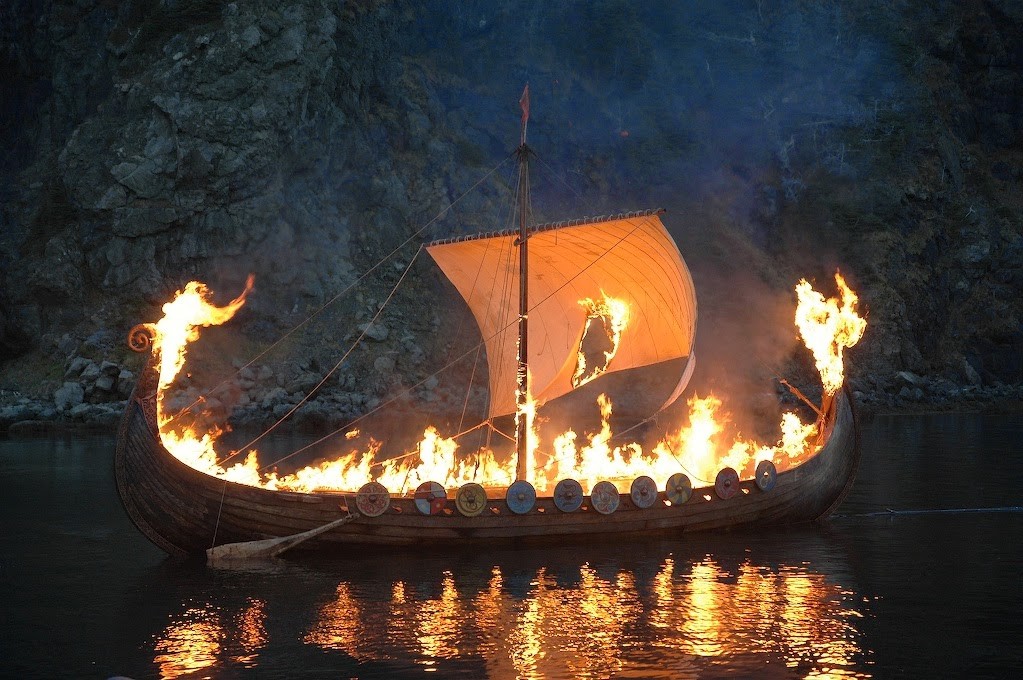
Simple equation for the 21st century: tweak the theology(s) and make all clauses gender neutral. And with that excuse out of the way, son preference will disappear (hopefully). And yes, Viking funerals are classy (but we suspect…not sustainable).

Truth be told, we sympathize with Arya Samaj people who claim not to believe in caste, rituals and idolatry. But then we also feel that people should be free to follow the path that suits them. However girls must have justice and they must be honored. Otherwise, forget about that thing called society.
……………………….

She
may be in the eye of a storm for lighting the funeral pyre of her
father ignoring objections from her close relatives and immediate
neighbours on Saturday, but Shalini, a Class XII student, remained
unrepentant.


She claims that as her father had no son, she had
every right to light the funeral pyre. Opposing one and all, she finally
lit the funeral pyre of her father, Ajay Yadav, on Saturday. Now, she
is determined to go ahead with the rest of the ‘shhradh’. “I will just
not perform all the rites but also allow some of my hair to be cut,” she
says.

An alcoholic, Ajay Yadav, breathed his last at his small
house in Maranga locality on the outer fringe of Purnia town after
protracted illness on Saturday leaving behind his wife, Mira Sinha and
two daughters, Rohini and Shalini. Mira Sinha is an anganwadi sevika
since 2007 while Rohini is married to Ravi Kumar in Jamalpur in Munger
district.

Though close relatives and neighbours did everything
possible to stop Shalini from lighting the pyre quoting Hindu
scriptures, she went ahead with it. Her close relatives and immediate
neighbours did not go to the cremation ghat as a mark of opposition. 

Now
the same people are doing everything in their power to stop Shalini
from going ahead with the rest of the rites. “They are preventing the
local pundits and thakur from performing ‘shhradh’ and related rites,”
Shalini told local reporters at her house on Sunday. “But, if they are
bent on such mischief, I will bring pundits and others from outside,”
she said. “What crime have I done if I lit the funeral pyre of my father
and want to observe the rites,” she says with a tinge of defiance.

Quoting the last wish of Yadav, his close relatives, however, maintain
that he always wanted his nephew to perform the last rites. Ajay Yadav
was always shabbily treated by his wife, two daughters and even his
son-in-law, they insinuate. This is, however, strongly disputed by Mira
Sinha who tied the nuptial knot with Yadav in 1994 in spite of stiff
opposition from relatives. It was an inter-caste marriage.

A
small piece of land has been left behind by Yadav, averred Mira Sinha
before newsmen. “My husband had five brothers and some of them have
already forcibly grabbed a small piece of land,” she said.

Meanwhile, Purnia Mahila Morcha chief Nutan Anand, who called on the
bereaved members on Sunday, has assured them of all possible help, even
promising to approach the district administration for providing security
to them. 

…………………………..
……

regards

Bad blood overflows in Baksa

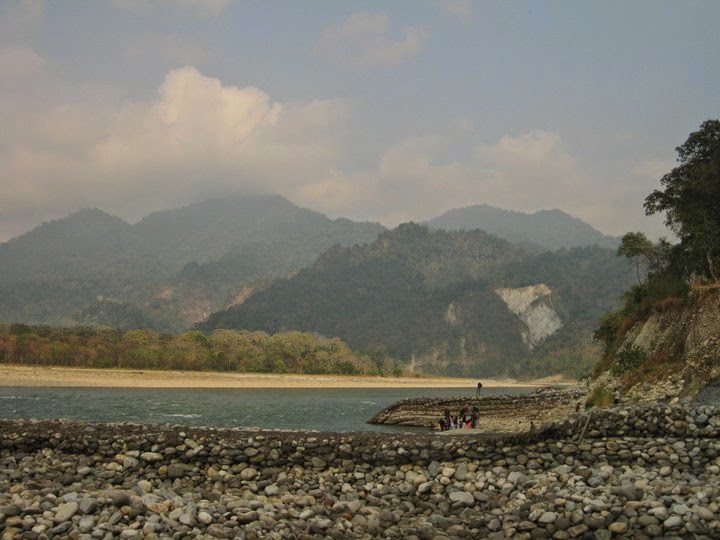
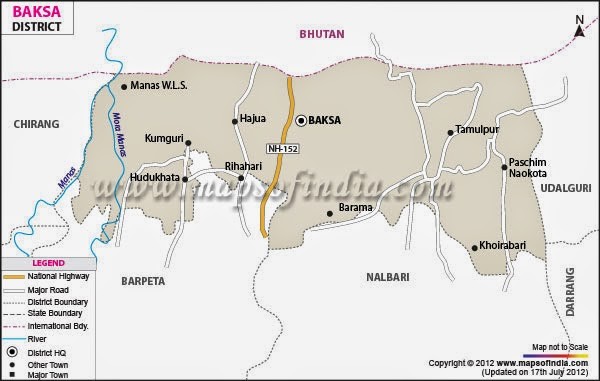
Supremely beautiful place bordering Bhutan- the Manas Wild Life Sanctuary is famed for one-horned rhino and many other life-forms. It is sadly being polluted by evil people killing teenage boys. Illegal migrants or no, the govt has a duty of care to protect people.

For the majority communities everywhere tolerance for minorities is a lesson that must be learned (the easy way or the hard way). Killing people is soul destroying. Every religion, all big men (and women) agree. Kicking out the short-term minded criminal goons (aka politicians) will help.  

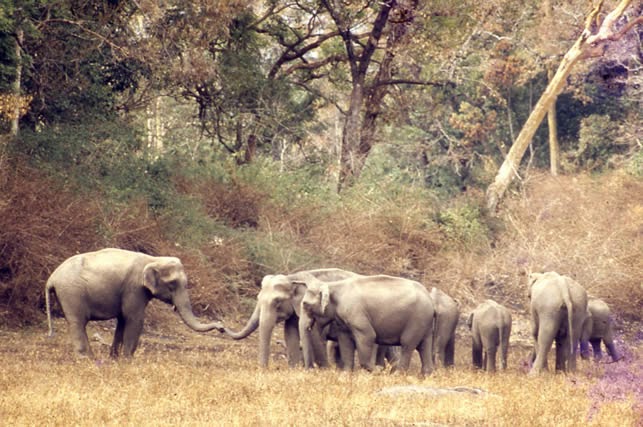
Look to Iraq and learn not to live in a divided house. Learn from the animal kingdom if you have to. And if you do not learn you will never prosper. Never. 

How about the minorities? We propose a silver bullet: give freedom to the women to live life as they please. Yes, some girls may marry outside the community (no coercion allowed in either direction). In the worst case scenario the minority will be merged in the melting pot. So what? Is multi-generational life in a ghetto any way  to live?
…………………………………….
Bodies of all the four who were kidnapped on Friday night by suspected
NDFB (Songbijit) militants, including two teenaged boys, have now been
found. The first body, bearing a cut mark on the head, was recovered
last evening from the river in Barpeta district.


……..

The bodies recovered today were identified as those of Ataur Rahman
(27), Rubul Amin (45) and Saddam Ali(13), while that of Bakar Ali(13)
was found yesterday.


The four were among seven lemon traders who had gone to Labdanguri market in Baksa district from the adjacent Barpeta district.

….

The family members and villagers in Barpeta district, from where the
four hailed, have refused to conduct the last rites demanding that Chief
Minister Tarun Gogoi visit the area to address their grievances.


….

The police fired in the air to disperse a mob protesting against the
kidnap ignoring the curfew at Anand Bazar area, Seshan said, adding
“police had to use force as the people violated the curfew and refused
to leave the place.”


The state government last evening replaced the Baksa Superintendent of
Police Nimbalkar Vaibhav Chandrakant and appointed 10th Assam Police
Battalion commandant Mojibur Rahman in his place.


In May this year, 50 people were killed in Baksa and Kokrajhar in
Bodoland Territorial Area Districts by suspected Bodoland Peoples
Front-supported militants. NIA and the state government are separately
probing the incidents.


In another incident, a police official was beaten up and critically
injured by agitated people while he was taking the three bodies for
post-mortem in Baksa, forcing the police to resort to lathicharge and
fire tear gas shells.


Nine persons were arrested in connection with the incident on the charge
of rioting and attacking a police officer on duty during curfew,
Additional Director General of Police (Law and Order) Ajit Prasad Rout
said.


The official had been admitted at the Barpeta Medical College and Hospital for treatment, he said.

“After the bodies were recovered and some tense situation during the
day, we requested the Army to show ‘area dominance’ but no flag march is
ordered yet,” Baksa Deputy Commissioner Vinod Seshan said.


….

Rout said the ‘janaja’ (last rites) of Abu Bakkar was performed during
the day, while those of the other three will be carried out tomorrow
after the post-mortem was done.


The state goverment has announced payment of ex-gratia of Rs eight lakh each for the next of kin of the victims.

….

Indefinite curfew has been clamped in the Gobardhana police station and
Anandbazar police station areas in Baksa district as well as the
northern side of railway line in Barpeta district since yesterday.

……..

Link: http://www.outlookindia.com/news/printitem.aspx?849585

……

regards

Brown Pundits