Arab spring chickens come to India

…[Islam] encouraged the westward
transfer of ‘Indian’ crops…. sorghum,
rice, sugarcane, citrus (Seville oranges, lemons, limes, pomelos),
banana, plantain, watermelon, spinach, eggplant
…..Apart
from fruits and vegetables, Laudan lists some key foods Islam helped
spread: wheat, sugar and coffee…

We admit it, we are first class foodies. And celebrations, celebrations of food, the more exotic the better, are always a good thing.

OTOH have you seen how teenage girls eat these days? One spoon of ice-cream, plus two thimbles of carrot juice……thanks so much for the lunch. And this was a girl who used to love, really really love eating, from the time she was a toddling toddler. We do not get this emphasis on thin is beautiful, size zero that percolates from the Western world to ours ( we understand that the trend was driven by gay men who dominate the fashion world). Boys and girls should be happy about their bodies and throw all that self-hate into the (arabian) sea.
……
Ramzan during the rainy season may not tempt many to leave home to have a
street-side iftar meal. But if you do venture out — and even many
non-Muslims have started going out at least once in the season to sample
the food — then you might notice a relatively new trend among the food
stalls. Among the usual sellers of kebabs, tandoori chicken, mutton
rolls, khichada or haleem and other specialties, a few now advertise
themselves as “Arab” restaurants.

..

This is particularly evident
in South India, in Kerala and Tamil Nadu, but you find them in Mumbai as
well. How Arab these restaurants really are is debatable — many of them
take on the name with just a shawarma grill and a chicken rotisserie.
At most, they might also add a vaguely hummus-like concoction of
chickpeas and a yoghurt raita, renamed labneh sauce.


Most of
them have been started by Indians with connections in the Gulf, whose
travels back and forth have led to the idea that there is a market for
mostly grilled meat dishes that are well priced and convenient to order.

But the Arab label still seems to be a draw, and it is a reminder of how
Islam and the Arab world (not always the same thing) have been major
routes to transmit trends, especially through its institutions of Ramzan
and the Haj. This is easy to forget in a world dominated by European
and American trends.

We tend to think of fried chicken as KFC, soft drinks as Pepsi or Coke
and Mexican food as Tex-Mex cuisine. European empires like the
Portuguese or the British are credited with spreading foods like
chillies and tea, while the great exchange of foods from the 16th
century onwards between the Old and New Worlds is called the Columbian
Exchange after the Italian explorer. Yet Islam was a route for culinary
transitions from long before.

Rachel Laudan, in her new work Cuisine and Empire: Cooking in World
History, describes the successive waves of religion-directed change that
spread from Asia — Buddhist, Islamic and finally Christian: “Islamic
rulers and their agronomists, according to historian Andrew Watson,
pulled off an agricultural revolution in the arid and often exhausted
landscapes of the Islamic empires.


They encouraged the westward
transfer of ‘Indian’ crops as they were then called — sorghum [jowar],
rice, sugarcane, citrus (Seville oranges, lemons, limes, pomelos),
banana, plantain, watermelon (from Africa via India), spinach and
eggplant.”

….

Laudan suggests that the Islamic route influenced
places not usually associated with the religion. Mexican food, for
example, with its complex blends of spices in curry-like dishes called
moles, could show the influence of the world of al-Andalus.


This was the Islamic empire that flourished in Spain till 1492, the same
year Columbus first sailed for the New World. The food of Islamic
Spain, which linked east to Mughal India, would have lingered long
enough to be transferred to Spain’s new American empire.

Apart
from fruits and vegetables, Laudan lists some key foods Islam helped
spread: wheat, sugar and coffee. Wheat grains were cooked whole in
porridges, ground into flour for flatbreads and noodles and made into
starch that was cooked into gelatinous sweets.

Sugarcane came
from India, but was processed here into jaggery, and the techniques for
further crystallising and refining sugar were possibly developed in
places like Egypt (brown sugar is called misri in India). 

Coffee was
providentially discovered by the Islamic world just when it was moving
away from an earlier tolerance of wine — the berries from Yemen or
Ethiopia provided an alternative, non-alcoholic stimulation.

In
all these cases, it is easy to see how the Haj and Ramzan accelerated
the regular pace of movement. Mecca had always been an important trading
centre, and its focal point for the Islamic world made it a central
point from which products could spread.

Past centuries might
not have seen as many Haj pilgrims as seen today, but those who did
manage would have carried products with them, possibly to trade and
finance the trip. (The downside of centrality of pilgrimage centres is
that they become ideal places to transmit diseases, and there are now
fears of the MERS virus spreading from Mecca).

Ramzan, or
Ramadan as it’s known outside India, is a major way to spread foods both
due to its predictability, which helps traders plan stock movements,
and the need for feeding large numbers when the fast is broken.

Dates are the most obvious commodity traded for Ramzaan, thanks to the
belief that the Prophet broke his fast with them. But other products
also benefit from the Ramzaan feast, such as oats from Scotland which
are seen as a healthier way to make the porridges, both sweet and meaty,
that help people go through the day-long fast. Before oats were
available, it was wheat that benefitted from Ramzaan.

Wheat was
historically rarely consumed in South India, but Kerala’s Moplah
Muslims made some of their most characteristic dishes from it, like
gothamba kanji, a wheat- based soup, and alisa, wheat cooked with meat,
both of which were Ramzaan specialties.

Fine wheat noodles
called seviyan are cooked by Muslim communities across India, especially
for the Eid feast that ends the month. Sweets of all kinds, of course,
are part of the evening’s feasting, including the sticky wheat halvas
made in South India. Jalebi is another sweet that has origins in the
zalabiyya of the Islamic world. 

The great wave of Islamic transmission
that Laudan details started tailing off with the rise of Christian
empires from the 15th century onwards. But different kinds of trends
have continued to travel the Islamic route, in more low-profile ways.
One example is kushari, one of the most popular street foods of Egypt – a
mix of rice, macaroni and lentils eaten with aspicy tomato sauce.

It is very likely a form of Indian khichri that may have travelled with
soldiers of the British Empire in the 19th century. It is part of a
tradition of working class contacts between Egyptians and Indians that
has continued in the Gulf today, where both communities work side by
side, in the hard situations that build bonds.

Gary Nabhan, an
American writer whose family has Syrian roots, has chronicled a
surprising route of food travel in his book Arab/American: Landscape,
Culture and Cuisine in Two Great Deserts.

In the 19th century,
Arabs came to the US with camels to help make the great deserts of the
American South West navigable. The scheme was pushed in particular by
Jefferson Davis, who became the President of the rebel Confederacy
during the American Civil War, as a way to create a supply route that
bypassed the Northern states. (Camels from Rajasthan went to Australia
for a similar purpose).

This never worked out, but much later
Nabhan came across a Northern Mexican cafe serving Arab dishes with
Spanish names like jumus bi-tajin con limon (hummus bin tahina), quebbe
(kibbe) and berenja asada (grilled brinjals) and jocoque (a
yoghurt-based drink)!

The new Arab restaurants in India are, in
a way, coming up in this tradition of culinary transfer that has always
run through the Islamic world and which is worth celebrating this
Ramzan.

……

Link: http://timesofindia.indiatimes.com/india/Ramzan-food-in-India-seeing-an-Arab-Spring/articleshow/37828831.cms

…..

regards

“Death was so close to us”


“All the buildings around the hospital were bombed by insurgents,The
mortuary in the hospital was also demolished in an explosion,” she said.
“All we could see out of the hospital window was smoke and fire”


Now that the nurses are safe home there is still the problem of the 3Lakh loan which needs to be paid off. Also there are no jobs in sight. The govt has promised an AIIMS like medical college in every state (why has this taken 65 long years?). Faster please….

Our (useless) advice, cut back on (useless) defense items (allow the USA to have permanent bases in exchange for border protection, if Pakistan can be a non-NATO ally, why not India?) and build more hospitals with the savings.

India probably needs ten times the number of doctors and nurses than what we have now, and the medical profession (in our opinion) benefits the society much more than an MBA-manager or a pilot (just to name a few “dream” professions).
……..
P
Lesima Jerose Monisha (25), a Tuticorin-based nurse, is back home from
Iraq, relieved and happy. “I will never go back,” she said on Saturday,
though she has to now find ways to repay the loan of 3 lakh she took for
studying nursing.


“Every day, we would hear at least 50 to 60
bomb explosions in the proximity of hospital where we were held. Barely
30 minutes after we were evacuated from the hospital in Tikrit, the
building was bombed,” she said on Saturday.

Monisha was one
among the 46 Indian nurses released by ISIS insurgents in Iraq. She
reached Kochi along with other nurses on Saturday morning in a special
flight and arrived at Tuticorin later in the day.

“We did not
know what was happening around us. It was our family members who kept
updating us about the developments in Iraq,” Monisha told TOI over phone
on her way to Tuticorin. Certain that their lives were at risk, the
nurses kept awake most of the days.

Though the insurgents
assured them they would not be harmed, there was always a fear that a
bomb would land on the hospital, she said.

She said the
scariest moment was when the militants gave them just two hours to get
ready and leave the hospital on July 2. “Indian embassy officials told
us over phone to follow the gunmen’s instructions for our own safety.”
Monisha said they were taken in a bus to Mosul where they were detained
in a jail-like building.  

Finally on Friday they were once again
told to pack up their belongings and board a bus. “Only then we
realized we are being released. The insurgents released us on the
outskirts of Mosul from where Indian embassy officials took care of us,”
she said.

Three days after ISIS insurgents reached Tikrit,
they took control of the hospital and held 46 Indian nurses captive.
Since then, the nurses were not allowed to leave the hospital, but were
permitted to speak to relatives and Indian embassy officials over phone.    “They did not harm us. We were provided food and water,” she said.
The armed militants had insisted that the nurses treat the injured
insurgents. But the nurses refused.

“One moment there would be
hope and the next moment despair. Death was so close to us,” she said.
“All the buildings around the hospital were bombed by insurgents,The
mortuary in the hospital was also demolished in an explosion,” she said.
“All we could see out of the hospital window was smoke and fire”.

Her mother P Edvija Ammal, 65, was overjoyed to see her daughter. “Our
prayers have been answered,” she said. Monisha, youngest in the family,
completed her nursing in Bangalore two years ago. After working in New
Delhi for eight months, she left for Iraq on February 17.

“Apart from the 5,000 financial assistance given by the Kerala
government to all nurses, chief minister Oomen Chandy has directed that
Monisha’s family be given an additional 7,000 towards taxi fare from
Kochi to Tuticorin,” said Hari P Nair, a NORKA (Non-Resident Keralites
Affairs) official.

….

Link: http://timesofindia.indiatimes.com/india/Nurse-relives-Iraq-horror-says-death-was-so-close-to-us/articleshow/37868625.cms

…..

regards

D men frm East India Co wud like to c u*

William Hague is UK foreign secretary. George Osborne is UK chancellor of the exchequer
 
These gentle-ministers no doubt come in peace and mean well.  

The powers that be should solve the present education/VISA mess, Indian govt should allow private sector and foreign direct investment (FDI) in higher education, UK govt should permit Indian executives to get a hassle-free VISA. Goodwill will be generated only if both sides accommodate each other in a fair handed manner.
……..
The whole world watched India undertake the largest election in the
history of mankind, and we have not stopped watching. Prime Minister
Narendra Modi’s historic victory and his bold plans for India’s future
have grabbed the world’s attention.


The Indian people have given their government a mandate for change
and for reform that could be transformational and the United Kingdom
stands ready to partner with India to realize your prime minister’s
vision of growth and development, benefitting all Indians and releasing
more of this nation’s immense potential. 

That is why, as the British
foreign secretary and chancellor of the exchequer, we are here in India
this week as a team to build on the partnership between our two
countries.


We already have a deep and important relationship, but it could be
even stronger. That is why our government has made a determined effort
to strengthen the foundations of our partnership over the past four
years. It is why we have made more than 50 ministerial visits to India,
why we have strengthened our diplomatic network and why we put new
energy into increasing trade and investment.


This effort is bearing fruit for both countries: our bilateral trade
is now almost 50% higher than it was in 2009; UK companies are the
biggest investors in India; and, over the last few years Indians have
invested more in the UK than European Union countries put together.


We are visiting India this week because we want to work with Prime
Minister Modi’s government to build on those ties, to back his plan for
economic development and to strengthen our partnership on the world
stage. As India pursues a wide-ranging programme of change, we believe
Britain has something to offer across the board.


First, our bilateral trade and investment has huge potential for
further growth. British companies still sell less to India than they do
to Switzerland, a country 150th the size. This has to change, and there
is a new drive for trade in the British economy: we are growing faster
than almost any other western country, we are massively increasing
support for exporters and we have made our business environment even
more competitive.


We want to see more Indian companies coming to Britain, following in
the footsteps of the likes of Tata. We want to help India access
international markets for investing in infrastructure.


We want British firms who built the infrastructure for the London
Olympics to help build the 100 new cities Prime Minister Modi is
planning, our world-leading transport companies to help develop your new
roads, railways and ports, and our defence and aerospace companies to
help bring India more cutting-edge technology, skills and jobs.


Second, we believe we should strengthen our educational ties because
we both benefit from the flow of ideas and expertise, and from the
understanding and contacts our students and researchers develop.


The UK has welcomed almost 1,00,000 Indian students to our
world-class educational institutions in the last five years and
thousands of researchers and academics. We are clear: there is no limit
to the number of qualified Indian students who can study at British
universities and no limit to the number that can work in graduate
employment.


We have now allocated £50m through our Newton Fund for joint research
with India to tackle some of the world’s biggest challenges, from
sustainable water supply to renewable energy to public health; and we
will continue to look for opportunities to build up our educational
links.


Third, we want to strengthen our cooperation in development and in
foreign policy. Together we can do more to advance our shared interests,
from tackling terrorism to addressing climate change to building
regional stability.


India wants a secure environment abroad in which to pursue
development at home and the UK through our diplomatic and defence
capabilities and our membership of the UN Security Council, Nato and EU,
can help find solutions that work for us both to problems that affect
us both.


We are deeply concerned over the kidnapping of Indian citizens in
Iraq and we want to work more closely together to address the many
challenges of an unpredictable and unstable world. To help us do this,
we want an expanded UNSC with a permanent seat for India.


The UK has had a steady purpose over the past four years: to
strengthen ties with India for the long term. This week we will be
pursuing that goal in our meetings with business leaders, civil society,
with Prime Minister Modi and with external affairs minister Sushma
Swaraj and finance minister Arun Jaitley.


We want to build on the advances we have already made, to support
your new government’s clear and ambitious plans for the future, and to
give a new impetus to this special relationship that can be one of the
great partnerships of the 21st century.

……..

Link: http://blogs.timesofindia.indiatimes.com/the-times-of-ideas/britain-will-do-all-it-can-to-help-release-indias-immense-potential

….

regards

* how we spell like a teenage girl

End of Hunger?

“These children are deprived of their future from birth,” says Indian
agronomist Monkombu Swaminathan..
..”For the real poor, this pearl millet is a great hope”….increased iron levels in the blood of
local women

In India it is unfortunate that the poor will not let themselves be eliminated through draconian programs (the elites have tried). Life in a democracy, however flawed, is an insurance against state-sponsored genocide. 

As a revenge we have developed a nation-wide strategy (by intention or by negligence) of letting poor people survive…barely above starvation levels. The good news is technology can help and at some point people will have to find a way around the middlemen (aka corruption)….also using technology (Rajiv Gandhi famously told that only 15 paisa in a rupee reached the poor- we think that ratio is optimistic).

Things will work out best if India is used as a laboratory- usually a basket of solutions will work better than one single silver bullet. From organic farming to biotechnology, let us see what works best, without bowing to one ideology or the other. 

…………………………..
Over one third of humanity is undernourished. Now a group of
scientists are experimenting with specially-bred crops, and hoping to
launch a new Green Revolution — but controversy is brewing.


It may not make his family wealthy, but Devran Mankar is still
grateful for the pearl millet variety called Dhanshakti (meaning
“prosperity and strength”) he has recently begun growing in his small
field in the state of Maharashtra, in western India.
“Since eating this pearl millet, the children are rarely ill,” raves
Mankar, a slim man with a gray beard, worn clothing and gold-rimmed
glasses.


Mankar and his family are participating in a large-scale nutrition
experiment. He is one of about 30,000 small farmers growing the variety,
which has unusually high levels of iron and zinc — Indian researchers
bred the plant to contain large amounts of these elements in a process
they call “bio-fortification.” 

The grain is very nutritional,” says the
Indian farmer, as his granddaughter Kavya jumps up and down in his lap.
It’s also delicious, he adds. “Even the cattle like the pearl millet.”


Mankar’s field on the outskirts of the village of Vadgaon Kashimbe is
barely 100 meters (328 feet) wide and 40 meters long. The grain will be
ripe in a month, and unless there is a hailstorm — may Ganesha, the
elephant god, prevent that from happening — he will harvest about 350
kilograms of pearl millet, says the farmer. It’s enough for half a year.


The goal of the project, initiated by the food aid organization
Harvest Plus, is to prevent farmers like Mankar and their families from
going hungry in the future. In fact, the Dhanshakti pearl millet is part
of a new “Green Revolution” with which biologists and nutrition experts
hope to liberate the world from hunger and malnutrition.


Global Problem

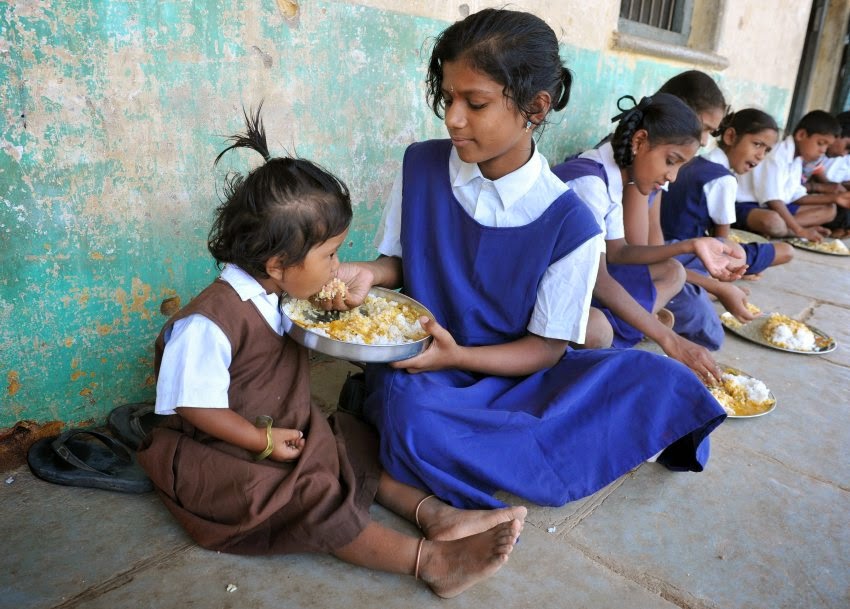
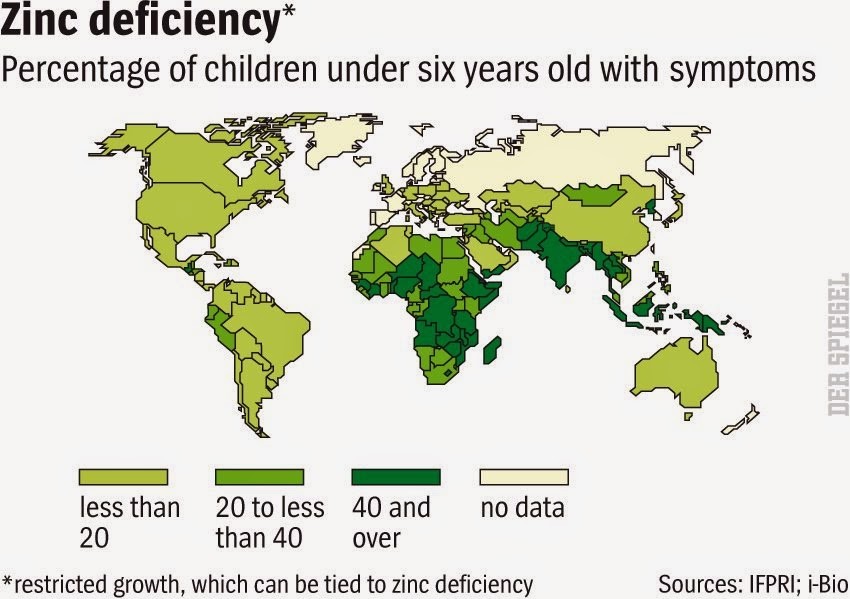
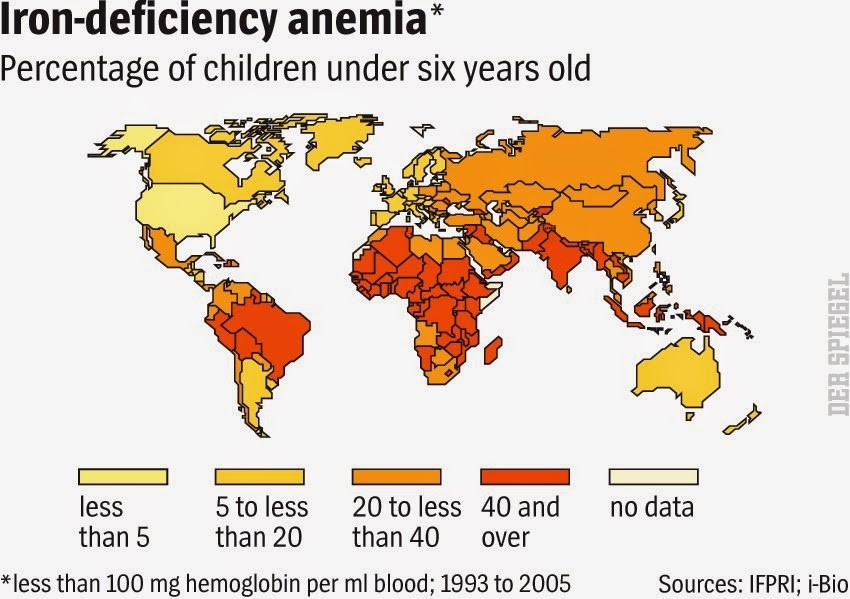
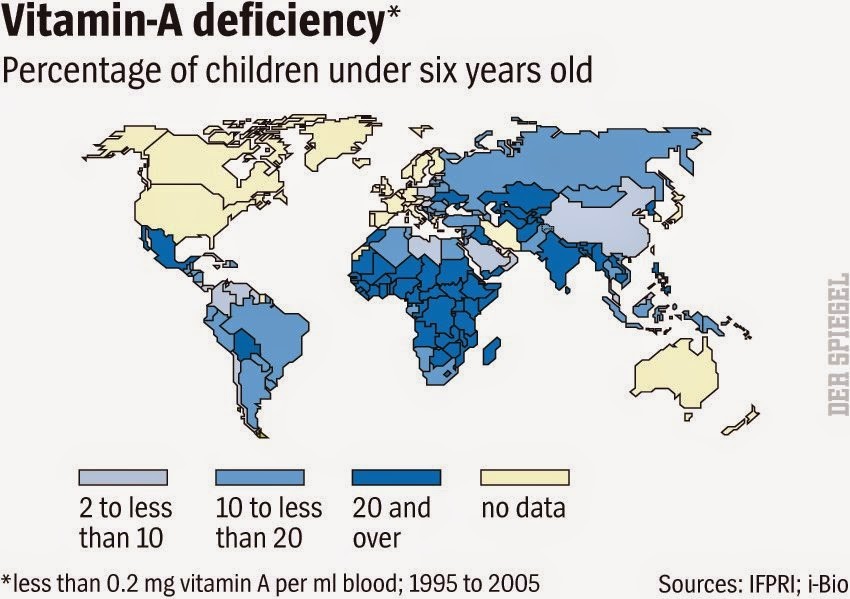
Today some 870 million people worldwide still lack enough food to
eat, and almost a third of humanity suffers from an affliction known as
hidden famine, a deficiency in vitamins and trace elements like zinc,
iron and iodine. 

The consequences are especially dramatic for mothers
and children: Women with iron deficiencies are more likely to die in
childbirth, and they have a higher rate of premature births and
menstruation problems. Malnourished children can go blind or suffer from
growth disorders. Throughout their lives, they are more susceptible to
infection and suffer from learning disorders, because their brains have
not developed properly.


“These children are deprived of their future from birth,” says Indian
agronomist Monkombu Swaminathan, who has campaigned for the
“fundamental human right” of satiety for more than 60 years. 


To solve
the problem of hunger once and for all, Swaminathan and other nutrition
experts are calling for a dramatic shift in our approach to agriculture.
They argue that instead of industrial-scale, high-tech agriculture,
farming should become closer to nature — and involve intelligent plant
breeding and a return to old varieties.


The world has enough to eat. The only problem is that the poor, whose
diet consists primarily of grain, are eating the wrong food. Corn,
wheat and rice – the grain varieties that dominate factory farming —
are bred primarily for yield and not for their nutritional content. They
cannot adequately feed the poorest of the poor — nutrients and trace
elements are at least as important as calories.


Food safety is tied to variety, says Swaminathan, who calls for a
sustainable “evergreen” revolution. He advocates the development of new,
more nutritional grain varieties better adapted to climatic conditions.
“We must re-marry agriculture and nutrition — the two have been too
far away from each other for a long time,” says the scientist.


The First Revolution

Swaminathan, 88, is considered the father of India’s 1960s Green
Revolution. He created rice and wheat varieties that were smaller than
normal but with substantial higher yields than existing varieties. He
also worked with heterozygous plants, so-called hybrids, which are up to
twice as productive as their parent generation.
 

The walls of his office
in the city of Chennai on the east coast of India are covered with
tributes and certificates — one reads: “India’s Greatest Global Living
Legend” — and in 1987, he received the United Nations World Food Prize.


“The Green Revolution was a tremendous success,” says Swaminathan. As
an adolescent, he lived through the “Great Bengal Famine” that killed
millions of Indians in the mid-1940s. “Back then we used to get less
than one ton of wheat per hectare (2.5 acres),” says Swaminathan, adding
that the yield per hectare has more than tripled since then.


….
But at what price? Although new high-performance varieties guaranteed
high yields, they depleted the soil and consumed far too much water.
More and more fertilizer and pesticides were needed. Many small farmers
lost everything when they invested in seed grain and were unable to sell
their harvest at a profit. Meanwhile, they neglected to grow
traditional bread cereals.


“Formerly, the farmers were depending on 200 to 300 crops for food
and health security,” says Swaminathan, whereas today there are only few, but gradually we have come to the stage of four or five important
crops, wheat, corn, rice and soy bean.” “The Green Revolution,” says the
scientist, ” did not eliminate hunger and malnutrition.”


Springtime in Maharashtra

In India, where about 250 million people, or a fifth of the
population, are undernourished, the problem is urgent. Some 50 to 70
percent of children under the age of five and half of all women suffer
from an iron deficiency. Almost half of all children are physically
underdeveloped or even crippled because they are chronically
undernourished or malnourished.


The situation is especially precarious in Maharashtra. In the early
morning, we travel out to the countryside with Bushana Karandikar, an
economist from the city of Pune (formerly Poona). Karandikar manages the
Dhanshakti Project for Harvest Plus. …

..
“Malnutrition is the sad part of
the Indian growth story,” she says during the trip. “It is very
surprising, but India is almost in the same league as sub-Saharan
African countries, which have much, much lower per capita income.”


It is spring, and Maharashtra is green — the land looks fertile,
with its lush fields and fruit plantations lining the road. But as
scientist Swaminathan puts it, this is part of “India’s enigma”: “green
mountains and hungry millions.”


In the town of Ghodegaon, the problems quickly become apparent. Men,
children and, most of all, young women in colorful saris are waiting on
an unpaved street outside the town’s 15-bed clinic. They remove their
shoes at the door to the building, where the walls are decorated with
portraits of the gods adorned with garlands of flowers.


Dr. Rajneesh Potnis greets us on the second floor, where we are
served sweets and aromatic coffee. Potnis has been working in this
clinic for 25 years. His fellow medical students told him he was crazy
when he went to Ghodegaon, but Potnis was determined to help people.
Today he provides advice to nursing mothers, helps women give birth, and
treats conditions like rickets, night blindness and anemia.


“The women are the worst off,” says the doctor. “They work the
hardest, and yet they eat what’s left over.” As a result, he explains,
they frequently suffer from premature deliveries and stillbirths,
infections and sudden attacks of faintness. The tribal people, ethnic
minorities which live on the margins of society, are in the worst
position. “They only come when they have no other choice.”


Potnis hands out mineral and vitamin pills subsidized by the Indian
government. He also advises families to eat a varied diet, but his
efforts are often futile, he explains. “It’s so easy to say to people:
Eat more pulses, more vegetables and eggs — but most of them can’t
afford any of that.”


The Millet Solution

This is where biofortified pearl millet comes into play. Farmers in
the region have always grown pearl millet. So why not simply replace the
traditional variety with Dhanshakti? “Then people will get their
minerals from the bread they eat every day, anyway,” says Potnis.


Ramu Dahine’s five-person family, in the nearby village of Vadgaon
Kashimbe, is a case in point. Daughter-in-law Meena is baking bhakri, a
traditional round, unleavened flatbread made from pearl-millet flour.
Dressed in a red sari, she crouches on the floor in front of a small
stone building with a corrugated metal roof. She combines pearl-millet
flour and water, kneads the dough, places the flatbread into a pan and
blows through a long tube onto the coals of a small wood fire until
flames begin to flicker.


The Dahines eat the bread, and hardly anything else, twice a day. The
seed dealer recommended the pearl millet, says the farmer. He doesn’t
even know that the grain has a high iron content, but he did notice that
his family was healthier than usual by the end of the last rainy
season. The variety also has another benefit: Because it isn’t a hybrid,
Dahine can use a portion of his harvest as seed for the next season.


“For the real poor, this pearl millet is a great hope,” says
Karandikar. Swiss scientists have shown that the consumption of
Dhanshakti millet significantly increased iron levels in the blood of
local women. And Indian researchers showed that a daily serving of only
100 grams of the pearl millet could completely satisfy the iron
requirements of children.


Can a New Revolution Take Root?

But for the global champions of the new, gentle Green Revolution and its
campaign against hunger, this is but one of many successful attempts to
develop more nutritious grain and vegetable varieties. 

In Brazil, for
example, the research organization Embrapa developed biofortified beans,
pumpkins and manioc. In Uganda and Mozambique, farmers are growing a
new variety of sweet potato rich in provitamin A. In Rwanda, more than
500,000 families are eating beans enriched with iron. And in India,
farmers will soon begin growing rice and wheat with especially high
levels of zinc.

The Harvest Plus program has already reached about seven million men,
women and children, says program head Howarth Bouis, adding that
biofortified grain is expected to improve the nutrition of a billion
people by 2030. 


Bouis’ early decision to apply only conventional methods
in breeding the new varieties was important to its success. “At Harvest
Plus we took the decision not to invest in transgenics, because we
wanted to avoid the controversy,” he says, remembering all too well the
dispute over a variety known as Golden Rice.


The Genetic Engineering Conundrum

The transgenic plant, developed in 1992 at the Swiss Federal
Institute of Technology in Zurich, contains almost twice as much
beta-carotene, a precursor to vitamin A, as ordinary rice. 


Nevertheless,
there has been so much public resistance to genetic engineering that it
has yet to be approved for use anywhere in the world.


But in many cases, genetic engineering is unnecessary anyways. There
are often natural varieties with grains that already contain the desired
vitamins or nutrients. Rice is a perfect example, with about 100,000
varieties in existence worldwide. 

“You can basically find any trait you
can think of,” says Swaminathan. In the laboratories of his M. S.
Swaminathan Research Foundation (MSSRF) in Chennai, scientists are
experimenting with high zinc-content rice. The biologists analyzed
thousands of rice strains and eventually discovered about a dozen
varieties with especially high zinc levels. They are now being crossed
with high-yield varieties.


But Swaminathan isn’t opposed to choosing the high-tech approach if
it can help alleviate hunger. ” I won’t worship nor discard genetic
engineering,” he says. “It is important to harness all the tools that
traditional wisdom and contemporary science can offer”


Because, for example, it is very difficult to increase iron levels in
rice with conventional breeding techniques, the scientists have turned
to biotechnology. “We isolated genes from mangroves and introduced them
into the genome of rice,” explains Ganesan Govindan, one of the
bioengineers at MSSRF. The transgenic rice grains contain elevated
levels of iron, and the plants are more tolerant of drought and salt.
Researchers expect the variety to be ready for market in two or three
years.


‘25,000 Farmer Suicides’

But these high-tech solutions are also controversial. Vandana Shiva, a
prominent opponent of modern agricultural engineering, lives in the
Indian capital New Delhi. In the offices of her organization, Navdanya
— located in the affluent neighborhood of Hauz Khas — are decorated
with a flower arrangement on a glass table and clay vases containing
sheaves of grain.


Shiva, dressed in a flowing robe and with a large bindi on her
forehead, is an impressive figure, steeled by her tough, decades-long
battle with the establishment. The civil rights activist never tires of
castigating seed companies. “A globally operating industry is pushing
hard to make the world dependent on their products,” she says. 

Farmers
who have made the switch, she explains, give up their traditional seed
and are then forced to buy the commercial varieties, which often come
with license fees, in perpetuity.


….
“This type of agriculture has taken the lives of 25,000 farmers in
India, who committed suicide because they couldn’t pay back their
debts,” says Shiva. She doesn’t think much of biofortified varieties,
either. “Harvest Plus is focused on one nutrient,” she says critically.
“But a single nutrient is not a solution to multidimensional
malnutrition crisis; the body needs all the micronutrients.”


….
Instead of these “monocultures,” Shiva is calling for a return to
diversity in fields. “Most of our traditional crops are full of
nutrients,” she explains. Why create Golden Rice with lots of vitamin A
when carrots and pumpkins contain plenty of it already? Why develop
genetically modified bananas with high iron content when horseradish and
amaranth contain so much iron?


Shiva recommends field crop-rotation, and the fostering of vegetable
and fruit gardens and small family farms primarily geared toward
nutrition instead of maximized profit. Because Shiva believes organic
farming is the only viable approach to defeating hunger, her
organization has trained 75,000 farmers in organic farming methods since
the late 1980s.


‘There Isn’t Enough Arable Land’

Harvest Plus Director Bouis believes that Shiva’s approach is naïve.
“We have the fundamental problem that there isn’t enough arable land for
a constantly growing population,” he says.


A UN Environment Programme report predicts that by 2050, agriculture
will have to produce 70 percent more calories than today to feed an
expected global population of 9.6 billion people. This “food gap” can
only be closed, says Bouis, if we “make agriculture even more
productive.”


But in Maharashtra, it’s clear that new varieties of super grains are
not always the entire answer. A third farmer from the town of Vadgaon
Kashimbe, Santosh Pingle, 38, and his family are visibly better off than
their neighbors. They live in a plastered house, they have cows and
goats for milk, and they enjoy the occasional luxury of a chicken from
the market. Pingle’s recipe for success is that he has done more with
his land than other farmers.


The farmer grows iron-rich Dhanshakti millet to satisfy the iron
needs of his family of five. On the other half of their field, the
Pingles grow tomatoes and high-yield hybrid millet, which they sell in
the market. They also grow protein-rich pulses and other vegetables in
their house garden, and his wife Jayashree and her daughters harvest
lemons, coconuts and mangoes several times a year.


The Pingles are well on their way to achieving “prosperity and strength” — and they always have enough to eat.

……

Link: http://www.spiegel.de/international/world/india-experiments-with-pearl-millet-to-end-world-hunger-a-973504.html

….

regards

The Mosques of Mosul (no more)

“We lived together side-by-side (with Muslims) for 14 centuries. We still want to communicate and live together,” Sako said.

…..
Mosul, Iraq (05 July 2014)….Muslims
persecuted because they are the wrong type of muslim. Muslim mosque(s)
erased because it was the prayer room of the apostate.
Our heroes are your villains. This is how
civilization will end, brothers fighting against brothers. Only
chance…give the sisters a chance.

…………..
Images emerged on Saturday purporting to show that Islamist militants,
who seized parts of northern and western Iraq last month, had destroyed
at least 10 shrines and mosques in the province of Nineveh.


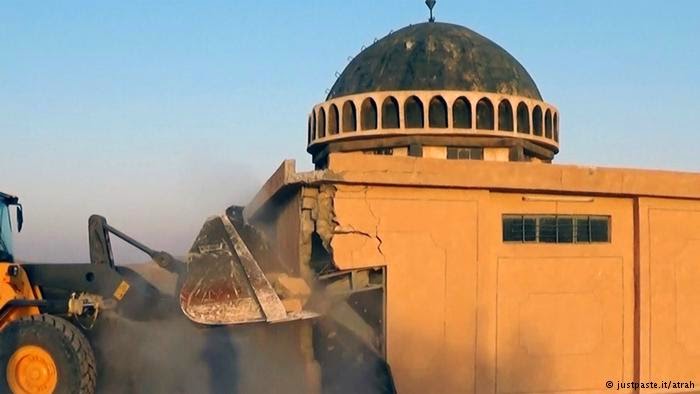
Photos from Nineveh showed bulldozers plowing through walls, demolishing
four shrines of Sunni Arab or Sufi origin. Explosives were used to
destroy six Shiite mosques.


Residents of Mosul, which is the capital of Nineveh, said the militants
had also occupied two cathedrals belonging to Chaldean and Orthodox
Christians.
Crosses on their frontages had been replaced by the black flag of the
Islamic State of Iraq and Syria (ISIS), the group which recently
declared itself to be an “Islamic State.”


Iraq’s most senior Christian leader, Chaldean Patriarch Louis Sako,
appealed on Saturday for the release of two nuns and three orphans who
went missing on Tuesday in Mosul. He appealed to “scholars in Mosul and tribal sheikhs” to help locate the
five and arrange their release, according to the news agency AFP.

“We lived together side-by-side (with Muslims) for 14 centuries. We still want to communicate and live together,” Sako said. According to Sako, “at most” only 500,000 Christians remain in Iraq. Before 2003 they numbered 1.2 million.

…………………

Link: http://www.dw.de/images-show-shrines-demolished-in-iraq/a-17760683

….

regards

Pak-China Tunnel Vision

What’s the problem in turning a blind eye towards china? After all the
whole world is quite, the OIC is silent, the new Caliph hasn’t said
anything. I think we should not say Anything. (from the Comments, filed under wicked humor)

Rafia Zakaria is the latest to jump on the band-wagon.  
Question: Why does Pakistan choose to remain silent in face of grave religious violations by the Chicoms against the Uighurs?
Following the musings of the delightfully pen-named BPeep– Carvak Charan and summoning our best inner teenage girl spirit, we respond: well, duh!!!

Rafia did make one (unusual for her) mistake. Pakistanis (81%) do not love China more than the Chinese. The Chinese love themselves the most (95%).
That raises a separate ethical issue for Pew querying Chinese over the phone (or inter-webs or god forbid, in person) and asking to put their non-love of the nation on public record.
Finally, it is surprising that Pew has queried state-less Palestinians (and many others) about the Chinese but not the Indians (naughty, naughty).

Next, we set aside the favs/unfavs data and look at the poll in totality. The picture that emerges is a complex one.
…….

Is China’s growing military power a good or bad thing for our country? Pakistan- 64%

Does China consider your country’s interests? Pakistan- 52%

Both the huge drop in numbers and/or rankings point to the clear eyed understanding that Pakistanis have about China. As Pakistanis get more and more exposed to Han racism (which may be even worse than Arab racism) we can also expect a realistic appraisal in case the crucial question is posed: what do you think how China/Chinese think about your country/people?
…..
According to a Pew Research Center survey
done just last year, the only country that loves China more than China
itself, is Pakistan. Now, suddenly, there is news that threatens to fray
these bonds of affection.

According to news reports, the Chinese
Communist Party which has long placed restrictions on fasting in the
Chinese Muslim province of Xinjiang has issued a ban on fasting.
A Government website announced that all teachers, all students, and all
civil servants would be banned from fasting in the month of Ramazan.

The
ban is a sudden and severe curb on religious freedom in a province
already often beleaguered by religious clashes and political unrest.

In
one part of the region, retired school teachers were posted outside
mosques to prevent students from entering the premises. In another, a
school website announced that fasting could not be permitted because it was detrimental to student health.

The
Bureau of Forestry in Xinjiang’s Zhaosu County held an event the day
before Ramazan began in which party affiliates signed pledges saying
that they and their family members would desist from fasting.

A
weather bureau in the Hotan area of the province went even further
announcing on its website that all Muslim employees would be required to
sign a letter saying that they would not be fasting.

China does
not have a stellar record of respecting the rights of minority
religions. But this new ban and its accompanying restrictions are the
most blatant curb on the freedom to practice religion seen in the
country in recent days.

At the same time, there is China’s long record of aid and alliance with Pakistan.

Not
only has China been a longtime supporter of Pakistan’s nuclear program,
it has recently also pledged to help bolster Pakistan’s civilian
nuclear power capacity over the next five years. This includes the
construction of a 2200MW nuclear power complex in Karachi that is
forecasted to cost over 10 billion dollars.

China is also
Pakistan’s largest supplier of military equipment and Beijing operates
the strategic port of Gwadar in the Balochistan province.

On the
civilian end, the two countries enjoy a free trade agreement, an accord
signed last year created the “Pak-China Economic Corridor” The project
which involved the construction of a 200 km tunnel, would connect
Pakistan ironically to the very location of the problem, the Chinese
Muslim province of Xinjiang.

As a Muslim country, Pakistan has
been eager to stand up to the injustices committed against Muslims
anywhere in the world. In most cases, these denunciations, whether they
are of veil bans in France or pogroms in Gujarat, oft have not posed
much of a challenge to the country’s strategic and economic interests.

This
issue with China; its outright banning of what is a basic tenet of the
Muslim faith may prove to be a trickier proposition.

Used to denouncing only the West and India, Pakistanis ignore the
racism and human rights abuses perpetrated by those they consider to be
their ‘friends’.

In this respect, the condition of Muslims in
Xinjiang requires the solidarity of others who believe in their rights
of free exercise and the injustice of this ban.

At the same time,
China’s actions against its Muslims are not that different from
Pakistan’s indifference toward its own religious minorities.

Pakistani
Hindus and Christians, while not facing outright bans, are used to
being hounded, harassed and even killed. Viewed from this lens then, the
Chinese and Pakistani positions on minorities are perhaps not that far
apart; the difference only in the detail of which minority, Muslim,
Hindu or Christian, bears the brunt of an intolerant state.

Hard
as it may be on the poor Muslims of Xinjiang, this ban on fasting may
not bring a break-up between Pakistan and China, becoming instead the
wilful compromise on which marriages of convenience are built.

…..

Link (1): http://www.dawn.com/news/1117038/breaking-up-with-china

Link (2): http://www.pewglobal.org/database/indicator/24/
….

regards

The life of Sheila

Lalu Prasad …has Z Plus security cover with NSG commandos
guarding him….even when he was pronounced convicted in fodder scam and
put inside Birsa Munda jail. The NSG, of course could not stay inside
the jail. The commandos were back on duty once he was released on bail.

This (and many others) can be made into a fine Monty Python sketch but Indian media is too deferential towards politicians. 

Sheila Dixit was the Chief Minister of Delhi during the disaster that was the Delhi Commonwealth Games. When told that an over-bridge collapsed and killed some laborers (just like in Brazil yesterday) she responded that “no VIPs were going to use the bridge.”

This and other acts of arrogance directly led to her humiliating loss to Arvind Kejriwal in the Delhi elections. But politicians never ever lose their privileges. She was appointed by the previous Congress regime as the present governor of Kerala. The BJP wants her out which may not be the right constitutional thing to do. But one major benefit will be that she will lose her immunity and be open to corruption charges. 
…………..
As Delhi chief minister Sheila Dikshit lived a regal life. No surprises
that she does not want to leave the opulent perks that come with the
high constitutional office of Kerala Governor. 

Resigning from that post,
as desired by the Modi government would not just take away her immunity
to be prosecuted in a criminal case but will also force her to live
life as an ordinary citizen, howsoever affluent and connected, but pay
for wasteful services enjoyed.


When the whole of Delhi used to sweat it out during summer, both due to
power outage and high electricity tariff,s Sheila forced government
agencies to fix 31 Air conditioners and 15 desert coolers at her
official 3 Motilal Nehru residence. She also did not need to pay the
electricity bills. And it was not only the fact that she wanted to stay
cool in the summer. She also ensured that during winters, all corners of
her house were kept adequately warm. In addition to 25 heaters that
were installed in various corners, 12 geysers of 50 litre and 25 litre
capacity were fixed to ensure an uninterrupted supply of warm water in
bathrooms.


The bungalow has sprawling manicured lawns, made up as per the taste of
the former Delhi chief minister. This type VIII bungalow is spread
across an area of three acres.


These revelations have been made in an RTI response to queries made by
the noted RTI activist Subash Agrawal. It also comes to light that the
former Delhi chief minister now Governor of Kerala, had sundry household
and kitchen durables bought on government expenses. She did not
consider it necessary to buy these things herself for her own use.


These included things like two RO system (water purifier) , refrigerator
not one but two (265 litre and 310 litre), 16 air purifiers, two
microwave ovens, hot case, toaster, three TVs etc.


These were the items which were removed by the CPWD when they came to
renovate and refurnish the house to make it a post re-retirement home
for former prime minister Manmohan Singh. The CPWD added in its response
that “the AC’s and other fixture have been partially utilized in
various Government offices as per the requirement”.


Agrawal said, “Consumption of electricity and expenses on such a large
fleet of electrical equipment can be well imagined that too at a time
when austerity-drive was there in existence with shortage of electricity
for commoners having been a common phenomenon. Our elected
representatives should be role-model citizens adopting austerity in
their personal lives especially when it is at cost of tax-payers’ money.
Enquiry should also be made if former Delhi chief minister was entitled
for such princely facilities, and necessary action may be taken against
concerned ones responsible for allowing expenses more than permissible
limit.”


If Sheila will have to explain for her pompous living on public
expenditure, some other UPA benefactors who still continue to live with
walking symbol of VVIP culture, Z Plus and Z category security will get
anxious moments in days to come. It would be left to their lobbying
capacity to see whether or not they are removed from the list of high
and mighty.


In most cases Z Plus or Z category security has come as perk of power
than due to any genuine threat perception. The Union home ministry has
begun the “review”. But to avoid the consequent political storm, Home
Minister Rajnath Singh may like the “review” process to take its own
sweet time, till mid-August when budget session of Parliament concludes.


Lalu Prasad, for instance has Z Plus security cover with NSG commandos
guarding him. It presented a unique sight when NSG was by his side,
protecting him even when he was pronounced convicted in fodder scam and
put inside Birsa Munda jail. The NSG, of course could not stay inside
the jail. The commandos were back on duty once he was released on bail.


The ever growing list of VVIP protectees saw too many inclusions in the
list. Besides, Lalu, Beni Prasad Verma, Amar Singh, Manish Tiwari,
Pratap Singh Bajwa, Pramod Tiwari, Brajesh Pathak, Satish Chandra
Mishra, Naveen Jindal, journalist Anirudh Bahal of Cobrapost and former
Union minister Matang Sinh some of those who were given security of
varying category Z Plus, Z or Y during the UPA regime. Two BJP leaders –
Shahnawaz Hussain and Rajiv Pratap Rudy were accorded ‘Z’ category
security.


The list of VIP protectee has 427 names, 346 Central protectee and 81
local. Over 35 are in Z Plus category, more than 50 in Z category. A Z
plus protectee has 36 commandos guarding him, in Z category 22 commandos
guard him, in Y category 11 security personnel are attached to the VIP
and in X category two policemen guard him.

…..


Link: http://www.firstpost.com/printpage.php?idno=1601629&sr_no=0

…..

regards

3 dads (racism, communalism, greed), 600 orphans

…League leaders…jumped
in to defend the orphanages…attacked police officers for
registering cases and chastised Chennithala….They also hit out at him for ‘communalising’ the
issue.
..….Malayalam TV channels sent reporters to the children’s villages in Bihar
and Jharkhand…they had been “purchased” …for Rs 1,000 each to be sold at double the price to
orphanages.


The racism of Indians is best illustrated by observing how Indians behave with other Indians. North Indians despise South Indians and vice versa. The Indians from the North-East are despised by everyone else.

Kerala, by most measures, is a progressive state. Universal literacy, sympathy for the downtrodden, the (relatively speaking) liberation of women, these are all huge achievements and mallus are justifiably proud of this progress.


Unfortunately the child trafficking incident noted below highlights the racist, perverted and communal nature of some Keralites who know full well that the corrupt, vote-bank seeking politicians have their back. The only way forward that we can think of is to empower women. Women can make a difference (they are the only hope).

Also cheers to the Social Welfare Board and the (Kerala High) Court. Building (secular) institutions is what will help improve India and make it a modern nation. But still the stench of prejudice may still not go away.
………………………………
The Kerala conundrum has become a cliché by now. Yet, it refuses to
die, with newer contradictions continuing to pop up every now and then
to remind us just how well and how badly Kerala is doing. The latest
scandal is the ‘orphan trade’ that has recently surfaced to rock the
state.


Kerala has a peculiar labour scenario. Thanks to petro-prosperity and
the peculiar status-consciousness created by huge financial
remittances—estimated at Rs 60,000 crore last year—sent by its 2.5
million- strong community of Malayalees employed in the Gulf, there are
almost no takers in the state for blue-collar jobs. This is in spite of
the state’s high rate of unemployment. 

Unsurprisingly, the state’s high
minimum wages have lured unskilled migrant labour by the drove even from
distant states such as Assam. The state that thrives on Gulf money has,
in effect, turned into a Gulf of sorts for migrants from other Indian
states, with their count touching 2.5 million now— the same number of
people from Kerala who are in the Gulf.


So while the state has the rare distinction of being the highest
exporter as well as importer of labour, an even more interesting
demographic phenomenon is that its number of immigrants more or less
equals its emigrants. In sectors that range from construction to
domestic help, Kerala depends on labour from other states for most of
its low-paid jobs.


..
Until recently, however, few knew that Kerala has even been sourcing orphans from other states!


..
The state, it seems, does not have enough orphans for its 2,000 odd
private orphanages to admit. Hence, these orphanages, most of them run
by Muslim and Christian religious groups, have been getting hundreds of
poor Muslim children from states such as Bihar, Jharkhand and West
Bengal with the help of a network of agents.


..
It is no secret that more than any humanitarian concern, what drives
orphanages to desperately seek inmates are the liberal government grants
and huge donations from abroad. According to statistics available with
the Union Home Ministry, 1,500-odd organisations based in Kerala—most of
them religious entities or NGOs—received more than Rs 10,000 crore over
the past decade as donations, of which 60 per cent went to those
running orphanages and destitute homes. 

In 2012-13 alone, 1,502
organisations received a total Rs 850 crore. Except the Mata
Amritanandamayi Mutt, all the top recipients were Christian and Muslim
organisations, with the Believers Church leading the pack with Rs 417
crore collected in the past three years.


The scandal of Kerala’s orphan trade surfaced dramatically on 24 May
when the Railway Protection Force at Palakkad Railway station
intercepted two long-distance trains coming from Assam and Bihar. Out
came from two coaches of either train about 600 Muslim boys and girls
aged between five and 13 years, all of them originally from Bihar, West
Bengal and Jharkhand. These children, packed like sardines in the
compartments, were utterly exhausted from their long journey, and more
than 150 of them had neither tickets nor any documents. 

Under
interrogation, the eight adults who had travelled with them disclosed
that the children were being brought to be admitted to two orphanages in
Kozhikode and Malappuram districts run by Sunni clerical organisations
closely associated with the Indian Union Muslim League (IUML), a party
that happens to be the second largest constituent of Kerala’s ruling
United Democratic Front. One of the two orphanages under the scanner is
headed by Syed Hyderali Shihab Thangal, the League’s state president.


On their arrival at Palakkad, the orphanage authorities paid the
fines levied by the Railways on those who had travelled without tickets,
admitted that the children were being taken to their institutions, and
proclaimed themselves to be do-gooders, wondering aloud what was wrong
with their “humanitarian” mission of helping orphans from other states,
as they had been doing for decades. 

However, the District Child Welfare
Committee under the state Social Welfare department, led ironically by a
Muslim League minister, took custody of the kids and recommended action
against the orphanages and their agents under the Juvenile Justice Act.
On their part, the state police registered cases of child trafficking.


Asked Ramesh Chennithala, Kerala’s home minister and former KPCC
President, “Why [do] these orphanages import children from other states
instead of setting up centres there if they’re [so] concerned
about these children?” Even the IUML’s MK Muneer, the state’s social
welfare minister, demanded action against the alleged child traffickers.


The children, it was confirmed, had been brought in violation of laws
on orphan admission. This kicked up a storm. Under the Juvenile Justice
Act of 2006, sanction letters from the concerned state governments,
local self-governments and families are mandatory, as also birth
certificates (among other things), for the admission of children from
other states to orphanages. Most children did not have these documents.
Some had fakes.


The state government appeared to initiate strict action against the
offenders. But soon, League leaders and scores of Muslim outfits jumped
in to defend the orphanages. They attacked police officers for
registering cases and chastised Chennithala for portraying the so-
claimed ‘minor procedural lapse’ on the orphanages’ part as a case of
child trafficking. They also hit out at him for ‘communalising’ the
issue, as they put it.


Chief Minister Oommen Chandy parroted the League line and Chennithala
fell silent. Kerala’s Minorities Commission, led by a Congress leader,
defended the orphanages as well. Muneer, too, changed tack and swallowed
his words, saying there was no case of child trafficking but only a
minor procedural lapse.


The state BJP, in the meantime, took the case to the Centre. Union
Minister Maneka Gandhi described it as one of child trafficking.
Malayalam TV channels sent reporters to the children’s villages in Bihar
and Jharkhand, and reported that they had been “purchased” from their
families by agents for Rs 1,000 each to be sold at double the price to
orphanages. 

Officials of the Jharkhand government arrived in
Thiruvananthapuram and confirmed that it was a case of child trafficking
and asked for the children’s immediate return. The state Human Rights
Commission came down heavily on the orphanages and instituted an
investigation. With the Kerala High Court too reprimanding the state
government for its casual attitude towards the incident, League and
Congress leaders have now chosen silence. 

Chandy has offered to bear all
expenses for the children’s return journey. But as the dust over the
scandal settles, the case of child trafficking looks like being given a
silent burial and the orphanages getting back to business as usual.

 
……

Link: http://www.openthemagazine.com/article/nation/auctioned-elsewhere-orphaned-in-kerala

…..

regards 

The RSS is back in (cultural) business

The appointment of Y Sudershan Rao to the ICHR is only the first of more
appointments to follow.
….ICSSR, NIAS, UGC, Indira Gandhi National Centre for the Arts (IGNCA), National
Book Trust, NCERT, Films Development Corporation, Censor Board, Sangeet
Natak Akademi, Lalit Kala Akademi…


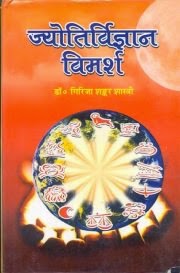
Happy days are here again when we can (again) get a masters degree in Jyotir Vigyan Jyotirvigyan or astrology (response to Shah Alam: thanks for the tip, our Sanskrit gyan is bilkul shunya, root word is jyoti, jyotish, jyotishi, jyotirvigyan are all formed by conjoining words…re-written jyotirvigyan as one word). Especially happy are the people who will be dusting off their decade old research proposals in deciphering mythology- the events and the people.

Our favorite query: did India have airplanes as recounted in Ramayana (which Lord Rama used to fly from Sri Lanka to Ayodhya) and atomic weapons as described in the Mahabharata (the Brahma-Shir-Astra that Ashwatthama and Arjuna launched at each other and which threatened to wipe out the world).

We have admittedly mixed feelings about this. Ramayana and Mahabharata are unparalleled as stories which have been retold in million different ways (all possible art forms included) from India to Indonesia. These are no simple tales of good prevailing over evil – Ravana is the greatest of kings (and devotees). It was his blind arrogance that led to his downfall (he was not bothered enough to take insurance against men and monkeys). Rama, the ideal man (maryada purushottam) is cursed with hundred and one flaws – which are recognized as flaws – starting with his treatment of his own wife.

But the jump from mythology to history and science is not acceptable. The RSS is playing the same lousy game that the left has played for such a long time- denigrate and deny the parts of Indian culture that does not meet the purity test. It is stupid and pointless.

Take the example of Kabir and Shirdi Sai Baba. These saints have been fully accepted into the pantheon of Hinduism. If you are convinced that donating money to a shrine/deity will help you score a business deal, the Sai Baba shrine is as good as any (indeed it is one of the richest). The puja ceremony that takes place is identical to the ones that take place in Siddhi Vinayak, the foremost Ganapati temple in Maharashtra.

Thing is, if RSS really wanted to play smart they can use the Baba worship culture as a wedge issue. The reasoning is simple – the muslim communities (primarily Sunnis) have become increasingly disenchanted with the Baba-shrine culture. This is following the Saudi money and Wahabi logic which insists that all such activity is un-islamic.

The fundamental question that RSS is always worried about (and the reason behind all these culture games) is – are you (the muslim) an Indian first or a muslim first? Or even more bluntly, are you (the muslim) with India or with Pakistan? The Baba culture is too deeply rooted in India, the roots are increasingly weak in Pakistan and may vanish at some point. At that time the wall between the Middle East (includes Pakistan) and South Asia (mainly India) will be complete. The sifting that RSS wants will thus happen automatically without lifting a finger.
…………………
The new chairperson of the Indian Council of Historical Research,
Yellapragada Sudershan Rao, has an interesting blog post from 2013,
about ‘Ayodhya and History’.

….
“All thinking men — religious activists, intellectuals,
politicians, professional historians and archaeologists- are divided
into at least three groups; a) those who stand for the Hindu cause, b)
those who stand for the Mosque and c) the majority of others who support
an amicable settlement of the controversy. In influencing the public
opinion in favour of Muslim community, the ‘secular’ historians and
‘progressive’ intelligentsia make concerted endeavor in support of the
Muslim cause. They further condemn all those who sympathize the Hindu
cause as Hindu fundamentalists and ‘saffron brigade’.”

….
Rao goes on to argue that modern history — which he claims has received
disproportionate attention and legitimacy — will be unable to provide
answers to the Ayodhya issue since “Ayodhya stood even before the modern
genre of history was born.”


A retired history professor, Rao has penned several articles arguing
that stories from the Ramayana and the Mahabharata are truthful accounts
of history. According to his blog page, he has interests in Indian
mythology, Vedic literature, Sanatana Dharma, ‘Bharatiya Sanskriti’,
among other subjects. Rao reportedly told The Telegraph that
he hopes to push projects to rewrite ancient history to document the
“continuous Indian civilisation”, including the period of the two epics.


“The stories of the Ramayana and the Mahabharata cannot be termed
a-historical just because there is not enough archaeological hard
evidence,” Rao said, adding,“A lot of historical material has come
through cultural, anthropological, archaeological and ethnographic
studies in the last 60 years about the continuous Indian civilisation.
The findings can be compiled by researchers. I think the ICHR should
support historians interested in doing work on these aspects.”


….

Rao’s elevation is the first of the many NDA decisions that will
determine who will lead India’s top research, educational and cultural
institutions. Asked if he foresees a flood of RSS-sympathetic
appointments to these institutions, former ICHR chairperson and
historian S Settar retorts, “Do you doubt it? I don’t.”


Settar was ICHR chairman from 1996 to 1999, and was witness to a gradual
Hindutva takeover of socio-cultural research organisations in the late
1990s. After the UPA assumed office in 2004, Settar was also on a review
committee that examined NCERT books published by the BJP government.
The committee discussed the safronisation of the texts at length and
recommended replacing them.


Speaking to Firstpost, Settar says, “There are many rightist corners
hungry to get into the ICHR. But in any case, it is such an incompetent
organisation — the Leftists have used it as a platform for their
ideology and friends, and now the rightists will want to use it for
their ideology and friends.”


ICHR will hardly be the only institution to see top-level changes given
the BJP’s track record in power. In 1999, not long after the NDA
government was sworn in, a slew of appointments were made, including
some on the very first day after then HRD minister Murli Manohar Joshi
assumed office.


The Indian Council of Historical Research (ICHR) got a new chairman, Prof B R Grover who soon became notorious
for punishing any historical research project or institution perceived
as “hostile” to the ruling government or its saffron view of history.


The Indian Council for Social Science Research (ICSSR) head at the
time was M L Sondhi, a Rajya Sabha MP from the BJP who would later,
ironically, be summarily replaced
after he complained repeatedly and publicly of pressure from an RSS
cabal within the ICSSR. Sondhi, considered close to then PM Atal Behari
Vajpayee, famously complained that the RSS faction in the institution,
led by Devendera Swaroop, a former editor of RSSmouthpiece Panchajanya,
was hindering a proposed Indo-Pak social scientists’ meet ahead of the
Vajpayee-Musharraf summit in Agra.


Also among MM Joshi’s early appointees was RSS sympathiser G C Pande, a
Sanskrit scholar and ancient India historian, who became head of the
Indian Institute of Advanced Studies (IIAS) in Shimla. The University
Grants Commission (UGC) top job was handed to Dr Hari Gautam, who soon
after introduced courses in Jyotir Vigyan or ‘Vedic astrology’ and Hindu
karmakand or rituals. …


The move raked up a debate on whether the UGC,
the institution that controls higher education institutes across the
country, was legitimising superstition.


And it is these institutions and their impending appointments that will
be closely tracked by activists and academicians who will be keeping a
close eye on the research projects they undertake, and changes they
institute in curriculum and historiography.


The appointment of Y Sudershan Rao to the ICHR is only the first of more
appointments to follow. Apart from the ICHR, ICSSR, the NIAS in Shimla,
the UGC, here are other institutions to watch closely in coming months:
The Indira Gandhi National Centre for the Arts (IGNCA), the National
Book Trust, NCERT, Films Development Corporation, Censor Board, Sangeet
Natak Akademi, Lalit Kala Akademi, to name a few. Also to watch: Likely
expansion plans for the network of Shishu Mandir schools and Vidya
Bharati schools, and funding patterns for other schools including those
run by the VHP.

In his blog post about Ayodhya, Rao bemoans the politicisation of
history, writing “Revisiting the past with preconceived notions and
vested interests leads to misinterpretation of historical facts. Since
independence, volumes are written by the teams of scholars owing
allegiance to either side of the issue. In this milieu, the worst
sufferer could be history as a scientific discipline and historiography
as a technical craft.”

If history is any indication, these words may soon prove to be ironic, indeed.

…….

Link: http://www.firstpost.com/printpage.php?idno=1602761&sr_no=0
….

regards

Dual Lt Generals up for a duel

…the main
accusation against Suhag is that …he
was shielding the Colonel commanding the Intelligence Unit that had
indulged in the above cases of murder and dacoity….This particular Colonel faces several
other allegations, the most significant of them being narcotics
smuggling on the Indo-Myanmar border…

Indian Army succession battles are becoming more and more frequent and the allegations are getting more and more serious.

The concern now is about possible links to illicit drug trade running from the North-Western border of the country to the North-East. We hope that the Supreme Court will clean up the mess so that the integrity of the Army is not compromised. The last thing we want is Mexico like drug warfare breaking out and the complete destruction of civil society.
…..
Here is where the concern comes in and is reflected in the ongoing
legal battle between two of the senior most Lieutenant Generals of the
Indian Army—Dalbir Singh Suhag and Ravi Dastane. 

Recently, there was a
controversy about the tearing hurry in which the appointment of the
former as Chief of the Indian Army was announced by the UPA government
after it was virtually voted out. 

……..
Strangely enough this appointment was
confirmed by the acting defence minister of NDA government the day he
took charge and was re-confirmed in the Rajya Sabha, though a writ
petition filed by Lt Gen Dastane against the seniority of Lt. Gen Suhag
was pending in the Supreme Court. 


….
The Apex Court has finally come around to hearing the petition in the
second week of July. It was to have been heard on May 2, but the
ministry of defence (MoD) under A.K. Antony got it deferred to September
which would have rendered the case infructuous
and facilitated the
implementation of the ‘line of succession’ drawn up by the UPA and
adhered to by the NDA government without let or hindrance. In the
event, Suhag would become Army Chief on 1st August 2014 and Lt Gen
Dastane would superannuate on August 31. 


Dastane’s case hinges on the actions taken by General Bikram Singh
who took over as the CoAS from General V.K. Singh on June 1, 2012.  It
is alleged that a cabal of bureaucrats in the MoD, purportedly having
links with the arms lobby and drug traffickers, is hell bent on ensuring
the status quo ante. 

Inter alia Dastane’s writ petition points out that
the MoD had put up only two names to the Appointments Committee of the
Cabinet to fill the vacancy of two Army Commanders in the summer of
2012. 

According to rules, four names should have been submitted which
would have automatically included Dastane’s as well. Suhag was then
under Discipline & Vigilance (DV) Ban and therefore not eligible to
be promoted.
Had Dastane got his rightful promotion as Army Commander
then, he would have been the one in line to succeed Bikram Singh as the
CoAS based on the principle of seniority and unblemished service
record. 


….
The DV Ban imposed on Lt-Gen Suhag, then General Officer Commanding 3
Corps, was based on the advice and recommendation of the Judge Advocate
General and Vigilance branches of the Army Headquarters for the command
failure to take appropriate action in the Dimapur fake encounter case
and the Jorhat dacoity case. 

While the triple-murder in the fake
encounter case was hushed up, the Court of Inquiry by the Army and later
Court Martial found the Intelligence Unit working directly under the 3
Corps Commander fully responsible for the Jorhat dacoity. Recovery of
most of the loot from the officers of the unit by the police further
proved its involvement. 


….
Though concealed by MoD and spun differently by the media, the main
accusation against Suhag is that by not initiating stringent action he
was shielding the Colonel commanding the Intelligence Unit that had
indulged in the above cases of murder and dacoity. Because of this, the
victims in both cases were forced to approach the Guwahati High Court
for justice, which is pending. 

This particular Colonel faces several
other allegations, the most significant of them being narcotics
smuggling on the Indo-Myanmar border by abusing Armed Forces Special
Powers Act. This has not been refuted so far. 

MoD officials have only
come out with childish excuses that Lt. General Suhag was either not in
station or was on leave when these horrific offences were committed by
officers directly under his command. They also ensured the promotion of
Suhag as Army Commander by, it is alleged, illegally overturning the DV
Ban against him. This has now become the bone of contention in
Dastane’s writ petition in the Supreme Court. 


….
As is their wont, in this case also, Army brass and MoD have been
indulging in deception, falsehood and character assassination of those
raising these concerns. And they are determined to bulldoze the
appointment of Lt General Suhag as next Army Chief come what may. 

It is
only hoped that the Apex Court would go into all aspects of the case
and render justice. It is also time Prime Minister took charge of
matters and sort out the MoD mess before it is too late. Because what is
at stake is not mere national security but the nation’s very future.

….

Link: http://www.outlookindia.com/printarticle.aspx?291305

…..

regards

Brown Pundits