India or Pakistan?

It is probably fair to say that India is now all but in name a Hindu democracy ruled by the Hindu Brother-hood which permits non-Hindus to reside with some constitutional protections related to a) specific listing as minorities -muslims, christians, buddhists, sikhs, parsis and jains, b) minority specific civil laws, and c) minority specific institutions with special privileges (for example reservations for minorities but none for OBC/Dalits).

Policy-wise the present govt (unlike a hypothetical UPA-III regime) is likely to put a stop to any affirmative action program targeting minorities (specifically muslims). There will be also stiff barriers put in place to restrict (or even re-capture) conversion from Hinduism (specifically evangelicals). In some way this path is indicated by the recent Intelligence Bureau (IB) advisory against foreign-funded NGOs such as Greenpeace.

While there are vast differences in societies and societal attitudes, all of the above is in line with ethnic-pure enclaves (and initiatives) that are popping up everywhere in the non-Western world. Han-first China, Rohingya-free Burma, Egypt without Copts,…etc. etc. Pakistan is a long declared Islamic Republic (and now a de-facto nation for Hanafi-Sunnis) and Israel calls itself as (and would like to be recognized as) a Jewish democracy.

Given the way the future is shaping up, it will be interesting to speculate on the nature of relationships that will materialize in the long-term between the West led by the USA and Hindu India and Islamic Pakistan (and also Jewish Israel).

Here it may be relevant to mention that Christian influence is rising in the once considered secular West. Prime Minister David Cameron has been crystal clear in his thinking: “UK is a Christian country” and even more significantly “we should not be afraid of saying so. While it may not be remarkable that a Tory public-school educated man is mouthing such a statement, it is astonishing to know that a militant atheist like Richard Dawkins, has described himself as a “cultural Christian” who liked “singing carols along with everybody else”.

While opinions will naturally differ on this we feel that America will be having the most intense interaction with Pakistan and the generous aid regime will continue even past 2014 (Pakistan is already the largest beneficiary of UK aid, all aid to India will stop by 2015). There are two primary reasons: USA wishes to have an influence on the Muslim world (geo-strategic importance, oil etc) and USA is worried about Pak nukes falling into terrorist hands.

With respect to Israel the facts on the ground are that American Jews vote are increasingly put-off by Israel’s apartheid like policies in the West Bank. While America will continue to protect Israel with vetoes, it may be the case that Washington will become detached from Tel Aviv (John Kerry actually used the apartheid word recently) and there will be growing pressure to reduce aid to Israel, even as the Boycott, Divestments and Sanctions (BDS) movement gathers steam (primarily propelled by as Islam-Left alliance).

With respect to India it is likely that both nations will place the relationship on the back burner. Americans (and non-Hindu expats) will be displeased by evidence of explicit Hindutva policies going forward, in the long run there may even be a BDS movement specific to India (related to Kashmir). The 50% (non-Gujarati) Hindu population in the US is growing but the next generations will grow up increasingly secular and sensitive to charges of persecution against muslims and christians (just as in the case of Israel). There will be most likely a strong evangelical voice (allied with Republicans) also as part of the anti-India lobby. Only  the Gujarati lobby will be standing against this formidable alliance and they will have not much to offer to America politically and precious little more economically.

In contrast, India under Modi will find it much easier to interact with China and Japan (who are not so attentive to human rights issues and who do not have muslim/christian pressure groups asking inconvenient questions). This is in line with the look-East policy declared by the UPA regime. In Afghanistan India may actually ally with a group comprising of northern (Uzbek) establishments and Iran against the wishes of USA. Thus at the establishment level between India and US, it will be a case of “Micro Expectations.”

In summary, as far as Washington and the West is concerned, the following prioritization is probable: Israel > Pakistan >> India (past, now, near-future), and Pakistan > Israel >> India (distant future). Never forget, Nixon all but declared war on India (in support of Pakistan) when he ordered the seventh fleet to move into Bay of Bengal. Declarations of friendship are not worth the (toilet) paper they are written on, it is the permanent interests that matter. India must know this fact and act accordingly.
……………………………..
regards
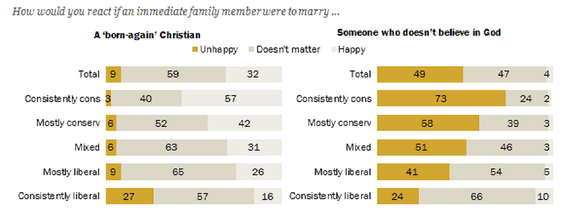
Atheists are really bad, horrible people

Marrying an atheist in the USA is considered much much worse than marrying inter-racially or getting hitched with a foreigner (mail-order brides? illegal immigrants??). Only if you are a deep-blue liberal then marrying a born-again Christian counts as a (slightly) worse fate.

It would be useful to ask the “atheist boy-friend in your family” question in other countries, and especially so in South Asia. In India, it may be meaningful to substitute “atheist” with “communist” (it would be equally interesting to ask Americans the “communist boy-friend” question). Finally, it would be nice to know the man/woman split on these questions.

It may be the case (as we have seen before) that Americans equate atheism with lack of morality. An interesting what-if for the Pew people- what if the question set was re-phrased/updated to clarify that an atheist boy-friend can have high morals (or a believer boy-friend may lack morals).
……………
One of the questions Pew
asks to gauge how seriously people are taking their identity politics
these days is how upset would you be if an immediate family member—say, a
child or a sibling—married someone outside of your identity parameters. 

The good news: Americans are okay with their family members marrying
someone who isn’t in their “tribe.”


There are all different kinds of tribes, of course. When it came, for
instance, to the question of how you’d feel if your family member
married someone with a different party affiliation, the vast majority of
Americans responded that they’d feel either “happy” or that it “doesn’t
matter.” 

Even for strict partisans, this was mostly true. Strong
conservatives approved of a family member marrying a Democrat 70 percent
of the time and strong liberals approved of marrying a Republican 78
percent of the time. Similar numbers turned up for identity markers like
“gun ownership” or “went to college,” with most people being
indifferent to these factors when it comes to bringing new people to
family holiday dinners. 


Other good news is that opposition to interracial marriage, at least
overt opposition, is also fairly low, with only 11 percent of Americans
balking at the idea of a new family member of a different race. 

And Americans are even more welcoming to foreigners, with only 7 percent
of respondents opposing marriage to someone born and raised outside of
the U.S.

There’s one group, however, that continues to cause fear and loathing across the land: atheists.
………..
Link: http://www.theatlantic.com/national/archive/2014/06/shun-the-atheist-boyfriend/372709/
…….

regards

Pakistan Taliban- ISIL in waiting? Random Thoughts

ISIL/ISIS’s recent victory in North-West Iraq and  North-East Syria (barring Kurdish regions) made me wonder if the same can happen in Pakistan.
Things working strongly in favor of Pakistan Taliban (vis-a-vis ISIL):
  1. Unlike Iraq & Syria, Pakistani is legally and emotionally a Muslim Homeland which has now graduated into a Fort for Islam. Masses have been indoctrinated to believe in this ideology. Taliban are only pious executors of the Muslim Nationalist vision of Pakistan Movement  and Islamist vision of Pakistan’s Objective Resolution.
  2. Unlike Iraq and Syria,Pakistan has a double-dealing Military that still makes distinction b/w Good and Bad Taliban thus allowing groups with Talibanistic ideologies to escape punishment by opportunistically switching sides, as and when necessary. This works to the advantage of Taliban.
  3. Pakistan’s Development level, which before the civil war broke out, was lower than Iraq and Syria. It is the Middle Classes that give a State stability. If they couldn’t do so in case of Iraq and Syria, little reason to believe they can do the same in Pakistan.
  4. Like Iraq, A Shia dominated (perceived Anti-Sunni) Iran  next door which can be smartly used to whip Anti-Shia (and pro-Taliban) rhetoric in Pakistan.
 Things working against Pakistani Taliban (compared to ISIL):
  1. Deep rooted and vibrant Party  Politics in Pakistan (atleast in Punjab and Sindh Core). This was non-existent in Iraq and Syria due to prolonged dictatorship. So when the revolution happened, in opposition benches, there was a power (grounded in public support) vacuum which was soon taken over by the best armed factions- Jihadists.
  2. A sunni majority in comfort with a Sunni dominated elite. In both Iraq and Syria, Sunni Arab population was deeply disenchanted with the Government of the day. There was sectarian hatred against the ruling elite which was capitalised by Jihadists. This is not the case in Pakistan. There exists little or no sectarian hatred among  masses against Pakistani Government (here assuming Shiites will not pull off an ISIL in Pakistan)
  3. Unlike Iraq & Syria; Pakistan is surrounded on all sides by rabidly Anti-Taliban &
    powerful countries-China, India, Russia  (via Central Asia) and Iran. Gulf countries are far away. There will be little to no ‘active’ flow of weapons to Taliban from neighbors (though Afghan NDS is a dark horse here).
  4.  Unlike Iraq & Syria; no rich country (neither Gulf nor US or neighbors) has any interest in toppling existing Pakistani Regime for Taliban. So, there will not be much external monetary help to  any anti-regime Rebels (including Taliban). They’ll have to do it in their own and without assistance of big Oil Reserves.
  5. Unlike Iraq and Syria, Pakistan has a really big and a largely professional military. Spectacular attacks against it are possible but complete capitulation like Iraqi Army will not come so easy.

This is a partial (perhaps superficial) list of factors. Also It is difficult to predict which factors will dominate in near future, so no concrete forecast from my side.

What if we cannot change the past?

A (serious) question for friends in the desi elite (this is not a rhetorical question, i am genuinely curious to know what the best minds of the age are thinking):

Suppose (just for the sake of argument) that we have no power to go back in time and change the past. What would you advise at this point about Iraq? I am not looking for descriptions of what happened and why it happened and who was at fault ..we all have our theories about that and  I am well aware of most of them; I do live among the desi elite and read their posts and emails. 
I am looking here for your views about what should be done now, or in the days to come, by America, by the Iraqis, by Iranians, by whoever.

As I said, I am genuinely curious. I dont get any clear sense of direction from the elite left and wonder if I am missing something? or could it be that there really IS no party line yet? 

Of course, there is a subtext of sorts behind the question. I have had the thought that this lack of clear direction may say something about how far our party line and the reality of the world have diverged (they were always separate, but there were connections, points of contact). But before I develop that thought, I want to know if I have missed something….

New (Middle-East) states bloom in (Jihadi) Spring

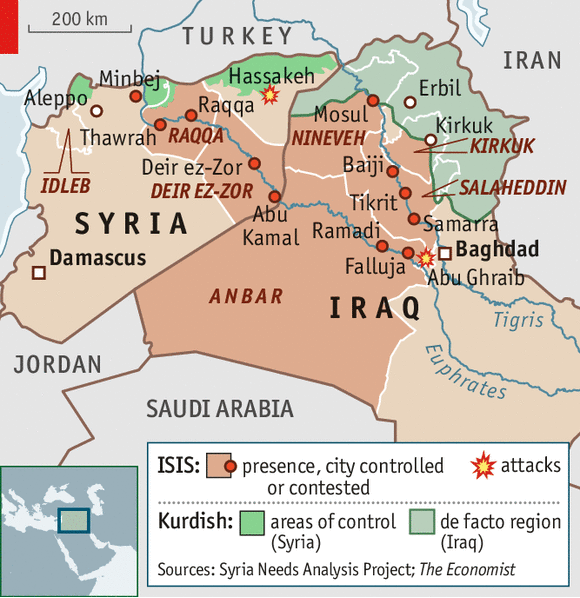
Run by Abu Bakr al-Baghdadi, an Iraqi jihadist, ISIS may have up to
6,000 fighters in Iraq and 3,000-5,000 in Syria, …nearly a thousand from Chechnya and
perhaps 500 or so more from France, Britain and elsewhere in Europe.
….Even al-Qaeda has deemed ISIS too violent. Ayman Zawahiri, leader of
the core group, has long disagreed with Abu Bakr al-Baghdadi, ISIS’s
leader, warning him that ISIS’s habit of beheading its opponents and
posting such atrocities on video was giving al-Qaeda a bad name.

…………………………
A century ago, the Middle-East was artificially carved up into states by the British and the French. Now it appears (as a result of nationalist movements everywhere, ho ho ho) the real states will finally take shape via numerous partitions. 

We are clear as to our own preferences: partitions are bad for the minority and also for the majority– once the genie of bad blood is poured out the bottle it will bleed the new nations dry for a long long time.

Normally it would be a straight-forward division: Sunnis and the rest, but there are a few local complications such as Bahrain which is Shia majority but ruled by Sunnis (with 5th Fleet support from Americans). Also Sunni Kurdistan seems more progressive than most and may even support the co-existence of minorities (such as Christians and Shias).

Everywhere else we can look forward to (not really) brutal ethnic cleansing and the coming-to-life of larger-than-life Sharia states. The left-liberal brigade can indicate disagreement from a distance but this much is probably true- populations everywhere are fed-up with the status quo and do not really mind the social upheavals. After all the benefits are to be measured in the long run and in the next life.
……….
WHOEVER chose the Twitter handle “Jihadi Spring” was prescient. Three
years of turmoil in the region, on the back of unpopular American-led
wars in Iraq and Afghanistan, have benefited extreme Islamists, none
more so than the Islamic State of Iraq and Greater Syria (ISIS), a group
that outdoes even al-Qaeda in brutality and fanaticism.
In the past
year or so, as borders and government control have frayed across the
region, ISIS has made gains across a swathe of territory encompassing
much of eastern and northern Syria and western and northern Iraq. 

On
June 10th it achieved its biggest prize to date by capturing Mosul,
Iraq’s second city, and most of the surrounding province of Nineveh.
The
next day it advanced south towards Baghdad, the capital, taking several
towns on the way. Ministers in Iraq’s government admitted that a
catastrophe was in the making. A decade after the American invasion, the
country looks as fragile, bloody and pitiful as ever.


After four days of fighting, Iraq’s security forces abandoned their
posts in Mosul as ISIS militiamen took over army bases, banks and
government offices. The jihadists seized huge stores of
American-supplied arms, ammunition and vehicles, apparently including
six Black Hawk helicopters and 500 billion dinars ($430m) in freshly
printed cash. Some 500,000 people fled in terror to areas beyond ISIS’s
sway.


The scale of the attack on Mosul was particularly audacious. But it
did not come out of the blue. In the past six months ISIS has captured
and held Falluja, less than an hour’s drive west of Baghdad; taken over
parts of Ramadi, capital of Anbar province; and has battled for Samarra,
a city north of Baghdad that boasts one of Shia Islam’s holiest
shrines. Virtually every day its fighters set off bombs in Baghdad,
keeping people in a state of terror.


….
As The Economist went to press, it was
reported to have taken Tikrit, Saddam Hussein’s home town, only 140km
(87 miles) north-west of Baghdad. The speed of ISIS’s advance suggested
that it was co-operating with a network of Sunni remnants from Saddam’s
underground resistance who opposed the Americans after 2003 and have
continued to fight against the Shia-dominated regime of Nuri al-Maliki
since the Americans left at the end of 2011.

It was barely a year ago, in April 2013, that ISIS announced the
expansion of its operations from Iraq into Syria. By changing its name
from the Islamic State of Iraq (ISI) by adding the words “and al-Sham”,
translated as “the Levant” or “Greater Syria”, it signified its quest to
conquer a wider area than present-day Syria.


Run by Abu Bakr al-Baghdadi, an Iraqi jihadist, ISIS may have up to
6,000 fighters in Iraq and 3,000-5,000 in Syria, including perhaps 3,000
foreigners; nearly a thousand are reported to hail from Chechnya and
perhaps 500 or so more from France, Britain and elsewhere in Europe.


It is ruthless, slaughtering Shia and other minorities, including
Christians and Alawites, the offshoot to which Syria’s president, Bashar
Assad, belongs. It sacks churches and Shia shrines, dispatches
suicide-bombers to market-places, and has no regard for civilian
casualties.


….
Its recent advances would have been impossible without ISIS’s control
since January of the eastern Syrian town of Raqqa, a testing ground and
stronghold from which it has made forays farther afield. It has seized
and exploited Syrian oilfields in the area and raised cash by ransoming
foreign hostages.


Rather than fight simply as a branch of al-Qaeda (“the base” in
Arabic), as it did before 2011, it has aimed to control territory,
dispensing its own brand of justice and imposing its own moral code: no
smoking, football, music, or unveiled women, for example. And it imposes
taxes in the parts of Syria and Iraq it has conquered.


In other words, it is creating a proto-state on the ungoverned
territory straddling the borderlands between Syria and Iraq. “This is a
new, more dangerous strategy since 2011,” says Hassan Abu Haniyeh, a
Jordanian expert on jihadist movements. If ISIS manages to hold onto its
turf in Iraq, it will control an area the size of Jordan with roughly
the same population (6m or so), stretching 500km from the countryside
east of Aleppo in Syria into western Iraq.


It holds three border posts between Syria and Turkey and several more
on Syria’s border with Iraq. Raqqa’s residents say Moroccan and
Tunisian jihadists have brought their wives and children to settle in
the city. Foreign preachers have been appointed to mosques. ISIS has
also set up an intelligence service.


Whether in Iraq or Syria, ISIS has sought to terrify people into
submission. On June 8th, as a typical warning to others, it crucified
three young men in a town near Aleppo for co-operating with rival
rebels. It has kidnapped scores of Kurdish students, journalists, aid
workers and, more recently, some Turkish diplomats.


Even al-Qaeda has deemed ISIS too violent. Ayman Zawahiri, leader of
the core group, has long disagreed with Abu Bakr al-Baghdadi, ISIS’s
leader, warning him that ISIS’s habit of beheading its opponents and
posting such atrocities on video was giving al-Qaeda a bad name.


The forces best equipped to face down ISIS may be Kurdish ones: the
Peshmerga guerrillas, who have protected Iraq’s autonomous Kurdish
region for the past two decades, and the People’s Protection Units,
better known as the YPG, the armed wing of the Kurdistan Workers’ Party,
which dominates north-eastern Syria. The Kurds’ regional government in
Iraq has mobilised its forces on the east side of the Tigris river,
which runs through Mosul, and may well block ISIS from heading east and
north into Kurdish territory; on June 12th the Kurds captured all of
Kirkuk city from fleeing Iraqi forces.

……

Link: http://www.economist.com/news/middle-east-and-africa/21604230-extreme-islamist-group-seeks-create-caliphate-and-spread-jihad-across

……

regards

18-05-2014 (the day Britain left India)

India …like its predecessor,
was ruled by a
relatively small English-speaking elite whose attitude toward the masses
was alternately benevolent and exploitative but never inclusive…..Mr Modi…is from
the lower castes. He is not a natural English speaker. He has no truck
with the secular and socialist traditions that shaped Congress. But,
more important, that voice has announced a new kind of India….

…….
Wow!!! How did we miss this editorial in the Guardian. On the whole it is fair comment and pays half a compliment towards the silent social revolution we keep talking about. As a result of this revolution we have (as both the BJP and the Guardian sees it) a Congress-mukt Bharat and a British-free India.

The BJP was able to win emphatically precisely because it crowned a Shudra as king. If Congress/AAP want to create a viable left-wing alternative they will need to groom a Dalit/Muslim as a top-3 (wo)man.
The days of  the forward castes ruling India directly or by proxy is over. 

We do have one wish which is likely to be fulfilled sometime in a not to far off future. That is a woman prime minister who is also a Dalit. It will be the making of India.
………………….
Today, 18 May 2014, may well go down in history as the day when Britain finally left India. 


Narendra Modi’s
victory in the elections marks the end of a long era in which the
structures of power did not differ greatly from those through which
Britain ruled the subcontinent. India under the Congress party was in
many ways a continuation of the British Raj by other means.
The last of midnight’s children
are now a dwindling handful of almost 70-year-olds, but it is not the
passing of the independence generation that makes the difference.

The
India those men and women lived in was one that, like its predecessor,
was centralised, garrisoned, culturally constricted, and ruled by a
relatively small English-speaking elite whose attitude toward the masses
was alternately benevolent and exploitative but never inclusive.
Universal suffrage gave Indians a vote but not, at least for much of the
time, a voice.  

When that voice was occasionally heard, as it was in
1977 in the elections that followed the disastrously unpopular Emergency
declared by prime minister Indira Gandhi, there could be a sudden sense
of its almost volcanic capacity to remake the political landscape, but
such moments were rare.

Now that voice has been heard again. It
has endorsed a new kind of leader in the shape of Mr Modi. He is from
the lower castes. He is not a natural English speaker. He has no truck
with the secular and socialist traditions that shaped Congress. But,
more important, that voice has announced a new kind of India.
In the old
India the poor were there to be helped, when the elite remembered to do
so or when they needed to seek or, in effect, to buy votes. The
middling classes were taken for granted and sometimes snubbed. The new
India, most observers agree, is not interested in handouts, and refuses
to be snubbed.

Instead it wants the obstacles it sees as impeding
its aspirations swept away. It has discarded the deference it displayed
toward the Gandhi family and toward the Anglicised or, these days,
Americanised top levels of society.
Whether in its older and purer
socialist guise or in its later embrace of the market, Congress has lost
its magic, even though the party includes some profoundly decent and
well-intentioned people.  

The core constituency of the Bharatiya Janata
party, meanwhile, never shared the non-sectarian values that Congress
imperfectly upheld and wants an India where its version of Hinduism has
unchallenged primacy.

It should be obvious that these underlying
changes in Indian society have brought us Mr Modi and not the other way
round.
He sensed a great shift in mood and played to it. Nevertheless it
matters enormously what kind of man he is. The answer is that we really
do not know. It is not only that the question of what role he played in
the Gujarat massacres
of 2002 remains unresolved. Nor that his personality is rather closed,
reserved, even secretive. It is more that the balance in his character
between pragmatism and the extremist ideology with which he has been
associated since he was a young man is not clear. 

Pragmatism would lead
him to avoid sharp confrontation with Indian Muslims, perhaps offsetting
any trouble at home by a peace-seeking diplomacy with Pakistan.
It
would temper any savage cuts in the subsidy programmes vital to many
Indians on the breadline. It would put a measurable distance between the
party and the Rashtriya Swayamsevak Sangh movement. And pragmatism
would lead to caution in a man who has never held national office
before. He has an unexpectedly large mandate, but India is not Gujarat.
It is a very big ship to steer, and he will need all the help he can
get.

He knows that the aspirations that have swept him to power
must be satisfied in part – they could never be satisfied in full – if
his new beginning is not to flounder in a morass of disappointment and
recrimination from which the temptation might be to take a extreme
nationalist way out. Whatever else he is or is not, Mr Modi is a gifted
politician.
We must hope that he understands that his new India will
sooner or later hold him to account.

………


Link: http://www.theguardian.com/global/2014/may/18/india-narendra-modi-election-destiny

……

regards

World Cup thoughts

glad Matthew Kenyon of the BBC and I share the exact same thoughts on have match. A very dubious penalty (what was Japanese ref thinking?) and a selfie (own goal) put Brazil in a very poor light.

The political pressure on both the Brazilian govt & FIFA for Brazil to acquit itself more than honorably is immense. Croatia played very well whereas Brazil were a bit of a disappointing (excepting the ubiquitous Neymar & the ever-trying Oscar).
Finally the music (we are one by J-lo& Pitbull) does sound awful even if it shares the same Soca beat with the catchy 2010 World Cup song Waca Waca by Shakira.
There is always something special about the World Cup & Olympics it just brings back the memories for me (so does Wimbledon but then I am also British so that would figure).

The soft-spoken man speaks (yes he has a stick)

“We do not have any remote control….But it is our
wish that the government sustains the momentum and meets people’s
aspirations” 

………

Mohan-bhau (elder brother in Marathi) is actually an accomplished artist who has a singer’s voice, can play a number of instruments and is a hot number on the stage (Marathi theatre is very popular and powerful).

But that is not his main claim to fame. Mohan Madhukar Bhagwat is the head of the Rashtriya Swayamsevak Sangh (aka Hindu Brotherhood). Politically he is as deft as Madam Sonia and he belies the popular (Marxist) concept of a Hindutva-vadi as a fire-breathing dino. In short, the most foolish thing would be to under-estimate him and his people.
……….

RSS
chief Mohan Bhagwat
has for the first time publicly expressed his
satisfaction over the ‘change’ in governance of the country. “We are
confident that the new government will tread the chosen path. People
thoughtfully elected it because they were desperate for change and are
looking forward to better times,” the Sarsanghachalak said on Thursday.

However, he refused to acknowledge any role in installing the new
government at the Centre. “We do not have any remote control,” he
stressed. “People congratulated the RSS for bringing about this change,
but let me tell you, all we did was to encourage voters to participate
in election process. We do not believe in any control. But it is our
wish that the government sustains the momentum and meets people’s
aspirations,” said Bhagwat.

The RSS chief was addressing over
700 activists from across the country attending a three-week camp as
part of the third-year RSS training required to work for the
organization. “It is not necessary to get into khaki knickers and do the
drill. Every citizen is welcome to join the Sangh endeavour to build a
better society. For last 88 years this what the RSS has been doing. But
our work of instilling discipline and values is often misunderstood,”

the RSS chief lamented.

He did not name Narendra Modi, or any
political party, but likened the change in the country to Chhatrapati
Shivaji’s coronation. “Why do we celebrate Shivaji’s coronation even
after 440 years. It is because Shivaji exemplified good governance that
thrived on confidence of people.
I am sure the change we are seeing
today is similar, and will meet with success it deserves,” said Bhagwat.

In an oblique reference to the Congress failures, the RSS chief said
soon after Independence there was an opportunity to channelize energies
of the nation to desired goal but it was lost. “Instead of a bright
dawn, we were led into dark times,” he said, evoking a song penned by
Marathi poet Suresh Bhat.

……….

Link: http://timesofindia.indiatimes.com/india/Full-support-to-Modi-sarkar-without-remote-RSS-says/articleshow/36452806.cms

…….

regards

“Everybody knows there is going to be a blowback”

“I was terrified”…Phimraphat Wisetsoem could see and
hear explosions from her seat on a Thai International Airways aircraft.
It was trapped near the runway along with an Emirates jet and contained
hundreds of passengers.
Phimraphat suspected that hijackers in disguise had already boarded her plane.   

Yes, finally we face the truth (maybe). The lion and the lamb are not going to be happy bed-mates.  

But as usual the Pankajists have done their job and the common (wise)man will not be blamed for uttering such drivel:

What a clever analysis!! both Mumbai and Karachi airport attackers were
using cell phones so they must be related!! Bravo! what a level of
intelligence shown here. Mumbai was a false flag operation while the
Karachi airport attack is done by trained uzbuks who works for foreign
intelligence agencies.

….
It was the shoes that betrayed Corporal Faiz Mohammad’s would-be killers. When 10 Taliban militants attacked Karachi airport
on Sunday night, sparking a five-hour gun battle that killed at least
34 people, Mohammad and his fellow officers from the Airports Security
Force (ASF) were the first line of defence.

“There was a moment of confusion because the militants had the same ASF uniforms as us,” said Mohammad, 30. “But
then we saw their shoes.” ASF officers wear black leather shoes, but
the men who stormed Jinnah International Airport in Karachi, wore
white-soled sneakers. 

That
the Taliban failed in its main objective – to hijack an aircraft and
hold its passengers hostage – should bring no comfort to embattled Prime
Minister Nawaz Sharif, since the attack signals an alarming shift in
tactics by an increasingly formidable foe.

The strike at the
airport in Karachi, home to 18 million people, deals a blow to Sharif’s
bid to attract foreign investors to revive the economy. It has also
destroyed prospects for peace talks with the Taliban and made an all-out
military offensive against militant strongholds along the Afghan border
a near-certainty.

A
top Taliban commander confirmed to Reuters that attacks involving
aircraft were part of a new strategy to counter the government’s
preparations for a full-scale operation against them in North
Waziristan. “We decided to change our strategy and hit their main economic centres,” he said. “They will kill innocent people by their bombs and we will hit their nerve-centres in major cities.”

Tariq
Azeem, a senior official in Sharif’s administration, said a full-scale
military operation was imminent in North Waziristan, and seemed resigned
to it sparking terror attacks elsewhere in Pakistan. “Everybody knows there is going to be a blowback,” he said. 

The Taliban is most likely to rely on small militant teams, emulating
the protracted, high-impact operations like those in Mumbai in 2008 and
Nairobi’s Westgate mall last year.

“In Mumbai, and in Kenya, you
will find a lot of similarities,” said Muhammad Amir Rana, director of
the Islamabad-based think tank Pak Institute for Peace Studies.

“They
(the Taliban) are adopting this as their prime strategy.” The
similarities between the Karachi and Mumbai incidents are startling and
instructive.

The attack on Mumbai, India’s largest city, was carried out by Lashkar-e-Taiba.
It lasted three days, killed 166 people and transfixed the world.
As with Karachi, it was meticulously planned and involved well-trained and heavily armed militants.
In both cases, a 10-man team quickly split into pairs and carried provision-stuffed knapsacks in preparation for a long siege.
In Mumbai, militants used mobile phones to coordinate with handlers in Pakistan and with each other in the heat of battle.
Their Karachi counterparts were also seen using mobile phones during the assault.
Lashkar-e-Taiba
has said it has no connection with any attacks on Pakistani soil and
there is no evidence that it works with the Taliban.

The attack began at 11.05 p.m, with five of the militants breaching the Fokker Gate with assault rifles and grenades.
Minutes
later, as the ASF fought back, a second five-strong squad attacked the
nearby Cargo Gate. Both gates granted access to the cargo area in the
airport’s west.

Azeem, the administration official, praised the ASF while admitting how hard it was to protect the sprawling airport. “You need almost two brigades to cover . . . every inch of it,” he said.
“Any
entrance will have two, three, four people who are fully armed, but one
burst of machinegun fire will kill all four of them and you can enter.”

By
11.30 p.m., a contingent of police and paramilitary Rangers had arrived
at the airport, followed 30 minutes later by an army unit. They
formed what Azeem called “the second or the third layer” of airport
security which stopped the militant advance on the main passenger
terminal further east.

The gunfire was now
punctuated by the boom of militants firing rocket-propelled grenades
(RPGs). They had come prepared for a long fight. Their knapsacks
contained water, medicine and food. Some were spotted using cellphones
during the attack, said a security official involved in the
investigation, although it was unclear who they were talking to – each
other, or distant commanders.

Phimraphat Wisetsoem could see and
hear explosions from her seat on a Thai International Airways aircraft.
It was trapped near the runway along with an Emirates jet and contained
hundreds of passengers. Phimraphat suspected that hijackers in disguise had already boarded her plane. “I was terrified,” she told reporters as she arrived back in Bangkok. “I sat still and didn’t dare move around.” Passengers on both planes were later safely evacuated.

Just
after midnight, as all outbound flights were suspended and inbound
flights diverted to other airports, there was a large explosion near
Fokker Gate: the first militant had detonated his suicide vest.

By now, dead and wounded were being ferried to the nearby Jinnah Hospital.

Their
numbers rose steadily through the night – by morning, the hospital
would report 16 dead and dozens injured – as security forces intensified
their counter-attack.

As the fighting raged outside, seven
employees from a cargo company took refuge in a warehouse – as it turned
out, a fateful decision. They burned to death.

Elsewhere, Hamid Khan, 22, a junior technician, hid with eight other men in the washroom of an aircraft maintenance company.
A
hand-grenade blew off part of the roof and bullets peppered a nearby
container. “If anyone is inside, come out now!” shouted someone – friend
or foe, Hamid couldn’t tell. He and his colleagues kept silent and
stayed put. “I was so afraid that I started reading my last prayers,” he
said, his voice still shaking with emotion days later.

Two more militants would blow themselves up.

By
4 a.m, all 10 were dead, their shattered bodies sprawled in pairs
across the tarmac. It had taken 150 security personnel to counter them.

The Rangers identified them as ethnic Uzbeks.
Pakistani officials often accuse foreign militants of staging attacks alongside the Taliban.
“We
admit we carried out this attack with the help of our other brotherly
mujahideen groups,” the senior member of Taliban told Reuters. 

In daylight, Karachi airport resembled a war zone. Smoke billowed from gutted buildings.
Rescue
workers retrieved the seven cargo company employees, their corpses
charred beyond recognition, and raised the death toll to 34.

Junior
technician Hamid Khan and the other eight emerged unscathed from their
washroom refuge. “I felt as if God had heard our prayers,” he said.

At
least three passenger aircraft, all unoccupied, were damaged during the
battle, a senior Pakistani security official told Reuters.

A
satellite photo on Google Earth showed a fourth aircraft in the cargo
area completely destroyed, its broken wings lying amid the blackened
remains of its fuselage. However, officials have not confirmed the
destruction of any aircraft. Even as flights resumed and the clean-up began, Taliban struck the airport again.

On Tuesday evening, gunmen on motorbikes opened fire on an ASF academy, although there were no casualties.
There would be “many more such attacks” in future, Pakistani Taliban spokesman Shahidullah Shahid told Reuters.
Adil Najam, dean of Boston University’s Pardee School of Global Studies, agreed.
Karachi
was “not just another terrorist attack,” he said. “It is among the
latest skirmishes in what is now an actual war between the Pakistan Army
and the Taliban. 

……..

Link: http://www.dawn.com/news/1112251/karachi-airport-attack-signals-alarming-tactical-shift-by-taliban

…..

regards

Hello Drones (please come fly our friendly skies)

It is unbelievable but the last time there was a drone attack was in December, last year. The initiation of talks appeared to be a positive step (perhaps it was done to pre-empt an attack from the right-flank by Imran Khan) but now post-Karachi it is clear that the Pashtun nationalists bent on making war are more numerous and determined than those who will settle for peace.

In our thinking, the motivation for this wide-scale war is that Pashtun-stan (as imagined by the nationalists) will not be content with a joined-up South-East Afghanistan and North-West Pakistan, the access to sea is a must. Thus Karachi is so to speak, the jewel in the crown, the real prize in the battle.
……
The
last drone attack in the country had been carried out on Dec 25 last
year near Miramshah, the regional headquarters.
Three suspected
militants had been killed in that attack on a compound in Qutab Khel
area. Residents said that US drones kept hovering over North Waziristan throughout the day. The missile explosions were heard up to 20km away, they said.


The government had urged the United States to stop drone strikes in the tribal areas during its negotiations with the Taliban.

According
to AFP, an intelligence official in Miramshah said the missiles had
struck a pick-up truck carrying six militants and laden with explosives. “Four of them were Uzbeks and two were Punjabi Taliban,” he said.

The
militants had parked their truck along the outer wall of the compound —
both of which were destroyed and remained ablaze for some time.

Another
security official said the authorities had intercepted a radio message
about the attack in which “one of the militants was asking others to
reach the site and search for any one injured in the strike and also to
dig up the bodies”.

The area west of Miramshah where Wednesday’s
attack was carried out is considered a stronghold of the Al Qaeda-linked
Haqqani network.

The strike came as Pakistani Taliban said that
Uzbek militants had been involved in the siege of the Karachi airport on
Sunday night in which 37 people, including the 10 attackers, had been
killed.

……

Link: http://www.dawn.com/news/1112127/drone-attack-kills-4-uzbek-militants

…..

regards

Brown Pundits