“…abundance of everything but …no izzat”

At the end of the day everything boils down to izzat. And izzat is tied up with how your women behave. If the castes inter-mingle the position of the elites become untenable.

During British rule it was clear that the Englishman was the top caste in India. One of the most important ways to preserve their reputation was to never never allow white women to come into contact with the darkies. However World War I created a crisis that was not easily resolved. And ultimately the lost British prestige was the starting point for the movement for independence.

“If you want any French women, there
are plenty here and they are very good looking,” wrote a rather excited young
soldier to a friend in the Punjab. He was not alone. From the first deployment
of the Indian Expeditionary Force to France in 1914, the Indians proved
extremely popular with European ladies and the feeling was often mutual. Their
presence in large numbers (some 90,000 Indians were deployed to the theatre),
their distinctive appearance and good manners made them a magnet for local
women. 
When these same sepoys were invalided to Britain, as many were for
treatment and convalescence, their reception was much the same. In seaside towns
along the south coast, where most of the hospitals for Indians were located,
convalescent sepoys and their Indian carers were objects of fascination for the
English ladies. “Brighton is covered with girls who make a lot of the natives,”
wrote a British hospital orderly to his wife in the spring of 1915, adding
that, “They are to be seen arm in arm with ward servants and are very fond of
coloured people.”

The reaction of the Indians varied.
“The women have no modesty,” wrote Surjan Singh, a patient in Brighton’s
Kitchener Hospital, “but walk with the men who please them most.”
Another
patient declared in a letter to his brother, “There are lots of women to be
had. They write letters to us to come to their house and have food with them,
and that we can get a woman. I am very much confused in mind.” But most had
fewer reservations: “I am very happy in this place,” wrote one Sikh patient,
with obvious enthusiasm.

It goes without saying that the
military authorities were not best pleased with this situation. Foremost in
their minds was the thought that sexual and even romantic relationships between
British women and Indians would dim­inish the izzat—dignity—of the Raj.
Sepoys’
letters referring to the ready availability of white women were usually
censored and, for the same reasons, female English or European nurses were
almost never employed in Indian hospitals in either Britain or France. British
commanders and senior politicians knew well that liaisons between Indian
soldiers and white women could wreck the carefully constructed mythology of
racial distinctiveness.

But British women, in India at
least, were generally beyond the reach of Indian men, for they tended to be of
the “better sort”—the wives of officers and administrators, or perhaps pious
missionaries.
Encountering a white woman who did not fit the constructed image
of the self-disciplined, morally upright memsahib was obviously as much a
revelation to Indians as much as it was a worry for the British elite. 
Most of the women attracted to Indian soldiers in France and Britain were from
the working or lower middle classes. They showed little in the way of prejudice
towards Indians and their familiarity was clearly unsettling to those further
up the social scale.
Commanders feared that this familiarity would undermine
the sedulously constructed barriers and hierarchies that separated troops drawn
from the colonies from white British troops. Moreover, it shook the very
foundations of Empire. Would Indians—indeed those on whom the British
ultimately depended to police their Empire—ever see the British in the same
light again? The mask of racial distinctiveness was slipping forever and
drastic action needed to be taken.

The military authorities in Britain
and France were now determined to do all that they could to prevent
un-trammelled liaisons between Indian soldi­ers and European women.
In the
spring of 1915, the commandant of the Kitch­ener Hospital in Brighton, Colonel
Bruce Seton, ordered all Indian hospital staff to remain within the compound.
The same was true of patients, with the exception of a few convalescent
officers and warrant officers, who were sometimes issued with restricted passes
to visit the town. But as Seton readily acknowledged, the confinement of some
600 Indian patients and staff within the hospital area was “no easy matter”.
The brick walls had to be supplemented with barbed-wire palings and a police
guard was placed around the perimeter. Similar precautions were taken elsewhere
in England and, as far as possible, in France.

These restrictions were deeply resented
by soldiers who had grown accustomed to a measure of freedom. “They do not let
us out to the bazaars,” protested one patient to a comrade in the 40th Pathans.
“They do not let the French or English girls talk to us, nor do they let us
talk to them. The English have become very bad. They have become dogs. 
Our Indian soldiers are very much oppressed, but they can do nothing. There is
abundance of everything but there is no izzat
.”

In one notable case, this anger
found an outlet in violence. An Indian Sub-Assistant Surgeon, who had been
working in a hospital along the coast in Bournemouth, burst into Seton’s office
and attempted to shoot him with his revolver.
He missed and was subjected to
seven years’ rigorous imprisonment. 

regards

Varanasi- Waterloo of the East

Varanasi is actually the Jerusalem/Mecca of the East- the holiest of holy locales for the Hindus.

Right now however it is the Waterloo analogy that fits. The Napolean of our times calls out the republican guards to be committed  to battle as a last (lost) hope solution- if this does not work, nothing else will.

And in the (upper-caste dominated) battle-fields of Varanasi it will be a face-off between a divine Brahmin (Congress) and a lowly Shudra (BJP). The Shudra is favored to win and has a shot at becoming the next PM. This is how a slow revolution (67 years) looks like.

It would be psychologically traumatic for the Grand Old Party (not to mention hurtful for the top leadership under a brand new leader) to score below 114 (the previous low point 15 years ago in 1999).  

Hence we have Mission 115.

As per our (wild) predictions this is the Congress (and allies) top-line:
Telengana (10), Karnataka (20), Kerala (10), Maharashtra (10), North-East (10). It is doable to get (40) from rest of the nation to get to (100). But beyond this will be difficult and will require lots of luck.

A lot will depend critically on the muslim block vote, going by the experience of Delhi, the old generation will probably stay loyal, however it will be grim news if the young muslims abandon the party in favor of the AAP in urban areas (and BSP is rural ones).


The
Congress has rolled out its heavy artillery to salvage as many seats in
what threatens to be its toughest election in recent times and dodge
what is considered to be a serious risk of party posting its lowest ever
score.


Sources said that the decision to persuade its
reluctant leaders to take the field was a deliberate one, influenced by
party’s desire not to slump below its 1999 tally of 114 — its worst-ever
LS election tally.

The party has nominated its senior leaders,
former Punjab CM Amarinder Singh, Union minister Ghulam Nabi Azad,and
senior party functionary Ambika Soni.

Amarinder Singh , put on
combat fatigues by dubbing Arun Jaitley, his BJP rival in Amritsar as
“outsider”. However, the former Punjab CM was not very keen to enter the
fray, and tried to bat aside suggestions that he contest by saying that
he could do so only at the cost of the prospects of his spouse,
minister of state for foreign affairs , Parineet Kaur, in her Patiala
constituency.

Union health minister Azad was also not
enthusiastic about putting on war paint ,but changed his stance because
of the promise of the J&K chief minister Omar Abdullah to transfer
votes of National Conference in Udhampur . Party’s assessment that the
candidates of both BJP and PDP in Udhampur were ‘weak” also helped Azad
summon the nerve.

The party brought in Soni as a replacement
for Ravneet Singh Bittu who was adjudged to be “extremely vulnerable”
because of high level of incumbency against him.

Anxious to
duck the threat of crashing to its lowest score, party had to cajole a
number of party leaders in Rajasthan to enter the ring, although the
persuasion was of no avail in the case of finance minister P Chidambaram
who vacated his Sivganga seat in Tamil Nadu for his son.

“The political and psychological consequences of folding up below 114 can be debilitating”, acknowledged a party source.

Meanwhile deliberations in the party over who should be its candidate
against BJP’s PM candidate in Varanasi continues.
Party sources said
that the choice could be between party general secretary Digvijaya Singh
and known Brahmin face, Pramod Tiwarii, Rita Bahughuna Joshi or a local
choice.
 
 regards

“The nation would soon hear good news”

The go-betweens were never meant to work out, so here is the real thing- direct talks (hopefully).

It appears an important element will be prisoner swapping, Taliban is expected to release the civilians it has captured in exchange for the govt to set free some dangerous thugs. Unpleasant reality that has to be faced.

Again it would be a good idea (but perhaps futile) to insist that Taliban forswears violence and tolerates (it does not have to accept) the framework of the Pakistani constitution.
…….
“The process of talking directly to the Taliban will start in two to three
days, both sides have agreed on the venue”,
he told reporters following the
meeting also attended by the Interior Minister Chaudhry Nisar Ali Khan. Sami further said that reports that the Taliban had rejected the notion of
holding talks outside Waziristan were mere speculation. The TTP had proposed its stronghold of North Waziristan as the venue, while
the government wanted to hold talks in Bannu.

Maulana Samiul Haq, however, stopped short of specifying if the negotiations
would be taking place in Bannu. “Both sides are showing flexibility and a willingness for success of the
talks,” Haq added, saying the chosen place would be declared a “peace zone” but
without specifying its location.


Another member of the committee, Maulana Yousuf Shah, said that Saturday’s
meeting between the two committees were an important breakthrough. “The nation
would soon hear good news,”
he said.

Sources had told DawnNews earlier that the meeting also deliberated on the
list of ‘prisoners’ under government detention shared by the Taliban. The two
sides also discussed the release of persons kidnapped and held hostage by the
militants, the sources said.

The interior minister told
a press conference on Friday that direct talks between the government
committee and Taliban Shura would begin in a few days. A sensitive phase of the peace process was about to start and it would bring
to an end all misgivings and misconceptions, he said. He indicated that a month-long ceasefire announced by the TTP would continue
beyond the March 31 deadline but did not elaborate.

regards

A muslim activist speaks his mind

How will muslims vote in the General Elections 2014? Not surprisingly, as Tanweer Alam explains, there is a single point agenda- vote tactically, stop the BJP/NDA. There are also some claims about how the UPA govt has delivered for muslims (but much more remains to be done).

The observations are generally on the money except for Kerala. IMO Congress will win big in Kerala, Karanataka and Telangana backed by muslim votes. This will mark Congress as primarily a south Indian (shudra) party with north Indian (brahmin) leadership (a bit like Tamils being led by a super-caste supremo).

Also one major howler- India does practice a variant of secularism but it is hardly the case that
“this country has evolved over millennia in a way that religion and
its practice have been left out of the domain of the state”
as stated by the author.


    …A
majority of Muslims live in states such as UP, Bihar, West Bengal and
Kerala that have a strong presence of regional parties. Congress figures
only in the third or fourth position in these states. In these states, a
majority of Muslims vote for regional parties. In states such as Assam
and Andhra Pradesh, Muslim voting for Congress has come down.

According to the Centre for the Study of Developing Societies, more than
70% of Muslim votes go to Congress in states such as Rajasthan, Madhya
Pradesh, Gujarat and Delhi where the contest is bipolar, between
Congress and BJP.

In states where the contest is multipolar and
Congress is in number two or three position, or the junior partner,
Muslim votes for Congress come down to 30%. A majority of Muslim votes
are fragmented and go to different political parties, reflecting their
local and class interests. It is evident from this that no party can
take the Muslim vote for granted.

In the 2014 parliamentary
elections, they are likely to vote for the best-placed candidate to
defeat BJP nationally.
In 2009, Muslim votes started to come back to
Congress in UP. They voted for Samajwadi Party and BSP also in almost
equal proportions. There is a ray of hope for Congress in UP in the
post-Muzaffarnagar situation, where Muslims may largely vote for
Congress and BSP.

AAP is a new phenomenon and Muslims are still
sceptical. The AAP agenda does not fully reflect their hopes and fears.
For Muslims, communalism is a much bigger issue than corruption.

There is another myth, largely among Muslims, that they have not
benefited from economic development. It is nobody’s argument that a lot
has been done for Muslims by succeeding governments. However, it is not
the case that nothing has been done for them.

Since
Independence, the state’s approach to the rights of religious minorities
has proved inadequate in promoting inclusion. Despite constitutional
safeguards and stark backwardness of the Muslim community, it has been
kept out of the purview of affirmative action policies, except for a
small number of Muslims in the OBC category.

Their issues were
limited to protection of religious identity and security. But over the
last decade a noticeable shift has occurred in political thinking
regarding minorities, and many policy initiatives have been taken to
empower them. The Sachar Committee report was one such landmark step.

In pre-Sachar days, talking about Muslims meant ‘appeasement’. Sachar
gave an atmosphere in which pluralism and diversity could be acceptable
socially and legally. In the wake of Sachar’s recommendations, many
welfare programmes were started for Muslims, yielding substantial
improvement in some areas.

As per latest data by HRD ministry,
enrolment of Muslim children at elementary level has risen to 13% from
8% in 2006-07. The refrain about no benefit having reached Muslims is
obviously untrue. As per government data, the flow of priority
sector credit to minorities during 2012-13 reached Rs 1,71,960 crore,
which was more than 15% of total priority sector lending.

Many
studies found problems in the delivery mechanism of minority welfare
schemes during the 11th plan. In the 12th plan a focused strategy has
been adopted, making blocks instead of districts the basic unit for
planning and implementing these schemes. Now that an area-specific
approach has been adopted, benefits should go directly to
minority-concentrated villages where a substantial number of Muslims
live. Bottlenecks are now being identified and the delivery system is
being streamlined. Amid all this, nobody can honestly claim that
benefits of economic development have bypassed Muslims.

Finally, there is a misunderstanding among some people, mainly Muslims,
that preservation of secularism is the exclusive responsibility of
Muslims. This certainly is not the case. India is secular not because
Muslims want it to be so, but because this country has evolved over
millennia in a way that religion and its practice have been left out of
the domain of the state.

This is reflected in India’s
Constitution. It is relevant to note that Europe did not become secular
to accommodate Jews, Muslims or Buddhists, but to protect people from
sectarian strife within Christianity. US secularism has similar origins.
India too is secular because of Hindus, not Muslims, Sikhs, Christians
or Parsis.

Nehru’s idea of nationalism was based on a shared
historical past and a future project of common development. This idea
still holds good. It is a broad reflection of Congress thinking and a
tradition of accommodation and synthesis that stretches back to a hoary
past.
                                                                                                                                                           regards
 

Asian Americans defeat affirmative action

The (chinese) tiger mother pride defeats the California Democratic machine.

That said congratulations are premature. As far as Asian Americans are concerned, the problem of being whiter than whites is that one day the whites will get wise and ask: dude where is my uni seat? That day may have been postponed but it is coming. Proportional representation (aka quotas) is a powerful weapon in the hands of the less privileged (as also seen in India). Be very afraid.

And as far as black/hispanic pressure groups the real target was falling populations at UC Berkeley and UCLA. However they ignore (perhaps intentionally) that the famous two are now admitting more poor students and that is a worthy target as well.


Democrats in California are in a state of shock at the defeat of their
effort to reinstate racial preferences in university admissions….The state Senate approved a measure 27-9 to ask voters in
November to overturn the ban. Little did it expect the backlash that ensued.

California’s politically sleepy Asian-American community, in defiance of its
own civil
rights leaders, mounted a massive grassroots campaign to kill the measure.
It made phone calls, wrote letters, blanketed the airwaves. Ultimately, not
only did the Assembly abandon the proposal, but three Asian senators who
originally supported the measure reversed themselves.


The liberal idea of racial justice is proportional representation under
which each group is represented in proportion to its population at universities
and other institutions. The whole point of scrapping Prop 209 is to hand
university officials the power to ignore student test scores and grades to
create a more balanced student body based on racial criteria.


Setting aside the moral objections to putting groups rather than individuals
at the heart of a scheme of social justice, such racial balancing is profoundly
at odds with Asian-American interests.
They represent the single largest ethnic
group among the University of California’s 173,000 undergraduates. They form
about 14 percent of the Golden State’s population, but in 2008, they constituted 40 percent of the student body at
University of California, Los Angeles, and 43 percent at University of
California, Berkeley — California’s most selective public universities — as
well as 50 percent at University of California, San Diego and 54 percent at
University of California, Irvine. They had an admission rate of 73 percent compared to 63 percent
of all in-state applicants last year.


Trying to perform a racial balancing act in a country that was neatly
divided into two groups — the white discriminators and the black discriminated
— was one thing. But pulling it off in a diverse country with diverse groups
with diverse histories and diverse interests is quite another. 

regards

World War I (from an Indian viewpoint)

It has been a hundred years past now. The Indian numbers are pretty impressive, it is sad that none of our JNU educated historians (mostly elite class Bengali Marxists) have dwelt on this aspect of Indian history.

….

How many Indians were involved in WW-I, where did they mostly hail from?

Figures differ. Though most estimates say 1.4 million Indians—950,000
soldiers and 450,000 non-combatants— participated in the War, some
figures show that almost 1.7 million Indians, including 6,00,000
non-combatants signed up for war between 1914 and 1918, from a then
total population of 225 million. The soldiers were mostly from Punjab
(which would now include  Haryana), Garhwal and Kumaon, though with the
setting up of a Bengali regiment there were recruits from eastern India
and elsewhere.

How many Indian soldiers were killed?

Officially, about 50,000 Indian soldiers died, while more than 65,000
were wounded and about 10,000 were reported missing in action.


How do we remember the Indian soldiers who fell in the War?

The India Gate in New Delhi is the most visible symbol of the War in
India. It was dedicated to Indian soldiers who fought in the First World
War for the British Empire. It commemorates the 70,000 Indian soldiers
who fell in defence of the Empire in the War and, subsequently, also
other soldiers who died in the Northwest Frontier and the Third Afghan
War and had no known grave. ‘The eternal flame’ was installed there in
1971 and has since become the site of the symbolic tomb of the ‘Unknown
Soldier.’

Where were Indian soldiers deployed?

They were deployed in the European theatre, Egypt, Palestine and Africa. They fought in many of the major battles of the War.

What impact did WW-I have on India’s freedom movement?

It had a major and fundamental impact on India’s freedom movement. It
began with Britain’s decision in 1917 that India  will be granted 
“responsible government” like other British “white dominions.” It
shifted the leadership in the Congress from the “moderates” to Gandhi’s
movement of “Swaraj in one year”. It also brought about a shift in
politics from the avowedly “secular” to more strident appeal for
religious allegiance.  

The popular outrage movement against the “Rowlatt
Act”, seen as a tool to curb freedom of expression, led to the
Jallianwala Bagh massacre in Amritsar in April 1919 and devolution of
power to the provinces in India by Britain.

regards

The United States of India

Conventional wisdom has it that the regional parties will gradually increase their foot-print across India (at the expense of the national parties- Congress, BJP, Communists). It is expected (justifiably) that the regional leaders will focus on their backyard first and the nation second. So what will such a manifesto look like?

“Fire-brand” Tamil leader Vaiko proposes to re-name the country as the United States of India.

The (ban) death penalty stance is connected to the ongoing controversy related to the LTTE gangsters. Indeed Vaiko wants to lift the ban on LTTE wholesale. This is similar to the arguments used in favor of RSS- these organizations are just too big to ban. It is perhaps an appropriate thing that Vaiko and Modi are in an alliance- birds of a feather so to speak.

It will be interesting to speculate on Vaiko’s reactions in the event that Sri Lankan agents terminate the lives of a dozen Tamilians (which is just what the above gang did, even if a certain non-Tamil victim is taken out of the equation). He would probably insist on fast-tracking the death sentence(s). But then again he may not.

No to Kudankulam- a bit NIMBY- why not take a stand against all nuclear energy? Anti-GMO. Anti-methane exploration. All seems to be part of standard issue left-populism.

Tamil ambassador to Sri Lanka (OK). Supreme Court bench in TN (long overdue).

Statehood for Puducherry (it may be a better option to merge the various scattered parts of Puducherry to TN, Kerala, and Andhra).

Declare war on Sri Lanka and retrieve Katchatheevu- a bit mad.

Reservations in private sector (this will have broad support across all Shudra/Dalit communities nation-wide). This is the final frontier of reservations in India, the only thing now missing is reservations for economically backward, forward castes. Interestingly, Mayawati has promised both in her manifesto.

The MDMK has promised in its manifesto released on
Saturday that it would rename the country as the United States of India if
takes part in government formation after the Lok Sabha polls.


The party, led by firebrand Tamil leader Vaiko, also said it would lift the ban
on Liberation Tigers of Tamil Eelam (LTTE).


The party also demanded the Centre transfer back to the states the powers
relating to education and the residuary powers listed in the Constitution
should be fully given to the states.


The party said it would work for holding of a referendum on creation of Eelam
in Sri Lanka for Lankan Tamils. According to MDMK, the referendum should be
held in places where Lankan Tamils live.


The party has assured appointment of Tamils as ambassadors in nations having a
sizeable Tamil population.


The party has promised reservation in the private sector, inter-linking of
rivers, setting up of Cauvery Management Board and Cauvery Water Regulation
Committee to oversee sharing of Cauvery waters between Tamil Nadu and
Karnataka.


The party said it would ban death penalty.


The MDMK also promised to work to force India to take severe action against Sri
Lanka if it continues to attack Indian fishermen and also retrieve Katchatheevu
— an islet in Palk Strait, from Sri Lanka.


The party also promised declaration of fishing community as scheduled tribe,
provide pension for fishermen and prevent plunder of beach sand minerals.


On the nuclear power, MDMK said it would prevent additional units at Kudankulam
in Tamil Nadu and also work for closure of the first two units there.
The party has also opposed field trials of genetically modified crops, methane
exploration project in Thanjavur, the natural gas pipeline project by GAIL in
Tamil Nadu.


With the difficulties faced by people in the south in approaching the Supreme
Court in New Delhi, the MDMK has promised for bring a bench of the apex court
here.


To the people of Puducherry, the MDMK has promised statehood. Citing that the
Union Territory got its freedom from the French Nov 1, 1956, the MDMK assured
that steps will the taken to declare that day as Puducherry’s Independence Day.


regards

40 or 70?

Team USA is really pitching it strong with the Pew survey and most recently, a “bankers for Modi” cheer-leading squad.

The question is whether all this support will be converted into some relative advantage on the ground. It is doubtful (for example, multi-brand retail is not supported by the BJP).

In case Modi decides he is more comfortable with China- there will be a lot of eggs on a lot many faces (including secular NRIs who keep focusing laser like on the symbolism of an US VISA).

Will AAP leader Arvind Kejriwal threaten to
put Adam Gilmour, Citigroup head Asia-Pacific currency and derivatives
sales,
into jail for saying that if Narendra Modi becomes India’s next
prime minister the weak rupee — which had dropped to an all-time low of over 68 to the US dollar — will strengthen by some 35% to become 40 to the dollar?

Gilmour was unstinted in his
praise for Modi as the man most likely to help kick-start the country’s
fortunes, saying “The market view is that if Modi gets in, it will be a
game-changer.  We always take politics with a pinch of salt, with the
rare exception of India, where it’s going to really make a difference.”


On
the other hand, the banker said that if the upcoming elections resulted
in the ‘worst-case’ scenario of a weak coalition, it could see the
Indian rupee fall below its record low of Rs 68.83 against the US
dollar.

Gilmour is not the first foreign financial analyst who’s
given his personal thumbs-up sign in favour of the politically
controversial saffron ‘strong man’.  Earlier, a former head of Goldman
Sachs had expressed  similar views about Modi, and the company itself in
its official report had highlighted the Gujarat chief minister as being
pivotal to India’s hopes of economic recovery.

regards

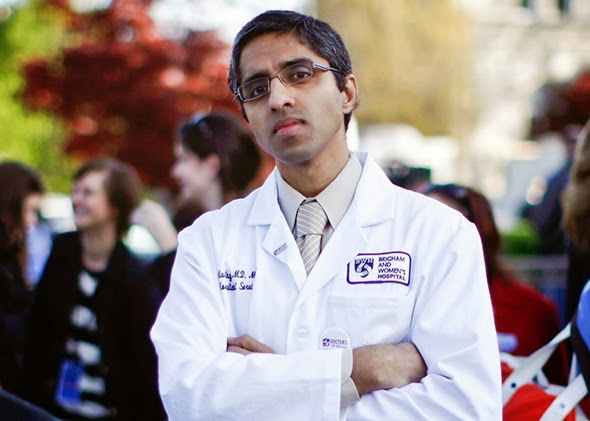
Vivek Murthy shot down by the NRA

A not quite predictable story. The NRA came in with guns blazing and the Democrats blinked.  

How did this happen with a 50 threshold (and a 55 member count in the Senate)? Dave Weigel explains:

This tweet still haunts Murthy. As of last week, his nomination hangs in
jeopardy because Senate Democrats—who can afford to lose every Republican vote
and four of their own—aren’t confident they can confirm him. Months after reforming
the filibuster, after lowering the vote threshold from 60 to 51, Democrats
are facing their second defeat of a nominee in less than a month. 

The
most-stated reason is that in his tweets and in his work at DFA, Murthy
couldn’t help himself from criticizing guns as a “health care issue.” 

In a
post–Sandy Hook letter, DFA even supported an assault weapons ban.

Every other Democrat, in Congress and in the White House, is baffled. They
went into the confirmation vote for Justice Department nominee Debo Adegbile expecting
to lose a few of their own—Adegbile had joined a defense team for Mumia
Abu-Jamal and criticized the role of race in the justice system—but
not to lose. Joe Biden didn’t show up for the vote to lose. He expected to
cast a tie-breaking aye.  

They didn’t expect the NRA to oppose a nominee for
surgeon general because, as one White house source put it, when has that
ever happened
?

 Vivek Murthy earned the ire of the NRA,
and the NRA scared off the necessary rump of Democrats.


Feb. 4: Murthy appears before the Senate Committee on
Health, Education, Labor, and Pensions. Tennessee Sen. Lamar Alexander
calls him out on this. “Much of your credential, it seems to me, is a political credential,” says
Alexander. Murthy had advocated for the Affordable Care Act,
when there was “at
least a large majority of Americans and a large number of the Congress who
disagree with that law.” He’d tweeted critically of the NRA, when “Americans
have a First Amendment right to advocate for the Second Amendment or any
amendment.”

Murthy backs down immediately, saying his priority in office would be
fighting obesity, not gun ownership. “My concerns with regard to issues like
gun violence have to do with my experience as a physician,” he says, “seeing
patients in emergency rooms.”
The issue seems to peter out. Wyoming Sen. Mike
Enzi says he’s “glad” Murthy walked back the gun talk, and adds that “in the
West, violence is mostly caused by people taking away guns.”


Feb. 26:
Kentucky Sen. Rand Paul sends Majority Leader Harry Reid a letter announcing
his intention to put a hold on the Murthy nomination. “In his efforts to
curtail Second Amendment rights, Dr. Murthy has continually referred to guns as
a public health issue on par with heart disease and has diminished the role of
mental health in gun violence,” writes Paul.
“As a physician, I am deeply
concerned that he has advocated that doctors use their position of trust to ask
patients, including minors, details about gun ownership in the home.”


On the same day, the NRA sends
a letter
to Reid and Kentucky Sen. Mitch McConnell officially opposing the
nomination.


March 11-12: At the start of the Senate’s last week before
a short recess, Fox News starts covering the Murthy nomination. “Do you want a partisan
physician?” asks Elisabeth Hasselbeck, rhetorically. Megyn Kelly’s
prime-time show books Chris Cox, the NRA executive who wrote the no-Murthy
letter, where he claims the nominee “is hell-bent on treating a constitutional
freedom like a disease.”


March 14: Toomey, the co-author of the 2013 gun control
amendment that the NRA opposed, comes
out against the Murthy nomination. “Dr. Murthy, as the president of a
partisan political organization, has been an active promoter of Obamacare,” he
explains. “Dr. Murthy also has advocated for policies that would erode our
important Second Amendment rights.” Later that day, the New York Times
runs ahead of the curve and reports that the Senate is
“balking” at a vote on Murthy, with “as many as 10 Democrats” refusing to vote
aye.

regards

This (investor visa) nest will cost you a million bucks

There are 10 million millionaires in the USA (and 30 million semi- and deci-millionaires).

In contrast India has only 180K. Still visa benefits are available if you invest a million bucks in the USA (there is a similar program in the UK as well). Things may change if the new immigration bill passes (it will not).

Assuming that you are a well-off minority or a liberal (or both). You are (justifiably) not a fan of Hindutva raising its head in your homeland. This is perhaps a good time to migrate to the West- the safe haven for minorities and liberals world-wide (made extra safe by checking every word of your emails/posts/letters….).

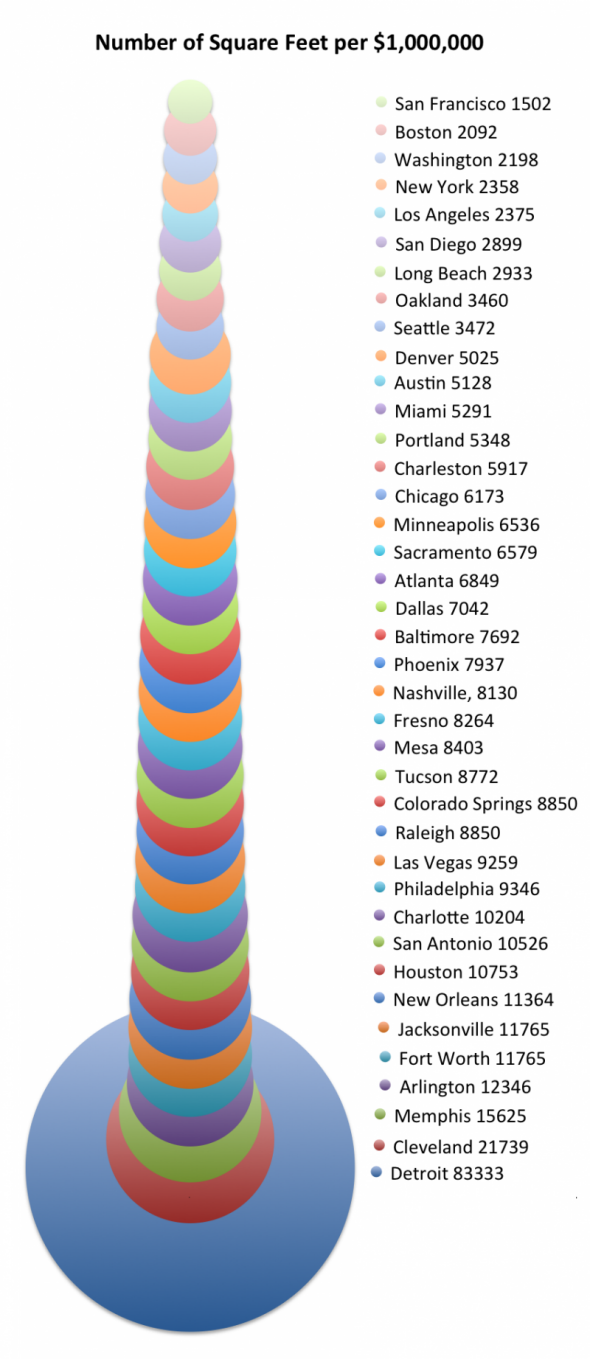
Here is a helpful chart which informs you on how much square footage you can get out of your million bucks. One thing to keep in mind- Detroit is not a very good choice.

regards

Brown Pundits