The nirīśvaravādiādi-accelerationists no doubt consider our usage of the word ‘God’ and countless references to ancient myths and texts a serious breach of the philosophy and a perversion of its ideas. Though we are not interested in soothing their fears, the objections they will raise must nevertheless be wrestled with, as Landian Accelerationism portrays itself a purely materialist philosophical system, which, although not often talked about at present, is properly referred to as ‘libidinal materialism’. Thus, we must descend into the ‘sublime basement’ of Land’s philosophy before we may return once more to the heady poetics of Meltdown. His system of thought is most comprehensively laid out in the opus The Thirst for Annihilation (Land, 1992b), which makes it clear that his philosophy follows in the wake of the Nietzschean ‘death of God’, something he explicitly states when he assembles a theoretical machine linking Kant, Schopenhauer, Nietzsche, Freud, and, most importantly, Bataille to himself. As Mackay and Brassier put it in the ‘Editors’ Introduction’ of Fanged Noumena (Land, 2012): “Land allied himself to a line of renegade thinkers – Schopenhauer, Nietzsche, Bataille – who mocked and disparaged academicism and wielded philosophy as an implement for exacerbating enigma, disrupting orthodoxy, and transforming existence” (p. 2-3). Continue reading Meltdown Bhāṣya: Verse 1.1.1 (Part 1.3)
Anon · November 2, 2025 · Comments Off on What’s in a name? That which we call a Swastika, isn’t exactly a symbol of hate
Disclaimer: As this post deals with an academic discussion on the Swastika symbol, I have included various images containing Swastika below. If you are repulsed by the symbol or do not like to look at it, please consider yourself warned. Also, for the same reason, this post is NSFW.
Growing up in India, I had developed this habit of drawing symbols of auspiciousness and good luck on my exam answer sheets. I have no recollection of who taught me to do that or when I started doing it but I can clearly remember even during my bachelor studies, I would collect the answer sheet from the invigilator and immediately proceed to draw an ‘ॐ’ (Om), a ‘श्री’ (Shree) and a ‘卐’ (Swastika, albeit with 4 dots in the middle as one would draw in India) at the top of the first sheet of the answer paper. This rather innocent practice wasn’t unique to me. Apparently many other students used to do this until the universities started cracking down on this ‘malpractice’ for ‘displaying symbols of faith on answer sheets’ and ’emotionally appealing to the evaluators’. In a religiously polarized India of the 2010’s, I don’t expect any less ham-handed response from our University VCs. But, personally, what prompted me to stop this practice was my move to Germany for my master’s.
In the first few weeks of the semester, all international students took part in an orientation program at the university. One of the most shocking things I learnt that day was that any public display of Swastika was BANNED in Germany. I was not ignorant of Germany’s sordid past. Watching ‘Schindler’s list’ beamed onto the wall of a dark classroom with my fellow drama club members in high school is one of the most vivid memories I have. I was just 15 then and the movie shocked me to my core. It was one of those instances of loss of innocence in my life when cruelty, inhumanity, Germany, Hitler, Jews and hate took on a whole other meaning in my psyche. In spite of that, discovering Swastika, an omnipresent sign in India that I had grown up seeing everywhere and that which is considered good and auspicious by everyone around me, could be a banned symbol of hate in the country I had just moved to, was another instance of loss of innocence.
Just like me, many Indians who have moved to the west have discovered this in their own way. The subreddit r/AITA (no connection with raitas 😛 ) has quite a few posts from hindus who have been mistaken for a white-supremacist (Oh! The irony!) for displaying Swastikas as a pendant gifted by grandmother, in the form of a rangoli/kolam in their frontyard, a tattoo on the arm they got while in India, having portraits of hindu gods at home, etc. All these instances happened in the US. From my personal experience, I have found the germans to have better awareness about Swastika; it’s use as the Nazi party symbol, a hate symbol of neo-Nazis and also as the auspicious symbol for many asian religions and cultures. This is because of two reasons:
1. The curriculum at schools explore all aspects of Germany’s sordid past with a level of frankness that I can only describe as ‘very German’. The curriculum makes the differentiation between the two symbols very clear as you can see from this children’s website that takes them on a german historical journey of the last 100 years.
2. The germans use two different words for this symbol. The symbol of hate used by Hitler and the neo-Nazis is called ‘Hakenkreuz’ while the auspicious symbol of the orient is called ‘Swastika’. Just the existence of two different words makes it easy to differentiate the meaning of the two symbols.
Funnily enough, even though I lived in Germany for 5+ years, I was not aware of the existence of ‘Hakenkreuz’. I only came to know about it in the past year or so through twitter! It was probably through a thread by True Indology (lost when his account was suspended) that I became aware of the german word ‘Hakenkreuz’ that when translated to english means hooked cross and not Swastika. The problem lies with the current mistranslation of Hakenkreuz in English.
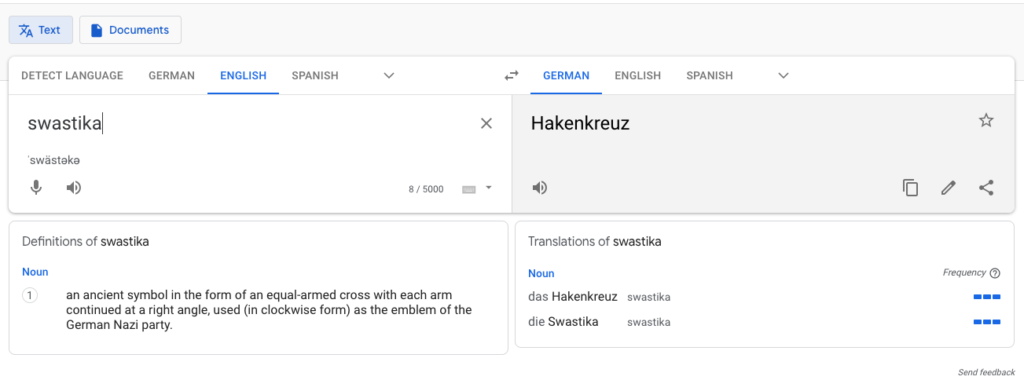
Google translate translates Swastika as Hekenkreuz in German. Notice the possible translations of the word – das Hakenkreuz and die Swastika. Also notice the definition of Swastika in english. It only defines the Hakenkreuz, the symbol used by Hitler.
Instead of translating into hooked cross, it is translated as Swastika, which is clearly wrong. So, why IS it mistranslated to Swastika? Who first translated Hakenkreuz to English as Swastika and how did that translation stick? More importantly, did Hitler adopt the eastern symbol Swastika as the anti-semitic symbol of his political party or did the inspiration come from elsewhere? These were some of the questions that recently led me to write a thread on twitter (you could also read it on the thread reader app here). I will summarize my findings below.
Colonialism and imperialism in the 18th and 19th century CE brought about a great deal of interest in the eastern cultures by the west which gave rise to the field of oriental studies and orientalism. All things east were considered exotic and the ‘popular’ phenomenon of cultural appropriation led to the adoption of various eastern symbols in the west. One among those was the Swastika. It shot up in popularity among the western academicians in the 1880’s and pretty soon entered the pop culture scene as a symbol of good luck, akin to today’s good luck charms like Maneki-neko (Japanese beckoning cat), Chinese fortune cookies or the Irish shamrock.
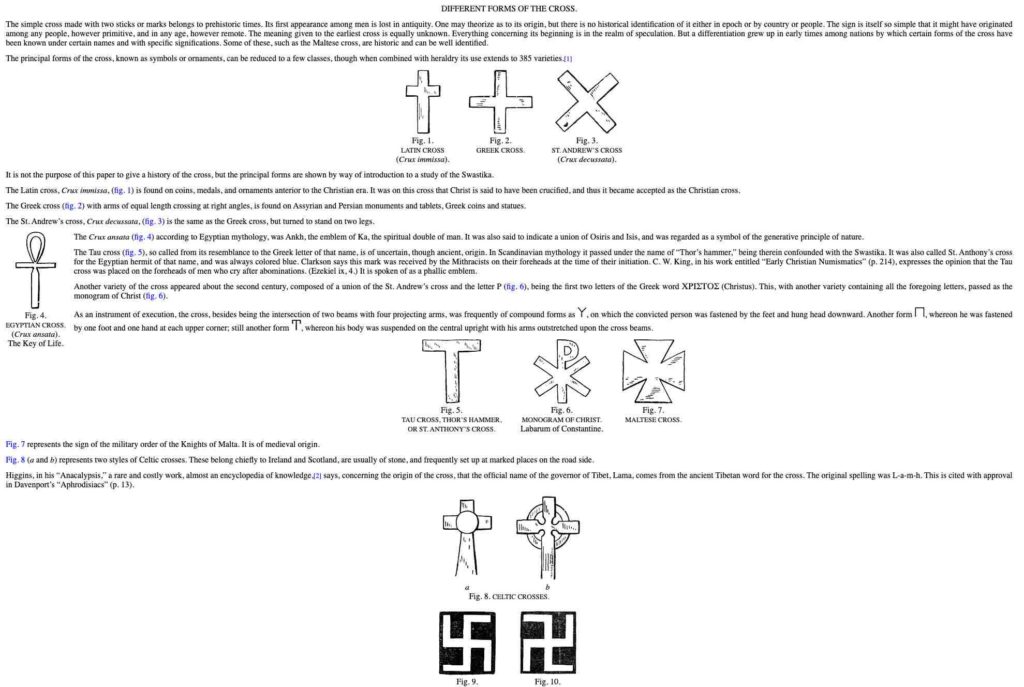
A report by Thomas Wilson titled ‘THE SWASTIKA, The earliest known symbol, and its migrations; with observations on the migration of certain industries in prehistoric times” for the US National museums in 1894 wonderfully compiled the then existing knowledge of Swastika. It is meticulous and very clearly written with almost no bias from Mr. Wilson. This also happens to be the first recorded instance where an English speaker tried to compile all the crooked cross like symbols and used the umbrella term of Swastika in English. Until then, the word Swastika did not exist in any english dictionary or encyclopedia. He writes in the preface:
An English gentleman, versed in prehistoric archæology, visited me in the summer of 1894, and during our conversation asked if we had the Swastika in America. I answered, “Yes,” and showed him two or three specimens of it. He demanded if we had any literature on the subject. I cited him De Mortillet, De Morgan, and Zmigrodzki, and he said, “No, I mean English or American.” I began a search which proved almost futile, as even the word Swastika did not appear in such works as Worcester’s or Webster’s dictionaries, the Encyclopædic Dictionary, the Encyclopædia Britannica, Johnson’s Universal Cyclopædia, the People’s Cyclopædia, nor Smith’s Dictionary of Greek and Roman Antiquities, his Greek and Roman Biography and Mythology, or his Classical Dictionary. I also searched, with the same results, Mollett’s Dictionary of Art and Archæology, Fairholt’s Dictionary of Terms in Art, “L’Art Gothique,” by Gonza, Perrot and Chipiez’s extensive histories of Art in Egypt, in Chaldea and Assyria, and in Phenicia; also “The Cross, Ancient and Modern,” by W. W. Blake, “The History of the Cross,” by John Ashton; and a reprint of a Dutch work by Wildener. In the American Encyclopædia the description is erroneous, while all the Century Dictionary says is, “Same as fylfot,” and “Compare Crux Ansata and Gammadion.” I thereupon concluded that this would be a good subject for presentation to the Smithsonian Institution for “diffusion of knowledge among men.”
In this report, Wilson examined different forms of crosses that had been found all around the world and concluded that Swastika is the most ancient one of them all.
Different cross-like symbols examined by Thomas Wilson in THE SWASTIKA
He complied various definitions of Swastika as recorded by different researchers and it was commonly understood to mean ‘good being’ or ‘good fortune’ in Sanskrit. The symbology was interpreted by different academicians differently. Although mostly everyone agreed that it is an auspicious symbol for the hindus and buddhists, there was no consensus on how to interpret the symbology. He writes,
Many theories have been presented concerning the symbolism of the Swastika, its relation to ancient deities and its representation of certain qualities. In the estimation of certain writers it has been respectively the emblem of Zeus, of Baal, of the sun, of the sun-god, of the sun-chariot of Agni the fire-god, of Indra the rain-god, of the sky, the sky-god, and finally the deity of all deities, the great God, the Maker and Ruler of the Universe. It has also been held to symbolize light or the god of light, of the forked lightning, and of water. It is believed by some to have been the oldest Aryan symbol. In the estimation of others it represents Brahma, Vishnu, and Siva, Creator, Preserver, Destroyer. It appears in the footprints of Buddha, engraved upon the solid rock on the mountains of India. It stood for the Jupiter Tonans and Pluvius of the Latins, and the Thor of the Scandinavians. In the latter case it has been considered—erroneously, however—a variety of the Thor hammer. In the opinion of at least one author it had an intimate relation to the Lotus sign of Egypt and Persia. Some authors have attributed a phallic meaning to it. Others have recognized it as representing the generative principle of mankind, making it the symbol of the female. Its appearance on the person of certain goddesses, Artemis, Hera, Demeter, Astarte, and the Chaldean Nana, the leaden goddess from Hissarlik, has caused it to be claimed as a sign of fecundity.
Until then, Swastika, as a symbol was known by different names in different languages because the symbol existed almost everywhere in the world, in Asia, Europe, northern Africa and the Americas. Also in Great Britain. So, what did the English call the symbol? Fylfot. Wilson writes,
In Great Britain the common name given to the Swastika, from Anglo-Saxon times by those who apparently had no knowledge whence it came, or that it came from any other than their own country, was Fylfot, said to have been derived from the Anglo-Saxon fower fot, meaning four-footed, or many-footed.
So, there existed a word for the 卐(crooked cross) symbol in english but only for the 卐 found in and around great britain. Instead of using this word for all crooked crosses in English, Mr. Wilson instead chose to use the word Swastika since he found it to be the most ancient of them all. This was a ham-fisted move because the Indic name swastika corresponded to the 卐 that symbolized auspiciousness which the other crooked crosses did not. Even Wilson admits that by quoting a letter by the famous Indologist Prof. Max Müller,
I do not like the use of the word svastika outside of India. It is a word of Indian origin and has its history and definite meaning in India. * * * The occurrence of such crosses in different parts of the world may or may not point to a common origin, but if they are once called Svastika the vulgus profanum will at once jump to the conclusion that they all come from India, and it will take some time to weed out such prejudice.
So, in 1894, the word Swastika was proposed by Mr. Wilson to denote all crooked crosses in english language and we see that the practice stuck since the use of the word in english language increased since then. So, is this when the German word ‘Hakenkreuz’ started being called as Swastika? Interestingly, no! In fact, the report mentions finding variants of swastika in Germany but mentions no name in German. ‘Hakenkreuz’ was barely used until then and was relegated to 19th century vocabulary books like the Bailey-Fahrenkrüger’s Wörterbuch der englischen Sprache and the Deutsches Wörterbuch von Jacob Grimm und Wilhelm Grimm (yes, they are the Brothers Grimm of Grimm’s fairy tales). So, to answer one of the questions posed above, ‘Hakenkreuz’ wasn’t actually translated into English. By the time germans started using Hakenkreuz as the word for the infamous anti-semitic symbol, the English speaking world had already picked up on the word Swastika and called any crooked cross symbol as such.
So, when and why did the Nazis adopt the Hakenkreuz as their anti-semitic symbol? The reason goes all the way back to Troy, the location of the fabled trojan war (it’s an interesting story, you can read a detailed article here). When a german businessman and amateur archeologist Heinrich Schliemann found the remains of the mythical city of Troy in modern day Turkey in 1871, along with the ruins, he found the 卐 symbol on everything – pieces of pottery, ruins of buildings, marble carvings, etc. Being an amateur archaeologist he did not understand the significance of his find. So, he consulted his orientalist friends – Max Mueller(yes, the same guy who didn’t want to call ‘Swastika’ found outside India as Swastika) and Émile-Louis Burnouf, a leading expert of Sanskrit. Fun fact: Bernouf was also an anti-semite and a propounder of Aryan master race.
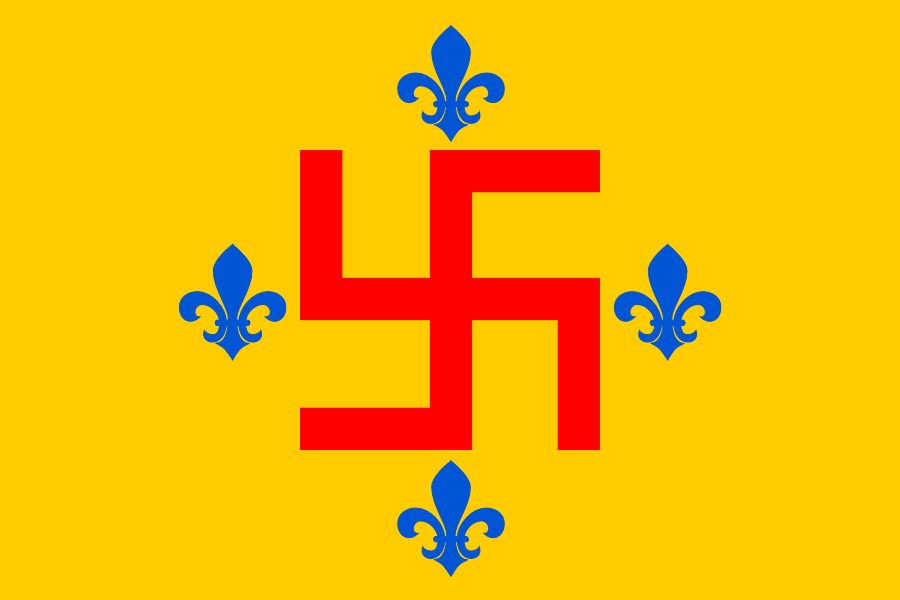
Burnouf made a bunch of dubious claims (debunked by Wilson in his monumental report on Swastika) which was covered in Schliemann’s book ‘Troy and its remains‘ and concluded that Suastika (that was the spelling he went with) is an essential symbol of the Aryan race. The popularization of this flawed idea led to its appropriation as the symbol by the German ‘Völkisch‘ national movement gaining steam at the juncture of 19th and 20th century. It was a nationalistic movement which propounded that Germans belong to the Aryan ‘master race’ and hence need to dominate the world. Poetically, the year Burnouf breathed his last, 1907, was also the year when the Swastika was first used as a symbol of Aryan dominance by a secret society called ‘Order of the New Templars’ (Ordo Novi Templi, or ONT) in Austria by Lanz von Liebenfels, an Austrian racialist. So, in early 20th century, as most of the west started embracing Swastika as a ‘cool’ motif, it was also being appropriated secretly by an anti-semitic and racist underground movement becoming a symbol of racial supremacy for various organizations until it was mainstreamed by Hitler in the Nazi flag in 1920.
Flag of the ‘Order of the new Templars’. This was the first instance of Swastika used as a symbol of Aryan dominance in 1907.
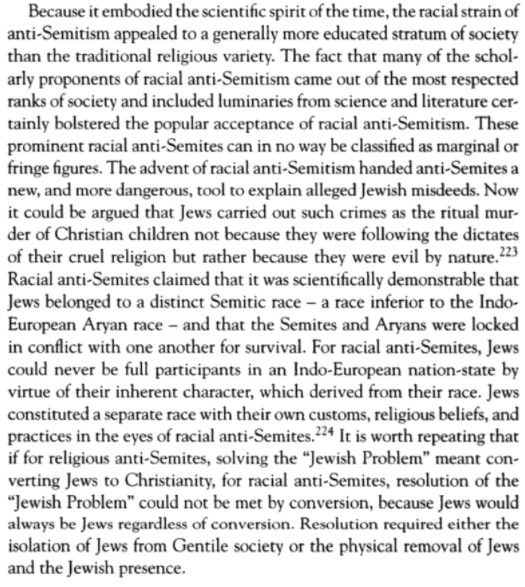
What inspired Hitler to choose this symbol for his political party? Was it just the connection to Aryan race or did the inspiration come from elsewhere? The anti-semitism displayed by the Nazis did not arise from a vacuum. Anti-semitism or anti-Judaism has existed in Europe since pre-Christian times but morphed into ‘religious anti-semitism’ due to the early christian belief that jews were collectively responsible for the death of Jesus Christ. This sentiment and the associated conflict intensified after Christianity spread as a state religion in Europe. However, the pseudo-scientific racial theories that became widespread in 19th century Europe threw up an additional strain of ‘racial anti-semitism’ where the basis of discrimination and persecution was the ‘scientific evidence’ that jews belongs to a separate lower ‘non-Aryan’ race. The combination of these two strains of anti-semitism, one historic and one modern, manifested politically in the form of Hitler’s Nazi party.
Professor William Brustein’s book, Roots of hate delves deep into pre-Holocaust anti-semitism in Europe
Adolf Hitler was a complicated man to understand. Forests have been felled to publish books speculating his inspirations and motives. Most scholars however agree that although Hitler distanced himself away from Christianity in his later years, he leaned heavily towards christianity in his early years. His catholic upbringing, his admiration for
I am quite familiar with History of England and Europe since even before my teens. That was because my father had beautifully illustrated school History text books from England. Plus many historical novels eg Walter Scotts The Talisman which is set in Palestine during the Crusades. I read them all many times over as nothing better to do as no TV then in SL till 1977.
Let us start with the historical Jewish Diaspora. Historical as verified from sources other than the Bible. The Romans controlled the middle east around 1 BC. (Think Julius Caesar and Cleopatra an Egyptian Queen of Greek Origin)
To quote Asia Minor after the Macedonian Wars (214–148 B.C.). In 63 B.C. The defeat of the Carthaginians gave Rome almost complete control of the Mediterranean. Romans conquered most of Asia Minor in 188 B.C., Syria and Palestine in 64 and 63 B.C.
In 70 C.E. (a few years after the purported passing of Jesus Christ the Romans Destroyed the Judaism Temple in Jerusalem. Apparently this ended the ability to make animal sacrifices to God (Yahweh). Plus the Roman persecution of the Jews and Judaism led to their disperal from Palestine, i.e. the Diaspora
Note: There is no evidence of a Kingdom or Country called Israel in any of the Historical or Pre-historical records of the Babylonians and Assyrians. There was region called Palestine (Palaistinê, Παλαιστῑ́νη) since at least since the Greek times. The word Israel became considered “Fact” when Europe became Christian and the Bible an accepted source of fact given by the Divine. The Jews became notable and rich because they were money lenders. Christians (and Muslims) are forbidden to lend money on interest (usury). Think Merchant of Venice and Shylock the Jew
Tom Holland started off writing vampire novels but moved on to non-fiction and has since written an excellent history of the Persian invasion of Greece, several books about the Romans, one about Islam and one about the slow rise of Christian Europe that started around 1000 AD ; in retrospect at least, all his non-fiction books have had a hint of Christian Western European apologetics (some of it is probably well deserved reaction to the excesses of contemporary wokeness) but this book makes it explicit. Dominion is well written and well researched and he does make a lot of effort to include the nasty bits of Christian history, but in the end it IS a work of Christian apologetics, albeit from a modern liberal angle. Tom Holland’s basic thesis is that almost the entire set of “humanist” values modern liberals take for granted (universal human equality and dignity, separation of church and state, care for the weaker sections of society, suspicion of power, privilege and wealth, condemnation of slavery, cruelty and oppression, valorization of the weak and downtrodden, etc) is purely Christian in origin. No other civilization or culture had these values (or at least, foregrounded them in quite the same way as Christianity). For example, while some thinkers have always been unhappy with slavery, the abolition of slavery was a Christian effort through and through. True, the slave owners had their own Biblical justification for slavery, but those who opposed them did so on the basis of their Christian beliefs, and they won the argument.
Holland also insists that the most viciously anti-Christian progressive thinkers of the post-enlightenment era also turn out be using Christian values to attack Christianity. When Marx cries out against the oppression of the proletariat or Lennon sings “all you need is love”, they are really being more Christian than most Christians. Since Nietszche thought something similar (that liberalism is “Christianity without Christ”), he gets a lot of positive play in this book, which is a bit ironic, since he also regarded Christianity as something of a disease.
It’s like a waterfall: you stumble on an idea that comes from the mouth of Doug Coe, describing the principle behind the influence of The Family, of which he was the long-time leader —
— and it turns out the same principle is referenced in an article on surveillance in Defense One —
There’s clearly a principle at work here that could find application in many fields, contexts, silos — and the concatenation of such instances is itself a demonstration of the value of silo-breaking thinking.
FWIW, I wouldn’t have so much as heard of the Goddess Kubjikaa were it not for my half-century friendship with Mark Dyczkowski, to whom I owe so much, and into the waters of whose scholarship so deep I have dipped no more than a toe.
This is a very simple poll. I posted a couple of these questions on Twitter (@omarali50) and want to do the same here. The idea is to test a hypothesis (not about what will happen to the Indian religious landscape, but what do readers of this blog THINK will happen to it, and why) which will be part of a later blog post I plan. For now, please take this very simple 3 question survey by scrolling down within the survey below.. and comment on the post as you see fit.. We may learn something, or at least have some interesting discussions..
Recently I read a piece, Confronting White Supremacy in Christianity as a Christian South Asian, which is interesting from an anthropological perspective. After all, I don’t know what it’s like to be a progressive South Asian Christian, which is the perspective of this author. But as I read the piece I felt that it elided and conflated so much. A much deeper and richer story was being erased so as to serve up another illustration of the primacy of white supremacy.
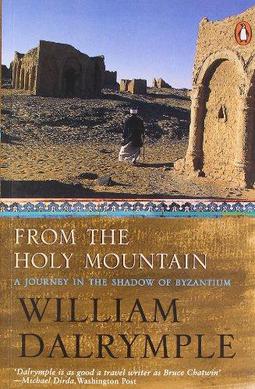
If you read From the Holy Mountain: A Journey Among the Christians of the Middle East you know that how white American Christians treat non-white Christians can be rather ridiculous. One of the stories I recall is of an Arab Christian waiter in Jerusalem who wore a cross, and was very irritated with white Americans with strong Southern accents would inquire when he had converted to Christ. This person of course privately scoffed, and reflected that when his ancestors had been Christians for centuries his customer’s ancestors were still worshipping pagan gods.
Here is a passage from the above piece which I think really confuses:
Christianity in India highlights a violent history of white supremacy through colonization and mass conversion by Europeans including, the Portuguese, Irish, Dutch, Italian, French, and English many of whom hold cultural influence that has remained to this day in places like Kerala, Pondicherry, and Goa. Similarly, there doesn’t appear to be much of a difference in the diaspora. For instance, my family converted to Christianity while living under the Apartheid regime in South Africa, an entire system of white supremacy supported by ‘Christian’ values.
The writer is a young Canadian woman whose family is from South Africa of Indian heritage. Additionally, though she never is explicit about it, her family seems to be evangelical Protestant. This is an interesting perspective, but it is a totally different one from that of South Asian Christianity.
Bracketing Kerala with Pondicherry and Goa is simply misleading. Christians are nearly 20% of the population of Kerala, and most are St. Thomas Christians, whose origins predate European contact with India by many centuries. Originally part of the territory of the Persian Church of the East, modern St. Thomas Christians have splintered into numerous groups with varied affiliations, in part due to the trauma of contact with Portuguese Catholicism. But through it all they maintain an indigenous Christian identity which is distinct from any colonial imprint.
Second, large numbers of India’s Christians are converts from Dalit populations, or, tribal peoples in the Northeast who are racially and culturally distinct from other South Asians. The framing in the piece is that South Asian Christianity has to bear the cross of colonialism, but a good argument can be made that for Dalit converts and tribal groups in the Northeast Christianity is the vehicle for resistance to oppression, assimilation, and colonialism on the part of the dominant South Asian cultural matrix.
This is not to say that the piece does not speak to a real dynamic. North American white evangelical Protestantism is inordinately freighted with racialized baggage. And it is easy to reduce into the Manichaean framework of postcolonial theory, where whites are the sole agents of action in the world. But to the generality, Indian Christianity has many disparate threads, and this sort of reduction is misleading.