
I did a podcast with roon on shape rotators and wordcels. Check out A Song of Shapes and Words.
Tag: Culture
On the Hindu contradiction of intents
A few days ago some Indian politician was making the case for ghar wapsi (conversion of non-Hindus of Hindu ancestral background to Hinduism). Of course, he had to withdraw the comments due to an uproar. Myself, I’m American, and people convert from religion to religion all the time. It’s a bit tasteless for a public official to engage in this, but it happens.
India’s a different country, so I understand that this official had to be prudent.
That being said, these calls to bring non-Hindus back into the fold are in my opinion kind of a joke. Yes, if someone is born a Hindu, or if someone’s family converted a generation ago, perhaps ghar wapsi is feasible. One can slip back into the social network that one was born into, or that is accessible in cultural memory. But outside of particular sects, like Hari Krishna, Hinduism is too “community-oriented” a religion to accept large numbers of converts. Perhaps if a whole community converts back all at once, that’s possible then, but there won’t be the low-level social-network-based conversions that drive a lot of the constant defection or adoption (e.g., it is well known among Mormons that most converts come through friendship networks between Mormons and non-Mormons, as well as marriages between Mormons and non-Mormons, not door to door conversion).
Calls for ghar wapsi are just rhetorical. If large numbers of Indian Muslims began to convert to Hinduism would they be accepted with open arms? I doubt it. The social system is just not set up for that (again, outside of sectarians like Hare Krishna).
Consider the fact that on social media Hindu nationalists (some) routinely refer to me as a Muslim. I am not someone to patrol what terms people use to refer to me as (you can use any pronoun, I don’t care), but it seems weird to call me a Muslim when I’m an atheist that has drawn and posted a photo of a drawing of Muhammad getting sodomized by a camel (on this weblog), something most Hindu nationalists would never do out of religiosity or cowardice. But it’s not about my identity (I don’t socialize with any Muslims nor do my children even know anything about the religion, so I’m not one of those “atheist Muslims”), it’s about the fact that many Hindus reflexively view religion as ascriptive. Something like race, an identity that you’re born with.
With that in mind, Hindus should work on their birthrate. Most Indian Muslims that convert to Hinduism will have Muslims who hate him, and Hindus who will still think of them as Muslim.
Note: Obviously, my generalizations apply to a particularly low IQ set. I actually know Hindu nationalists or fellow travelers in that movement who don’t have this sort of collective/ethnic mentality. But it’s a minority position from what I can tell.
I for one welcome our new Brown overlords!
Amy Wax is on Glenn Loury’s show going off on Asian immigrants, and to a great extent, Indian American women who play the whole woke game.
First, I myself have written about the representation of Indians/browns among woke activist types. Amy is reflecting a descriptive reality; don’t deny it, it’s true. Though this is especially prevalent among the 1.5 and 2nd generation, there are some immigrants getting in on the game too (though proportionately far less).
Second, I know Amy a bit personally. We’ve met and hung out in real life at a conference. She’s clearly familiar with my work.
Third, to be candid, Amy is a Boomer, and her comments, observations, and sensibilities reflect her generation. If you listen to her earlier conversations she operates in a world of racial black-white dichotomies, which is the world she came up in. She’s trying to integrate other groups, but these are not people she necessarily grew up with, and she’s trying to understand them.
Fourth, don’t doubt her intelligence. She graduated summa in biological sciences and has an M.D. and a J.D.
Finally, to be honest, I find a lot of her structural analysis here kind of lacking, and I think Glenn made some good points. Some of her talking points, like the idea that Indians are conformist and subservient to power, are pretty widely disseminated on the dissident right, but let’s just say a lot of these observations don’t come from a place of detached analysis, as opposed to emotive reaction and fear. Unfortunately, I think Glenn’s suggestion that Indian Americans are just assimilating, very well, to professional-managerial-class norms, is spot on.
All of that being said, no matter what you think of Amy’s analysis between observation and conclusion, I think her endcaps are probably correct. As I noted above, the description rings true. There are these brown cadres everywhere, with fancy degrees and upper-middle-class upbringings, decrying America as a white supremacist terror regime. It’s embarrassing, offensive, and cringe. And, I also don’t think America as a whole will tolerate rule by a brown-faced elite with exotic names and mostly non-Christian religion. Yes, I can see an Indian American President. Until recently, the Supreme Court had three Jewish Justices (with RBG gone and ACB replacing her it’s Jewish to Catholic now). Imagine if there were three Indian Americans. Not sure the populace would be happy seeing those faces all the time and knowing how different they were than the rest of America.
A new way to say generic “Brown People”
They call it “MASA,” for “Muslim, Arab and South Asian.”
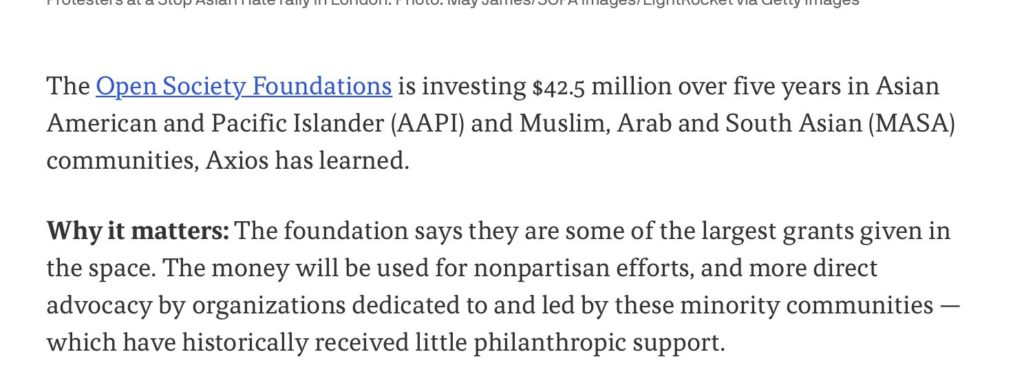
So this is a category that includes Norwegian converts to Islam, Assyrian Christians, and Bhutanese Buddhists.
Also, “South Asians” are now part of two overlapping acronym communities, as we’re already “AAPI.”
Academic freedom, Hinduism, and the end of the age
We are at a tipping point,” said Rohit Chopra, one of the conference organizers and a professor of communication at Santa Clara University. He said the issue went beyond the conference. “It’s about the principles of freedom of expression, academic freedom and of a university being a space where people can speak for the most vulnerable.”
The online conference, Dismantling Global Hindutva, included panels on the hierarchical caste system, Islamophobia and differences between Hinduism the religion and Hindutva the majoritarian ideology. The event was co-sponsored by departments of more than 40 American universities, including Harvard and Columbia.
The whole piece is a mishmash. First, let’s stipulate that many Hindu activists are unsophisticated, illiberal, and nasty pieces of work. But someone like Suhag Sukhkla is none of those things. So the article focuses more on the former than the latter because the former is sensationalistic. Yet, many of the reported threats are credible to me because I myself have received various forms of these invectives from 15-year-old masturbaters in India on Twitter (though a little surprised adults behave like this too). But beneath the bluster and thuggishness, there’s a legitimate grievance. Imagine an academic conference on Islam that spotlighted its hierarchical gender system, religious dominionism, and the differences between Islam as a culture and Islam as a religion. Such a conference wouldn’t happen because academics would fear Muslim outrage and violence, and, they see Muslims as subalterns and marginal, and so above criticism.
The first issue illustrates why many Indians and Hindus are behaving like this: they’ve seen the heckler’s veto work on weak-spined academics before. They’ve seen it work for Muslims, and they’ve seen it work for left-wing activists. When Charles Murray was physically attacked at Middlebury it got results. Murray really can’t speak in public anymore at such venues because the cost of security would be prohibitive. The second issue is that academics don’t really believe in freedom of expression anymore, they believe in critiquing the powerful. They’re activists. Ideologues. What the Hindus are doing is turning the master’s tools against the master when they leverage identity politics and their status as people of color. The academics, who don’t really believe in freedom of expression, respond with most gusto when they try and smear Hindus by connecting them with Nazism and argue for their hegemonic status vis-a-vis Muslims in the subcontinent. It’s all who/whom here.
I believe in dispassionate analysis and Epoche. Many Hindu activists and believers are wrong on many things. And I tell them so when I think this. But I don’t do this because I want to “deconstruct Hinduism.” I don’t really care that much about Hinduism, or Islam, or any religion. I want to know what’s true. When humanities scholars gave up on the truth, they gave up on the high ground from which they could defend their viewpoints as part of free speech. This is the world they created. You told people that truth is subordinate is power. Your enemies now seek power to force you to speak their truth.
I’m on Urban Chatterati again!
Best comment: “Razib guy is trying so hard to keep his woke islamism under check and I appreciate it.”
Pew Survey on India (religion, etc.)
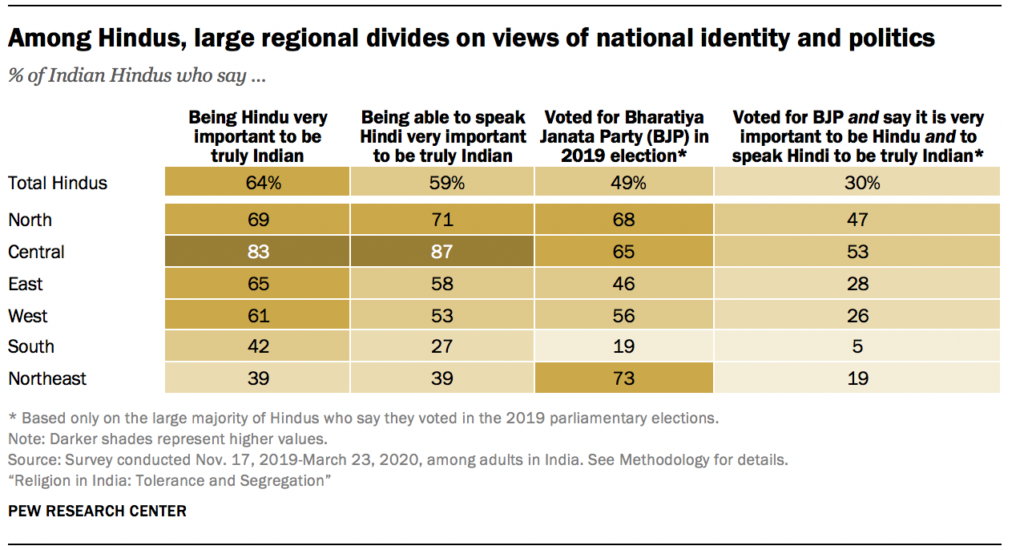
The Pew Survey on India is long. Here are my main impressions/surprises:
– The strong emphasis on Hindi in the Gangetic plain is pretty striking (“Central”)
– The stuff about mass conversions to Christianity in South India seems overdone. I understand people can/will lie on Census due to reservations, but this seems less plausible for a pollster. That being said, a disproportionate number of conversions are in the South
– South India is less religious, less nationalistic, etc. This seems to apply across religions (that is, Muslims in the South are less focused on religion just like Hindus in the South are)
– Opposition to “inter-caste” marriage is very strong. And, it is strong among non-Hindu groups too
– All Indians seem rather nationalistic
Indian American survey (outmarriage rate)
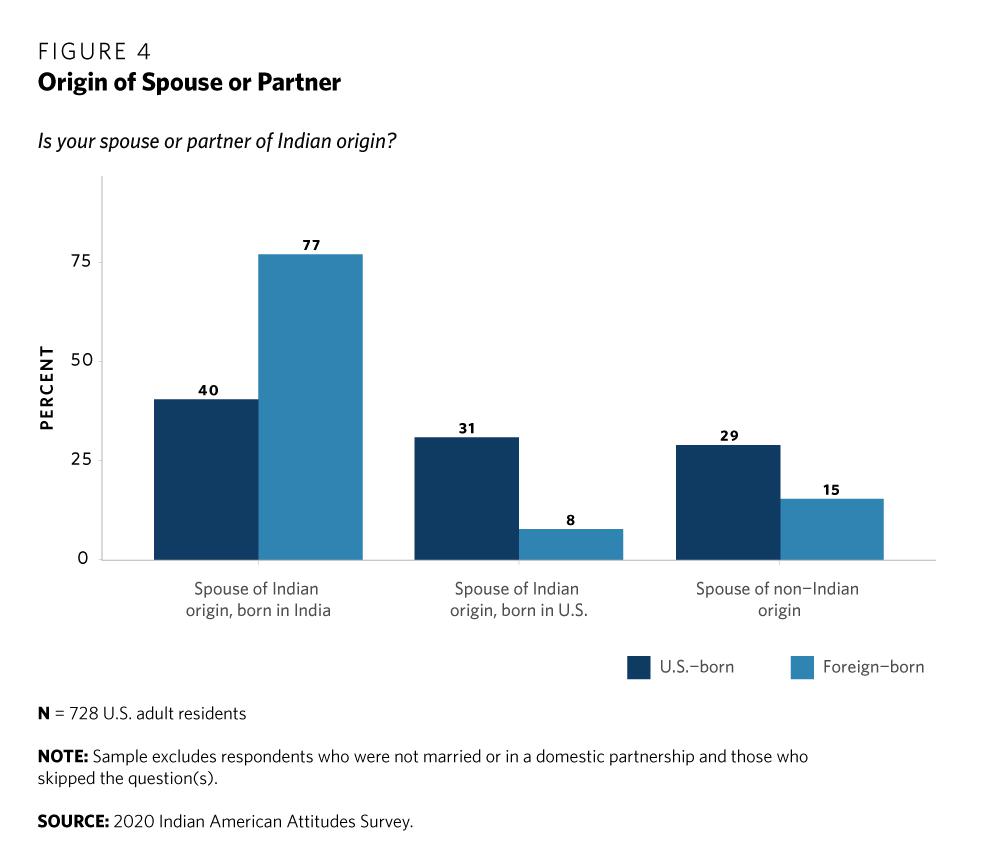
The sex-ratio skews male outmarriage for immigrants but balances out for native-born Indian Americans. The 30% rate is pretty low from what I expected. Also, surprised that 40% of spouses of Indian Americans were Indians born in India, but I wonder what percentage of these are 1.5 generation (born abroad, raised in the USA).
Yoga: do your thing my brownz
 Sometimes I can’t help it, I’m going to do it. So here it goes, Yoga Teacher Jessamyn Stanley Believes White Supremacy Has Polluted Yoga – and It’s Time to Talk About It:
Jessamyn Stanley needs you to know what yoga is really about – and it’s not the poses.
In her new book Yoke: My Yoga of Self-Acceptance, the yoga instructor and body activist shares reflective personal essays that touch upon everything from racism to the cultural appropriation of American yoga, from consumerism to cannabis.
…
The book explores the existence of white supremacy and cultural appropriation in American yoga. “I would venture to say that everything in our collective society is rooted in white supremacy. I am sure there are many people who would disagree with that, and honestly I don’t care because I believe that and I know it’s the case,” she says.
…
“The appropriation comes from practitioners who are not South Asian looking at South Asian teachers and saying, ‘I need to do exactly what they’re doing. I need to practice yoga exactly how they’re practicing it.’ Yoga as a concept exists in so many cultures. It’s literally the basis of so many different things: the idea of acceptance and the yolking together of the light and the dark. But these teachers are just saying, ‘Practice yoga.’ They’re not saying, ‘Pretend to be Indian.’ They’re not saying, ‘Steal someone else’s ethnic identity.’ They’re saying, ‘Practice the balancing of truth and light within yourself.’ “
 Two words: Kali Yuga. This whole timeline is cursed. It’s absurd. It’s perverted.
I’m not Hindu, so I don’t “believe” in yoga in a spiritual sense, though I have seen its efficacy is a form of exercise firsthand. But the way it is…yoked, to the most absurd and bizarre social justice movements today is just a wonder to behold.
Stolen oppression
The psychiatrist in question is Aruna Khilanani. Her parents are doctors. She was educated in private schools. But, she talks about her experience with discrimination. You know, stuff like not being supported as much in her medical residency as a blonde peer.
We have a problem. Who has the standing to point out the hypocrisy and manipulation of these people? I’m frankly sick of it. Any brown person in the United States does experience some racism. But those of us with education and resources are not really underprivileged in any way. The vast majority of white Americans, whose life expectancy is decreasing, have it worse off than us. That’s just a fact.