The end of the Kalash is nigh

Verily I say unto you, this generation shall not pass, till all the Kafir Kalash bend the knee to the one true God!

I think anyone who has given it any thought knew that this was inevitable and just a matter of time. That time seems to be now. The Kalash compensated for conversion with higher endogenous fertility, but if it is true that educated young women are converting to Islam, their ability to reproduce their numbers will decrease rapidly.

Anxious Times In Pakistan’s Pagan Valley Rising Islamic Influence Pressures An Ancient People:

Naveed is a member of the Kalash, a pagan community known for their fair skin that has long inhabited this area near the border with Afghanistan. The Kalash people, many of whom believe they are the descendants of the armies of Alexander the Great, have held on to their religious beliefs and colorful rituals for centuries, even as a sea of Islam has encircled them.

But the unique traditions of the Kalash are coming under mounting cultural pressure as the pace of conversions to Islam accelerates within Pakistan’s smallest ethnoreligious community. The Kalash population currently numbers between 3,000-4,000, and locals estimate that some 300 of their members have converted to Islam over the past three years, The Washington Post reported in November. Some local reports, however, have said the figure is not that high.

First, to preempt genetic comments: the Kalash do not descend from Europeans like Alexander’s Macedonians, as such. Rather, they are a mix of Indo-Aryan steppe ancestry, with a base of Iranian farmer (the largest component probably), along with a residual but non-trivial amount of indigenous deep South Asia ancestry (AASI in other posts). It is probably fair to say that they are among the most Indo-Aryan peoples in the Indian subcontinent, but the recent work on the Ror people indicates that some Jatt groups are similar.

Second, the fact that they are not Muslim to this day is simply due to the contingencies of history. The Afghan conquest of nearby Nuristan in the last decade of the 19th century resulted in the wholesale conversion of the pagans of that region. The fact that the Kafir Kalash were on the British side of the border meant that they were spared forced conversion.

And so almost magically deep into the 21st century, we got a window into the world of Indo-European customs and practices of the descendants of the Andronovo and Sintashta cultures, relatively isolated from the primary stream of what became Hinduism to the south and east and Zoroastrianism to the west (both of which interacted with non-Indo-European indigenous elements). The sun is setting on these people, whether through forced conversion, or the attractiveness of modernization and assimilation into the dominant culture of Pakistan.

In a few generations, they will be but faint memories to their descendants, and a single thread of the many threads of human cultural history will vanish forever.

Indian Muslims are more latitudinarian than Pakistani Muslims

There is a lot of talk on this weblog. Probably because this is South Asian focus, and we tend to be a loquacious people on the whole (some more than others). But I decided to look in the World Values Survey in regards to the question of whether believers believed their religion was the only acceptable religion.

Before some of you ask about methods and cross-tabs, the website has a late 1990s interface. You too can use it and look up facts!

(also, Hindu intolerance surprised me a bit, though not too much)

Continue reading Indian Muslims are more latitudinarian than Pakistani Muslims

How serious is the Hindu-Muslim conflict in India ?

Writing in the journal India Review, Korean scholar Heewon Kim says,

This article reviews the approaches used to understand the BJP-led NDA government’s policies toward religious minorities and argues that far from marking a radical departure, there are more continuities than discontinuities in these policies with previous administrations.

For all kinds of keyboard internet warriors, this conclusion would come as a disappointment. But it is only the boring conclusion to a truly banal argument.

There seems to be an understanding among many that Hindu-Muslim conflict is primordial, immemorial and ultimately irreconcilable. Partition is seen as incontrovertible proof of this view.

I would like to offer another perspective. In my view, taking into context the entire history of the twentieth century, the Hindu-Muslim conflict in India is rather benign, mainly due to the low real stakes in this conflict. I base this view on my readings of Russian, Chinese and Mexican history, especially the scale and intensity of armed conflict seen in inter group rivalries within those countries.

The forces of industrialization and democratization unleashed by England starting from 18th century proved immensely destabilizing to all world civilizations. This period saw extremely volatile political competition between groups harboring competing, irreconcilable visions for the future of various countries. In Russia, China and Mexico, this competition took the form of conservatives (usually capitalists), versus radicals (usually leftists). In the Muslim world, such competition has appeared in the form of secular regimes being pitted against Islamist movements, and increasingly, sectarian conflicts amongst various conservative movements.

The stakes for both sides in these conflicts were extremely high, and no accommodation with the opposing group was sought. This is evident from the sheer scale of warfare seen in these conflicts. The death tolls in each country ran into the multi millions, with decades of devastation.

Italian Trulli

Such high levels of conflict are not seen amongst Hindus and Muslims in India. The real stakes in Hindu-Muslim arguments are simply too low to militarize the conflict. On the table in other world conflicts, were programs of massive wealth transfer via land reform, extreme and eternal concentration of political power and utter suppression of language and religion. In contrast, Hindus and Muslims mostly argue about long dead kings, culinary choices and obscure theological points.

The simple truth is that even the establishment of a Hindu state will not alter the ground realities for India’s Muslims. Nepal was a Hindu monarchy for many decades, and its 5% Muslim population showed no interest in challenging the regime. Interestingly, the eventual overthrow of Nepal’s Hindu monarchy was carried out by a leftist movement (comprised of Hindus) in a civil war, much like the pattern seen in Russia, China and Mexico.

In many ways, India’s immense diversity and the sheer scale of its minority population, has restricted conflict to elite sparring rather than total war, which has very much been the norm across the world. But it has also prevented a genuine confrontation between the masses and the elites, the often mentioned lack of a revolution in Indian society. For a left vs right conflict in India, Hindu would need to fight Hindu. But the very presence of the Muslim seems to have softened any edge in this conflict.

Browncast Episode 30: Philippe Lemoine on philosophy, politics, French immigration & The European Union

A creature of the night

Another BP Podcast is up. You can listen on LibsyniTunes, Spotify,  and Stitcher. Probably the easiest way to keep up the podcast since we don’t have a regular schedule is to subscribe at one of the links above.

You can also support the podcast as a patron (the primary benefit now is that you get the podcasts considerably earlier than everyone else…).

I’m toying with an “AMA” on a YouTube live stream for “Patrons” only another benefit. Since there aren’t too many Patrons it might be a simple thing to do if no one shows up!

But I would definitely appreciate more positive reviews. Many of you listen to us, but don’t leave any reviews!

Best with Bourdeaux

This week we talked to Phillipe Lemoine, a philosopher, pundit, and data scientist. Phillipe has his own blog, but I would also recommend his pieces in Jacobite magazine

Informally I think of this episode of the BrownCast as “frawg-talk.”. We addressed Phillipe’s intellectual journey, from computer scientist to philosopher of science to data scientist. How he got involved in various assorted issues, and hard-headed analysis of migration into France, as well as sanguine attitude toward the European Union.

What is in a name?

Image processed by CodeCarvings Piczard ### FREE Community Edition ### on 2016-02-09 15:57:42Z | http://piczard.com | http://codecarvings.com

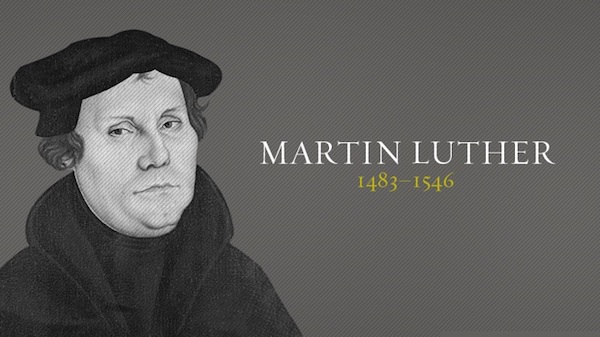
Martin Luther was the key figure in the precipitation of the Reformation.

The name Martin:

Martin may either be a surname or given name. Martin is a common given and family name in many languages and cultures. It comes from the Latin name Martinus, which is a late derived form of the name of the Roman god Mars, the protective godhead of the Latins, and therefore the god of war….

And Luther:

As a German surname, Luther is derived from a Germanic personal name compounded from the words liut, “people”, and heri, “army”. As a rare English surname, it means “lute player” (Hanks and Hodges 1988). Luther is also derived from the Greek name Eleutherius. Eleutherius is a cognate of the Greek word eleutheros (έλεύθερος) which means “free.”

I bring this up because it is curious and notable to me that apparently is common for converts to Christianity in India (I’m setting aside traditionally Christian groups such as Nasranis) to take a “Christian name”. One of the arguments is that you shouldn’t have names which refer to a pagan god. Someone should have told Martin Luther. The Anglo-Saxon kings retained the myth of descending from pagan German gods long after their Christianization (they obviously didn’t believe it literally, though they still refused to let go for the prestige).

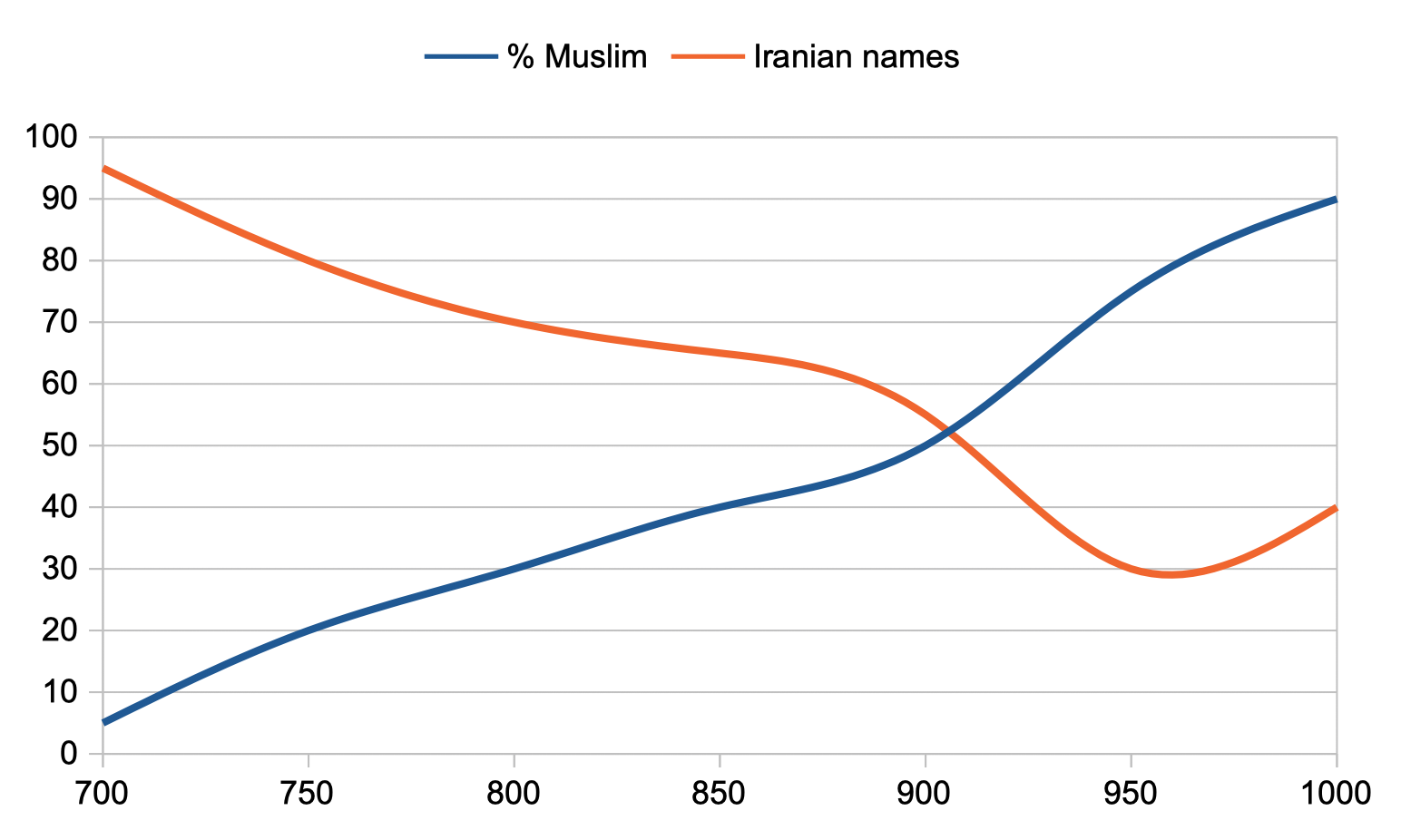
About ten years ago I read a book about the Islamicization of the core Muslim world. In particular, there was a curious feature of the process that occurred over three centuries in Iran. There was a chart of the form:

The records were clearly from sub-elite individuals. People from whom records remained due to their service or taxes paid. What one sees is that for several centuries the proportion of classical Iranian names drops as the number of local landlords who are non-Muslim drop….and then as the Muslims become overwhelming, there are individuals who are known to be Muslim who are being given classical Iranian names all of a sudden.

The link between being non-Muslim (generally Zoroastrian) in rural Iran among sub-elites and having an Iranian name disappeared when the number of non-Muslims declined to the point where they were not a major community (outside of isolated areas such as Yazd).

In a similar manner, Bangladeshi Muslims often have more ostentatiously Arabic names than Pakistani Muslims, who reflect more Iranian and Central Asian influence. The Bengali  Muslim intelligentsia is a recent creation of late modernity, balancing its sincere religious beliefs with an ethnic identity distinct from the post-Mughal Islamicate culture further up the Gangetic plain and into Punjab (the Muslim elites of Mughal era Bengal did not speak Bengali as their high language, and the early Bengal Rennaissance was due to Hindu gentry). The extremely Arabic names are probably one way to emphasize one’s Muslim bonafide in a cheap manner.

My own children have conventionally Western forenames (though not generic ones). The reasoning is straightforward: they are being raised in a conventional white American milieu. I have no religious attachments obviously, nor am I passionately ethnic, outside of some food preferences. Their South Asian heritage is part of their past through me, but the future is different, and the names reflect that.

Going back to names…it’s ridiculous to say that they don’t indicate deep culture dynamics. The hyper-Muslim people in my family don’t make recourse to Bengali pet names. My father, whose father was an ulem, did not have such a pet name.  As the lineage secularized, with my father, pet names in Bengali reappeared.

Since I am not a believer and am unlikely to passionately convert to some religion, I don’t know the motivations and psychology. And people are free to do what they want. But the idea that conversion to Christianity necessitates a name change seems ridiculous to me. The first Christian king of Sweden was Olof Skötkonung. The first Christian Roman Emperor was named Flavius Valerius Aurelius Constantinus Augustus from birth to death. Could think of a name more Scandinavian or Latin Classical?

Though it is common in the Islamic world to have distinct names rooted back to the Middle East (Indonesian Muslims being an exception), there is far less uniformity in Christianity. And yet many Christians adopt this pattern. Why? Similarly, white converts to Hinduism sometimes adopt Indian names. Why?

The post is not so much an argument for anything. But an observation that opens up a discussion….

What Happened to African Americans

I had this comment why are African Americans so so down.  Apparently thats because they are not part of the Santa Danda Claus belief.  Nothing to do with Santa belief people coming in and taking the jobs of those jungle Bunnies.

Now we have Kamala Harris taking up the cloak of  Jungle Bunnies  while playing pander to Santa Danda Claus.

What could have been.  This is Watts Stax, the answer to Woodstock.

Just before the Santa Danda Claus started invading and  taking the jobs.


Big Foreheads, Smart People

One of these days, I am sure will be banned from posting.
While I am allowed why not.

Sometime back posted this music video by Rajasthan gypsy Gulab popularized  by Latch Drom.

Recall a commentor saying plenty of women like that in India.
I listen to this video often, because of the voice and the woman is pretty.

Today I was struck by that, Gulab has a big forehead.
And supposed opinion is big forehead is smart.

Then was thinking my mother, sisters (and I, before hair fell off) have hair upto our eyebrows. Yeah we are the Jungle Bunnies.


=================================================================
Bonus

This guy should be hired as the dancer for Sri Lanka. Our National bird is the jungle fowl.

Browncast Episode 28: Obesity, Lifestyle, Fat and more..

Another BP Podcast is up. You can listen on LibsyniTunesSpotify,  and Stitcher. Probably the easiest way to keep up the podcast since we don’t have a regular schedule is to subscribe at one of the links above.

You can also support the podcast as a patron (the primary benefit now is that you get the podcasts considerably earlier than everyone else…). Would appreciate more positive reviews.

In this episode Razib and Omar move away from politics and culture to talk about the science (and non-science) of nutrition, lifestyle, obesity and fatness, especially as it relates to South Asians.  As some readers may know, I am an endocrinologist with a research interest in obesity and insulin resistance and Razib is a geneticist with a personal interest in health, nutrition and lifestyle, so I hope listeners will find it useful. Comments welcome.

PS: a couple of people have asked what my recommendations are for treating obesity. I hope to do a longer post some day, but here is the brief outline of what I advise my (pediatric) patients:

-Increased physical activity (1 hour of moderate to vigorous daily activity that gets your heart rate up; minimum of 30 minutes per day). This can be as simple as taking a brisk walk or using a treadmill or going up and down the stairs or dancing in front of a video or playing activity games on a game console.
-Try to adopt a lifestyle in which most meals are home-cooked and consist primarily of fresh ingredients rather than processed foods. Try to limit overall caloric intake and I especially recommend limiting the intake of carbs (smaller helpings of pasta, rice, bread, potatoes, more of fresh veggies and meats that are not heavily breaded or fried; for significantly obese patients I recommend limiting carbs to 2 servings per meal (30 grams of carbs) and no carbs in snacks). That said, each person can find a lower calorie, lower sugar diet that they are most comfortable with. As long as it is helping them lose weight, it’s good.
-Eat fruit rather than drink fruit juice. Increase your intake of fresh vegetables and eat whole grains rather than highly refined ones. This may not have much impact on weight per se, but will improve cholesterol, cure constipation and may have other health benefits.
-Avoid all chips, Cheetos and other high-calorie snacks. Stop buying these snacks, stop eating them except on rare occasions. 
-Limit foods made with added sugar (cookies, brownies, donuts, cakes, pastries, candy, etc.) to small helpings on special occasions. Limit fast food intake to occasional outings.
-Stop the regular use of soda, gatorade, powerade, iced tea and juice, try to drink more water at meals.
-Avoid all foods that contain trans fats (read labels).
-Most studies indicate that dairy is good for you and drinking 1-2 cups of milk daily is strongly recommended for all children and adolescents. Yogurt is good for you, and cheese (in moderation) is also beneficial rather than harmful. There is evidence that whole fat dairy products may be healthier than low-fat alternatives for most people.
-Nuts, avocados and lentils appear to be healthier than equivalent amounts of other foods and eating them in moderation may have long term health benefits in addition to helping with weight loss.

-Limit screen time. (the official advice is <2 hours daily, but the fact is that most students spend more than that on just work, but limit as much as possible, set up “phone-free time” for physical activity and other social interactions.  

Finally, do NOT make a constant struggle over dieting and weight control the dominant feature of your child’s life. A healthy lifestyle for the whole family is the aim, rather than obsessive control of one child’s food intake.
-Do not be discouraged if weight loss is slow. Your body will always resist weight loss; the aim is to stick to an overall healthier lifestyle (more exercise, less processed foods, few snack items, more fresh foods)

BrownCast Podcast episode 27: Zach on why he’s an Islamophobe and why he hates PewDiePie

Another BP Podcast is up. You can listen on LibsyniTunes, Spotify,  and Stitcher. Probably the easiest way to keep up the podcast since we don’t have a regular schedule is to subscribe at one of the links above.

You can also support the podcast as a patron (the primary benefit now is that you get the podcasts considerably earlier than everyone else…). Would appreciate more positive reviews.

Today Zach and I talk about his evolution in relation to Islam. In particular, why Zach has become vocally and unapologetically Islamophobic recently, and what the difference between Islamophobia and anti-Muslim prejudice is. I also ask Zach what his problem white people, and in particular PewDiePie, is.

And he will be a wild man; his hand will be against every man, and every man’s hand against him; and he shall dwell in the presence of all his brethren.

– Genesis 16:12

Brown Pundits