
This post is to be treated as Precedent on two matters.
First, on moderation
We have been alerted by Hamza that a number of Pakistani commentators on this site have been using anti-Dravidian racialised language against South Indian communities. This will not be tolerated on Brown Pundits.
Any comment that uses racialised language against Dravidian, Tamil, or South Indian communities will be removed, and the offending commenter will have twenty comments removed instantly as an automatic fine. There is no warning phase.
This is personal as well as editorial. DLV’s family was driven out of Sindh by Muhajirs at Partition. It was the Dravidians and the Tamils of Chennai who welcomed them, gave them a second home, and treated them as their own. Any racialised language against those communities on this site will be met with the full weight of the moderation tools available.
To Kabir’s credit, as far as we are aware, he is the only regular Pakistani voice on this blog who has never used racialised language of any kind, even in sharp disagreement. He remains institutional and high-minded even when the argument turns to nuclear rattling. He does not share in the wider Desi pathology with regards to skin colour and race, and that exception is worth naming. It may be the American side of him. Whatever the source, it is the standard this site expects of every commenter, Pakistani, Indian, Bangladeshi, or otherwise.
Second, on substance
The post below establishes a framework for how this site will discuss the sacred geographies of Partition going forward. The recent Kabir-Kishore exchange on Sikh holy places, is the occasion, but the framework is intended to apply across all such disputes: Hindu sites in Pakistan, Muslim sites in India, Sikh sites on both sides of the Wagah, Buddhist sites across the subcontinent. Future BP posts on sacred geography should refer back to the founder-institutional distinction laid out here.
Founder Sites and Institutional Sites: A Note on Sikh Sacred Geography
A recent exchange on this site sets out two claims about Sikh holy places. The first says Sikhs lost most of their sacred sites to Pakistan in 1947. The second calls that claim nonsense. Both are right, and the disagreement turns on a distinction neither has named: founder sites versus institutional sites.
The Pakistan-side Holy Sites
- Gurdwara Janam Asthan, Nankana Sahib (Guru Nanak’s birthplace, 1469)
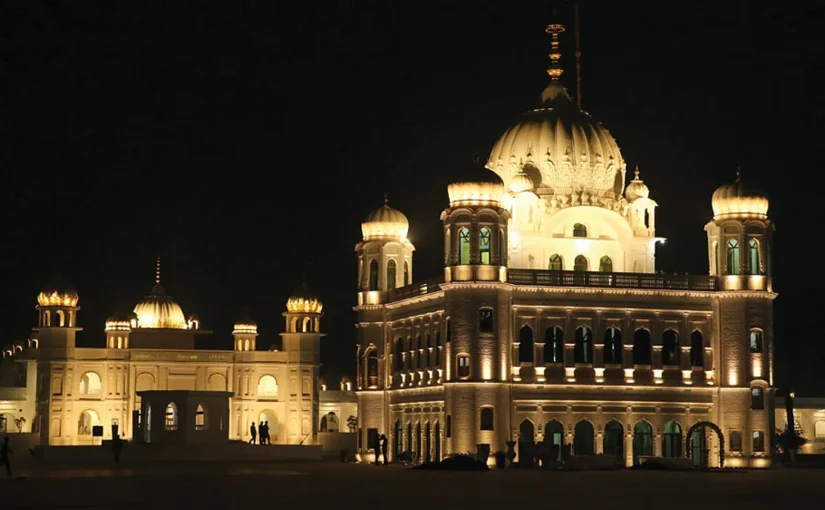
- Gurdwara Darbar Sahib, Kartarpur (where Guru Nanak spent his final eighteen years and died in 1539)
- Gurdwara Panja Sahib, Hasan Abdal
- Gurdwara Dera Sahib, Lahore (martyrdom site of Guru Arjan, 1606)
- Gurdwara Rori Sahib, Eminabad
- Gurdwara Sacha Sauda, Farooqabad
Every site tied to Guru Nanak’s own life sits inside Pakistan. That is the founder geography.
The India-side Holy Sites
- Harmandir Sahib, Amritsar (the Golden Temple, the spiritual centre of the Panth)
- Akal Takht, Amritsar (the first and highest of the Five Takhts)
- Takht Sri Patna Sahib, Bihar (birthplace of Guru Gobind Singh)
- Takht Sri Kesgarh Sahib, Anandpur (founding of the Khalsa, 1699)
- Takht Sri Hazur Sahib, Nanded (cremation site of Guru Gobind Singh)
- Takht Sri Damdama Sahib, Talwandi Sabo
- Gurdwara Bangla Sahib, Delhi
- Gurdwara Sis Ganj Sahib, Delhi (martyrdom site of Guru Tegh Bahadur)
Every Takht, the entire seat of institutional Sikh authority, sits in India. That is the institutional geography.
Both claims resolve
The life of the founder runs across Pakistani soil from birth to death. The living architecture of the Panth, its temples of sovereignty and its mother shrine, sits in India. Neither reading is false. They are counting different things.
The Bahá’í parallel
The Bahá’í Faith shows the same structure in sharper relief. The founder sites sit in Iran: the House of the Báb in Shiraz, the Síyáh-Chál of Tehran where Bahá’u’lláh received his revelation, the family homes across Mazandaran. Each is a pilgrimage site. The institutional sites sit in the Holy Land: the Shrine of the Báb on Mount Carmel, the Shrine of Bahá’u’lláh at Bahjí near Acre, the Universal House of Justice in Haifa. Each is also a pilgrimage site. Both geographies are sacred. Yet the Holy Land matters more than the cradle. In a strange way the Faith needs Haifa more than it needs Shiraz just as the Roman Catholic Church needs Vatican more than Jerusalem.
The House of the Báb in Shiraz was demolished by Revolutionary Guards in September 1979, paved over, and the site converted first into a public square and later into a road. It was the single most sacred site in Iranian Bahá’í geography. Its destruction did not end the Faith. The pulse had already moved to Mount Carmel.
The deeper argument
Founder sites are irreplaceable in sentiment. Institutional sites are irreplaceable in function. A religion can survive the loss of its founder sites. It cannot survive the loss of its institutional sites, because institutions are what transmit the tradition across generations. The Sikhs kept the Akal Takht. That is why the Panth remains coherent despite losing Nankana. The Bahá’ís kept Haifa. That is why the Faith remains coherent despite losing Shiraz.
The Kartarpur Corridor
The visa-free bridge from the Indian border to Gurdwara Darbar Sahib was finally inaugurated in November 2019, more than seventy years after Partition. It operated through the pandemic, through diplomatic chills, through successive Pakistani governments. It was closed, by the Indian government, in the wake of Operation Sindoor in 2025. A corridor that took half a century to build took weeks to shut. The founder site is once again out of reach, visible through the binoculars the Indian government installed at the border.
The puzzle of Sikh consent
Given that partition cost the Sikhs their founder geography, why did the Sikh leadership consent to it? Master Tara Singh unsheathed his kirpan outside the Punjab Assembly in March 1947 and led the Akali Dal into the partition camp. The calculation was political survival against sacred geography, and political survival won. The Sikhs feared Muslim-majority rule in a united Punjab more than they feared losing Nankana. They traded Nankana for the Akal Takht. It was a rational trade. It was also a tragic one. They kept the pulse of the religion and lost its cradle.
The Confederation that never was
Here is the counterfactual the subcontinent refuses to examine. Partition was not the only way to resolve 1947. A confederated India, organised into cultural and linguistic zones rather than two warring states, could have preserved every sacred geography across the board.
The zones write themselves from the map:
- Zone A: Greater Indus, stretching from the Khyber potentially to Delhi, anchored on Lahore and Karachi
- Zone B: Hindustan proper, the Gangetic heartland
- Zone C: Greater Bengal, centred on Calcutta and Dhaka
- Zone D: A Dravidian south, anchored on Madras
Extend the logic outward and the confederation could have drawn in Afghanistan, Nepal, Sri Lanka, Myanmar, the Maldives, and Mauritius. A subcontinental bloc stretching from Kabul to Yangon would have been a hyperpower nothing could deconstruct.
The Brits failed at this. So did Congress. So did the Muslim League. Everyone wanted unilateral power. No one was a visionary. Jinnah wanted a sovereign Pakistan. Nehru wanted a centralised India. Mountbatten wanted a quick exit. None of them imagined a structure that could hold Nankana Sahib and Harmandir Sahib inside the same polity while still granting Muslims, Hindus, Sikhs, and everyone else genuine self-governance over their own cultural and religious space.
This is the genius of the Jambudvīpa idea, and of Dharma more broadly. The Indic civilisational tradition has always understood that the subcontinent is not one thing but a federation of things. Bengal is not Punjab. Tamil Nadu is not Gujarat. Sindh is not Kashmir. Each has its own language, its own saints, its own temperament. A confederation that recognised this, granted each zone real autonomy over its own religious and cultural life, and pooled sovereignty only for defence, currency, and external relations would have given every community the one thing 1947 actually denied them: the freedom to be themselves inside a structure too large to fail.
Instead the subcontinent got two states, three wars, a bomb on each side, and a Kartarpur Corridor that opens and closes with the weather of the relationship.
Closing
The wish that Punjabi Muslims claim Guru Nanak as shared heritage is worth supporting. Nanak’s teaching that there is neither Hindu nor Muslim was not sectarian diplomacy. It was a theological claim about the singular source of God. A Punjab on either side of the Wagah that could hold that claim would be closer to what Nanak actually taught, and closer to the confederal Jambudvīpa that 1947 destroyed.
Until then, the binoculars remain.
1) Sikhs loosing their cradle and keeping takhts. Happens all the time.
Similar to Serbs loosing kosavo, Russians loosing Kiev, Armenians loosing van, Hindu Bengalis loosing east,mohajars loosing ajmer and nizamiddin, sodha Marwadis loosing amarkot.
2) Dravidian south cannot be anchored in madras. Well, many tamilians including some political parties are distancing from Dravidian ‘faith’. Also sadly a majority of south Indians are not willing to accept noisy Tamil overlords and not willing to be called Dravidians as the word has a narrow meaning these days.
Why would they make racist comments or derogatory comments towards Dravidians is beyond me.
We have preserved our culture, we are thriving, and we are educated. Nevertheless, there’s a lot for us to achieve.
We have a rich history, arts, poetry, and monuments to showcase, within peninsular India and thousands of miles of away.
Because of skin colour I assume.
Pakistan also has a lot of darker skinned individuals, but mostly poorer/lower caste hence there is a mental association of superiority.
Not only are Dravidians the best off in South Asia and have a really bright future (Will be the first part of South Asia to become “first world” they have also had a far glorious past than what is Pakistan).
The Indo-Islamic culture that Pakistan claims is 85-90% within India.
And to cap it off, Dravidians are the most friendly people towards Pakistan with no specific animus towards them.
Pictured: Pakistani Christian cricketer Yousuf Youhana of the chuhra caste. He later converted to Islam. Probably the greatest Dalit cricketer.
It’s not about color, it’s more of a reaction against your constant obsession and vilification of Pakistanis and the repeated insults against our identity and country. It’s the fact you can dish it but can’t take it and this is a common pattern across social media platforms when Pakistanis do react in kind.
Nuh-uh, don’t lie.
Why Dravidian though? Why not something like Bihari? Biharis are the poorest and most backward community in India.
Is it because of plenty of Biharis in your own country, including ones controlling the financial capital of Karachi?
Are you one too?
Bihari control financial capital in Khi? Memons?
Just Mohajirs in general.
Muhajirs are more white collar. It’s memons who dominate business in Pakistan. Whether it’s the new owners of PIA or the various media houses in Pakistan.
Memons are also Muhajirs, just Gujarati ones instead of from UP/Bihar.
Most of them don’t identify as such and Sindhi nationalists don’t exactly consider them muhajirs as their ancestral roots go back to Sindh.
Memons identify as Muhajirs (and still do) in opposition to Sindhis and others. But since they are not urdu speakers, they also don’t fit perfectly, but because they are urban, they are still culturally more aligned with Muhajirs than Sindhis.
Yeah I guess it’s more nuanced.
Karachi’s financial sector is dominated by Memons and some other ethnic groups I won’t name for national security reasons.
Why Dravidian though? Why not something like Bihari? Biharis are the poorest and most backward community in India.
There isn’t a lot of them on the internet and majority of the hate we’ve detected on Pakistani forums and social media spaces traces back to southern India or the south Indian diaspora in America. There’s a lot of evidence for this and a topic of conversation within the community. They use messaging services like whatsapp and telegram to coordinate disinfo campaigns and brigade Pakistani online spaces.
This isn’t racist, it’s just a data-driven observation.
There are a lot of Biharis on the internet especially X and they are at the forefront of online Hindutva and Pakistani hate. eg HindutvaKnight etc.
This isn’t the 2010s anymore.
All Biharis have internet due to Jio.
Maybe but not to the extent of south Indians. They don’t do it as a hobby, a lot of major tech companies and “body shop” consultancies have online troll farms and disinfo teams, they make their employees post nationalist propaganda and anti-Pakistani, islamophobic content, which does violate their visa. Most of the internet traffic on Pakistani websites and online spaces comes from India and that too, mostly from southern India.
South Indian IP address says nothing about personnel at whatever info war consultancy shop is putting out the content. Same with the Kolkata scam centers, nary a bengali in sight
Respectfully, I need numbers! How do you even track these ?
skin color, urdu pronunciation, and ‘bad’ English/ accent are common Pakistani dog-whistles on bigotry aimed at Indians, and not just Hindus.
The delusion and bigotry go together. The feigned superiority is a common symptom of an inferiority complex.
Pakistanis have even worse English though.
“Boys played well” is a common joke in cricketing circles.
I don’t think bragging about accents or ‘English’ is a “win” for either party. It just betrays an immature mindset.
It’s a joke only among Indian circles stemming from Inzamam’s use of that phrase.
Indian circles ARE cricketing circles.
Check out r/cricket lol.
That sub is like 80% Indian
Exactly.
Indian circles ARE cricketing circles.
Which makes them just Indian. The “running joke” is just regular Indian bigotry against Pakistanis.
Inzamam and “running” is another joke in itself. 😂
Good batsman though. Scored plenty of runs against us.
Unlike the current day crop of “King”, “No Look” etc.
>skin color, urdu pronunciation, and ‘bad’ English/ accent
Indians are extremely sensitive about all these three, and Pakistanis have picked it up on it.
I remember vaguely when the opening match of the 2011 was played between India and Bangladesh in Dhaka, I was in an Indian group. The amount of racist and vile comments against Bengali women passed on by Indians whenever the camera panned into the Dhaka crowd was shocking, because funnily enough these same guys had opposite reaction when the camera panned into the Pakistani crowd in another match in the same tournament. We know your dirty secrets dude.. and from the trends on X, it appears that even the whites are now catching onto it.
Bad Urdu & English pronounication is just a low hanging fruit, most Indians speak these langauges pretty confidently but they speak it improperly, it’s just lunch for the bullies.
Yeah there’s a lot of racism towards Bengalis and Sri Lankans from Indians and towards other Indians. Even now the nasty stuff heard from Indians about Bangladeshis is insane, like the slurs they came up with – I’ve never heard a Pakistani ever say that. They really look down on Bangladeshis. As for Sri Lankans, I remember back in school there were a lot of Indians (mostly south Indians) in my class and they would make fun of the darker skin ones in their group as “Sri Lankan” even though there’s really no discernible difference but they do have this superiority complex against Bangladeshis and Sri Lankans.
Ironically the most racist stuff I’ve heard about south Indians has come from North Indians in America (mostly Gujaratis, Punjabi Sikhs and Indian Bengalis), for some reason they think I’d approve of what they’re saying as a Pakistani but I don’t have an interest in India’s internal dynamics.
I mean Sri Lanka had a massive civil war between Tamils and Sinhalese groups, which naturally affected Tamil groups in India. So poor opinion between the two groups don’t exist out of place. In terms of Bangladesh, they share a border with India that naturally causes geopolitical issues which gradually bleeds over into racial conflicts in digital (and real) world space, where both groups throw slurs at each other. Pakistan doesn’t have a similar relationship with Bangladesh anymore after the split in 1971 (from my perspective).
For the part about North Indians, well most western migrants from India tend to be come from privileged backgrounds (upper caste, rich or high middle income, more educated etc.), which ironically represent the core base for conservative politics/ideas a lot more often (Kash Patel is a example). This might not always be the case. Also, dynamics in western countries are different from the motherland since western notions of “race” shapes people views on cultural identity.
A point that worth mentioning is the “In group/Out group” Dynamics. Pakistanis and Bangladeshis share a religious in-group to bond over, South Indians and north Indians share a common religious identity as well as complex cultural relations over 3000 years. South Indians don’t share anything with Pakistanis or Bangladeshis, hence they act as the Out group. In addition to fact that both groups come from a foreign country, foreign race and different religions (or sects) on top of poor geopolitical relations naturally worsens opinion.
As a final note, I should point out that the urban middle class acts as a core base for modern day BJP. In simpler terms, if you are interacting with Indians over the internet, there is nice chance that your taking with the BJP’s core voter base (who hold similar opinions). Most people external to this base (rural populous, South Indians to an extent, working class etc.) generally tend to cluster around spaces that use vernacular language (does include “standard” Hindi or Urdu, think Bhojpuri/Tamil) or cultural spaces that cater specific regional social/political/economic issues. For example, my parents speak Malayalam as their mother tongues in addition to Arabic, Hindi and vaguely understanding of Tamil (especially western dialects). They only interact with online material in their mother tongues often ignoring content in other languages.
So you are a cricket fan and lived through Mohali. 😆
you are…extrapolating about a 1.5 billion folks based on an hour spent with sports fans 15 years ago. That’s……silly and I’m being very polite.
Fun fact:
I was in college at that time and had stopped watching cricket by 2007. The only cricket I had seen was the final two overs of the 07 T20 WC final (Misbah scoop) and that too due to my family’s shouting in the TV room.
So I was aware of the 2011 WC happening but didn’t pay any heed. During the day of the QF vs Australia I was in my hostel room chilling while I heard lots of shouting from an adjacent room where all the guys were hanging out.
So I just went to watch and saw Ponting and Lee, the nemeses of my childhood. Watched the tense chase post which some of the guys started chanting a Pakistan centric chant with some abuses. That’s when I realized the semi was with Pakistan.
Watched the entire Pakistan match with the guys this time and it was a great match. Was quite tense. At no point was Pakistan ever ahead but it veered between India ahead and even. I think Yuvraj taking those two wickets in succession was when I breathed a sigh of relief.
Was a great comeback to cricket.
Even my cricket watching experience started with that Pakistan match in the 03 WC. Insane Sachin innings.
Wonder what the breakdown will look like if you do the sites of the Indo-Islamic culture that Pakistanis claim.
Almost all of the major palaces, capitals, tombs, monuments etc are within India whether they are from the Delhi Sultanate era, the Mughal era or the later Nizam/Nawab era.
Lahore is the only site with a few major Mughal monuments.
A similar sites division of the Sikh Empire and the IVC will be far more favourable to Pakistan imo.
I dont think one should put Nehru in the same bracket as Jinnah or Mountbatten.
He would have loved to have a confederated united India from Pedhawar to Chhitagong and Ladakh to Kanyakumari. Not so much the other two and the ML.
And imo, a string center is a necessity especially given the place we are in. Being surrounded by china, russia and American empires makes having a strong center necessary.
The tragedy of the last century is that trust and empathy could not be established amongst the different communities mostly due to some elites wanting domination above all.
For the record, Quaid-e-Azam accepted the Cabinet Mission Plan– which was basically a confederated united India. Pandit Nehru initially accepted it but then said that it could be renegotiated in ten years. This was the last straw for Quaid-e-Azam and led to Direct Action Day.
So it is historically incorrect to state that Pandit Nehru did not want a centralized Indian nation-state with himself as PM.
If Pandit Nehru had accepted Gandhi ji’s suggestion (perhaps this is an apocryphal story) that Quaid-e-Azam should become the first PM of independent India, perhaps there would have been no Pakistan.
Don’t get me wrong. I’m immensely grateful that the Pakistani nation-state exists as a sovereign entity. But it was not inevitable.
//If Pandit Nehru had accepted Gandhi ji’s suggestion (perhaps this is an apocryphal story) that Quaid-e-Azam should become the first PM of independent India, perhaps there would have been no Pakistan.//
I dont think it was the PM seat thst hr wanted but he basically wanted a turbo charged version of the communal award. With a larger than the share of population at the time ,number of seats be reserved for muslims, greater freedom given to muslim in managing the areas they are predominant in and some others that basically made muslims a privileged minority completely seperate from the rest of the population.
While, overt hindu orientation of congress and numerical dominance can be blamed for a large section of muslims turning away from the idea of a united India, we should also consider the intellectual trends of revivalism and separating from Indian roots that when combined with british divide and rule created a culture that could not fathom living under a country as equals with people of other religions. The congress and particularly Nehru and Gandhi, failed to recognize and confront this kind of psychosis and sadly Jinnah despite his liberal ways, did not seem to be able to transcend his cultural identity.
As I said, perhaps it is an apocryphal story. But the Quaid would have probably have accepted being Prime Minister of “undivided” India. A Muslim PM would have been enough of a safeguard against “Hindu Raj”.
The Quaid was basically a lawyer fighting his client’s case. His client was the Muslim community (or at least a substantial section of it).
Nehru was a good man even if a bit idealistic and naive.
Jinnah was pure evil. Anyone who advocates for “Direct Action Day” cannot be called anything other than that.
“The first terrorist” one could say.
This is an absurd and ridiculous comment.
@XTM:
BB just made a comment calling Qauid-e-Azam “pure evil”
https://www.brownpundits.com/2026/04/20/founder-sites-and-institutional-sites-a-note-on-sikh-sacred-geography/#comment-132181
Not only is this historically inaccurate but it is also triggering to Pakistanis.
Indian nationalists need to introspect about why someone who was known as “the ambassador of Hindu-Muslim unity” became the father of Pakistan.
@XTM: Replying to this as it is referring me.
Pakistanis cannot expect a figure who instigated violence which led to massive loss of Indian lives (both Hindu and Muslim) to be seen positively by Indians.
He might be the “Qaid-e-Azam” for Pakistan but not India.
Indians have their own opinions on him and should be freely allowed to express it, even if it is “triggering” to Pakistanis.
Vice versa, I along with many Pakistanis hold the same view about Nehru and other Indian founding fathers.
Okay.
Pandit Nehru was not “pure evil” either. This is an a-historical point of view.
With all due respect, you don’t need to be the mirror image of BB.
@XTM;
I addressed my comment to you and not to him. BB is violating the rule by responding to me.
@BB:
Calling someone “pure evil” is hyperbolic. You simply reveal your lack of understanding of History. Please cite some sources. What books have you read? Perhaps start with Sam Dalrymple’s “Shattered Lands”.
Quaid-e-Azam was not Hitler.
The Dalrymples aren’t the gold standard of Indian historiography by any means – they have been called out for bias and selective reading of history including on this forum before. Any serious history department in any decent liberal arts college knows better than to take either of them seriously.
I have read a handful of books on Independence and Partition – Penderel Moon, Stanley Wolpert and NS Sarila’s books are probably the best. For those not so inclined, the podcast on Partition by Conflicted History is perhaps the most balanced take I’ve seen so far.
Jinnah may be a national hero in Pakistan (and rightly so from a Pakistani pov) but he has the blood of thousands on his hands which cannot be washed away – and mind you this is not the looking the other way while his party’s goons ran riot but rather a deliberate call to action to slaughter non-Muslims. Therefore, from an Indian perspective it is completely reasonable to view him as an egotistical, tactical evil genius who didn’t foresee the 2nd order effects of his demands and actions and caused unimaginable suffering.
My limited point was regarding the phrase “pure evil”. This is a-historical and triggering.
Sam Dalrymple may not be the “gold standard of Indian historiography” but his book is recent and relatively accessible.
One can also read Maulana Azad’s “India Wins Freedom” (Orient Longman 1988). Maulana Azad was a member of the Congress and as such certainly not uncritical of the Quaid-e-Azam.
Your characterization of the Quaid as an “egotistical, tactical evil genius” is also a-historical.
I absolutely understand that Indians are taught in school that the Partition happened only because of the Muslim League. This is a-historical but that’s what Indian nationalism teaches.
However, one hopes that when people grow up they are able to examine such things academically.
The Quaid was not Hitler. He wasn’t sending people to gas chambers.
Your characterization of the Quaid as an “egotistical, tactical evil genius” is also a-historical.
Direct Action Day is literally a historically recorded event? There is no equivalence there. The mass killings were started by the Muslim League.
I’m not defending Direct Action Day.
My limited point is that calling a historical figure an “evil genius” is a caricature. This is not good academic practice.
Exactly.
yes we had an exchange with Sam Dalrymple; very sloppy.
was Direct Action day a call to violence or a strike?
You know to email in.
I wasn’t calling for the comment to be deleted.
I was just calling it out for the absurdity that it is (as you also noted)
BB you email constantly asking for revisions; you can email it in.
Next time you reply to Kabir, in any circumstance. We will remove all your comments and revoke your Authorship.
Stop playing games, calling the QeA pure evil is simply provocative and completely untrue.
You are crossing the line once again.
Will email any such communication next time.
As far as Jinnah is concerned, he might be a hero from the Pakistani perspective but from the Indian perspective he is “evil” in the sense that he caused communal violence which affected Indians – both Hindu and Muslim.
Pakistanis have a similar perspective towards the much loved in India Modi for his role in the 2002 riots with people on this site calling him the “Butcher of Gujarat” as well.
And in a way, those two events aren’t even equivalent because no Pakistani was hurt in 2002 – that was a local issue unlike Direct Action Day.
If Jinnah cannot be called “evil”, then I think a precedent should be set that such labels are not used for Modi too and he be referred to in a neutral manner on this site by Pakistani posters if they do refer to him.
Nehru and his ilk on the other hand don’t have blood on their hands.
this is rejected | you are welcome to write a post on this.
Kabir, we will be ignoring any requests made in forum. Email it in.
[…] Bombay Badshah on Founder Sites and Institutional Sites: A Note on Sikh Sacred Geography […]
I have written a rebuttal of BB’s comment calling the Quaid “pure evil”.
As far as PM Modi is concerned, show me a single comment I have made where I labelled him “pure evil”? I’m no fan of his but I understand that no historical figure or politician is “pure evil”.
I will take issue with the phrase “Gujarat riots”. They were not “riots” but pogroms.
The point is that any discussion of serious historical events like Partition demands nuance.
The following is a cut and paste from a facebook post by ch.abbas grewal.
Probably his sons converted. The comments were interesting, not all were hostile.
—–@——–@———-
Our great-grandfather, Sardar Balwant Singh Grewal, earned his Bar-at-Law from Lincoln’s Inn, London, alongside Pandit Jawaharlal Nehru, who later became the first Prime Minister of India. His distinguished legacy is referenced, and his photograph appears in The Sikhs in Britain by Peter Bance, preserving a remarkable chapter of our famil
y history and heritage for future generations.
It was nissar abbas grewal ‘s post . Some commentators were amazed that a Sikh grewal converted, as these were affluent landlords. Others said that not all conversions were due to force and not all were poor.
One commentator recognized that the Pakistani Punjabi ruling and military elite were converted khetris and jats.
Are there mazhabi (dalit) sikhs still in Pakistan Punjab?
Yes a ton of wealthy Sikhs & Hindus probably converted during Partition to keep their lands and properties.
However also Jat names are replicated among all three but especially between Muslim & Sikh Jats in West Punjab.
Funny story.
In a cricket match where Shubman Gill was smacking around Shaheen Afridi, a Pakistani Punjabi nationalist on X tweeted “Jatt 1 – Pathan 0” or something of that sort.
As a half Garhwali and half Jat, I find this extremely funny.
lol
the reason why Confederation idea was a non starter back in 40s and even now is same. Greater Indus and Greater Bengal would/will first cleanse Hindus in those areas before moving to Gangetic Hindustan and eventually Peninsular and South India. The 1950 constitution of India is a hodge-podge of federalist and unitary impulses because it was drafted in the aftermath of Direct Action Day and Post Partition violence. Despite this the modern Indian state was not able to prevent Kashmiri Pandit cleansing. The only possibility for this idea is when Pakistan and Bangladesh have a sizable and flourishing (economically) Hindu minority (a modern version of 50s hostage theory).
Also both of the confederations formed in the 20th century in Yugoslavia and USSR are dead with the constituents fighting against each other for territory with wars spanning years.
India and Pakistan have fought for a cumulative total of less than a year in 75+ years and there has been minimal change in territory since 48 (at least to each other).
India kept some villages in Kargil in 71 and took Siachen in 84.
That is the only instance of land changing hands between the two.
Also X.T.M I feel is a bit romantic about the power a unified India would possess.
Thing is, India isn’t doing so bad.
India already is 80-85% of the economy of the three countries combined and considering Pakistan’s anemic growth rates will be 90-95% by mid century.
Like people used to say back in the day – If we were one country, we would have both Sachin and Wasim.
But it’s 2026 now – India already has both Kohli and Bumrah.
touché
Couldn’t but agree more with you. Every time I have run the counter-factual in my head, it comes down to the situation you described above. A loosely held confederation would’ve led to completion of the Pakistan project with the subcontinental Prussia all but wiping out native culture across the whole subcontinent.
Interestingly, I think a lot of the blame for this can also be apportioned to the Brits. The constitution of British Indian Army was not so much in favour of Muslims prior to 1857. The martial race theory was then implemented to arm groups that were seen as more favourably disposed towards the empire. For all his faults, Savarkar did foresee this well before partition and encouraged Hindus across castes to join the armed forces.
Not really – Yugoslavia collapsed because the Catholics left not because of the Muslims
Umm nowhere did I compare with Yugoslavia?
[…] Founder Sites and Institutional Sites: A Note on Sikh Sacred Geography April 20, 2026 […]