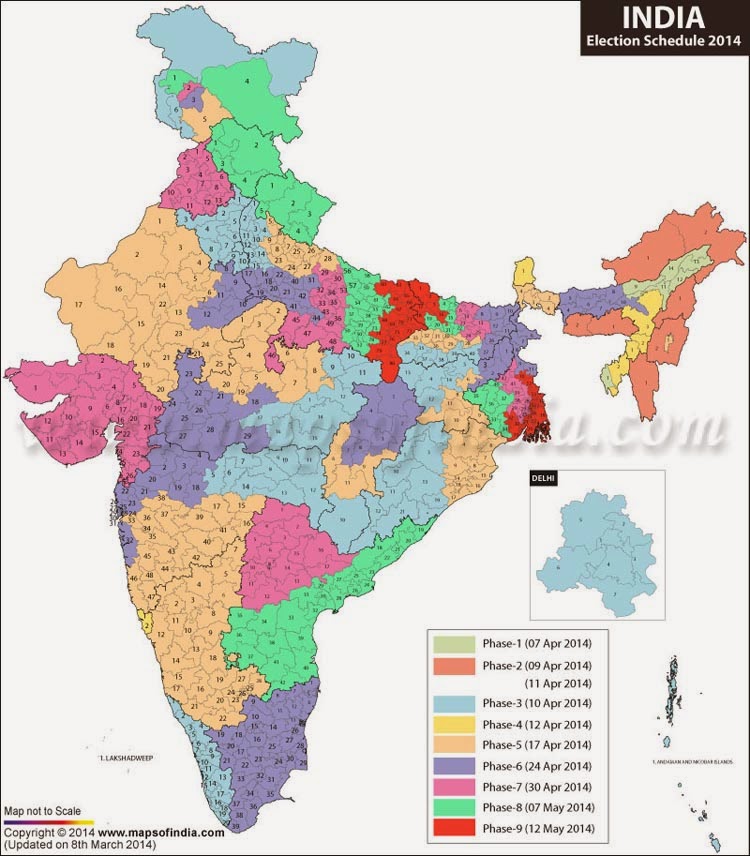
Mother of all ballots (180 mil, 117 seats, 04/24)

Tomorrow is a most  crucial day for the republic.
If you are one of the 180 million voters who plan to exercise their responsibilities as citizens, please pay attention to this last minute message (see below) from a (Christian) Father (Fraser Mascarenhas, Principal, St Xaviers College, Mumbai) to his (mostly Hindu) students.

An interesting point that needs highlighting, is the difference between Muslims and Christians in their attitude to Modi. Amongst the activists and intellectuals (Mascarenhas included) there is of course complete unanimity, an united wall against the Great Satan. 

However at the community level there are stark differences. The upper-caste Kerala Christians (Syrians) are publicly backing Modi (votes not so much), so are a large section of Goan Christians (votes will make a difference). There is no (apparent) solidarity with tribal, dalit Christians who may face an onslaught from Hindutva forces post elections. 

In contrast, the only muslims who will be freely voting for Modi are the Bohras of Gujarat/Maharashtra and the Shias in Uttar Pradesh. The Bohras are businessmen and are voting based on caste interests (as opposed to the interests of the Ummah), while Shias will vote due to their grievances against Sunnis (there is no Ummah).  


……
The
Bharatiya Janata Party (BJP) on Wednesday lampooned St Xavier’s College
principal, Frazer Mascarenhas, for writing a message to his students
criticizing the Gujarat development model and praising the flagship
schemes of Congress-led UPA government.


Mascarenhas has apparently written a message to his student saying,
“All the Human Development Index indicators and the cultural
polarization of the population show that Gujarat has had a terrible
experience in the last ten years.”

“As opposed to this, efforts
like the Rojgar Yojana and the Food Security Act have been called
“election sops”. However, some of our best social scientists like
Amartya Sen and Jean Dreze have supported these as necessary in the
emergency economic situation the country and the world is facing.” . “The
country is grateful that committed activists like Aruna Roy and Shailesh
Gandhi have worked with the government to initiate and sustain the
Right to Information Act which makes accountability possible. Corruption
still needs to be addressed effectively, but since it is so prevalent
at every level of society, it will take civil society long agonizing
efforts to root it out,” he further stated.

……

Lashing
out at the principal of St Xavier’s College Mumbai for his
controversial advisory to students which is critical of Narendra Modi’s
‘Gujarat Model’ of development, BJP on Wednesday complained to the
Election Commission.

Demanding an ‘immediate withdrawal of the
statement’ issued by Father Frazer Mascarenhas, BJP alleged that the
principal’s email to students is a violation of model code of conduct.

In its letter to the Election Commission, BJP wrote, “Xaviers is a go ..

A letter addressed to students by Father Frazer Mascarenhas, principal
of St Xavier’s College, criticising the Gujarat model of development
triggered a storm with strong reactions coming in from across the
spectrum. The BJP filed a complaint on Wednesday with the Election
Commission against him saying that the letter which was published on the
college website violated the model code of conduct because the college
is government-aided.


In his letter which does not directly name any individual or political
party, Father Mascarenhas’ urged students to “choose well” and exercise a
“reasoned choice of individuals and political parties who promise to
work for a real quality of life”. The letter speaks about the poor human
development indicators in Gujarat, including education and rights of
the tribals. “So what lessons does a reflection on the approaching
elections teach us? The prospect of an alliance of corporate capital and
communal forces coming to power constitutes a real threat to the future
of our secular democracy,” his letter read.


Prominent alumni from St Xavier’s college also joined the debate.
Theatre personality Alyque Padamse said: “This is a democracy. People
have a right to air their views.” Former Attorney General of India Soli
Sorabjee, while saying that Mascarenhas had not misused his position as
principal, he should have refrained from making a public statement. “St
Xavier’s College has been an institution which has been aplolitical. It
shouldn’t dabble in politics.


At St Xavier’s College, many students supported their principal. TYBA
student Rujuta Sabnis said that there was nothing wrong in what he had
done. “It’s good that he’s making sure we’re getting the right
information. Anyway, everything he has said is true,” she said.


However, some others were not impressed. “While I love Father
Mascarenhas mostly and what he teaches us, I feel this is a way to
influence students by using his authority. I am not a first-time voter
but there are many in my college who are. The letter does not make a
difference to me as I have already made up my mind but it could
influence many others,” said an MSc student who did not want her
identity to be disclosed.


…….
Link: http://www.thehindu.com/news/cities/mumbai/bjp-moves-ec-against-st-xaviers-principal/article5940394.ece
…..
regards

Animist Army vs. Christian Crusaders

The Church had sinned by engaging in a spot of idolatry (blasphemy??) by portraying Mother Mary as a tribal lady with Baby Jesus in a sling. The Animists are not prepared to take this outrage lying down and now a (century old) fight is reaching its Waterloo phase. With the fading of the Catholic-Parsi-Brahmin First Family of India from the scene the Christians will have a tough time (post elections) in keeping their ranks united and their flanks protected.

…..

Two months before polling began in Jharkhand, Ajay Tirkey began dividing
his day between campaigning for the Bharatiya Janata Party in Ranchi
and attending to his real estate business. Mr. Tirkey, who heads the
Central Sarna Committee(CSC), with lakhs of animistic Sarna tribals as members in urban parts of Ranchi, Gumla and Hazaribagh,
believes that the BJP’s Narendra Modi will get the community what it
has been demanding for decades: the distinction of being a minority
religion with all attendant benefits.
“We submitted a memorandum to Modi
in December to introduce a Sarna code in the census, and [the] BJP’s
State leaders agreed,” he says.


Mr. Tirkey owns the commercial
complex we are sitting in. “This is a century-old fight. I have not let
the Christians get away with conversions since I became the head in
2000,” he says. “We broke the walls of a church in Tape in Ormanjhi
while it was being constructed. There was a case of conversion of five
families in Ghagrajala village in Ranchi; we re-converted three. Then a
few families in Gaitalsud, Angada, of whom only one member escaped
because he worked somewhere else. He has not come back since; he fears
us,” he recounts, beaming.


Mr. Tirkey, the BJP’s mayoral candidate from Ranchi in 2013, describes the “re-conversion” ceremonies as being similar to the ghar-waapsi (homecoming)
ceremonies conducted by BJP leader Dilip Singh Judeo in Chhattisgarh,
in the mid-2000s. Mr. Judeo used to wash the feet of the converted
person with holy water and declare the person Hindu again. Sarnas, Mr.
Tirkey says, besides washing feet, made the converted person taste a
drop of blood of a freshly sacrificed rooster and sprinkled water on
them. A member of the Rashtriya Swayamsewak Sangh’s Vanvasi Kalyan
Ashram (VKA) or Dharam Jagran usually accompanied CSC members for this
ceremony, he says. Sitting by Mr. Tirkey’s side, Manoj Kumar, a member
of the BJP’s Jharkhand Kisan Morcha Pradesh Samiti, nods in agreement.


In the last century, religious conversions in the Chotanagpur region
have led to tensions. The first missionaries to arrive were the German
Protestants in 1845, followed by the Catholics. The rift between
Christian and non-Christian tribals was visible in 1947-48. Concerned
with the growing influence of Christians, Sarna leaders formed a ‘Sudhar
Sabha,’ notes academic Dr. Alex Ekka in an essay on the Jharkhand
movement.


The former captain of the Indian hockey team, Jaipal Singh Munda, is
credited with getting equal rights including reservations for Christian
tribals, as a member of the Constituent Assembly. A few Sarna leaders
opposed this move then. Congress MP Kartik Oraon introduced a bill in
Parliament in 1968 to de-schedule Christian tribals, albeit
unsuccessfully.


The Jan Sangh and the RSS began making inroads in the Chotanagpur region
in the 1960s, initiating developmental activities in forest villages to
counter the growing reach of Christian missionaries. While the VKA
already has a strong presence in the Gumla and Latehar districts of West
Jharkhand, more recently it has focused on increasing its influence in
Sahebganj and Pakur along the State’s border with West Bengal, close to
Bangladesh. Both districts feature in a map of areas from Uttar Pradesh
to the north-east as “Areas of high Muslim and Christian influence” in a
publication by Sankat Mochan Ashram, New Delhi.


“The church was trying to proselytize in Pakur but slowed down after we increased our presence. We recently performed ghar-waapsi
for 50 families there. Sarna groups are doing re-conversions themselves
now; we prefer it this way. We explain to them that 2000 years ago, we
worshipped trees. Sarnas are Hindu too,” says Prakash Kamat, the
Bihar-Jharkhand zonal secretary of the VKA.


Tribals constitute 26.3 per cent of Jharkhand’s population. According to
the 2001 Census, of the State’s population of 3.29 crore, 68.5 per cent
are Hindus and 13.8 per cent are Muslims. Only four per cent follow
Christianity. Though Sarnas, who worship their ancestors and nature, are
not counted separately, they make up most of the ‘Other’ category,
estimated at 11 to 13 per cent of the population. Sarna groups claim
that the actual numbers may be higher, given the absence of a separate
category for them. A common perception is that despite their small
numbers, Christian tribals have better access to higher education and
jobs. Whether due to economic disparities or the stoking of enmities by
different religious groups, the chasm between Sarna and Christian
tribals has widened.


The most stark instance of this was in 2013 when a spate of protests
erupted in Ranchi soon after the Cardinal Telesphore Toppo unveiled the
statue of a “tribal” Mary — a dark-skinned Mother Mary wearing a white
and red saree and bangles, holding an infant Jesus in a sling, as is
common among tribal women. Sarna dharamguru Bandhan Tigga,
considered more moderate than Ajay Tirkey’s group, gave the Church three
months to remove the statue, describing it as a conversion tactic. In
August, over 3,000 Sarna tribals marched to the site, a small Catholic
church in Singpur on Ranchi’s outskirts, threatening to bring it down.
 

The police imposed Section 144 of the Indian Penal Code in the area to
stop the protesters. Three days later, a FIR was registered against
members of Sarna groups after they threatened families in Ormanjhi, 50
km from Singpur, who had converted to Protestantism several years ago,
to re-convert to Sarna religion within a week, even breaking the gate of
the house of one of the families.


Sources close to the Cardinal claim he had not known that the statue was
that of a “tribal” Mary before he reached the parish for the
inauguration, but have chosen to stay silent, fearing that a step back
now may only weaken the church’s position. Before this, in 2008, the
church was on the back foot when Sarna groups questioned the ‘Nemha
Bible’ published by a Lutheran church in the tribal language, Kuduk,
which they said contained portions offensive to animistic worship.


In Singpur, the residents still recount last year’s protests cautiously.
“Thousands marched from Dhurva to the parish. While the march had been
called by Sarna groups, several Bajrang Dal members wearing saffron
bands marched with them. Even tribals from neighbouring Odisha,
Chhattisgarh districts reached here,” recalled a member of the
community. It was done by evoking Sarnas’ pride, say Dharam Jagran
members.

…..
Link: http://www.thehindu.com/opinion/op-ed/tribals-torn-apart-by-religion/article5934381.ece
…..
regards

Nirvana-stan welcomes you (arrive, inspect, deport)

The scriptures famously refer to the soul-awakening impact of sickness, old age, and death on the young, impressionable prince Siddhartha Gautama. There is no command that we know of which forbids graven images of the Lord. The tattoo (below) does not look disrespectful, but we defer to the faithful on that account.

This event should be viewed as part and parcel of the learning process for faith-led communities around the world  as they scramble to secure their own pure (infidel-free) fiefdoms. The initial spark (usually lit by Islam envy) eventually becomes a raging fire that consumes the believer, non-believer and the dis-believer alike. Blasphemy and apostasy are used by opportunists to terrorize the innocent. The road to Hell is indeed paved with good sentiments (hurting others’ religious feelings).

…….
A British tourist is to be deported from Sri Lanka because of a tattoo of Buddha on her arm.


Sri
Lankan police said Naomi Coleman, 37, was arrested at Bandaranaike
international airport in the capital, Colombo, after she arrived from
India.

A police spokesman said she was arrested for “hurting
others’ religious feelings” after the tattoo of Buddha seated on a lotus
flower was spotted on her right arm.

Buddhism is the religion of the country’s majority ethnic Sinhalese, and Buddhist tattoos are seen as culturally insensitive.

Coleman
appeared before a magistrate who ordered her deportation. The spokesman
said she was being held at an immigration detention centre and would be
removed “very soon – it could be tomorrow or the day after tomorrow”.

In March last year another Briton, Antony Ratcliffe, was reportedly deported for sporting a Buddha tattoo on his arm.
…….
Link: http://www.theguardian.com/world/2014/apr/22/sri-lanka-deports-british-tourist-buddha-tattoo
……
regards

“Muslims ought to be more communal”

This is the true face of secularism as practiced in India. If the majority community gets its constituent groups working together for a common purpose (the spirit of Hindutva so to speak) it is ipso facto bad. If the minorities do the same thing, this is an unqualified good.  

There is no sense of striving for a common bond of citizenship which rises above these petty differences for fighting against the evils of poverty, corruption, malnutrition,….

The most disappointing thing about this is the Aam Aadmi Party was supposed to be a party with a difference (also Shazia Ilmi is a highly qualified woman who should know better than to spout nonsense). If you tarnish your brand in this manner, why should the common citizen vote for you?

Days before the crucial fifth phase of Lok Sabha elections, Aam Aadmi
Party (AAP) leader Shazia Ilmi has landed into a controversy because of
her alleged “Muslims ought to be communal this time” remark.

The party distanced itself from her remark and said she should not have said it.

“Muslims are very secular. Muslims ought to be more communal. (They) do not vote for their own. (AAP leader) Arvind Kejriwal
is your own. I say, it is enough of secularism,” Ilmi, who contested
the Lok Sabha polls from Ghaziabad earlier in the month, is seen saying
in the video.

“Here helping the Congress win, there someone
else. Please do not be so secular. Muslims are secular. They will
continue to vote for others. Other parties don’t do such things?” she
said.

It is a short 1.19 minute video clip, apparently a sting
operation, where Ilmi is seen talking to Muslims. The video, believed to
be shot in Mumbai, where she had gone for campaigning for AAP’s South
Mumbai candidate Mira Sanyal, shows Ilmi talking with her head covered
with a dupatta. Mumbai goes to polls on April 24.

Ilmi, a member
of AAP’s national executive, is seen further saying “agree, this is
controversial, but this is important” in reaction to a person sitting
next to her who said “we are afraid, we have to vote”.  

The clip ends with Ilmi saying, “Kaam badal dijiye … lado aur jito (change the work. Fight and win).”
……
Link: http://www.hindustantimes.com/elections2014/state-of-the-states/shazia-ilmi-muslims-too-secular-be-communal-this-time/article1-1211024.aspx
……
regards

1984 (no justice, only insults)

We have now counted more than a hundred articles (national, international) as to why Narendra Modi should not come to power (and we mostly agree with those justifications).

However the extent to which the liberal crowd will avert their gaze to prevent an immodest look at the injustices committed against Sikhs in 1984 is something truly shameful. Has a single person even suffered one day in prison for his crimes? Why have the top people (and they are well known) gone scot-free? How is this dereliction of duty possible in a modern nation where the wheels of justice, even if slow, must turn eventually in favor of the victims? It is already 30 years past, how long must the victims endure the slings and arrows of outrageous (mis)fortune?

Now we have insults adding to injury- clean chits being issued on behalf of monsters by unworthy people. The hand of the liberals are getting stained by virtue of their acts of omission. Speak now or forever remain silent!!!

Akali Dal today staged a protest outside Congress
headquarters here against its Amritsar Lok Sabha candidate Amarinder
Singh’s alleged remarks on the anti-Sikh riots of 1984.


Scores of Akali activists reached the Congress office at 24, Akbar Road,
holding placards and raised anti-Congress slogans and clashed with
police, which had erected barricades to stop them.


As the protesters refused to budge, police resorted to use of water cannon to disperse them.


In his recent remarks to a private channel Singh had said that he
believed Congress leader Jagdish Tytler played no role in fuelling the
violence in 1984 that left hundreds of Sikhs dead.


The protesters were detained and taken to a nearby police station.
……
Link: http://news.outlookindia.com/items.aspx?artid=838023
……
regards

Alia Bhatt shines in 2 States

The critics were luke-warm but our friends who saw the movie (across age group) liked it very much. This is also great news since newbie director Abhishek Varman has succeeded in his first attempt, OTOH Arjun Kapoor and Alia Bhatt will prolong the stranglehold of dynasties in Bollywood (we still wish them well).

……
In
spite of the IPL fever, this film has been declared the biggest hit of
2014 so far. Trade Analyst Taran Adarsh tweeted about the film’s
success,”#2States all set to cross $ 1 million mark in USA-Canada in
opng wknd itself.
BIGGEST OPENER of 2014 there. Excellent!”


Writer
Chetan Bhagat who was in an ecstatic mood also took to Twitter to post,
“Kudos @abhivarman and his entire team | 2 States Emerges Biggest Hit
Of 2014. 2 States opening wknd ~Rs40cr, similar to 3 Idiots opening
wknd! Only this time, with debut director, upcoming actors! Miracles do
happen.” 


The
film raked in around Rs.12 crore on its opening day in the country (India).
According to sources, the first day collection for the entertainer,
directed by first-timer Abhishek Varman, is Rs. 12.42 cr net.

The movie was released in nearly 2,400 screens
worldwide. In India, “2 States” released in over 2,000 screens and
internationally, it released in close to 350 screens in 30 countries.
 

……Alia Bhatt too could not hide her excitement post the film’s release,
considering her last film Highway did not fare too well at the Box
Office. She tweeted, ” Thank you all for all the love !!!!!! Soo
overwhelmed with the response to #2states !!! We do this for you and
just you .. Thank you #1love…….

……
Review (no spoiler): Pretty Tam Brahm ‘ponnu’ plus ‘hatta katta’ Punjabi munda equals to
match made in heaven? If you go by ’2 States’, yes, but getting to it is
long and arduous. The film sets out to be a solid, emotionally
satisfying rom com, and goes well for a bit but then turns into a
too-stretched-out ‘jhagda’ between the two sets of North-South parents.
And the romance gets short shrift. 


It’s the meet–the-parents aspect of the plot, based on Chetan
Bhagat’s autobiographical novel of the same name, that becomes too much:
just why are parents in this day and age so fiercely opposed to the
union of ‘chicken’ and ‘sambhar’? Mr Malhotra (Ronit Roy) drinks and is
obnoxious. Mrs Malhotra (Amrita Singh) feels that Ananya has
‘phansaaoed’ their ‘gora chitta ladka’. The truth is that Ananya is more
‘gori’ and ‘chitti’ than their sonny boy, and holds down an equally
well-paying job. So what’s the problem?


When the going is good, both Kapoor and Bhatt, she more than he, rise above the film’s flaws. He has a few good moments. But Alia Bhatt is a surprise.
She leaves behind her earlier films, and gets into her character: she
may not be an authentic ‘Southie’ in terms of body language, but she is
all girl, easy and fresh and natural.

It’s nice to see Bollywood attempting to create a contemporary young
couple. I liked the way they proceed without fuss into that most modern
of compacts — of attraction that leads to conjugation, minus coyness
.


Get the outdated folks out of the way, make it crisper, and show us what Krish and Ananya did next. I’m waiting.
……
Link (review):  http://indianexpress.com/article/entertainment/movie-review/2-states-movie-review-alia-bhatt-is-easy-fresh-and-natural/2/
…….
regards

Killed by ice, saved by ice

Filed under the truth is stranger than fiction category: the only men who escaped the (ice) cannon balls of the avalanche were under protection of a big wall of ice.

This is symptomatic of larger problems which need resolution through long-term planning and action. While Himalayas earn a lot of foreign exchange for Nepal, the high volume of thrill seekers – even so far as to creating a traffic jam at 29000 feet –  does not do any good to either man or mountain. The relentless pressure to ease access – there is actually a mad plan to attach ladders on mountains to make climbing easier (see below) – may lead to larger disasters. And now 13 Sherpas are dead due to avalanche (and they will not be the last to be killed).

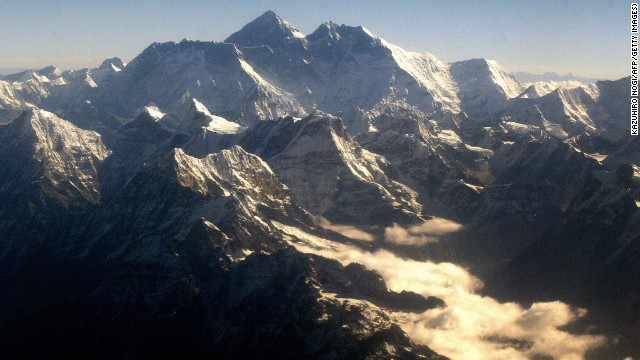
Photos: Exploring Mount Everest


Another Sherpa guide has died in Friday’s Mount Everest avalanche,
bringing the death toll to 13, a Nepalese government official said
Saturday.

It is the single
deadliest accident on Mount Everest, officials said. Three others are
missing, said Madhu Sudan Burlakoti of Nepal’s Tourism Ministry, and at
least half a dozen are injured.


A group of about 50
people, mostly Nepali Sherpas, were hit by the avalanche at more than
20,000 feet, said Tilak Ram Pandey of the ministry’s mountaineering
department.


The avalanche took place just above base camp in the Khumbu Ice Fall.


Climbers and guides had
been setting the ropes for the route, acclimating and preparing the
camps along the route when the avalanche hit Friday, said Gordon Janow
with Alpine Ascents International in Seattle.

“A big piece of ice
suddenly came off the mountain. I did not think I would survive. I am
very happy to have survived,” said Wangdi, who has reached the
mountain’s summit three times before.


He and an assistant, who were attached to a safety rope, hid behind a piece of ice as the avalanche came tumbling down, he said.


“We could do that
because we were in the front,” he said. “Up to 12 of those behind us
survived, but the ones after them died. Those who had already crossed
ahead when the ice came off also survived.


……..
It was the final obstacle, the 40 feet of technical climbing up a
near vertical rock face that pushed Sir Edmund Hillary to the limit.
Once climbed, the way to the summit of Mount Everest lay open.

Now,
almost exactly 60 years after the New Zealander and his rope-mate,
Sherpa Tenzing Norgay, stood on the highest point in the planet, a new
plan has been mooted to install a ladder on the famous Hillary Step, as
the crucial pitch at nearly 29,000ft has been known since it was first
ascended. The aim is to ease congestion.

“We are now discussing
putting a ladder on the Hillary Step but it is obviously controversial,”
said Dawa Steven Sherpa, who runs commercial expeditions on Everest and
is a senior member of the Expedition Operators Association in Nepal.

This
year, 520 climbers have reached the summit of Everest. On 19 May,
around 150 climbed the last 3,000ft of the peak from Camp IV within
hours of each other, causing lengthy delays as mountaineers queued to
descend or ascend harder sections.

“Most of the traffic jams are
at the Hillary Step because only one person can go up or down. If you
have people waiting two, three or even four hours that means lots of
exposure [to risk]. To make the climbing easier, that would be wrong.
But this is a safety feature,” said Sherpa, who co-ordinates the work to
prepare the traditional route up the mountain for clients who pay
between $45,000 and $75,000.

The plan has received some support from the world’s mountaineering authorities.
Frits
Vrijlandt, the president of the International Mountaineering and
Climbing Federation (UIAA), said the ladder could be a solution to the
increasing numbers of climbers on the mountain.

…….
Link (1): http://www.cnn.com/2014/04/19/world/asia/nepal-everest-avalanche/
Link (2): http://www.theguardian.com/world/2013/may/27/mount-everest-ladder-hillary-step
…….
regards

“endorsement of Modi …lose faith in humanity”

S Anand is a ferocious Indian super-caste liberal, his mission is to fight on behalf of all the down-trodden against the (as he sees it) upper-caste dominated Indian society.

The almost existential problem he faces (but refuses to acknowledge) is that the down-trodden may identify with a humble chai-wala Shudra (who is also the face of Hindutva). Indeed Modi has strongly campaigned in Bihar and in many other places as a leader of the OBCs and by necessity (and also by nature) he has had to clear out the super-caste dominated top order of the BJP.

In another life (Bollywood movie script that will never be written) Anand and Modi would have been brother revolutionaries engaged in up-ending the social order in their own way. But here they are, representing the magnetic north and south poles of an India at cross-roads.

Anand now`admits that his decision to censor (he does not like the word, naturally) Joe D’Cruz (famous Tamil author and Modi supporter) may have been made in anger/haste, but the logic of the social justice movement is relentless (see below comments of feminist translator V Geetha), any friend of Modi must be denounced as an enemy.

Anand (in our humble opinion) is too blinded by the BJP packaging. He is a smart enough guy to be able to visualize an India in which Shudras are the kings, and who are quite capable of keeping Dalits and Muslims under-foot. The upper-caste vs. the rest was a clear cut case, it is not clear how Anand and his fellow travellers will handle the rise of the dominant middle-castes (who want to terminate the Dalit Atrocities Act officially and prevent cross-caste marriage socially). Will they even bother to listen to an upper-caste guy like him?

Finally we feel compelled to repeat our statement (since we really love Americanisms), censoring speech is always wrong. All free speech fundamentalists (includes journalists and publishers, writers and readers) must believe that (bad, even evil) speech must be countered by (better) speech.


The formal agreement with D’Cruz had been signed on 7 April, and he
announced his support for Modi on 9 April. Our decision to halt the
publication was taken on the evening of 13 April (Sunday), after
speaking to both Geetha and D’Cruz, and may well have been a hasty
error of judgment.
But the sequence of events is important. When we came
to know of D’Cruz’s position via a Facebook update on 9 April we did
not jump to conclusions, and both Geetha and Navayana tried to get in
touch with him. 

However, since he would not respond to phone calls, we
both sent him separate emails expressing dismay and concern. As
publisher, my email to him on 11 April merely said this:

Dear Joe, 
I read with distress the news that you have endorsed Modi. Initially,
I thought it was a lie; that someone posted this on your FB, and
that these are not your views. I spoke to Geetha too. After some Tamil
newspapers reported this, there has been no clarification from you. This
is disturbing.

Do tell us it’s a lie. For me it’s not merely a question of whether
Navayana will publish this book or Geetha will allow you to use her
translation. Your endorsement of Modi, if it’s true, makes me lose
faith in humanity. 

Anand


There was no talk here of annulling the agreement. Geetha had sent a
similar mail a day earlier. D’Cruz chose not to respond to both of us,
but instead he was quoted by the Tamil and English media misrepresenting
our views. 

For instance, on the morning of 13 April, the Chennai
edition of New Indian Express, had this to say: On the reaction in literary circles, he alleged “certain people
blackmail.
Others threaten that my literary work that are currently
getting translated will be in trouble. For instance, a translation of
‘Aazhi Soozh Ulagu,’ which is under the process of publication in
English will be halted, they say. Some have sent hate mails that shower
abuses.”

Joe D’Cruz chose to directly speak to the media rather than
communicate with his publisher, or the translator who had worked closely
with him over several months. This, we think, was a breach of trust.
 

When the media started calling Navayana and Geetha for responses, we had
to respond. It was only after a desperate SMS on Sunday that D’Cruz
returned our call and stoutly defended his decision to support Modi.


In retrospect, I believe, as a publisher I responded more in anger than using sound judgment.

V. Geetha: “As the translator of Joe D’ Cruz’s novel, I am in the unenviable
position of feeling both bereft and bewildered. While some think that I
have taken a principled stand, others wonder if I should have separated
the work from the man. I can only say that I find it difficult,
personally, to think beyond what Modi stands for, and for me and many
others, he remains the principal architect of the Gujarat pogrom of
2002.
 

This is why I have withdrawn the translation. I would like to
reiterate that I stand by the novel, and am glad to have translated it.
However, given D’ Cruz’s insistent and clear-cut support for Narendra
Modi, I cannot bring myself to allow my translation to be published.
I
would therefore like to wait on that decision, until Joe D’ Cruz and I
can have a conversation on how we see and understand what has happened.”


…..
Link: http://www.outlookindia.com/article.aspx?290312
…..
regards

17/7 Rajputs for 24/7 defense (against China)

The 17/7 Rajput regiment is in charge of guarding the North-Eastern (India) borders aka “undisclosed high-altitude location under Eastern Command”

Most of us are not really familiar with the (Indian) military and its ways. For example, is a Rajput regiment composed of only Rajputs (khatris)? Look deep and ye shall find. 

The “barhe chalo” regiment was raised during the WWII by Field Marshall Cariappa and fought in the North-Eastern Frontier (Kohima, Nagaland on the Indo-Burma border) against the mighty battalions of the Japanese Imperial Army. They will now be prepared to defend the north-east frontier once more, this time against the mighty battalions of the People’s Liberation Army.
….
“Among all
battalions of the Rajput Regiment, 17 Rajput has a unique place in present day
history of the Indian Army. It was raised during the period of Quit India
Movement in 1942. It was also among 10 other Rajput Battalions that were raised
following outbreak of World War-II from 1940 to 1943.”


In so far as its historical significance is concerned, 17/7 Rajput as it was
then known, was the only ‘War Raising’ battalion by any Indian officer who was
none other than Lt col KM Cariappa, OBE, popularly called ‘Kipper’ who went on
to become the first Indian commander-in-chief and later the chief of army
staff. He was also conferred the highest rank of field marshal on April 28,
1986.


17/7 Rajput was raised at Fatehgarh on April 15, 1942 as the Machine Gun Battalion
of the erstwhile 7th Rajput Regiment.
A distinctive colour of maroon and blue
was adopted for the new outfit. On August 1, 1942, the battalion was converted
into a Regiment of Indian Armoured Corps (IAC) and designated 52nd Rajput
Regiment IAC (Bawanja Risala) and moved to Lahore.


On September 15, 1942, the battalion was converted into a ‘Lorried Battalion’
and moved to Secunderabad to form part of 268th Lorried Brigade. On March 16,
1943, Kipper was transferred and succeeded by Lt Col G.B. Macnamara. In May
1944, 17/7 Rajput moved to Kohima and later deployed at Imphal.


Informed readers may know that Rajput Regiment is one among the senior most
regiments of our country. It must therefore, logically, rank higher in the
hierarchy of the nomenclatures. Then why the seventh standing? Evidently, Maj Gen Parr, who had commanded the 7th Rajput in Mesopotamia during
world war-I desired that the Regiment to which his battalion belonged be named
7th Rajput Regiment.
The suffix ‘7’ was adopted and remained so for all
battalions of the Rajput Regiment between 1920 till Independence, where after
it was dropped altogether.


In the redesignations that followed, Barhe Chalo became 17th Battalion of the
Rajput regiment on May 1, 1948. Later when its founding father, Lt Gen KM
Cariappa became Army Chief on January 15, 1950 (commemorated as Army Day), an
honour was bestowed on the battalion. The distinct maroon and royal blue hackle
of the unit was now adopted by all Rajput Regiment battalions. 

In 1965, Barhe
Chalo participated in Op Riddle as part of 7th Infantry Division, where it
successfully executed its task of capturing Bedian bridge. The unit also
participated in Op Cactus Lily in 1971 as part of 86 Infantry Brigade in Dera
Baba Nanak sector, where it captured Khokherke and Sadhuwan posts of enemy and
provided a firm base for Op Akal. The unit was also successful in capturing a
crucial enemy post for which Capt Nawal Singh Rajawat and Late Sep Satyawan
Singh were awarded VrC.


In 1982, the battalion underwent a change in class composition and reorganised
to include Rajputs, Gujjars, Brahmins, Bengalis, Jats, Ahirs and Muslims in
equal percentage composition.

The battalion was also the first unit of Rajput Regiment to be inducted in
Siachen Glacier in 1991. The unit had a successful tenure without having a
single fatal casualty, which indeed is a unique achievement.


Among the wars and major operations that Barhe Chalo participated include world
war-II, between May to August 1944, Indo-Pak War of 1965 between September 1965
to February 1966 and Indo-Pak War 1971, from October to December 1971. Among
the various military operations include Operatons Orchid, Rhino, Vijay, Rakshak
and Parakram.


Glory to the Barhe Chalo has been brought through its gallant officers and
soldiers through 2 Military Cross, an OBE and PVSM each, 7 Kirti Chakras, an
AVSM, 4 Shaurya Chakras, 3 Vir Chakras, 12 Sena Medals, 3 VSM, 6
Mention-in-Despatches, 38 COAS, 7 VCOAS and 33 GOC-in-C Commendation Cards
including several other gallantry certificates.


The battalion is presently serving at an undisclosed high altitude location
standing vigil under Eastern Command. The Barhe Chalo battalion is presently
being commanded by Colonel Balbir Singh Siwach, a second-generation army
officer, commissioned in December 1990.


regards

(slow) Train to Ernakulam

We are familiar with strange truth (stranger than fiction). Here is an example of plain scary truth (not as scary as flying by Malaysian Airlines, but still….)

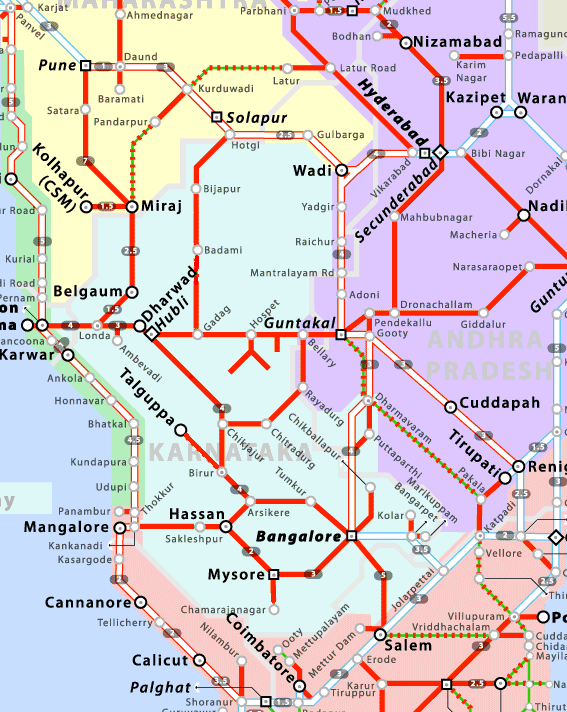
Above we have the map of (Indian Railways) South-Western Zone. The original route was along the west coast (Konkan Railway shown in green). Instead the train got diverted to Pune (top left corner in yellow zone). At that point it should have moved directly south to Miraj and from thereon turn west to reach Goa. Instead it traveled south-east (right-wards in the map) to Solapur and then on to Gulbarga, a few hundred km on the wrong track.

Not a single official noticed (the passengers eventually did). BTW Udupi is a town on the west coast near Mangalore.


Passengers
of the Okha-Ernakulam express from Gujarat to Kerala were stunned when
they saw that their train had reached Gulbarga station in Karnataka on
Tuesday.

The train was on track till 10.30pm on Monday but
passengers were alerted at Punwale that due to an accident near
Ratnagiri, the train would be diverted towards Pune and then it would
reach Wadgaum in Goa via Miraj. But at Pune, the train was mistakenly
diverted to Solapur and then to Gulbarga.

Passengers were
shocked early morning when they saw their train at Solapur station at
6am. They informed the station master at Solapur and were told the train
would be diverted at Guntakal to Hubli….

..
The train reached Gulbarga at 11.30am and
was parked 1km from the station and later taken to the station.

..Keerthan, a passenger
on the train who was supposed to reach Udupi at 11am Tuesday, got down
at Gulbarga and took a bus to reach his destination. He said almost 30
passengers in the bus he was traveling, were passengers from the
mis-routed train.

…..

regards

Brown Pundits