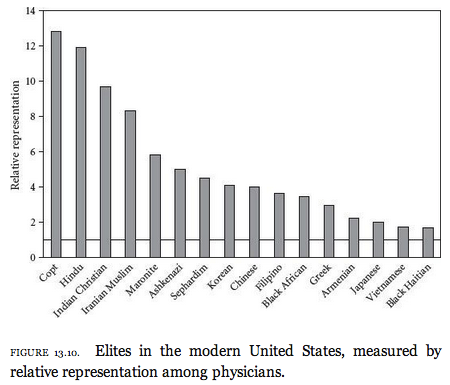
Copts- elites amongst elites

as per Gregory Clark (The Son Also Rises). Indian Christians merit a separate category (why? they are all Brahmins). Separate Iranian Muslim category (there must be a large count of Iranian non-muslim physicians). Chinese are surprisingly low down in the ranks. Black African is possibly the most meaningless classification (the author would probably like to single out black non-Americans, but then there is also black Haitian).

As far as Indians are concerned it would be of interest to look at data across generations- first generation, second generation,…and so on.

regards

Flat out prejudice

Many people much wiser than me have voiced this thought but it needs repeating, Hindus (and Jains and..) and Muslims of all stripes need to learn to co-exist with each other. Communities (to use a cliche) should learn how to recognize is that the enemy is not the other man (or woman), but the common poverty, illiteracy, and all other social ills. All said and done you dont have to be a hero to get a flat in Mumbai, let alone a muslim one.

In September 1990, Captain Zainul Abidin Juvale, master of a cargo vessel called MV Safeer, became master of the fate of 722 Indians who sailed out with him from Kuwait to Dubai. Iraqi dictator Saddam Hussein’s troops had invaded Kuwait and the Indians there were stranded for over a month.

For over a month now, Juvale has been house-hunting in Bandra (W), but he is unable to buy a flat when he likes one. The brokers have frankly told him that the societies where he has shown interest have an unwritten rule: not to rent or sell flats to Muslims.

“Nobody asked me my religion when I risked my life to rescue fellow Indians who faced starvation and death in Kuwait,” says Juvale. “Now I am being made aware of my Muslim identity.” 
regards

PS In response to Zachary, most likely to be societies dominated by veg Hindus/Jains. Non-veg Hindus will also not be welcome.

The victims of partition(s)

…the (in)fighting never stops as the poison re-circulates in perpetuity…. minority communities will bear the greater burden everywhere…the lines separating the minority from the majority are very thin and are being continuously re-defined (majority oppressor class today, minority oppressed class tomorrow). Finally, it would appear that the separating and dividing exercise will continue until we are all in our box of one- each one of us a minority fighting against the other (my brother, cousin, friend,…etc.)


Unidentified gunmen shot dead four persons, including a prominent India-born Shia scholar, in this Pakistani port city on Thursday in target killings. Four gunmen opened fire on an auto-rickshaw in which Allama Taqi Hadi Naqvi was traveling.
Naqvi succumbed to his wounds in hospital, police official Imran Shaukat said.

Renowned within academic circles, Naqvi was born in Moradabad district
of India’s Uttar Pradesh state and moved to Pakistan with his family
after independence.

Three other persons, including the
administrator of a madrassa and his son, were shot dead by gunmen in
separate incidents in the city.                                                                                                                                                                                                                                                                                                                              
regards

Jab We Met: Encounters between Islam and Hinduism in Early-Medieval Punjab

Yesterday, I posted a piece on my blog (http://barbarikon.blogspot.com) that may be of interest to readers on Brown Pundits as well. So, at Zach’s suggestion, I am posting it here as well.

If the exhortation to pity the nation that forgets is own
history is taken seriously, few nations are more pitiable than Pakistan today.
Occupying one of the most historically rich pieces of land on the
planet, modern Pakistanis go about their business oblivious to the echoes of
the past that swirl all around them and the layers of history that lie buried
under their feet. And more’s the pity for a better understanding of this
historical past could explain a lot of the present and its problems, and
perhaps even help solve them.
One of the most interesting and least understood periods in
the history of the region is the time between 711 CE and 1200 CE, i.e., from
the time when the first Arab conquerors under Muhammad bin Qasim established
the so-called Emirate of Sind to the end of Ghaznavid rule in Punjab. One
reason why this period is of special significance is that it represents the
first extended encounter between Islam and the religious traditions of India,
notably Hinduism (Buddhism too, but more on that another time). Given how the
interaction and conflict between these two traditions has shaped – and
continues to shape – the history of the region, looking back to the earliest
encounters is especially important.
Though not studied as intensely as some other periods, the
history of the early medieval period in Northwestern India has attracted its
share of scholarship, from the contemporary writings of Al-Biruni,
Al-Maqdisi
and Ibn Hawqal to the
work of modern historians such as Romilla Thapar1,
Finbarr Flood2,3
and Derryl MacLean4.
These works describe a fascinating process of interaction, integration and
antagonism between two great cultures in an ancient land. In this piece, I will
only consider a narrow but interesting set of issues, motivated, as often, by a
coin in my collection – a bilingual
Ghaznavid dirham
circa. 1128 CE, shown below.
                                            

The silver coin was minted in the name of the greatest ruler
of the Ghaznavid dynasty, Mahmud, who is famous – at least in South Asia – for
his repeated attacks on India and his destruction of the great temple at
Somnath in 1024. While his attacks ranged over large parts of northern India,
Mahmud annexed only regions that lie in modern Pakistan. The coin was struck in
419 AH (1028 CE) at Lahore, which was then known as Mahmudpur – itself an
interesting bit of historical information (the name “Mahmudpur” can be read
clearly in the margin of the image on top at the 6 o’clock position). The
complete inscription in the margin reads (as far as I can reconstruct it from
this and other similar coins): bismillāh
zuriba hādha-al dirham mahmudpur tis’a ‘ashra wa arba’ mi’ah
(In the name
of Allah. This dirham struck at Mahmudpur 419). The central text on this side
of the coin reads: lā-ilāha ill-allāh /
muhammad rasūl-ullāh / yamīn-ud dawlah / wa amīn-ul millah Mahmud
(There is
no God but Allah / Muhammad is His messenger / protector of the state / and
custodian of the community Mahmud). The inscriptions at the 12 o’clock and 9
o’clock positions together read al-qādir
billah
, which was the name of the Abbasid caliph in Baghdad, to whom Mahmud
nominally professed allegiance (more on this below).
Even more interesting is the reverse side of the coin, shown
on the bottom. The text is in Sanskrit, written using the Sharada script, which was
used throughout the region at the time and is the ancestor of the Gurmukhi and
Kashmiri scripts. The text in the margin declares that the “tanka” – the Indian
equivalent of the dirham – was struck in Mahmudpur on the given date, but it is
the central inscription that is most interesting. The text reads: avyaktam ekaṃ, muhamadaḥ avatāraḥ, nrpatiḥ
mahamudah
. This translates as: The
Invisible is one; Muhammad is His manifestation (avatar); Mahmud is the king
.
The margin also has a Sanskrit translation of the statement about the mint and
date, including the Arabic bismillāh
(in the name of Allah) translated as avyaktīya
nāme
(in the name of the Invisible). I rely on the reading reported by Flood
in Objects
of Translation: Material Culture and Medieval “Hindu-Muslim” Encounter3
(with
citations to several other works),  but
also given by Thapar in Somnatha:
The Many Voices of History
1, and other
sources, such as the entry for coin number 39207 in
the Zeno Oriental Coins database and CoinIndia.
This inscription, which is the first known “official”
translation of the Muslim declaration of the creed (shahada) into Sanskrit, is
interesting for three reasons. First, the very fact of putting a Sanskrit
version of the shahada on a coin signals a certain outreach to the conquered
Hindu population. After all, they were the only ones who would be expected to
read the Sanskrit version. Perhaps there was also an element of proselytization
in the move, trying to acquaint Hindus with the basis of Muslim belief. In any
case, it was a remarkable acknowledgement of the need to communicate across communal
lines. Second, the exclusive Islamic declaration, “There is no God but Allah”
is translated as “The Invisible is one” (or sometimes as “the Unmanifest is
one”), which excludes nothing. Indeed, it is best read as an affirmative
statement declaring the unity of all that is ineffable and immaterial – the
great world spirit, so to speak. For Hindus who believed in the undefinable,
unchangeable reality – Brahman – at the core of everything, this would not have
been a stretch at all. This is especially so if
MacLean is correct
and the major form of Hinduism prevalent in the area was
Pasupata Saivism with
its strongly monotheistic beliefs. Finally, the most remarkable aspect of the
translation is the declaration that the Prophet Muhammad is a manifestation
(avatar) of God – not a messenger, as Muslims believe.  From an orthodox Islamic viewpoint, this is a
heretical statement, but there it was on the coins of that most pious protector
of Islamic orthodoxy, Mahmud “the idol-breaker”!
It is worth noting that, as far as is known, these bilingual
coins were issued only at Lahore, and only for two years (418 and 419 AH). In
an end note, Flood
(p. 279) quotes Tye
and Tye 5
, as suggesting that these might have been fiduciary
coins for local use. Nevertheless, given the importance of Lahore to the empire
– it was virtually a joint capital with Ghazni – and the fact that in 1028
(when the coins were issued), it
was governed by Mahmud’s hand-picked governor
, Malik Ayaz (of Mahmud-o-Ayaz
fame), the issuance of the bilingual coins and the text of the Sanskrit inscription
cannot be dismissed as an anomaly. Clearly, there was an explicit and official
attempt to reach across the communal divide, not only in form but also in ideas
– perhaps to promote a version of the Islamic creed that would win greater
acceptance among the Hindu populace. Nor was this the only such example.
Mahmud’s son, Mas’ud I, also issued coins depicting
Hindu iconography
, including an image of Nandi, the bull of Shiva, which
had been a prevalent motif in the Hindu Shahi coinage before the Ghaznavids.
Indeed, these Hindu
motifs continued to be used on Ghaznavid coins
by Mahmud’s successors in
clear contravention of the orthodox Islamic proscription against images. Some coins also used Sharada
inscriptions naming the king
and occasionally invoking Hindu deities. These
iconographic practices persisted
into the Ghorid dynasty as well.
But the history of bilingual coinage and syncretism between
Islam and Hinduism in the region goes back somewhat further, and has some ironic
twists.
As far as is known, the first bilingual coins by any Muslim
rulers in India were struck in Multan by the Sāmid Amirs who reigned there in
the 10th century. Multan was then the capital of what is sometimes
called “Northern Sindh”. After the initial Arab conquest in 711, Sindh was
rules by a succession
of governors
appointed by the Umayyad administration, and then by the
Abbasids after they took over in 750 CE. However, the hold of the caliphate on
Sind became increasingly tenuous, and by the early tenth century, the region
had split into a southern part, ruled from Mansurah by descendants of ‘Umar bin
‘Abd-ul-‘Aziz al-Habbāri
, and a northern part, ruled from Multan by the
descendants of Sāmah bin Lu’ayy
. Both dynasties were of Qurayshi Arab
origin, and professed nominal allegiance to the Abbasid caliph in Baghdad.
Multan, at the time, was famous for its magnificent Sun Temple, which was a
major center of Hindu pilgrimage. The Sāmid rulers seem to have supported the
temple and a tolerant, perhaps syncretic version of Islam. However, sometime in
the mid-tenth century, the rulers of Multan converted to Ismai’ili Islam, and
transferred their allegiance from the Abbasids to the Fatimid caliph in Cairo,
who was also the Isma’ili imam. Initially, the Isma’ili religious leadership in
Multan appears to have continued on a tolerant course, but this aroused the
wrath of the Fatimid Caliph, Al-Mu’izz, who sent a new preacher (dā’i), Jalam
bin Shayban
, insisting that the Isma’ili Amir of Multan purify the local
religious practice (per Isma’ili doctrine, of course), and end support of “idol
worship”. In a famous incident, the Caliph, hearing that a major local idol had
been destroyed by the new preacher, asked that the head be sent to him as proof
of destruction. It has been believed, on the authority of Al-Biruni, no less,
that this refers to the destruction of the Sun Temple and its idol, but other
evidence, summarized by MacLean, suggests
that it was probably another, lesser idol. Nevertheless, it is ironic that the
first recorded instance in Punjab of systematic idol-breaking in the name of
Islamic purity came from Isma’ilis rather than orthodox Sunnis. A second irony
is that it was the Isma’ili presence in Multan that attracted the most famous
of “idol-breakers”, Mahmud, to attack
Multan in 1010 CE
, depose its Isma’ili ruler whom he regarded as an
apostate, and annex the province into the Ghaznavid empire. Apart from
his religious objections, Mahmud may also have been motivated to punish
the rulers of Multan for transferring their allegiance away from the
Abbasid caliph, to whom Mahmud pledged nominal fealty.
 

The bilingual coins are thought to be from the early
Isma’ili period Multan around
965 CE
. As shown in the examples from my collection (above), the text on
these very small coins is usually hard to read. However, one side had the name
of the ruler in Arabic (left panel) while the other often had a Sanskrit word,
written in the Sharada script, with Hindu religious significance (right panel).
According to Flood3,
four distinct Sanskrit inscriptions have been identified – two referring to
Vishnu, one to Lakshmi, and the fourth to “Madhumadi”, which is regarded as the
Sanskritized version of “Muhammad” (also used elsewhere in India at the time). If
this is true, the coins represent an attempt to insert the Prophet of Islam
into the Hindu pantheon. Perhaps it was such practices that raised the ire of
al-Mu’izz and motivated him to send a “purifier”.
To summarize the sequential ironies of the situation: First,
Isma’ili Muslim rulers in Multan attempted to create a syncretic culture among
the Hindus and Muslims of their emirate; then they were chastised by an
Isma’ili Caliph in Egypt who ordered them to destroy idols and temples – which
they did; but their Isma’ili faith was still seen as heretical by the pious
Sunni king, Mahmud, who invaded and annexed their kingdom; and then, Mahmud’s
own hand-picked governor in the region made another similar effort at syncretic
outreach, minting coins with statements that orthodox Muslims would have
regarded as heretical – but only in Sanskrit!
History is a lot more complicated than we think!
References:

1.       R. Thapar (2005) Somanatha: The Many Voices of a History. Verso.

2.        F.B. Flood (2011) Conflict and Cosmopolitanism
in “Arab” Sind. In: A Companion to Asian
Art and Architecture
, R.M. Brown & D.S. Hutton (eds), pp 365-397. Blackwell.

3.      
F.B. Flood (2009) Objects of Translation: Material Culture and Medieval
“Hindu-Muslim” Encounter
. Princeton University Press.

4.        D.N. McLean (1989) Religion and Society in Arab Sind, Brill.

5.        J. Tye and M. Tye (1995) Jitals: A Catalogue and Account of the Coin Denomination of Daily Use
in Medieval Afghanistan and North West India
. John Tye.

the Sanskrit tongue was chilled at 500metres

Also how India’s population density while extraordinarily high wasn’t necessarily conducive to economic growth.

Interesting thoughts about on Sanskrit and how Indian civilisation was essentially a lowland phenomenon. 

 Also from a couple of pages later we see Pakistan and Iraq as the two most illogically drawn states in the Ummah?
The four great Civilisations of Eurasia. The pre-Ummah (increasingly homogeneous Greater Middle East) flanked by Greece (the West), India & China.
Tibet may orient towards China but appeals to India as a balancing Great Power.

Institutional Racism affects Sikh Marathon Runner

http://espn.go.com/espn/story/_/page/Fauja-Singh/fauja-singh-runner

Fauja agreed to run the London Marathon again the next spring. He ran his third-fastest time ever, 6:07. He was back. Now Haramander approached Fauja with another proposal. “You’ve already set every marathon record you possibly can. There’s only one left to break, the record for the oldest marathoner ever.” At the time, that record was held by Dimitrion Yordanidis, who ran the original marathon course, from Marathon, Greece, to Athens, in 1976. Yordanidis had been 98. Fauja was 93. “You can’t break that record now,” Harmander said. “All you can do is wait.”
So Fauja waited, running shorter races to fill his time. Then, in April 2011, his 100th birthday arrived, and with it, an opportunity to break the record. Soon he received an invitation from the Toronto Waterfront Marathon, where years ago Fauja had run his fastest time. He accepted.
The race was set for October. In September, Harmander received an email from Vin Sharma, a London-based Global Talent Manager at Guinness. “What would be great,” Sharma wrote, “is to start by acknowledging ‘Oldest Marathon Runner’ title which rightfully belongs to Fauja-ji.” (Ji is an honorific suffix used in Indian languages.)
“He’d used running to pull himself out of the depression he fell into after his son died. What was he going to do without it? ”

– Harmander Singh

The email from Sharma continued: “Birth certificate or passport to verify his age would also be useful.” Fauja, of course, did not have a birth certificate. But he did have a passport. He’d gotten his first when he visited his children abroad, decades prior. On that passport, and on each one he’d received since, there was listed the same date of birth: April 1, 1911.
Sharma attached a document with official guidelines for the record. “Where a birth certificate is not available,” it said, “a copy of a relevant ID should be submitted.”
They submitted the documents, and weeks later they flew to Toronto. Fauja finished in 8:25. In his mind, and in the minds of everyone present at the race, Fauja had done what no man had done before.
“100-YEAR-OLD MARATHON RUNNER not recognised by Guinness,” read the BBC News headline after the event. In an interview with the network, Guinness editor-in-chief Craig Glenday said, “We would love to give him the record. We’d love to say this is a true Guinness World Record, but the problem is there is just no evidence.”
By no evidence, Glenday meant that there was no birth certificate. “We can only accept official birth documents created in the year of the birth,” Glenday told the BBC. “Anything else is really not very useful to us.” In September, a Guinness representative had sent guidelines suggesting a passport would be sufficient. Now in October, the company said only a birth certificate would do. It didn’t matter that Fauja had received his first passport before he began running, negating any significant possibility of a plot to break the record. Nor did it matter what the Guinness official had told Harmander.

Cara Kilbey, Fauja Singh, Billi Mucklow and their friend Lulu pose for a photo during the London Marathon in April 2012.

Christopher Lee/Getty Images

“This is a case of institutional racism,” Harmander said, after learning of the news. The thinking was simple. Guinness had decided its age records could be held only by people with birth certificates. The vast majority of people with birth certificates in the early 20th century came from Europe or North America. Fauja could not have the record. And for that matter, neither could most anyone else from Asia or Africa or other parts of the developing world.
Now came the follow-up stories. “Marathon man Fauja Singh runs into racism row,” said the headline in London’s conservative paper, The Daily Telegraph. Members of the Sikh community, both at home in Punjab and across the diaspora, signed a petition and set the Internet aflame with angry comments. “BROWN PEOPLE OF TUMBLR,” one person wrote on the popular blogging platform about Singh, “I SUMMON YOU TO RIGHT THE WRONGS. TO BRING JUSTICE TO THE INJUSTICES.”
Yet it would do no good. Guinness remained firm. “Passports may be used as proof of identification, NOT of birth. …” Guinness spokeswoman Jamie Panas wrote to ESPN The Magazine in an email. ” … Passports and other mid-to-late-life representations of age are notoriously unreliable when unaccompanied by original proofs of birth.” Panas emphasized that Guinness never guaranteed that a passport would be sufficient. She also said that Sharma, the Guinness talent manager who advised Harmander, is no longer with the company. Sharma could not be reached for comment. His personal website says he left Guinness at some point last year.

India 2014

Right now the polls say that BJP/NDA will get 200+ seats. As I have noted this (if it actually happens) will be a game-changer because enough opportunists can be purchased to reach 272. However I consider this to be unlikely, mainly because of the impact of rural-based caste coalitions as well as that of the urban-based Aam Aadmi Party (incidentally why not Aam Aurat Party?). The Congress is optimistic about a Delhi like scenario where the BJP was stopped from getting an absolute majority. Indeed the same polls predict that AAP will win an overwhelming majority if elections are held afresh in Delhi.

Again the way I read the polls, Congress will do very poorly in North and West (Bihar and UP will be critical for the BJP), however it may get a few seats in the North-East. The bulk of the Congress seats will come from the south- Kerala, Karnataka and Telangana. This will make the transition of Congress from a pan-India party to a South Indian party complete.

That said it is instructive (and amusing) to see Big Brother monitoring the 2014 elections (in their usual soft-footed, light-touch manner). The piece below says a lot (even when it says little), for what it is worth polls were quite accurate in the most recent round of state elections. In my opinion, BB is unsure about the rise of the BJP, on the one hand they cant be happy about an assertive Hindu majority (kind of like the Muslim Brotherhood part II), on the other hand they are probably interested in new business opportunities. Again my feeling on this is if NaMo does come to the throne, he will push for China over America and this will be a nightmare all the way around (but may be good for regional stability). I conclude that a lot many people are deeply interested in what happens in India following the 2014 polls.

The sudden thaw in the relationship comes as India heads into the 2014 Lok Sabha (Lower House of Parliament) elections to be held this April and May. Modi’s Hindu-nationalist Bharatiya Janata Party (BJP) has
named him as its candidate for prime minster should the BJP gain an
electoral victory.
By meeting with Modi, American officials are
signaling that they view a BJP victory in the coming elections as a real
possibility, and are hoping that they can improve the damaged
relationship with Modi as much as possible prior to the election.


Unsurprisingly, U.S. officials and India watchers around the world
are closely monitoring the torrent of election polls and public opinion
surveys streaming out of the Indian media to see where the BJP stacks up
against its rivals as the elections draw near.

regards

The bounds of decency

It is clear that the Tamil political leadership believes (driven by electoral compulsions) that the LTTE gangsters responsible for the death of Rajiv Gandhi are innocent and should be set free. It is also clear that given the nature of coalition politics (now and in the future) gangsters can always bank on regional identity to protect them- be it a Sikh or a Tamil or whatever. Kashmiris like Afzal Guru have not been so lucky.

Incidentally this is the same claim of normalization/vindication for Narendra Modi (who in my book is much more obnoxious for having used the powers of the state to terrorize people). The electoral victories that the people of Gujarat have bestowed on him carry more authority that any number of court verdicts.

Hear is Harithra, daughter of Nalini and Murugan who is making the case for the release of all the gangsters

In yet another emotive appeal to AICC president Sonia Gandhi and her children, Rahul and Priyanka, Harithra, the 22-year-old daughter of Nalini and Murugan, convicted in the Rajiv Gandhi assassination
case, has sought the release of her father. If they helped to get back
her father, they would be hailed as saviours, she said..
…The recent letters were written in the wake of the
Supreme Court order commuting the death sentence of the three convicts,
Murugan, Santhan and Perarivalan, the subsequent decision of Tamil Nadu
chief minister J Jayalalithaa to release them, and the apex court’s move
to stay their release. Harithra said her parents have been behind the
bars ever since she knew about them. “When I was mature enough to
understand the world around me, I’ve heard people talking about the
heinous assassination of Mr Rajiv Gandhi. Now I truly understand that
the incident is one of the most tragic and devastating moments of Indian
history,”
she said.                                                                                                                                                                          
It seems no one cares for the bombing victims who were also Tamils.                                                                                                                                                                                                                    


“Where is the justice for the bereaved families after
all these years,” asked S. Abbas, who lost his mother Shanthini Begum in
the Sriperumbudur blasts.
Of the 15 other victims of the blast, five
were Congress workers while and 10 were policemen, including nine from
the State force…..“We are not advocating death penalty
but we want those convicted by the highest court of carrying out a
heinous act to undergo the punishment meted out by the court. They
cannot be allowed to walk scot free,” said ‘League’ M. Mohan, whose
Congressman father ‘League’ P. Munusamy was one of the victims.

                                                                                                                                                                    I am anti- death penalty and applaud the Supreme Court decision for rescinding the same but I worry about what broader message that this campaign is sending. In the future the only form of retributive justice that will be available will be mob justice (while the petty politicians will plead ignorance and innocence).                                                                                                                                                                   regards

Welcome to the newborn (#29)

A new state is officially born as the Telengana bill passes both Lok Sabha and Rajya Sabha. The agitation for the separate state was initiated right after independence. In its own way, this development honours the memory of Gandhi. Everyone has a different opinion on what aspects of the Gandhian path are bene(male)-volent, in my own opinion the most significant is his stress on local rule. For people-power to be truly realized, power has to be taken out of hands of a few elites sitting (and stealing) in Delhi.

regards

Brown Pundits