The Shias of Kashmir

From our regular contributor, Dr Hamid Hussain. 

In my last piece about Kashmir, I briefly mentioned Shia factor in Kashmir in current context and Ahmadi factor in historical context.  Many otherwise well informed individuals admitted that they had little idea about these.  Others with more direct interaction with Kashmir issue asked questions and this is in response to these exchanges.  Enjoy if you are bored of black and white narratives on the subject and interested in ‘fifty shades of grey’.

Hamid

Shia of Kashmir

Hamid Hussain

Shia of Kashmir has a unique history.  There were two groups of Shias who migrated to Kashmir from present day Iran and Iraq in fifteenth and sixteenth centuries.  One group escaped persecution and other were missionaries.  Some artisan classes also joined these groups.   Local conversion due to efforts of missionaries increased Shia numbers.  In Gilgit-Baltistan area with geographic links to Badakhshan province of Afghanistan and Tajikistan, Ismaili missionaries were successful in small pockets while mainstream Ath’na Asha’ari (followers of twelve Imams) missionaries were successful in areas that are now part of Indian Controlled Kashmir (ICK).  Separation of Gilgit-Baltistan from Pakistan Controlled Kashmir (PCK) which is ethnically and linguistically different from Kashmiris left no significant Shia population in PCK.

In ICK, there are about one million Shia out of a total Muslim population of 8.5 million.  Shia are geographically and politically separated in ICK.  Sparsely populated Ladakh which is now separated from Jammu & Kashmir (J&K) as Union territory has equal numbers of Buddhists and Muslims.  In Kargil area, ninety percent of Muslim population is Shia numbering about 125’000.  There are small numbers of Sunnis in Drass area.  Remainder Shia population is concentrated in the Valley. Continue reading The Shias of Kashmir

A letter to Gandhi

(In 2017-18, an Indian friend wanted to collect essays from Pakistanis on how they view MK Gandhi across the border. I wrote this short letter to Mr. Gandhi that I recently saw in my collection. Sharing it with the BP community. )

Mohandas Karamchand Gandhi
Birla House,
New Delhi.

Dear Mr. Gandhi,

My name is Abdul Majeed and I am writing to you from the city of Lahore, Pakistan. I have been asked to write about you by an Indian friend of mine and I accepted his proposition. I feel ambivalent writing about you since I have thought about you in myriad ways over the course of my life. I grew up in a conservative Muslim household in a small Punjabi town called Sialkot and first learned about you in the ‘Social Studies’ textbooks taught to schoolchildren. My first impression of you as a person was quite negative since the role assigned to you by virtue of ‘Two Nation Theory’ (or TNT, as I now call it) was that of a Hindu politician who opposed the formation of Pakistan and probably hated Muslims. Like many schoolboys of my age, I idolized Mr. Jinnah, your arch-nemesis and a founding father of Pakistan. For us, Jinnah was the David to your Goliath, a defender of minority rights against all odds, an impeccably dressed man who stood up to the might of Hindus and saved Muslims of India from a cultural annihilation. In our imagination, he was everything you were not. We used to make fun of your attire and your persona. I grew up in a society where violence was the channel through which you expressed your masculinity and thus we thought your non-violent methods were signs of cowardice. I learned that All India Congress, a party you led for many years, did not support the idea of an Independent Pakistan (or a divided India, depending on whom you ask) and refused to believe in Partition even after two separate countries had been established.

My outlook towards history and towards your personality changed when I went to boarding schools in the northern part of the country. While the basic ideological framework remained in place, facts added up through the years. At one point in time, I could recite the whole ‘Pakistan Studies’ book by heart in two hours, including names of the books written by Sir Syed Ahmad Khan, a Muslim educationist and reformer in Nineteenth-century, charter of demands presented by the Shimla deputation to Viceroy of India in 1905, consequences of Bengal’s partition in 1905, Minto-Marley reforms of 1909, Fourteen points of Mr. Jinnah (a proposal for constitutional reform in British India) and the Islamic clauses in Pakistan’s three constitutions. You might be astonished to know that history books in our schools start the story from the Nineteenth century as if nothing happened in this land before. The boarding schools I went to, were located near Mansehra (containing artifacts from two thousand years ago) and Taxila (where the oldest University in the world was once present) respectively, sites containing artifacts from a past I never had. I knew you as a wily politician who duped Muslims during the Khilafat Movement. The word ‘Mahatma’ was used as a prejudicial slur towards anyone ‘Indian’. I often got called by this name because I was a vegetarian.

Years later, I ended up seeing you in a different light. I was roaming the streets of New York City in the immediate aftermath of Hurricane Sandy when I chanced upon a statue of you in Greenwich village. A week after that, I saw another one of your statues at the MLK memorial in Atlanta. I learned about your influence on Martin Luther King Jr. and the strategy of non-violence resistance. It was around this time that I read Arundhati Roy’s foreword to ‘Annihilation of Caste’ and ‘The South African Gandhi: Stretcher-bearer of Empire’. As I grew up, I came around to the idea that human beings contain multitudes and having contradictions is partly what makes us human. On one hand, you paid lip service to the idea of caste in Indian society, on the other, you made public displays of spending time with the untouchable community. You accelerated the fusion of religion and politics in India during the late 1910s and the Khilafat movement and you also held fast when Pakistan was not paid money it was due after partition. You used elements of Hinduism in your political and social message and were eventually gunned down by a Hindu nationalist. You didn’t subscribe to the Two nation theory but the last century proved you wrong. India and Pakistan have grown and keep growing apart as a Sunni state and a Hindu state. Some of your ideas were as controversial then as they are now. You were in favor of treating Nazis with peace and non-violence and you lived to see how that turned out. In Pakistan during the 2000s, some people wanted to talk to the Pakistani Taliban (TTP) and that didn’t go as planned either. The question then is, how does one deal with groups whose founding ideology is based on violence? With this, I’ll leave you in peace in your forever abode.

Greetings from Lahore,

Abdul Majeed Abid


Kashmir, Analysis by Dr Hamid Husain

From our regular contributor and well respected Military historian Dr Hamid Husain

Following was outcome of exchanges with some informed individuals from both sides of the border about Kashmir.  I was educated & enlightened. It is just a glimpse on my part about possible scenarios.  It is first of a two part; second part deals with the legal aspect of the issue as Constitution bench of Indian Supreme Court has taken up the case.

“Borders are scratched across the hearts of men

By strangers with a calm, judicial pen

 And when the borders bleed we watch with dread

The lines of ink along the map turn red”

                                                               Marya Mannes

Regards,

Hamid

Paradise Lost – Kashmir at Crossroads

Hamid Hussain

“Any intelligent fool can make things bigger, more complex and more violent; but it takes a touch of genius and lots of courage to move something in the opposite direction.”    Albert Einstein

On 05 August 2019, newly elected government of India announced change in Kashmir status. President issued an order under Article 370 superseding a previous Presidential Order of 1954 thus removing restrictions on application of Constitution of India in the state of Jammu & Kashmir (J&K).  This also removed Article 35 A that gave special status to residents of J&K. In addition, J&K was divided into two Union territories with separation of Ladakh.

Currently, three countries control parts of the territory that was once princely state of Kashmir during the Raj.  Indian Controlled Kashmir (ICK) is fifty five percent of the territory, Pakistan Controlled Kashmir (PCK) is thirty five percent and Chinese Controlled Kashmir (CCK) is fifteen percent. There is no conflict at Indian-Chinese border in Kashmir called Line of Actual Control (LAC) and there has been no border incident in the last fifty years.  I recall the only incident of military history several years ago when tempers escalated at that border, the soldiers simply threw stones at each other. The story of Line of Control (LOC) between India and Pakistan is totally different.

Kashmir is more of an ideological element between two countries.  Both sides have a psychological entanglement where the raison d’etre of both countries is linked with it.  India views continued control of Kashmir as vindication of its stand that Hindus and Muslims are not two separate nations and that is why a Muslim majority state is part of Indian union.  Pakistan contests this narrative and see India’s control of Kashmir as challenging the very idea of Pakistan based on ‘two nation theory’.  Both sides are intelligent enough to recognize the old dictum that ‘possession is the nine-tenth of the law’. Rhetoric aside, in real politic, both countries are fully aware that LOC is now a de facto border, and no one can force a military solution of the problem.  When there is an interlude of peace between two countries, public opinion is in favor of compromise.  However, with every crisis, jingoism runs supreme on both sides of the border.

India

‘Nationhood is rooted in rites of violence we all prefer to forget’.  Quoted in Karl Meyer & Shareen B. Brysac’s King Makers

India’s recent efforts to remove special status of Kashmir is to fully integrate the state in Indian union with the hope that this will end separatism in ICK.  Unique circumstances of Kashmir at the time of partition in 1947 necessitated a compromise.  Article 270 of Indian constitution gave Kashmir a special status where Indian constitution was exempted from the state in governance of the state.  In the last seventy years, 94 of the 97 entries of the Union List and 260 of the 395 articles of the constitution were extended to Kashmir.  Ironically, it was all done through Article 370 as this was the only ‘tunnel’ through which center could act in Kashmir.  The result is that in practical terms Article 370 had ceased to provide any special concessions to Kashmiris.  More important is Article 35 A that was inserted by a Presidential Order in 1954 as a compromise between Indian Prime Minister Jawaharlal Nehru and Kashmiri leader Shaikh Abdullah.  This clause gave the authority to state government to define ‘permanent resident of the state’.  A Dogra rule era law of 1927 that prohibited acquisition of land in Kashmir by an outsider was incorporated in Constitution of J& K in 1956 that closed the door for acquisition of land by outsiders. Now only a permanent resident of the state was eligible for land acquisition, government jobs and scholarship in state educational institutions. Article 370 was a psychological and 35 A practical anchor of special status of Kashmir. Continue reading Kashmir, Analysis by Dr Hamid Husain

A tale of two Pakistans

Bangladesh to clock highest growth in Asia this year.

Pakistan’s growth to be lowest in South Asia in current fiscal.

8% vs. 3%. From a geopolitical perspective at current rates of relative stagnation India’s Pakistani problem will “solve” itself as the Islamic Republic is turning into a macroeconomic midget. All of the geopolitical posturing will be irrelevant if the Pakistani polity doesn’t get its structural house in order (e.g., shift away from the oligarchy).

The Indian cultural Left is in India, but not of India

A comment on Twitter about the lack of the Islamic world’s own Arundhati Roys, and therefore the lack of Leftism. My own reaction is that this is wrong. There is plenty of Leftism in the Islamic world, just not the sort of cultural criticism that Arundhati Roy specializes in.

To give an example, the PLO has several Communist member parties, and its largest element, Fatah, is Left-nationalist. Though the high-tide of Marxism in the Islamic world, and the developing world in general, was in the 1970s, the ghost of Left-nationalism haunts us to this day (the Syrian Ba’ath party has its origins on the Left, though today it is basically an Assad family enterprise). India, there remains to this day a militant Marxist movement.

So what’s going on with people like Arundhati Roy? I think the best way to understand her is that she is part of the global English-speaking intelligentsia, and as such caught up in cultural currents which are beyond, and above, her Indian milieu. She applies the tools and concerns which are validated among the global cultural Left to an Indian context.

It’s not just an English-speaking phenomenon. There is a global elite cultural movement united by share mores and disposition. Consider the movements for gay rights in East Asia, which seem to be clearly shaped by Western precursors. But, I think the Indian English-speaking elite exhibits the tendency to imitate and replicate far faster than in other developing societies because of its shared cultural presuppositions and linguistic fluency with the Anglosphere.

How Islam’s greatness redounds to Indian religion


Reading a paper on Yemen made me realize something that is quite bizarre upon reflection: the greater the evidence of Islam’s transformative power, the greater the miracle and robustness of Indian religion in the face of its expansion. To me, Islam’s demographic impact is clear when it comes to Sub-Saharan African ancestry. Though some of the admixture into Near Eastern and Mediterranean populations predates the Islamic era, most of it always seems to date to the last 1,000 years.

Whatever the ideological merits of Islam, the Islamic civilization had massive economic, social, and demographic consequences as seen in the genes. It took the culture of Iran and transformed its religion.

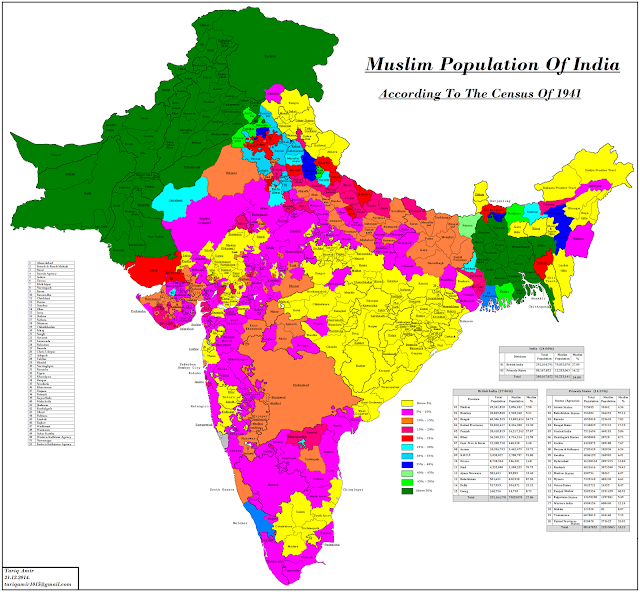
Which takes me to India: the more impactful Islam seems to me, the more amazing it is that India remained 75% non-Muslim on the eve of partition. The most Islam-skeptic Indians tend to be pro-Hindu, but historical evidence of Islam’s power and influence actually suggest that Hinduism is something very special as a cultural complex.

Note: I say “Indian religion” to side-step semantic arguments about Hinduism. Ironically, I think modern elite Hinduism probably emerged and developed around the same time as Islam itself, though proto-Hindu beliefs are clearly very old.

Climate change: impact on the Hajj


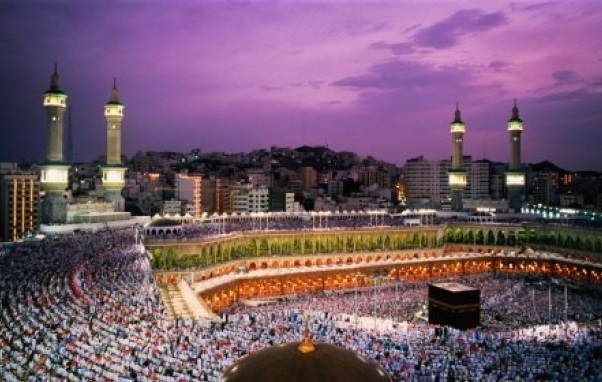
The Hajj, Mecca

**

Since I posted my poem Mourning the lost Kaaba in late November 2017 — though not, I imagine, because of my poem — a report on the likely impact of climate change on the annual Hajj pilgrimage has come out from scientists at MIT and Loyola Marymount:

Kang, Pal, & Eltahir, Future Heat Stress During Muslim Pilgrimage (Hajj) Projected to Exceed “Extreme Danger” Levels

Here’s the abstract:

The Muslim pilgrimage or Hajj, which is one of the five pillars of Muslim faith, takes place outdoors in and surrounding Mecca in the Saudi Arabian desert. The U.S. National Weather Service defines an extreme danger heat stress threshold which is approximately equivalent to a wet?bulb temperature of about 29.1 °C—a combined measure of temperature and humidity. Here, based on results of simulations using an ensemble of coupled atmosphere/ocean global climate models, we project that future climate change with and without mitigation will elevate heat stress to levels that exceed this extreme danger threshold through 2020 and during the periods of 2047 to 2052 and 2079 to 2086, with increasing frequency and intensity as the century progresses. If climate change proceeds on the current trajectory or even on a trajectory with considerable mitigation, aggressive adaptation measures will be required during years of high heat stress risk.

**

That’s the science — and while Saudi Crown Prince Mohammed bin Salman told the G20 in June that the Saudis are committed to “reducing greenhouse gas emissions and adapting to the negative effects of climate change,” beliefs concerning the Prophet’s institution of the Hajj in 632 CE following on earlier Abrahamic practice may well clash with scientific claims that the Hajj may become impossible for future devout Muslims to observe.

What happens, then, when this divine command intersects with increasing temperatures that eventually render Mecca uninhabitable? How do the climate change scientists fare when they sit across the table from the ulema, the scholar-clergy of Islam?

From a Muslim point of view, we’d better climate-correct, and do so fast:

Shahin Ashraf, We must stop climate change before it makes Hajj impossible

**

The issue I’ve raised above is tightly focused on one sanctuary, one religion, one pilgrimage. Below are some other major pilgrimage sites to consider in light of climate change:

I would be interested in the cross-disciplinary exploration of the impact of climate change as understood by the scientific consensus, global migration patterns now and as expected in the coming years, and the devotional rituals and ceremonials of the various religions involved.

Large pilgrimages and religious ceremonials

This list draws text from Wikipedia and other online information sites.

Kumbh Mela:

Allahabad, India, 120 million devotees, every 12 years. The Prayag Kumbh Mela is a mela held every 12 years at Allahabad, India. The fair involves ritual bathing at Triveni Sangam, the meeting points of three rivers: the Ganga, the Yamuna and the mythical Sarasvati. The Kumbh Mela in 2013 became the largest religious gathering in the world with almost 120 million visitors.

Arba’een:

Karbala, Iraq, 30 million pilgrims annually. The Arba’een Pilgrimage is the world’s largest annual public gathering, held every year in Karbala, Iraq at the end of the 40-day mourning period following Ashura, the religious ritual for the commemoration of martyrdom of the grandson of Prophet Mohammad and the third Shia Imam, Husayn ibn Ali’s in 680. Anticipating Arba’een, or the fortieth day of the martyrdom, the pilgrims make their journey to Karbala on foot,where Husayn and his companions were martyred and beheaded by the army of Yazid I in the Battle of Karbala. The number of participants in the annual pilgrimage reached 30 million or more by 2016.

Papal Mass

Philippines, 7 million adherents, occasional. Pope Francis’ apostolic and state visit to the Philippines garnered a record breaking crowd of 7 million people. The mass conducted by the pope was the largest gathering in papal history.

Makara Jyothi

India, 5 million pilgrims annually. This pilgrim center and temple is located amidst a dense forest in the southern region of India. It was visited by over 5 million pilgrims in 2007 for a festival known as ‘Makara Jyothi,’ occurring annually on the 14 of January. Although the Sabarimala Temple, site of the Makara Jyothi celebration) draws a crowd of 50 million visitors annually, the specific day of the miraculous celestial lighting observation gathered 5 million pilgrims in 2007.

Bishwa Ijtema:

Near Dhaka, Bangladesh, 5 million pilgrims annually. The Bishwa Ijtema, meaning Global Congregation, is an annual gathering of Muslims in Tongi, by the banks of the River Turag, in the outskirts of Dhaka, Bangladesh. It is one of the largest peaceful gatherings in the world. The Ijtema is a prayer meeting spread over three days, during which attending devotees perform daily prayers while listening to scholars reciting and explaining verses from the Quran. It culminates in the Akheri Munajat, or the Final Prayer, in which millions of devotees raise their hands in front of Allah (God) and pray for world peace.The Ijtema is non-political and therefore it draws people of all persuasion. It is attended by devotees from 150 countries. Bishwa Ijtema is now the second largest Islamic gatherings with 5 million adherents

[ this is where the Hajj, with 2.3 million pilgrims annually, fits in ]

Umrah:

Mecca, size unknown, year round. The ?Umrah is an Islamic pilgrimage to Mecca, Hijaz, Saudi Arabia, performed by Muslims that can be undertaken at any time of the year, in contrast to the ?ajj which has specific dates according to the Islamic lunar calendar. It is sometimes called the ‘minor pilgrimage’ or ‘lesser pilgrimage’, the Hajj being the ‘major’ pilgrimage which is compulsory for every Muslim who can afford it. The Umrah is not compulsory but highly recommended.

Kalachakra,:

Various locations, 500,000 participants, variously. The Kalachakra is a term used in Vajrayana Buddhism that means “wheel(s) of time”. “K?lacakra” is one of many tantric teachings and esoteric practices in Tibetan Buddhism. It is an active Vajrayana tradition, and has been offered to large public audiences. The tradition combines myth and history, whereby actual historical events become an allegory for the spiritual drama within a person, drawing symbolic or allegorical lessons for inner transformation towards realizing buddha-nature. The Dalai Lama’s 33rd Kalachakra ceremony was held in Leh, Jammu and Kashmir, India from July 3 to July 12, 2014. About 150,000 devotees and 350,000 tourists were expected to participate in the festival. The Kalachakra has also been performed, eg, by Grand Master Lu Sheng-yen of the True Buddhs School, a Chinese Vajrayana group.

**

The impacts of climate change will need to be studied as they apply not only to these sites of pilgrimage, but also to holy sites in general, notably including Jerusalem, Rome, Varanasi, and Kyoto.

Book Review: The 1965 War by Shaukat Riza

From Major Amin

  1. THE PAKISTAN ARMY –WAR 1965 MAJOR GENERAL SHAUKAT RIZA (RETD) –ARMY EDUCATION PRESS 1984-309 PAGES , MAPS AND PHOTOGRAPHS Reviewed by Major Agha H Amin (Retired)
  2. This book was the first official effort to record military history of 1965 war. Major General Shaukat Riza an artillery officer dabbled in military writing and had penned many articles and military papers etc. He was described as a soft spoken gentle man who did not take kindly to being ordered to carry out ruthless action against civilians thus his removal from 9 Divisions command in 1971 in East Pakistan. On the other hand Brigadier Amjad Chaudhry when I met him in 1977-78 described him as not getting along well with major general abrar in the staff college in 1967-68 while serving as chief instructor. In addition he had a long record of having served as an instructor at various army schools of instruction including the prestigious command and staff college. The first major attempt at writing the 1965 war history was made by Brigadier Amjad Ali Khan Chaudhry whose book on 1965 war was published in 1977. Shaukat Rizas book was officially sponsored and he was provided access to all records.
  3. However as all official publications are , the book was doctored and sanitized and the author did not enjoy the right to critical analysis. The book nevertheless has great value. First it contains almost all major orders of battles of all major formations . Second it gives a clear picture of major events of the war. Third it manages to give insights about some most decisive battles of the 1965 war. Most interesting battle of Gadgor where Shaukat Riza described how clueless the 24 Brigade commander was when the Indian 1st Armoured Division broke in and all he could say was “ Nisar, Do Something”.
  4. Brigadier Shaukat Riza’s analysis of Operation Grand Slam is also reasonably critical.  where he faults 12 Division with bad handling of artillery and dispersing artillery fire. He totally misses out how armour was divided by 12 Division on first day of the war thus leading to failure although B Squadron 11 Cavalry had reached Chhamb at Tawi River at 0830 Hours in the morning. However with regard to change of command it appears that major general shaukat riza was forced to give legitimacy to the post 1965 pakistan army whitewash, i.e that change of command of operation grand slam was pre planned and not a surprise as was mostly believed. His treatment of Pakistan Armys First Armoured Division attack is critical and incisive.He admits that whole 4 cavalry. was captured by the Indians .Further he admits that there was much exaggeration of enemy strength in the reporting of armoured division commanders at various levels. When he describes how various brigades of Pakistans 1st armoured division were ordered left and right away from the scene of attack he hints at a Pakistan Army general headquarters deeply afflicted and paralysed by supreme indecision, vacillation and irresolution.
  5. The maps of the book are weak in details of what actually happened merely showing topgraphic details while what formations actually did is left to the readers imagination. However when we received this book via the army book club in 1985-86 this was a revolutionary development as till that time censorship had deeply plagued the cause of military history in Pakistan. Much blame of the failure was passed to ZA Bhutto while Generals Ayub and Musa were presented as innocent bystander pure maidens !
  6. One must admit that the general was handicapped by too many cooks doctoring his book and practicing sycophancy with the usurper and dictator zia , at the height of his power. Even General Mc Chrystal confessed that his book was subjected to some kind of official censorship and sanitization. This is the cost of becoming generals in any army where a man has to compromise over many things . As Sir Francis Bacon brilliantly summed it up , men gain dignities through indignities.
  7.  Major General Saeeduz Zaman Janjua many times recounted how even General Asif Nawaz , although his close relative , had to be obsequious and flexible with his seniors , as a brigadier and major general , failing which he would not have been promoted. Particularly he recounted a situation where a very senior officers son was caught cheating in the Pakistan Military Academy and General Asif Nawaz had to stop at relegation while the minimum punishment was withdrawal from the academy. This is how the world moves and only those who compromise and submit climb high in the so called systems or hierarchies. A man with no war record but one who was all in all in Pakistan of 1984.A sad year like George Orwells book 1984.
  8.  The book ignores how badly Pakistan Army was organized with formations like 12 Division holding an area of responsibility occupied by some five Indian divisions. What stopped Ayub Khan from raising 5 more divisional headquarters in 12 Division area of responsibility. At least this book gave us some idea about what had happened and a skeleton structure to construct a more detailed picture. His two later books Pakistan Army 1947- 59 and Pakistan Army 1966-71 were also similarly handicapped by censorship and sanitization by the Pakistan Army GHQ but more of this in subsequent book reviews.

Continue reading Book Review: The 1965 War by Shaukat Riza

Obituary: Brigadier Nisar Ahmed SJ

From Dr Hamid Hussain. Perhaps not of general interest on this site, but worth preserving in any case. See details of Col Nisar’s critical (and courageous) action in 1965 are added below this obituary.

Obituary – Brigadier ® Nisar Ahmad Khan (28 March 1920 – 30 July 2019)

Hamid Hussain

Brigadier ® Nisar Ahmad Khan passed away on 30 July 2019 in Michigan; United States.  He was nick named ‘Kaka Nisar’.  A fine officer and gentleman who was instrumental in a very important holding action of armor in 1965 Indo-Pakistan War faded away into the fog of history.  He was born on 28 March 1920 at Bassi Pathana near Sirhind in Patiala state.  This Muslim Pathan colony was established during Mughal era.  This small Muslim enclave in a Sikh state provided soldiers to the Maharaja of Patiala.  Several generations of Nisar’s ancestors proudly served Patiala state. According to Maharaja Patiala Captain ® Amarindar Singh, Kaka Nisar was sixth generation of the family to serve Patiala state.  He followed the family tradition, joined Ist Patiala (Rajindra) Lancers and commissioned on 21 March 1943. Continue reading Obituary: Brigadier Nisar Ahmed SJ

Letter of General Akhtar Malik (Re Grand Slam)

There is endless controversy in Pakistan about the way Gen Akhtar Malik, who led the opening phase of Pakistan’s invasion of Kashmir in 1965 (operation Grand Slam) was removed from command the day after the attack started. The Pakistan army had decisive superiority in tanks and artillery and on the first day captured Chamb and were threatening to break through towards Akhnur, but on the 2nd day of operations there was an abrupt change in command as Gen Malik was replaced by Gen Yahya Khan. This led to some delay and gave the Indians the chance to reinforce their defenses. Many in Pakistan blame this command change for the failure of Grand Slam. You can read more about the operation in another post. The controversy will no doubt continue. Here is a letter from Gen Malik to his brother, written 2 years after the war, which gives his version of events (I received this via Major Amin).
Gen Akhter Hussain Malik’s Letter to His Brother Gen Abdul Ali Malik
My Dear brother,
I hope you and the family are very well. Thank you for your letter of 14 Oct. 67. The answers to your questions are as follows:
a. The de facto command changed the very first day of the ops [operations] after the fall of Chamb when Azmat Hayat broke off wireless communications with me. I personally tried to find his HQ [headquarters] by chopper and failed. In late afternoon I sent Gulzar and Vahid, my MP [military police] officers, to try and locate him, but they too failed. The next day I tore into him and he sheepishly and nervously informed me that he was ‘Yahya’s brigadier’. I had no doubt left that Yahya had reached him the previous day and instructed him not to take further orders from me, while the formal change in command had yet to take place. This was a betrayal of many dimensions.
b. I reasoned and then pleaded with Yahya that if it was credit he was looking for, he should take the overall command but let me go up to Akhnur as his subordinate, but he refused. He went a step further and even changed the plan. He kept banging his head against Troti, letting the Indian fall back to Akhnur. We lost the initiative on the very first day of the war and never recovered it. Eventually it was the desperate stand at Chawinda that prevented the Indians from cutting through.
c. At no time was I assigned any reason for being removed from command by Ayub, Musa or Yahya. They were all sheepish at best. I think the reasons will be given when I am no more.
d. Not informing pro-Pak Kashmiri elements before launching Gibraltar was a command decision and it was mine. The aim of the op was to de freeze the Kashmir issue, raise it from its moribund state, and bring it to the notice of the world. To achieve this aim the first phase of the op was vital, that is, to effect undetected infiltration of thousands across the CFL [cease-fire line]. I was not willing to compromise this in any event. And the whole op could be made stillborn by just one double agent.
e. Haji Pir [Pass] did not cause me much anxiety. Because [the] impending Grand Slam Indian concentration in Haji Pir could only help us after Akhnur, and they would have to pull out troops from there to counter the new threats and surrender their gains, and maybe more, in the process. Actually it was only after the fall of Akhnur that we would have encashed the full value of Gibraltar, but that was not to be!
f. Bhutto kept insisting that his sources had assured him that India would not attack if we did not violate the international border. I however was certain that Gibraltar would lead to war and told GHQ so. I needed no op intelligence to come to this conclusion. It was simple common sense. If I got you by the throat, it would be silly for me to expect that you will kiss me for it. Because I was certain that war would follow, my first choice as objective for Grand Slam was Jammu. From there we could have exploited our success either toward Samba or Kashmir proper as the situation demanded. In any case whether it was Jammu or Akhnur, if we had taken the objective, I do not see how the Indians could have attacked Sialkot before clearing out either of these towns.
g. I have given serious consideration to writing a book, but given up the idea. The book would be the truth. And truth and the popular reaction to it would be good for my ego. But in the long run it would be an unpatriotic act. It will destroy the morale of the army, lower its prestige among the people, be banned in Pakistan, and become a textbook for the Indians. I have little doubt that the Indians will never forgive us the slight of 65 and will avenge it at the first opportunity. I am certain they will hit us in E. Pak [East Pakistan] and we will need all we have to save the situation. The first day of Grand Slam will be fateful in many ways. The worst has still to come and we have to prepare for it. The book is therefore out.
I hope this gives you the gist of what you needed to know. And yes, Ayub was fully involved in the enterprise. As a matter of fact it was his idea. And it was he who ordered me to by-pass Musa while Gibraltar etc. was being planned. I was dealing more with him and Sher Bahadur than with the C-in-C. It is tragic that despite having a good military mind, the FM’s [Foreign Minister Z.A. Bhutto’s] heart was prone to give way. The biggest tragedy is that in this instance it gave way before the eruption of a crisis. Or were they already celebrating a final victory!!
In case you need a more exact description of events, I will need war diaries and maps, which you could send me through the diplomatic bag.
Please remember me to all the family.
Yours,
Akhtar Hussain Malik
Brown Pundits