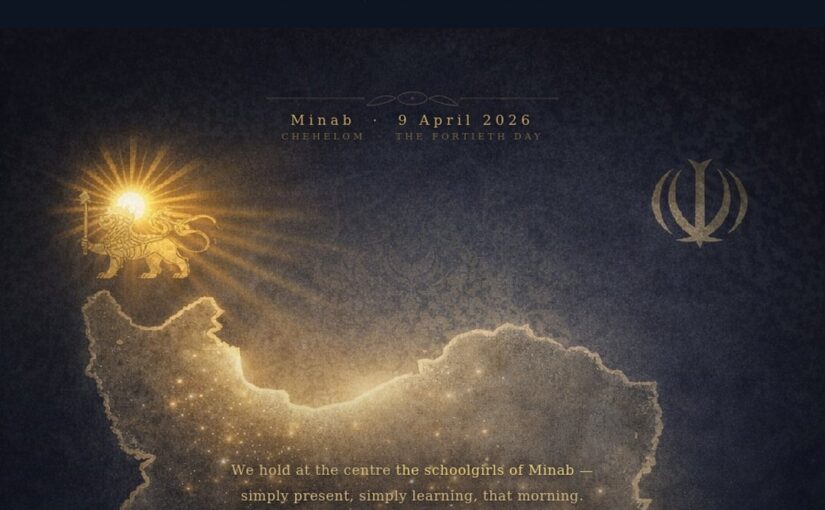
A Minute of Silence for the Schoolgirls of Minab | Chehelom, 9 April 2026

If you would like to receive an invite to the Minab Zoom Memorial; please email the Brown Pundits email address on the left. Thank you.


The Chehelom, چهلم, is the Persian tradition of gathering on the fortieth day after a death to pray, remember, and bear witness. It predates Islam and runs through every strand of Iranian culture. We mark it here not as a political act but as a human one. Set your alarm. One minute. That is all we ask. XTM

At 10:45am on 28 February 2026, 165 human beings, most of them schoolgirls aged 7–12 from the Bandari and Afro-Iranian communities of southern Iran, were killed in the bombing of the Shajareh Tayyebeh school in Minab.

9 April is their Chehelom; the Persian fortieth-day memorial.

Wherever you are in the world, please set an alarm for 10:45am Tehran time on Thursday 9 April and take one minute of silence.

For the girls of Minab. For every innocent life lost in this war. No hierarchy of grief; Jewish or Arab, Muslim or Persian, American or migrant.

We are all One.

🕰 Tehran 10:45 · London 08:15 · New York 03:15 · LA 00:15 · Sydney 17:15

Share as far as you can. 🕊 Continue reading A Minute of Silence for the Schoolgirls of Minab | Chehelom, 9 April 2026

The Forty-Day War: Pakistan Saved the World?

[A note before we begin: We held back out of respect for Iran Zamin and the weight of what was unfolding. Pakistan has now acted where others would not, and the moment deserves acknowledgement.

This should have been India’s role. No other power sits closer to both Tehran and Washington. No other civilisational bridge existed with the credibility to hold both sides. That fatal trip, PM Modi’s visit to Tel Aviv, poisoned those waters permanently. It did not merely signal a foreign policy choice. It signalled comfort with regime change in a neighbouring civilisation. The opportunity cost is historic and will not be recovered.

What Pakistan has achieved is without precedent in its modern history. The Muslim Prussian Republic, forged in argument, held together by will, perpetually doubted, walked into the gap the subcontinent’s greater power vacated and stopped a war. The world owes a debt to Quaid-e-Azam and Allama Iqbal’s creation that it will not rush to acknowledge. That is how it goes. But we are noting it here, now, while the moment is live.]

History named the last one. It was called the Twelve-Day War. Clean. Surgical. A rehearsal. This one will be called the Forty-Day War. It began on 28 February 2026 with a decapitation strike that shattered Iran’s command structure in a single night and a brutal attack on a girl’s school. It paused on 8 April, when a Pakistani Prime Minister’s tweet achieved what five weeks of bombardment, ultimatums, and a pope’s intervention could not.
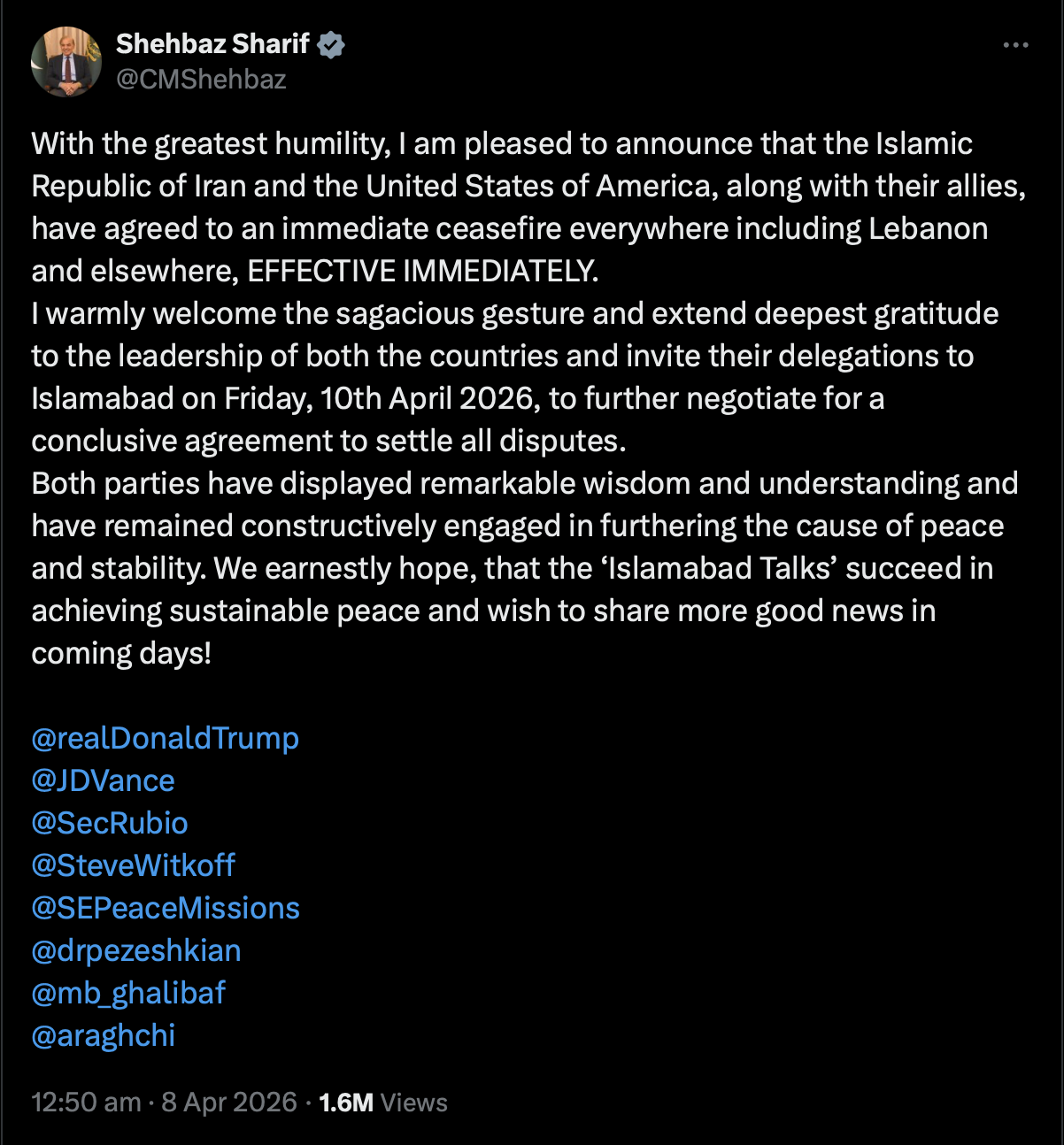
Pakistan forced the pause the world could not secure.

This is not sentiment. It is structural. Islamabad was the only room both sides could enter. Pakistan maintained working diplomatic channels with Tehran throughout the war. It shared enough institutional credibility with Gulf capitals to be trusted as a mediator. It was sufficiently operationally relevant to Washington; Field Marshal Munir’s name appeared, unremarkably, in Trump’s own ceasefire announcement, to be taken seriously rather than patronised. No other state sat at that intersection. Egypt tried. Turkey tried. Neither had all three legs of the stool.
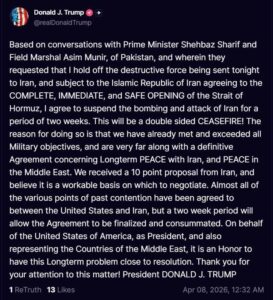
Over forty days, escalation outran control. Oil surged past $110 a barrel and briefly touched $117. Insurance markets seized. Traffic through the Strait of Hormuz reduced to a trickle. American signalling moved from coercive to apocalyptic, “a whole civilization will die tonight.” Iranian signalling hardened even as its leadership structure absorbed shock. Each side retained the capacity to raise costs further. Neither had a clean exit.

Pakistan supplied one.

The mechanics of the pause reveal everything. Tehran accepted a two-week window in which maritime traffic would resume under its coordination. Read that precisely. Coordination, not surrender. The Strait remains, in Iranian framing, an instrument of state power. That is not the language of defeat; though states rarely speak the language of defeat in real time, regardless of battlefield reality. What matters is what the text actually says. Iran controls the reopening. Iran does not yield it.

Washington will declare victory. The machinery is already running. Continue reading The Forty-Day War: Pakistan Saved the World?

Zahak versus Husayni

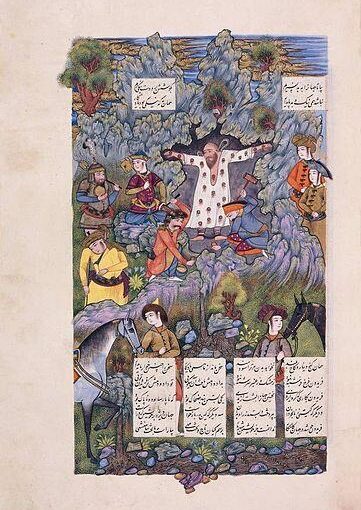
On March 1, 2026, Reza Pahlavi issued his statement on the killing of Ali Khamenei: “Ali Khamenei, the Zahhak of our time; the evil being who, just a few weeks ago, issued the order to slaughter tens of thousands of Iran’s finest children, is gone.

The Shahnameh framing was not ornamental. For years, Pahlavi has used the Zahhak figure, the serpent-shouldered tyrant who fed on the brains of Iran’s youth, as his shorthand for the Islamic Republic.

Zahhāk: An Etiology of Evil - The Markaz Review

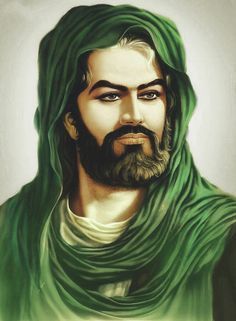
And Khamenei, symmetrically, had organized his entire ideological project around the Husayni archetype: the martyr of Karbala, the one who refused submission before Yazid’s overwhelming power. Every day is Ashura. Every land is Karbala. That was the grammar of the revolution.

Imam Hussain: The Man Who Opposed the Founding Fathers of ISIS | HuffPost  Contributor

Now the “Zahhak” is dead (or the Husseiny attained martyrdom depending on your viewpoint). The question that follows is the only one that matters: who is Iran? Continue reading Zahak versus Husayni

Indian Music Spotlight – Kazinama – Ahista Ahista

I am a big fan of neo-soul/neo-funk, so good to see Indian artists also doing something in that style.

A remix of an old Pakistani* song.

*XTM edit; I do not condone intellectual theft. The original version was sung in Pakistan in the late 80’s.


Please note to all I’m now going to be far less tolerant of tricks & provocations on ALL sides.

It’s in very poor taste to appropriate the hard & beautiful work of a now deceased female artist.

Iran and Pakistan Are Not the Same Kind of State

Iran cannot be analysed using the same political categories as Pakistan or most modern states. The difference is not whether a regime is monarchical, clerical, or military. It is the age of the civilisation being governed. Pakistan is a young state. Its borders, institutions, and political language were assembled in the twentieth century. In such states, power fills a vacuum directly.

Power in Young States, Authority in Old Ones

A military dictatorship governs by force, hierarchy, and command. Its legitimacy is procedural and immediate: order, security, survival. This form works where political memory is thin and inherited meaning is limited. Pakistan’s army did not overthrow an old order. It stepped into an empty one. Iran is structured differently. It is a civilisational state that has existed in recognisable form for roughly three thousand years. Power there has never been exercised through force alone. Authority has always been tied to ideas that predate any single regime.

Monarchy as Civilisation, Not Administration Continue reading Iran and Pakistan Are Not the Same Kind of State

Lord Zoroaster’s Fire Still Burns

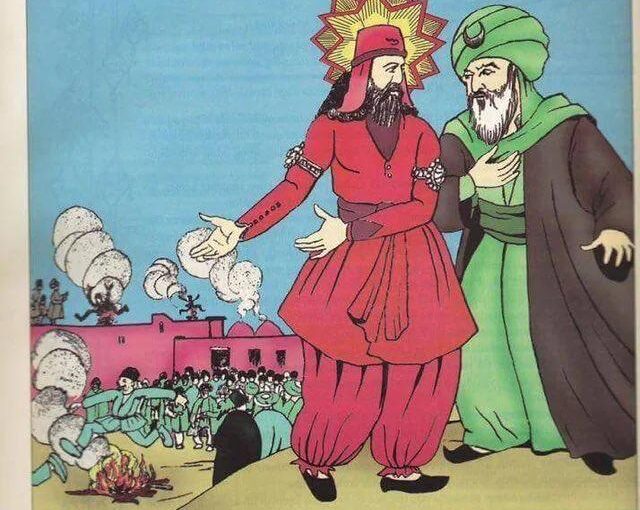
In the 1920s, Soviet Azerbaijan produced a remarkable satirical magazine called Molla Nasreddin. It mocked clerics, superstition, empire, and authority with a sharpness that would soon be extinguished by Stalinist conformity. One cartoon from that period shows two figures standing side by side: Lord Zoroaster in red, radiant and amused; Prophet Muhammad in green, solemn and slightly defensive. Below them, a crowd leaps over a fire.

Lord Zoroaster turns and says: “You claimed to bring them a new religion, but they still jump over my fire.”

The joke is simple. The implication is not. It is a jab at how ancient Persian customs; Nowruz, fire-jumping, seasonal rites, survived Islamic conversion not as relics, but as living practice. Islam arrived. The civilisation did not leave. The fire stayed lit.

Iran Is Not a Regime Problem Continue reading Lord Zoroaster’s Fire Still Burns

How will the Iranian Regime Survive? By Becoming Persian & Crowning a Pahlavi Queen

Iran After Ideology

The Iranian Revolution survived because it fused two forces that had long resisted foreign domination: Shi‘i Islam and Persian historical memory. It endures today because it still commands the machinery of the state. But endurance is not the same as viability. The revolution has reached a point where its original ideological heft, once an asset, has become its primary liability.

The Iranian Revolution must become Iranian. Not rhetorically, but structurally. Islam can no longer function as an export ideology or as a permanent mobilisation doctrine. It must become a civilisational substrate: Islam with Persian characteristics, not Persian life bent permanently around Islamic revolution. The clerical class has to accept a hard truth that other revolutionary elites eventually learn; that ideology is a ladder, not a house. Nuclear ambition, permanent resistance, and theological maximalism were once instruments of leverage. Today they are liabilities. Iran is not losing legitimacy because it is insufficiently Islamic; it is losing legitimacy because it insists on remaining revolutionary long after the revolution has exhausted its social utility.

The English Example Continue reading How will the Iranian Regime Survive? By Becoming Persian & Crowning a Pahlavi Queen

Between Arab Conquest and Persian Conversion: The Sasanian Inheritance

The Clip That Explained a Civilisation

A short video of an Iranian woman is circulating on X. In it, she says Islam is not Iran’s native religion and was imposed on Zoroastrian Persians through torture, massacre, rape, and enslavement. The clip is amplified by familiar accelerants, including Tommy Robinson, and is now being treated as a one-line explanation for a fourteen-century transformation.

Almost immediately, a counter-narrative appears. It insists there is “not a single piece of evidence” for forced conversion in Persia; that Islamisation was slow; and that many Persians, especially Sasanian elites, moved toward the new order for political, fiscal, and social reasons. A further layer is added: nostalgia for the Sasanians is misplaced because late Sasanian society was rigid, unequal, and harsh, and early Muslim rule improved conditions for ordinary people. These are two different claims. They are routinely fused. History does not require that fusion.

Conquest Is Not Conversion Continue reading Between Arab Conquest and Persian Conversion: The Sasanian Inheritance

Why Hasn’t Pakistan Collapsed Yet?

A cultural explanation, not an institutional one.

The comments on the last post revealed something important: there is a difference between learning about a culture and living inside it. The Indo-Muslim legacy sits precisely in that gap. It is not owned by a census or a successor state. It survives in people whose habits, tastes and instincts are shaped by it, even if they no longer identify with the religion that produced it.

Most arguments in the thread reduced the issue to arithmetic. “India owns the legacy because most Muslims stayed.” “Pakistan can’t own it because Delhi and Lucknow are in India.” These claims are tidy, but they miss the point. Culture does not follow borders. It follows continuity.

My own shift in identity made this clear. As I Hinducised through marriage, I also Persianised. The Islamicate part of me did not vanish; it was absorbed into a Bahá’í frame where contradictions resolved themselves in a Dharmic canvas. It taught me something simple: civilisations are not inherited by territory; they are inherited by people who keep caring.


1. Rushdie and the Islamicate Without Islam

Continue reading Why Hasn’t Pakistan Collapsed Yet?

On the Question of Who “Owns” the Indo-Muslim Legacy

Reading Sophia Khan’s superb piece on the lost Muslim cities of Hindustan, and then watching the BP comment-thread unfold, a few thoughts crystallised for me; less about “ownership,” and more about the intellectual pattern that keeps resurfacing whenever Indo-Muslim history is discussed.

First: I genuinely did not know that Khan was originally pronounced with a silent n, nor that paan had such a deep Islamicate turn in its social history. Much like music, I had long assumed paan to be a largely Hindu-coded practice. The article forces a re-examination of how intertwined everything actually was. The same goes for Hindustani music: I once thought of it as essentially a Hindu, temple-rooted tradition. Then you realise how much of the courtly synthesis, Persian, Hindavi, Turko-Central Asian, was shaped by Muslims, even if the Vedic lattice underneath remained foundational.

This is partly why I found Bombay Badshah’s objection (“Pakistan cannot claim any of this”) an odd line to draw. One can, of course, make the territorial argument; but it collapses immediately once you observe what India itself is doing: aggressively appropriating the Indo-Muslim aesthetic while deracinating its historical context. If Bollywood, tourism, cuisine, and the Indian cultural machine can freely claim Delhi, Lucknow, Agra, and Hyderabad as national inheritances, then Pakistanis whose families actually come from those cities are hardly crossing an intellectual red line by acknowledging lineage, memory, or loss. Continue reading On the Question of Who “Owns” the Indo-Muslim Legacy

Brown Pundits