MH-370- eyewitness account?

In her account, Katherine
Tee has described seeing “an elongated plane glowing bright orange, with
a trail of black smoke behind it”,
heading from north to south.


With all the wonders of modern technology they still have no clue about what happened to the plane. But astonishingly enough, there may have been an eyewitness. Is she credible? That is now the million dollar question.
….She said: “I saw something that looked like a plane
on fire. That’s what I thought it was. Then, I thought I must be mad

It caught my attention because I had never seen a plane with orange
lights before, so I wondered what they were.

……

A
British woman who was sailing near Indonesia at the time Malaysia
Airlines flight MH370 disappeared has said she believes she saw the
plane “burning” and billowing smoke before it crashed in the southern
Indian Ocean.


An eyewitness account from yachting enthusiast
Katherine Tee, 41, has now been filed with the Joint Agency Coordination
Centre (JACC) leading the search based in Australia, which is yet to
find any trace of the missing jet.

In her account, Katherine
Tee has described seeing “an elongated plane glowing bright orange, with
a trail of black smoke behind it”, heading from north to south.

The object was flying at “about half the height” of two other flights
in the same patch of sky at the time, she said, in a series of posts
detailing the sighting on the yachting website Cruisers Forum, where
Katherine Tee is a moderator.

 She
later told the Phuket Gazette that she initially dismissed the incident
as being “just a meteor” or even a figment of her imagination — until a
recent check of GPS logs confirmed that the plane’s projected track may
have taken it very close to where the yacht was sailing at the time.
“This is what convinced me to file a report with the full track data for our voyage to the relevant authorities,” she said.

As for whether or not what Katherine Tee saw really was a burning
plane, she has admitted on the forum that she was going through a
particularly stressful part of the journey at the time, including
difficulties in her marriage, and that her judgment may have been
impaired.

She said: “I saw something that looked like a plane
on fire. That’s what I thought it was. Then, I thought I must be mad …
It caught my attention because I had never seen a plane with orange
lights before, so I wondered what they were.

“There were two
other planes passing well above it — moving the other way — at that
time. They had normal navigation lights. I remember thinking that if it
was a plane on fire that I was seeing, the other aircraft would report
it.”

When the pair arrived in Phuket everyone was talking about
the missing jet, and asked if they had seen anything. Ms Tee said she
told them what had happened, but that she “didn’t think anyone would
believe me when I was having trouble believing my own eyes”.

The JOCC has reportedly told Katherine Tee it will use her data logs
alongside those of the British satellite operator Inmarsat in its
ongoing investigation The JOCC has reportedly told Ms Tee it will use
her data logs alongside those of the British satellite operator Inmarsat
in its ongoing investigation “I didn’t even consider putting out a
Mayday at the time. Imagine what an idiot I would have looked like if I
was mistaken, and I believed I was.”

She has now filed two
reports to the JACC, which she said had replied to say her data logs
would be looked into. The Phuket Gazette reported that officials are yet
to confirm the account will be investigated in full.

…..

….
Link: http://timesofindia.indiatimes.com/world/rest-of-world/MH370-search-British-sailor-may-be-last-to-see-lost-jet-after-reporting-burning-plane-with-trail-of-black-smoke-over-Indian-Ocean/articleshow/36006286.cms
…..

regards

Justice (for the dead) and dignity (for non-dead)

It is very unlikely that justice will come in time for all the internally displaced people (IDP) who are literally dying in the refugee camps in South Asia, Australia and elsewhere. At the least we should try and make sure that the survivors are able to live with dignity. 
….
A 29-year-old asylum seeker…Seemanpillai died
of his injuries after burns to 90% of his body and is the second Sri
Lankan asylum seeker to have self-immolated in Australia this year.

……..

But…as the bishop says…we are all one people. We must have faith in this sentiment
even while all over South Asia, one community after another, is trying
to create high purity enclaves in which no minority voice will be
tolerated.

….The
resettlement process in Sri Lanka cannot move forward without India’s
assistance and the country can do more to help thousands of widows and
children who have been rendered orphans, Bishop of Jaffna diocese Daniel
S Thiagarajah said on Tuesday.

And if we find the will-power to help Sri Lankan Tamils let us also be mindful about the Gujarati Muslims and the Kashmiri, Bengali, and Sindhi Hindus (and many others).

It would be also nice if the Pankajists spend even one percent of their ink on ALL of the forgotten South Asians (Hindus mainly). Arundhati Roy has even claimed that the India has let the Pandit refugees suffer on purpose so as to discredit Kashmiri muslims. She needs to grow up and remove her ideological blinkers.

 
Not to diminish the suicides noted above, it is women who suffer the most from such adverse social dynamics. They suffer during war and they suffer during peace. They suffer because men (collectively, individually) act as if deprived of any conscience whatsoever.

To our elites one simple message: stop bickering and start governing. Maintain law and order and provide the basic amenities of life. Stop purchasing submarines and aircraft carriers till you can stop the society from sinking into the mud. Above all stop polarizing communities against each other for petty gain. 
…..
A 29-year-old asylum seeker who died after setting himself on fire
has been named as Leo Seemanpillai, a Tamil man who lived in Geelong,
Victoria.

Seemanpillai died of his injuries after burns to 90% of his body and is the second Sri Lankan asylum seeker to have self-immolated in Australia this year.
The
Tamil Refugee Council said Seemanpillai had set himself alight on
Saturday evening and died on Sunday morning at Alfred Hospital.

Seemanpillai
arrived in Darwin by boat in January 2013 and was said to be suffering
depression for more than a year. He was being held in community
detention on a bridging visa with work rights. His refugee claim was
still being processed, Scott Morrison said on Monday.

Arasa Ratnakanthan, a Sri Lankan refugee activist
who spoke to Seemanpillai’s flatmate on Monday morning, said the asylum
seeker had left Sri Lanka in the early 1990s aged just three or four.

Ratnakanthan
said Leo had spent more than 20 years as a refugee in India and had
tried to return to Sri Lanka in 2002 but had been persecuted by the Sri
Lankan military and so had returned to India.

Ratnakanthan said Leo’s family had been members of the Tamil political movement.

The
Australian government has close diplomatic ties with Sri Lanka and many
Sri Lankan asylum seekers have been subject to a fast track “enhanced
screening” process, which human rights groups say denies them due
process as many have their claims assessed without the presence of a lawyer before being returned. More than 1,000 Sri Lankans have been returned by Australia in recent years.

Seemanpillai was not subject to the enhanced screening process, but in October the immigration minister warned Sri Lankan asylum seekers who planned to enter Australia by boat: “Anyone who may have come from Sri Lanka should know that they will go back to Sri Lanka.”

……
The
resettlement process in Sri Lanka cannot move forward without India’s
assistance and the country can do more to help thousands of widows and
children who have been rendered orphans, Bishop of Jaffna diocese Daniel
S Thiagarajah said on Tuesday.

He said the Church of South India has set up a centre in Jaffna to help
those who witnessed the war and to help them overcome their fear.

He stressed that the church was focusing on the well-being of all
people in the country. “We are all one people. Ahead of us is a
challenging task of rehabilitation of our people who have gone through
the darkest period in our history,” he said.

…..
Link (1): http://www.theguardian.com/world/2014/jun/02/asylum-seeker-who-set-himself-on-fire-spent-18-months-in-limbo

Link (2): http://timesofindia.indiatimes.com/india/Jaffna-bishop-says-Sri-Lanka-requires-Indias-help-for-resettlement-of-Tamils/articleshow/36010366.cms
…..

regards

Crisis in Karachi: Altaf Hussain arrested

Altaf Hussain head of Muttahida Qaumi Movement has been arrested in London, supposedly on money laundering charges. Why now. after all these years? We presume this is all rolling in the context of a Pakistan-West entente in which long-time POWs are being swapped between the USA and the Taliban.   

PM Nawaz Sharif is likely to get a significant boost out of this, which will silence his main opposition (Imran Khan and the Deep State). A truly master-stroke from a political genius, but the fall-out must be now handled carefully.

We do not expect AH to be extradited to Pakistan (the European Court does not permit extradition to a country where death penalty is legal and there is also a legitimate fear of torture at the hands of the state authorities).

For now Karachi is in crisis mode and we hope that peace will be maintained at all costs. The British High Commission is closed. We wish the hapless citizens all the best. Please stay safe!!!!
……
Muttahida Qaumi Movement (MQM) chief Altaf Hussain
was arrested on Tuesday in London on suspicion of money-laundering as
thousands of people in his home city of Karachi staged a sit-in calling
for his release.

The London Metropolitan police
confirmed that a 60-year-old man had been arrested from a northwest
London property on charges of money-laundering, but they declined to
disclose the exact identity for “legal reasons.”

The police said a Specialist Operations unit was currently carrying out a search operation at the property in northwest London.
DawnNews quoted the Scotland Yard as saying that the investigation would continue for 24 hours.
Moreover, London police has said that an audio-video statement has been recorded of the arrested man. 

Moreover, a spokesman for the British High Commission said that the UK’s consulate in Karachi has been temporarily closed down.
“We
deployed extra security at the British High Commission in the southern
part of Karachi as soon we learnt about Altaf Hussain’s arrest in London
through media,” Deputy Inspector General Abdul Khalique Shaikh told
Reuters.

“We have increased police patrolling and we are making further deployments at sensitive spots in the city,” he added.

Prime
Minister Nawaz Sharif said that the issue of Hussain’s arrest was of an
extremely sensitive nature, adding that the government would take all
legal angles into account.

The premier has directed parliamentarians and members of the PML-N not to comment on the news.
……

Link: http://www.dawn.com/news/1110316/altaf-hussain-arrested-in-london-on-charges-of-money-laundering
…..

regards

Indian Friends of Hitler (and Tojo)

Liberals everywhere are shocked at the BJP victory and wondering how did India get to this point. The backs of envelopes are filled up with sketches of straight lines drawn between two co-ordinates (Jews, 1939) and (Muslims, 2014). The imaginary gas chambers have also been fired up and are ready to go.

Assuming however that such an extreme scenario is unlikely (we are hopeful), there are still important questions to be asked (and a few history lessons to be learned) which may point to where Modi plans to go from here to the future. 

Is BJP truly a fascist party? Yes, the gloves do seem to fit quite snugly.  
Are there RSS honchos who carry feelings towards Muslims just like Hitler once (and many many German leaders) felt about Jews? Yes, however the favored approach now is assimilation and not assassination (for muslims, same difference).  
Finally, is it true that there were Indian nationalists who supported Hitler and Tojo in order to get rid of the Holocaust architects of South Asia- the British? Why, yes, that is also very much a part of Indian history, even though the Nehru-Gandhis have tried hard to rub it out. And Netaji Subhash Bose has plenty of fans even to this day, and not just in liberal-left Bengal.
……..
It was not just Netaji though, was it? There were famous muslim partners of Hitler, including a number of Waffen-SS divisions comprising of Bosnians-Kosovars-Albanian muslims. The Mufti of Jerusalem (Haj Amin Al-Husseini) raised 20,000 troops for Hitler and was a proud partner of the Third Reich. It will be no surprise if some of these valiant leaders/soldiers and  their exploits have found a pride of place in the History of Ummah.

Love of Hitler, or to be precise, love of the Fuhrer’s Friends now and in the past, seems to be much more universal than the liberals in the West are willing to let on.
……………………

To Muslims in both India and Pakistan, Modi
may represent the devil they know;
a leader whose economic success and
reputation for leadership provides stability and confidence. 
More
importantly, given Modi’s Indian nationalism, these voting patterns
suggest India’s Muslims who supported the BJP see themselves as Indians
first and Muslims second.


The powerful Indian nationalist sentiment
Modi has tapped into draws upon allegiances and ties some Americans
might find troubling. At a May 8 BJP rally in Varanasi, Modi honored a
115 year old Indian colonel who served under Subhash Chandra Bose in the
Indian National Army (INA). 
Known to most Indians as Netaji, Bose was
recognized by the Axis Powers during World War II as India’s rightful
government, whose support he sought against the British to help India
achieve independence. INA soldiers fought alongside the Japanese against
the British in the Burma campaign, were defeated, and 300 officers were
tried for treason. In August 1945, Netaji (Bose) died in a plane crash
in Japanese-occupied Taiwan.


Outside of India, the INA’s legacy has been
mostly forgotten. But within the country—and especially among India’s
rising business titans—Netaji is revered.  
“I believe India would have
been a powerful exporter much before China if only Netaji had a front
seat in our policy making along with (Jawaharlal) Nehru,” said Infosys
Technologies founder Narayana Murthy at Netaji’s 114th birthday celebration. “Netaji was one of the most courageous leaders in India.”


It is the name absent from that list which
speaks loudest. Mahatma Gandhi, whom many Americans see as India’s most
important founding father, does not command the same respect throughout
his country.  
Although Gandhi’s 1948 assassination inspired national
mourning, it was sponsored by the Hindu Mahasabha, the spiritual and
political forerunner to the BJP. The conspirators saw killing Gandhi as a
necessary evil, believing his policies would destroy India.
 
In the
Hindu nationalist view, although Gandhi led a powerful nonviolent
resistance movement, he was responsible for giving away Pakistan,
setting India on a ruinous economic course, and promoting the country’s
cultural division into 22 official languages.


Although Gandhi had few good options for
evicting the British and uniting India, Hindu nationalists believe his
nonviolence and socialism were fine for spirituality but had no place in
statecraft. Ironically, this makes Modi the Mahatma’s antithesis and
populist successor. Like Gandhi, Modi’s charismatic patriotism, austere
lifestyle and disciplined leadership have won India’s trust. But Modi’s
conservative policies run contrary to the socialist Congress, and thus
the vote is a clear mandate for change. “He is our Obama,” several Modi
voters told me, perhaps unaware of how far off the mark our current
president fell from his soaring campaign rhetoric.


No one really knows how Modi will affect
India’s international relations, but his hardline conservatism and long
memory suggest he will be friendly towards countries who have
steadfastly supported India’s independence.
Ties to Russia have endured
since the Cold War, when India embraced the Soviet Union after the
United States supported Pakistan. 
In 2007, Japanese Prime Minister
Shinzo Abe visited Netaji’s memorial in Kolkata, a gesture Modi is
unlikely to forget. 
Relations with China could benefit from India’s
economic rise, should India grow as a consumer market, or become
strained through geopolitical competition, if skirmishes occurred over
the Arunachal Pradesh or Aksai Chin border disputes.


In the Mahabharata, the epic Hindu
scriptures, Lord Shiva is depicted as a multi-formed enigma, embodying
both honor and brilliance as well as invincibility and terror. Modi
supporters treat the 2002 violence—in which they tacitly acknowledge his
responsibility—with an Indian equivalent of a Gallic shrug: it was
unfortunate, they say, but sometimes good people are forced to do bad
things. His opponents respond, correctly, that Modi’s victory repudiates
Gandhi’s vision of religious unity, and is thus an Indian tragedy.
Shiva has many forms in the Hindu tradition, but the two most dominant
are as either a benefactor or a destroyer.


One of every five people—22% of the world’s
population—lives in either India or the United States. By 2025,
according to current projections, India will overtake China as the
world’s most populous country. “They are much the most interesting
people in the world—and the nearest to being incomprehensible,” Mark
Twain concluded about Indians. “Their character and their history, their
customs and their religion, confront you with riddles at every
turn
—riddles which are a trifle more perplexing after they are explained
than they were before.” 
If Ma Ganga could speak, she could not have
better explained the man poised to lead her dynamic and paradoxical
nation. Only time—or, perhaps, the sacred river—can tell which of Lord
Shiva’s many incarnations the devout Hindu leader will become.

…………………
Link (1): http://www.the-american-interest.com/articles/2014/05/15/what-does-a-modi-win-mean/

Link (2): http://www.monbiot.com/2005/12/27/how-britain-denies-its-holocausts/
………..

regards

From middle-east with love

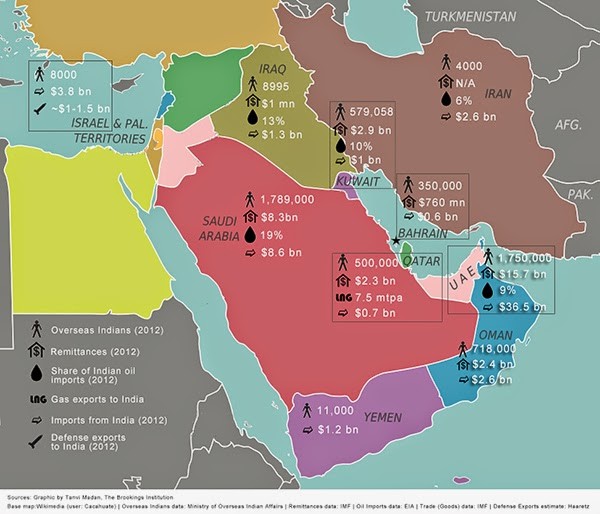
One simple map says it all. The bonds between India and the Middle East. Dramatic, really.

There are 3 lovely god-ladies bearing rich gifts- the first promises India access to Central Asia (Pakistan bypass), the second helps under-write the Kerala model by giving employment to millions of Mallus, and the third supplies India with critical (civ, mil) technology (and which may one day need India as an ally, as much as India needs her). All of them are ready and willing to supply India with oil and natural gas. 

The only problem is that these ladies insist on monotheism (they hate each other). It is just like Indian politics, if you love Nitish Kumar then you have to leave Lalu Yadav. Modi should be fine tackling this minefield.

……
Potential access to Afghanistan and Central Asia through Iran is
another crucial reason for India’s ties with Iran. 

Since Pakistan is not
currently a feasible transit option to the region, New Delhi finds the
prospect of using an Iranian transit corridor attractive. India’s desire
to invest $100 million to upgrade the Iranian port of Chabahar is
linked to this need…

The impending drawdown, if not withdrawal, of NATO
troops from Afghanistan has made this Iran route—as well as potentially broader India-Iran cooperation in and on Afghanistan—even more crucial for the Indian government.


A fourth element in play is domestic. India houses 10-15% of the
world’s Shia population, much of which is concentrated in
electorally-significant areas. 

………
….even as India has ties with Iran, it also has a number of other
key relationships in the region that will keep it from getting too close
to Iran.  

Saudi Arabia and the other Gulf Cooperation Council states
supply a significant amount of the oil India imports. Qatar is also its
largest source of imported natural gas. 

The large Indian diaspora in
these countries, which is a major source of remittances, and the
significant Sunni population in India (over 120 million) also make these
relationships crucial. 

In addition, there are existing and potential
trade and investment ties at stake with these countries. For Delhi, a
relationship with Riyadh is also particularly critical because of the
leverage the Saudi government is thought to have with Islamabad.  


There is an overall sense in India that these countries are taking it
more seriously—partly thanks to Iran, partly in the Saudi case because
of American urging, but also because of India’s potential as a market as
other consumers drop off the list. 

These countries’ interest in India
has been evident in the fact that in the ten days before Zarif’s trip,
Delhi saw visits from the king of King of Bahrain, the Saudi crown prince, the Omani fo
reign minister and the chairman of the Kuwaiti national security apparatus. 

…..
….India’s relationship with
Israel has also become crucial. That country has become one of India’s
largest defense defense suppliers, and is also
seen as a major source of agricultural technology and tourism revenue.
 

Furthermore, Indian companies are keen to invest in Israel’s technology
sector. The two countries are also negotiating a free trade agreement.
Since the Mumbai attacks, shared concerns about terrorism have created
additional space for bilateral cooperation. 

…..

Link: http://www.brookings.edu/blogs/iran-at-saban/posts/2014/02/28-iran-india-complicated-relationship-madan

…..

regards

The famous unknown (BJP) muslim

Brown liberals (who self-identify as Team Coconut) are shouting from the roof-tops that the BJP does not have a single muslim MP (member of Lok Sabha) in its ranks. While a tsunamo swept the nation, the lone BJP Muslim candidate Syed Shahnawaz Hussain lost from Bhagalpur (Bihar), to a Hindu (Shailesh Kumar) of the (majority) Muslim supported Rashtriya Janata Dal, led by Lalu Yadav. Such is indeed the unpredictable nature of life in India.

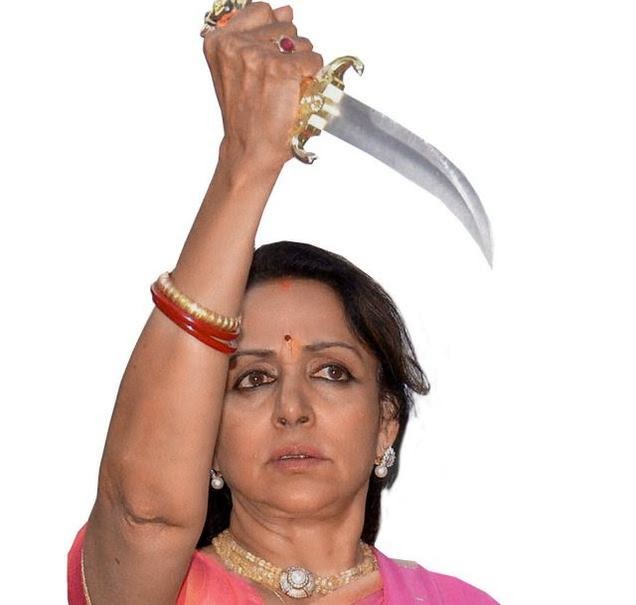
But look deep and it seems that this is not quite the complete truth. The BJP (Team Orange) does have one world famous Hindu-converted muslim in its ranks, one who is a self-proclaimed devotee of Lord Krishna and who was duly elected from the Lord’s playgrounds of Mathura-Vrindavan (Uttar Pradesh). Her name is Aaisha Bi and the aforementioned Lalu Yadav is a long-time fan.

On the road to victory, Aaisha’s (original) Hindu roots have been emphasized (in the Hindu). How else to explain the “nari-shakti” image above (see link below)? Hindus are fond of the concept of a woman-leader and
there are a plethora of legends, old and young, where the woman conquers all (when all men have failed). In contrast, her day to day living as a devout muslim remains un-explored, an equilibrium that both the Orange and Coconut gangs have taken care not to disturb. We wonder very much about this equal opportunity vow of silence.

Incidentally, our (respectful) opinion is that this violent god-woman imagery is
taking things a bit too far, a nightmare vision of Indian women being transformed into millions of Lorena Bobbitts.
Still, given the real-life nightmare social scenario prevalent in India today, we males have forfeited our right to complain. 

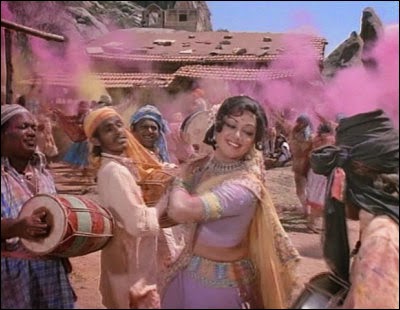
If fans like us were given the vote we would have certainly elected the dream-girl “Basanti” image (from
the Hindi movie Sholay), a lady who dances on broken glass in honor of her
lover (we understand that the Coconuts would sneer at the very idea, but then there is no pleasing everyone). 

We end with the words of the first Fan. The (ex) boss of Bihar had once promised his people that black money stored in Swiss banks will be used to make the roads of Bihar as smooth as Hema Malini’s cheeks (alas, none of the promises have been kept). But image wise, unquestionably  the best of them all. Shabash, Lalu-ji and Salaam.
………..
Film star Dharmendra, now a BJP MP, could not have
thought in his wildest dreams that his second marriage to “Aaisha Bi R.
Chakravarty” alias Hema Malini would come to haunt him one day. 

Dharmendra had converted to Islam to marry Hema Malini as Hindus are not
allowed second marriage. Their marriage was solemnised on 21 August
1979 in Bombay in accordance with Islamic rites. He had married Hema
while his first wife Prakash Kaur was still alive. Had he not contested
the Lok Sabha elections from Bikaner, the matter probably would not have
come to light.

While filing his nomination papers as a BJP
candidate before the returning officer, Dharmendra had written his name
as Deol Dharmendra Kewal Krishn concealing his Muslim name Dilawar Khan
and wrote the name of his first wife in the respective column. When his
political rivals brought the issue to the notice of election authorities
and the general public, he denied his conversion to Islam and change of
name. 

But Delhi magazine Outlook published a photocopy of his Nikahnama
(marriage document) which clearly said that Dilawar Khan Kewal Krishn
(44 years) accepted Aisha Bi R. Chakravarty (29 years) as his wife on
21 August 1979 at a mehr of, Rs 111,000 in the presence of two legal
witnesses…’ The nikah was solemnised by Maulana Qazi Abu Talha Misbahi
Faizabadi. 

Two Congress leaders of Madhya Pradesh, Akhtar Baig and KK Mishra filed a
lawsuit against him in Indore’s sessions court demanding rejection of
his nomination papers on account of submission of false information and
concealing his conversion to Islam and adoption of a Muslim name,
demanding trial under section 420 of
IPC.

According to Akhtar Baig and Congress leader from Rajasthan, Nawal
Kishore Sharma, under Hindu Marriage Act, a Hindu cannot take a second
wife if the first wife is still alive. However, he can marry for a
second time if he has divorced his first wife or embraced Islam.

………
Link (1): http://www.thehindu.com/news/national/once-a-dream-girl-shes-now-giving-nightmares-to-rival/article5938365.ece

Link (2): http://www.milligazette.com/Archives/2004/16-30Jun04-Print-Edition/163006200433.htm
……

regards

PS FWIW our coconut friends also consider the Hindu god-woman image as not quite conforming
to feminist ideals.
This is perhaps because
feminists (just like Quakers) always stand for
peace, they would never advocate cutting of the balls of demons
even while they are out destroying the bodies and souls of innocent women.

USA and Taliban part as (future) friends

This is one facet of the American psyche we really admire, the powers that be see everything as a business venture, no emotions need apply. They have on earlier occasions led efforts which have destroyed whole countries (for example, Vietnam) but when they finally did acknowledge defeat and turned back, there has been no long term bitterness. Indeed going by the experience of Vietnam, it would not surprise us if the USA and the Taliban sign up a friendship pact after a gap of say 10-20 years (ditto for Iran).

Make
no mistake: Bergdahl did not “lag behind on a patrol,” as was cited in
news reports at the time. There was no patrol that night. Bergdahl was
relieved from guard duty, and instead of going to sleep, he fled the
outpost on foot. He deserted.

This action of exchanging POWs tells us very clearly (more than anything else) that USA is withdrawing from the world (for the foreseeable future at least). The campaigns which took off have suffered almost as much as the campaigns which did not- Libya is suffering almost as much as Syria. The only bright star in all of this is an independent Kurdistan. Now even the drones have fallen silent as Uncle Sam has decided to go home and leave a mad, mad world behind.

They had young
boys hold him down, boys between the ages of 10 and 15, all of whom
giggled like they were jumping on a trampoline. The prisoner screamed
and pleaded for his life. The captors cut this poor man’s head off.
No human being deserves that
treatment, or to face the threat of that treatment every day for nearly
five years.

 
So, this man was a deserter and many of his brothers died in trying to rescue him. And now some of the fiercest enemies of America will walk free so that Bergdahl can come home. He in is such a bad physical state that he has forgotten all English. The powerful have no understanding of how much hell war is and what permanent damage it inflicts on the powerless.
……..
It was June 30, 2009, and I was in the city of Sharana, the capitol of
Paktika province in Afghanistan. As I stepped out of a decrepit office
building into a perfect sunny day, a member of my team started talking
into his radio. “Say that again,” he said. “There’s an American soldier
missing?”


There was. His name was Private First Class Bowe Bergdahl, the only prisoner of war in the Afghan theater of operations. His release from Taliban custody on May 31
marks the end of a nearly five-year-old story for the soldiers of his
unit, the 1st Battalion, 501st Parachute Infantry Regiment. 

I served in
the same battalion in Afghanistan and participated in the attempts to
retrieve him throughout the summer of 2009. After we redeployed, every
member of my brigade combat team received an order that we were not
allowed to discuss what happened to Bergdahl for fear of endangering
him. He is safe, and now it is time to speak the truth.


And that the truth is: Bergdahl was a deserter, and soldiers from his own unit died trying to track him down.

On
the night prior to his capture, Bergdahl pulled guard duty at OP Mest, a
small outpost about two hours south of the provincial capitol. The base
resembled a wagon circle of armored vehicles with some razor wire
strung around them. A guard tower sat high up on a nearby hill, but the
outpost itself was no fortress. Besides the tower, the only hard
structure that I saw in July 2009 was a plywood shed filled with bottled
water. Soldiers either slept in poncho tents or inside their vehicles.


The next morning, Bergdahl failed to show for the morning roll call.
The soldiers in 2nd Platoon, Blackfoot Company discovered his rifle,
helmet, body armor and web gear in a neat stack. He had, however, taken
his compass. His fellow soldiers later mentioned his stated desire to
walk from Afghanistan to India.

The Daily Beast’s Christopher Dickey later wrote
that “[w]hether Bergdahl…just walked away from his base or was lagging
behind on a patrol at the time of his capture remains an open and
fiercely debated question.” Not to me and the members of my unit. Make
no mistake: Bergdahl did not “lag behind on a patrol,” as was cited in
news reports at the time. 

….
There was no patrol that night. Bergdahl was
relieved from guard duty, and instead of going to sleep, he fled the
outpost on foot. He deserted. I’ve talked to members of Bergdahl’s
platoon—including the last Americans to see him before his capture. I’ve
reviewed the relevant documents. That’s what happened.


Our
deployment was hectic and intense in the initial months, but no one
could have predicted that a soldier would simply wander off. Looking
back on those first 12 weeks, our slice of the war in the vicinity of
Sharana resembles a perfectly still snow-globe—a diorama in miniature of
all the dust-coated outposts, treeless brown mountains and adobe
castles in Paktika province—and between June 25 and June 30, all the
forces of nature conspired to turn it over and shake it. 


On June 25, we suffered our battalion’s first fatality, a platoon leader named First Lieutenant Brian Bradshaw. Five days later, Bergdahl walked away.


His disappearance translated into daily search missions across the
entire Afghanistan theater of operations, particularly ours. The combat
platoons in our battalion spent the next month on daily
helicopter-insertion search missions (called “air assaults”) trying to
scour villages for signs of him. 

….
Each operations would send multiple
platoons and every enabler available in pursuit: radio intercept teams,
military working dogs, professional anthropologists used as intelligence
gathering teams, Afghan sources in disguise. They would be out for at
least 24 hours. I know of some who were on mission for 10 days at a
stretch. In July, the temperature was well above 100 degrees Fahrenheit
each day.


These cobbled-together units’ task was to search villages one after
another. They often took rifle and mortar fire from insurgents, or
perhaps just angry locals. They intermittently received resupply from
soot-coated Mi-17s piloted by Russian contractors, many of whom were
Soviet veterans of Afghanistan. It was hard, dirty and dangerous work. 


The searches enraged the local civilian population and derailed the
counterinsurgency operations taking place at the time. At every juncture
I remember the soldiers involved asking why we were burning so much
gasoline trying to find a guy who had abandoned his unit in the first
place. 

….
The war was already absurd and quixotic, but the hunt for
Bergdahl was even more infuriating because it was all the result of some
kid doing something unnecessary by his own volition.


….
On July 4, 2009, a human wave of insurgents attacked the joint U.S./Afghan outpost at Zerok.
It was in east Paktika province, the domain of our sister infantry
battalion (3rd Battalion, 509th Infantry). Two Americans died and many
more received wounds. Hundreds of insurgents attacked and were only
repelled by teams of Apache helicopters. 


Zerok was very close to the
Pakistan border, which put it into the same category as outposts now
infamous—places like COP Keating or Wanat, places where insurgents could
mass on the Pakistani side and then try to overwhelm the outnumbered
defenders.


One of my close friends was the company executive officer for the
unit at Zerok. He is a mild-mannered and generous guy, not the kind of
person prone to fits of pique or rage. But, in his opinion, the attack
would not have happened had his company received its normal complement
of intelligence aircraft: drones, planes, and the like. Instead, every
intelligence aircraft available in theater had received new
instructions: find Bergdahl. …

My friend blames Bergdahl for his soldiers’
deaths. I know that he is not alone, and that this was not the only
instance of it. His soldiers’ names were Private First Class Aaron Fairbairn and Private First Class Justin Casillas.


Though the 2009 Afghan presidential election slowed the search for
Bergdahl, it did not stop it. Our battalion suffered six fatalities in a
three-week period. On August 18, an IED killed Private First Class Morris Walker and Staff Sergeant Clayton Bowen
during a reconnaissance mission. 

..
On August 26, while conducting a
search for a Taliban shadow sub-governor supposedly affiliated with
Bergdahl’s captors, Staff Sergeant Kurt Curtiss
was shot in the face and killed. 

….
On September 4, during a patrol to a
village near the area in which Bergdahl vanished, an insurgent ambush
killed Second Lieutenant Darryn Andrews and gravely wounded Private First Class Matthew Martinek,
who died of his wounds a week later. …

On September 5, while conducting a
foot movement toward a village also thought affiliated with Bergdahl’s
captors, Staff Sergeant Michael Murphrey stepped on an improvised land mine. He died the next day.


It is important to name all these names. For the veterans of the
units that lost these men, Bergdahl’s capture and the subsequent hunt
for him will forever tie to their memories, and to a time in their lives
that will define them as people. He has finally returned. Those men
will never have the opportunity.


Bergdahl was not the first American soldier in modern history to walk
away blindly. As I write this in Seoul, 

I’m about 40 miles from where an American sergeant defected to North Korea in 1965.
Charles Robert Jenkins later admitted that he was terrified of being
sent to Vietnam, so he got drunk and wandered off on a patrol. He was
finally released in 2004, after almost 40 hellish years of brutal
internment. The Army court-martialed him, sentencing him to 30 days’
confinement and a dishonorable discharge. He now lives peacefully with
his wife in Japan—they met in captivity in North Korea, where they were
both forced to teach foreign languages to DPRK agents. His desertion
barely warranted a comment, but he was not hailed as a hero. He was met
with sympathy and humanity, and he was allowed to live his life, but he
had to answer for what he did.


I
believe that Bergdahl also deserves sympathy, but he has much to answer
for, some of which is far more damning than simply having walked off.
Many have suffered because of his actions: his fellow soldiers, their
families, his family, the Afghan military, the unaffiliated Afghan
civilians in Paktika, and none of this suffering was inevitable. None of
it had to happen. 


Therefore, while I’m pleased that he’s safe, I
believe there is an explanation due. Reprimanding him might yield
horrible press for the Army, making our longest war even less popular
than it is today. Retrieving him at least reminds soldiers that we will
never abandon them to their fates, right or wrong. In light of the
propaganda value, I do not expect the Department of Defense to punish
Bergdahl.

He’s lucky to have survived. I once saw an insurgent
cellphone video of an Afghan National Police enlistee. They had young
boys hold him down, boys between the ages of 10 and 15, all of whom
giggled like they were jumping on a trampoline. The prisoner screamed
and pleaded for his life. The captors cut this poor man’s head off.
That’s what the Taliban and their allies do to their captives who don’t
have the bargaining value of an American soldier. That’s what they do to
their fellow Afghans on a regular basis. No human being deserves that
treatment, or to face the threat of that treatment every day for nearly
five years.


But that certainly doesn’t make Bergdahl a hero, and that doesn’t
mean that the soldiers he left behind have an obligation to forgive him.
I just hope that, with this news, it marks a turning point for the
veterans of that mad rescue attempt. It’s done. Many of the soldiers
from our unit have left the Army, as I have. Many have struggled greatly
with life on the outside, and the implicit threat of prosecution if
they spoke about Bergdahl made it much harder to explain the absurdity
of it all. Our families and friends wanted to understand what we had
experienced, but the Army denied us that. 


I forgave Bergdahl because it was the only way to move on. I wouldn’t
wish his fate on anyone. I hope that, in time, my comrades can make
peace with him, too. That peace will look different for every person. We
may have all come home, but learning to leave the war behind is not a
quick or easy thing. Some will struggle with it for the rest of their
lives. Some will never have the opportunity.


And Bergdahl, all I can say is this: Welcome back. I’m glad it’s
over.
There was a spot reserved for you on the return flight, but we had
to leave without you, man. You’re probably going to have to find your
own way home.

……
Link: http://www.thedailybeast.com/articles/2014/06/02/we-lost-soldiers-in-the-hunt-for-bergdahl-a-guy-who-walked-off-in-the-dead-of-night.html
……

regards

Gopinath Munde death…massive setback for BJP

Gopinath Munde, who was the
OBC face of BJP in Maharashtra and who had joined the Union Cabinet as rural
development minister, died today following a road accident. This family has
been gravely troubled over the last few years, earlier, brother-in-law Pramod Mahajan, another
top flight leader from Maharashtra was shot dead by
his own brother.
Now with Munde dead, BJP will have lost the person who was expected to lead the party to victory in upcoming state elections in Maharashtra.


Gopinath Munde met with a road accident at 6:30 AM of June 3, 2014, while on
his way to the Delhi airport.
Munde’s convoy met with an accident in the Moti Bagh area of South Delhi, which
is near Delhi airport. Minister was on his way to Airport to leave to Mumbai. Munde’s car collided head on with another car and in the
accident, the BJP leader sustained multiple head, chest and spinal injuries.
Munde, a diabetic
patient, fell down from the car and asked to be taken to a hospital when his
security guard helped him. Munde has suspected to have suffered a cardiac
arrest and he was taken to the AIIMS Trauma Center where he passed away around
7.20 am.

The back-story [ref. wiki] is remarkable, it shows how Mrs Gandhi’s emergency regime brought many of today’s (non-Congress) mass leaders, most of them from working class backgrounds to the fore-front of Indian politics (Congress and to some extent the Left enjoyed  the patronage of the elite and the educated class). Indian democracy was saved by defeating the all powerful Mrs Gandhi and her son Sanjay (ma-bete ki sarkar of a bygone age) under the leadership of Jay Prakash (JP) Narayan, who (in our opinion) remains the most respected Gandhian after Gandhi. And yes, many of these people, just like Narendra Modi, graduated in political education from RSS university.

From Lalu Yadav in Bihar to Chandrababa Naidu in Andhra, all leaders have one common point in their resume- incarceration during 1975-1977. The only group who backed Mrs Gandhi during those dark days were the Communist Party of India (Russian backed CPI, not the Chinese backed CPIM). And today CPI (and to some extent CPIM as well) has been pushed deep into the dustbin of history. Congress must also adapt and reform quickly, else it will follow the same path to oblivion.
……..

Munde was born in Parali, Maharashtra,
on 12 December 1949, to Pandurang Munde and Limbabai Munde in a middle class Vanjari
(caste) farmer’s family.
Munde’s wife Pradnya is sister of Pramod
Mahajan (a Brahmin). 

His family included Sister Saraswati Karad. She is followed by
elder brother Pandit Anna, who is actively involved in social and political
work. He was third child in the family. He was followed by younger brothers,
Manikrao and Venkatrao. Munde has three daughters — Pankaja, Pritam and Yashashri. Pankaja is an
MLA. Pritam is a doctor, and Yashashri is studying law.

Munde
attended a government primary school, in Nathra village, Beed district where
classes were conducted “under a tree”. He later attended the Zilla
Parishad high school in Parali. He obtained a BA in commerce from college in
Ambejogai. Subsequently, he studied at the ILS College in Pune.

Munde
got involved into politics when he met Pramod
Mahajan, a friend and colleague in the college. As a member of the Akhil Bharatiya Vidyarthi Parishad,
he took part in the agitation against the state of emergency imposed by the
Prime Minister Indira Gandhi. He was incarcerated in the Nashik
central jail until the Emergency was lifted.

In 1971, he associated with the campaign of the Bharatiya Jana Sangh candidate in the Lok
Sabha election in the Beed
constituency.
He attended the Rashtriya Swayamsevak Sangh’s Shiksha
Varga (Training Camp) held in Pune that year.
He soon became the Sambhajinagar Mandal
Karyavah, looking after half a dozen shakhas of the RSS, and subsequently, the
in-charge of its Pune
City Students’ Cell. 

Later, he was made a member of the executive committee of
the city RSS.
The Janata Party by this time had split, and the Bharatiya Janata Party, founded by the
leaders the erstwhile Bharatiya Jana Sangh had come into existence.
Munde was made President of the Maharashtra
unit of the BJP’s youth wing, the Bharatiya Janata Yuva Morcha.

He was Leader of Opposition in Maharashtra Vidhan Sabha from 12 December
1991 to 14 March 1995. Munde was sworn in as the Deputy Chief Minister of
Maharashtra when Manohar Joshi-led government took over the reins of
the state on 14 March 1995.

Munde
served as a member of the 15th Lok Sabha (2009–2014), representing the Beed constituency.
Munde won 2014 Loksabha election from Beed Constituency by margin of 2
lacs. He defeated NCP’s Suresh Dhas.Subsequently, he was appointed as Minister of Rural Development
by Prime minister Narendra Modi.

……..
Link: http://timesofindia.indiatimes.com/india/Union-minister-Gopinath-Munde-dies-in-road-accident-in-Delhi/articleshow/35980717.cms
…….

regards

Achhe din has come to…Pakistan

The economy is steadily improving, almost reaching the high points under Musharraf. The projected growth rates of 7% in 2017 may be a bit too ambitious, unless there is an economic breakthrough with India. Also promised are 900,000 jobs in next four years, which will again require economic co-operation with India.

In turn India will also significantly benefit from economic ties with Pakistan.

It all points to a fast time-table for resolution of the Kashmir problem. While all other interests will have a look in, the efforts can only succeed if common Kashmiris agree to a final settlement. The politicians have always claimed that they were very close to a solution before Kargil created a brake or Mumbai put a stop to talks. Such events may happen in the future as well and it will be always best to remain prepared.
……..
Launching the survey at a press conference, he said this is less than
the targeted 4.14 per cent but it is for the first time in six years
that the country has entered the territory of four per cent growth this
year.


And, the GDP growth rate would be increased one per cent
each during the next three years taking it to 7 per cent in 2017.
Similarly, the industrial growth has been recorded at 5.84 per cent as
against 1.37 per cent last year.

The minister also said that the
large-scale manufacturing recorded growth of 5.135 per cent as against
4.08 per cent last year. He said electricity generation and gas
distribution growth last year was minus 16.33 per cent and this year it
has grown by 3.72 per cent.

Construction recorded growth of 11.31
per cent this year as against minus 1.685 per cent last year while
wholesale and retail trade increased by 5.181 per cent as against 3.38
per cent last year, he said.

Ishaq Dar said that transport and
communication recorded growth of 2.89 per cent as against 2.88 per cent
last year while agriculture sector showed growth of 2.12pc against
2.88pc last year.

Major crops showed growth of 3.74 per cent as
compared to 1.19pc last year. Wheat production this year is 25.29
million tonnes as compared 24.21 million tonnes last year, he said.

Rice
production this year stood at 6.8 million tonnes as against 5.54
million tonnes; sugarcane 66.47 million tonnes as compared to 63.75
million tonnes last year and maize production this year is 4.531 million
ronnes as against 4.22 million tonnes last year.

Provisional
estimates of cotton production this year are 12.77 million bales as
against 13.03 million bales last year. Similarly, grams and oil seeds
recorded growth of minus 3.52 per cent.

The minister said
inflation in the first eleven months of the current financial year was
8.6 per cent as against 7.5pc last year.

Exports in ten months of
the outgoing financial year stood at $21 billion as against $20.1
billion last year, showing an increase of 900 million dollars.

Ishaq
Dar said the grant of GSP Plus concession by the European Union has
started impacting our textile sector positively as it grew by 7 per cent
in value terms.

According to the survey, imports in ten months of
the outgoing financial year stood at $37.1 billion as against $36.7
billion last year, indicating 1.2 per cent increase. The minister said
there was a significant increase in import of plant and machinery which
was a positive indication.

Workers’ remittances in ten months of
current financial year reached $12.9 billion as against $11.6 billion
last year, showing a growth of 11.5pc. Foreign investment this year
stood at $2.979 billion against $1.277 billion last year.

Foreign exchange reserves presently stood at $13.63 billion against $11.4 billion dollar last year, said the minister.

The
survey further unveiled that per capita income this year has increased
to $1,386 from $1,339 last year. Stock market crossed 29,700 points and
its capitalisation increased by about 38 per cent. Tax revenue as
percentage of GDP this year is 7pc as against 6.8pc last year.

Non-tax
revenue as percentage of GDP remains at 2.7pc while total expenditure
as percentage of GDP reduced to 12.9pc from 14.8pc last year.

Development
expenditure this year as percentage of GDP was 2.2 per cent as against
2pc last year. Fiscal deficit in first ten months was 3.2 per cent as
compared to 4.7pc last year.

The finance minister further said that FBR tax collections in 11 months have grown by 16.4 per cent. Ishaq
Dar said the State Bank of Pakistan’s borrowing last year was Rs 416.8
billion, but this year the government paid back Rs 10.5 billion to the
bank.

Hinting an increase in the defence budget, he said the PML-N government has made the defence of the country invincible.

To a question, he said major incentives will be given to the private sector to restore the confidence of the investors.

It is estimated that
around 900,000 jobs will be created in the next four years after the
introduction of G-3 and G-4 spectrum, said the finance minister.

……

Link: http://www.dawn.com/news/1110122/414pc-gdp-growth-recorded-highest-since-2008-09/
……

regards

Communal? Who, me??

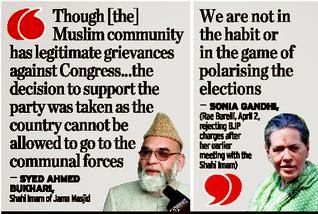
So, this is how the last brick wall crumbles. There is now unprecedented, open criticism about the Queen, not just the Prince. In order for the Congress to have a chance to recover from the shellacking this is only the first (but welcome) step. There must be a root and branch reform whereby the dynasty forswears power and remains confined to an advisory role (just like the Shahi Imam).

….
Bihar (Congress) MP Asrarul Haque’s criticism of the
Bukhari-Sonia meeting
in April which was followed by the Delhi-based
cleric’s appeal to Muslims that they
should vote for Congress –
“The meeting should not have happened and it was wrong
on the part of the Congress party to issue an appeal to one community.

..
And yes, the Shahi Imam is communal, just as we expect a Sadhu and a Padri to be communal. While all religions have nice words to say re: co-existence, the point of the matter is that you self-identify with one tribe and that your preferences will be to suit yourself and your brothers, often at the expense of others.

If the post-election surveys are accurate then the top-three vote gathering combinations are as follows. 
(1) The BJP/NDA axis was supported by Upper Caste hindus, non-Sunni muslims, lower- Other Backward Castes (as opposed to landowning higher caste shudras), non-Jatav Scheduled Castes (Dalits) and (non-Christian) Scheduled Tribes. 
(2) Sunni Muslims and upper- OBCs (for example, Yadavs in UP/Bihar) voted for Congress/UPA (except in Tamil Nadu, Odisha, and Bengal where these groups voted for Jayalalitha Jayaram, Naveen Patnaik and Mamata Banerjee). 
(3) The Jatav vote concentrated in North India (particularly in UP, Rajasthan and Madhya Pradesh) was in favor of the Bahujan Samaj Party led by Mayawati.

There are signs that voting patterns in India will become fixed (due to polarization) unless there is a wave election in favor of a charismatic person, or against an unpopular incumbent. With the benefit of hindsight the tsunamo in 2014 combined both these effects.

There were perhaps 10-20 seats (mostly in Uttar Pradesh) where the Muslim-Yadav vote got split between the Congress and the Samajwadi Party (SP), and resulted in the BJP winning even majority muslim seats. If Congress and SP had a formal alliance with clear-cut seat divisions, then it may have been enough to deprive the BJP of the huge psychological boost of a simple majority.

What Sonia did wrong was that she gambled that muslims will unite behind the Congress and vote against SP in the marginal seats. In that narrow sense the Imam’s appeal to his flock is actually responsible for a BJP mandate. This is what being “communal” gets you in the end- you unite the Hindus against you and you split up your own vote-bank.

And you lose so terribly that you may never win again.
……………………..

In an
implied criticism of party boss Sonia Gandhi’s pre-election meeting with
the Jama Masjid shahi imam, senior Congress leader Digvijaya Singh has
dubbed Syed Ahmed Bukhari as a “communal” man.

Singh told
reporters, “I do not consider him (Bukhari) a secular person. I believe
Imam Bukhari is a communal person.”  The remark comes on the heels of
Bihar MP Asrarul Haque’s criticism of the Bukhari-Sonia meeting in April
which was followed by the Delhi-based cleric’s appeal to Muslims that
they should vote for Congress. The appeal triggered a controversy.

In what is seen as a direct jibe at Sonia, Haque, according to reports,
said, “The meeting should not have happened and it was wrong on the
part of the Congress party to issue an appeal to one community.”


The meeting, which BJP used to accuse
Congress of playing “appeasement” politics, has been controversial
because many in the party feel it helped the saffron camp to polarize
voters in its favour.

Now, the public criticism from within is
likely to embarrass the leadership much more than the attacks from BJP,
especially when it has come from a Muslim MP, as also a senior Congress
general secretary.

Critically, it marks the first instance of
Sonia facing fire for the election debacle or related issues; the anger
among party men till now was directed against her son and heir apparent
Rahul Gandhi. In the last week, Congress has had to suspend two senior
leaders in Kerala and Rajasthan for slamming Rahul.
…….

…..
Link: http://timesofindia.indiatimes.com/india/Now-Sonia-Gandhi-too-draws-flak-from-her-party/articleshow/35969282.cms
……

regards

Brown Pundits