Toxic textbooks and social engineering in Pakistan

(Originally published at Naya Daur, whose website was blocked by PTA in Pakistan a day after this was published).
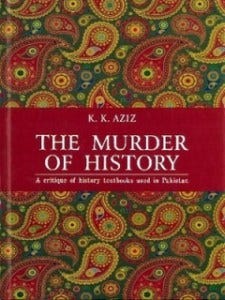
“In every country, the textbook is the primary implement of education at the school and pre-university stages of instruction. In Pakistan, it is the only instrument of imparting education on all levels, because the teacher and the lecturer don’t teach or lecture but repeat what it contains and the student is encouraged or simply ordered to memorize its contents. Further, for the young student the textbook is the most important book in his little world: he is forced to buy it, he carries it to the classroom every day, he has to open before him when the teacher is teaching, he is asked to learn portions of it by rote, and he is graded by the quantity of its contents that he can regurgitate.”

This was how Pakistani historian K.K. Aziz started his groundbreaking work The Murder of History: A critique of history textbooks used in Pakistan. The book was published 25 years ago (in 1993) and the only change in the role of textbooks since then is that provinces were granted the right to formulate their own textbooks under the 18th amendment to the Constitution. Another significant change in the last two decades has been the mushrooming of private schools that use textbooks different from the official ones.

History doesn’t start with Muhammad bin Qasim

While textbooks for natural science subjects — like Physics, Chemistry and Biology — or those pertaining to language studies are less likely to form a child’s worldview, textbooks for history and “social studies” (a mixture of history, civics and geography) are supposed to be the first step toward a social conscience.

In the textbooks that my father’s generation studied, history textbooks did not start with the year 712 A.D., when Muhammad bin Qasim invaded Sindh. They contained history of the Indian Subcontinent before that particular event. They were also devoid of chapters devoted to the ‘Ideology of Pakistan’ and other such vague ideas.

But the distortion of history in Pakistan started as soon as the country came into being. On the 17th of August, 1947, a mere three days after Independence, an article written by Mr. Abdullah Qureshi was published in national newspapers, titled “Textbooks of History and Need for Reform”.

The atrocity that was Abdullah Qureshi

In that article, Mr. Qureshi argued, “The person who knows the Islamic history accurately, would prove to the best citizen of Pakistan. He will not commit any act against the state of Pakistan. His heart would be filled with love for Islam and Muslims and he would not even think about treason. In my view, it is imperative that history of Muslims should be popularized as it will lead to strengthening Pakistan. Every citizen should be made aware of Glorious Islamic Traditions. Every Citizen should be reminded that straying from National Interest would lead to destruction of the Nation.”

He further wrote, “The history that is taught to our children in schools is not factual. It is based on propaganda spread by the British and it serves to justify British Imperialism. It is based on personal biases of British Historians. As a result, worthless events have been presented as glorious occasions. It promotes a false Hindu-Muslim parity, while the fact is that before arrival of Muslims, Hindus did not have any authentic history or collection of traditions. Due to need of the hour, British historians concocted false narratives to appease the Hindus.”

The British periodized Indian history

Now it is interesting to note that Mr. Qureshi rails against the biases of British historians, and yet, falls back on a form of Indian historiography invented by them. After all, as Dr. Mubarak Ali wrote in an article:

“The periodization of the Indian history as the Hindu, the Muslim, and the British was not done by any Hindu historian but by a British historian, James Mill, the author of the “History of British India”. He intentionally divided the history on religious basis, but did not call the British period a Christian period in order to keep a secular outlook, and to maintain a balance between these two opposite religious communities. This periodization is challenged and severely criticized by a Hindu Historian [sic], Romila Thapar. In India, historians no more use these terminologies whereas in Pakistan historians persist to use them”

Following the debacle of 1971, textbooks were modified to rationalize the separation of East Pakistan as a ‘Hindu Conspiracy’

Nevertheless, the project of historical revisionism proposed by Abdullah Qureshi was, indeed, put into motion in Pakistan.

Distortion of History to rationalize the Fall of Dhaka

K.K. Aziz analyzed history textbooks written during the period 1960–1990 and he found factual errors in most of these books. Distortion of history had started soon after Independence but the particular ideological tilt that we are today most familiar with started in the 1970s. Following the debacle of 1971, textbooks were modified to rationalize the separation of East Pakistan as a ‘Hindu Conspiracy’. This obfuscation was intended to whitewash the atrocities committed upon Bengalis starting from 1947.

Zulfikar Ali Bhutto came to power amidst political confusion with an Islamic socialist programme, promising to build a new Pakistan and to address the economic and political issues facing the country at the time. The result was an over-emphasis on a separate “Pakistani identity” and a new description of “the enemy” so as to unify the nation. The strategic use of Islam in education policy started during the era of General Ayub Khan and continued during the Bhutto period.

Manufacturing a false pride?
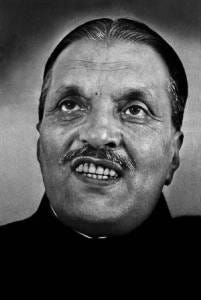
Gen Zia ul-Haq — PC: Dawn.com

The worst of the rot truly set in during General Zia-ul-Haq’s regime during the period 1977–88. Dr. Parvez Hoodbhoy and A.H. Nayyar mention in their book “Rewriting the History of Pakistan” in Islam, Politics and the State: The Pakistan Experience (published in 1985):

“In 1981, General Zia-ul-Haq declared compulsory the teaching of Pakistan studies to all degree students, including those at engineering and medical colleges. Shortly thereafter, the University Grants Commission issued a directive to prospective textbook authors specifying that the objective of the new course is to ‘induce pride for the nation’s past, enthusiasm for the present and unshakeable faith in the stability and longevity of Pakistan’. To eliminate possible ambiguities of approach, authors were given the following directives:

To demonstrate that the basis of Pakistan is not to be founded in racial, linguistic, or geographical factors, but, rather, in the shared experience of a common religion. To get students to know and appreciate the Ideology of Pakistan, and to popularize it with slogans. To guide students towards the ultimate goal of Pakistan — the creation of a completely Islamised State.

Islamization of Science books

As a result of this ideological onslaught, even the books of science were “Islamised”. Specific chapters have been dedicated in books of Physics, Chemistry and Biology, introducing young students to Muslim Scientists. Most of these “Muslim Scientists” were a product of the Mu’tazilla tradition in the medieval period, a fact that is not included in any of the introductions.

Any effort to reform the current textbooks should ideally cleanse all the waste material that the books have accrued in the last 65 years.

The ideological propaganda that has plagued the textbooks has also contributed to a confused state of mind among the next generation of Pakistan. It is not a co-incidence that according to a survey of educated youth by Pakistan Institute for Peace Studies, “A sizeable percentage of the survey population believed that religion should be the only source of law in Pakistan.”

How distortion of History begets fundamentalism

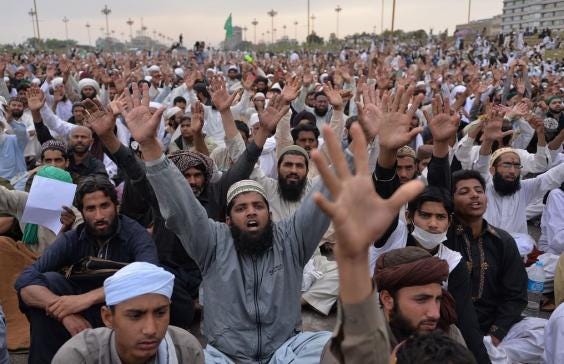
The British Council released a report in November 2009 titled “Pakistan: The Next Generation” focusing on issues surrounding the youth in Pakistan. The report also noted, worryingly, that “Disillusion with democracy is pronounced. Only around 10% respondents have a great deal of confidence in national or local government, the courts, or the police. Only 39% voted in the last election.” Another report by the British Council in 2013 mentioned that “38% respondents expressed a desire for implementation of Shariah as opposed to parliamentary democracy with 29% respondents opting for continuation of Democratic system.”
Confusion has led to identity crisis

Any effort to reform the current textbooks should ideally cleanse all the waste material that the books have accrued in the last 65 years. It is expected to be a Herculean task and it requires a great deal of willingness from the provincial governments.

The insertion of exclusionary modes of thinking and petty ideological narratives in textbooks has resulted in the emergence of a confused, disillusioned and restless educated class of Pakistanis. Textbooks have become a contested space for ideological skirmishes in the last few decades. The educated youth of Pakistan faces a dilemma when confronting realities on the ground — because they have been taught a very different narrative. This national confusion has led to a widespread identity crisis.

Meanwhile, in an Islamiyat textbook for undergraduate students in Punjab, the introduction to the book states, “Pakistan is an ideological state. It has been founded on the pattern established in Madinah.”

  • According to a Pakistan Studies textbook used in Punjab, something known as “Nazriya Pakistan” (Ideology of Pakistan) is based on Islam, which itself is claimed to be a complete code of life.
  • In an Islamiyat textbook for undergraduate students in Punjab, the introduction to the book states, “Pakistan is an ideological state. It has been founded on the pattern established in Madinah.”
  • A sociology textbook for the Intermediate level in Punjab paints the Baloch people, citizens of Pakistan, as ‘looters’.

These are but a few examples of the pernicious ideological conditioning that these textbooks perform.

ANP’s improvements to curriculum in KP rolled back by PTI

In the aftermath of the 18th amendment, provincial governments were provided an opportunity to make amends. In the case of Khyber-Pakhtunkhwa, the Awami National Party (ANP) government during 2008–2013 made some positive changes in the curriculum — driving the focus away from religious militarism towards an ideal of coexistence and peace. But, following the rise to power of the Pakistan Tehreek-e-Insaf (PTI) government in that province, most of those gains were reversed under the influence of religious parties allied to the PTI.
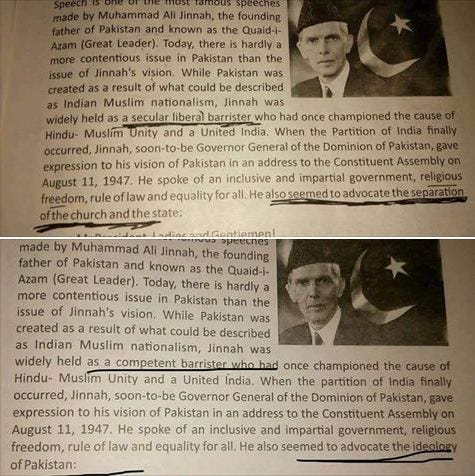
The upper one is a picture of a KP textbook from ANP era, terming Jinnah a ‘secular liberal barrister’ who ‘also seemed to advocate the separation of the church and the state’. Below is the current version of the same book where the ‘secular liberal’ has been replaced by ‘competent’ while ‘separation of the church and the state’ has been replaced by ‘ideology of Pakistan’. — Picture courtesy: Omer Qureshi

In Punjab, according to Dr. Hoodbhoy, textbooks have been “improved considerably”, moving beyond some of the worst dogma. One hopes that this experiment is implemented nationwide and Pakistan’s next generation is taught according to the finest international standards of education — where there is little room for deliberately conditioning young students into authoritarian, theocratic and racist mindsets.
Why do Indians care about OIT/AIT

From my blog:

Razib: I follow your super feed and read your postings here and on Brown Pundits. The subject of the ancestry of South Asians comes up frequently. It seems to have a political valence that I, as an outsider, do not understand.

Can you explain it? or point us to an explanation?

My response is “British colonialism and modern-day culture wars.” I could say more, but honestly, I don’t care that much. The science is more interesting to me, and it’s a lot to keep track of. Can readers comment?

(Related: there are some Pakistanis who try and pretend as if they are descended from Persians, Turks, or even Arabs. The explanation is pretty straightforwardly summarized as “self-hatred”, though we could all elaborate on that).

The water rises and Canute drowns

The Genetic History of Indians: Are We What We Think We Are?. The answer is that people of all races have always been what they always were. What we think about what we were…well, that changes.

“I KNOW PEOPLE won’t be happy to hear this,” geneticist Niraj Rai says over the phone from Lucknow. “But I don’t think we can refute it anymore. A migration into [ancient] India did happen.” As head of the Ancient DNA Lab at Lucknow’s Birbal Sahni Institute of Palaeosciences (BSIP), he earlier worked at the CCMB in Hyderabad and has been part of several studies that employed genetics to examine lineages. “It is clear now more than ever before,” he says, “that people from Central Asia came here and mingled with [local residents]. Most of us, in varying degrees, are all descendants of those people.”

Some researchers, even those associated with the current study like Shinde, aren’t quite convinced that an ancient influx of people into the subcontinent from the northwest has finally been established by the latest findings. Shinde does not like the word ‘migration’. “It is better to say movement,” he says, implying a two-way pattern. “Everyone back then was moving to and fro. Some people were moving here and some were moving out. There was contact, yes. There was trade. But local people were involved in the development of several things. So I am not very sure of the interpretation.”

As Rai points out, the analysis of the DNA sample they will present will be of a period before the Steppe people supposedly arrived in India. If R1a is absent in the Indus Valley sample, it suggests that it was brought into South Asia, perhaps by a proto-Indo- European speaking group, from elsewhere. “How do I say it? See, I am a nationalist,” Rai says over the phone. “People will be upset. But that’s how it is. All the studies are showing that people came here from elsewhere.”

I’ve been hearing from Indian journalists that some of these researchers have only “evolved” over the last few months. First, it’s a credit to them if they changed their views on the new data. If the above is correct they got usable DNA from one Rakhigarhi sample. I predict it will be like “Indus Periphery”, but with more AASI. It seems rather clear they’re going to submit a preprint within a month or so (that’s the plan, but it’s been the plan for a year!), but the results are being written up now.

Meanwhile, the ancient DNA tsunami is going to come in further waves in the near future. Various groups have huge data sets from Central Eurasia that are going to surface. Unfortunately, samples are going to be thin on the ground from India, but we have enough now that in broad sketches most people are now falling in line with what happened demographically from the northwest. The “AASI” ancestry is deeply rooted in South Asia, and it doesn’t look like there’s much of an impact of this outside of the subcontinent aside from nearby regions.

The real action is now in understanding the cultural and archaeological processes involved in the perturbation in the years after 2000 BCE. I’ve talked to a few of the geneticists working in this area over the past month or so, and they agree.

Echo Chambers and Epistemic Bubbles

An Excellent essay from Aeon
(https://aeon.co/essays/why-its-as-hard-to-escape-an-echo-chamber-as-it-is-to-flee-a-cult)

What are Echo Chambers and Epistemtic Bubbles?

C Thi Nguyen: Both are social structures that systematically exclude sources of information. Both exaggerate their members’ confidence in their beliefs. But they work in entirely different ways, and they require very different modes of intervention. An epistemic bubble is when you don’t hear people from the other side. An echo chamber is what happens when you don’t trust people from the other side.

Current usage has blurred this crucial distinction, so let me introduce a somewhat artificial taxonomy. An ‘epistemic bubble’ is an informational network from which relevant voices have been excluded by omission. That omission might be purposeful: we might be selectively avoiding contact with contrary views because, say, they make us uncomfortable. As social scientists tell us, we like to engage in selective exposure, seeking out information that confirms our own worldview.

An ‘echo chamber’ is a social structure from which other relevant voices have been actively discredited. Where an epistemic bubble merely omits contrary views, an echo chamber brings its members to actively distrust outsiders. In their book Echo Chamber: Rush Limbaugh and the Conservative Media Establishment (2010), Kathleen Hall Jamieson and Frank Cappella offer a groundbreaking analysis of the phenomenon. For them, an echo chamber is something like a cult. A cult isolates its members by actively alienating them from any outside sources. Those outside are actively labelled as malignant and untrustworthy. A cult member’s trust is narrowed, aimed with laser-like focus on certain insider voices.

In epistemic bubbles, other voices are not heard; in echo chambers, other voices are actively undermined. The way to break an echo chamber is not to wave “the facts” in the faces of its members. It is to attack the echo chamber at its root and repair that broken trust.

Listen to what it actually sounds like when people reject the plain facts – it doesn’t sound like brute irrationality. One side points out a piece of economic data; the other side rejects that data by rejecting its source. They think that newspaper is biased, or the academic elites generating the data are corrupt. An echo chamber doesn’t destroy their members’ interest in the truth; it merely manipulates whom they trust and changes whom they accept as trustworthy sources and institutions.

And, in many ways, echo-chamber members are following reasonable and rational procedures of enquiry. They’re engaging in critical reasoning. They’re questioning, they’re evaluating sources for themselves, they’re assessing different pathways to information. They are critically examining those who claim expertise and trustworthiness, using what they already know about the world. It’s simply that their basis for evaluation – their background beliefs about whom to trust – are radically different. They are not irrational, but systematically misinformed about where to place their trust.

Notice how different what’s going on here is from, say, Orwellian doublespeak, a deliberately ambiguous, euphemism-filled language designed to hide the intent of the speaker. Doublespeak involves no interest in clarity, coherence or truth. It is, according to George Orwell, the language of useless bureaucrats and politicians, trying to go through the motions of speech without actually committing themselves to any real substantive claims. But echo chambers don’t trade in vague, ambiguous pseudo-speech. We should expect that echo chambers would deliver crisp, clear, unambiguous claims about who is trustworthy and who is not. And this, according to Jamieson and Cappella, is exactly what we find in echo chambers: clearly articulated conspiracy theories, and crisply worded accusations of an outside world rife with untrustworthiness and corruption.

Once an echo chamber starts to grip a person, its mechanisms will reinforce themselves. In an epistemically healthy life, the variety of our informational sources will put an upper limit to how much we’re willing to trust any single person. Everybody’s fallible; a healthy informational network tends to discover people’s mistakes and point them out. This puts an upper ceiling on how much you can trust even your most beloved leader. But inside an echo chamber, that upper ceiling disappears.

Being caught in an echo chamber is not always the result of laziness or bad faith. Imagine, for instance, that somebody has been raised and educated entirely inside an echo chamber. That child has been taught the beliefs of the echo chamber, taught to trust the TV channels and websites that reinforce those same beliefs. It must be reasonable for a child to trust in those that raise her. So, when the child finally comes into contact with the larger world – say, as a teenager – the echo chamber’s worldview is firmly in place. That teenager will distrust all sources outside her echo chamber, and she will have gotten there by following normal procedures for trust and learning.

It certainly seems like our teenager is behaving reasonably. She could be going about her intellectual life in perfectly good faith. She might be intellectually voracious, seeking out new sources, investigating them, and evaluating them using what she already knows. She is not blindly trusting; she is proactively evaluating the credibility of other sources, using her own body of background beliefs. The worry is that she’s intellectually trapped. Her earnest attempts at intellectual investigation are lead astray by her upbringing and the social structure in which she is embedded.

For those who have not been raised within an echo chamber, perhaps it would take some significant intellectual vice to enter into one – perhaps intellectual laziness or a preference for security over truth. But even then, once the echo chamber’s belief system is in place, their future behaviour could be reasonable and they would still continue to be trapped. Echo chambers might function like addiction, under certain accounts. It might be irrational to become addicted, but all it takes is a momentary lapse – once you’re addicted, your internal landscape is sufficiently rearranged such that it’s rational to continue with your addiction. Similarly, all it takes to enter an echo chamber is a momentary lapse of intellectual vigilance. Once you’re in, the echo chamber’s belief systems function as a trap, making future acts of intellectual vigilance only reinforce the echo chamber’s worldview.

There is at least one possible escape route, however. Notice that the logic of the echo chamber depends on the order in which we encounter the evidence. An echo chamber can bring our teenager to discredit outside beliefs precisely because she encountered the echo chamber’s claims first. Imagine a counterpart to our teenager who was raised outside of the echo chamber and exposed to a wide range of beliefs. Our free-range counterpart would, when she encounters that same echo chamber, likely see its many flaws. In the end, both teenagers might eventually become exposed to all the same evidence and arguments. But they arrive at entirely different conclusions because of the order in which they received that evidence. Since our echo-chambered teenager encountered the echo chamber’s beliefs first, those beliefs will inform how she interprets all future evidence.

Modern Love

(The post by Razib about encountering racism in the US reminded me of a short story, part memoir part fiction, that I wrote last year. I feel that fiction is a better tool to understand complex issues and tried my hand at it).


Imagine that you are a Pakistani man living alone for the first time in an American city. How do you cope with it? All your friends are back in Pakistan, the time difference affects your relationship with even your closest comrades and for the first time in your life, you stop berating your insomniac friends; they are all you have right now because of the eleven-hour time difference. Living alone is fantastic but it gets quite boring after a while. You go and watch a good movie, attend a stand-up comedy show and go sight-seeing. You have spent close to a month in the city and yet you don’t know anyone here. There are days when the only conversation you have is with the library staff who ask you for ID every time you enter. How long can you survive like that? You need to find people to talk to, share jokes with, learn from, cry with. Listening to playlists of your favorite music seems like a drag after the umpteenth time. Netflix loses its charm after a few weeks. Distant friends stop replying to your messages. You are studying for an exam which is unpredictable and even if you pass it, there is no guarantee that you would get the job you want.  You descend into a state of sub-clinical depression. You can’t go up to people studying in a library and engage them in a conversation, especially if they don’t know you at all. The way most people meet other people in the United States is through their workplace or in school or college. One can also find people to hang out with in bars and clubs. However, what do you do when you have no money, no job, no friends and you live in a one bedroom apartment with your brother, and his wife.


Your brother doesn’t have these issues; he is married, to the girl your parents chose for him. You finally understand why he never really opposed that idea. He and his wife come back from work late at night and neither of them has the energy to indulge in conversations with you. You don’t have any issues with Alcohol but you have never been to a bar alone and you tend to drink only if you have company. It’s a chicken and egg type situation. You have tried talking to random people on the street, in the metro or at the University campus where you use the library but you feel shy starting conversations with people whom you don’t know already. You decide to try the world of online dating. Statistics show that almost 40% people in the United States are meeting new people through online dating. You have read Aziz Ansari’s book titled ‘Modern Love’ dedicated to online dating and have a cursory knowledge of the whole thing.


You decide to launch a frontal attack and download Tinder, Zoosk and Match.com. They are the top three online dating apps in App Stores. Something’s gotta work. The first issue that you face is that of finding a perfect picture. You discover for the first time in your life that you don’t have a perfect picture, or even a good picture. You have deliberately shied away from the camera all your life and now you rue your life choices. Your friends and well-wishers have always told you that your personality is very different from your appearance. You find some half-decent pictures of yourself and upload them in hope your profile is good enough for someone to ignore your bad looks (and worse pictures). You create a profile that lists your interests, likes, dislikes, idea of a perfect date and what you are looking in the other person. You have never been in a stable relationship for long so you write whatever comes to your mind. You also buy the Service Packs on Zoosk and Match so that at least you can see who has viewed your message and the ability to send replies.


Valentine’s Day is approaching in a week and the sight of red balloons, gifts and valentine-themed treats at every store sickens you and worsens your loneliness. You right-swipe every second girl on Tinder, press the ‘Heart’ button on Match and Zoosk, in hope of at least having a conversation. You take advice from Aziz Ansari’s book and try sending personalized messages to everyone (after carefully perusing their profiles). It takes a lot of work though. Every break that you take from studying, every minute that you spend at home, even the time spent on the metro station, you are right-swiping, pressing ‘Hearts’ for anyone within a five-mile radius (since you don’t have a car) and with mutual interests (which you can always lie about). You have seen ‘Masters of None’, the TV show based on Aziz Ansari’s book and you think that anything could happen.


A few days pass by and you have received no replies, no right-swipes, a few spam messages asking you to contact girls (based in Russia) through email. You constantly alter your profile, adding new photos, deleting old ones, coming up with funnier descriptions of yourself, trying to sound funny. You discover some distinct patterns emerging from your time on the apps: Most girls are looking for Caucasian men with a certain expectation regarding income. You are a lighter shade of brown and don’t have much income to speak of. A week goes by and you are stuck in the vicious cycle. There are times when you wake up in the middle of the night and stare at the screen of your mobile. You wish you lived in the futuristic world of Spike Jonze’s movie ‘Her’. After ten days of signing up to the dating apps, you have received a total of two replies. One day, you get a reply from a girl who lives slightly further but is well-travelled (according to her pictures) and looked good. You chat with her on the app for two days and then you asked her number. She gives it to you. You think you have made it. You forget all the misery and felt on top of the world. You ask her if you can call her and she tells you to call her the next day. The next day is Valentine’s Day.


You are excited to talk to this White American girl for the first time. You have talked to many White, Black and Brown American girls before but never like this. Never in an ‘online dating’ context. You call her on the decided hour and she picks up after two rings. She sounds nice, your inner monologue starts. She tells you that she is a massage therapist and works at a spa. She went to school for learning massage therapy after working as a Barista for many years. She has also visited India in the past, which you think is really cool. You tell her that your best friend got married that day in India and you couldn’t have attended the wedding, even if you were back in Pakistan. You joke about high rates of open defecation in India and then tell her about yourself, how you ended up in the States and what had you done on your previous visits. She hears you out and doesn’t say much. You are about to end the call and before saying goodbye, she says, Oh and Happy Valentine’s Day. You are elated, overjoyed, over the moon. You text her the next day and she doesn’t reply. You wait for a full day, try to call her and send another text. She texts you back, apologizes for the delay and ‘regrettably informs you’ that she doesn’t feel this could work. According to her text, she wanted the relationship to be more about her than you and all you talked on the phone was about you. You suppress your anger and don’t tell her that you asked her everything about her and that she didn’t have anything to say. Your dream shatters and you are back on your knees, swiping, clicking on ‘Hearts’, changing your photos and updating your profile.


You also sign up for a speed-dating event in the city. Maybe in-person interaction will work better than online interaction? You arrive slightly later than the designated hour because of terrible traffic in the city. The venue is a small bar with five tables and chairs on both sides of them. There’s barely space to walk when all five of those chairs are occupied. You see that there are five ladies and seven men. You’ll have to be better than at least two other people if you are going to match. It is Darwinism at its finest. Everyone gets six minutes with each girl and then you have to move on. Everybody has ‘scorecards’ and assigned numbers. At the end of the night, you are supposed to write down your top five matches and if any of them put you in their top five, you’ll get their email and can contact them. You sit opposite the first lady. She is very good looking (and your standards are miserably low) and is wearing a low-cut dress. You can’t keep your eyes off her. She is a cosmetician with an 11-year-old son. You find it hard to concentrate on her face. You try your best though, and try to have a decent conversation. By the time you have composed yourself, your time is over. You move on to the next lady.


She works in marketing and seems to have an imposing, bossy personality. You try your best to survive those six minutes. The third lady is a cross-fit trainer and massage therapist. You hit it off instantly with her. She has seen all your favorite TV shows and you spend most of those six minutes talking about them. There is a break in between during which you go and talk to the ‘men’. One of them tells you that for online dating, you need excellent photos and that you should get them professionally taken. The event resumes after a ten-minute break. Your next potential match is a Nursing student. You decide to ramp up the charm offensive and do some stand-up comedy material for her (you have always wanted to perform stand-up on stage). She can’t stop laughing at the jokes and those six minutes pass by before you could even breathe. The last lady works as a data analyst and you try some of the jokes with her as well. You also talk about the city and she tells you her experience living there for the last five years. Times flies by and the event is officially over. You feel good. Even if none of them picks you as a match (and you secretly hope it is the cross-fit trainer/massage therapist). Once you get out, you are approached by a lady wearing a suit and a charming smile. She works for a company that ‘grooms’ people for dating, providing them with suggestions on how to work on their personality. You are in high spirits so instead of rejecting her offer, you joke with her, calling her the ‘Love Guru’. She gives you her company card, just in case. You take a cab, reach home and start waiting. You receive an email next day from the Speed dating company with two names and email addresses, the cross-fit trainer is not among them. It’s the two girls whom you made to laugh. You email both of them, only the nursing student replies and after a day or two even she stops. Your self-esteem goes down the gutter. You wish you were a white guy. You go back to reading Aziz Ansari’s ‘Modern Love’.


Race Stereotypes in Medieval Islam (and some lines on cousin marriage)

This is just a short note from Irfan Muzammil. I hope to have Irfan writing blog posts directly on Brownpundits, but he is a busy man (and a real scholar), so this may take a while. Until then, I will be copying and pasting some of his musings..

Omar

Medieval Muslim scholars and courts seem to have been obsessed with the question of superiority of races: Arabs, Persians, Greeks, Indians, Franks, etc. (a debate that still rages). Abū HÌŁayyān al-TawhÌŁīdi’s al-ImtaÌ„Êż wal-muÊŸānasah (Enjoyment and Geniality), a classic of Arab literature, presents discussions conducted in Baghdad at the court of the vizier Ibn SaÊżdān al-ÊżĀridÌŁ, who was executed in 984 AD after a short period in office. It illustrates the debates regarding a movement called ShuÊżūbiyyah, which claimed cultural equality or superiority for the Persians over the Arabs. But the most surprising part, at least for me, is at the end.

First he quotes Ibn al-Muqaffa’, a prominent 8th century Persian philosopher, and seemingly a massive racist:

We said, ‘The Byzantines!’
“But he replied, ‘Not them either. They have strong bodies, they are good at building and at geometry but know nothing besides these two things and are good at nothing else.’
“we said, ‘The Chinese then!’
“He said, ‘They are good at handicraft and making artefacts; they have no deep thought or reflection.’
“we said, ‘well then, the Turks!’
“He said, ‘They are wild animals that can be made to fight.’
“we said, ‘The Indians?’
“He said, ‘People of delusion, humbug, and conjurer’s tricks.’
“we said, ‘The Africans!’
“He said, ‘Dumb beasts to be left alone.’
“Then we left the matter to him, and he said, ‘The Arabs!’ Continue reading Race Stereotypes in Medieval Islam (and some lines on cousin marriage)

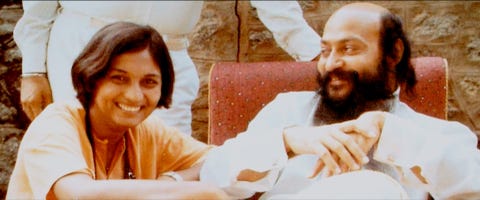
Rajneesh and Sheela Ambalal Patel,

Any thoughts on Wild Wild Country, the new Netflix documentary series about the Rajneeshees cult (also sometimes called sannyasins) who spent four years living in the Oregon countryside in the early 1980s?
Ma Anand Sheela

There’s Bhagwan Shree Rajneesh, a spiritual guru. There are the followers themselves, most of them white, middle class, and college educated. But the actual villain and most compelling character of this story is a refreshing surprise. It’s Bhagwan’s right hand, his personal secretary who eventually showed how far a person granted an absurd amount of power will go to keep it. Here’s everything you need to know about the fearless (and ruthless) Ma Anand Sheela.

Asians & Aryans

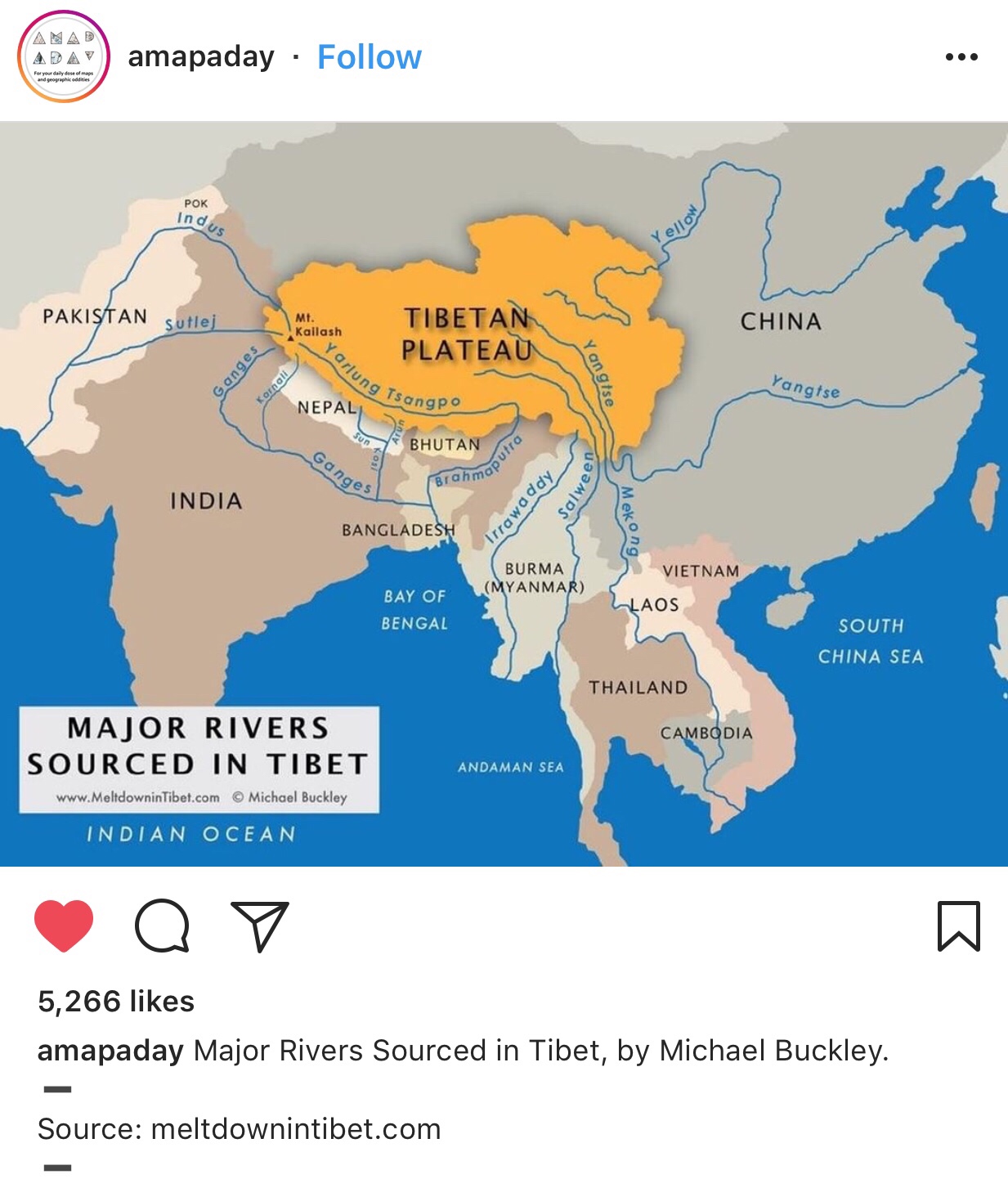
A few things jump out of this map:

(1.) Tibet is important, real important. These rivers feed half the world and these are the population centres of what we mean by “Asia.”

(1a.) Continents ultimately are arbitrary political constructs; what geographic feature cuts off Europe from Asia (is it really the Urals)? This map represents “core Asia” and more than ever I can see why the Middle East has an entirely different orientation. If a world government did ever come about; for fairness sake there would have to be some redistribution in how the Asian super-continent is treated; Africa’s population is burgeoning but difficult to see how it can match this.

(2.) It’s interesting to see how all the South Asian rivers have a common source (the Ganges has another source); a poetic meditation on the unity of the Subcontinent.

(3.) invaders or not; foreign or alien what is admirable about the Aryans is the extent to which they co-opted local traditions. As most readers of this blog know, Mt. Kailash is known as the home of Shiva and it literally feeds the Subcontinent.

(3b) Each initial wave seemed to have weaker and weaker ties to the land. The AASI seemed to have settled in the mists of pre-history, the (Elamitic?) Dravidian farmers may have fused with them to found the Indus Valley Civ.

(3c) the best way to think of the Aryan invasion is the Mongol conquests. The demographics of Central Asia and Mesopotamia shifted (and collapsed) as they did not (only) because of the rapacity of the Mongols but because of the failure to maintain the qanat (complex irrigation systems). I know that for a fact in Greater Iran whereas I can’t be sure that they used qanats in Mesopotamia.

(3d) At any rate either the Aryans filled in an ecological collapse (which seems unlikely since they spread with a rapidity elsewhere meaning that they had some technical and military advantage) or they triggered it. The indigenous compounded Dravidian-Negrito/Australasian (sorry for the loaded terms but easier to use Arya/Dravid than the newfangled terms) collapses and the remainder population did a Latin America where Aryans males were polygamous and high status.

(3e) the Aryans were the last invaders to both fully merge and embrace India as their core civilisation. The Muslim (Turkic?) invaders were oriented West and the British even further West. Each succeeding invasion wave was invested in India by an order of magnitude less than the preceding wave. The English returned to their colonies, the Muslims created Pakistan and the Aryans kept Aryavarta while the Dravidians have their local politics that tie them (especially in TN; the heart of the Dravidian movement).

(3f) I know it’s contentious but I would imagine the AASI would be like the Negrito coastal population and a related equivalent further upriver in the Indus prior to the Dravidian farmer wave. Prehistory was probably pretty ugly and tragic we just don’t know about it as we don’t have records but think the New World repeated time and time again.

(4) a final point as to why Iran may not have had as much a genetic impact. The Iranian plateau is exactly that a plateau. As I was told in Tehran a couple of years ago by a geographic; the mountain is life, every city in Iran is based on hills and mountains the rest is all desert (fertile plains are in short supply). It’s probably why it’s difficult to effect population replace in Iran as it is in its neighbours (Turko-Mongols introversion in Central Asia, Arabs influx in Mesopotamia, Aryan “invasion” in the Indus).

That’s all I can think for now btw the title is a bit misleading since Aryans are always a good lede lol.

Brown Pundits