Hindus/buddhists threat perception of christianity and islam.

This ofcouse was always the issue, which anyone in their minds would have known, but this is the first time someone mentioned it for what it was about.


Threat Perception among Hindu and Buddhist Nationalists

I am not quoting the text as I am not sure of the rules regarding that with this person and I am not too sure of the permission.


But I also think Western analysis (especially press coverage) of these movements sometimes misses a key aspect of how they see themselves – as defensive projects provoked by expansionistic, proselytizing religions while being subjected to the hypocrisy and double standards of bien-pensant elites. “

Male Misogyny

Please read this article in full:

Each of us has enabled the men who raped Asifa. I am tired of the posts on social media about being “heart-broken.” I no longer even feel the space in my chest where my heart should be. I am angry, and my anger is at aimed at you.

I will be 50 years old on Sunday. I lived 29 of those years in India. I was 8 years old when I was first sexually assaulted. Unlike Asifa, I wasn’t kidnapped and murdered. I lived to be sexually abused and assaulted multiple times, by men I knew, by strangers, by doctors, by faith healers, by the editor-in-chief of a major newspaper. I was 45 when I was last physically (not sexually) assaulted, by my brother, at his wedding, in full view of the wedding guests.

Nobody took a stand. None of these men was jailed. None was fired. None was shamed. None was named. Nobody walked out of the wedding in protest.

But there were consequences. India chose to turn its consequences on me. I was shamed, with love, for being an 8-year-old girl who was asking for it. I quickly internalized it. I believe even today that I should have been a different kind of child, hidden my legs as I played, been a little less proud of my pretty face, been a little more aware of my surroundings, a little less disabled so I could run. As an adult, in a high-ranking position in my journalism career, I was asked if the thing with the newspaper editor actually happened or if I’d imagined it (no matter that other women had charged him with similar abuse). I was locked up in a room at my brother’s wedding, “for my own safety”.

I was asked to apologize, to forgive, to forget, to draw upon my resources of compassion. I was asked, by all the family and friends I loved and still long for, to be a better Indian woman.

But let’s not make this about me. Let’s make this about you. Do you call out the violent tempers of the men around you or do you just get out of their way until they “calm down”? Do you step up and stick your neck out when a man or woman is deriding another woman/girl for being too sexy, too fat, too old, too progressive, too wanton, too transsexual, out too late, or in too long? Do you write that comment to shut down a good but sexist joke your popular and powerful male friend just posted on social media? Do you tell your son there will be consequences if he raises his voice, leave alone his hand, on his sister? Or do you ask him to “protect” her, as if she were a victim and he, her savior? Do you order him to get out of her way so she may grow so formidable that she will need no protecting? Do you pay your policemen and your lawmen to look the other way at your misdemeanors but punish the man who has no money for a bribe? Do you revere the “bad boy” movie star who was accused by multiple women of physical assault? Do you elect a prime minister who is charged with inciting a genocide against Muslims and then wonder why a little Muslim child was raped for days in a Hindu temple?

I am haunted by the cries I didn’t hear, of Asifa locked up in that Hindu temple. Our girls have been crying out for years, knocking to be let out from behind locked doors. The parents of Jyoti Singh, the medical student who was brutally gang-raped by five men on a Delhi bus in 2012 and thrown from the bus to later die, say that five years later, things have become worse for girls and women in India. The Dalit women among us have been warning us for decades that the rape of one of them will soon be the rape of one of us. But perhaps their faces are not light-skinned enough, their caste not high enough, their innocence not innocent enough to find their way in our news and social media feeds.

Yes, I am shaming you, on behalf of all the girls and all the old women in and from and with ties to India. Yes, I am blaming you for the childhood I had and the childhood Asifa lost. Yes, I know all the things even the most progressive among you whisper about the secrets some of us don’t keep. Quiet your whispers. Quiet your slogans. Go home and look your boys and men in the eye. Shut up and do the real work, India.

Continue reading Male Misogyny

Recent Spats

Just a few quick words about this iteration of Brownpundits and some recent spats here:

1. I have added a large number of authors and ALL those authors have the right to delete comments on their OWN posts. No one should be deleting comments on anyone else’s posts.
2. As far as possible, please try not to launch into personal attacks against other authors on the blog. Reasoned arguments are fine.
3. There is NO commitment on this blog that all posts will be in line with any particular ideology. Some authors love Pakistan, some don’t. Some are Islamophobic, some are very Islamophilic. Stick to reasoned argument as far as possible, and don’t lose your mind over perceived violations of this or that ideological purity test. No one is going to like every opinion. But all the authors have a right to their opinion. Feel free to argue with them, but there is NO policy of deleting posts unless they contain personal attacks or appeals to violence. As I said above, authors CAN censor comments on their own posts. In general, that is the only censorship on this site. VERY rare exceptions may occur, but none of the administrators have signed on to any general policy of censorship.

Try not to be too sensitive.
Cheers.

Final word

I just checked brown pundits after a nice night out to see that a comment I had deleted been excerpted. Regardless of any spat we may have or have not had that is a shocking violation of my own words and my right to expression especially after I had removed the comment.

I initially deleted the post but instead decided to let it stand (I tried reading it but frankly the only interesting thing in it was my excerpt).

This will be my last post/comment on Brown Pundits (I’ve deleted my account) since a irreparable line has been crossed.

End of an era for me at least. Persian pride and Pakistani passion have always been my vices.

Freedom leads to freedom, not anything else

Since posts are being deleted, thought this response would be necessary.

Ambedkar himself admired ramanuja , advaita . He said in his annhilation of caste ” no foreign ideology is necessary
” . So, no, he didnt see Hinduism as without hope. As for moral development in India is concerned, Coming of Islam was a big factor in all round under development altogether. There are many more people in Hinduism who stood up on issues of caste and they were allowed to criticise religion in its entirety. Ambedkar was made chairman of constitution by Gandhi and congress whom he criticised a lot. He visited and praised rss in its service as well. One cant say that of Islam. Islam kills its critics. so, no, I dont hold the same degree of hope for thee. As for borg, that is more apt for christianity and islam. It is not Hinduism that seeks converts.

Islam comes into it just as british are brought into it to explain harmful effects of colonialism to understand the relative under development. Europe succeeded because of 3 things, science, printing and freedom to criticize, India was the pre eminent place for new math and astronomy, it allowed freedom to criticize, atheists existed in India till the coming of Islam. Ramanuja , was the second greatest theologian in last 1500 yrs possibly and he stood against caste discrimination and so did many others in past 1000 years. Without Islam to worry about, people would have possibly be worried about these issues instead. Atheists existed in India for longer period than entire history of christianity thus far or the entire peak period of greeko roman civilization. To understand the influence of Islam, one only needs to wonder, what would have happened to western civilization had it been occupied, its universities destroyed, oxford and Cambridge being replaced with taj mahal and qutb minar. It was knowledge that changed the west and it would have been knowledge that would have changed India too, and knowledge production under Islam in India was bad.

The extraction under mughals was one of the highest, this point with evidence was already made here before. There seem to be many people out there who seem to fail the most basic test of understanding how progress whether it be in science or moral issues are made.

There is only one rule that leads to progress. Disagreement. Allowing critics to live and voice their opinion .  This freedom is of course not absolute anywhere in the world.  But is the bedrock of all progress. With this freedom, all other progress can be captured with time, but without this, it isnt sure how much progress can even be made. Freedom leads to freedom, not anything else.

With this in mind consider this.


girmitsays:

You can convert someone by appealing to their conscience, as christianity or islam do, or you can claim that a people belong to your fold (and they just don’t realize it), as brahminical hindus and their affiliates do, both are strategies to strengthen one’s identity group. The latter isn’t more compassionate. And if shudras criticize the hinduism of brahmins, it is not something that is permitted to them through enlightened reasoning, it is something that no one can do anything about and must endure. Weakness is not tolerance.
In some parts of India we are seeing shudras and others (who have force of numbers and willingness to take personal risk) aligning behind brahmins, and we are now seeing the so-called tolerance to criticize hinduism. Targeted assassination of writers, ransacking history departments, its all happening. Hindu exceptionalism is dangerous, the idea that we are uniquely peaceful and open to a multiplicity of viewpoints, and the Abrahamics are violent logocentric absolutists.
I’m not drawing a complete equivalence between all faith communities, there ARE qualitative differences, but we don’t know the history of dissent in hinduism. The people who used to get flogged for casting a shadow in the wrong direction or drawing from the wrong well, it doesn’t occur to me that their dissenting opinions on theological matters would be well received.”


This person cant seem to recognize, that west made strides of progress because of this very reason.Even if you were to credit this new progress in India due to enlightenment values in west, it would amount to the same idea.  As for history of dissent in hinduism, one can count the success of buddhism, ajivika, jainism, atheism in Indian history along with ramanuja, bhakti movement, veera shaivas among others,  eventual displacement from India of buddhism, atheism was not due to Hinduism either.

And one is infact thankful and should be thankful that people to a large degree are obeying laws of the land, constitution introduced under chairmanship of Ambedkar, with An atheist like Nehru being the Prime .This happened because  Gandhi built the social capital and entrusted it to them.   The chap seems to not realize,  without this social capital won and entrusted, which is what actually happened, the constitution remains but a piece of paper no one read. A formality. Without this trust if people had taken it upon them to destroy the social contract, massive amounts of damage could have been done . Especially if those people are the elites. So, yes, everyone must be thankful for combined cooperation that keeps the society working.To try to explain  this away by calling it “so called tolerance ” is outrightly moronic. It is a form of leftist delusion that has become all to common to see all progress as a product of forcible extraction. There is such a thing as win win deal or one earned through trust. One makes progress by making it so, otherwise, degree of fighting would lead to civil war as it happens in real failed states. People who make the above arguments live under delusion that things could not have been worse. No, they could have and could go south in future as well. One must make sure it doesnt happen so. And be appreciative therefore of progress made and one continues to keep making. The assembly that passed important bill on hindu code bill had many hindus of upper castes origin.

And one must look only across the borders to realize what freedom really means.  And one shouldnt make false equivalence even in partial way. And it is indeed right to praise polytheism to be better than monotheism on this issue. As for allowing dissent, it is the only freedom that counts, everything else is product of this one freedom. So, yes polytheism is most certainly more open for allowance of criticism. Infact I would argue that a world without monotheism would have developed far faster.  Even the success of the west is under girded on the knowledge and practices of hellenic and roman civilizations.


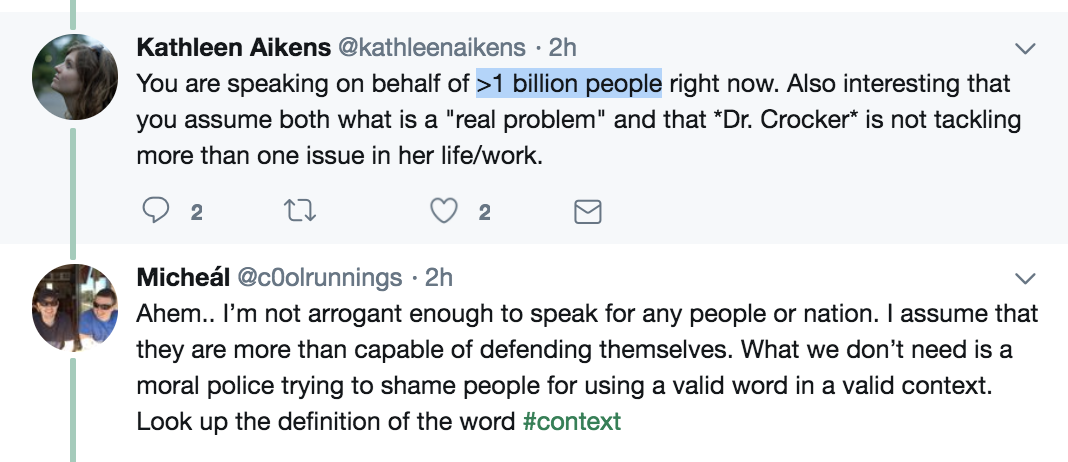
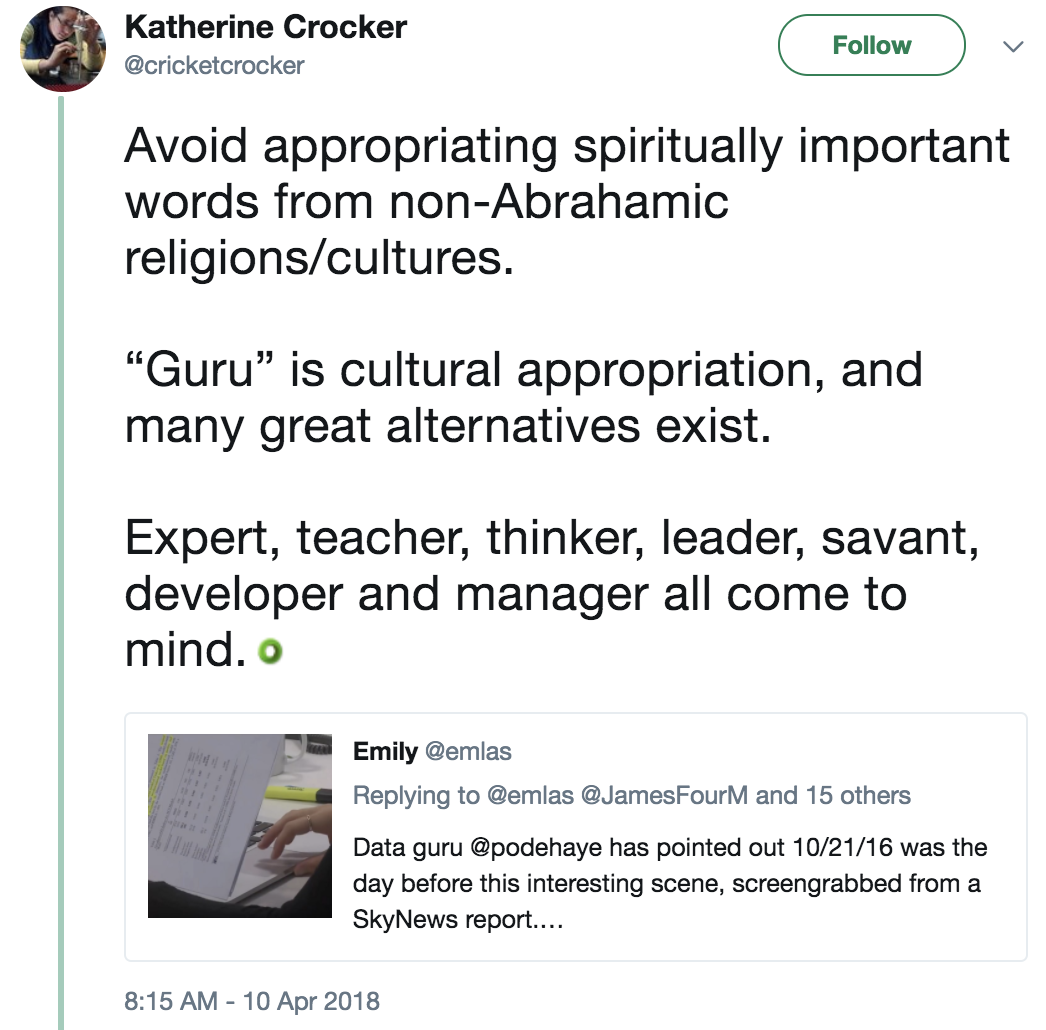
White presenting, women presenting, person defends Dharmic terminology from white people

Not sure if I would have believed this tweet existed if it didn’t. But it does.

But wait, it gets better! More white presenting people defending the cultural sensitivities of people of the Dharmic persuasion.

Now, I do think it is true that Dharmic religious perspectives tend to be made light of on occasion. For example, Hindus have “mythologies.” As opposed to the presumably real Abrahamic “God of history”?

But I don’t think this is going to help the situation. In fact, these sorts of public posturings are more about the person posturing than about what they are posturing about.

From the entry on Newspeak:

In “The Principles of Newspeak”, the appendix to the novel, George Orwell explains that Newspeak usage follows most of the English grammar, yet is a language characterised by a continually diminishing vocabulary; complete thoughts reduced to simple terms of simplistic meaning.

Moneylenders & Indian farmers

I’ve edited a fairly interesting passage about Indian agriculture on sorghum written by my Father in Law, Ramesh Lalchand, in the course of some import-export correspondence (we work together on Raef LLC):

I must inform you that Indian agriculture is extremely fragmented. Unlike the US or Europe, farming in India is carried out by small and medium scale farmers.

Except of course for rice and wheat, which is an entirely different ball game altogether. Rice and Wheat is consumed by the entire Indian population, hence realising the importance of this we had a Green Revolution organised by the then Indian Prime Minister in 1974, Indira Gandhi. From 1974 and for the next 5 years; the focus was on rice and wheat. This Green Revolution was so successful that from a net importer of Rice and Wheat, we are today one of the exporting forces in the world.

Due to the Green Revolution in rice and wheat other agri-products were neglected. Though we are now self sufficent in most agri-commodities; our other cereals and pulses never received the importance they deserved. As a result of this most other commodities, including sugar cane, is produced by small and medium farmers who not only sell to wholesalers but also to the government.

Sorghum in particular is grown in Maharastra state , Karnataka state and Andhara state, which amounts to 70%  of the sorghum. The balance 30% is grown in various different parts of the country but not in very large quantities

The grains market are normally organised once a week. All farmers literally bring their produce to a huge playground where brokers, wholesalers and other interested parties attend. They bring it in Bullock carts!!! And some have tractors with a trailer attached but mostly it is Bullock carts.

But in the case of rice and wheat is not traded like this. The growers are given govenment warehouses where the grains are given floor space and then it is sold to the government. The biggest buyer of Rice and Wheat is the FOOD CORPORATION OF INDIA, which is a govenment undertaking. What goes on there is another story. That will be discussed some time later. Let us for now focus on sorghum.

These small farmers bring in as little as one ton to max 10 to 15 tons . And payments are on the spot cash payments only.

The suppliers are the farmers, their forefathers were farmers and so are they in farming too. They only have their past performance of growing sorghum and nothing else.

You must also know that the Indian farmers is born in debt, lives in debt and dies in debt. So even he would have to get concurrence from his money lender. Let us say hypothetically even if we are ready to pay the money lender off, he will refuse to let go. Because of this thousands of farmers commit suicide every year due to the abuse they have to tolerate from money lenders. The government knows that and is desperately trying to rectify this problem . That is why over USD 2 Billion dollars in Indian currency loaned to the farmers by the Indian government is written off year after year as bad loans.

India got its independence in the year 1947 . At that time our food grain imports was the biggest bill on our heads in spite of the fact our population was much much smaller then. Today with 1.2 Billion people to feed we export food and food related products including seafood to the tune of 60 billion dollars !!!!!!

China on the other hand with a population of 1.5 billion has a much smaller export of food grains but a very large import bill on its head.

The Rawalpindi Conspiracy Case

(Originally published in The Friday Times)

History is an ensemble of memorable events and it is the job of historians to unweave the mystery of those events. Some historical events can be classified as outliers or turning points, altering the course of history. In Pakistan’s context, the first decade after partition held important pointers for things to come. One of the more significant events taking place soon after partition was the scramble for Kashmir. From the embers of the first Kashmir war arose the roots of a conspiracy to overthrow the incumbent civilian government. The conspiracy, known as the ‘Rawalpindi Conspiracy’ was hatched by military officials, all of whom had taken active part in the war for Kashmir. It was one of the first attempts in Pakistan’s history, by members of the armed forces, to stage a coup d’état. It can be argued that seeds of discontent (with civilian rule) among the military were sown during this conspiracy.

The conspiracy and principal actors involved in it have received scant attention during the last few decades. Hassan Zaheer, a retired civil servant, has written an excellent book detailing the conspiracy and its background. What distinguishes the book, titled ‘The Times and Trial of The Rawalpindi Conspiracy 1951’, is the attention to detail by the author who narrates the contemporary history of Kashmir in great detail, providing a platform for the reader to understand subsequent actions after partition.

The Muslim-majority princely state of Jammu and Kashmir was ruled by Maharaja Hari Singh, a Hindu Dogra Rajput. The Muslim population was not comfortable with Maharaja Hari Singh’s regime and its repressive policies. In July 1931, a commotion erupted in the Kashmir valley when Abdul Qadeer, employee of a British Officer visiting Kashmir, delivered an inflammatory speech about the sacrilege of mosques and restrictions on performance of religious rituals by the Dogra administration. In the agitation that followed Qadeer’s arrest and trial, one policeman and twenty-two demonstrators were killed. Srinagar city was placed under martial law and the agitation was suppressed brutally.

The All-India Kashmir Committee was formed in June 1933 by concerned Indian Muslims to highlight the plight of their Kashmiri brethren. The British government had to take note of the situation and the Maharaja appointed an official commission of Inquiry. The commission recommended granting a constitution to the State and safeguarding civil liberties. In the aftermath of the Qadeer agitation, two young leaders emerged to take over the leadership of popular protests.

Chaudhry Ghulam Abbas from Jammu and Sheikh Abdullah from Kashmir joined hands to organize people and in October 1932, the All Jammu and Kashmir Muslim Conference was established. Sheikh Abdullah had become the undisputed leader of the vale, but had no influence in Jammu while Ghulam Abbas’s leadership was confined to the Muslims of Jammu. In a few years, Abdullah gained power in the ranks of the Muslim Conference and changed its name to All Jammu and Kashmir National Conference to bring Hindus into the party’s fold, as advised by his idol, Pandit Nehru. Ghulam Abbas formed another party named Muslim Conference, with exclusive membership for Muslims.

In May 1944, Mr. Jinnah visited Kashmir in order to bring about a compromise between the National Conference and the Muslim Conference. In June 1944, after failure of the talks, addressing its annual session, Jinnah fully supported the Muslim Conference as the representative body of the Muslims of the State and criticized the National Conference for having opened its doors to non-Muslims.

The future of India after withdrawal was to be decided by the Cabinet Mission that arrived in 1946. The Mission presented a memorandum regarding the fate of more than 500 Princely states in India. The 3rd June Plan reaffirmed the plan discussed in the memorandum. It stipulated that states had to join either India or Pakistan after partition, there was no option of Independence. In the run-up to the partition, All India Congress took an active interest in Kashmir and wooed the Maharaja, forcing him to change his pro-Pakistan Prime Minister at one point.

All India Muslim League had a policy of non-intervention in matters of Princely States, summarized in a letter written by a Muslim Conference leader from Jail. M. Shaukat Ali wrote, “What we are surprised about is the complete indifference and nonchalant attitude of the League vis-à-vis Kashmir. Nothing should prevent the League from taking an active and positive interest in our affairs. Why can’t the League send two top ranking members, like Nishtar and Daultana, to pay a visit to Jammu?” During the same period, Patel and other Congress Leaders were cultivating high level contacts with State authorities, whereas the Muslim league had no communication with any of them.

On the eve of partition, the Maharaja tried to impose a wide range of oppressive taxes on the Muslims of Poonch. It was a Muslim-majority area and many veterans of Subhash Chandra Bose’s Indian National Army (INA) hailed from this district. The refusal to pay these new taxes by villagers and landlords in June began to take the shape of a guerrilla movement, a command structure, and a network of communication between the villages and communities. In the last week of August 1947, a series of public meetings were organized by Sardar Abdul Qayyum Khan and other local leaders in Bagh Tehsil of Poonch district. From the meeting at Neelabutt on 23rd August, an armed revolt against the state was launched. By the second week of September, the armed revolt had spread to whole of Poonch, as well as to the adjacent regions of Mirpur and Bhimber. Volunteers and tribesmen from Punjab and NWFP joined their kinsmen in the fighting that was going on in the Poonch areas. Most of the Muslim Conference’s top brass had managed to land themselves in jail because of a costly error of judgment. In the immediate post-independence days, the Muslim Conference failed to mobilize people and demonstrate their strength in favor of Pakistan.

An ‘Azad’ force comprising of tribesmen from FATA and Balochistan, under the command of veteran soldiers, was sent to Kashmir by the ruling government. Due to lack of discipline and training, the irregular force failed to advance upon Srinagar, having reached within a few miles of the State capital. Fearing the approaching tribals, Maharaja Hari Singh signed a document of accession to India, resulting in an influx of the Indian army to Kashmir. Mr. Jinnah ordered General Douglas Gracey (C-in-C, Pakistan Army) to move troops immediately ‘to seize the pass on Rawalpindi-Srinagar Road, and then to proceed through Srinagar, occupy Banihal Pass on the road to Jammu, isolating Srinagar and nullifying Indian intervention’. Mr. Jinnah was convinced by General Auchinlek to reconsider his orders and resolve this matter by talking to Nehru and Mountbatten. Failure of talks led to open confrontation between India and Pakistan. Brigadier Akbar Khan, a distinguished member of the British Army, had been appointed Director of Weapons and Equipment Directorate at the General Headquarters (GHQ) after Partition. He played an active role in providing arms to ‘Azad’ forces and returned to Kashmir during the first Indo-Pakistan war, which ended in a stalemate due to UN intervention. He was openly critical of the way the whole Kashmir operation was conducted. Akbar Khan’s Wife, Nasim Akbar, was inspired by communism and distributed communist literature among officers visiting their residence. The couple used to argue that ‘After the death of Quaid-i-Azam, there was no leader of his caliber to run the state, and that civil servants and police were corrupt. The people were not fully ready for a democratic state, but they had great faith in the army and there was no reason why it should not take over the government to run it honestly and efficiently’. Akbar Khan laid the blame of ‘failure’ in Kashmir squarely upon the civilian government.

During 1949, the initial planning of a coup was finalized and it was decided to arrest the Prime Minister (Liaquat Ali Khan) while he was visiting Peshawar in December 1949. Akbar Khan’s unit was based in Kohat and his co-conspirators included Major General Nazir, Bridagier Habibullah, Brigadier Latif Khan, Brigadier Sadiq Khan and Lt.Colonel Siddique Raja. It was planned that Governor General would be arrested in Lahore while the Commander-in-Chief of the Army, Chief of Staff, All British Generals and Adjutant General would be arrested from Rawalpindi. All Divisional Commanders were to be summoned to GHQ, relieved of their duties and arrested. Akbar Khan gave three reasons for military action, including the economic plight of the country, weakness of government during the Kashmir issue and incompetence of government in internal and external affairs. The Prime Minister was to be forced to announce his resignation and a military council was supposed to take over the reins of power.

Due to the unavailability of one of the conspirators, the plan didn’t materialize in 1949 and was postponed. In February 1951, the plan was revised and help was sought from members of the nascent Communist Party of Pakistan. The conspirators were arrested before they could seize power and the event was perhaps one of the first attempts to undermine the civilian government. It was, unfortunately, not to be the last one.

I recently recorded a podcast on this topic, which can be heard here:

https://patari.pk/home/song/Understanding-Pakistan-Episode-2-The-Rawalpindi-Consiracy-Case-Ft-Abdul-Majeed-Abid

Brown Pundits