Arabic and Koran lessons after school in Sri Lanka

This was a comment I made on a post in an online news paper.  Probably caters to less than 5% of Sri Lanka.
==========================================

In the village I live (North West Province of SL), the young Muslim male children spend two hours after school at the Mosque learning Arabic and the Koran. Apparently funded by the Mid East.
No Science, Math or English. They can barely speak Sinhalese.

I dread to think what opportunities these children will have when they are adults.

A century or more ago, the English/American Christian Missionary Schools were similar. Missionary Schools pushed Christianity, while at the same time an education in Science and Math. Literature and History was limited to Europe, as an agenda.

There is one large difference between the students of the Christian Missionary Schools and the village students attending Islamic studies. That is class and economic status.

The Missionary School graduates were assured of senior administrative positions in govt or able to enter into professions such as Lawyers, Engineers, Doctors and Surveyors.

What is going to happen to the children in this Village. No science and math skills, not fluent in English or Sinhalese. What is their future?

To be done: Translate into Tamil and hand out in Village.

A Plea To Our Muslim Brethren; Please Look In The Mirror

Early Indian Islamists (An Overview)

Part 1

Islamism or Political Islam are ideas that emerged in the early twentieth century and were formulated in different parts of the world mainly in response to fall of the Ottoman Caliphate. Two major figures that contributed to this debate immensely were Syed Qutb from Egypt and Abul Ala Maududi from India. The practical expression of this ideology came to fore in the later part of twentieth century and at the start of the twenty first. Browsing through the archives of history, one encounters figures that have been all but forgotten for the roles they played in the grand scheme of things. One such character that needs to be resurrected or at least identified for his role in popularising Islamism is that of Raja of Mahmudabad.

Amir Ahmad Khan (his given name) was a prominent landlord from United Provinces (U.P.). He received education from Lucknow and later from England. He was the youngest member of the Central Working Committee of All India Muslim League and its National Treasurer. He was the chief organizer of the Muslim League National Guard (till 1944) and the chief patron of the All India Muslim Students Federation (AIMSF) formed by Muslim students till August 1946. Despite his aristocratic background, he cultivated an austere personal style. He habitually wore khaddar, was known for his generosity towards his tenants, and his piety as a practicing Shia.

He was ultimately sold on the idea of Pakistan, but he chose to see the future state in a different light than Mr. Jinnah. He claimed that the Lahore resolution possessed global—and not just regional—significance. He exclaimed in a speech that it had been passed not just for Muslims in India but for Muslims in Turkey, Iran and Afghanistan and indeed the whole Islamic world. He held half-baked ideas about democracy and an ‘Islamic political system’ which he articulated in the following words: “When we speak of democracy in Islam it is not democracy in the government but in the cultural and social aspects of life. Islam is totalitarian — there is no denying about it. It is the Quran that we should turn to. It is the dictatorship of the Quranic laws that we want — and that we will have — but not through non-violence and Gandhian truth”.

He outlined some features of ‘Pakistan’ as he envisioned it in his Presidential address to Bombay Muslim League in May 1940: “There will be prohibition, absolute and rigorous, with no chance for its ever being withdrawn. Usury will be banished. Zakat will be levied. Why should not we be all allowed to make this experiment? In treading this path, we will not be crossing the path of any right-minded individual”.

Among contemporary ideologies, he found socialism to be compatible with Islam by and claimed that socialism was first inaugurated by Prophet Muhammad (PBUH) in Arabia long before it came into existence in Russia under the Bolsheviks. To the Raja, socialism just like Islam was based on a new vision of the world where there would be no discrimination based on colour, class, sect, region, or language. Before the Peoples’ Party of Zulfikar Bhutto appropriated the slogan of ‘Islamic Socialism’, Raja of Mahmudabad (and even Liaqat Ali Khan) had blown this trumpet.

Mr. Jinnah was not in favour of an overt theocracy at any time in his career and was irked by the frequent outbursts of Raja of Mahmudabad. An anecdote from Isha’at Habibullah’s unpublished autobiography demonstrates this attitude perfectly: “The Raja started the conversation by saying that since the Lahore resolution had been passed earlier that year, if and when Pakistan was formed, it was undoubtedly to be an Islamic State with the Sunna and Sharia as its bedrock. The Quaid’s face went red and he turned to ask Raja whether he had taken leave of his senses?

Mr. Jinnah added: Did you realize that there are over seventy sects and differences of opinion regarding the Islamic faith, and if what the Raja was suggesting was to be followed, the consequences would be a struggle of religious opinion from the very inception of the State leading to its very dissolution. Mr. Jinnah banged his hands on the table and said: We shall not be an Islamic State but a Liberal Democratic Muslim State.”

Major differences between Mr. Jinnah and Raja of Mahmudabad developed in 1946, due to the Raja’s espousal of violence in North West Frontier Province (NWFP) and his opposition to the Third June Plan that laid the way for partition of India. On the eve of the Partition, the Raja was in Hyderabad but refused to visit Karachi for the 14th August Independence ceremony.

He was appalled by the violence that accompanied the   Partition and left for Iran with his family soon after India was divided.

They travelled from there to Mashhad, then Tehran and finally to Karbala. The Raja and his family stayed in Iraq for ten years. In 1957, the Raja went to Pakistan and changed his Indian passport for a Pakistani one. He had thought of going into politics but then Pakistan was a different country. He was a Mohajir, a refugee in Pakistan, a Shia in a predominantly Sunni country. The Raja left Pakistan again and travelled to London where he finally settled down and passed away in 1973.

Part 2

Browsing through the archives of history, one encounters figures that have been all but forgotten for the roles they played in the grand scheme of things. One such character that needs to be credited for Islamist tendencies was Chaudhry Khaliquzzaman, a political figure from United Provinces (UP).

Early in his political career, he had visited Turkey as part of Red Crescent Society’s medical mission to Turkey led to Dr. M.A. Ansari during the Balkan Wars (1912-13). During the First World War, Ottoman Turkey (ruled by Pashas) decided to side with Kaiser Wilhem’s Germany (part of the Central Powers). Following the defeat of Central Powers, Ottoman Turkey was deprived of its territories and this sparked a furious reaction amongst Muslims in India. A ‘Khilafat Movement’ was led by clerics from India to pressurise the British Government into restoring the Ottoman territories. Khaliq was actively involved in the movement during the early 1920s and led Indian Muslim delegations in the 1930s to international conventions organised to defend Palestinian Arab rights in the face of the Zionist movement and the perceived British attempt to appease world Jewry.

In 1935, British Government introduced the ‘Government of India Act’ which proposed a Federal Structure for running the country under limited Indian rule and elections in provinces. Khaliquzzaman was a member of All India Congress for many years before officially joining All India Muslim League (AIML). He was the Secretary of Muslim Unity Board (MUB) comprising mostly of Muslim politicians with close links to the Congress party, and Ulema belonging to the Jamiatul Ulama-i-Hind. He was involved in a power struggle for leading the Muslim League Parliamentary Board in UP with Raja of Salempur. Before the 1937 Elections, Khaliquzzaman, was parleying with the Congress leadership over ministry making, against Mr. Jinnah’s wishes. He started an Urdu newspaper named Tanveer for propagating pro-AIML’s message.

Speaking at the Pakistan session of the Punjab Muslim Students Federation conference in March 1941, Khaliq said that, “Just as the Prophet had created the first Pakistan in the Arabian Peninsula the ML now wanted to create another Pakistan in a part of India.”

Addressing a gathering in his hometown of Lucknow, he explored the relationship between territorial nationalism and Islam. The Hindus, he noted, saw nationalism as a Hindu Goddess (Devi) that needed to be worshipped. This practice was abhorrent to a Muslim for even though he loved his nation, he could never worship this Devi and become a slave of nationalism. In May 1942, he stated his Islamist goals in following words, “Pakistan is not the final goal of the Muslims. We want more. Pakistan is only the jumping off ground. The time is not far distant when the Muslim countries will have to stand in line with Pakistan and then only the jumping ground will have reached its fruition.”

Soon after the Lahore Resolution, Nawab Ismail Khan convened a conference of Ulema and prominent Muslim intellectuals to draft a blueprint for an Islamic Constitution that would inaugurate an Islamic state in Pakistan. The first meeting was held at the Nadwatul Ulama, Lucknow and was attended by Ismail Khan, Khaliquzzaman, Syed Sulaiman Nadwi, Azad Subhani and Abdul Majid Daryabadi. He firmly believed that a solution to the communal problem can be found by use of force. At a public meeting at Fyzabad, he said: “If the Musalmans of India pursue the policy of tooth for tooth, eye for an eye, nail for a nail, no power on earth can dominate them.”  On the question of the Muslims in the ‘minority provinces’ such as the U.P., Khaliq subscribed to the ‘Hostage population theory’ which he explained in the following words: “After Pakistan is established, the Hindu majority provinces will think a hundred times before they resort to any tyrannical act. They know the Indian Muslim who can shed his blood for his Muslim brethren of Turkey can also do something to save his Indian Muslim brethren of the minority provinces.”

He was fond of recalling past Muslim victories in the subcontinent for furthering political causes. Before the 1946 Elections to the UP Assembly, Khaliq asked Muslims to win the fourth and fifth battles of Panipat corresponding to the central and provincial assembly elections, by casting their votes in favour of the All India Muslim League. After the elections, Khaliquzzaman joined the Constituent Assembly as the leader of the opposition and pledged his loyalty to the Indian Union (although he resigned and left for Pakistan after Partition. Once in Pakistan, he resumed his Islamist activities. He was a founding member of the ‘Islamic World Brotherhood’ alongside Molana Shabbir Usmani. They convened a ‘World Muslim Conference’ in January 1949. A brochure at the conference titled ‘Muslims of the World Unite’ stated that ‘it was but natural that such an effort is made by Muslims of a country who do not subscribe to the theory that a nation is based on geography or race, but whose country’s very foundation is laid on a theory of religious nationality.’

Chaudhry Khaliquzzaman was appointed the President of Pakistan Muslim League a year after he moved from UP. Khaliq affirmed the World Muslim Conference promoted by Shabbir Usmani, as the first step in the creation of a permanent world organization, which would have branches not only in Muslim countries of the world but also in countries with Muslim minorities. It could soon be extended to become an organization similar to the Organization of American States. Expressing the long term aims of the Conference, he noted that in the context of the failure of the Arab League and Arab racial sentiment, he expected the ‘natural reaction’ of Muslims in Arab countries to work for the creation of a ‘central authority for Muslim States which can protect them against further political and economic inroads of other powerful States.’ He conceived this supervening authority in terms of the ‘Quranic State’, which he believed could be brought about through ‘political associations, social contacts, economic co-operation, and linguistic changes.’ This state would embrace any and all Muslim countries that wished to join and would be structured as ‘a loose federation of autonomous states bound together alike by adherence to the principles of Islam and mutuality of interests.’

His last political appointment was to the Governorship of East Pakistan. He passed away in 1973, two years after East Pakistan seceded. Religion did not play the role of ‘glue’ between the two halves of Pakistan, despite the claims of Islamists from UP.

A Tale of Two countries

It has been 70 years since the Partition of India. The separation was an ugly affair, with both sides holding grievances against each other. After living side by side for more than a thousand years, Hindus and Muslims were declared separate nations by the All India Muslim League which used religion as the primary reason to demand a separate state. When Pakistan came into being, Mr Muhammad Ali Jinnah tried to be inclusive in his August 11th speech at the Constituent Assembly. But his was a lone voice in a chamber full of proto-Islamists. Debates over the Objectives Resolution brought this issue to the fore when all the non-Muslim members of the Assembly voted against it. The Islamic identity that was chosen by the ruling elite, was propped up in opposition to secular India. Pakistan’s attitude towards India has steered its foreign policy and at times, domestic policy, throughout the last seven decades.

Former Pakistani Ambassador to the US Husain Haqqani has had a ringside seat to developments in this arena since the late 1980s. His latest book, India vs Pakistan: Why Can’t We Just Be Friends, tries to capture this unique relationship by focussing on four key areas: History, Kashmir conflict, Nuclear Bombs, and Terrorism. His analysis is peppered with interesting anecdotes that shed a new light on how politicians from the two countries have interacted over the years. It is also a concise history of different efforts by both countries and the International community (United Nations, the United States, and China) to reach a settlement on bilateral issues, especially the Kashmir dispute. Another book that sheds light on recent milestones in India-Pakistan relationship is Myra Macdonald’s ‘Defeat is an Orphan: How Pakistan Lost the Great South Asian War’. Based on her reporting experience in South Asia for more than a decade, MacDonald has penned a magisterial account of events that underpin the current relationship between the two countries.

On Kashmir, Ambassador Haqqani mentions the 1962-63 Indo-Pak talks when India was willing to give up 1500 square kilometres of territory but then Foreign Minister Zulfikar Ali Bhutto stuck to a maximalist position, rejecting the offer out of hand. Both sides have stuck to their guns since then and neither side is willing to consider a middle-of-the-road compromise anymore. Pakistan has tried using non-state actors and direct intervention, worsening its own case. India neglected the Kashmiris — despite Kashmir’s state assembly ratifying the accession of state to India in the 1950s — and tried manipulating election results in 1987, resulting in a full-scale insurgency that was later supported by Pakistan. After 9/11 attacks, when the insurgency in Kashmir died off, India failed to sell its multicultural and liberal democratic dream to the Kashmiris. In a recent interview with Indian Express, former chief of India’s Research & Analysis wing (RAW) A.S. Dulat spoke about the failure of Indian government to try rapprochement with Kashmiri leadership, resulting in the current unrest in the Valley.

I have heard similar anecdotes first-hand from people who had a chance to interact with military top-brass in Pakistan. Pakistan remains the only state among the nuclear-capable countries to publicly say that its nukes exist as a defence against another country (India) but it has not yet stated a ‘No First Use’ policy. Nuclear weapons have thus become an integral part of Pakistani nationalism and identity, according to analyst Feroz Hassan Khan. India started its nuclear programme ostensibly to obtain nuclear energy but changed course after the 1962 Indo-China war. Macdonald has mentioned at least three instances when India was ready to display its nuclear capability (before 1998) but was restrained by International pressure. The spectre of a nuclear war hangs over India and Pakistan and remains the biggest threat to humanity in this region. Unlike Nuclear scientists elsewhere in the world, many of Pakistan’s scientists have gone ‘rogue’ in recent years. These include the megalomaniac Dr AQ Khan indulging in a global nuke trade and others who are known to have visited Osama bin Laden in Afghanistan.

The year 2016 saw three different events that will define the broader contours of Indo-Pak relations in the 21st century. On Christmas day in 2015, also the birthday of Pakistan’s current prime minister, India’s Prime Minister Narendra Modi had made an unexpected visit to Lahore, raising hopes for improvement in relations and opening of a dialogue. Exactly a week after that, terrorists attacked India’s Pathankot airbase. Investigations by Indian authorities revealed a Pakistani connection and Pakistan’s government publicly agreed to cooperate with the investigation. In March 2016, Pakistan’s National Security Adviser called his Indian counterpart and alerted him about a possible attack during the Shivartari celebrations in Gujarat. As a result, security was beefed up and nothing untoward took place. In April of the same year, Pakistan arrested a suspected Indian spy from Balochistan. The arrest was presented as evidence of Indian meddling in Pakistan’s internal affairs and ended any hope of a dialogue with India.

In the last few years, India has started treading the path that Pakistan has taken since the beginning: a path of intolerance, jingoistic nationalism and a visceral hatred for secular values. Pakistan’s political class has lately been trying to change course but the immovable force known as the ‘establishment’ stands in the way. Without improvement of relations between the two countries, the future of South Asia is bleak.

artilce in outlook on Islam & reform

https://www.outlookindia.com/magazine/story/god-is-not-a-khomeini/298043

…An Islamic prototype for free thought and action: Part of the unthought and the unthinkable in Islam is the lesson to be gleaned from the parting of ways between God and Satan, as described in the Quran. When Satan rebelled against God’s command and threatened to lead humanity astray until the day of judgement, God had the option of doing a Khomeini and deciding to finish off Satan once and for all (in the memorable words of V.S. Naipaul in response to the fatwa against Salman Rushdie, ‘an extreme form of literary criticism!’). But he dec­ided to let Satan go and do as he pleased. In other words, God granted Satan absolute freedom of expression and action for eternity. As the Malayali Marxist intellectual K.E.N. recently stressed, the Quranic narrative about God’s decision to grant Satan full freedom is perhaps the best model for Muslims to emulate in matters of freedom of thought and expression. Once they do that, the prospect of a civilisational ascent, as happened during the days of the Abbasid and Andalusian glories, will again beckon.

(Shajahan Madampat is a cultural critic, writing mostly in Malayalam and English and occasionally in Arabic.)

If the House of Islam were a family

The Arabs would be the venerable, schizophrenic and impotent patriarch.

Iran would be the ageless, beautiful but bitter bride, constantly scheming and harlotting where she can.

The Turks would be the valiant general with whom Iran has carrying on with for the past millennia shortly after her Arabian rape.

Pakistan would be the 20-something sub-altern to the general desperately trying to win the respect of the Patriarch and love of the Bride; to the amusement of all 3.

The Afghans would be the angry teenage chowkidar (gatekeeper) pushed around by the sub-altern after he’s been slapped around.

The Kurds and Berbers would be the angry adopted kids constantly plotting to break up the House but never really getting anywhere except for minor victories. They win a bedroom here and there but they aren’t able to make their own house; no funds, no love, no real friends.

The Indians & Bangladeshis would be the next neighbours over wondering why the sub-altern prefers to be a servant in that house rather than a friend in theirs.

The rest (Malays, Africans) are distant cousins who come over once a year for an Eid reunion and visit the ailing Patriarch.

Someone should make a comic strip about the Ummah; I’m sure it’ll be a blast, no pun intended..

What would ‘secularism’ mean in Pakistan?

In his inaugural address to the Constituent assembly of Pakistan, Mr. Muhammad Ali Jinnah proclaimed, “You are free; you are free to go to your temples, you are free to go to your mosques or to any other place or worship in this State of Pakistan. You may belong to any religion or caste or creed that has nothing to do with the business of the State”. It was a vision of a state where religious practice is entirely separated from the functions of state – as enunciated by the man who almost singlehandedly brought that state into existence. Mr. Jinnah knew that a clear majority of people in Pakistan at the time were Muslims. He was also well aware of the fact that almost a quarter of Pakistan’s citizens (at that time in history) belonged to various non-Muslim faiths.
Changed contours
Over the years, the contours of Pakistan changed, geographically and demographically. According to the latest estimates, an overwhelming majority of Pakistan’s citizens are Muslims. This has led many to question whether secularism is a viable option for a polity that belongs to a particular religion.
Secularism is not atheism
Secularism as an idea has taken some beating in the Land of Pure. It is associated with atheism, debauchery and lawlessness. However, secularism, as a political ideology has nothing to do with a particular religion. It is true that secularism arose out of the Enlightenment in Europe as a counter to Papal theocracy. It evolved into different shapes based on geography thereafter. The French version of secularism (with its basis in the concept of Laïcité) is profoundly different from the constitutionally mandated secularism in India, Turkey and the United States. The charge that secularism is akin to atheism is frequently thrown by religious commentators in Pakistan. As a result, the popular narrative in Pakistan is that secularism means going against religion (Islam) which can be a dangerous notion for anyone claiming to be secularist. This misinterpretation was done with an aim to close the debate altogether about system of governance.
The challenge for proponents of secularism in Pakistan is to demonstrate how a Muslim-majority country that was conceived to be a place specifically designed to be a ‘laboratory of Islam’ would function as a secular country.
Secularism in Pakistan – a neutral state promotes coexistence
Secularism, in my opinion, would mean coexistence, tolerance
and a confessionally neutral state in a multicultural society such as Pakistan. Even within Islam, there are different strains of thought. In fact, sectarian conflicts within Islam over the last three decades are only one of the reasons as to why a neutral state is required to mediate the different schools of thought and the conflicts that arise from within.
Moreover, Pakistan still is home to millions of people who are non-Muslim. Biased policymaking and intolerant jurisprudence has made the lives of these minorities a living hell. In the age of modern technology, people in Pakistan are still arguing over interpretation of religious texts and killing each other over it. The state has abdicated its responsibility towards Hazaras, Ahmedis, Christians and Hindus. The only way we can protect the minorities and establish a rule of law is in the presence of a neutral state.
What needs to be understood is that the opposite of secularism is theocracy, in which religious figures control the reins of government. In countries with diverse populations, the rule of one faction over the other leads to brutality and in some cases, genocide. One of the major examples of this trend can be seen in Myanmar where Buddhist monks have aligned with the ruling government to wreak havoc on Rohingya Muslims.
In Pakistan, secularism would mean respect for existing religious identities
In a country like Pakistan, secularism would not mean erasing religious identities but a respect for existing identities and no efforts by the state to impose its version of faith on its citizens. The first attempt at reversing Mr. Jinnah’s secular message was the passage of Objectives Resolution in 1949 that foreshadowed an Islamization of Pakistan’s constitution. In the 1973 constitution, the resolution was kept as a preamble but a dictator (General Zia) made it part of the main text.
The importance of secularism for Pakistan can be understood by the way it has been opposed – tooth and nail – by the religious lobby since the very first day of Pakistan’s establishment. The poorly-constructed Nazriya-e-Pakistan (Ideology of Pakistan) was supposed to put Islam at the center of our politics. Currently, with exception of Jamaat-e-Islami and some factions of Imran Khan’s PTI, no major political party is willing to defend the ‘Nazriya’ as Zia defined it – and the sooner such a poorly thought-out concept is consigned to the dustbin of history, the better.
Pakistan deserves a secular, constitutional democracy, instead of a narrow-minded Mullah-cracy.

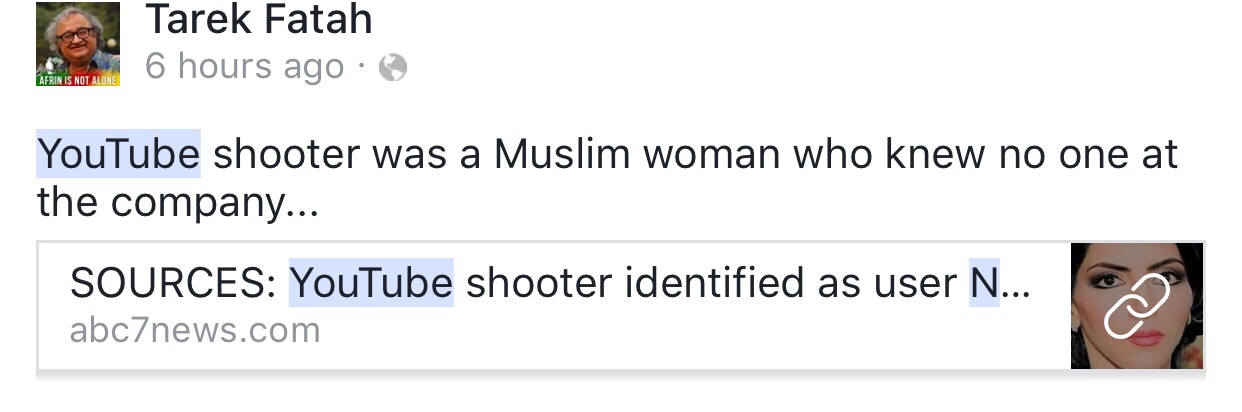
Tarek Fatah is a fu*king moron

Pardon my French!

The shooter’s name was Nasim Eghdam, who anyone would know was Persian.

In fact she turned out to be a Bahai (like me)! Also there are some Persian surnames that are predominantly or disproportionately BahĂĄ’Ă­ in origin because Iran adopted surnames in the 20’s/30’s. Eghdam did sound like a BahĂĄ’Ă­ surname..

Of course it seems she had some sort of mental illness and I apologise on behalf of our faith (any violence is forbidden). There could have been no justifications for her action and her father did warn the police. Thankfully no one was killed (3 were unfortunately wounded) and it really does seem like mental illness.

I’m really shocked that a BahĂĄ’Ă­ could do something like this but I’m sure there are many learning lessons for the community in this (what do we do with isolated believers etc).

Finally Tarek Fatah is a fool and a half. Anyone with common sense would know that this was a Persian name and that Persians won’t do Terrorism in the name of Islam. I’m beside myself with fury at his blatant Islamophobia; not that I’m an apologist for Muslims in any way.

As one can contrast my approach and apology about a BahĂĄ’Ă­ shooter (the genuine shame that she brings on the Faith & the sadness that the Faith was not there for her) in contract to the constant defensiveness of Muslims about terrorism done in the name of Islam.

Not all Aryans are Indian, though most Indians are part Aryan, and most Aryan ancestry is in India

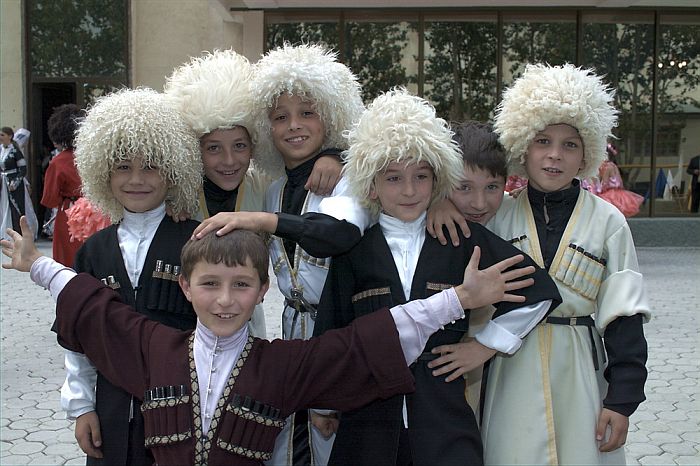
Ossetian boys

This post needs to published mostly to clarify some issues in relation to terminology. The genetics is moving fast, and people are going to get overwhelmed.

First, the term Aryan, or Arya, is not exclusive to South Asia. As most of you know it was used by many (though not all!) Iranian peoples. The Indic and Iranian branches of the Indo-European language family are close enough they form a very tight clade. The only comparison might be Baltic and Slavic, though some have asserted that that is due to the fact that Baltic peoples have lived so close to Slavic peoples for such a long time.

Though in the main Iranian peoples are in close proximity to South Asia, or in West Asia (e.g., Kurds), one group is exceptional in that it has no connection to West or South Asia: the Ossetes.  These people on the northern fringes of the Caucasus are descended from Iranian steppe pastoralists who never went south. You know them as Scythians, Sarmatians, and Alans.

To my knowledge these northern Iranian peoples never called themselves Arya, so perhaps the world itself was some sort of loanword? (internet resources are of differing opinions on the provenance)

Second, the division between Indo-Aryans and Iranians predates the  arrival of the latter into the Indian subcontinent and to West Asia. The latest genetic work indicates that steppe signal did not show up at BMAC until ~2000 BC. We also know that a group of Indo-Aryan provenance was in Upper Mesopatamia 1500 BC. In contrast, Iranian peoples show up to the east of Assyria ~1000 BC, and there were Iranian peoples to the north of Turan deep into antiquity (the Sarmatians who harried the Pannonian frontier were Iranian heirs to the Scythians).

The “Indo-Aryans” who were integrated into the kingdom of Mittanni/Hanigalbat may never been resident within South Asia. Where the major pulse of migration went to the India subcontinent after 2000 BC, another wave probably sent outriders to the west.

But where the Indo-Aryans in South Asia would have  encountered collapsing IVC order, the societies of West Asia bounced back reasonably from the time of troubles around the turn of millennium, when barbarians from the northern and eastern peripheries (“wild Guti”) collapsed the Third Dynasty of Ur and Semitic pastoralists took the reins of Mesopatamian civilization.

There are suggestive but very clear Indo-Aryan aspects of the Mitanni elite culture. But, by and large it was absorbed into the Hurrian substrate of the region. The analogy here might be what happened to the Turkic Bulgars in what became Bulgaria, as they were cultural absorbed by the Slavs over whom they ruled (or, the Scandinavian Rus).

Let’s call these steppe people “Aryans.” Iranians and “Indo”-Aryans.

How many are there around today? Let’s say 10% of South Asian ancestry is Aryan. This is very conservative (see this post). That’s 150 million people, 0.10 x 1.5 billion. There are ~200 Iranian speakers. There’s no way that 75% of the ancestry among this group is steppe. It is high in Turan and eastern Iran, but in populous western Iran and in Kurdistan the steppe fraction declines (Haber et al. found 7% “pure steppe” signal in Lebanon, so it’s not trivial even in western Iran, but it’s probably not going to be more than 50%).  Most of the Aryan ancestry in the world is in India.

That being said, one should not confuse South Asian culture with Aryan culture and Aryan culture with South Asia. The two are distinct. It is hard to deny that South Asian culture was strongly shaped by the Indo-Aryans; most of us (or our recent ancestors) speak an Indo-Aryan language. The Hindu priestly caste seems to have more Indo-Aryan ancestry, and some of their rituals and customs date back to the Vedic period. Only a few groups have zero evidence of steppe ancestry, even in South India.

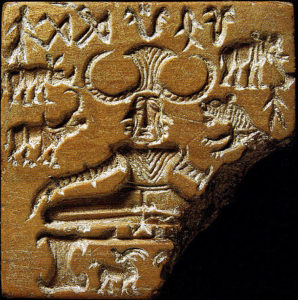
Indus Valley artifact

But Indian culture and Indo-Aryan culture in South Asia are not exclusively Indo-Aryan. The “Hindu religion” is diverse, but it is clearly not present outside of South Asia, except as reflux as South Asian polities and peoples moved to the margins of Turan (e.g. the Shahi kings), or through cultural and demographic diffusion to Southeast Asia (there is robust evidence of Indian genetic impact in places like Cambodia and Bali).

I do not believe that Hinduism, and Indian culture more generally, can be understood without consideration of its non-Aryan component. The cultural archaeology of this is beyond the purview of this post, but I believe that like the Greeks the Indians were strongly shaped by pre/non-Indo-European currents.

As Indian culture in the 1st millennium BC can only be understood as a synthesis between Aryan culture, and non-Aryan culture, the expansion of Buddhism into other parts of Asia, and more specifically to Turan, was not just of Indianized Aryan culture, but of an Indian culture which was a synthesis of Aryan and non-Aryan. It was something new, novel, and distinctive, that was exported throughout Eurasia.


How did I handle casual racism in Los Angeles? Awkwardly

I am trying to avoid the “P-word” in BP but my wife assures me that after the Shahid Afridi controversy that if BP were to simply be about that “topic” we’d get a million viewers a day (I was telling her the readership views). I’ll probably crack from the moratorium but in the meantime let’s read on the sublime Romesh Ranganathan (his sense of humour is just wicked).

Before I first arrived in the US, I had been bombarded with advice from my friends about the nightmarish experiences that anyone brown faces at immigration, and warned that I should steel myself for a thorough interrogation and a cavity search. This turned out not to be the case, as I was welcomed by the officer at immigration and wished well on my new journey. He then started discussing astrology with me, which I couldn’t give a shiny shit about, but obviously had to feign interest to avoid immediate deportation.

It was only a couple of weeks later that my attitudes towards racism were once again brought under scrutiny. My family and I were at a restaurant having dinner with an all-white family (I mention this because it’s relevant to the story, not just because I want to show off that I have white friends) when an older woman approached our table.

“I have been watching you all evening, and I have to say how wonderful I think you are.” Nobody at the table had any idea what she was talking about, but, I have to admit, a small part of me hoped I might have been recognised so that I could demonstrate to my wife that I did in fact have some profile over here and this move to the US wasn’t a complete waste of time. My dreams were immediately shattered, however, when she announced to most of the restaurant: “This is what America is all about. Families eating together regardless of colour! This makes me so happy. And I’m saying this as a Republican!”

I sat in astonishment as my wife and friend discussed how nice that was and what a positive experience we had just had. I firmly disagreed. I made the point that we were just sitting having dinner and that we should be able to do that without it being commented on or misinterpreted as some sort of social statement. My wife and friend, however, felt that this woman might have felt like she had made some progress in her attitudes and that her approaching us to share that was something to be celebrated.

On both of these occasions, I felt that my response to what was happening was insufficient and that perhaps I have a responsibility to tackle these beliefs to help combat discrimination. But, mostly, I just want to have a quiet Mexican meal with my token white mate.

Brown Pundits