(In 2017-18, an Indian friend wanted to collect essays from Pakistanis on how they view MK Gandhi across the border. I wrote this short letter to Mr. Gandhi that I recently saw in my collection. Sharing it with the BP community. )
Mohandas Karamchand Gandhi
Birla House,
New Delhi.
Dear Mr. Gandhi,
My name is Abdul Majeed and I am writing to you from the city of Lahore, Pakistan. I have been asked to write about you by an Indian friend of mine and I accepted his proposition. I feel ambivalent writing about you since I have thought about you in myriad ways over the course of my life. I grew up in a conservative Muslim household in a small Punjabi town called Sialkot and first learned about you in the ‘Social Studies’ textbooks taught to schoolchildren. My first impression of you as a person was quite negative since the role assigned to you by virtue of ‘Two Nation Theory’ (or TNT, as I now call it) was that of a Hindu politician who opposed the formation of Pakistan and probably hated Muslims. Like many schoolboys of my age, I idolized Mr. Jinnah, your arch-nemesis and a founding father of Pakistan. For us, Jinnah was the David to your Goliath, a defender of minority rights against all odds, an impeccably dressed man who stood up to the might of Hindus and saved Muslims of India from a cultural annihilation. In our imagination, he was everything you were not. We used to make fun of your attire and your persona. I grew up in a society where violence was the channel through which you expressed your masculinity and thus we thought your non-violent methods were signs of cowardice. I learned that All India Congress, a party you led for many years, did not support the idea of an Independent Pakistan (or a divided India, depending on whom you ask) and refused to believe in Partition even after two separate countries had been established.
My outlook towards history and towards your personality changed when I went to boarding schools in the northern part of the country. While the basic ideological framework remained in place, facts added up through the years. At one point in time, I could recite the whole ‘Pakistan Studies’ book by heart in two hours, including names of the books written by Sir Syed Ahmad Khan, a Muslim educationist and reformer in Nineteenth-century, charter of demands presented by the Shimla deputation to Viceroy of India in 1905, consequences of Bengal’s partition in 1905, Minto-Marley reforms of 1909, Fourteen points of Mr. Jinnah (a proposal for constitutional reform in British India) and the Islamic clauses in Pakistan’s three constitutions. You might be astonished to know that history books in our schools start the story from the Nineteenth century as if nothing happened in this land before. The boarding schools I went to, were located near Mansehra (containing artifacts from two thousand years ago) and Taxila (where the oldest University in the world was once present) respectively, sites containing artifacts from a past I never had. I knew you as a wily politician who duped Muslims during the Khilafat Movement. The word ‘Mahatma’ was used as a prejudicial slur towards anyone ‘Indian’. I often got called by this name because I was a vegetarian.
Years later, I ended up seeing you in a different light. I was roaming the streets of New York City in the immediate aftermath of Hurricane Sandy when I chanced upon a statue of you in Greenwich village. A week after that, I saw another one of your statues at the MLK memorial in Atlanta. I learned about your influence on Martin Luther King Jr. and the strategy of non-violence resistance. It was around this time that I read Arundhati Roy’s foreword to ‘Annihilation of Caste’ and ‘The South African Gandhi: Stretcher-bearer of Empire’. As I grew up, I came around to the idea that human beings contain multitudes and having contradictions is partly what makes us human. On one hand, you paid lip service to the idea of caste in Indian society, on the other, you made public displays of spending time with the untouchable community. You accelerated the fusion of religion and politics in India during the late 1910s and the Khilafat movement and you also held fast when Pakistan was not paid money it was due after partition. You used elements of Hinduism in your political and social message and were eventually gunned down by a Hindu nationalist. You didn’t subscribe to the Two nation theory but the last century proved you wrong. India and Pakistan have grown and keep growing apart as a Sunni state and a Hindu state. Some of your ideas were as controversial then as they are now. You were in favor of treating Nazis with peace and non-violence and you lived to see how that turned out. In Pakistan during the 2000s, some people wanted to talk to the Pakistani Taliban (TTP) and that didn’t go as planned either. The question then is, how does one deal with groups whose founding ideology is based on violence? With this, I’ll leave you in peace in your forever abode.
Greetings from Lahore,
Abdul Majeed Abid

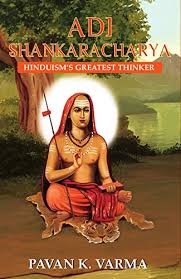 It seems Adi Shankaracharya: Hinduism’s Greatest Thinker is now $0.99 on Kindle, so I got a copy. From what little I know the subhead is warranted, so understanding Adi Shankara goes a long way to understanding elite Hinduism.