
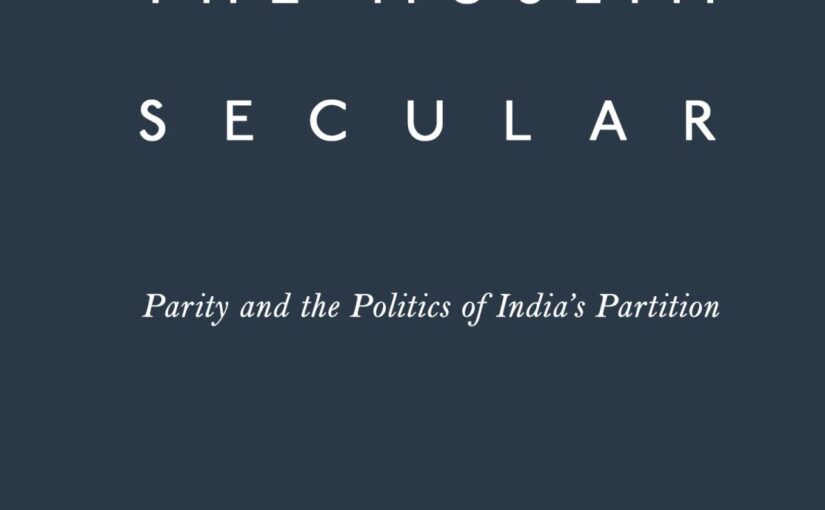
Since Partition is a popular topic here on BP, I am posting this review from my Substack. Amar Sohal’s book is important because it focuses on three Muslim politicians who did not support the Muslim League’s vision: Maulana Azad, Sheikh Abdullah and Abdul Ghaffar Khan. Thus, the book foregrounds a vision that is an alternative from those of Indian and Pakistani nationalisms.
Historians of the politics leading up to the Partition of British India usually focus on the Indian National Congress and the Muslim League. To an extent, this is understandable–along with the colonial power, the Congress and League were largely responsible for the decision to partition British India into the sovereign nation-states of India and Pakistan. This historiography is largely focused on judging which of these two parties was most responsible for the lack of compromise that led to the ethnic cleansing of August 1947 and to decades of antagonism between (the now nuclear armed) states of India and Pakistan. Ayesha Jalal’s The Sole Spokesman: Jinnah, the Muslim League and the Demand for Pakistan can be considered a representative work of this school of historiography.
Amar Sohal’s book The Muslim Secular: Parity and the Politics of India’s Partition attempts a very different task. Based on his DPhil thesis at Oxford, the book examines three comparatively lesser-known thinker-politicians of late colonial British India: Maulana Azad, Sheikh Abdullah, and Abdul Ghaffar Khan. While unequivocally Muslim, all three of these figures aligned their politics with the Indian National Congress’s vision of a united India. As Sohal writes in his “Introduction”:
My endeavour, then, is to escape, as far as possible, from the long shadow cast on modern Indian history writing by Britain’s dramatic withdrawal and the minutiae of the Partition negotiations. Rather than rehash that familiar tale, I want to contribute instead to the burgeoning field of Indian and global political thought by unearthing a forgotten argument for integrationist nationalism and shared sovereignty. And this is significant because ideas (and not only transitory interests) mould the narrative of history, and ultimately survive it to speak to the epochs that follow. The subjects of my investigation were some of India’s foremost politicians…. So like other intellectual historians of India and the Global South that have engaged with this anti-colonial moment, here my task is ‘to reconstruct these “politicians” as thinkers and their words as concepts that were central to the making of political thought’. (Sohal 2-3)
Later in his “Introduction”, Sohal further explicates the importance of the three figures that he has chosen to focus on. He writes:
Therefore, while Muslim separatism, in both its earlier ethno-racial and its later presentist incarnations, contended that only Muslim sovereignty could guarantee minority rights, I want to suggest that the Muslim secular fully embraced the historical loss of such sovereignty to enable a productive engagement with Indian democracy… And so my point is that by willfully forgoing this former dominance when thinking about modern forms of democratic power, our three anti-colonial thinkers, to albeit different degrees, struck a rare compact with loss for a peaceful future, something that many associated with Muslim nationalism were disinclined to do. We have already seen that the Muslim secular possessed enough conceptual space to house some significant Muslim constituencies within its Indian democracy; these constituencies were not required to entirely relinquish their own claims to political power or influence. And yet, in the best interests of both the Muslim minority to which they belonged and Indian society as a whole, they had to ultimately fold these claims into a new conception of shared sovereignty. None could be afforded an absolute political rank (23-24)
Sohal contrasts his own thesis with traditional historiography which:
…has cast Muslim opponents of Partition as tragic pariahs suspended between Pakistani nationalists and the Hindu leaders of Congress, and unable to chart a meaningful course of political action in a majoritarian age. But the lament of this scholarship is somewhat out of tune with the body of work that our three thinkers produced. Over the middle decades of the twentieth century, they were conscious of both Jinnah’s popularity and their inability to shape Congress and its independent state as much as they had wished. Still, they did not dwell on their defeats for very long and remained interested in theorizing positive visions for the future (25)
At this point, it is important to discuss the concept of “parity” which features prominently in the subtitle of Sohal’s book. He writes:
Parity is able to positivize, at once, both the status of Hindus and Muslims as India’s co-founders, and their religious autonomies. Hence it is a more exact descriptor than equality per se, which requires another set of qualifications to avoid its blanket-like connotations. Equality-as-assimilation functions negatively by denying difference, whereas equality-as-parity is well-positioned to positively assert claims to it. Jinnah, of course, focused on the power of parity to convey this very difference. For him, any commonality was reserved not for what Hindus and Muslims positively shared but simply for their empty rank as independent nations. As such, we might say that it was not Muslim separatism but the Muslim secular which produced a thicker conception of parity. After all, it was not Jinnah but Azad, Abdullah, and Ghaffar Khan who insisted on a thorough theorization of both these elements. So if their own notions of parity were, at least in part, designed to counter Jinnah’s legal claim, they cannot be accused of ventriloquizing it. And this is not just because their ideas often had intellectual histories of their own, and in some cases predated Jinnah’s adoption of the ‘two-nation’ theory. More important is the extent to which they radically rearmed parity as an Indian Muslim concept with a new set of meanings for an expressly democratic project (32).
The bulk of the book consists of individual chapters on Azad, Abdullah and Ghaffar Khan. For reasons of space, I don’t intend to discuss these chapters in detail. Instead, I would like to focus on why this detailed historical account is important today. In his “Conclusion”, Sohal writes:
Increasingly marginalized by populist right-wing governments, today north Indian Muslims, Kashmiris and Pashtuns all make for groups of citizens that are non-essential to prevailing national visions of India or Pakistan. The forgotten ideas I have excavated in this book have the potential to be imaginatively reintegrated into our present for they clearly speak to the contemporary problems of these (and other) populations–many of which have been directly inherited from the mid-twentieth century. But what is particularly important about the thought of Azad, Abdullah, and Ghaffar Khan is that it refuses parochialism and is decisively integrationist. This makes it valuable to us not least because it is impossible to imagine a future for their respective constituencies that is not tied to that of other South Asians. And this ambitious, wider orientation also means that the Muslim secular is not the inheritance of these Muslim groups alone. Its legacy belongs to all those in India and Pakistan, and even beyond, who wish to think about how best to accommodate and celebrate–but also unite–human diversity. (310-311)
Though it can be a difficult read–understandably for a work that originated as an academic dissertation– I would highly recommend this book to those who are interested in History or in South Asian Studies. It is particularly important because it foregrounds an alternative vision from those of Indian and Pakistani nationalisms.

The problem with religious and so called divine prophecies.
People believe in them despite logic and rational thought.
The is woman is convinced that Israel will stretch from the Nile to the Euphrates
The only way to end this idiocy is to economically destroy Israel by BDS, i.e. Boycott, Divest and Sanction by the rest of the world.
https://web.facebook.com/reel/1750197675695733
all the three had their own personal reasons for their stands.
1) sheikh abdulla had a quarrel with the dogra king. he has supported by nehru who was from his ‘jati’, the kauls. nehru had a issue or two with the hindu king. also abdulla knew well that we would be a second class subject in a punjabi pakistan. after all dogras were close cousins of punjabis. all this helped.
2) khan saheb’s independence was more tribal. he wanted a union with india, and nehru should have obliged. the problem was that the gangetic hindu had ‘forgotten’ the art of ruling after years of subservience. the way khan was treated by the rulers of pakistan shows that his gut instincts were correct.
3) kalam azad was a traditional muslim, born in mecca, did not have a ‘secular’ education, was more inclined to jamat-e-islami type of politics of having all of india as muslim, rather than the ‘english educated elite’ led by jinnah and others, who were more practical and decisive. azad was a misfit in this crowd.
Another out of topic comment
I have had no background on the conflict in Sudan. This article filled in some info. Looks like everyone including their donkey are involved directly or indirectly.
Excerpts
Gold is one of the two key elements to understanding Sudan’s conflict. The other is Port Sudan, located on the Red Sea coast. There, the geopolitical ambitions of foreign interests in the country intersect.
But there is a strong ethnic and racial component to the killings. Those supporting SAF in El Fasher through the Tasis coalition were predominantly non-“Arabized” Sudanese.
The RSF was built upon the Janjaweed militias, a paramilitary group created by Sudan’s deposed president Omar al-Bashir. The main purpose was to protect him by counterbalancing the power of the army and avoiding the fate of most of his predecessors, including the prime minister he deposed through a coup in 1989
The genocide killed an estimated 200,000 people during the Darfur War. The genocide was part of the war, but it had an added component: it was the killing of people because they belonged to the Fur, Masalit, and Zaghawa tribes, and Khartoum held them responsible for secessionist claims. These are Sudanese tribes that are not “Arabized.”
Current events in Darfur might be read as a continuation of the Darfur War because the war morphed from a struggle for autonomy into one over gold. The war was initiated by a secessionist movement with similar claims to those of South Sudan, which gained independence from Sudan in 2011. Around that same time (2010–2011), a significant gold deposit was found in North Darfur. This was critical because Sudan had lost 75% of its oil reserves and 95% of its foreign exchange, which had been coming from the oil reserves in the south.
In 2022, before the war, gold production in Sudan totaled 87 tonnes, most of which ended up in the United Arab Emirates (UAE).
to gain international support, the al-Burhan faction has courted Russian and Chinese investors; a Russian delegation in May 2024 secured a major exploration concession and central-bank arrangements to settle in roubles, facilitating Sudanese purchases of Russian arms.
Russia took a more official stand in support of the SAF, looking to build a naval base in the Red Sea. In 2024, Russia accounted for half of the country’s oil imports to SAF. In 2025, SAF agreed to allow a Russian naval base.
. Another reason for Iran to side with the SAF is that RSF sent fighters to Yemen to fight on the side of the Saudis against the Houthis
China also has an interest in Port Sudan, where it built a $140 million harbor.
A port on the Red Sea is a prized possession and a key stronghold of the SAF, which has moved its headquarters there from Khartoum.
None of the parties involved can claim legitimacy, since they were all together in deposing al-Bashir, promised a transitional period towards a civilian government, and then reversed course. They fell out over resource control, not ideology.
Ultimately, the conflict in Sudan reflects the failure of the nation-state system inherited from Western colonies.
In reality, either faction’s claim to legitimacy in Sudan is grounded in military force and control of resources. Both have committed heinous crimes. They will keep fighting as long as they control those resources
https://www.nakedcapitalism.com/2025/10/sudan-war-gold-a-key-port-and-two-armies-with-no-legitimate-claim.html