
A calm and clear conversation with Sagar, senior staff writer at The Caravan. We speak about why Bihar is more than a broken state, how caste politics really works on the ground, and how election season gets distorted by the memification of leaders who should not be elevated in the first place. He explains the gap between lived reality and the stories told by mainstream media, the truth behind the jungle raj label, and why Bihar has been misread for so long. Tune in for a grounded look at a state that carries more history, complexity, and dignity than the usual headlines allow.
Month: November 2025
The Weight of Memory: A Sri Lankan Reminder
By Sbarrkum
Every country carries its wounds, but some of us carry them in our bodies. I rarely speak about Sri Lanka’s civil war on this blog, because most of us have learned, painfully, to move on. But sometimes a comment or a casual reference to the LTTE pulls open a door that many of us have spent decades trying to close gently.
For me, this is not rhetoric. It is family history.
Two of my cousins were killed in the late 1980s; one by the LTTE, the other by the Army. Two more relatives were tortured. During the worst years, mobs came to burn down our home because they suspected we were Tamil. My mother stood outside, spoke to them calmly in Sinhalese, and convinced them to leave. That is how close violence came to us; literally to our doorstep.
I myself was arrested twice on suspicion of being an LTTE operative. I spent two days in police remand and was beaten with a belt. Friends who happened to witness the arrest intervened and contacted someone who could get me out. Had I remained until Monday, I would have been taken before a judge and sent to the notorious Boosa Prison. Many never returned from there.
I also lost people I cared about deeply. My late partner’s parents were among the sixty villagers killed in a single LTTE attack. In the area where I live, nearly every family lost someone; a brother, a father, a cousin, a neighbour.
Most Sri Lankans have made their peace with the past. We have had to. The country could not function otherwise. But when the conflict is invoked lightly or abstractly, without awareness of the cost paid by ordinary people, it reminds me how easily those of us outside the centre of global conversation are forgotten.
This is not a demand for silence. It is simply a reminder:
For many of us, this history is not theoretical. It is personal, lived, and unbearably real.

Meltdown Bhāṣya: Verse 1.1.1 (Part 1.3)
The philosophy of Land and the idea of God: The Cathedral of physicalism, A protestant materialism
Originally Published: February 03, 2025
The philosophy of Land and the idea of God
The nirīśvaravādi ādi-accelerationists no doubt consider our usage of the word ‘God’ and countless references to ancient myths and texts a serious breach of the philosophy and a perversion of its ideas. Though we are not interested in soothing their fears, the objections they will raise must nevertheless be wrestled with, as Landian Accelerationism portrays itself a purely materialist philosophical system, which, although not often talked about at present, is properly referred to as ‘libidinal materialism’. Thus, we must descend into the ‘sublime basement’ of Land’s philosophy before we may return once more to the heady poetics of Meltdown. His system of thought is most comprehensively laid out in the opus The Thirst for Annihilation (Land, 1992b), which makes it clear that his philosophy follows in the wake of the Nietzschean ‘death of God’, something he explicitly states when he assembles a theoretical machine linking Kant, Schopenhauer, Nietzsche, Freud, and, most importantly, Bataille to himself. As Mackay and Brassier put it in the ‘Editors’ Introduction’ of Fanged Noumena (Land, 2012): “Land allied himself to a line of renegade thinkers – Schopenhauer, Nietzsche, Bataille – who mocked and disparaged academicism and wielded philosophy as an implement for exacerbating enigma, disrupting orthodoxy, and transforming existence” (p. 2-3). Continue reading Meltdown Bhāṣya: Verse 1.1.1 (Part 1.3)
Clearing the Augean Stables
I removed a few disruptive authors from the BP roster recently, primarily because some interactions had crossed into personal abuse. That’s not something I’m willing to absorb or normalise.
What continues to surprise me is how quickly discussions become ideological flashpoints, even when my own approach has consistently been one of congeniality and openness.
That said, the overall atmosphere on the blog already feels lighter and more functional with fewer volatile personalities in the mix. It’s a reminder that BP only works when the space is manageable and not dominated by ego or hostility.
Also to the current Commentariat; stick to the facts, not inflammation please. So reflect on whether your comment is adding more light or heat beforehand.
Why India needs to understand the new Pakistan| A Frontline Webinar
A very important interview with Ramanathan Kumar, former R&AW Pakistan desk head. Those Indians who truly want to understand the implications of the 27th Amendment to Pakistan’s Constitution must listen to this podcast.
In the latest edition of Frontline webinars, independent journalist Amit Baruah is in conversation with former R&AW Pakistan desk head Ramanathan Kumar. The two dissect the implications of Pakistan’s recently passed 27th Constitutional Amendment—a sweeping overhaul that elevates army chief Asim Munir to a new “Chief of Defence Forces” role, places all three armed services under his command, and grants him lifetime legal immunity. Passed by a two-thirds parliamentary majority, the amendment also restructures Pakistan’s judiciary: it removes the Supreme Court’s power over constitutional matters and establishes a new Federal Constitutional Court whose judges will be appointed by the executive. Critics argue that these changes represent a dramatic consolidation of military power and a sharp erosion of judicial independence.
For India, this is not just about Pakistan’s internal politics—it fundamentally reshapes the balance of power in the region. With a trigger-happy Field Marshal protected for life and commanding the entire military, Pakistan’s civil-military equilibrium could tilt decisively toward a more authoritarian and militarised state. Ramanathan Kumar and Amit Baruah explore how the amendment raises serious questions about democratic checks, legal accountability, and how India should recalibrate its approach to a new Pakistan.
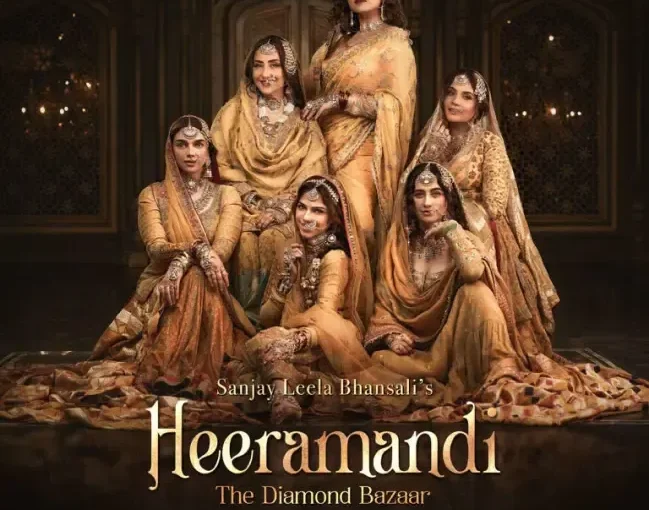
Review: Sanjay Leela Bhansali’s Heeramandi
Since “Recovering News Junkie” mentioned Heeramandi in his latest post, I am reproducing this review from my SubStack. Regarding the specific criticism that that Heeramandi was a “Pakistani and not an Indian story”, I think the main issue people pointed out was that it is a-historical for a miniseries set in 1940s Lahore to not have a single character who supports the Muslim League or espouses the cause of Pakistan. A secondary issue was that–despite the setting in Lahore– the courtesans were speaking the Urdu of Lucknow rather than Punjabi.
As a student of Hindustani classical music and someone fascinated by courtesan culture, I eagerly anticipated Sanjay Leela Bhansali’s new miniseries Heeramandi (available to stream on Netflix starting May 1). Bhansali is known for directing opulent costume dramas such as Devdas (2002), Bajirao Mastani (2015) and Padmaavat (2018). In the tradition of these earlier films, Heeramandi boasts an all-star cast led by Manisha Koriala and Sonakshi Sinha. The costumes and production design are also noteworthy.
Set in Lahore in the twilight years of the British Raj, the series focuses on the lives of the tawaifs who live in the Heera Mandi neighborhood of the city. Also known as Shahi Mohalla (Royal Neighborhood), this area is located south of the Lahore Fort and was originally a residential neighborhood for attendants and servants of the royal court. It became particularly associated with the tawaifs, who received patronage from the nobility.
In today’s Pakistan the word “tawaif” has come to be associated with prostitution. However, the word originally denoted elite courtesans who were highly-skilled singers and dancers trained in the arts of poetry and conversation. Aristocrats would send their sons to tawaifs to be trained in manners and etiquette. These women were often wealthy and, because of their unmarried status, were able to move around freely. They were particularly known for their renditions of thumris–a semi-classical genre of Hindustani music associated primarily with the emotional expression of romantic longing. However, their status was degraded with the advent of British colonialism because the British regarded them as “nautch girls” or prostitutes. The new Indian middle-class also came under the influence of Victorian morality and began to perceive their own musical traditions as decadent and immoral. This led to the Anti-Nautch Movement and to efforts by reformers such as Pandit Bhatkhande to cleanse Hindustani music of its disreputable associations. Continue reading Review: Sanjay Leela Bhansali’s Heeramandi
Bollywood calling Pakistan. Again.
So a new trailer for a hindi acshun phillum dropped recently, and its another one of those that throws around the ‘based on true events’ tag for additional street cred. This time around though, there’s a bit of a twist. The plot apparently centers around the Lyari Gang wars in Karachi, with some additional fictional tempering of course.
Unsurprisingly, this will elicit a whole gamut of reactions from either side of the Radcliffe line, especially due west. The preview is unusually long, and somewhat unsurprisingly filled with shocking violence – the recent success of movies like Kill and Animal were bound to result in a race to ever-increasingly levels of ‘ketchup’ and fireworks. But apart from that, at least to me, didn’t seem very novel or interesting. I am mildly curious about the world building that the movie manages to pull off.
Sanjay Leela Bhansali’s Netflix series Heeramandi is another example of this phenomenon. Where the Indian movie industry is accused of ‘cultural appropriation’ and telling a story that is “Pakistani, and not Indian”. With that one, as much as I am… unimpressed with Bhansali’s output – I view him more as a choreographer, less of a filmmaker, one who is far more successful at spectacle, not so much with cinema – I still think that the stories of the subcontinent should be accessible to all. Lahore after all, especially pre-partition Lahore is as much a legacy of Ganga Ram as it is of the Mughal Empire, or the Sikh, for that matter.
This time around however, the setting isn’t historical or pre-partition. Is there an argument to be made that this is “cultural appropriation”?
For me, more than anything, its yet another missed opportunity. In an alternate timeline, a movie like this would have been a golden opportunity for Pakistani actors to get visibility on a much larger Indian stage, and the quality of the output could have been immeasurably raised with behind-the-scenes contributions – production design, location and language expertise, to name a few.
Somewhere down the line, if things finally start reverting to ‘normal’, perhaps future projects like these will incorporate Pakistani participation and be better for it.
#Dhurandhar's real life characters & their onscreen depictions! pic.twitter.com/wdM81tJmyd
— Filmynews (@filmynewsnetwrk) November 19, 2025
10 years ago a few collaborators and I set out to make a film about the Lyari gangsters and drug mafia, couldn’t raise a Rs locally because a film 80% in Balochi won’t sell, approached Netflix who said Pakistani content not needed, the Twitter page is from 10 years ago too pic.twitter.com/p6LeyyFUEO
— Faisal Rafi (@faisalrafi) November 20, 2025
Racism Is Wrong. So Is Calling People Sub-Human.
It is wrong to dehumanise anyone. One of the recurring issues on BP is this histrionic insistence that individuals “own” the truth. The truth is broad, multi-layered, and something we all approach imperfectly. No single person has a monopoly on it.
I obviously reject racism in every form; that should go without saying. But I also find it nonsensical to claim that it is a moral imperative to call a racist “sub-human.” That is a classic moral slippery slope. Once you begin dehumanising others, even for views you find repugnant, you simply replicate the logic you oppose.
What I’ve noticed recently is that people are increasingly confusing ego with ideology. That never ends well. This is a blog. Nothing here is existential. We should be able to disagree fiercely without crossing into territory that strips others of their humanity.
Open Thread
IMF: Pakistan loses up to 6.5% of GDP to corruption as elite capture strangles growth
Trump’s 28-point Ukraine peace plan in full
I’ll add more interesting links; I have more of a zero-tolerance approach so low-signal, overwrought comments will either be deleted, edited or their author’s privileges revoked.
I am back
I am now going to manage the blog more actively.
Everyone please behave. I have restored all deleted comments (I haven’t read them).
I’ve also realised that the Commentariat are actually manifestly ungrateful.
I expect everyone to adhere to civility; if I don’t like the tone of a comment, I will simply trash it. This is a no-nonsense policy that applies to ALL.
Also to all authors, contributors and editors please make sure you are above board; don’t descend into the pettiness.
An internal note I sent earlier to all authors/contributors/editors: Continue reading I am back