
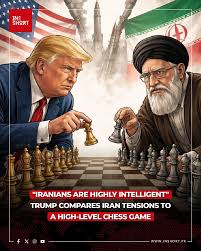
The presumption behind the grand-strategist mythos is always the same. Trump, Milei, Netanyahu, Modi and Orbán are playing three moves ahead, and the other side is stupid. Strip the second half of that sentence and the first collapses.
Look at the scoreboard.
Op Sindoor. India’s post-operation strategic environment does not favour India. Whatever the tactical ledger reads, the diplomatic map around South Asia has tightened against Delhi, not loosened. Delhi has learned. The region has taken notes.
Pakistan. The surprise winner of Op Sindoor is not India. Rawalpindi has played the post-operation hand better than anyone expected and is now cashing cheques in Washington, the Persian Gulf and Beijing in the same quarter. On the current scoreboard, Pakistan is the diplomatic champion of the world.
Iran.* Tehran has pushed back harder than the MAGA-Likud axis priced in. Hormuz did not close on Washington’s schedule. The Islamic Republic has not folded on Washington’s terms. The deterrence calculus is running the wrong way.
Lebanon. Netanyahu was ordered to stop. Not persuaded, not incentivised. Ordered. That is a tell about who holds the leash, and it is not Jerusalem.
Hungary. Orbán conceded on 12 April 2026. Sixteen years, gone in a single parliamentary cycle, to Péter Magyar’s Tisza on a two-thirds supermajority. Some say it was thanks to JD’s Kiss of Death. The flagship of illiberal democracy in Europe was voted out by the electorate it was supposed to have captured.
The structural point is harder than any single theatre. Xi and Putin operate without the constraint of competitive elections, independent courts or coalition arithmetic. The far-right quintet operates inside all three and is trying to match authoritarian tempo from within liberal scaffolding. It does not work. The flexibility differential is not a skill gap. It is a regime-type gap. You cannot out-Putin Putin with a cabinet that has to stand for re-election, a judiciary that can still strike your orders down, and allies that can still walk.
Worse, the bloc has drifted into an Israel-centred alignment as its organising axis. Milei has called himself the “most Zionist president in the world.” That is a narrow base on which to hang a civilisational project. It collapses the quintet’s foreign policy into one theatre, one survival question, and one ally’s political clock.
What looks from inside the movement like civilisational restoration looks from outside like the accelerated stripping of American hegemony. Every arena in which the quintet has tried to project force in the last six months has reverted, stalled or reversed. The chess masters are losing pieces, and the board is being rearranged by others.
Read our comments. Every thread runs the same circuit. Trump does X and a chorus explains why X was the deep play. Modi does Y and the same chorus decodes Y as civilisational mastery. Netanyahu does Z, and Z becomes, retroactively, the only move available.
Demonetisation: the canonical case.
8 November 2016. Five hundred and one thousand rupee notes voided overnight. Stated targets: black money, counterfeiting, terror financing. The RBI’s own data later confirmed that over 99% of demonetised notes returned to the banking system. The policy cost roughly ₹1.28 lakh crore in the first three months alone. Around a hundred deaths attributable. The unorganised sector, the MSME economy, the daily-wage poor and the rural cash economy were eviscerated, because for them cash is not a convenience but the circulatory system of economic life. Every stated target missed. Every unstated cost borne by the poorest.
A decade later, a Ranveer Singh blockbuster, Dhurandhar 2, is enlisted as post-hoc exegesis. A fictional RAW operative named Hamza infiltrates an ISI-Dawood counterfeit pipeline, a fictional ₹60,000 crore note-flood is foiled, and Notebandi is retconned from economic catastrophe into civilisational masterstroke. The chorus cites the film. The film cites nothing.
Cinema is the Evidence by which Theology can justify the Corpses
Men are not gods. Political projects are not revelations. Every serious civilisational tradition has warned against the sanctifying of temporal rulers, and it warned for a reason. This is what the worship of earthly gods produces, not analysis, but hagiography with a box-office gross, making a habit of which rots the capacity to see.
The question BP should sit with is not whether this is happening. It is who picks up what Washington is dropping. Beijing and Moscow, on current form, are not building an order. They are waiting out one. The multipolar settlement that emerges may be something neither the liberal order nor the authoritarian one has a template for.
PS. Power, Constituency, and the News Cycle
One extension to the argument above.
Start with the realist premise. All leaders in power are pragmatic in at least one dimension: they want to remain in power. The interesting variable is not whether they are strategic but whom they are strategic against. The critical constraint is the constituency they have to pacify to keep their seats.
Pakistan is the clean case. The military is the de facto sovereign and its civilian population is an audience, not a veto. Rawalpindi can absorb domestic pain, shift its foreign posture and reorder its alliance map without clearing it with the electorate. Modi cannot. Trump cannot. Netanyahu, increasingly, cannot.
So the real question on Op Sindoor is not whether it was a strategic move against Pakistan. It is whether it was a strategic move at all, or a populist move dressed as one. The two are often indistinguishable at the moment of launch and cleanly distinguishable in the wreckage six months later.
Apply the same test to Trump. The Epstein files are no longer dominating the news cycle. They have been displaced, and the displacement is not accidental. A war on Iran that has not advanced Washington’s agenda, not advanced Jerusalem’s agenda, not advanced any discernible strategic agenda whatsoever, has nonetheless advanced one thing: the news cycle has moved. That is not strategy. That is domestic political hygiene projected outward through airpower.
This is the quiet update to the grand-strategist mythos. The quintet is not playing three moves ahead on a global chessboard. Most of the time it is playing one move ahead on a domestic one, and calling the move a strategy because the word sounds better than the truth.
* Standing Note on Iran
BP Precedent · 19 April 2026
For this post and every future BP post that touches Iran, one thing on the record.
We hold no brief for the Iranian regime. Our argument that Washington and Jerusalem have miscalculated on Tehran is a strategic observation, not a moral endorsement. The two are different categories and BP should not let commenters collapse them.
To our mind, the Iranian government is genuinely evil in what it does to the Bahá’ís. Iran’s roughly 300,000-strong Bahá’í community, the country’s largest non-Muslim religious minority, has faced 47 years of systematic state persecution: exclusion from education and employment, confiscation of property, demolition of graves, mock executions, the 1991 government memorandum that formalised the policy of blocking Bahá’í development, and a sustained propaganda apparatus that brands Bahá’ís as Israeli spies. See ThePrint’s 12 April 2026 report: Iran is oppressing its biggest non-Muslim minority. Baha’i are labelled as Israeli spies.
And not only Bahá’ís. The Iranian revolution has been an unmitigated disaster for every Iranian citizen: Muslim, minority, secular, religious. Women. Dissenters. Journalists. Ethnic minorities. Economic migrants. An entire generation has been immiserated by a theocratic ruling class that has fused state power, religious authority and organised violence.
The strategic point stands independently of all this. Tehran can be a monstrous government and still be winning the board against Trump and Netanyahu. Recognising the second does not dilute the first.
Analysis of regime behaviour is not endorsement of the regime. Any future BP post on Iran should be read with this note in mind.
1) Americans should not get into these kinds of fights. They neither have the patience nor the stomach. Four days into any conflict and half a dozen bodies, every body and their uncles start ‘bring the boys back home’ chorus.
2) will America stop getting into this type of fights in the future? No, they will involve. If they sit back at home, they will not be respected as a super power. Also the debt will push them into wars.
3) one apprehension is that Pakistan will try it’s luck against india after the so called success of the peace talks. No nuclear bomb can save them.
4) Iran will be sorted out. Expecting America to leave the region is delusional.
They will stay, Arabs have no other choice.
4) China, well china, we don’t have the wisdom yet to know what they are thinking. Managing decline?
why would Pakistan “try its luck?”
Because in the depth of their hearts they know that India won opsindhoor.
erm
Pakistan’s geopolitical utility ramped up for Drumpf after Oct 7th not Pahalgam. You keep harping on drawing unsupported corelations with it and Op Sindoor. Not sure why.
October 7th happened when President Trump was out of power. It did not change President Biden’s attitude towards Pakistan.
There is a clear difference in President Trump’s attitude to India before and after the ceasefire in May 2025. This is obvious to any neutral observer.
On a side note, it is very rude to distort someone’s name. His name is Trump not “Drumpf”.
Pressed X to doubt:
Comparision between 1975 and 2025 Iran:
Population: 30 mil to 90 mil
Literacy rate: 35% to 95% now (with youth literacy now at 100%)
Post Graduate rate: 0.1% to 5% (50x increase)
Hunger index: 13 (moderate) to 7 (low) now
Infant mortality: 122 per 1000, to 7 per thousand.
Doctors per 1000 people: 0.35 to 1.8 (~5x increase)
Life expetancy: 55 years in 1975, to now 79 years in 2025
No Public Healthcare to now Highly accesable public healthcare
No Onlyfans though
@S Qureishi, this is the classic “compared to nothing” move. The counterfactual is not pre-modern Iran. It is the Iran that was already in flight in 1975.
The Shah’s White Revolution had been running since 1963. Literacy Corps, Health Corps, women’s suffrage, mass university expansion. Life expectancy had already moved from the low 40s in the 1950s to 55 by 1975. That curve does not flatline in 1979. Infant mortality was collapsing across the entire developing world over that period, including in countries with no revolution at all, no oil, and no developmental state. The Islamic Republic is claiming credit for a global secular trend.
Run the comparators. Turkey in 1975 had roughly Iran’s GDP per capita. Today Turkey sits around $13k, Iran around $4-5k, with all of Iran’s oil endowment on the Iranian side of the ledger. South Korea was poorer than Iran in 1975 and is now $33k. Malaysia, Indonesia, the Gulf states. Every comparator with a functioning state has outperformed Iran on per capita terms, on HDI, on every metric that is not raw population.
Which is the giveaway. Iran went from 35m to 90m partly because Khomeini’s regime explicitly banned contraception and promoted early marriage in the 1980s. Deliberate pronatalism, reversed by Rafsanjani once the state realised it had manufactured an unmanageable youth bulge. A counterfactual Pahlavi Iran on the Turkish demographic curve lands closer to 70-75m.
The 1988 prison massacre. 150,000+ graduates emigrating every year. Systematic persecution of Bahá’ís, Kurds, Baluch, Ahwazi Arabs, women, journalists, trade unionists. An entire Iranian diaspora built by flight, not choice.
The revolution did not produce Iranian development. It inherited a development trajectory, slowed it, impoverished the people riding it, and now claims the residual gains as its own.
No OnlyFans is not a punchline. It is a symptom.
If Iran was in flight in 1975, there would have been no revolution. I say this because the revolution was not foreign backed (no external actors wanted it), it was entirely indigenous from the ground up so clearly most of the people were unhappy
Your comparision with Turkey makes sense because Turkey also went through a revolution with Erdogan. Pre Erdogan, the economic benefits were distributed in a very lopsided way to the European minded elite, but after 20 years Turkey is a much more resilient nation.
Using GDP per capita figures are useless. Iran is under sanctions and it’s currency heavily devalued.. even more so than Turkey.. converting to US dollar figure gives weird results and it’s not wise to draw your conclusions from it on the actual quality of life.
No Onlyfans is a big win.
this makes no sense but we’ll engage.
We speak to Iran every day; presumably you live in the USA.
It is offensive to advocate for others to live in Oppression while you avail yourself of First World Western Capitalism.
Empathy above all.
You have also not engaged with anything written. This a Precedent Post; we won’t deviate from the line that the Islamic Revolution was a terrible disaster for Iran as virtually all sensible Iranians agree.
This is a RedHerring, but I will counter:
There are millions of people who feel oppressed in the “First World”
Broken families, drug addition, depression, lack of health care, loan sharks and bankrupcies, lack of community, high crime, third world immigration, sexual assaults all stemming from direct government action.
To them, this is all an unmitigated disaster. Why are the horrible lives of these people averaged out with yatch owners and island-party goers, and their concerns eliminated?
I clearly pointed out that Iran has progressed significantly under the theocratic regime. Stats that matter, not pump figures. If it was such a disaster, they would have capitulated long time ago against the entire might of the West.
where do you live?
Definitely, not the US.
touché
Yes, I don’t think their independence was a disaster for Bengalis.
>Demonetisation: the canonical case.
At a minimum, there is an undeniably strong co-relation between demonetization and the sudden drastic decline in every friday stone-pelting chaos that had infected J&K.
Look into it.
Imprisoning Separatist leaders isn’t exactly democratic.
We don’t mind if societies don’t want to be democratic but we notice, in this blog, everyone is willing to sacrifice high minded ideals for national interest.
So it’s not a conversation about who is morally right but what each side can get away with.
That was because Kashmir was put under lock down.
There has been no lockdown for well over 2 years now and Kashmir is now governed by Omar Abdullah and yet Friday noon stonepelting is nowhere to be seen.
India doesn’t ask concessions of the Kashmiri Muslims the Chinese ask of the Uyghurs – there is no forced marriages to non Kashmiri men or de-islamization.
Heck, Kashmiri Muslims gathered in large numbers to protest for Iran and India did nothing.
Kashmiri Muslims have all the rights of other Indians including the right to do morchas.
Agree. People really don’t understand how much freedom the average Kashmiri has under the Indian system. The govt has been far gentler than almost any other state in an equivalent position.
Good post.
I agree India is in a weaker diplomatic position one year after “Sindoor”.
President Trump is now firmly aligned with the Field Marshal and Shahbaz Sharif (whether this is really flattering for the Field Marshal is a different matter).
JD Vance is coming to Islamabad for the second time in a week.
“Sindoor” does seem to have been a populist move rather than a strategic one.
Since 2014, the current gov has tried multiple tactics to tamp down the proxy war by Pakistan sponsored terrorists. Demonetization was one of them. Supporters think it was effective, others do not. But what is not debatable is the reduction in the number of attacks . So most non ideological people don’t mind giving BJP the credit for this and don’t go around second guessing each and every tactic employed in service of the goal.
[…] A week ago, S Qureishi observed that the only downside of the Islamic Revolution was that “there is no OnlyFans.” We were deeply offended by this line seriously enough to write the next piece on […]