The Last Hurdle to Afghan Peace

Brigadier Simon Saraf wrote a piece on the Afghanistan “peace” process that reflects the Paknationalist viewpoint. Major Amin has added his comments to it. (Major Amin’s comments are bolded). Major Amin is a military history aficionado who has decades of on the ground experience in Afghanistan.  

The last hurdle to Afghan peace

https://nation.com.pk/02-Feb-2019/the-last-hurdle-to-afghan-peace

Taliban and USA are in constant negotiations over withdrawal of US forces from Afghanistan. A draft pact addressing mutual sensitivities is concluded. The two parties facilitated by Pakistan will again meet towards end February to build a roadmap on the skeletal agreement.  

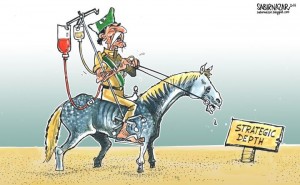
APPEARANCES ARE DECEIVING— US HAS NO STRATEGY AND ITS ACTIONS ARE ACTIONS OF A LAME DESPERATE PRESIDENT BESIEGED BY SCANDALS AND A MINORITY IN CONGRESS–THIS MAKES HIM MORE DESPERATE THAN THE MOST UNDERFED TALIBAN–MR TRUMP WANTS TO NEGOTIATE A US WITHDRAWAL WHICH WOULD BE COMPLETED BY THE TIME ELECTIONS ARE ON THE TOP AND HE MAY WIN THE ELECTIONS—AFGHANISTAN AND PAKISTAN CAN GO TO HELL—A.H AMIN

The best solutions must consider lessons learnt from the Soviet withdrawal in 1989, leaving power in hands of proxies and ignoring a broad based representative government. A representative government for Afghanistan does not mean democracy. Besides the people, it also means co-opting various warring groups, warlords and educated elites. Links with drug mafia and gun running are intrinsic. So unless these groups are satisfied, they have many supporters to make them disruptive. 

BROAD BASED REPRESENTATIVE GOVERNMENT WAS NEVER THE LESSON IN SOVIET AFGHAN WAR— PAKISTAN HAD ITS STOOGES–LOWEST RUNG MULLAHS LIKE HAQQANI WHO AS PER HIS ISI HANDLER COL QASIM ABBAS STANK SO MUCH THAT THEN MAJOR QASIM MADE HIM SIT IN THE OPEN BACK BODY OF HIS VEHICLE–THERE WAS NO BROAD BASE IN SOVIET AFGHAN WAR AND NO BROAD BASE NOW–ONLY STOOGES-PAKISTANI STOOGES OR IRANIAN STOOGES OR AMERICAN STOOGES OR RUSSIAN STOOGES OR INDIAN STOOGES—A.H AMIN

USA, the Afghan resistance, Taliban and Pakistan have been here before as a resistance to Soviet occupation and then a broad based alliance approved by Pakistan and USA. 

Return of warlords gave meteoric rise to Taliban. They over ran most Mujahedeen groups led by warlords and fought fierce battles with Al Qaeda. 

AL QAEDA NEVER EXISTED — FOUGHT AFGHAN WAR AS LOGISTICS ADVISOR OF A SIDE –NEVER SAW AL QAEDA–BASED IN AFGHANISTAN SINCE 2001–NEVER SAW AL QAEDA—DAESH IS ALSO A FICTIONAL ENTITY THAT THE PAKISTANI STATE INVENTS WHEN IT GUNS DOWN INNOCENTS LIKE AT SAHIWAL Continue reading The Last Hurdle to Afghan Peace

Afghanistan. Exit to Chaos?

Prompted by some discussion on Twitter, a few random thoughts:

  1. The US has spent 100s of billions of dollars in its longest war and Trump has had it and wants out. He is not wrong in regarding this as a colossal waste of money. But Trump being Trump, he will probably end up wasting whatever gains the US DID make in the region in the process. Zalmay Khalilzad may be sincerely interested in a viable Afghanistan, but his boss has neither the interest nor the ability. Without knowing ANYTHING about the various layers of secret planning and execution going on right now, just on general principles (losers don’t get to dictate terms, winners are not bound by promises they made, Trump is an ignorant conman, etc) this is not going to end well. There WILL be blood.
  2. The waste is going to get blamed on “corrupt Afghans”, but really, the Afghan elite (while undoubtedly corrupt in many cases) is not the main actor here. The United States is simply not a very effective imperial power. Much of the corruption is on the US side (contractors for the most part) and all of it is ultimately the responsibility of the imperial power cutting the checks. The US has a frighteningly capable military and a huge war chest. For the US to spend 100-1000 billion dollars and be unable to manage Afghanistan is a tribute to American incompetence, not Afghan resistance or corruption. If they were fooled by Pakistan is it Pakistan’s fault? if they were fooled by Afghans, is it all the Afghan’s fault? Beyond the obvious corruption on the US side there is the issue of ideological incompetence; the US is neither a capable imperial power, nor an innocent spectator with no interest in meddling in far away countries. And somehow its processes are so designed that it is easier to waste a 100 billion per year than it is to sit back and figure out what the aims are, where the carrots and sticks are most likely to work and now to apply them.
  3. The threat of withdrawal is not necessarily a bad idea. There is an obvious moral hazard in this situation, where Afghan (and other anti-Taliban parties, including India, Iran, Russia, China etc) have limited incentive to shape up or step up as long as the US is walking around with a generous checkbook and a tremendous fighting force willing to act on their behalf. In better hands, this might have been exactly the way to make everyone shoulder their own share of the burden.. but these are not “better hands”. Trump has no plan and less interest in any good (or bad) outcome. I find it hard to imagine that this could end up as a US “win”. As a US citizen, I will be happy if it does, but I am not holding my breath.
  4. Pakistan, supposedly the “winner” in this war, will not find victory too satisfying. The Taliban will not take orders (I mean they probably WILL entertain requests to kill X or Y as a favor to us, but they won’t do things they don’t want to do anyway), anti-Taliban Afghans will not roll over and play dead. India will continue to support them and Indian support is not insignificant. Russia, Iran and even China probably do not want a Taliban govt either. Instead of peace, we will have renewed civil war and more violence, not less violence. (Including blowback IN Pakistan). While the US may pay us (directly or more likely, indirectly via Gulf allies) for help in getting out, they will not keep paying once they are out. And they may not leave either. They may stick around to support the rump Afghan regime, and may pay troublemakers in Pakistan. And China will never be as generous as Uncle Sam used to be. Our troubles will not end with “victory” in Afghanistan.
  5. It would have been better to work WITH the US to stabilize a pro-US Afghan regime back in 2002 instead of playing double games. The cost of these games may extend beyond “victory”.
  6. 316743_10150340654784292_529734291_7856373_1074019852_n1-300x185

(Machine) Learning Biases

Cross posting from Ali Minai’s excellent “Barbarikon” blog (this is, of course, Ali Minai’s writing, not mine)

 In a recent tweet, Congresswoman Alexandria Ocasio-Cortez – widely known as AOC – responded to a report from Amazon that facial recognition technology sometimes identified women as men when they have darker skin. She said:

When you don’t address human bias, that bias gets automated. Machines are reflections of their creators, which means they are flawed, & we should be mindful of that. It’s one good reason why diversity isn’t just “nice,” it’s a safeguard against trends like this

While I agree with the sentiment underlying her tweet, she is profoundly wrong about what is at play here, which can happen when you apply your worldview (i.e. biases) to things you’re not really familiar with. To be fair, we all do it, but here it is AOC, who is an opinion-maker and should be more careful. The error she makes here, though, is an interesting one, and get to some deep issues in AI.

The fact that machine learning algorithms misclassify people with respect to gender, or even confuse them with animals, is not because they are picking up human biases as AOC claims here. In fact, it because they are not picking up human biases – those pesky intuitions gained from instinct and experience that allow us to perceive subtle cues and make correct decisions. The machine, lacking both instinct and experience, focuses only on visual correlations in the data used to train it, making stupid errors such as relating darker skin with male gender. This is also why machine learning algorithms end up identifying humans as apes, dogs, or pigs – with all of whom humans do share many visual similarities. As humans, we have a bias to look past those superficial similarities in deciding whether someone is a human. Indeed, it is when we decide to override our natural biases and sink (deliberately) to the same superficial level as the machine that we start calling people apes and pigs. The errors being made by machines do not reflect human biases; they expose the superficial and flimsy nature of human bigotry.

There is also a deeper lesson in this for humans as well. Our “good” biases are not all just coded in our genes. They are mostly picked up through experience. When human experience becoming limited, we can end up having the same problem as the machine. If a human has never seen a person of a race other than their own, it is completely natural for them to initially identify such a person as radically different or even non-human. That is the result of a bias in the data (experience, in this case), not a fundamental bias in the mind. This is why travelers in ancient times brought back stories of alien beings in distant lands, which were then exaggerated into monstrous figures on maps etc. This situation no longer exists in the modern world, except when humans try to create it artificially through racist policies.

The machine too is at the mercy of data bias, but its situation is far worse than that of a human. Even if it is given an “unbiased” data set that includes faces of all races, genders, etc., fairly, it is being asked to learn to recognize gender (in this instance) purely from pictures. We recognize gender not only from a person’s looks, but also from how they sound, how they behave, what they say, their name, their expressions, and a thousand other things. We deprive the machine of all this information and then ask it to make the right choice. That is a huge data bias, comparable to learning about the humanity of people from distant lands through travelers’ tales. On top of that, the machine also has much simpler learning mechanisms. It is simply trying to minimize its error based on the data it was given. Human learning involves much more complicated things that we cannot even fully describe yet except in the most simplistic or metaphorical terms.

The immediate danger in handing over important decision-making to intelligent machines is not so much that they will replicate human bigotries, but that,within their limited capacities and limited data, they will fail to replicate the biases that make us fair, considerate, compassionate, and, well, human.

Watching Shtisel.. (and Turkish TV)

We have been watching the Israeli TV serial “Shtisel” the last few days  (it is available on Netflix). I find the availability of foreign serials on Netflix a very good development; We watched Yunus Emre (a Turkish serial about the Turkish Sufi poet; a sort of less famous Rumi) and enjoyed it.  Turkish serials have good production values, though the propaganda requirements of modern Turkey can be heavy handed (and therefore the depictions of 13th Century Turks are likely to be not even close to accurate), but even so, at least they shed light on what contemporary Turkish media mavens regard as desirable. Yunus Emre is about “spiritual” matters, so the propaganda is not a huge issue (no more than what it would be in a Western production), but it is a much bigger element in Ertrugul.. another series worth sampling (though it is extremely long, so don’t even try to watch it all). The propaganda in this series completely dominates any actual historical record that may be buried under it. Still, at least one can see what kind of founding myth the neo-Ottomans want to project (short version: The torch of Islamdom is passed to the vigorous (though as yet insignificant) Ottomans as the Seljuks and others are falling to the Mongols and the vicious conspiracies of the Crusaders; the spiritual side of this great clash is being handled by Ibn ul Arabi on the Islamic side and the Templar Grand Master on the Christian side). 

Shtisel is far closer to reality than either of the Turkish serials I mentioned (it is also set in contemporary times, so that makes a difference, though the Turkish serials set in current times are much more crudely propagandistic as well). I have never been to Israel and don’t know a lot about the Haredi community, but what little I know (mostly from reading the news and from conversations with a couple of Israeli colleagues), this seems to be a very realistic (and very sympathetic) portrayal of this ultra-orthodox community. Some of the subtler plot elements may be missed by viewers who have no knowledge of Israeli society, but maybe the serial will be gateway to learning more?

I have only seen about 6 episodes, so I have no idea how it holds up later.. still, check it out.

1857: The Central Indian Campaign

This is a chapter from Major Amin’s history of the Sepoy Rebellion (“The Sepoy Rebellion Reinterpreted“). The formatting needs work, but I wanted to post it anyway just to give readers an idea of the kind of campaigning that took place in that region. For a quick overview of the entire rebellion, see here. 

CENTRAL INDIA CAMPAIGN ; A SMALL AFFAIR APART FROM MUCH RHETORIC

Chapter Seven: The Central India Campaign 1857-1859

Maj (Retd) AGHA HUMAYUN AMIN

The Central India Campaign was fought over the widest area in terms of length and breadth as compared to all the other campaigns of 1857. It took the British longer in terms of time to suppress the rebellion in Central India as compared to all other regions involved in the rebellion. Yet the Central India Campaign in terms of forces involved and casualties suffered was only a very minor campaign of the Sepoy Rebellion. The smallest number of units of Bengal Army were actively involved in this campaign, as far as the Sepoys were concerned. The conflict in Central India was a minor one because nothing strategic was at stake. The Bengal Army before the outbreak of the rebellion had a sizable strength in Central India in terms of number of units. However as soon as these units rebelled most of them marched towards Delhi because Delhi was the most popular point of concentration of the Bengal Army Rebels. Some units however did march to Cawnpore, Kalpi or to Banda. Banda was the hot choice because of the prospects of looting. The Nawab of Banda who had rebelled was active in looting and his leadership inspired many rebels to go to Banda. Three units of infantry entered Central India because of geographical compulsions. These were led by the indomitable Hindu Rajput Talukdar Kanwar Singh and came to Central India because they could not move to the north because of the Ganges River and because of proximity of European units who were marching on the main Grand Trunk Road from Calcutta to Benares.

The Central India Campaign however was significant because of presence of three charismatic figures who caused a lot of trouble to the British. There were the Rani of Jhansi a Hindu contemporary of Hazrat Mahal of Lucknow, Tantia Topi the only sepoy leader who executed an offensive plan of strategic level to sever the British Army’s communications with Calcutta and Feroz Shah a Mughal Prince who fought valiantly and also later on managed to escape and survive the rebellion by almost twenty years. The Rani we admire because although a woman by sex she was more of a man than most of our worthy feudals whose grandsons later on became our Prime Ministers and Chief Ministers! Tantia Topi we admire because without any formal military education or background he did at least effectively and physically threaten the British communications. Something in which our Generals Rajinder Prasad and Nasir Ahmed Khan  years later failed miserably despite possessing much more in terms of education, manpower and material superiority ! Feroz Shah we admire because despite being a Muslim he inspired many Hindus to fight for a just cause at a time when Muslims in Muslim majority areas were soldiering for a foreign nation ! After the failure of the rebellion he also made many attempts to convince Muslim Kings of “martial races” like Afghanistan or Iran to resist the British. But all praise to General Nott and Pollock, the lesson taught by them to the Afghans in 1842 in the Grand Bazar of Kabul was too hard to forget. And that handsome subsidy of Rs. 12 lakh the Afghan King was getting was so hard to refuse !!

INITIAL DEVELOPMENT OF TROOPS

Various Bengal Army troops and princely state contingents were present in Central India and Western Rajputana in 1857. We have included the following areas in Central India for the purposes of analysis / discussion:– (1) Central India Agency comprising various princely states in the area between Narbadda River and Jumna River. (2) The Southern and Eastern Rajputana area of Ajmer Jodhpur Tonk etc. (3) The Bundelkhand, Saugor and Narbadda territories. Rough deployment of various units and contingents was as following356 : a. Bengal Army Infantry:- (1) 12 NI -Wing each at Jhansi and Nowgong. (2) 15 NI -Naseerabad (3) 30 NI -Naseerabad (4) 72 NI -Nimach (5) 23 NI -Mhow (6) 31 NI -Saugor (7) 42 NI -Jubbulpur (8) 52 NI -Jubbulpur (9) 50 NI -Nagode b. Bengal Army Cavalry (1) 1 LC -Wing each at Mhow and Nimach. (2) 14 Irregular Cavalry – Wing each at Jhansi and Nowgong. (3) 3rd Irregular Cavalry- Saugor. c. Gwalior Contingent (8318 men) (1) Infantry-Seven Regiments at Gwalior, Goonah, Sipri, Nimach etc. (2) Cavalry-Two Regiments. (3) Artillery-Four Field Batteries and a Light Siege Train. c. Jodhpur Contingent. A Composite Force of infantry, cavalry and artillery comprising approximately three Troops of Cavalry, eleven Companies of Infantry, and two Nine Pounder Camel Guns stationed at Erinpura in Jodhpur State. Cavalry entirely Hindustani Muslim/Ranghar/Kaimkhani Muslim and eight Infantry companies out of the total entirely consisting of Hindustanis. d. Malwa Contingent. Similar to Jodhpur Contingent. e. Other Contingents. There were similar other but smaller contingents of other states like Jaipur State Troops and Kotah Contingent.

DEVELOPMENT OF THE REBELLION IN CENTRAL INDIA AND RAJPUTANA

On 28 May 1857 the sepoys at Nasirabad comprising of 15 and 30 NI regiments rebelled, killed their British officers and after plundering the town marched towards Delhi. In Central India the initial development of the rebellion was slower than Eastern Rajputana. Here on 9 June the Malwa contingent rebelled and on 14 June the Gwalior contingent rebelled at Gwalior and Sipri. The wings of 12 NI and 14 Irregular cavalry stationed at Jhansi and Nowgong rebelled on 6th and 9th June respectively. On 1st of July the Indore contingent rebelled. The Indore contingent was soon joined by the Bhopal contingent comprising mostly Pathans and some Hindustanis. However most of its Sikh troops who constituted a minority stayed loyal. The Begum of Bhopal like the Rani of Jhansi was a woman, but was made of the same passive fibre as most of the Muslim Hindu and Sikh Feudals of that era. Thus she stayed loyal to the British. The 23 NI and the wing of 1st Light Cavalry stationed at Mhow rebelled on 1st July and marched towards Gwalior on the Grand Trunk Road. They reached Gwalior on 31st of July 1857 and from here marched to Delhi via Agra. The 23 NI and 1st Light Cavalry sepoys played an important role in reviving the spirits of the Gwalior contingent troops who after their initial rebellion on 14 June had subsequently become very demoralized because of clever propaganda by their ruler the Sindhia who was secretly in League with the British at Agra. Another factor in the earlier demoralization of the Gwalior contingent troops stationed at Gwalior was the arrival of remnants of the 6th Infantry Regiment of Gwalior contingent who had earlier rebelled at Lalitpur and had joined the Nana Sahib at Cawnpore. These troops withdrew from Cawnpore to Gwalior after having been routed by General Havelock in July 1857. Anyhow after 31 July the Gwalior Contingent troops gained greater resolution, thanks to successful exhortation by the 23 NI and 1st Light Cavalry who stopped at Gwalior on their way to Delhi for a few days.

Meanwhile following was the situation in eastern half of Central India: – a. The 42 NI and 3rd Irregular Cavalry stationed at Saugor rebelled on 1st July. The 31 NI stationed at Saugor however remained loyal. The 3rd Irregular Cavalry and the 42 NI for some time marched around Saugor looting and plundering but finally they marched towards Banda which they reached around September 1857. Here they joined the Nawab of Banda who had declared himself independent in the aftermath of a rebellion led by sepoys of the detachment of 1st NI stationed at Banda on 14 June 1857. (Subsequently they went to Kalpi)

Prince Ferozeshah who had gone to Mecca for Haj in 1857 meanwhile was in Central India after returning via the port of Surat. Ferozeshah was in area inhabited mostly by Hindus and had no army. It is an irony of history that the two finest Muslim military commanders Hyder Ali and Tipu Sultan offered the toughest resistance to the British despite the fact that they were ruling a Hindu majority state. This clearly proves that it is not mere majority in population but superiority in terms of quality of leadership which is the deciding factor. On the other hand we see that many Muslim majority areas were rendered impotent merely because of absence of good leadership. Ferozeshah managed to reach Mandesar in Gwalior state territory with some followers. He was still wearing the ahram which pilgrims on Haj wear. He reached Mandesar on 26 August 1857. There was a detachment of Gwalior troops stationed here. These being mostly Hindus but from Northwest province immediately joined Ferozeshah and raised the standard of revolt in Mandesar ! Continue reading 1857: The Central Indian Campaign

Brownpundits- Episode 8. The Glass Bead Game (and the decline of Western Civ)

The latest BP Podcast is up. You can listen on Libsyn, iTunes and Stitcher. Probably the easiest way to keep up the podcast since we don’t have a regular schedule is to subscribe at one of the links above.

This week Omar talks to poet Charles Cameron (who also runs the Zenpundit security blog and is something of a vagabond monk) and Professor Ali Minai (a professor of Electrical engineering who focuses on complex systems and artificial intelligence, but who is also a published Urdu poet, a numismatist and an all round rennaissance man)about the Glass Bead Game, poetry, Artifical intelligence and the (possible) decline of Western civilization. (My apologies for some syncing issues in the last quarter of the podcast, where my questions start before Ali or Charles have finished speaking)

Professor Minai
Charles Cameron

PS: Razib Khan does all the editing and other electronic scut work on this site. Kindly chip in with whatever you can donate to his Patreon account and we can get some professional help for the editing and posting. Thanks

An Unfair Comparison: Modi and Liaqat Ali Khan

Someone on Twitter posted a video of Arundhati Roy speaking out against Indian liberals who have “normalized” Narendra Modi by treating him as just another PM or CM.
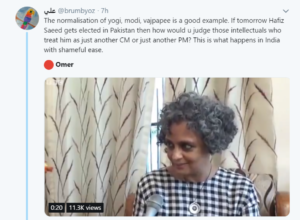
The tweeter is an Indian Muslim (who, as far as I can tell, now lives in Australia) and I assume that he regards Modi, Yogi and Vajpayee as Hindu Nationalists who are out to make India a “Hindu Pakistan”, where minorities (especially Muslims) will be second class citizens who will fear for their life and live under humiliating and unfair restrictions. Let us assume this is true (that the BJP is a Hindu Nationalist party with exactly such ambitions), then liberals who “normalize” this party and its leaders are indeed guilty of betraying liberal principles. But even if that is true (and to some extent it surely is; we can debate to what extent), there can be several objections to this tweet, especially to the fact that ALL THREE are being compared to Hafiz Saeed. I raised this particular objection in the following tweet:
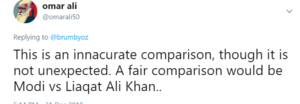
I will be the first to admit that this was mildly trollish, since I am well aware of the fact that the “done thing” is to make such judgments in terms of “local standards”.. by Pakistani standards, Hafiz Saeed is a religious extremist and a terrorist. So when Brumby wants an unflattering comparison for Modi, he picked Hafiz Saeed. On the other hand, Liaquat Ali Khan (first prime minister of Pakistan) is a Pakistani moderate. But my point was precisely this: the two standards are NOT the same. What Modi (or Yogi, or Vajpayee) may want is what Liaqat Ali Khan and Jinnah demanded and already got (thanks to some timely British help): an Islamic state, with discriminatory rules and laws that privilege one religion over all others. In that sense, Jinnah and the Muslim League leadership are indeed the correct comparison for a Hindu nationalist party.

But people also have other objections in mind. One is that Modi was CM during the Gujrat riots, when around 2500 people (mostly Muslims) died in a well organized pogrom during which the state machinery either stood aside or actively cooperated with the killers. Surely Liaquat Ali Khan cannot be compared to such a person? but even this objection stands on shakier ground than people may imagine. Liaquat Ali Khan was prime minister of Pakistan during a period when there was near-total ethnic cleansing of Sikhs and Hindus in Punjab and Karachi. This was not simply one or two spontaneous riots; there were well organized pogroms and the state machinery mostly stood aside (as in Gujrat, there were exceptions) and there is at least SOME evidence that Liaqat Ali Khan wanted them to stand aside because he did not really object to this cleansing (at a minimum he considered it the natural response to what was happening to Muslims in many parts of India). You can read more about this aspect here, but I will just post a paragraph from that newspaper article:

The prime minister, Liaquat Ali Khan, was angry with Khuhro when he went to see him on January 9 or 10. Liaquat said to Khuhro: “What sort of Muslim are you that you protect Hindus here when Muslims are being killed in India. Aren’t you ashamed of yourself!” In the third week of January 1948, Liaquat Ali Khan said the Sindh government must move out of Karachi and told Khuhro to “go make your capital in Hyderabad or somewhere else”. Liaquat said this during a cabinet meeting while Jinnah quietly listened. The Sindh Assembly passed a resolution on February 10, 1948, against the Centre’s impending move to annex Karachi. The central government had already taken over the power to allotment houses in Karachi. Khuhro was forced to quit and Karachi was handed over to the Centre in April 1948.

The above facts made me write that the violence against Sindhi Hindus and their mass migration to India was a tragic loss scripted, orchestrated and implemented by non-Sindhis in Sindh. I will happily withdraw my claim when furnished with the evidence to the contrary.

Published in The Express Tribune, June 5th, 2012.

The final objection I heard to my tweet was that Modi is an illiterate rabble rouser while Liaquat was the highly educated Westminster type. While it is true that Liaquat Ali Khan came from a rich feudal family (his grandfather, the nawab of Karnal was boss of 300 villages and had been given many honors because of his support of the British during the Indian Mutiny of 1857) and was educated in Oxford, he was never as thoroughly English as Jinnahbhoy, and neither is Modi as illiterate as his opponents make him out to be. That said, this objection has does have a little truth to it. My defense is that I was not saying they are exactly alike, I was only saying that as far as comparing BJP leaders to Pakistani politicians goes, the correct comparison is “any Muslim League leader” and not Hafiz Saeed.

I understand that many readers will find this comparison (BJP to Muslim league) hard to digest, but that is the point; it is hard to digest because it is unfamiliar. TIME magazine would not make this comparison and they have conventional wisdom on their side. But then again, we are not TIME magazine 🙂

PS: Arundhati, who admires Lenin (and Mao) has far to go before she can sit in judgment on liberals who “normalize” violent leaders.. If nothing else, we can all agree on that (see my article on Arundhati and her ilk here)

PPS: For details about partition violence (and later episodes of mass killings in Pakistan), see here.. 

Saudi Arabia; Kingdom at the Crossroads..

From Dr Hamid Hussain

Overview of challenges faced by Saudi Arabia and role of Crown Prince Muhammad Bin Salman (MBS). His meteoric rise from obscurity in an interesting phenomenon.

“Men in great fortunes are strangers to themselves, and while they are in the puzzle of business they have no time to tend to their health either of body or mind”.  Francis Bacon’s Of Great Place

Enjoy

Hamid


Kingdom at Crossroads

Hamid Hussain

“We always take criticism from our friends.  If we are wrong, we need to hear that we are wrong.  But if we are not wrong, we need to hear support from our friends.  What I request is that the thing you actually believe, to say it”.  Saudi Crown Prince Muhammad Bin Salman interview with The Economist, January 6, 2016

External environment of Saudi Arabia changed dramatically in the aftermath of murder of Saudi journalist Jamal Khashoggi in Saudi consulate in Turkey in October 2018.  It made international headlines and many started to ask questions about Saudi Arabia and the royal family.  This event also strained relationship of Saudi Arabia with its western allies as governments came under increasing pressure to raise this issue.

Saudi Arabia operates in a zone of opacity and not much is known about royal family dynamics and Saudi public opinion.  Crown Prince Muhammad Bin Salman (nick named MBS) moved rapidly to consolidate all power centers under his own personal command since the ascension of his father King Salman Bin Abdul Aziz to the throne in 2015.  Very little is known about how MBS consolidated his power inside the Kingdom.  He also broke with the tradition of family consensus and removed many powerful royal family members and their sympathizers from important centers of power.

MBS was first appointed Defence Minister and in this capacity, he gradually took control of all branches of the military. Defence procurement and defense construction contracts are a major source of patronage and in June 2017, MBS took control of this cash cow of patronage.  He established Saudi Arabia Military Industries (SAMI) and made it a defense subsidiary of Public Investment Fund (PIF).  PIF is country’s sovereign wealth fund under direct control of MBS. In August 2017, General Authority Military Industries (GAMI) was established and made responsible for all defense procurement.  SAMI and GAMI are controlled by an inter-ministerial committee headed by MBS.  In July 2017, commander of Royal Guard was removed, and six months later Chief of Staff of land forces and air force and air defense commanders were also removed.  Within few months of becoming heir apparent, MBS was in full control of operational and economic aspects of all defense establishments.

Parallel to these developments, interior ministry; a potential rival power center that had become a behemoth patronage center of deposed Crown Prince Muhammad Bin Nayef was gradually neutralized. In July 2017, a new ministerial level agency named Presidency of State Security (PSS) was established that reported to Crown Prince.  Counter-terrorism, internal surveillance, cyber-intelligence and national information center functions of interior ministry were transferred to PSS. MBS also took control of all economic activities as Chairman of Council of Economic and Development Affairs.  In this capacity, he cancelled and revised many previous civilian contracts most likely creating new networks of patronage loyal to him. Continue reading Saudi Arabia; Kingdom at the Crossroads..

A Historic Picture (and some reminiscences about 1971 BD War)


From Dr Hamid Hussain

IMG_1589 (005)

General Sam Manekshaw speaking to two Pakistani Air Force officers in plane bringing him to Pakistan for negotiations after 1971 Indo-Pakistan war. Gentleman sitting in suit is a public relations officer of Indian Ministry of Defence and gentleman standing in white overall is a sergeant of the Indian Air Force. Photograph courtesy of Brigadier Behram Panthaki.

This picture is dated 29 November 1972, when Indian army Chief General (later Field Marshal) Sam Manekshaw flew to Pakistan for negotiations after 1971 Indo-Pakistan war. The two Pakistani Air Force (PAF) officers were prisoners of war and brought by Sam as a good will gesture. Both officers were shot down in western theatre of war. The one near Sam with handle bar moustache (matching Sam’s own impressive moustache) is then Squadron Leader Amjad Ali Khan. His F-104 was shot down on 05 December 1971 by anti-aircraft fire while attacking Amritsar Radar. He retired as Air Vice Marshal. The other officer is then Flight Lieutenant Wajid Ali Khan. His F-6 was also shot down by anti-air craft fire during a close air support mission over Marala headworks on western border. After repatriation, he left air force and settled in Canada. He became member of Canadian parliament serving from 2004 to 2009.

Indian Air Force (IAF) TU-124 VIP plane brought Sam Manekshaw to Lahore. When plane was taxing to reach the parking bay, it passed the skeleton of the burnt Indian Airlines Fokker Friendship aircraft, ‘Ganga’, that had been hijacked on January 30, 1971 on its flight from Srinagar to Jammu and brought to Lahore. On February 02, the hijackers had set the aircraft on fire. Sam was received by Pakistan Army Chief, General Tikka Khan. Tikka was wearing his famous dark glasses. Continue reading A Historic Picture (and some reminiscences about 1971 BD War)

Forbidden Fruit. Military in Politics in Pakistan

From Dr Hamid Hussain. An old article (from 2003).

Forbidden Fruit – Military & Politics

Hamid Hussain

2003

Introduction

Politics and profession of soldiering has nothing in common. They are totally different but essential elements of any society. Politicians and soldiers have an interesting relationship in all societies. In societies where civilians are in control, military officers act in accepted boundaries though ready to defend their turf against civilian encroachment. In societies where political institutions are weak and there is lack of consensus on legitimate course of succession, soldiers gradually expand their area of influence. They gradually restrict the role of civilians in various areas and sometimes directly take over the state replacing the civilians. This generally accepted model does not mean that military as an institution has no relevance to the important policy decisions. Even in countries where the tradition of civilian supremacy is well established, military has a political role relating to national security, albeit a different one. One commentator has correctly pointed that “the military’s political role is a question not of whether but of how much and what kind”. [1]

This article will evaluate soldier’s attitude towards political activity and how it develops. This will be followed by the details of Pakistani experience of politicization of officer’s corps and how repeated and prolonged military rules have militarized the politics. In the end, the complex relationship between soldiers and politicians will be summarized.

Soldiers & Politics

Soldier’s disdain for politics and politicians is universal. Soldiers by nature of their training and job requirement place high value on discipline, recognized chain of command and espirit de corps. These values are essential for any professional army. Soldiers generalize these values and attitudes to the whole society without appreciating the difficulties and various conflicting demands by interest groups in a modern nation state. In under-developed countries, the problems are compounded by host of other negative social and economic factors. Discussion, debate and arguments about different points of view are essential ingredients of politics in every society. The nature of political activity is more chaotic on surface. Soldier’s concept of political order is based on the model of discipline, which he has learned in his barracks and daily life. “Institutions that permit disorder are condemned. The men who purposefully encourage disorder, as well as those whose inactions inadvertently allow for disorder, are dangerous”.[2] This is how soldier sees the political activity of his society. Political activity is seen as undermining of the discipline of society and politicians as opportunists and self-seeking demagogues. This thought process is at the root of how a military first withdraws respect and later support of any civilian government which is followed by kicking the quarrelling politicians out of the corridors of power. The chaos and instability caused by the weak civilian institutions is blamed for paving the way for military to take over the state. This is the universal justification used by all military rulers. Once the politicians are condemned as useless bunch, the question arises then who is competent to run the state? Now the self-righteous attitude of officer corps comes into play. In under-developed countries, military sees itself as the most modern institution of the society. In addition, being a member of a well organized and disciplined force and overdose of patriotic and nationalistic symbols reinforces the notion that soldiers are more competent than civilians. In countries where military is the dominant institution, the military leadership considers itself as ‘final arbiters of political process, final judges as to whether a particular turn of events is acceptable from their standpoint as the guardians of national integrity’. [3] Continue reading Forbidden Fruit. Military in Politics in Pakistan

Brown Pundits