Why Indian Americans are not the new Jews

In the 2000s I would have arguments with some Indian American friends about the ethnic trajectory of Indian Americans in terms of their similarity American Jews, where I staked out the position that the analogy was superficial (e.g., on the Sepia Mutiny blog). To understand why the analogy doesn’t work, you need to know the history of American Jews first. Though Judaism in the United States goes back to small Sephardic communities along the eastern seaboard before the Amerian Revolution, to understand the Jewish community in the 20th and 21st centuries one needs to focus on the two Ashkenazi migrations from Central and Eastern Europe that occurred in the 75 years between 1850 and 1925.

The first wave was the “German Jews”, most of whom were Bavarian peddlers. Many of them scattered across the country, starting general stores and the like. Though numerically a very small migration, they founded many Jewish American institutions. There is a reason that the headquarters of Reform Judaism, which is of German origin, is in Cincinnati. This reflects the migration of German Jews along routes of commerce in the 19th century.

The second wave, and the much larger one, is the migration stream that issued out of the expanded Russian Empire, in particular Lithuania and Galicia. These are who the German Jews referred to as the “Ostjuden”, the Eastern Jews. This was a term applied in Germany to Jews from Poland and further east as well. The Ostjuden were often destitute. Those that fled the early 20th century pogroms may have had nothing but the clothes on their backs. In fact, in all likelihood, the richer and more assimilated Jews were the ones who remained in Europe.

America was the destination for the more marginalized.

Continue reading Why Indian Americans are not the new Jews

Open Thread – 08/22/2020 – Brown Pundits

The usual.

But I’ll make a comment here. I am of the school that thinks facts matter a lot. Many of you trade in standard Hindu nationalist tropes and generalities about Islam. As someone who told Shadi Hamid on our interview, I am not a big personal fan of Islam, I don’t really mind people fearing Islam. I have personal experience of the religion after all.

But, facts matter. And a lot of the “facts” that get bandied about here are false.  I won’t tolerate that. There are two general categories I will point to:

1. First, people take traditional Muslim historiography at face value. You shouldn’t. This is like taking Christians at face value when they talk about the Four Gospels are pure positive history, when they were finally compiled and redacted decades later. Whether Muhammad exists is an empirical question in the same way that whether Jesus exists is an empirical question. As it happens, I’m modestly confident both figures existed in some form but were quite different from what Christians and Muslims depict them as (I do suspect that Josephus was a later interpolation).

The broader issue here is that Muslims on the whole have not gone through the modernist transition in regards to a critical-rationalist take on their religion. In Christianity, traditionalist-fundamentalists exist, but they have to take dialogue with modernists as a given. They exist in large part as reactions to modernism. This is not the case with Islam. Muslims accept that non-Muslims reject their religion, but within Islam, there is not a strong rationalist engagement with their texts that applies the sort of criticism than the Germans pioneered within Protestantism in the 19th century. That means they present a “unified face” about their early history which too many non-Muslims take for granted. Islam with all of its constitutive elements is not truly recognizable to us until about 850 A.D.*

2. Because this is a blog with a South Asian focus a lot of Hindu nationalist tropes and facts get presented at face value. I don’t really mind them as mythologies that give people succor or create their identity, but a lot of them have as much factual basis as a pagan Mecca: not much.

Most of the Hindu nationalist commenters do reflect a reality of “lived experience.” As someone who grew up around South Asian Muslims, I can admit they have total contempt on the whole (there are exceptions) for Hindus and their “bizarre” beliefs. But, as someone who is personally anti-Islam and literally tolerant of diverse views, many people from Hindu backgrounds of all ideologies have told me what they really think of Muslims, and the contempt is returned.

My issue is always when people turn their personal experiences into deep historical insights. Do not do that if you don’t enjoy me jumping down your throat, because if I’m not busy, I will do so.

More broadly, lots of Indian readers would benefit from reading more history. Especially non-Indian history. A broad cross-cultural perspective is essential, so do more!

For the curious here are a few books:

China: A New History
History of Rome
A History of the Byzantine State and Society
A History of the Arab Peoples: Updated Edition

* The Shia-Sunni split starts to become discernible in a way we’d recognize, Hadith culture is already on track to marginalize the “philosophers” and Hellenists, and the ulema centered around madrassas spread from the east to the west.

Kamala Harris embrace of ‘victim identity’ bothers me

Apparently Kamala Harris was admitted to law school through LEOP:

LEOP offers admission to approximately 50 high-achieving students each year—up to 20 percent of the class—who have experienced major life hurdles, such as educational disadvantage, economic hardship, or disability. The majority are students of color. Besides traditional admissions criteria, such as grades and LSAT scores, the program also considers students’ overall potential and the obstacles they’ve overcome. “These are extraordinary students who have been playing while injured in the game of life, but all they do is win,” McGriff said.

Once students enroll, LEOP supports them throughout their tenure at UC Hastings, offering a weeklong orientation, academic counseling, practice exams, and help preparing for the bar exam and job interviews, among other resources and services.

…. LEOP went on to count many prominent alumni among its ranks, including U.S. Senator Kamala Harris ’89; San Francisco Public Defender Jeff Adachi ’85; Adelmise Warner ’01, chief counsel at Pandora; and Andrew Houston ’07, procurement counsel for the University of California’s Office of the General Counsel.

We know a lot about Kamala Harris’ mother’s family. They are upper-middle-class Tamil Brahmins. Her mother did raise her mostly alone. So she was a single mother. But she was also a Ph.D. biomedical researcher.

Here is a profile about her father, Kamala Harris’s Father, a Footnote in Her Speeches, Is a Prominent Economist:

Dr. Harris was raised in a landowning family on the north coast of Jamaica by a paternal grandmother whom he described as “reserved and stern in look, firm with ‘the strap,’ but capable of the most endearing and genuine acts of love, affection and care.” Reserved and highly intelligent, he was more cut out for academia than activism, contemporaries said.

Basically, on both sides of Harris’ pedigree, there is evidence of sub-elite status. Her utilization of the LEOP program seems to be unfair to students who were genuinely disadvantaged.

The Aryan Integration Theory (AIT)

I’ve been thinking a bit recently about loaded terms like the “Aryan Invasion Theory.” Since I’m not Indian I don’t get super worked up about the ideological valence of the term. But, after thinking about it for a while, a few weeks ago I decided that the term “Aryan Invasion Theory” (AIT) is not useful, and I will abandon my gentle defense of its utility.

My own views can be read extensively at already, so I won’t belabor the details of what I believe.

Rather, I think that the classical version of the “AIT” is not useful because I think most people associate the idea of a barbarian “invasion” with a conflict between two clear and distinct groups, and one of the groups have a coherent social and political organization in a complex fashion. This is not what I believe at this point. Rather, I believe that Indo-Aryans interposed themselves into a fallen landscape.

The best evidence from Narasimhan et. al. indicates that “steppe” admixture into Indian subcontinental groups in the northwest dates to the period between 1900 and 1500 BCE (95% confidence intervals). What we now call “Ancestral North Indian” (ANI) and “Ancestral South Indian” (ASI) seem to have emerged in the period between 2000 and 500 BCE. In the “Swat transect” which begins ~1000 BCE there is an increase in AASI related ancestry over time (and, increase in “steppe” as well), suggestive of subcontinent-wide gene flow, including into the northwest from the southeast.

My idea for how Indo-Aryans became preeminent in South Asia is similar to the arrival of Rohirrim into Rohan. The “Mature IVC” had almost certainly have collapsed by the time of the Indo-Aryans arrived. This is part of a West and South Asia wide collapse of complex urban societies. This is often attributed to a climatic shock and was correlated with an influx of barbarian peoples (e.g., the Guti of the Zagros into the territory of Ur III). In some cases, such as Egypt, the indigenous elites recovered rapidly. In the case of Babylonia, an intrusive Semitic population, the Amorites, assimilated into the high culture of the Akkadians and Sumerians.

The situation in South Asia is unlikely to be peaceful. The Y chromosomes of South Asians are on the order of 10-20% attributable to the steppe (depending on sampling and weighting of populations). A much smaller percentage of mtDNA is attributable to these people. The indication here is that this was a migration of males.

But, the opposition to the Indo-Aryans was not culturally as advanced as the IVC. Rather, the likelihood is that what we see is similar to what occurred in the Balkans after 550 A.D. and the withdrawal of East Roman forces. The Latin-speaking peasantry, with no elites, and the collapse of the Christian church, eventually assimilated into the “peasant culture” of the intrusive Slavs across much of the Balkans. A similar process seems to have occurred across much of Britain, where a minority of pagan Germans assimilated larger numbers of semi-Christianized Celts after their elites retreated to Cornwell, Wales, and Brittany.

It seems that complex specialized societies can be quite brittle. Especially those from the Bronze and early Iron Age (the late Bronze Age collapse is another case). The decline of the IVC probably resulted in the evaporation of many elites who had served to anchor the identity of these polities. My assumption is that the arrival of Indo-Aryans, who had more social cohesion at this point (steppe nomads are all easily mobilizable as a fighting force due to lack of specialization), resulted in integration of the remnant local elites rapidly into the new social order.


Getting beyond the nerd understanding of religion

Since about 2006 I’ve had to write the same post again and again due to the nature of my audience: religion is not the purview of technically oriented nerds, and technically oriented nerds just don’t “get” it intuitively. This is something that is relevant to me personally, because I am myself a technically oriented nerd, and I just don’t “get” religion.
A few years ago I was asking a co-worker whey he believed in ghosts, and he stated: “because I’m human.” This is actually a good response, as all societies have the sorts of supernatural beliefs that we might categorize under beliefs about gods, spirits, and demons. This is the cognitive raw material of religion, which is a universal feature of human cultures.

Do you believe this stuff???

A minority of people lack such intuitions. At least with any strength. I am definitely one of those. My realization that I was an atheist occurred when I was eight, as I thought for a few moments about the idea that God might not exist. At that moment I realized I did not think God existed, and, I also realized I hadn’t really thought about it before because religion was simply something I never really gave much thought to.

When I began to give more thought to religion when I was a teenager in the 1990s it was due to its cultural salience. By this, I mean two things. First, the rise of Islamic terrorism and political violence. Second, the emergence of the Christian Right in the United States. In my personal and private life, I had many conservative Christian friends and would engage them in the discussion from my atheistic vantage point.

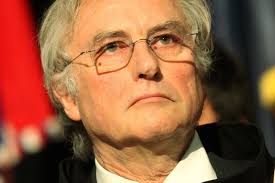
Between 1995 and 2005 I went through a “Richard Dawkins” phase. As it happens, I met Dawkins casually in 1995 at a talk and had been reading his biology works. I was not particularly interested in his religious commentary. Rather, I read books such as Atheism: A Philosophical Justification or relevant portions of Summa Theologica. I plumbed the depths of ontological, teleological, and cosmological arguments. I engaged with the works of men such as Norman Malcolm and Richard Swinburne.

Continue reading Getting beyond the nerd understanding of religion

Open Thread – 08/15/2020 – Brown Pundits

Dog days of summer..

One of the things with Indian American analysis of Indian culture/politics is the unselfconscious filtering of it through an American lens, rather than Indian. It’s annoying to listen to news shows where they interview an Indian American about Indian culture, and the interviewer and guest proceed to discuss Indian culture through the lens of American concerns, without ever acknowledging what’s going on. To give an example, talking about ‘colorism’, but immediately pivoting to anti-blackness.

Why there will never be an “India Lobby”

Back in the 2000s on the Sepia Mutiny blog I would get frustrated with commenters who would talk about India as if it was analogous to Cuba or Israel, in that a group of American nationals with family ties could influence the shape of American policy. This was always a crazy proposition.

The reason that focused American ethnic lobbies could shape Cuba and Israel policy is that these are small nations which to be frank don’t matter that much.

There’s no Germany lobby. There’s no Russia lobby. There’s no China lobby. These nations are too important to get caught up in pure interest group politics. Similarly, there will never be an “India lobby.” Even personal relationships and affinities between leaders are irrelevant when realpolitik is too important. Think of the fact that Trump clearly has an affinity for Putin, but the American government continues to impose various sanctions on Russia.

Note: Because of its embeddedness in the Great Power jockeying between the USA, China, and India, there will also never be a “Pakistan lobby.”

Why Hinduism is not inchoate paganism

An individual, who I have come to conclude is a troll after further comments (they are banned), mentioned offhand that Hinduism and/or Hindu identity is reactive Islam and the British, and that its origins are in the 19th century. This is a common assertion and presented recently by one of our podcast guests. I myself have entertained it in the past. It’s not prima facie crazy.

But I have come to conclude that this is not the right way to think about it. Or, more precisely, it misleads people on the nature of the dynamic of Indian religious identity and its deep origins. This is why I think Hindus themselves self-labeling ‘polytheists’ or ‘pagan’ can mislead people. Not because these are offensive terms. People can refer to themselves however they want. But these terms have particular relational resonances with other groups, periods, and peoples.

One can point to al-Biruni’s external observations about Indian religion, or Shijavi’s personal opinions in his correspondence, to make a case for Hinduism and Hindu identity (using both terms to avoid troll-semantic ripostes) being older than the 19th century. But this is not the argument that is strongest to me. I have spent many years and books reading about the cross-cultural emergence of religious identity, and its change, in places as diverse as Classical Rome, post-Arab conquest Iran, and 7th century Japan, to name a few places. Many of these places and times had local religious cults and practices. In all of these places, they were assimilated and absorbed into the intrusive “meta-ethnic” religion. In Rome, Tibet, and Japan, the religion had major initial setbacks, but eventually, the meta-ethnic “higher religion” came back and captured the elite.

In the modern world, we see massive Christianization, and to a lesser extent Islamicization, in Sub-Saharan African. The traditional religions persist, in particular in West Africa, but history is clearly against them. Importantly, most of the religious change occurred after the end of colonialization.

The relevance of this is clear. The Indian subcontinent would be an exception for all these above cases if the vast majority of people were unintegrated animists with only local religious cults. The precedent from Europe and the world of Islam is that Brahmins and a few other pan-Indian groups (e.g., Jains) would persist as religious minorities, while the vast majority converted to the newly introduced meta-ethnic religion.

Continue reading Why Hinduism is not inchoate paganism

Kashmiri Brahmins are just like other Kashmiris

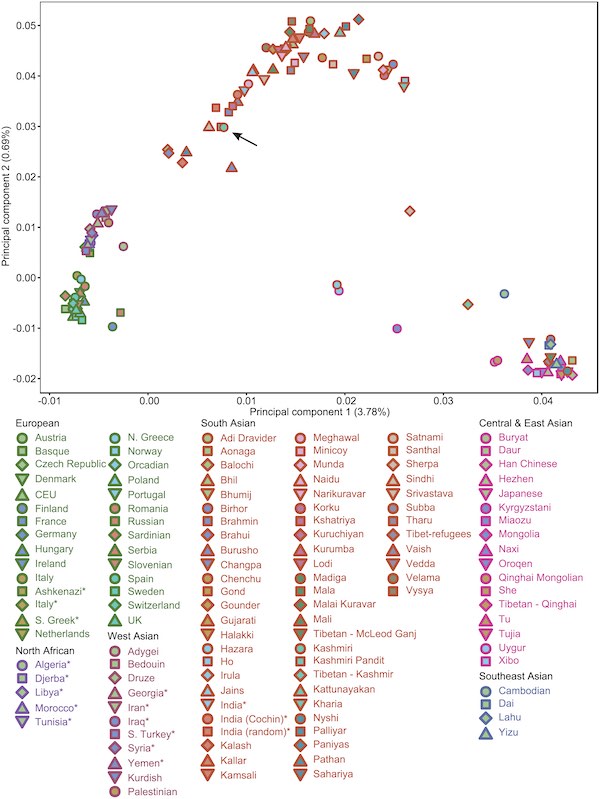
I think I’ve posted this before, but it was a while ago before we had so many readers. In this paper they took 15 random Kashmiris from the Valley, and compared them to various populations. The plot below, as well as admixture analysis in the paper, shows no daylight between the Pandit samples and generic Muslim Kashmiris.

This is not to say Pandits are not an endogamous community and were not before the Islamicization of Kashmir. But, it is to say that in their overall genome their origins are exactly the same as other Kashmiris. This is in contrast to many parts of India in regards to Brahmins, though the “stylized fact” seems to be the further north and west you go, the smaller the genome-wide difference between Brahmins and non-Brahmins will be. This seems to comport with the idea that Brahmins are intrusive to the south and east in a way they are not to the north and west.

Finally, the data from ancient DNA is strongly suggestive of “AASI-reflux” across north and west South Asia after 3000 BC. See my post The Aryan Integration Theory (AIT).

Brown Pundits