A reader sent me a post they wrote, The Aryans were Invasive to India:
The Aryan Migration into India was invasive; characterized by violent conquest, rape, racism, and religious supremacy. This was not a unique phenomenon in the premodern era, but a relatively standard episode that would ensue when two different tribes had to struggle over the same resources.
The Sanskrit-Vedic culture spread over India by Aryan conquest was likely not significantly influenced by native Indian traditions. That being said, Indian traditions certainly did work their way into later expressions of Hinduism, particularly after the rise of Buddhism, and the resulting reformations the latter faith affected in the former.
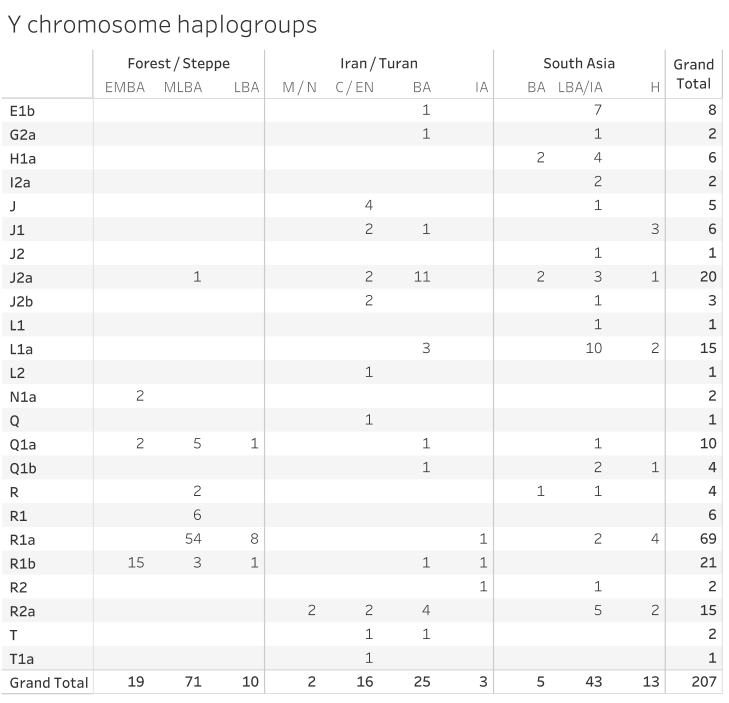
 They asked for my opinion. I agree with many of the aspects of the piece. There is something of an attempt, in my opinion, to downplay the coercion and violence that were part of the expansion of many Y chromosomal lineages, groups of males, ~4,000 years ago. In fact, the author of the above piece probably overestimates the fraction of Aryan mtDNA in India; most West Eurasian lineages in South Asia are probably from West Asian, not the Sintashta.
The violent conquest and rape are probably correct. There are details though that need to be clarified. I suspect the violent conquest was of the shadows and ruins of the Indus Valley societies. The Aryans were barbarians who arrived in a barbarized world. As far as rape goes, modern Americans would define the act of killing a woman’s brothers and fathers and taking her as a bride rape, but it was quite normal in the ancient world. The dramatic arc of Achille’s sulking in the Iliad is triggered by the fact that Agamemnon took his sex slave.
But I think racism and religious supremacy are terms I would avoid. The reason is that there is generic racism, which is pretty typical, and historically contingent, embedded and systematized racism developed in the 19th century in the West. This is what casts a shadow over us today. But racism in the premodern world was different. It is well known that in early Anglo-Saxon England the local British population were second class citizens. We know this because the fine for killing a Briton was less than a fine for killing a Saxon of the same class. But, we also know genetically and culturally that many Britons assimilated into Anglo-Saxon culture and become English. The lineage of Alfred the Great, who “saved” Anglo-Saxon England from the Danes, seems to have been one of Brythonic warlords who were Anglicized. Many of the early members of the House of Wessex had Celtic names.
The second issue is religious supremacy. There is a particular type of religious exclusion, supremacy, and ideology, that is common in the modern world, and dates to the last few thousand years. Let me quote from a 2005 article in The New York Times:
Next door to four houses flattened by the tsunami, three rooms of Poorima Jayaratne’s home still stood intact. She had a ready explanation for that anomaly, and her entire family’s survival: she was a Buddhist, and her neighbors were not.
“Most of the people who lost relatives were Muslim,” said Ms. Jayaratne, 30, adding for good measure that two Christians were also missing. As proof, she pointed to the poster of Lord Buddha that still clung to the standing portion of her house.
This is a way of thinking that makes sense in light of universal meta-ethnic religions which have flourished over the past few thousand years. During the Bronze Age, such religions did not exist. Rather, religion was to a great extent an extension of tribal custom and practice. The destruction of the idols of one’s enemies was part and parcel of violence against the enemy, not a particularly religious act. It is a cliche in anthropology that many primitive tribes refer to their own people as “human”, and other peoples as non-human. But this reflects a reality that premodern humans were quite ethnocentric. But they were not racist or religious supremacists in the fully-fleshed way we would understand that today, so I would be cautious about using these terms.
The final point about Sanskrit-Vedic culture being mostly exogenous, I disagree with this. The essay doesn’t really provide much evidence but makes a general argument. I have read some of the Vedas, and much of it does seem to resemble generic Indo-European barbarism. But there are clear differences and distinctions which indicate non-Indo-European uptake. It is quite like that southern Indo-Iranians learned soma/homa from the Bactria-Margiana culture. Those who know tell me that Vedic Sanskrit already shows strange influences that are probably broadly Indic. The most famous one being the retroflex consanant:
Retroflex consonants are concentrated in the Indian subcontinent, particularly in the Indo-Aryan and Dravidian languages, but are found in other languages of the region as well, such as the Munda languages and Burushaski. The Nuristani languages of eastern Afghanistan also have retroflex consonants. Among Eastern Iranian languages, they are common in Pashto, Wakhi, Sanglechi-Ishkashimi, and Munji-Yidgha. They also occur in some other Asian languages such as Mandarin Chinese, Javanese and Vietnamese.
Narasimhan et al. show that the BMAC people didn’t have a genetic impact on the Indo-Aryans who arrived in India, but they were culturally influential. Similarly, it seems quite likely that the various eastern Iranian/northwest Indian populations were also influential and integrated into the Indo-Aryans. As I have pointed out before, the figure of 30% “steppe” refers to Sintashta ancestry. It is quite plausible that the Indo-Aryans who arrived in India had already mixed with various eastern Iranian peoples in Khorasan and modern Afghanistan, before arriving in India.
The idea that Jainism and Buddhism were indigenous reactions to Aryan Brahmanical religion is common and widely asserted. The Shramanic sects are often assumed to be non-Aryan cultural revolts. I no longer believe this. Rather, I think a more philosophical and transnational religion naturally emerges out of complex societies. My argument is closer to a Marxist one than an ethnic one. The Vedic religion was not fundamentally viable in anything more than fossil form once India’s Iron Age polities arose. It maintained some archaisms from the steppe period, and, it was suited for a semi-mobile agro-pastoralist society.