Academic freedom, Hinduism, and the end of the age

Under fire from Hindu nationalist groups, U.S.-based scholars of South Asia worry about academic freedom:

We are at a tipping point,” said Rohit Chopra, one of the conference organizers and a professor of communication at Santa Clara University. He said the issue went beyond the conference. “It’s about the principles of freedom of expression, academic freedom and of a university being a space where people can speak for the most vulnerable.”

The online conference, Dismantling Global Hindutva, included panels on the hierarchical caste system, Islamophobia and differences between Hinduism the religion and Hindutva the majoritarian ideology. The event was co-sponsored by departments of more than 40 American universities, including Harvard and Columbia.

The whole piece is a mishmash. First, let’s stipulate that many Hindu activists are unsophisticated, illiberal, and nasty pieces of work. But someone like Suhag Sukhkla is none of those things. So the article focuses more on the former than the latter because the former is sensationalistic. Yet, many of the reported threats are credible to me because I myself have received various forms of these invectives from 15-year-old masturbaters in India on Twitter (though a little surprised adults behave like this too). But beneath the bluster and thuggishness, there’s a legitimate grievance. Imagine an academic conference on Islam that spotlighted its hierarchical gender system, religious dominionism, and the differences between Islam as a culture and Islam as a religion. Such a conference wouldn’t happen because academics would fear Muslim outrage and violence, and, they see Muslims as subalterns and marginal, and so above criticism.

The first issue illustrates why many Indians and Hindus are behaving like this: they’ve seen the heckler’s veto work on weak-spined academics before. They’ve seen it work for Muslims, and they’ve seen it work for left-wing activists. When Charles Murray was physically attacked at Middlebury it got results. Murray really can’t speak in public anymore at such venues because the cost of security would be prohibitive. The second issue is that academics don’t really believe in freedom of expression anymore, they believe in critiquing the powerful. They’re activists. Ideologues. What the Hindus are doing is turning the master’s tools against the master when they leverage identity politics and their status as people of color. The academics, who don’t really believe in freedom of expression, respond with most gusto when they try and smear Hindus by connecting them with Nazism and argue for their hegemonic status vis-a-vis Muslims in the subcontinent. It’s all who/whom here.

I believe in dispassionate analysis and Epoche. Many Hindu activists and believers are wrong on many things. And I tell them so when I think this. But I don’t do this because I want to “deconstruct Hinduism.” I don’t really care that much about Hinduism, or Islam, or any religion. I want to know what’s true. When humanities scholars gave up on the truth, they gave up on the high ground from which they could defend their viewpoints as part of free speech. This is the world they created. You told people that truth is subordinate is power. Your enemies now seek power to force you to speak their truth.
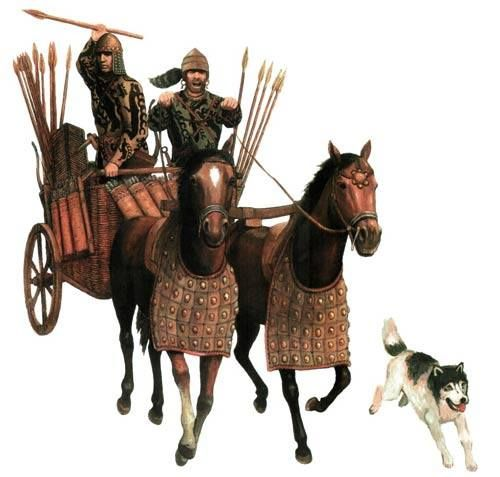
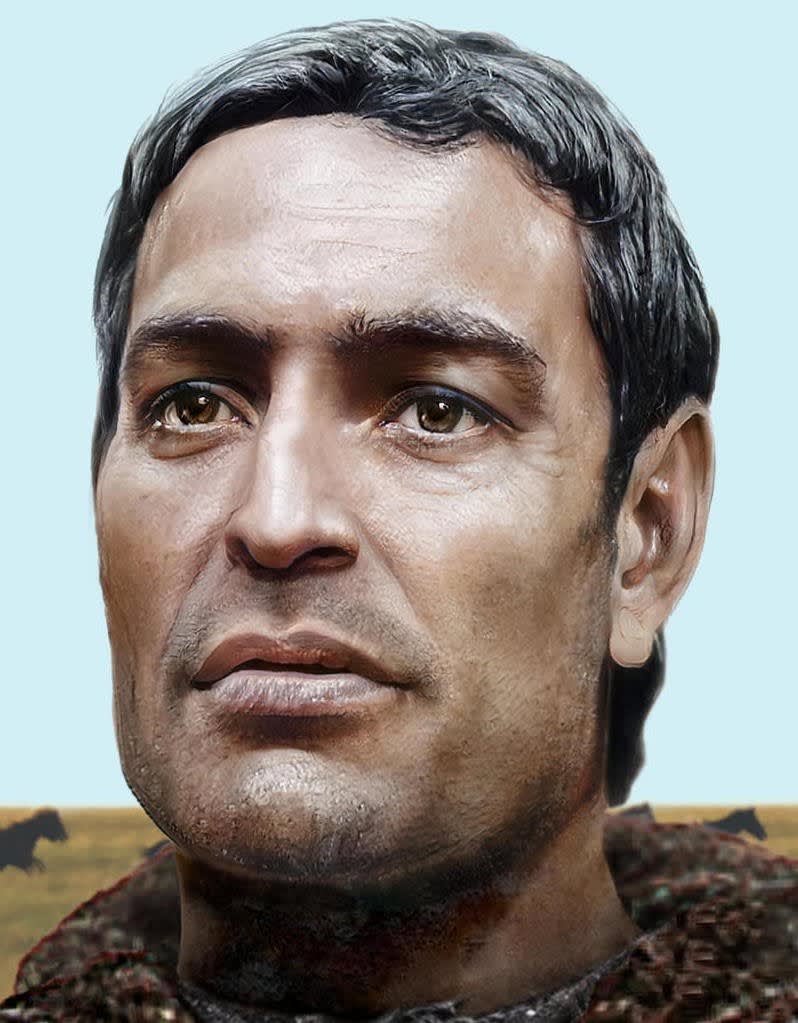
Hayagriva was a Sintashta!


The paper is not out, but since the data has been uploaded they posted the abstract for the world to see, Project: PRJEB44430:

Horse domestication fundamentally transformed long-range mobility and warfare. However, modern domesticates do not descend from the earliest domestic horse lineage associated with archaeological evidence of bridling, milking and corralling at Botai, Central Asia ~3,500 BCE (Before Common Era). Other long-standing candidate regions for horse domestication, such as Iberia and Anatolia, were also recently challenged. Therefore, the genetic, geographic and temporal origins of modern domestic horses remained unknown. Here, we pinpoint the Western Eurasian steppes, especially the lower Volga-Don region, as the homeland of modern domestic horses. Furthermore, we map the population changes accompanying domestication from 273 ancient horse genomes. This reveals that modern domestic horses ultimately replaced almost all other local populations as they rapidly expanded across Eurasia from ~2,000 BCE, synchronously with equestrian material culture, including Sintashta spoke-wheeled chariots. We find that equestrianism involved strong selection for critical locomotor and behavioral adaptations at the GSDMC and ZFPM1 genes. Our results reject the commonly held association between horseback riding and the massive expansion of Yamnaya steppe pastoralists into Europe ~3,000 BCE driving the spread of Indo-European languages. This contrasts with the situation in Asia where Indo-Iranian languages, chariots and horses spread together, following the early second millennium BCE Sintashta culture.

If you ever inspect the domestic horse lineages you will note that they’re a monophyletic clade. They are recently descended from a common ancestor. Additionally, there is a massive skew in stallion lineages toward a few breeders. Ancient DNA has now solved the question of which prehistoric horse population the modern domestic breeds descend from: the horses from the eastern edge of the post-Yamnaya cultural zone.

Afghanistan was never “Hindu”


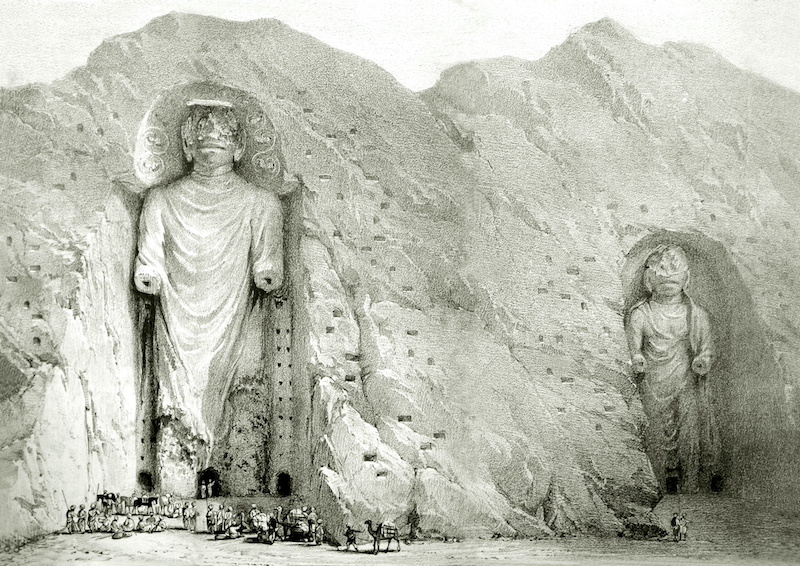
Buddhism and Islam on the Silk Road has an extensive section on Afghanistan. The Bamiyan Buddhas reminds us what the texts make clear: up until 900 AD the highlands in an around modern Afghanistan were heavily Buddhist. The Turki Shahi kings of Kabul seem to have patronized Buddhism. In contrast, their successors, the Hindu Shahi kings, seem to have tilted toward what we would call Hinduism.

Because I’m posting a Substack on Afghanistan soon the civilizational and cultural identity of Afghanistan is on my mind. After my reading and reflection, I’ve come to the conclusion that the area and the people can be thought of as a crossroads between Persian, Central Asian, and Indian. Central Asia includes both Iranic and later Turkic cultures, while the Persian influence reflects a deeply west Iranic sensibility. Finally, it has hard to deny that India and much of southern and western Afghanistan are deeply connected geographically, biologically, and culturally.

And yet some Indians keep claiming that “actually Afghanistan use to be Hindu…” This is false. At least by any comprehensible definition of “Hindu.” It is true that Afghanistan was once heavily Buddhist, but Buddhism is not Hinduism. It is true that there have long been Indians in Afghanistan, but there have been Indians in Southeast Asia as well. It is true that the Iranian pagans, like the Nuristanis, worshipped gods and practiced traditions that descend from one’s affinal to the Vedic Aryans, but the pre-Vedic religion of the Indo-Aryans was not Hinduism as we’d understand it.

To a great extent, this sort of cultural imperialism is harmless and cringe. But it’s a bit on the insensitive side given what’s going on in Afghanistan, where ironically Indian-origin Deobandi Islam is is reigning supreme…

Nepali Brahmins tend to have Tibeto-Burman ancestry


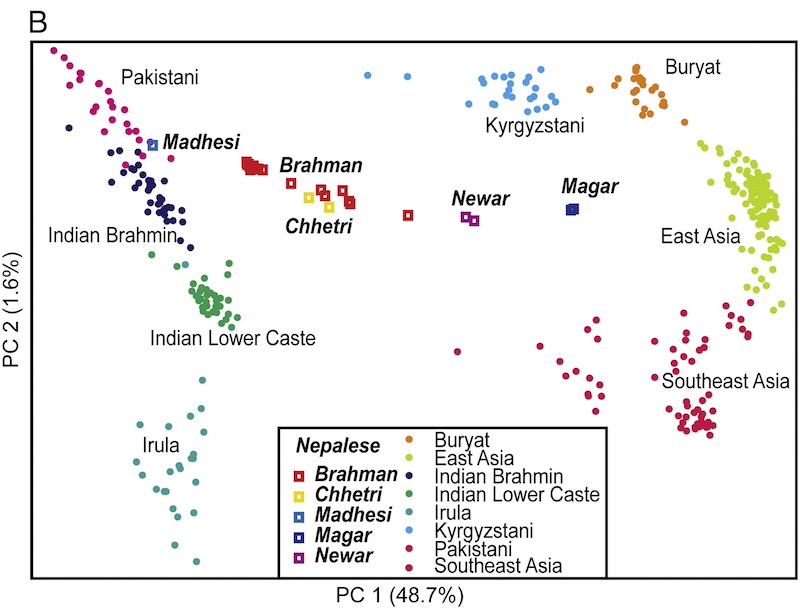
I ran a Clubhouse last night on Nepalese genetics. I said something to the effect that most Nepalese Brahmins have Tibetan admixture. A Nepalese Brahmin came up on stage to tell me this was inaccurate, and that they did not intermarry with native people.

To give the benefit of the doubt I went back and double-checked, and Toward a more uniform sampling of human genetic diversity: A survey of worldwide populations by high-density genotyping, which has a diverse set of Nepalese. What you see on the PCA is pretty straightforward. Except for the Madeshi, who is presumed to descend from recent migrants from India, all the Nepalese are Tibetan shifted.

The rank order is what you’d expect, with the Magar being mostly Tibetan, and the Brahmins being mostly non-Tibetan. But the Nepalese guy was totally full of shit. I’m sick of listening to people contradict genetics when it’s so clear.

Onward on the steppe!


After a long delay, I’ve dropped part 4 of my continuing series on the Eurasian steppe and its history (I am currently planning on going down to the 13th century AD…so this should take me into 2022 since I’ve barely made it beyond 2000 BC as of now). The next installment is planned to be on the early Indo-Iranians and their connection to the Fatyanovo–Balanovo culture, and subsequent expansion in the Andronovo expansion (this will compliment my two pieces on India from last January).

Antiblackness and British South Asians – some cultures are to be judged, but others are not

BP-emeritus Zach posted this piece on Twitter, ‘I’m Bengali, my boyfriend was black – and my mum freaked out’. The piece highlights the reality that anti-black prejudice, in particular, is pervasive among South Asians (Indians, Bangladeshis, Pakistanis, etc.). I’m not super invested in the idea that this is due to colonialism, as I doubt it is. But we all know this is objectively a true prejudice. And the article highlights it in many ways.

But I want to point out another aspect of the piece: many of the warnings, whether racially motivated or not, by the young woman’s family, turned out to be true. In the piece, she notes she had already had one abortion at 18, and now was refusing to at 21. That’s obviously her choice, but her boyfriend had apparently impregnated another young woman at the same time. Finally, “She had another child with the same partner, who later walked out on her for good.”

So she’s left in her mid-20’s to be a single mother. This is almost certainly one of the major worries of the woman’s mother and her relatives, even if they were racist. In England, 24% of black families are single-parent households, while 8% of Asian families are. Asians in England (this means South Asian) may be antiblack as a culture, but black Briton culture is partly defined by a level of family instability which horrifies people from traditional Asian cultures.

I think this near the conclusion is important:

A few months ago there was an interesting development in the family – Salma’s brother started dating a black woman. And to Salma’s surprise, her mother accepted it without hesitation.

“That’s progress for a woman who had never recognised or challenged her anti-black attitudes before,” she says.

“I’m so proud of how far she’s come, although we still have more to go.

“I don’t blame her for thinking the way she did. But it was time I challenged it. It’s time we did as a community.”

One interpretation here is that Salma’s mother is no longer racist. But another interpretation is that Salma’s brother picked a far better person as a romantic partner than Salma did. Throughout the piece the father of Salma’s children is a stand-in for a race, but what if her relatives and her mother knew exactly the kind of man he was going to be? What if they were very worried about the decisions Salma was making in large part because they were worried about her?

I am willing to bet Salma’s brother’s girlfriend raises some eyebrows. I doubt the racism disappeared in a few years. That’s a real thing. But I strongly suspect she is just a much better potential match.

These sorts of stories mix personal stories and social issues. Honestly, I think this is the story less of racism and more of an irresponsible young man and woman. They got pregnant twice. She chose to keep the baby and tried to maintain a relationship with a man who was cheating on her the whole time, to the point of impregnating someone else.  There’s more than just racism going on here.

Brown Pundits