We had some discussion on Twitter about Sikhs and I mentioned that my Punjabi Nationalist dad once said that he had thought about converting to Sikhism, but after he spent time with some Khalistani Sikhs in America, he decided their priests are as bad as ours, so he dropped the idea. Continue reading Are Sikhs Exceptional?
Category: Omar Ali
What is in a Name? Al Qadir University
Dear leader (aka Imran Khan) was in Sohawa laying the foundation stone of “Al-Qadir University” and he gave a speech that is a good summary of his (childish, Aitchison college and Pakistan studies) worldview. The guy introducing him mangles one of Iqbal’s finest urdu poems and then Imran Khan takes it from there.. He manages to mangle Ahle suffa, Roohaniyat, history, sufism and science in this speech.. worth a listen.
But today I am not concerned with his worldview (which at least has a certain childish sincerity about it), I am just concerned about the name “Al Qadir University”. We are told that this university is named after Abdul Qadir Jilani. Supposedly Imran Khan and his wife Bushra Maneka came up with this name. But why? Why the “Al”? Al-Qadir just means “THE Qadir”. If it is named after Abdul Qadir Jilani then there is no reason to call him “THE Qadir”. Why not “Abdul Qadir Jilani University”? or just “Qadir University”?
Al-Qadir is one of the names of Allah. It would make sense if the university was named for Allah, but dear leader himself says it is named for Abdul Qadir Jilani. Hence the confusion.
I suspect that this name is an example of the neo-Punjabi tendency to add “Al” to anything they want to Islamize or make attractive by making it sound Arabic. Hence we have “Al-Bakistan”, Al-Mashhoor Fried Chicken and Al-Sultan Shoes and suchlike. It looks like the name of this university is another example of this (unfortunate) practice.
This short blog post is my personal contribution to improving the naming traditions in neo-Punjab. May Allah bless our efforts with success.

Pearls of Nonsense About Drones
See It/Shoot It: The Secret History of the CIA’s Lethal Drone Program. by
Book Review from Major Agha Humayun Amin.Ā
This is an interesting endeavor by a self-styled expert on drones from the University of Southampton in United Kingdom.
I first read about this great expert on drones in a review by one Mr. Phillip O Warlick II of Air Command and Staff College who elevated the book and its author to prophetic heights.
Having witnessed some drone strikes personally and having extensively travelled in the area affected by the so called US drone program I decided to buy this book which was quite a blunder as I now reflect in retrospect.
Blunder in the sense that I learnt nothing additional about the drone program. Continue reading Pearls of Nonsense About Drones
Review: Pakistan’s Inter-Services Intelligence Directorate: Covert Action and Internal Operations

Book Review sent in by Maj Agha Amin. Unfortunately the pictures in the original are low quality and I was unable to fix that problem. Still, you will get the gist of it.Ā
This is a very interesting book by a Montana University (adjunct) Professor (Owen Sirrs).
The author explains that the Ā genesis of this book was his:– (page-9)
āTwo- month stay at the Counterinsurgency Training Center in Kabul, Afghanistan during the summer of 2009. It was there that I learned a great deal more about AfghanistanāPakistan relations in general and ISI operations in Afghanistan in particular.ā
The book examines the following issues in the writers own words:–
- How has ISI evolved as an institution exercising intelligence and security responsibilities at home and abroad? What were the driving forces behind that evolutionary process?
- How does ISI fit into the larger Pakistani Intelligence Community?
- What does the decades- old relationship between ISI and the CIA tell us about the larger USāPakistan security relationship?
- What is ISIās record in providing accurate and timely early warning intelligence to decision- makers?
- To what extent has ISI disrupted and abused Pakistanās democratic processes?Ā
- Is ISI a rogue agency or a state within a state?Ā
- Can ISI be reined in and the PIC (Pakistani Intelligence community) reformed?Ā
- How has ISI employed UW (Unconventional warfare) in support of the stateās nationalĀ security objectives? To what extent has UW been a successful strategyĀ for Pakistan?
Ā These are the very interesting question that the writer has formulated as stated in the books beginning and has attempted to answer in this most interesting book. Continue reading Review: Pakistan’s Inter-Services Intelligence Directorate: Covert Action and Internal Operations
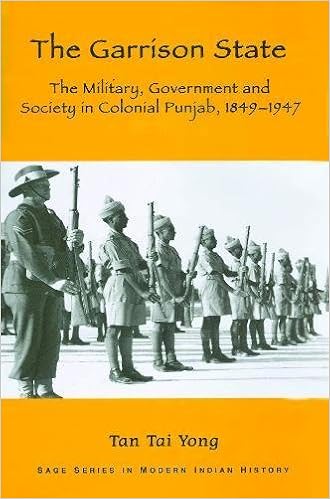
Review: The Garrison State: Military, Government and Society in Colonial Punjab, 1849-1947

The Garrison State: Military, Government and Society in Colonial Punjab, 1849-1947 (SAGE Series in Modern Indian History)
The following is a review sent in by Major Agha Humayun Amin (retd). As usual, Major Amin is sometimes, shall we say, harsh, but his knowledge of this subject is encyclopedic and always worth reading..
My first association with works of Professor Tan Tai Yong started in 2000 when he wrote an article that as per his own admission forms the basis of this book.
Although Professor Yong seemed at that time in 2000 to be a well meaning scholar,there were serious basic flaws in his research.
I wrote a letter to the Journal of Military History at that time in 2000 which that journal , keeping in line with its tradition of intellectual dishonesty, did not publish, citing lame excuses about lack of space. That letter is appended at the end of this review, so that the reader may have an idea about what was the basis of my criticism.
The West is in the habit of accepting so called scholars like Professor Yong as experts on Indo Pak history. So Journal of Military History of USA was merely following this strange tradition.
When I read this book under review in 2018 some 18 years after my initial critique I was disappointed to find that Professor Yong had not improved his knowledge , although most the faults he has committed in this book were entirely avoidable.
The first issue is regarding why the British started preferred Punjab and Frontier for the army recruitment.
First the assertion that it was only by the 1880s that the British started favoring soldiers from Punjab is wrong.
The hard facts of the situation are that some 90 % of the pre 1857 Bengal Army recruited from UP and Bihar had rebelled or disbanded in 1857 and an entirely new army was created, composed mostly of set of regiments raised in Punjab (frontier being its part) in 1857-58.
While Lord Roberts pronouncements can be credited as ā Martial Races Theoryā a clear shift in British recruitment policy favouring Punjab over UP and Bihar had been initiated in 1857-58.
Peel Commission of 1858-59 had clearly laid the basis of this policy. Thus the āPeel Commissionā constituted after 1857 to study and analyse the future composition of the Indian Army recommended that the native army should be composed of different nationalities and castes, and as a general rule mixed promiscuously through each regiment! Such system had existed in the Madras and Bombay armies but these were much smaller as compared to the Bengal Army. However, India was now viewed in terms of loyal and disloyal.
Professor Yong , if I am to understand this book , simply denies the existence of the British loyalist Syed Ahmad Khans landmark work āCauses of Indian Mutinyā written in 1859 and republished as an Indian translation in 1873.
This pamphlet which suggested formation of class regiments did have immense impact on British thinking and pre-dates Robert who only came into prominence after 1885.
Lord Canning’s views about the policy of āDivide and Ruleā expressed in 1857 are thought provoking; Canning thus said in a letter dated 9 October 1857:’ āthe men who fought against us at Delhi were of both creeds; probably in equal numbers. If we destroy or desecrate Mussulman Mosques or Brahman Temples we do exactly what is wanting to band the two antagonist races against ourselves…..as we must rule 150 million of people by a handful (more or less small) number of Englishmen, let us do it in the manner best calculated to leave them divided (as in religion and national feeling as they already are) and to inspire them with the greatest possible awe of our power .
Canning went further and very subtly defined certain guidelines regarding employment of various classes after 1857:-
āAll exclusion of Mahomeddan, Rajpoots or even of Brahmans should be a matter of management rather than of rule; and indeed that it will be right to take an opportunity, though not just yet, to show by an exception here and there, that the rule does not exist. It is desirable that no class should feel that it had henceforward nothing to expect from the governmentā
Collaboration and Loyalty in British India
This topic comes up a lot and there are many (contradictory) nationalist myths about who did and did not collaborate with the British during their rule in India. Major Amin has a short podcast about this topic that is worth listening to:
India was conquered by the East India Company using (mostly) the Bengal army, recruited primarily from what is now eastern UP and Bihar. Most of these soldiers were Hindus and a large section were Brahmins, but all religions, ethnicities and castes joined the EIC army at various points and all have examples of mutinies (many small, one large), frequently triggered by grievances over pay and conditions, but sometimes acquiring or having a nationalist color as well. Have a listen.
Podcasts by Major Amin. India, Pakistan, Proxy Wars
Readers of this blog are familiar with Pakistani military historian Major Agha Humayun Amin.Ā Major Amin has recorded a number of podcasts on the AnchorĀ app and they are worth a listen if you are interested in military history, Indian history and related topics.
This podcast in particular is a good introduction to Major Amin’s own background (he has worked with the Northern Alliance in Afghanistan, has been a Taliban prisoner, and then a contractor in post-American Afghanistan, with extensive experience in the region). He also mentions his mentor Edward Luttwak.
In this podcast he makes many interesting observations and has his usual blunt and sometimes harsh opinions. Some of his topics here include:
- His view is that there is no such thing as a “non-state actor”. All actors in Afghanistan are proxies of some state or the other. In the case of the Taliban, that means Pakistan.
- How the Americans were fooled into bombing (via drones) and paying for bombing (Pakistani armed forces) the FATA region, while Taliban were actually located in Balochistan.
- How Kiyani prolonged the FATA operations to milk American coalition support funds.
- FATA Pakhtoons as “Red Indians” , subject to endless operations, not just today but many years ago, regarded as “our firing range”. Regarded as such not just by non-Pakhtoons, but also by many “settled area” Pakhtoons.
- Some of the nuts and bolts of this endless war.
- Pakistan’s theory of nuclear brinkmanship, developed initially with American acquiescence (because they did not want India to attack Pakistan and disrupt their Afghanistan operation).
- Siachen, Kargil.
- The renewed Kashmir infiltration in the last few years.
- Pakistan army’s mindset and some of the more interesting nonsense that is promoted in its cause (such as Javed Hasan’s classic “India, a study in profile”).
- The security setups of both sides leak like a sieve. Nothing is really secret, yet most things are unknown to their own politicians and common people.
- No Indo-Pak war is likely, but proxy war will accelerate.
- Trump will abandon Afghanistan for electoral reasons, civil war will accelerate.
You don’t have to agree with Major Amin’s views. But his detailed knowledge of this murky world is worth a listen. At a minimum it should make you wary of all state propaganda narratives.
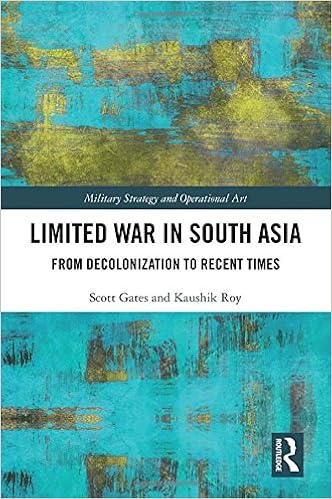
Book Review: Limited War in South Asia
This is Major Amin’s review of “Limited War in South Asia”
In 2018 when I saw this book by Kaushik Roy I was surprised since to my mind Kaushik Roy does very well with archives and records but is not a real military historian who understands hard core military matters.
I therefore decided to procure this book and read it , and find out what Mr Kaushik Roy has found out.
Below is my review of Kaushik Roy and Scott Gates book.
The maps which are published at the start of the book are poorly drawn, inaccurate and impossible to understand as the scale is too small.A serious failing for a book published by a publisher as eminent as Routledge as late as 2017 !
For example all Pakistani formations are marked incorrectly although the Pakistani order of battle is known worldwide.This is a simply inexcusable failure.
Like Pakistan’s 1 Corps is marked as 2 Corps while Pakistan’s 2 Corps is marked as 1 Corps and even its dispositions are not marked accurately.
Further the map invents a new corps which has never existed in the Pakistan Army, ie 3 Corps.Thus Lahore’s 4 Corps is shown as 3 Corps.
The writer magnifies the role of Indian Army in North Africa and Italy while in reality in both theaters Indian Army was part of a much larger British Australian New Zealand South African American force and enjoyed massive numerical superiority in both theaters. Thus Indian Army casualties in North Africa were very low and the same was the case in Italy.In most ways the Indian Army learnt little about higher command as British Indian Army was never trusted with major offensive operations. The brigade and divisional commanders were always British and each Indian brigade had one British infantry unit. Continue reading Book Review: Limited War in South Asia
Browncast Episode 28: Obesity, Lifestyle, Fat and more..
Another BP Podcast is up. You can listen onĀ Libsyn,Ā iTunes,Ā Spotify,Ā andĀ Stitcher. Probably the easiest way to keep up the podcast since we donāt have a regular schedule is toĀ subscribeĀ at one of the links above.
You can also support the podcast as aĀ patronĀ (the primary benefit now is that you get the podcasts considerably earlier than everyone elseā¦). Would appreciate moreĀ positive reviews.
In this episode Razib and Omar move away from politics and culture to talk about the science (and non-science) of nutrition, lifestyle, obesity and fatness, especially as it relates to South Asians.Ā As some readers may know, I am an endocrinologist with a research interest in obesity and insulin resistance and Razib is a geneticist with a personal interest in health, nutrition and lifestyle, so I hope listeners will find it useful. Comments welcome.
PS: a couple of people have asked what my recommendations are for treating obesity. I hope to do a longer post some day, but here is the brief outline of what I advise my (pediatric) patients:
-Increased physical activity (1 hour of moderate to vigorous daily activity that gets your heart rate up; minimum of 30 minutes per day). This can be as simple as taking a brisk walk or using a treadmill or going up and down the stairs or dancing in front of a video or playing activity games on a game console.
-Try to adopt a lifestyle in which most meals are home-cooked and consist primarily of fresh ingredients rather than processed foods. Try to limit overall caloric intake and I especially recommend limiting the intake of carbs (smaller helpings of pasta, rice, bread, potatoes, more of fresh veggies and meats that are not heavily breaded or fried; for significantly obese patients I recommend limiting carbs to 2 servings per meal (30 grams of carbs) and no carbs in snacks). That said, each person can find a lower calorie, lower sugar diet that they are most comfortable with. As long as it is helping them lose weight, it’s good.
-Eat fruit rather than drink fruit juice. Increase your intake of fresh vegetables and eat whole grains rather than highly refined ones. This may not have much impact on weight per se, but will improve cholesterol, cure constipation and may have other health benefits.
-Avoid all chips, Cheetos and other high-calorie snacks. Stop buying these snacks, stop eating them except on rare occasions.Ā
-Limit foods made with added sugar (cookies, brownies, donuts, cakes, pastries, candy, etc.) to small helpings on special occasions. Limit fast food intake to occasional outings.
-Stop the regular use of soda, gatorade, powerade, iced tea and juice, try to drink more water at meals.
-Avoid all foods that contain trans fats (read labels).
-Most studies indicate that dairy is good for you and drinking 1-2 cups of milk daily is strongly recommended for all children and adolescents. Yogurt is good for you, and cheese (in moderation) is also beneficial rather than harmful. There is evidence that whole fat dairy products may be healthier than low-fat alternatives for most people.
-Nuts, avocados and lentils appear to be healthier than equivalent amounts of other foods and eating them in moderation may have long term health benefits in addition to helping with weight loss.
-Limit screen time. (the official advice is <2 hours daily, but the fact is that most students spend more than that on just work, but limit as much as possible, set up “phone-free time” for physical activity and other social interactions. Ā
Finally, do NOT make a constant struggle over dieting and weight control the dominant feature of your child’s life. A healthy lifestyle for the whole family is the aim, rather than obsessive control of one childās food intake.
-Do not be discouraged if weight loss is slow. Your body will always resist weight loss; the aim is to stick to an overall healthier lifestyle (more exercise, less processed foods, few snack items, more fresh foods)
Guest Post: India, a wounded civilization
Rohit will (once technical issues are sorted out) be joining our stable of writers.Ā Until that happens, he asked me to post this from his own blog:
(again, to be clear, this is not my writing, it is written by Rohit Pradhan)
India: A Wounded Civilization
The facts are starkly clear. The Bangalore branch of a storied bakery chain based in Hyderabad was targeted by certain individuals who forced it to coverĀ Karachi. And replace it with the Indian flag. Never mind that the extant organization was founded by a post-partition Sindhi immigrant in the memory of the land he had been forced to flee in the orgy of the violence which followed Indiaās partition. The parent chain issued an abject clarification on multiple social media channels reiterating its Indian roots. It wasnāt a homage to Karachi which happens to fall in the Pakistan of 2019 but the city which was home for generations of the ancestors of its founder. The utter absurdity of this entire episode is beyond belief.
Perhaps, one is reading too much into a single incident. Perhaps, in a country of 1.3 billion people, it is easy enough to assemble a mob of few who are offended by everything. Or anything. Or perhaps it is not as singular as it may superficially appear and there are some larger lessons to learn here. Three points follow.
First, Karachi bakery has been forced to issue that absolutely shameful apologia because no one expects the Indian state to protect it from the anger of righteous mobs. The mobs which can cite whatever perverse version of nationalism they are extolling currently. And while the blame for it majorly goes to the ruling dispensation, the fact that its establishment was targeted in a state ruled by the opposition simply canāt be ignored. One formation may encourage this perversity; the other side has mostly abdicated its responsibilities so fearful it is now of rocking the prevailing doctrine. Politics is not a purist sport but if you canāt draw even the most basic distinctions, then it may not be one participating in as well. This is no attempt at false equivalence but underlining the fact that a reassurance from the leaders of Karnataka would have gone a long way in assuaging the frayed nerves of a bewildered organization caught in the middle of Indiaās cultural wars.
Second, the kind of nihilistic nationalism which thought it fit to assault a blameless commercial organization has sadly received a major assist from the social media. Where hunting down alleged anti-nationals has become a major sport and a pathway to gain popularity, cheap retweets, and potentially significant monetary rewards. The more strident the tone; the more heartfelt the criticism is the absurd logic where even a national icon like Sachin Tendulkar can no longer be insulated by his humongous achievements and services to India.
Liberals canāt escape the blame entirely here: their previous prescriptions of people-to-people contact or decrying war as a priori have failed abjectly to deliver any sensible results. They have long dominated the conversation utilizing similarly convenient rhetorical tools dismissing every criticism as warmongering.
As the narrative has dramatically shifted, they have no epistemological counter to this closing of the Indian mind. In this new world, they have failed to craft a new language which can counter this toxic and self-defeating nationalism. The neo-Right has intuitively understood and adroitly exploited the frustration of ordinary Indians. The liberals have withdrawn from this tough fight favoring the easy environs of their echo chambers facilitating the further normative dominance of this singular version of nationalism. Unless they are prepared to embrace patriotism located in the Indian genius and not their ersatz explication, their further disfranchisement is assured.
Third, writing in the Indian Express, Pratap Bhanu Mehta, has recently argued that India has lost to Pakistan. If further evidence was required of that interrogation of Indiaās deep psychological wounds: Karachi bakery provides the perfect instance. The anger, the frustration, the fecklessness, the sense of being utterly helpless have found the fullest expression. A country which in its own estimation deserves a place among the comity of the most powerful nations in the world has been utterly shown up. And it has nowhere to hide: unable to counter repeated terror attacks from an apparent also-ran which it had long left behind in its wake.
It maybe couched in the braggadocio of sneering twitter insults and memes recalling 1971, but no one should confuse it for what it really is: utter and complete surrender. Unable to punish the external perpetrators, its sullen frustration has turned inwards: manufacturing villains where none exist. The social media nationalists would indubitably disagree but this is weakness masquerading as strength and vicious backlash corralling the weak. A schoolyard bully lashing out at the vulnerable because even as its parades its strength, it is utterly aware of its decrepitude. A wounded civilization too proud to recognize its own ruins.
It makes one go back and read V S NaipaulāsĀ An area of darknessĀ A stronger criticism of the Indian civilization is yet to be written and its searing postmortem of its psychological wounds has never been surpassed. Unfortunately, because Naipaul was so unsympathetic a figure both as a writer and in his writings, both Indian liberals and nationalists have often misunderstand him as a brown sahib, and not what he really was: a man who wanted to embrace the land of his ancestors, and whose love story went awry.
There is anger, and then there is anger. There is the fury of Naipaul which uses a surgeonsā scalpel to bludgeon a country which had left him frustrated and confused. But it still stems from a deep reservoir of affection almost willing it to do better. And there is anger which is self-destructive; which appeals to the most baser instincts; and which simply canāt countenance the wisdom of a better India.
India must choose wisely. And must select which version serves it better: the defeatism of the inward looking malignancy which has long given up on India, and must therefore pander or the the one which pricks and raves and rants because giving up is simply not an option. And a better future might still arise from the debris of an eviscerated India. And from recognition of its weaknesses.
Naipaulās next two Indian travelogues were more hopeful of its future. Perhaps therein lies redemption.

![See It/Shoot It: The Secret History of the CIA's Lethal Drone Program by [Fuller, Christopher J.]](https://images-na.ssl-images-amazon.com/images/I/41I3yWq%2BjXL.jpg)