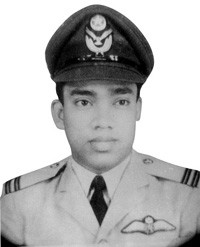
Pilot Officer Rashid Minhas Shaheed and Flt Lt Mati ur Rahman Shaheed. Heroes.

Matiur rahman.jpg

On August 20 1971 Flight Lt Mati ur Rahman and Pilot Officer Rashid Minhas died in the crash of a T-33 jet trainer near the Sindh coastline, 32 miles on the Pakistani side of the border with India. BOTH pilots were awarded the highest gallantry award available. Pakistan awarded the Nishan e Haider to Pilot officer Minhas and (2 years later) the newly independent state of Bangladesh awarded Flt Lt Rahman the Bir Sreshto, the highest gallantry award in BD. Educated Pakistanis are likely to know why Rashid Minhas is a hero (though some of the details they learned are less certain than the popular stories imply). Meanwhile it is my impression that even educated Bangladeshis are not as informed about Matiur as we are about Minhas. So here, as a public service, is what we know about this episode.

When the Pakistani army launched operation Searchlight in March 1971, the aim was to crush the movement for Bengali autonomy with overwhelming and decisive force. As a first step in the crackdown, the Bengali military and paramilitary units in East Pakistan were disarmed (and in several cases, most egregiously in Comilla, massacred en masse in the next few days). Those who got wind of the crackdown revolted and grabbed what territory they could (most successfully in Chittagong, which was mostly overrun by Bengali troops and where Major Zia ur Rahman was able to announce the independence of Bangladesh from the radio station) before the West Pakistani troops were able to bring superior numbers and firepower to bear and drive them out. Those who escaped capture or execution went to India where (with Indian help) they organized the Mukti Bahini and started a guerrilla war in East Pakistan.

Bengalis serving in the armed forces in West Pakistan were not subject to arrest or execution and the steps taken against them varied very widely. But partly because the autonomy movement did have very wide support and partly as a reaction to the extreme harshness of the crackdown, they were also overwhelmingly pro-Bangladesh. A few of them went to great lengths to escape from West Pakistan (e.g. via Kabul, or even by the hazardous route of sneaking across the Kashmir or Sialkot border into India) to join the nascent Bangladeshi resistance in India but given the difficulties involved, most remained, albeit unhappily, on their jobs. Many were reassigned to duties where they would not have access to sensitive materials or weapons, while some continued to perform their usual duties and a few were genuinely loyal to Pakistan and did all they could to convince their superiors of the same and aggressively participated in the West Pakistani war effort when permitted to do so.

Pilots serving in the Air Force were generally reassigned to ground duties. Several Bengali officers serving in Masroor airbase in Karachi were assigned to such duties and were supposed to be kept away from flying. One can get some idea of the intensity of nationalist feeling aroused in them from the fact that the entire group started trying to figure out what, if anything, they could do to play their part in Bengali resistance. They knew there were being watched by intelligence, so they did not discuss politics or make plans in any obvious meeting. Instead, they would discuss plans in short snatches in the course of normal work activities while appearing to be discussing work-related matters. Flt Lt Mati ur Rahman was assigned as deputy flight safety officer, an assignment that allowed him into the flight area a bit more than the others. He and his friends decided that he would try to hijack an aircraft and take it to India. Sneaking into and starting a fighter aircraft without ground crew assistance was practically impossible, so they decided he would hijack a T-33 jet trainer when it was being taken for a solo flight by one of the junior trainees. His fellow officers were to take his wife and infant daughters to the Indian consulate while he carried out his plan (this did not actually happen, the family was arrested but later released and repatriated). They themselves would face whatever consequences came their way. He apparently obtained a replica pistol that was recovered from the wreckage, so it seems that the hijacking was to be carried out using that weapon.

On the morning of the hijacking, young pilot officer Rashid Minhas was going for the second solo flight of his short carrier. As he started to taxi towards the main runway, Matiur drove his Opel Kadett to a point on the taxiway where it was obscured by some bushes and where his actions were not visible to the air-traffic control. No one knows exactly what happened on that taxiway, but it is assumed that he signalled the young officer to stop and seeing the deputy flight safety officer on the taxiway, the young pilot naturally stopped his plane. It is assumed that Matiur than climbed on to the aircraft and got into the instructor’s seat behind Rashid. He may have used his replica pistol to order Rashid to take off. In some versions put out later (for example, in the TV movie made by PTV with Air Force assistance) Rashid is knocked out using chloroform and hit repeatedly by Matiur, but there is no proof of either occurrence.

 What we do know is that the plane headed out to the runway with both of them on board and that Rashed was able to send out a message saying he was being hijacked. Given the unexpected nature of the call and the occurrence, it is no surprise that air traffic control took a few minutes to figure out what was happening and by the time the order to scramble interceptors was given, the T-33 had already disappeared flying close to the ground where it was not visible to radar. Matiur was aware of the gaps in radar coverage and may have used that knowledge but nothing is known for sure about what happened on that flight during this time. In any case, the Sabre jets scrambled to intercept the T-33 never caught sight of it.

Ground control and the airborne Sabres did try to radio Rashid to eject, knowing that he could actually eject BOTH pilots (with the rear seat pilot being ejected first) thus ditching the aircraft and bringing an end to the affair. But for whatever reason, he never did that (or never got a chance to do that).

But just 32 miles short of the Indian border, something did happen. According to eyewitnesses on the ground, the aircraft seemed to fly erratically before it crashed into the ground, killing both pilots. Later investigation showed that Rashid went through the instrument panel at the point of the crash, indicating that he had been in his seat inside the aircraft when it hit the ground. But Matiur Rahman’s body was found some distance away and seemed to have been thrown out of the aircraft while it was in flight at high speed. The cockpit canopy was found some distance away and forensic examination indicated that it had flown off in flight and hit the tail section at high speed. This has led to the conjecture that Rashid opened the canopy deliberately, pulling Matiur out of his seat (he was not strapped in because the rear seat harness is locked away during solo flight). That Matiur was squatting on the seat without a cushion may also have impeded his ability to control the aircraft (he was without a seat cushion because in the T-33 the pilot’s parachute IS the seat cushion and he did not have one). The aircraft has dual mechanically linked controls, so neither party can override the other completely without a struggle and both can interfere with the flight.

A few hours later, Karachi airbase learned that their missing plane was down within Pakistan and rescue choppers headed out for the wreckage (and the base commander probably heaved the biggest sigh of relief ever heaved east of Suez). The next day the air chief went to see President Yahya and recommended that Rashid be given a Sitara e Jurat (the third highest gallantry award in Pakistan), to which Yahya replied “Why Sitara e Jurat? Give the boy the Nishan e Haider!”.  Meanwhile Matiur Rahman’s body was brought back to Karachi and buried in a graveyard near the airbase. Naturally, he was also vilified as a traitor and backstabber.

It seems as if there was not much notice taken in East Pakistan until 2 years later, when the young Republic of Bangladesh gave him its own highest gallantry award and later named the Jessore airbase in his honor. After a long campaign by a small but determined band of Bangladeshi nationalists, his body was finally brought to Bangladesh in 2006 and buried in the martyred intellectuals graveyard in Dhaka with full honors.

Nobody is certain if a struggle actually occured on that plane. It seems likely that there was a struggle, but there are other theories, including one that says the canopy blew off because the pilots forgot to lock it, this pulled the un-belted (and squatting) Matiur out of the plane and led to a crash, with no need to posit a struggle.

In any case, both were treated as heroes by their respective countries.

Feel free to add comments with information that may change or add to this story.

Much of this account is derived from Kaiser Tufail’s excellent blog post on this topic. which I reproduce below. In addition, i have used a report from Cecil Choudhry (also reproduced below), another usually reliable and relatively objective source.
I remember reading a longish article from (or based on the account of) one of the Bengali officers who was with Matiur at Masroor Airbase, but cannot remember where it was published. If anyone knows what I am talking about, please comment.


The T-33 seat, with and without the parachute used as seat cushion. Explains why Matiur did not have an easy flying job ahead of him.

Picture
Matiur Rahman’s daughter prays at his grave in Pakistan in the 1990s.

Picture
Khaleda Zia at the state funeral in 2006

PHOTO: DAILYMOTION
another picture of Rashid Minhas


 “Bluebird-166 is Hijacked” By Kaiser Tufail 

“Why only a Sitara-i-Jur’at?  The boy deserves nothing less than a  Nishan-i-Haider,” retorted President Yahya Khan as PAF’s C-in-C, Air Marshal A Rahim Khan informed him of the hijacking incident that had taken place hours before.[1]  The Air Chief, who was hosting the President at lunch in Peshawar on 20 Aug, 1971, had recommended the lesser award, but was pleased to know that the PAF was being honoured with its first Nishan-i-Haider.[2]  The same day, announcement of the highest gallantry award was made.  In deference to the hallowed nature of the award, the Board of Inquiry into the aircraft accident was suspended and, eventually scrapped without finalisation.  The final moments of the flight of the hijacked T-33 have, therefore, been open to more than one interpretation over the years.  This write-up looks at some officially recorded vital bits of evidence (indicated in bold-face text), to reconstruct what really happened.

In the aftermath of the military crackdown that started in East Pakistan on 25 March 1971, the Bengali pilots in the PAF were grounded for fear of an adverse reaction.  As the situation became more complex and war clouds started gathering, it was felt prudent to withdraw the flying clothing and equipment of Bengali aircrew, with hijacking of aircraft being precisely one of the fears.

The Bengali pilots at PAF Base Masroor (Karachi), sensed the surveillance cover of Intelligence Units and agreed not to meet collectively.  It was decided that a charade of friendly relations with the Base personnel would be maintained, and any kind of protest avoided to the utmost.  In the meantime, short, meaningful meetings would be conducted in the course of normal activities.  The consensus on hijacking an aircraft to India emerged in no time, with the underlying thought being that the incident would call world attention to the cause of Bangladesh freedom movement.  It was also agreed that the backlash of the hijacking would be borne with fortitude by the remaining Bengalis.[3]

At first, the Bengalis mulled hijacking one or more F-86 Sabres, but the mere presence of a Bengali pilot on the tarmac would have been viewed with suspicion.  Besides, starting up a jet aircraft without help from ground crew and support equipment was a difficult proposition.  How about sneaking into an already started one – a two-seater being flown by a single pilot?  The idea sounded enticing, because gullible students going for their solo missions in the T-33 at No 2 Squadron seemed easy prey.  Students would surely obey any instructor’s command from outside, especially if it had something to do with aircraft safety.  A visual signal for a fuel or hydraulic leak, a flat tyre, even a finger pointed generally at the aircraft would get an immediate response from the student.  Chances were that the student could be sufficiently alarmed through hand signals about some external malfunction with the aircraft, and he would stop to find out more about the problem.

Flt Lt Matiur-Rehman had been an instructor in No 2 Squadron till he and his Bengali colleagues were grounded soon after the start of the counter insurgency operation in March. He was, however, given charge of the Ground Safety Officer with a mandate to check malpractices in aircraft maintenance and operations, thus authorising him to move around on the flight lines and tarmacs in an official transport.  Given his affability and, his wife’s friendliness with neighbourhood ladies, Matiur-Rehman was considered the least likely of the Bengalis to arouse suspicion.  He fitted the plot perfectly.  Apprehensions about the safety of his wife and two daughters were allayed by his Bengali colleagues when it was decided that the family would be moved, with prior coordination, to the Indian Consulate in Karachi, before the Hijack Day.[4]

Relaxing in the squadron crew room, Minhas ordered his Mess breakfast to be heated.  He could take his time to eat comfortably as he was not scheduled to fly that day, the visibility being poor for solo flying by students. Those scheduled for dual flying were busy checking their mission details, so as to prepare the briefing boards and get the pre-mission briefing from their instructors. One of them noted the scheduling officer adding Minhas’ name on the scheduling board for a ‘Solo Consolidation’ mission.[5]  The change in scheduling took place as the visibility had improved and students were cleared to fly solo.  This was conveyed to Minhas who was waiting for his breakfast in the Squadron tea bar.  He jumped up, half-excited, half-prepared and proceeded to get the mission details. After being briefed by his instructor Flt Lt Hasan Akhtar, Minhas quickly gathered his flying gear.  Breakfast had to wait, but Minhas hastily gobbled up a couple of gulaab jamans, the pilots’ favourite high-energy snack. He also shared a few swigs of a cold drink with his course-mate Plt Off Tariq Qureshi, before he headed to the flight lines to make good his 1130 hrs take-off time.  â€œThat was the last we saw of him, munching snacks on his way out,” recalls Qureshi. Preliminaries and start-up was uneventful as the T-33, with the call sign ‘Bluebird-166,’ taxied out of the main tarmac.

In the meantime Matiur-Rehman, who had earlier checked the students’ flying schedule during a brief visit to the squadron, sped off in his private Opel Kadett car to the north-eastern taxi track that led out of the main tarmac. The sides of the taxi-track had thick growth of bushes, which concealed his position both from the ATC tower as well as the tarmac. As the aircraft approached, he was able to stop it on some pretext, as expected.  Seeing the instructor gesturing, Minhas must have thought that some urgent instruction was to be conveyed. After all, his mission had been scheduled as an after-thought, and something might have gone amiss in the haste.  He expected Matiur-Rehman to plug in his headset and talk to him on the aircraft inter-com.  Not encumbered by his flying gear (parachute, anti-G suit, life jacket and helmet), Matiur-Rehman easily stepped on to the wing and slipped into the rear cockpit through the open canopy.[6]

Squatting on a seat without a parachute (which also doubled as a seat cushion), Matiur-Rehman was in an awkward position to properly control the aircraft himself.[7] To compel the student to follow his instructions would have required the threat of use of lethal force; else, the student could have turned back, or just switched-off the aircraft.  A replica pistol recovered later from the wreckage explains Minhas’ predicament.[8]

ï»żï»żAt 1128 hrs, ATC Tower received Minhas’ call: “Bluebird-166 is hijacked!”  In the rough-and-tumble that followed, the T-33 got airborne from Runway 27 (heading 270°), at 1130 hrs.  The aircraft turned left, (a non-standard turn out of traffic) and started steering 120°.  It was seen to be descending down to low level and, in no time, disappeared from view.  Two more frantic calls, “166 is hijacked,” were the last that were heard from the T-33.

Not sure if he had heard it right, Flt Lt Asim Rasheed, the duty ATC officer understood what was going on only when the aircraft did an abnormal turn out of traffic and ducked down very low. Asim called up the Sector Operations Sector (SOC) to inform about the unusual incident; however, when the Sector Commander started asking for details, a quick-witted Asim dropped the phone to save precious time and called up the Air Defence Alert (ADA) hut.  â€œA T-33 is being hijacked. Scramble!” he ordered. Wg Cdr Shaikh Saleem, OC of No 19 Squadron, who had just arrived in the ADA hut after inspecting the flight lines, immediately rushed to the nearby F-86s along with his wingman, Flt Lt Kamran Qureshi.  Kamran, the sprightlier of the two, got airborne first, with the leader following closely; the pair was airborne within the stipulated time. The SOC had, however, no clue about the T-33’s position as it had descended to the tree tops and was not visible on radar.  In any case, about eight minutes had already elapsed since the T-33’s  take-off, and the scrambled pair of F-86s would not have been able to catch up before the border, even at full speed.  Some more critical time was also wasted when the F-86 pair was mistakenly vectored onto a B-57 recovering from Nawabshah after a routine mission.[9]

After a while, another pair of F-86s led by Flt Lt Abdul Wahab with Flt Lt Khalid Mahmood as his wingman, was scrambled. Wahab, who had been watching the unusual departure of the T-33 from outside the pilots’ standby hut, recalled later, “We knew something was wrong, we had seen the aircraft taxiing dangerously fast. After we got airborne, there was a lot of confusion. Nonetheless, we gave fake calls on ‘Guard’ channel that the F-86s were behind the T-33 and, it would be shot down if it did not turn back. However, with no real prospects of scaring Matiur-Rehman with warning bursts from the F-86’s guns, the only option that remained was to order Minhas to eject.  A flurry of radio calls then started, asking Bluebird-166 to eject.  There was no response, but the calls continued for several minutes, being repeatedly transmitted by the F-86s, as well as the SOC.”[10]

Crash site is roughly in centre of picture
The situation remained confused and it was apprehended that the hijack might have been successful.  The prevailing uncertainty was cleared up in the afternoon, when a phone call was received from Shah Bandï»żï»żï»żar that a plane had crashed nearby and the aircrew had not survived.  The Base search and rescue helicopter was launched immediately and it was able to locate the wreckage at a distance of 64 nautical miles from Masroor, on a heading of 130°.  The tail of the T-33 showing its number 56-1622 could be seen sticking out in water-logged, soft muddy terrain at the mouth of Indus River, just 32 nautical miles short of the border. Estimated time of the crash was 1143 hrs.

Minhas’ body was found still strapped in the seat, 100 yards ahead of the wreckage, while Matiur-Rehman’s body was found clear of the seat, lying further ahead.  Both ejection seats had been thrown clear of the aircraft on impact and, there seemed no sign of ejection. The location of Matiur-Rehman’s body away from the ejection seat indicates that he was not strapped up, having being unable to free the stowed harnesses after he had hurriedly stormed into the cockpit.[11]

Investigators were baffled when the canopy was found to have a prominent scrape mark of the tailplane, while the tailplane was correspondingly dented by the canopy.  Normally, during ejection sequence or jettison of canopy alone, the canopy would have been rocketed up and, would have cleared the tail by a wide margin (this being the very purpose of the rocket thruster).  Now it seemed that the canopy had merely inched up into the airflow and had been blown into the tailplane.  Could Minhas have actuated the canopy opening lever to throw the unstrapped rear seat occupant overboard, and then safely recover the aircraft?[12] A proper procedure, though, would have been to use the canopy jettison lever which would have rocketed the canopy well clear of the tailplane. In the heat of the moment, it seems that Minhas did what came naturally to him.[13]

The massive canopy hitting the elevator would have deflected it downwards, causing a sudden nose-down attitude at a precariously low height.  Minhas would have then yanked back on the controls to prevent the aircraft from going into the ground.  The sudden and violent pitch-up – which was confirmed by eyewitnesses – resulted in the aircraft stalling out.  This is partially corroborated by the wreckage report of aircraft flaps found in the down position, implying a desperate need for vital lift to prevent stalling.  The rather flat attitude in which the aircraft fell, as well as the compact spread of the wreckage, also confirms the stalled condition of the aircraft.

Confronted with a very complex situation requiring quick thinking and steel nerves, Minhas was eventually able to counter Matiur-Rehman’s cunning design.  Despite having the option of ejecting safely, and in the course of action also tossing out the hijacker who did not have a parachute, Minhas ostensibly tried to save the aircraft. Sadly, the unusual attempt at opening the canopy had resulted in a chain of uncontrollable events that eventually caused the crash. Nonetheless, Minhas did manage to prevent the aircraft from being hijacked to an enemy country, laying down his life in the process.  He was destined to become the youngest star on Pakistan’s firmament of valiant heroes.  May Allah bless his soul and may his Nishan-i-Haider be an inspiration for the future defenders of Pakistan.

Cecil Choudhry’s account:

A few months back I had the opportunity along with a friend to spend an evening with Group Captain (R) Cecil Chaudry. Obviously the time was spent discussing his experiences. As it turned out Cecil was responsible for investigating the Rashid Minhas crash back in 1971 and told us a some details which are not known publicly.

The episode has become controversial over the past few decades with some people claiming that the Nishan-e-Haider award was politically motivated and perhaps the young Pilot Officer never deserved it. Also the media and school books information/portrayal of this episode has created some factual distortions. In the interest of hi story I am reproducing here substantially what Cecil told me about the incident. Obviously given that this discussion took place quite sometime back I do not remember his narration word to word but am reproducing the essential information. Also, I do not claim to have done any independent investigation but I believe that Cecil’s narration of events is an important input.

Now coming to the story,

It is important to remember that Rashid Minhas was a very young and inexperienced pilot. The crash took place during his second solo flight on T-33 aircraft. In the run up to the 1971 crisis the PAF had grounded all East Pakistani pilots in PAF and had assigned them ground jobs. As part of this Flt Lt Mati ur Rehman was made the Deputy flight safety officer of the base. The Flight Safety Officer was Flt Lt Basit (if I remember the name correctly).

Flt Lt Basit as FSO used to on occasions do surprise checks on the OCU students at the base. As part of this he used to stop these students while they were taxing out on a sortie and check if they had correctly stowed equipment in the cockpit or would query them on emergency checklists etc. As one would expect the student would get reprimanded if he was found wanting on any of this.

On the day of the crash when Rashid Minhas was taxing out on a dusk training sortie and saw Flt Lt Mati ur Rehman (Deputy Flight safety officer) signalling him to stop he naturally assumed that the purpose was to do a similar check. Therefore, he not only stopped but his attention shifted to the cockpit. This allowed Flt Lt Mati ur Rehman to enter the instructor seat and initiate roll for take off. By the time Rashid Minhas realized this the aircraft was well into the take off sequence. On this Rashid gave a call to the ATC saying that the aircraft is being hijacked. Now this was 1971, aircraft hijacking was not considered an imminent possibility that too in Pakistan and at an air force base. The ATC requested confirmation of the call and got one from Rashid. On this fighters on ADA were scrambled to intercept the aircraft Again as hostilities were not imminent at that time the fighters were not at the highest ADA level (I forget exactly the ADA level Cecil mentioned but I think that it was 10 minutes). However given that Mati ur Rehman knew where the Radar gaps were (being till recently an active pilot) and the dusk conditions an interception was not made.

No further information became available till late at night when the PAF base got a call from a police station near the Indian border stating that an aircraft had crashed near a village bordering India. Next morning a team was dispatched to the crash site. Following this an investigation into the incident was launched.

Now coming to the factors that led Cecil to believe that a struggle for control took place and the crash was perhaps intentional.

As the aircraft overflew a number of villages some eyewitnesses were available. According to them the aircraft was not flying straight and level but was banking or pitching up and down. If Mati ur Rehman had been in complete control of the aircraft this would have resulted in a straight and level flight. Only a struggle resulted in an erratic flight with probably Rashid Minhas trying to control the aircraft in one way and Mati ur Rehman counter acting.

Fl Lt Mati ur Rehman’s body was found some distance before the crash site while Rashid Minhas body was at the crash site, had gone through the instrument panel and in the nose of the aircraft. The aircraft had crashed nose first. Mati ur Rehman’s body also had a sand blasting type effect on one side which indicated that he was blown off from the aircraft and dragged quite a bit on the desert surface.

This evidence linked in with the earlier events. The manner in which Mati ur Rehman took over the aircraft did not allow him time to strap on. During the likely struggle for aircraft control he used his greater experience to counter Rashid’s efforts. Also he was sitting on the instructor’s seat and could over ride some of Rashid Minhas’s actions. However, the option to jettison off the canopy in an emergency was available with both pilots. Near the point of crash Rahid Minhas in his efforts, either intentionally or accidentally, jettisoned the canopy. As Mati ur Rehman was not strapped on he was blown off explaining the way his body was injured and the fact that it was found before the crash site.

This resulted in sudden force on the controls of the aircraft in one direction, as force applied by Mati ur Rehman to control the aircraft was removed. This along with perhaps the effect caused by the loss of canopy, low level and Rashid Minhas’s inexperience resulted in the crash of the aircraft.

I hope this clarifies some of the issues regarding this incident. Personally I would like to get hold of the PAF‘ official investigation report into the incident which should be more detailed and should also shed more light into the incident.

———————————————————————————————-
Poetic Perversion

Orya Maqbool Jan,
who is one of Pakistan’s best-known right-wing pundits, has turned his
attention to the heartbreaking
scandal of massive child abuse in the town of Kasur
. For those who may not
be up on this tragic affair, it has been reported that a local ring in the area
south of Lahore has been abducting children, abusing them, and using videos of
the abuse to blackmail the parents into silence while selling the videos to
consumers of child pornography. There are also allegations about the complicity
of the local police and politicians, and at least two police officials have
been disciplined so far. After the scandal broke in the media, the furor has
led to the government appointing a commission to “investigate” the whole
affair, but people are understandably skeptical. Meanwhile, there has been a
deluge of social analysis and much national soul-searching about the factors
that allowed such an unspeakable horror to go on for years. Of course, this is
not the first such incident – the previous
one
was, if anything, even more chilling – and reports of related evils
such as honor killings, bride burning, rape, etc., are all too common across
the whole region, not just in Pakistan. But it is natural for decent people to
ask: How could this happen in our society? Well, finally the wisdom of Mr. Orya
Maqbool Jan has produced
an answer
: It’s our literature. Oh, not trashy, pulp literature that gets
sold on the streets and gets serialized in the papers that pay Mr. Jan’s
salary, but the “high literature” of Urdu and Persian, a thousand years in the
making and recognized the world over as one of the great creations of the human
intellect. That literature, according to Mr. Jan, is so poisoned with
pederasty, so steeped in lust for young flesh, that it was but a matter of time
before something like the Kasur incidents happened. With uncharacteristic
restraint, he does not prescribe a remedy, but there’s a strong implication
that book burnings would be a good first step.

Mr. Jan’s article is in Urdu, and though many readers of this blog cannot
read it, I do not find in myself the will to translate it. Rather, having
summarized its core theme, I intend to use it as an occasion to comment on the
issue it raises as a dedicated consumer of the literature that Mr. Jan
excoriates. In particular, he points the finger of blame towards Urdu’s “god of
poetry”, Mir Taqi Mir, eighty-six percent of whose work, according to Mr. Jan,
is steeped in the evil of pederasty. Others who merit mention by Mr. Jan
include the great Persian master, Hafez Shirazi, and with a jump of a few
hundred years, the 20th century Urdu poet, Firaq Gorakhpuri, and the
great Urdu short-story writer, Saadat Hasan Manto. Two pious poets who get
praised for avoiding the filth are the great dreamer of geopolitical dreams,
Iqbal, and Altaf Hussain Hali, who, despite writing some great romantic poetry
himself, also predicted that most poets in his literary tradition were headed
to hell. Presumably, he did not wish to include in this list his beloved
mentor, Ghalib, on whose death he wrote the
most moving elegy
in the Urdu canon.

My first reaction upon reading Mr. Jan’s article was to feel sorry for him. Presented
with the vast and profoundly beautiful tradition of classical Farsi and Urdu
poetry, all he chooses to see in it is filth! However, like all bad analysis
based on unwarranted generalization, his article too contains a grain of truth.
Once you get past the odious hectoring, the ridiculous conflation of
homosexuality with pedophilia, the profound misunderstanding of romantic
expression in the classical poetic tradition, and just plain ignorance, the
author does have a very small point.
There is, indeed, a minor thread of pederasty that runs through the cultural
traditions underlying our beautiful poetry, and it does occasionally surface in
the poetry itself. But contrary to the implication in this article, it is not a
central theme – not even a significant marginal theme – in the literature. At
most, it is an occasional reference, and that too driven more by convention
than actual practice.

Much can be written on the long-standing prevalence of the evil practice of
pederasty across the world and about its seepage into literature, but here I
will focus on the issue of the poetic and linguistic confusions promoted by the
article at hand.

Mr. Jan refers to Hafez’ famous couplet

agar an tork-e sheeraazi ba-dast aarad dil-e maa raa
ba-khaal-e hindu-ash bakhsham samarqand o bokhaaraa raa

(If that Turk from Shiraz would take my heart in hand
I would give away Samarqand and Bokhara for the beauty spot on her cheek)

and somehow infers from it that the poet is referring to a young Turkish boy.
This inference may reflect Mr. Jan’s own psychological compulsions, but has no
basis in language. As is well-known, Farsi has no gender at all in terms of
pronouns or the handling of verbs and adjectives, which means that the gender
of a person being referred to cannot be inferred from text in the absence of
other information. Based on anecdotal justification from a few poets, some have
used this fact to assume that “the Beloved” in all of Persian poetry
is a young male, but that is patently absurd.

First, let it be noted that ghazal
poetry in both Farsi and Urdu is rife with lust. Sometimes, this can be
sublimated into a metaphorical and mystical “love of God” meaning,
sometimes not. When Hafez says:

zolf aashofte o kh(w)ee-karde o khandan-lab o mast
pirhan chaak o ghazalkh(w)aan o soraahee dar dast
nargisesh arbade-jooi o labash afsoos-konan
neem-shab mast be-baaleen-e man aamad binishast

(tresses wild, sweating, smiling, intoxicated,
dress open, singing poetry, flask (of wine) in hand,
eyes flashing combat, lips pouting sorrow,
drunk, she came at midnight to my bedside and sat down)

he clearly refers to a very Earthly personage, and a woman, based on the
description. The “tork-e sheeraazi” for whom Hafez was willing to
give away Samarqand and Bokhara was similarly unlikely to be male, let alone a young
boy!

In Urdu, the issue is complicated further because, when it adopted the
Persian idiom, it explicitly chose to refer to the Beloved as masculine – out
of a sense of propriety, it is said. But as anyone who reads this poetry with a
brain in their head knows, this is just convention. When Ghalib writes:

lay to looN sotay meN us kay paaoN kaa bosaa magar
aesi baatoN say vo mehroo badgumaaN ho jaaye gaa

Literally, it says, “Indeed, I could kiss his foot while he sleeps, but such
acts would prejudice that moon-faced one against me”. But clearly, in spite of
using the male gender, the poet isn’t referring to some “moon-faced” guy! As Ghalib’s
letters bear out – and as other material corroborates extensively – masculine terms
for the Beloved, e.g., “yaar”, “dost”, “but”, “janan”,
“dildaar”, etc., all, in fact, refer by default to women in the
poetry of Ghalib and others in his tradition. Sometimes this becomes quite
clear and even the gender shifts:

in paree-zaadoN se layN gay khuld mayN ham intiqaam
qudrat-e haq say yehee hoorayN agar vaaN ho gayeeN           (Ghalib)

(We will take revenge upon these fairy-folk in paradise if, by God’s will,
they became houris there).

or when in that fantastic poem Ghalib wrote about Calcutta, he says:

vo sabza-zaar haaye mutarraa ke hae ghazab!
vo naazneeN butaan-e khud-aaraa ke haaye, haaye!
sabr-aazmaa vo un ki nigaahayN ke haf-nazar!
taaqat-rubaa vo un ka ishaaraa ke haaye haaye!

(Oh! Those magnificent and verdant parks, and [in them] those haughty,
glamorous “idols”! Oh! The anguish caused by their glances – Heaven keep them!
– and Oh! Their gestures that induce utter helplessness [in me]!)

Of course, occasionally Ghalib throws out a curveball such as:

aamad-e khat say huaa hae sard jo baazaar-e dost
dood-e sham’-e kushta thaa shaayad khat-e rukhsaar-e dost

which literally means: “Since the emergence of facial hair (or the arrival
of a letter) has chilled the market for the Beloved’s favors, perhaps the down
on the Beloved’s cheek was like the smoke from a dying flame.” The play here is
on the dual meaning of “khat”, which can mean “facial hair” or “letter”, and on
the “chilling” in reference to both the end of love and the dying of the flame.
This couplet – which sounds much better in Urdu than in any possible
translation! – is mainly an exercise in linguistic virtuosity. This unfortunate
topic of facial hair is, indeed, something of a recurring theme in both Farsi
and Urdu classical poetry, but knowing something of the lives of some of these
poets (e.g., Ghalib), one can safely infer that they were more interested in
exploiting the double meaning of the word “khat” than in exploiting
any beardless youths.

There are some poets about whom there is separate anecdotal evidence
regarding their interest in boys. Even in these cases, the implication often is
that it represents a Platonic admiration – a worship of Divine Beauty, so to
speak – rather than sexual attraction. Many of these anecdotes are associated
with famous Sufis – notably Sarmad
and the Sufi poet
Fakhruddin Iraqi
– one of whose most famous ghazals (tirsaa-bache-i shangee,
shookhee, shikaristaani)
– describes a ravishing young Christian, albeit without
specifying gender. But the “Christian youth” (tirsa-bache)– like the “Magian
elder” (peer-e moghan) – also had a symbolic meaning within the Sufi poetic
tradition. Since Muslims were forbidden to traffic in wine, the tavern keepers
in Iran were mainly Magian (Zoroastrian) and many of the wine-servers young
Christians (or other non-Muslims). Since wine was used in Sufi poetry as a
metaphor for Divine knowledge, the Magian elder came to symbolize the mystical
Master, and the wine-server – sometimes represented as a Christian youth or a Magian youth (“moghbache”) –
acquired significance as the enabler of enlightenment. As such, this symbol is
found in the work of many poets, and though it is often accompanied by
descriptions of the individual’s beauty, a mystical reading is always possible
in these cases. A typical theme is how the youth entices the poet away from the
path of orthodoxy (e.g., this ghazal by Attar),
which, as any student of Sufi poetry would know, reflects the core idea that
traveling the (true) Sufi path of enlightenment requires abandoning the (false)
path of ostentatious orthodoxy. To read such poetry as representing love of
boys is “not even wrong”!

In India, we find the interesting case of the great poet, musician and
mystic, Amir Khusro, who often expressed his love for his mentor, the great
Sufi master Nizamuddin Auliya, as the love of a woman for her beloved. Though
such gender-bending may seem strange to us today, it is part of the Sufi poets’
recurring attempts to capture the essence of mystical love for the Master and
for God in comprehensible metaphors.

In the Urdu tradition, the attributes of the Beloved usually indicate that
the reference is to a woman. There are indeed exceptions – some of which Mr.
Jan quotes in his diatribe – but these are quite rare. Mir Taqi Mir and a few
poets of his time were probably the most serious culprits in this matter, which
does reflect a certain moral degeneration in that milieu, but even here this is
a very minor theme. Mr. Jan’s method of counting up all verses where the male
gender is used and assuming that they all refer to boys indicates either
ignorance or willful misrepresentation – probably the latter since Mr. Jan is
an educated man and himself a writer. He also does not seem to understand (or
acknowledge) that, in this idiom, the term “tifl” (literally: child) and
“bacha” (literally: child) do not have to mean little children. Rather, they
refer generically to a young person with the implication of innocence. One also
finds rather lecherous references to a “kamsin” Beloved, i.e., one of tender
age. In a milieu where girls were often married off in their early teens, such
references are not surprising – and, indeed, are still
encountered
in today’s pop culture.

Let it also be said that much of the talk of wine, women and song in
classical Farsi and Urdu poetry is, as they say, “baraaye she’r-goftan” (just for
the sake of turning a verse). Many great poets indeed led eventful lives that
provided the material for their work, and some of these experiences included
romance and revelry. But the impression that every poet was perpetually in the
throes of unrequited love with remarkably beautiful and bloodthirsty mistresses
who specialized in tormenting their lovers and chopping off their heads – well,
that is just fiction. We know enough of the lives of many poets to be certain
that, for them, all the talk of carnal pleasures was just a heady mix of
convention, metaphor and wishful thinking. Even Ghalib, who wrote about both
women and wine from personal experience, wrote in the highly romanticized and
exaggerated idiom of his tradition, and only someone utterly unfamiliar with
that tradition would read his romantic work – or that of other great poets such
as Hafez or Khusro or Mir Taqi Mir – in a literal way. To reject a vast,
profound literary corpus spanning a thousand years based on the existence of a
few – even a few thousand – examples of truly perverted lines is, to say the
least, rather perverse.

All this is not to minimize the issue of pederasty as a real problem in the
societies of the Middle East and South Asia, or that references to it in literature
are meaningless. After all, literature is the mirror of its environment. Both
Rumi and Sa’di mention pederasty in their poetry in a matter-of-fact way, which
tells us something about Persian society at the time. This declines with later
poets from Hafez onwards, but that is probably more because their work turned
towards other themes and became much less didactic. Given the implication in
Mr. Jan’s article that child abuse is mainly the doing of godless libertines,
it is worth recalling that the practice has been widely associated with
religious seminaries and schools – from predatory
schoolmasters at English public schools
to lustful mullahs in madrassas
and perverted priests in the Catholic Church (for which we now have plenty
of evidence
). Unfortunately, like slavery and violence against women, the
exploitation and molestation of children is an aspect of “man’s inhumanity
to man” that has existed in all human societies since time immemorial –
and is especially a problem in South Asia, where child
marriage is still a burning issue
. It is an unspeakable evil that must be
combated with every available resource. We are fortunate to live in an age when
this is at least recognized as an important imperative rather than the practice
being accepted or swept under the rug. But to blame this larger societal evil
on literature through selective, misguided and ignorant interpretations is itself
a kind of abuse.

Islam, ISIS and the Dream of the Blue Flower

First published on 3quarksdaily.com

A few days ago, Graeme Wood wrote a piece in the Atlantic that has generated a lot of buzz (and controversy). In this article he noted that:
“The reality is that the Islamic State is Islamic. Very Islamic. Yes, it has attracted psychopaths and adventure seekers, drawn largely from the disaffected populations of the Middle East and Europe. But the religion preached by its most ardent followers derives from coherent and even learned interpretations of Islam”
The article is well worth reading and it certainly does not label all Muslims as closet (or open) ISIS supporters, but it does emphasize that many of the actions of ISIS have support in classical Islamic texts (and not just in fringe Kharijite opinion). This has led to accusations of Islamophobia and critics have been quick to respond. A widely cited response in “Think Progress” quotes Graeme Wood’s own primary source (Princeton scholar Bernard Hakykel) as saying:
“I think that ISIS is a product of very contingent, contextual, historical factors. There is nothing predetermined in Islam that would lead to ISIS.”
Indeed. Who could possibly disagree with that? I dont think Graeme Wood disagrees. In fact, he explicitly says he does not. But that statement is a beginning, not a conclusion. What contingent factors and what historical events are important and which ones are a complete distraction from the issue at hand? 
Every commentator has his or her (implicit, occasionally explicit) “priors” that determine what gets attention and from what angle;  and a lot of confusion clearly comes from a failure to explain (or to grasp) the background assumptions of each analyst. I thought I would put together a post that outlines some of my own background assumptions and arguments in as simple a form as possible and see where it leads. So here, in no particular order, are some random comments about Islam, terrorism and ISIS that I hope will, at a minimum, help me put my own thoughts in order. Without further ado:
1. The early history of Islam is, among other things, the history of a remarkably successful imperium. Like any empire, it was created by conquest. The immediate successors of the prophet launched a war of conquest whose extent and rapidity matched that of the Mongols and the Alexandrian Greeks, and whose successful consolidation, long historical life, and development of an Arabized culture, far outshone the achievements of the Mongols or the Manchus (both of whom adopted the existing deeper rooted religions and cultures of their conquered people rather than impose or develop their own).
2. Islam, the religion we know today (the classical Islam of the four Sunni schools, as well as the various Shia sects) developed in the womb of the Arab empire. It provided a unifying ideology and a theological justification for that empire (and in the case of various Shia sects, varying degrees of resistance or revolt against that empire) but, at the very least, Islam and the nascent Arab empire grew and developed togetherone was not the later product of the fully formed other. Being, in it’s classical form, the religion of a (very successful and impressive) imperialist project, it is not surprising that its”official” Sunni version has a military and supremacist feel to it. Classical Islam is not intolerant of all other religions (though it is in principle almost completely intolerant of pagans) but the rules and regulations of the four classical schools all agree on the superior status of Muslims and impose certain restrictions, disabilities and taxes on the followers of the “religions of the book” that they do tolerate. By the standards of contemporary European “Christendom”, many of these rules appear tolerant and broad-minded; and since Western intellectuals (leftists as much, or even more than rightists) are completely focused on European history and culture (and therefore,on the achievements and deficiencies of that culture), this relative tolerance is frequently remarked upon as a stellar feature of Islamicate civilization. But it should be noted that this degree of tolerance is quite intolerant compared to contemporary Chinese or Indian norms and is horrendously intolerant compared to post-enlightenment ideals and fashions. The imposition of Ottoman rules today would be most unwelcome even to post-Marxist intellectuals if they had to live under those rules. Of course, this does not mean they cannot speak highly of these norms as long as they themselves are a safe distance away from them, but such long-distance  approval is of academic interest (literally, academic) and not our concern for the purposes of this post.


3. Modern states and modern politics (not just all the complex debates about how power should be exercised, who exercises it, who decides who exercises it etc., but also the institutions and mechanisms that evolved to manage modern states and modern politics) mostly reached their current form in Europe. They did not arise from nothing. Many ancient strands grew and intersected to create these states and their political institutions. And there are surely things about this evolution that are contingent and would have been different if they had happened elsewhere. But there are also many features of modern life that are based on new and universally applicable discoveries about human psychology, human biology and human sociology. They have made possible new levels of organization and productivity and in a globalized world (and the Eurasian landmass has had some sort of exchange of ideas for millennia, but this process has accelerated now by orders of magnitude) it is impossible for any large population to ignore these advances and suvive unmolested by those willing to take advantage of these advances.
The modern world that has been created is not just one random “civilization” among many. It is the cutting edge of human knowledge and the human ability to apply that knowledge to good and evil ends. Whatever else it may be (and there is no shortage of people who feel it is too oppressive, too unfair, too fast, too anxiety-provoking, too inhuman, etc etc.) it is an extremely powerful and progressive culture. You can reject it, and countless people (including, it seems, many of the most privileged intellectuals of this very civilization) do reject many aspects of it. But it should also be noted that there are degrees of rejection. Most of the critics (but not all of them) are either critics-from-within, who only reject certain aspects of it, or non-serious critics whose wholesale contempt for the project is not matched by any equivalent personal commitment or serious consideration of alternatives. Most of them also seem unable to do without critical aspects of modernity. Aspects you cannot have without having far more of the rest than they seem to care for. To give two random examples, I have never met a multiculturalist liberal or leftist in the West (including those of Desi origin) who is willing to himself or herself live under the restrictive sexual morality and the community-centric balance of community vs individual rights characteristic of “traditional cultures’. And I have NEVER met an Islamist who did not want an air-force (you can work out for yourself all the other innovations and institutional mechanisms that would be needed in order to have a competitive indigenous air-force). 
In fact, forget traditional cultures, just look at Maoist China and the Khmer Rouge, both of whom explicitly rejected modern individualism and mere meritocracy and insisted they wanted to be “Red rather than Expert“. One ended up honoring the legacy of Liu Bocheng and Deng Xiaoping over Mao, the other ended up on the proverbial “dust heap of history”. There is a lesson (or several lessons) in those choices and their spectacular failure.
In short, the only people who can realistically stay outside of “our universal civilization” are either museum communities permitted to survive as quaint exemplars of bygone days (like the Amish) or VERY tiny communities that are so isolated and remote that they have escaped the maw of the Eurasian beast until now.  Our universal civilization does not have to be seen as positively as Naipaul famously saw it, but it still has to be seen for what it is, a gigantic human achievement and a work in progress; all criticism and resistance being included within it (dialectics anyone?) 
And it is important to note that this universal civilization is no longer exclusively European (and never was exclusively European for that matter). Soon, this universal civilization may be dominated by non-European people, a fact that Eurocentric PostMarxist intellectuals seem to have very great difficulty assimilating into their worldview. The institutions and ideas that developed in Europe (from earlier sources that came from all over Eurasia) in the last 400 years have been adopted and adapted already by several Asian nations (Japan, South Korea, Taiwan), with China not far behind and India set to follow. Muslims are not special enough to escape that fate. The only thing truly remarkable about the Muslim core region is the widespread desire to integrate huge elements of modern civilization while remaining medieval in terms of theology, law and politics. Of course we are not unique in this desire; there are Indians and Chinese and Japanese who “reject  modernity” as being too European, and who insist they have an alternative path. Whether they do or do not is to some extent a matter of semantics, but Muslims are not unique in claiming that “we are a fundamentally different civilization”. Where we are unique (for now) is only in our inability to generate a genuinely open debate on this topic; the tendency in the Islamicate core is for almost everyone in the public sphere to pay lip-service to delusional or formulaic and practically meaningless Islamist ideals and to avoid direct criticism of medieval laws and theology. This is unlike how it is routine for Indians to criticize Indian “fundamentalists” or Christians to criticize Christian ones. And for that we have to thank the blasphemy and apostasy memes more than any intrinsic unchangeability of Islamicate laws and theology.
4. But while Islamicate empires (the dominant form of political organization in the middle east and South Asia from the advent of Islam to the colonial era) insisted they were “Islamic” and used Islam (especially in the first 500 years) as the central justification for their expansionist ambitions, there was another sense in which these same empires had a near-total separation of mosque and state. All these empires operated as typical Eurasian empires and they were, in most administrative details, a straightforward evolution of previous imperial patterns in that region. Religion was part and parcel of the empires, but religious doctrine provided practically no guidance to the political process. The rulers used religion to justify their rule, but the battle-axe determined who got to rule and how. Some rulers attempted to conduct an inquisition and impose their favorite theology on their subjects, but most were content to get post-facto approval for their rule from the ulama (and the ulama were happy to oblige). Islamic theologians accepted practically ANY ruler as long the ruler said he was Muslim and continued to work for the expansion of the Islamic empire. ALL four schools of classical Sunni Islam insisted that the ruler should be obeyed and rebellion was unislamic. This did not stop people from rebelling, but once a rebellion succeeded, the ulama advised submission to whatever ambitious and capable prince had managed to kill his way to the top. An imaginary idealized Islamic state was discussed at times but had little to no connection with actual power politics.
5. It must also be kept in mind that Empires governed loosely and interfered little with the everyday religious rituals of the ruled, especially outside the urban core. The rulers were interested in collecting taxes and continuing to rule. Most of the ruled gave as little as possible in taxes and had as little as possible to do with their rulers. This is not a specifically Islamic pattern, but it was practically a universal feature of Islamicate empires. Muslim religious literature developed no serious political thought. Power politics was guided more by “Mirrors of princes” type literature and pre-Muslim (or not-specifically Muslim) traditions and not some detailed notion of “Islamic state”. There is really NO detailed “Islamic” blueprint for running a state. The so-called Islamic system of government is a modern myth. Every Islamicate empire down to the late Ottomans ruled in the name of Islam, but they did so using institutions and methods that were typically West-Asian/Central-Asian in origin, or were invented to solve a particular Islamicate problem, but had no direct or necessary connection with fundamental Islamic texts and traditions.  
6. After defeat at the hands of more capable imperialists and during the (relatively brief) colonial interlude, some people dug up the old stories of the rightly guided caliphs; It seems to me that early Islamicate fantasists (like Allama Iqbal in India) took it for granted that the everyday institutional reality of any “Islamic” state would, for the foreseeable future, be much closer to England than it was to Medina (witness for example his approval of the Grand Turkish assembly). Most Muslim leaders, like their Chinese or Japanese counterparts, were first and foremost interested in getting out from under the imperialist thumb. If they gave some thought to the form their states would take, their imagination ranged from Marxist Russian models to very poorly imagined Islamist utopias.  But over time, stories frequently repeated can take on a life of their own. Islamist parties want to create powerful, modern Islamic states. But the stories they were using were more Islamic than modern. The result is that every Islamist party is forever in danger of being hijacked by those espousing simple-minded and unrealistic notions of Shariah law. It turns out that pretending to have “our own unique genius” is much easier than actually having any genius that can get the job done. Modern ideas (fascism, the grand theatre of modern media manipulation, modern methods of guerilla war) are used to promote legal codes and theology whose relationship with these new institutions has not been worked out yet (and I see no problem with sticking my neck out and saying “will NOT be worked out satisfactorily by ANY contemporary Islamist movement). 
7. The MODE of failure may vary, but the failure of the Islamist political project in the next 20 years is inevitable. This is not because there can be no such project in principle, but because the project as it has actually developed in the 20th century is based on the twin illusions of  an “ideal Islamic state” and an existing alternative â€œIslamic political science”
neither of which actually existed in history. AFTER this failure, there can certainly be new ways of creating modern, workable institutions that have enough of an Islamic coloring to deserve the label “Islamist” while incorporating all (or most) of the new discoveries in the hard sciences as well as in economics, human psychology, politics, social organization, administrative institutions, mass communication and so on.

8. I do want to emphasize that I do not believe Islamic theology per se is some sort of insoluble problem.  It may be a difficult problem, but both liberals who are trying to discover modern fashions in that theology and “Islamophobes” who insist that the theology is a permanently illiberal fascist program are wrong in their emphasis on the centrality of this theology. As Razib put it in an interesting post on this topic on his blog, “Islam is not a religion of the book”. NO religion is a religion of the book. People make religions and people remake them as the times demands. Messily and unpredictably in many cases, but still, there is movement. And in this sense, Islam is no more fixed in stone by what is written or not written in its text (or texts) than any other religion.
Someone commented on Razib’s blog (and I urge you to read the post and the comments, and the hyperlinks, they are all relevant and make this post clearer) as follows:
“Well, if you take the Old Testament and Koran at face value, the OT is more violent. The interesting question is then why Islam ends up being more violent than Judaism or Christianity, and for that I agree you have to thank subsequent tradition and reinterpretation of the violence in the text. It appears that for whatever reason Islam has carried out less of this kind of reinterpretation, so what was originally a less violent founding text ends up causing more violence because it is being interpreted much more literally.”
I replied that there is an easier explanation: Whether the text canonized as “foundational document” does, or does not, explain the imperialism and supremacism of the various Islamicate empires is a red herring. The Quran is a fairly long book, but to an outsider it should be immediately obvious that you can create many different Islams around that book and if you did it all over again, NONE of them have to look like classical Sunni Islam. The details of Sunni Islam (who gets to rule, what daily life is supposed to look like, how non-Muslims should be treated, etc) are not some sort of direct and unambiguous reading of the Quran. While the schools of classical Sunni Islam claim to be based on the Quran and hadith, the Quran and the hadiths are clearly cherry picked and manipulated (and in the case of the hadiths, frequently just invented) based on the perceived needs of the empire, the ulama, the individual commentators, human nature, economics, whatever (insert your favorite element here).
So in principle, we should be able to make new Islams as needed (and some of us have indeed done so over the centuries, the Ismailis being one extreme example; some Sufis being another) and I am others will do just that in the days to come. The Reza Aslan types are right about this much (though i seriously doubt that he can invent anything new or lasting; that does not even seem to be his primary aim). In fact, in terms of practice, millions of Muslims have already “invented new Islams”. Just as a random example, most contemporary Muslims do not have sex with multiple concubines that they captured in the most recent Jihad expedition to the Balkans (or bought from African slave-traders for that matter). Not only do they not buy and sell slaves, they find the thought of doing so somewhat shocking. Also see how countless Muslims lived very obediently under British laws in the British empire and in fact provided a good part of the armies of that empire.  Or see the countless Muslims who take oaths of loyalty to all sorts of “un-Islamic” states and for the most part, turn out to be as loyal and law-abiding as any of their Hindu or Sikh or Christian fellow citizens in the various hedonistic modern states. Their “Islam” has already adapted itself to new realities. 
What sets Muslms apart is really their inability (until now) to publicly and comfortably articulate a philosophical rejection of medieval (aka no longer fashionable) elements of classical Sunni Islam. And for all practical purposes, this is a serious problem only in Muslim majority countries. In other countries that have a strong sense of their own identity and of the necessity of their own laws, Muslims mostly get on with life while following those laws. In the Muslim majority countires, it is the apostasy and blasphemy laws (and the broader memes that uphold those laws) that play a central role in preventing public rejection of unfashionable or unworkable aspects of classical Islam.  A King Hussein or a Benazir Bhutto or even a Rouhani may have private thoughts rejecting X or Y inconvenient parts or medieval Islamicate laws and theology, but to speak up would be to invite accusations of blasphemy and apostasy. So they fudge, they hem and how, and they do one thing while paying lip service to another. Unfortunately, this means the upholders of classical Islam have the edge in debates in the public sphere. And ISIS and the Wahabis are not far enough from mainstream classical Sunni Islam; for example, classical Islamic theology recommends cutting the hands of thieves, stoning adulterers, going on jihad (not just some inner jihad of the Karen Armstrong type, but the real deal), capturing slaves, buying and selling concubines, killing apostates and so on; ISIS of course goes much further in their willingness to kill other Muslims, to rebel against existing rulers and to bypass common humanity and commonly cited restrictions and regulations about prisoners, hostages, punishments and so on, but when they say classical Islam permits the first set of things noted above, they are not lying, the apologists are lying. 
By the way, while this inability to frontally confront aspects of classical Islam that are out of sync with the current age is a serious problem in Muslim communities, it is not insoluble. The internet has made it very hard to keep inconvenient thoughts out of view. So even in Muslim majority countries, there will be much churning and eventually, much change. It’s just that some countries will emerge out of it better than others.
ISIS itself will not get anywhere. Of course, in principle, an evolved ISIS living on in the core Sunni region is possible. But we make predictions based on whatever models we have in our head. Like most predictions in social science and history, these will not be mathematical and precise and our confidence in them (or our ability to convince others, even when others accept most of our premises) will not be akin to the predictions of mathematics or physics. But for whatever it’s worth, I don’t think ISIS will settle into some semi-comfortable equilibrium (irrespective of whether more capable powers like Israel or Turkey or even the CIA are supporting them or not). They will only destroy and create chaos. And eventually they will be destroyed. It is possible that in the process parts of Syria, Iraq and North Africa could become like Somalia; too messy, too violent and too poor to be worth the effort of pacification, even by intact nearby states. But even if a Somalia-like situation continues for years, it will not go on forever. The real estate involved is too valuable, the communities involved were too integrated in the modern world, to be left alone. Eventually someone will bring order to to those parts. Though it is likely that this “someone” will be local and will use more force and cruder methods than liberal modern intellectuals are comfortable with. The first stage of pacification is more likely to be handled by local agents of distant imperialists, not directly by the imperialists themselves. That is just the way it is likely to work best. 
Of course, success and failure are always relative to something. If the zeitgeist (whatever that means) is no longer in favor of something then a “successful” policy would be one that achieves a soft landing. Since the zeitgeist is (almost by definition) unknowable in full in real time, even the soft landing is not going to land where the first planners of soft landing imagined it as being headed. Being able to land softly, wherever that may be is the best outcome we can hope for in many cases. With that cheery note, here are some other useful links (many extracted from an extremely learned discussion on smallwarsjournal)  that shed light on some aspects of the above, raise opposing ideas, or help to understand where I am coming from. 

 Our religion problem by Babar Sattar in DAWN Pakistan. 
 Reforming the blasphemy laws, in many ways, an enlightened “Islam-based” initiative.  
 Razib Khan on “The Islamic State is right about some things”
 From Zenpundit Charles Cameron on Misquoting Mohammed 
“Brown is a Muslim, a professor at Georgetown, and author of Hadith: Muhammad’s Legacy in the Medieval and Modern World. His book Misquoting Muhammad â€” not his choice of title, btw — lays open the varieties of interpretive possibility in dealing with the Qur’an and ahadith with comprehensive scholarship and clarity. In light of the upsurge in interest in Islamic and Islamist religious teachings occasioned by Graeme Wood‘s recentAtlantic article, I asked Prof. Brown’s permission to reproduce here the section of his book dealing with abrogation and the rules of war.
Here then, with his permission, is an extract from Misquoting Muhammad. I hope it will prove of use both here and to others beyond the circle of Zenpundit readers. Spread the word!”
http://zenpundit.com/wp-content/uploads/2015/02/Extract-from-Misquoting-Muhammad.pdf
An ISIS reading list. 
MUST read: Enough about Islam: Why religion is not the most useful way to understand ISIS
From a conservative Western perspective: The fantasy of an Islamic reformation. 

“Q 2:256, “There is no compulsion in religion . . .” (lā ikrāha fÄ« l-dÄ«ni) has become the locus classicus for discussions of religious tolerance in Islam. Surprisingly enough, according to the “circumstances of revelation” (asbāb al-nuzĆ«l) literature (see occasions of revelation), it was revealed in connection with the expulsion of the Jewish tribe of BanĆ« l-NadÄ«r from Medina in 4⁄625 In the earliest works of exegesis (see exegesis of the Quran: classical and medieval), the verse is understood as an injunction (amr) to refrain from the forcible imposition of Islam, though there is no unanimity of opinion regarding the precise group of infidels to which the injunction had initially applied. Commentators who maintain that the verse was originally meant as applicable to all people consider it as abrogated (mansĆ«kh) by q 9:5, q 9:29, or q 9:73 (see abrogation). Viewing it in this way is necessary in order to avoid the glaring contradiction between the idea of tolerance and the policies of early Islam which did not allow the existence of polytheism — or any other religion — in a major part of the Arabian peninsula. Those who think that the verse was intended, from the very beginning, only for the People of the Book, need not consider it as abrogated: though Islam did not allow the existence of any religion other than Islam in most of the peninsula, the purpose of the jihād (q.v.)against the People of the Book, according to q 9:29, is their submission and humiliation rather than their forcible conversion to Islam.[…]
From Tolerance and Coercion in Islam 
“Both verses that are said to have abrogated Quran 2:256 speak about jihad. It can be inferred from this that the commentators who consider Quran 2:256 as abrogated perceive jihad as contradicting the idea of religious freedom. While it is true that religious differences are mentioned in both Quran 9:29 and 9:73 as the reason because of which the Muslims were commanded to wage war, none of them envisages the forcible conversion of the vanquished enemy. Quran 9:29 defines the purpose of the war as the imposition of the jizya on the People of the Book and their humiliation, while Quran 9:73 speaks only about the punishment awaiting the infidels and the hypocrites in the hereafter, and leaves the earthly purpose of the war undefined. Jihad and religious freedom are not mutually exclusive by necessity; religious freedom could be granted to the non-Muslims after their defeat, and commentators who maintain that Quran 2:256 was not abrogated freely avail themselves of this exegetical possibility with regard to theJews, the Christians and the Zoroastrians. However, the commentators who belong to the other exegetical trend do not find it advisable to think along these lines, and find it necessary to insist on the abrogation of Quran 2:256 in order to resolve the seeming contradiction between this verse and the numerous verses enjoining jihad. p. 102-3t al-_arab). Despite the apparent meaning of q 2:256, Islamic law allowed coercion of certain groups into Islam. Numerous traditionists and jurisprudents ( fuqahā_) allow coercing female polytheists and Zoroastrians (see magians) who fall into captivity to become Muslims — otherwise sexual relations with them would not be permissible (cf. q 2:221; see sex and sexuality; marriage and divorce). Similarly, forcible conversion of non-Muslim children was also allowed by numerous jurists in certain circumstances, especially if the children were taken captive (see captives) or found without their parents or if one of their parents embraced Islam. It was also the common practice to insist on the conversion of the Manichaeans, who were never awarded the status of ahl al-dhimma. Another group against whom religious coercion may be practiced are apostates from Islam (see apostasy). As a rule, classical Muslim law demands that apostatesbe asked to repent and be put to death if they refuse.”
The pact of Umar 
“In the name of Allah, the merciful Benefactor! This is the assurance granted to the inhabitants of Aelia by the servant of God, ‘Umar, the commander of the Believers. He grants them safety for their persons, their goods, churches, crosses – be they in good or bad condition – and their worship in general. Their churches shall neither be turned over to dwellings nor pulled down; they and their dependents shall not be put to any prejudice and thus shall it fare with their crosses and goods. No constraint shall be imposed upon them in matters of religion and no one among them shall be harmed. No Jew shall be authorised to live in Aelia with them. The inhabitants of Aelia must pay the gizya in the same way as the inhabitants of other towns. It is for them to expel from their cities Roums (Byzantians) and outlaws. Those of the latter who leave shall be granted safe conduct… Those who would stay shall be authorised to, on condition that they pay the same gizya as the inhabitants of Aelia. Those of the inhabitants of Aelia who wish to leave with the Roums, to carry away their goods, abandon their churches and Crosses, shall likewise have their own safe conduct, for themselves and for their Crosses. Rural dwellers (ahl ‘I-ard) who were already in the town before the murder of such a one, may stay and pay the gizya by the same title as the people of Aelia, or if they prefer they may leave with the Roums or return to their families. Nothing shall be exacted of them.
Witnesses: Khaledb.A1-Walid, ‘Amrb.A1-Alp, ‘Abdar-Rahmanb. ‘Awf Muawiya b. Abi Sufyan, who wrote these words, here, In the year 15 (33).
Winston King states in the Encyclopaedia of Religion, 2nd Ed., Vol. 11
“Many practical and conceptual difficulties arise when one attempts to apply such a dichotomous pattern [ sacred / profane ] across the board to all cultures. In primitive societies, for instance, what the West calls religious is such an integral part of the total ongoing way of life that it is never experienced or thought of as something separable or narrowly distinguishable from the rest of the pattern. Or if the dichotomy is applied to that multifaceted entity called Hinduism, it seems that almost everything can be and is given a religious significance by some sect. Indeed, in a real sense everything that is is divine; existence per se appears to be sacred. It is only that the ultimately real manifests itself in a multitude of ways—in the set-apart and the ordinary, in god and so-called devil, in saint and sinner. The real is apprehended at many levels in accordance with the individual’s capacity.” p.7692, 
Paul Radin, Primitive Religion: Its Nature and Origin in connexion with early societies”Where there is little trace of a centralized authority, there we encounter no true priests, and religious phenomena remain essentially unanalysed and unorganized. Magic and simple coercive rites rule supreme”.p.21
Carl Schmitt in Political Theology,
“All significant concepts of the modern theory of the state are secularised theological concepts‟ (p. 36)
or again in The Concept of the Political that
“The juridic [sic] formulas of the omnipotence of the state are, in fact, only superficial secularisations of theological formulas of the omnipotence of God‟ (p. 42).


Shia-killing in Pakistan: Background and Predictions

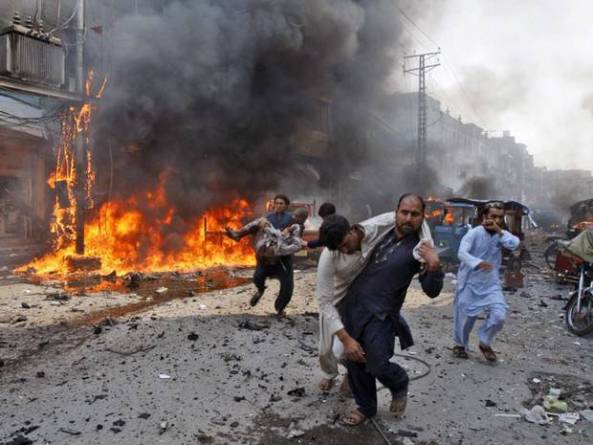
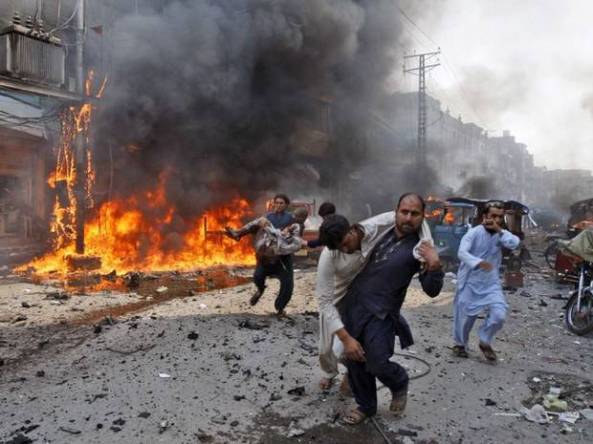
In the latest gruesome attack on the Shia community in Pakistan a suicide bomber blew himself up in a crowded ImambaRa (Shia mosque) and killed over 60 people, including several young children. People are still picking up pieces of their loved ones (literally, see video here if you dare). Who are these killers? how do they convince young people (some reports say the killer in this case was a young man  named Abubakr) to go and blow themselves up in a crowd of civilians? For some background, see below.
image
One question i have not been able to resolve: what is the PROXIMATE cause of individual attacks like these? do the LEJ leaders send bombers to blow up people randomly? or do they have specific tactical objectives? by tactical objective I mean things like “release person X or we kill a lot of people” or “pay us X or we blow up shit”…things like that? Will some knowledgeable people from Pakistan comment? Thanks

On to the background: the following is a slightly edited version of an older post on 3quarksdaily. I have added a few words at the very end about how the response of the state looks ineffectual.

Shias (mostly Twelver Shias, but also including smaller groups of Ismailis and Dawoodi Bohras, etc.) make up between 5 and 25% of Pakistan’s population. The exact number is not known because the census does not count them separately and pro and anti-Shia groups routinely exaggerate or downgrade the number of Shias in Pakistan (thus the most militant Sunni group, the Sipah e Sahaba, routinely uses the figure of 2% Shia, which is too low, while Shias sometimes claim they are 30% of the Muslim population, which is probably too high).

Historically Shias were not a “minority group” in Pakistan, in the sense in which modern identity politics talks about “minorities” (a definition that, includes some sense of being oppressed/marginalized by the majority). Shias were part and parcel of the Pakistan movement and a central component of the ruling elite. The “great leader” himself was at least nominally Shia. He was not a conventionally observant Muslim (e.g. he regularly drank alcohol and may have eaten pork) and was for the most part a fairly typical upper-class “Brown sahib”, English in dress and manners, but Indian in origin.


He was born Ismaili Khoja but switched to the more mainstream Twelver Shia sect; a conversion that he attested to in a written affidavit in court. According to Jinnah-scholar Yasser Latif Hamdani, his conversion was due to the Khoja Ismaili sect excommunicating his sisters when they married non-Khojas.

Clearly his position as a Shia was not a significant problem for him as he led the Muslim League’s movement for a separate Muslim state in India. Twelver Shias were well integrated into the Muslim elite, and in opposition to Hindus they were all fellow Muslims. The question of whether Jinnah was Shia or Sunni was occasionally asked but Jinnah always parried it with the fatuous stock reply “was the holy prophet Shia or Sunni?” This irrelevant (and in some ways, irreverent) reply generally worked because theologial fine print was not a priority for the (superficially) Anglicized North Indian Muslim elite. Their Muslim identity distinguished them from Hindus and especially in North India, it was mixed with a certain anti-Indian racism, the assumption being that they themselves were Afghans, Turks, Persians, or even Arabs, and were superior to the locals. This sense of superiority was racial and extended to poorer Muslims who were clearly local converts. One consequence of this attitude being the fact that North Indian Muslims who became prosperous frequently acquired retroactive Turko-Afghan origins. But foreshadowing the problems that would come later as the ideology of Pakistan matured, a Shia-Sunni distinction did arise when Jinnah died;  while his sister arranged a hurried Shia funeral inside the house,  the state arranged a larger Sunni funeral (led by an anti-shia Sunni cleric) in public.

This event and his own studied avoidance of any specifically Shia observance in his life, has led to claims by anti-Shia activists that Jinnah was in fact Sunni. But years later, a court did get to rule on this issue and the court ruled that he was Shia (property was involved). Incidentally, by the time his sister died in 1967, matters had become uglier in Pakistan and even an orderly Sunni funeral was not easily arranged.

Having used Islam to separate themselves from their Hindu and Sikh neighbors, the ruling Pakistani elite might occasionally use it to strengthen the spirit of Jihad in Kashmir or carry out other nation-building projects, but they rarely saw it as a potential problem. When the “objectives resolution” was passed to impose an “Islamic” color on Pakistan’s future constitution (“Sovereignty over the entire universe belongs to Allah Almighty alone and the authority which He has delegated to the state of Pakistan, through its people for being exercised within the limits prescribed by Him is a sacred trust.”) only one Muslim member voted against it (that one rebel being the left-wing Mian Ifikharuddin). But it would be wrong to imagine that ALL those who voted for the objectives resolution wanted shariah law in Pakistan. Most of them probably imagined some mildly Islamicate laws but having grown up as members of the pro-British North Indian elite in British-ruled India, they took it for granted that most laws and the basic administrative structure of Pakistan would remain British-colonial, with some harmless Islamic color being added where needed. Most of the push for sharia law came mullahs and from neo-fascist Islamists of the Jamat e Islami and neither group was strongly represented in the ruling elite. Most of these mullahs, as well as the Jamat e Islami, had strongly opposed Jinnah’s project on the logical grounds that no one as ignorant of Islam as Jinnah could possibly create an Islamic state. But they soon realized that this pork-eating, whisky drinking Shia had created the perfect laboratory for their Islamist project and they were quick to move in and try to take ownership.


Jinnah and some of the other Westernized Muslims in the Muslim League (like their later descendant Imran Khan) do seem to have had the vague notion that a true Islamic state was a sort of social-democratic welfare state that was first introduced into the world by the Caliph Omar and then taken by the Swedes to Europe (see here for details regarding this belief). Some others thought Pakistan would be a secular Westminster- style democracy, but one dominated by Muslims rather than Hindus (to which they added the common belief that Muslims are “inherently democratic” while Hindus are “caste-ridden”, an ahistorical belief shared by many Western-educated Hindu liberals btw).

But the mullahs knew better. An Islamic state must have Islamic laws. And these laws are not going to be created de novo by some Westernized Muslims impressed by Scandinavian Social Democracy; they already exist. They were developed over hundreds of years, mostly between the 8th and 12th centuries CE. And they are serious business. Very deep questions of legitimacy, authority and sources were debated by the people who created those laws. Part of the Shia-Sunni dispute has to do with exactly these questions of authority and legitimacy. As long as a state is British or Indian or ethno-nationalist, these debates are mostly history; if and when there is an Islamic renaissance these debates will be part of the historical tradition from which this rennaissance will build it’s new enlightenment. When that happens there will no doubt be people who will cite these 10th century laws as “the basis of our modern Islamic civilization” the same way some people insist the ten commandments are the basis of all Western laws, but that rennaissance and that level of development has yet to occur in any Islamic country. Outside of Saudi Arabia, what we have right now is Western/colonial legal codes and state institutions with a smattering of “sharia punishments” thrown in for effect. But if you have created a state with no real basis except Islamic solidarity it doesn’t take long to start wondering how and when the state will actually become Islamic. And once you start down that path, you have to specify which Islamic law? Or you have to do the hard work of inventing a whole new set. The “new set” option is a step too far for the limited intellectual resources available to the Pakistani elite (and involves fighting past the apostasy and blasphemy roadblocks), so we are back to arguing about which school of classical Islam to follow.

General Zia, who understood these matters better than the average Pakistani liberal, took his theology seriously. He favored hardcore Sunni schools of thought, though his exact allegiances are by no means clear. He also understood the importance of Saudi Arabia as a source of cash, and that may have played a role in his decisions (e.g.a senior official in his govt later claimed that he introduced the Islamic law of cutting off the hands of thieves purely in order to get short-term Saudi favor). In any case, he introduced a series of “Islamic laws” one of which made it compulsory for all Muslims to pay Zakat (poor tax) to the state. Shia jurisprudence regarded this as a personal matter rather than a state matter and a very large number of Shias organized to demand that they be excluded from this law. This Shia movement was given some support by Iran (a message from Khomeini was read out to the largest gathering in Islamabad), a fact that has allowed some apologists to claim that all later problems are part of some sort of proxy war between Iran and Saudi Arabia (a claim that is thoroughly debunked here). While the Shias won that round and were exempted from Zakat, a line had been drawn that has continued to become darker and bloodier with time.

At ground level a lot of this was not due to any single organized conspiracy but involved the confluence of several factors: Islamization put the question of “whose Islam” on the table; Zia’s personal leanings led to support for anti-Shia factions; Saudi Arabia inserted Wahabi-Salafi propaganda into the mix; The Shia response to the Zakat law and open (even if mostly symbolic) support from Iran helped opponents to label them Iranian agents; and modernization and modern education themselves led to a preference for modern (and fascist) versions of Islam in preference to Indian folk Islam with its “superstitious”, it’s heavy Indian coloring of  rituals and folk beliefs and it’s striking multicultural colorfulness.

Newly rich Saudi and Gulf individuals wished to promote “true Islam” in Pakistan. Many individuals in Pakistan wished to be paid by Gulf and Saudi millionaires to do the same. While the actual madrassa cannon-fodder came mostly from poor families, the policy the promoted the same came from middle class military officers and their civilian collaborators. Modern education and economics had prepared the minds of many middle class Pakistanis (including many whose families were traditionally Barelvi Sunni) to accept Maudoodi-type “back-to-basics” modern Islamism. Just like traditional folk Hinduism was rejected by Arya Samajis and other Hindu reformers, educated middle class Muslims in Pakistan were ready to reject folk Islam and strive for modernized purity. Thus,in predominantly Barelvi Pakistan, the majority of the new madrassas set up all over the country and paid for by Gulf money turned out to be hardline Deobandi, Ahle hadith and Wahhabi in sectarian orientation.

It is worth repeating that the Anti-Shia polemic was not paramount in the minds of many of the geniuses who promoted these policies. In fact, many in the Pakistani middle class still have no clear idea of where the anti-Shia polemic is coming from. It was not part of our education. While Shias were a minority sect, their version of Karbala and the martyrdom of Husain was widely accepted and reverence for Ali and the house of Ali was part of most Sufi orders. Shia symbolism had spread well beyond the Shias and become part of the cultural heritage of educated Sunnis in South Asia (or maybe, as Jaun Elya points out here, a lot of what is now typically “Shia” had it’s origin within Sunnis, things not necessarily always being divided in exactly the same boxes in which they are divided today). Certainly there were Ahle hadith and Wahhabi mullahs in Pakistan who were frankly anti-Shia, but even they tended to stay away from any direct criticism of Imam Hussein and his family. That this kind of reverence is not a universal feature of the Muslim word is not something that is even vaguely known to most Pakistani or Indian middle class Sunnis. That in Indonesia and Malaysia there is practically no sense of Moharram as a month of universal mourning is a surprise; that the Saudi Wahhabis have a well-developed anti-Shia polemic that brands the Shias as heretics, Jewvish agents and frank enemies of Islam was poorly understood.

But the fact is the Saudi Wahhabis and their fellow travelers DO have such a story. When I first heard the Saudi version (from a Pakistani doctor who had converted to Saudi Islam and ran a “study circle” in our residential camp in Saudi Arabia) it was a bit of a shock. It took a while for me to realize that his version of history was completely mainstream in Saudi Arabia. In this version, Islam (basically a military conquest enterprise from day one) was spreading rapidly on its way to conquer the world, until a Jew named Ibne Saba helped to create a fitna (the first civil war) that sabotaged this first attempt at world conquest. This fitna is now known as the Shia sect and they have been sabotaging Islam ever since. I paraphrase of course, but this is not too far from what any pious Saudi or Gulf millionaire believes. It is therefore no surprise that they spend good money to teach Pakistanis these “truths” and some of them go on to support killers who take the next step and start physically eliminating Shias.

A second and only locally important economic factor was the fact that there were some prominent Shia landlords and power-brokers in Southern Punjab. Anti-Shia polemics combined in those parts with what the Marxists gleefully call “class issues” to give it something of the color of a hardline Sunni revolt against the local Shia elite in these areas.

But the third and most critical component of this perfect storm was the state policy of Jihad or “strategic depth”. The Afghan Jihad that effectively destroyed Afghanistan may have been a CIA project, but from day one it was supported and then hijacked by local actors who had priorities of their own. Cynical Saudis saw it as a way to send away religious zealots to “jihad camp”; Pious Saudis saw it as a way to spread true Islam to the benighted heathens; and GHQ saw it as a golden opportunity to get “strategic depth” in Afghanistan, to be translated later into conquest of Kashmir and projection of power (perhaps even an empire!) in Central Asia.

As a result, the ISI got oodles of cash from the CIA and the Saudis (every American dollar was matched dollar for dollar by the Saudis) and had complete autonomy in who they handed it out to. They handed it out to the most hardline Islamist groups they could find. And the Saudis paid for the madrassas where hardline Islam was to be taught to future suicide bombers. That it included a healthy dose of anti-Shia propaganda was part of the package. Even today, many Pakistanis who have not been directly involved in jihad and anti-jihad have no idea of the kind of ideological poison that was being injected into Pakistan’s Madrassa and Jihad underworld starting in the 1980s and accelerating through the 1990s under state patronage; and continuing even as the state itself became at least partially ambivalent about the cause. One visit to this site and others like it should help to put things in perspective.

Very early on, some of the anti-Shia groups started targeting Shias within Pakistan. Jhang in central Punjab was an early battleground, as were Gilgit, Kohistan and Parachinar. Zia’s regime is known to have actively helped set up the Anjuman e Sipah Sahaba (ASS), the primary anti-Shia militant group, probably as a way of getting political leverage against uppity Shias. Like many other inventions of general Zia (MQM being the most famous) the puppets soon escaped from state control (while continuing to receive help and protection from factions within the state). Ultra-militant offshoots of the ASS (offshoot or deniable-militant-arm, take your pick) like the Lashkar e Jhangvi (LEJ) had launched open war on all Pakistani Shiites by the 1990s. The state made some intermitten efforts to rein them in (most notably in Nawaz Sharif’s second tenure) , but since the same militants were linked by common donors and patrons to other militants that were considered “good” by the state (as in Kashmir Jihadists, Taliban, etc.) and because their “legal” front organizations were friends of the Saudis and of the “good Jihad” factories, this crackdown was always ineffectual and remains so to this day.

The level of violence has steadily accelerated over time. To get an overview of the violence, see here. This has now reached the point where I personally know well-established Shia doctors who abandoned their life in Karachi and escaped to the US because someone across the hall was shot dead in broad daylight because of his sect. In 2012, over 300 Shias were killed or injured in attacks during the holy month of Moharram. Since 2001, nearly a thousand Shia Hazaras have been murdered in Quetta city and its environs and over 3000 injured. In events that evoke the horrors of partition and 1971, Shias were taken down from buses in Kohistan and identified either using their names (there are some typically Shia names, though overlap occurs) or the scars of self-flagellation many Shias have on their backs. They were then shot in cold blood. The term “Shia genocide” has been used and several op-eds have appeared in which prominent writers are asking where this will end.


Predictions:  So where will this end? Prediction is where the pundit rubber meets the road, so here goes:

1. The state will make something of an effort to stop this madness. Shias are still not seen as outsiders by most educated Pakistani Sunnis. When middle class Pakistanis say “this cannot be the work of a Muslim” they are being sincere, even if they are not being accurate.
But if the state makes a greater effort to rein in the most hardcore Sunni militants, it will be forced to confront the “good jihadis” who are frequently linked to the same networks. This confrontation will eventually happen, but between now and “eventually” lies much confusion and bloodshed.

2. The Jihadist community will feel the pressure and the division between those who are willing to suspend domestic operations and those who no longer feel ISI has the cause of Jihadist Islam at heart will sharpen. The second group will be targeted by the state and will respond with more indiscriminate anti-Shia attacks. Just as in Iraq, jihadist gangs will blow up random innocent Shias whenever they want to make a point of any kind. Things (purely in terms of numbers killed) will get much worse before they get better. As the state opts out of Jihad (a difficult process, but one that is almost inevitable, the alternatives being extremely unpleasant) the killings will greatly accelerate and will continue for many years before order is re-established. The worst is definitely yet to come. This will naturally mean an accelerating Shia brain drain, but given the numbers that are there, total emigration is not an option. Many will remain and some will undoubtedly become very prominent in the anti-terrorist effort (and some will, unfortunately, become special targets for that reason).

3. IF the state is unable to opt out of Jihadist policies (no more “good jihadis” in Kashmir and Afghanistan and “bad jihadis” within Pakistan) then what? I don’t think even the strategists who want this outcome have thought it through. The economic and political consequences will be horrendous and as conditions deteriorate the weak, corrupt, semi-democratic state will have to give way to a Sunni “purity coup”. Though this may briefly stabilize matters it will eventually end with terrible regional war and the likely breakup of Pakistan. . Since that is a choice that almost no one wants (not India, not the US, not China, though perhaps Afghanistan wouldn’t mind) there will surely be a great deal of multinational effort to prevent such an eventuality. If it does happen, the future may look very different from the recent past (btw, a little explanation of the scenario building in that last link is here).
Sadly, the Tariq Ali type overseas/Westernized-elite Left will play no sensible role in any of this. If we do (God forbid) get to the nationalist-Sunni-coup phase; Pankaj Mishra may find something positive in it (“strength” and the willingness to stand up against imperialism being a high priority for him) but events will not fit into that semi-positive framework for too long.

Addendum: A friend raised the objection that the state may well be trying it’s best. It is just not a very effective state,so they cannot stop the killers. I don’t think we can accept that argument. This is not what “trying your best” looks like and Pakistan in any case is not Nigeria. It is an order of magnitude more capable as a state. It can do much more it if wanted to. For example, in response to any terrorist movement one expects the state to launch a massive propaganda effort against them. All the PR resources of the state (and the resources of the Pakistani state are very potent in this case, see the PR around Kashmir, against Baloch separatism or even the anti-drone campaign that can be turned on or off as needed) are mobilized to identify and demonize the enemy. Has there ever been such an effort against the Lashkar e Jhangvi? much less against their legal fronts and fellow travelers? And in law enforcement, leads are pursued to the end, sympathizers are caught in the dragnet, people are given the message that it is unsafe to support the terrorist program. Has than happened anywhere in Pakistan?  Forget about a broad campaign, even in the case of specific attacks there is limited and very hazy information about the investigation and it’s findings. Who planned it? who carried it out? what was their motivation? who has been caught and who is still at large? in many cases, the local police may know a lot of these things a few months down the line, but how much gets communicated to the public? Since very little organized propaganda effort is mounted by the state, the field is open for every conspiracy theory under the sun.
This is not the best the state can do…

btw, the cartoons and the painting are the work of the highly talented Pakistani cartoonist and artist sabir nazar. http://pinterest.com/laiq/sabir-nazar-cartoons/

Obaidullah Aleem wrote this in 1971, it sound like he wrote it for today.

Indians vs Cowboys (Madison Square Garden)

….a human
rights group has obtained summons…
from the US Federal Court for the Southern District of New York….open letter addressed to Miss America 2014 Nina Davuluri… one of the emcees in
Madison Square Gardens…..“Modi is a lifelong member of the RSS….Hindu nationalist
organization that has praised Hitler…disheartening to know that you will be speaking”…

 …
A summons from the US Federal Court for the Southern District of New York…that sure rings a bell. The US Attorney for the Southern District is Preet Bharara, the cowboy lawyer who
(allegedly) ordered a top-to-bottom cavity search on Devyani
Khobragade
. What is the chance that he and his marshals will NOT attempt to arrest
the “Hitler loving” Modi??  

Then again, if Hitler-praise counts as a global standard thought crime (GSTC), Madhav Sadashiv “Guruji” Golwalkar of the RSS has nothing on Haj Mohammed Effendi Amin el-Husseini, the Grand Mufti of Jerusalem. The latter was not just a Fuhrer fan, he actually collaborated with the Third Reich (another collaborator/admirer was “Netaji” Subhas Chandra Bose, grand-uncle of Prof Sugata Bose of Harvard and a hero to millions of secular Bengalis).
…..
The Mufti’s people, the Palestinian nationalists and their brothers in the Ummah, in the internationalist Left and in the nationalist Right, recently marched in Germany while chanting “Hamas, Hamas…Jews to the gas.” This is most remarkable: a rainbow coalition expressing robust admiration for the Final Solution in its very place of origin. Hitler would be justly proud.

Now as it happens, the Hindu Nationalists also have their own “Hitler” list…YamÄ«n-ud-Dawla Abul-Qāsim MahmĆ«d ibn SebĂŒktegÄ«n (Mahmud of Ghazni), Mu’izz al-Din Muhammad (of Ghor), and many others…..who continue to receive undiluted admiration amongst the Ummah (and in school textbooks) for their unyielding endeavors in infidel crushing. This is the fundamental pillar of the two nation theory: our Ghazis are their villains. Are some Hitlers then superior to other Hitlers? 
 …….
Taking a step back now to the good old days when Indian monks used to travel to the USA to preach the message of goodwill to all. The story of Narendra-I aka Narendra Nath Dutta aka Swami Vivekananda who visited the United States in 1892 as representative of the Hindus is relatively well known.

What is not as well known is the story of Virchand Raghavji Gandhi who represented Jainism in the Parliament of Religions in Chicago in 1893 (his statue is displayed in the Chicago Jain temple).
….

[ref. Wiki] Jain monk Acharya Vijayanandsuri, also known as Acharya Atmaram, had initially been invited to represent Jainism
at the Parliament,
but as Jain monks do not travel overseas, could not
attend. He recommended Gandhi to go in his stead and serve as the
emissary for the religion. 

.
Atmaram and his disciple Vallabhsuri trained Gandhi for six months.  At the Parliament he said: 
“It is an astonishing fact that
foreigners have been constantly attacking India and in the face of all
this aggression the soul of India has stood vital and watchful.
Her
conduct and religion are safe and the whole world looks at India with a
steady gaze.” 

….

With adequate qualifications one may still say of India today that “her conduct and religion are safe.” The Jains are of course at the top of the social, economic and political ladder: Amitbhai Anilchandra Shah is the first Jain President of the Bharatiya Janata Party (BJP), he famously won the “man of the match” award (by Modi) in the campaign to crush a 50 year old dynasty. Another high-flying Jain (and a bosom friend of Modi) is Gautam Adani.
….
A sharp 152% jump in his
wealth saw Adani Group chairman Gautam Adani break into the list of 10
richest Indians even as Mukesh Ambani retained the pole position,
according to a latest report….Adani blazed into the top league
riding on the runaway share prices of his companies in recent past,
pegging his wealth at Rs 44,000 crore,
said Hurun Report, published by a
China-based luxury publishing and events group, tracking the uber rich.

……

It is also the case that with the advent of the second republic in May 2014, the world “looks at India with a steady gaze” (and so presumably does Preet Bharara). In light of this our best wishes (meant sincerely) to Narendra-II as he prepares to make his entry on to the world stage. It is on rare occasions that the Madison Square Garden is sold out…..certainly not for (brown) leaders.

Truth be told, this is a coming out party for the Hindu-Americans spear-headed by the majority Gujarati-American community. And as a wise american once said with great eloquence: “elections have consequences” and “I won” ….this is true in India as well. 

If you do not like the results (and we do not), then you still have a choice to fight for your rights (and for the votes of the people). But merely  invoking Hitler will not stop Hindus from electing Hindu nationalists. Indeed what all this drama-bazi does is to permit Hindutva-vadis to wear the victim mask while doing nothing for the actual victims.

It is clear (from the track record of the past ten years) that Modi cannot be defeated using law-fare. The Islamists have also tried guerilla war-fare with limited success– simply more victims have been created. The only way is to defeat the Hindutva-vadis through elections. That should not be too difficult- the BJP got only 31% of the national vote share (the NDA alliance as a whole got 40%). 

All that needs to be done is for a “secular alliance” to ensure that the balance 60% is not wasted through ego clashes. Indeed such a grand alliance (Congress + Nitish Kumar + Lalu Yadav) recently crushed the BJP in the Bihar by-polls. It will be hard work to achieve such unanimity on an all-India basis (not to mention, how to rule, once elected, with a sense of purpose). But this will be the only way.   
 
….
It is a rock ‘n’ roller’s dream to “sell out The Garden,” but for a
foreign politician to pack New York City’s most famous sports and
entertainment arena is another thing entirely.


Prime Minister Narendra Modi, on his first trip to New York as leader
of the world’s most populous democracy, will draw perhaps the largest
crowd ever by a foreign leader on U.S. soil when he takes the stage on
Sunday in Madison Square Garden
before a crowd forecast to total more
than 18,000 people.


Thousands more are expected to pack New York’s Times Square to watch
his address in Hindi on big screens as well as smaller viewing parties
around the country and on TV in India.


The Indian diaspora hopes this visit by a leader who was until
recently barred from the United States will signify India’s importance
not only on these shores but in the wider world too.

The event is being emceed by prominent members of the Indian American
community, Nina Davuluri, who has just relinquished her crown as Miss
America 2014, and TV journalist Hari Sreenivasan.


“Indian citizens and diaspora over the world are hopeful that this
(Modi) administration will cut bureaucracy and focus on people,” said
Dr. Dinesh Patel, chief of arthroscopic surgery at Massachusetts General
Hospital in Boston, who arrived in the United States more than 50 years
ago.


Patel, who says he was given an award for work in education by Modi, a
fellow Gujarati, added: “People are passionate to see the new leader.
Another Narendra is coming to this country to let the USA know what
India is about.”


The first Narendra was Swami Vivekananda, a 19th-century philosopher
and monk who propagated the Hindu faith in the United States. Modi often
cites a speech by Vivekananda, born Narendra Nath Datta, to the
Parliament of Religions in Chicago in 1893, as a source of inspiration.


“Let us remember the words of Swami Vivekananda and dedicate
ourselves to furthering the cause of unity, brotherhood and world
peace,” Modi wrote Sept. 11 to his 6.5 million followers on Twitter.
India’s economy, the third largest in Asia, has struggled to recover
from sub-par growth, shackled by layers of bureaucracy anathema to the
diaspora. Modi’s general election triumph in May was driven in large
part by his entrepreneurial mantra.


On the eve of his U.S. visit, tensions remain between the Washington and New Delhi over trade and spying. The 64-year-old former chief minister of Gujarat was denied a U.S.
visa in 2005 over sectarian rioting that killed more than 1,000 people,
mainly Muslims, three years before. Modi, who denies wrongdoing, has
been exonerated by a Supreme Court probe.


..
Washington was late to warm to Modi. Its ambassador to India only met
him in February, when opinion polls already put his nationalists on
course for a big election win.


India’s U.S. diaspora is a highly educated population of nearly 3.2
million, making up about 1 percent of the U.S. population, according to
latest U.S. Census Bureau data.


….
As a group, they are more likely to be hooked to the internet than
their fellow Americans, far more likely to have a college or
professional degree and twice as well off with an average household
income of more than $100,000.


“Indians are generally very ambitious and entrepreneurs,” said Mike
Narula, the founder, president and chief executive officer of Long
Island, New York-based Reliance Communications, a distributor of mobile
telecom devices and accessories.


Narula, who came to the United States 17 years ago, first working in
the garment industry, now has his own company with more than, 200
employees. He’s part of the host committee for Modi’s visit to
Washington, where the prime minister will meet with President Barack
Obama on Monday and Tuesday.
“We attempted to do business in India. I hope Modi will look into
streamlining issues such as VAT, the role of FDI (foreign direct
investment) and find a way for American businesses to not have to go
through 19 red tape bureaucracies,” he said.


While Indian Americans are well represented in America’s professional
class, they are less visible in the military. Some 0.1 percent serve in
the armed forces compared to 0.4 percent of Americans as a whole.
“The diaspora does very well on entrepreneurship, but not as much on
the physical sacrifices. It is not just enough to be a citizen and
taxpayer,” said Raj Bhandari, a 48 year old Mumbai-born banker from New
Jersey. “As a larger community I would like it to be more engaged on the
front lines.”

………………..

A day
before Prime Minister Narendra Modi’s landmark visit to the US, a human
rights group has obtained summons against him for his alleged role in
the 2002 Gujarat riots as state chief minister. New York based American Justice Centre (AJC) obtained the summons
from the US Federal Court for the Southern District of New York in a
suit filed with two survivors of what it called the “horrific and
organized violence of Gujarat 2002.”

Filed under the Alien Tort Claims Act (ATCA) and the Torture
Victim Protection Act (TVPA), the 28-page complaint charges Modi with
“committing crimes against humanity, extra-judicial killings, torture
and inflicting mental and physical trauma on the victims, mostly from
the Muslim community.”


AJC said it is providing legal support and advice to the
survivors in their effort to hold “Modi accountable for his complicity
in the violence.


“The survivors are suing Modi for the loss of lives and trauma in
their families, and caused emotional, financial and psychological
devastation in their lives.
“The Tort Case against Prime Minister Modi is an unequivocal
message to human rights abusers everywhere,” said John Bradley, an AJC
director.


“Time and place and the trappings of power will not be an impediment to justice.” The Alien Tort Claims Act, also known as Alien Tort Statute
(ATS), is a US federal law first adopted in 1789 that gives the federal
courts jurisdiction to hear lawsuits filed by US residents
for acts
committed in violation of international law outside the US, AJC said.

…..

Link (1): in.reuters.com

Link (2): hindustantimes.com/us-rights-group-gets-court-summons-against-modi

regards

Sail the 7 seas (on iceberg rafts)

…the evolutionary
history of ostriches, emus and rheas does not match the break-up of the
continents….scientists believe that their common ancestor could fly…..New
World monkeys rafted
to South America on a clump of earth…..these three groups
represent 73 percent of the land mammals living there…..


It was Darwin who first suggested that wolves arrived on the Falklands Islands by floating on icebergs. For making such an extraordinary speculation the greatest biologist ever was criticized in the strongest terms. Now there is fascinating evidence of snakes swimming 120 miles across the open ocean (and many others). Forget the boring old stories of human colonization, this is the exciting new story of animal colonization of the the planet we all call home.
……………

….
We are reminded here of Jurassic Park (the novel) where female dinosaurs had escaped from their habitat and had found a way to breed. Nature – it was famously said – will always find a way. And nature has found a way for creatures as immobile as snails to migrate from one continent to another by clinging on to the feet of birds.

In June 2000, Alan de Queiroz became curious about an enormous,
ragged-looking garter snake that lived on the tip of Baja California.
Like many other biologists of his generation, de Quieroz had been taught
that species traveled the Earth to new habitats on slowly drifting
continents.  


This snake had relatives on the other side of the Sea of
CortĂ©z on Mexico’s mainland, and de Queiroz assumed that this population
ended up on Baja 4 to 8 million years ago, when the peninsula split
from the mainland.


But using a new method based on genetic
sequencing to estimate when the two populations split, he found that it
had occurred in the past few hundred thousand years. In other words, one
or more pioneering garter snakes had probably floated across 120 miles
of open ocean.


As de Queiroz prepared to write up the surprising
results of his snake study, he discovered that the reptile was not an
outlier. Biologists were finding that even after continents drifted
apart, plants and animals somehow hopped between them.


“Obviously, the
continents had moved — nobody was claiming that the theory of plate
tectonics was wrong — and obviously, they had carried species with
them,” he writes, “but somehow, these facts did not explain nearly as
much about the modern living world as we had thought.” Chance ocean
crossings did.


In his engaging new book, “The Monkey’s Voyage,”
de Queiroz makes the case that the vibrant and distinctive biological
communities we see today were created by organisms rafting across oceans
and soaring through the atmosphere.
“The large number of these
colonizations tells us that, in the long history of this living world,
the miraculous has become the expected,” he writes.


To understand how contentious this notion is, de Queiroz takes us back
to the 1950s and ’60s, when a wealth of new information emerged about
continental drift. Geologists had long recognized that the coasts of
South America and Africa fit together like puzzle pieces and had
theorized that they were once a single landmass. 

But now measurements
from the ocean floor revealed several ridges, including one in the
middle of the Atlantic Ocean, where the sea floor was spreading before
the scientists’ eyes. These discoveries provided a clear mechanism for
how the continents creep along. Geologists determined that,
approximately 180 million years ago, there was an ancient uber-continent
called Gondwana, which sat on the equator and was composed of what are
now South America, Africa, Antarctica, India and Australia. 

Gondwana was also a revelation for evolutionary biologists. Its
break-up, they surmised, was probably etched in the history of life. For
instance, ostriches, emus and rheas, closely related birds found in
Africa, Australia and South America, became a textbook example of this
continental drift theory. Another famous example were southern beech
trees, which are found in South America, Australia and other smaller
pieces of Gondwana.

This theory was attractive because it was elegant and sensible, but,
as de Queiroz colorfully describes, its proponents became a little too
dogmatic about it. Léon Croizat, a self-trained botanist of French
heritage who lived in Venezuela, coined the phrase “Earth and life
evolve together” and believed that continental drift explained
everything about plant and animal distributions. To him, the idea that
plants or animals crossed oceans on their own was outrageous and
unscientific. 


He characterized Darwin as “congenitally not a thinker,”
in part because of Darwin’s suggestion that wolves may have reached the
Falkland Islands on icebergs. Croizat came in for criticism himself. An
eminent American paleontologist called him “a member of the lunatic
fringe.”


Indeed, there had always been evidence that, over the
long history of life on Earth, plants and animals made remarkable
journeys. Consider, for example, that young spiders are carried on the
wind by their silky threads and land on the decks of ships far from the
coastline. Freshwater snails cling to the feet of migrating birds. And
fishermen on the Caribbean island of Anguilla once watched a natural
raft of logs get washed onto shore with 15 green iguanas on it, a
species that had not previously existed there.


Proof of how
important these journeys are in evolutionary history finally arrived in
the late 1990s with genetic-dating studies, such as the one de Quieroz
conducted on his garter snakes. We now know that the evolutionary
history of ostriches, emus and rheas does not match the break-up of the
continents. Some scientists believe that their common ancestor could fly
and that they became flightless only after settling on their respective
continents. Among the other creatures de Queiroz considers are New
World monkeys and two other groups of mammals, which apparently rafted
to South America on a clump of earth. Today, these three groups
represent 73 percent of the land mammals living there.

Link: washingtonpost.com/monkeys-voyage-improbable-journeys-shaped-the-history-of-life-by-alan-de-queiroz

….

regards

The lives of peasants

The boy comes out at the sound….Nitai is quick, he has the energy and
focus of an animal filled with itself and itself only…..pushes him
against the mud wall and drives the curve of the blade with all the
force in his combusting being…This time the blood, a thin, lukewarm jet, hits him full on his
face…


Earlier it was feudalism. Now it is globalization. Even the so-called elites have very little control over their lives. If you are looking for a profession where you will never run out of clients (and money) try being a psychiatrist. The ones we know have one mile long queues in front of their office- clients suffering from unbearable stress of having great expectations (from ourselves, from our near and dear ones) in an uncertain and unforgiving world.
……

…. 
None of the above excuses the utterly horrific conditions in which peasants continue to lead their lives. If we enjoy living in a liberal democracy (however flawed) and not suffer from armed revolutions the elites will need to share. Every man, woman and child must be guaranteed dignity of life (and labor). To take just one example, all communities (and local governments) should learn from the example set forward by the Sikhs and adopt a no beggar policy.

The days of dividing and misruling are mostly behind us, as the BJP has discovered in the recently held by-poll(s) shocker – losing 9-2 to Samajwadi Party in Uttar Pradesh and 3-0 in Uttarakhand and 3-1 in Rajasthan to a Congress party which is supposedly dead and buried. We live in hope for a better tomorrow, but there will be many a (non-fictional) Nitai Das who need help now and are unable to wait.
…..
A third of the way through the half-mile walk from the landlord’s house
to his hut, Nitai Das’s feet begin to sway. Or maybe it is the head-spin
again. He sits down on the lifeless field he has to cross before he can
reach his hut. There isn’t a thread of shade anywhere. 


The May sun is
an unforgiving fire; it burns his blood dry. It also burns away any
lingering grain of hope that the monsoons will arrive in time to end
this third year of drought. The earth around him is beginning to fissure
and crack. His eyelids are heavy. He closes them for a while, then, as
sleep begins to take him, he pitches forward from his sitting position
and jolts awake. Absently, he fingers his great enemy, the soil, not
soil any more, but compacted dust. Even its memory of water has been
erased for ever, as if it has never been.


He has begged all morning outside the landlord’s house for one cup of
rice. His three children haven’t eaten for five days. Their last meal
had been a handful of hay stolen from the landlord’s cowshed and boiled
in the cloudy yellow water from the well. Even the well is running dry. 


For the past three years they have been eating once every five or six or
seven days. The last few times he had gone to beg had yielded nothing,
except abuse and forcible ejection from the grounds of the landlord’s
house. 


In the beginning, when he had first started to beg for food, they
shut and bolted all the doors and windows against him while he sat
outside the house, for hours and hours, day rolling into evening into
night, until they discovered his resilience and changed that tactic.
Today they had set their guards on him. One of them had brought his
stick down on Nitai’s back, his shoulders, his legs, while the other one
had joked, ‘Where are you going to hit this dog? He is nothing but
bones, we don’t even have to hit him. Blow on him and he’ll fall back.’

Oddly, Nitai doesn’t feel any pain from this morning’s beating. He knows
what he has to do. A black billow makes his head spin again and he
shuts his eyes to the punishment of white light.

All he needs to do is walk the remaining distance, about 2,000 hands. In
a few moments, he is all right. Some kind of jittery energy makes a
sudden appearance inside him and he gets up and starts walking. Within
seconds the panting begins, but he carries on. A dry heave interrupts
him for a bit. Then he continues.

His wife is sitting outside their hut, waiting for him to return with
something, anything, to eat. She can hardly hold her head up. Even
before he starts taking shape from a dot on the horizon to the form of
her husband, she knows he is returning empty-handed. The children have
stopped looking up now when he comes back from the fields. They have
stopped crying with hunger, too.

The youngest, three years old, is a tiny, barely moving bundle, her eyes
huge and slow. The middle one is a skeleton sheathed in loose, polished
black skin. The eldest boy, with distended belly, has become so
listless that even his shadow seems dwindled and slow. Their bones have
eaten up what little flesh they had on their thighs and buttocks. 

..
On the
rare occasions when they cry, no tears emerge; their bodies are
reluctant to part with anything they can retain and consume. He can see
nothing in their eyes. In the past there was hunger in them, hunger and
hope and end of hope and pain, and perhaps even a puzzled resentment, a
kind of muted accusation, but now there is nothing, a slow,
beyond-the-end nothing.

The landlord has explained to him what lies in store for his children if
he does not pay off the interest on his first loan. Nitai has brought
them into this world of misery, of endless, endless misery. Who can
escape what’s written on his forehead from birth? He knows what to do
now.

He picks up the short-handled sickle, takes his wife by her bony wrist
and brings her out in the open. With his practised farmer’s hand, he
arcs the sickle and brings it down and across her neck. He notices the
fleck of spit in the two corners of her mouth, her eyes huge with
terror. The head isn’t quite severed, perhaps he didn’t strike with
enough force, so it hangs by the still-uncut fibres of skin and muscle
and arteries as she collapses with a thud. Some of the spurt of blood
has hit his face and his ribcage, which is about to push out from its
dark, sweaty cover. His right hand is sticky with blood.

The boy comes out at the sound. Nitai is quick, he has the energy and
focus of an animal filled with itself and itself only. Before the sight
in front of the boy can tighten into meaning, his father pushes him
against the mud wall and drives the curve of the blade with all the
force in his combusting being across his neck, decapitating him in one
blow. This time the blood, a thin, lukewarm jet, hits him full on his
face. His hand is so slippery with blood that he drops the sickle.

Inside the tiny hut, his daughter is sitting on the floor, shaking,
trying to drag herself into a corner where she can disappear. Perhaps
she has smelled the metallic blood, or taken fright at the animal moan
issuing out of her father, a sound not possible of humans. 


Nitai
instinctively rubs his right hand, his working hand, against his
bunched-up lungi and grabs hold of his daughter’s throat with both his
hands, and squeezes and squeezes and squeezes until her protruding eyes
almost leave the stubborn ties of their sockets and her tongue lolls out
and her thrashing legs still. He crawls on the floor to the corner
where their last child is crying her weak, runty mewl and, with
trembling hands, covers her mouth and nose, pushing his hands down,
keeping them pressed, until there is nothing.

Nitai Das knows what to do. He lifts the jerrycan of Folidol left over
from three seasons ago and drinks, his mouth to the lip of the plastic
canister, until he can drink no more. His insides burn numb and he
thrashes and writhes like a speared earthworm, thrashes and writhes, a
pink foam emerging from his mouth, until he too is returned from the
nothing in his life to nothing.

….

Link: http://www.firstpost.com/printpage.php?idno=1714685&sr_no=0

…..

regards

A ring side view of the war

….the boom of artillery fire was briefly
drowned by the whoosh of Hamas rockets taking flight…..In the
street outside, whistles and cheers rose. Why the jubilation, I asked?
Surely the rockets were a prime reason for Gaza’s catastrophe?
…..You don’t understand, I was told. The Arab countries dare not throw
so much as a tennis ball at Israel. But Gaza can launch 100 rockets a day…..

…..
Now that the dust is settling down, difficult questions will be asked and will need honest answers. There will be very few unbiased people in this fight.

We fully expect (and so does the world) that there will be another war just around the corner. It is important (as they say) to keep learning the lessons that hopefully will postpone, delay, and slow down the conflict. It will be vital to keep reaching for the middle ground, even if it looks impossible and sounds foolish.
……………
I thought that killer drones were silent and practically invisible –
until I counted seven of the silver objects circling in the summer sky
overhead, buzzing endlessly like angry bees.


If you believe that all guns sound the same and one explosion is much
like another, then Gaza’s ceaseless symphony of war will provide an
education. Soon, you will be able to distinguish the staccato
thunderclaps of a naval bombardment from the deep and steady boom of an
artillery barrage.


You will learn that Hollywood is wrong and bombs do not whistle when
they fall – and you rarely see, or even hear, the jet fighter that
destroys the building in the next street. At first, this rib-shaking
explosion and its mini-mushroom cloud of black smoke appear to have
erupted from nowhere.


You will discover that salvos of Hamas rockets take off with a
prolonged “whoosh”, leaving trails of white smoke in the sky; that a
falling bomb does not explode on impact but drills a gaping void in the
centre of a building, smashing its way methodically through one storey
after another, before detonating under the foundations. Then you will
learn that when human beings are shredded and eviscerated, the street
runs with blood.


From previous wars, I knew that explosions have a strangely
capricious quality. But it was still a surprise to come across a single
surviving door, standing intact and defiant on a sea of rubble that had
once been a home. At another scene of destruction, a new television lay
beneath a mountain of white concrete, apparently unscathed; nearby, a
large bathtub had been hurled upwards to perch precariously on top of a
heap of debris.


After a few days in Gaza, however, you stop being surprised by the
extraordinary. Dinner takes place outdoors to the accompaniment of
explosions. Soon, you mentally phase out all but the most thunderous
blasts, just as someone who lives near a busy street will tune out the
sound of traffic.


But what if every blast is thunderous? That happened on Tuesday
morning when an ear-splitting, heart-pounding, wall-shaking bombardment
broke over Gaza City from midnight until 5.30am with barely a pause. 

For
those hours, I had some sense of what London must have sounded like
during the Blitz.


Most of all, you learn that conflict in Gaza is fundamentally
different – more intense, more soul-destroying and more perilous for
ordinary people – than just about anywhere else in the world.


….
Why is that? First and foremost because Gaza serves as Exhibit A for
the dictum that you can run, but you can’t hide. In other wars I have
covered, civilians who find themselves in the path of battle simply take
what they can and move. They walk to safety, travelling as far as they
need to go.


In January, I was in South Sudan at the outset of that country’s
civil war. When the town of Bor was besieged and bombarded, most of its
people crossed to the far bank of the White Nile and set up a vast
refugee camp.


This was a dangerous journey and the conditions that awaited them
were terrible. But at least they were safe on arrival. Once on the west
bank of the river, only the distant boom of artillery reminded the
refugees of the perils from which they had fled.


The 1.8 million people of Gaza have no such option. Their world
measures 25 miles in length and seven in breadth at its very widest
point – and just about every location within that tiny area has come
under attack. Thanks to the partial blockade enforced by Israel and
Egypt, Gaza’s inhabitants cannot leave: they have no means of escape.


The best that families can do is take refuge in the nearest United Nations property, usually a school, and hope for the best.


During my 12 days in Gaza, the number of people displaced in this way
grew by leaps and bounds. When I arrived, some 30,000 refugees were
sheltering in UN premises; by Friday, that total was close to 240,000 –
or 13 per cent of the territory’s entire population.


And that does not count the hundreds of people sleeping in the open
outside Shifa Hospital in Gaza City, nor the tens of thousands more who
have packed into the homes of relatives.


….
Remember one other fact: about half of Gaza’s people are under the
age of 18. No one fights in Gaza without maiming, killing, displacing or
traumatising legions of children. This not a campaign waged in empty
desert, mountain or plain – forget Iraq or Afghanistan – but a battle
fought in narrow alleyways crowded with infants and families.


So when Israel sends troops and tanks into Gaza, understand what that
means. First of all, the inhabitants of the targeted area receive an
order to leave, delivered by voicemail, text message or a leaflet
fluttering from the sky. I happened to arrive a few hours before the
ground invasion began and the 100,000 people of the towns of Beit Hanoun
and Beit Lahiya, lying squarely in Israel’s intended line of advance,
were receiving these alerts.


….
Israel says that its prime concern is the safety of the people: only
by emptying an area can its troops fight Hamas without killing even more
civilians. The warnings also offer clear reassurance that everyone will
be able to return once the operation is over.


….
I do not question the sincerity of Israel’s argument and I recognise
the dilemma of its battlefield commanders. 

I would simply offer three
observations.


….
First, these eviction orders presently apply to everyone inside an
Israeli-controlled buffer zone stretching for two miles along Gaza’s
northern and eastern borders. That amounts to 44 per cent of the
territory’s entire surface area. So almost half of Gaza has been
deliberately – if temporarily – cleared of its people.


….
Second, events have demonstrated the stark truth that nowhere is
safe. Twice, Israeli forces have bombarded UN schools housing the
displaced; in Jabaliya on Wednesday, they killed at least 16 people,
including children in their sleep.


Third, if Israel’s leaders act on their threat to expand the ground
operation and send their troops and tanks still deeper into Gaza, even
more Palestinians will be forced from their homes. Suppose Israel
decides to increase the area under military control from 44 per cent to,
say, 50 or 60 per cent. Every street and every block that Israeli
forces capture will represent thousands more refugees.


Where will they all go? Every available UN school is already packed.
Whatever threadbare system exists for sheltering the fugitives is, in
the words of Chris Gunness, the local UN spokesman, “overwhelmed” and
“at breaking point”.


….
Make no mistake: if Israel escalates this operation still further,
then the people of Gaza will be herded and corralled into
ever-shrinking, and ever more squalid, pockets of supposed safety.


….
What cause could possibly justify such suffering? This brings us to
the second reason why Gaza’s tragedy is different. Even by the standards
of wars down the ages, this one is singularly futile.


….
Israel, on its own account, is not fighting to destroy Hamas or solve
the humanitarian and security problem posed by Gaza. No, the purpose of
its campaign is to punish the radical Islamist movement for firing
rockets at Israeli cities, destroy its tunnels and delay the moment –
note the word delay – when Hamas will be able to resume launching
missiles. This is a struggle not for victory, but for temporary tactical
advantage in a campaign that Israel expects to have to repeat, time and
again, into the indefinite future.


….
And Hamas? Its rocket barrage is primarily intended not to solve a
problem, but to achieve psychological solace. Over dinner in a
Palestinian home last week, the boom of artillery fire was briefly
drowned by the whoosh of Hamas rockets taking flight nearby. In the
street outside, whistles and cheers rose. Why the jubilation, I asked?
Surely the rockets were a prime reason for Gaza’s catastrophe?


….
You don’t understand, I was told. The Arab countries dare not throw
so much as a tennis ball at Israel. But Gaza – little, impoverished,
blockaded Gaza – can launch 100 rockets a day. Never mind that Israel’s
“Iron Dome” missile shield minimises the damage they cause. What matters
is that they are fired at all.


….
My hosts, I hasten to add, did not share this view – and Palestinians
are enduring their nightmare with profound courage and stoicism. Even
in the midst of privation and terror, they greet visitors with dignity
and courtesy. Yet they are trapped in a vortex of suffering – and one
that has no discernible end.

…..

Link: http://blogs.telegraph.co.uk/news/davidblair/100282273/you-learn-a-lot-very-quickly-in-gaza/

……

regards

Tea Party Zindabad

We are not ideological enough to be termed left-liberals but we are compassionate enough to start feeling sorry for the coconut people. They are getting thrashed everywhere  in the polls and how. In each case the victories (defeats) have been correctly described as historical.

It’s a historic defeat. Not since the 2004 defeat of Tom Daschle has a
party’s congressional majority leader lost an election; I’m still
struggling to find a case where a majority leader lost a primary. 

In India the LLs fought hard against a chai-wallah’s son. They wrote passionate letters to the Guardian. They formed voter advisory groups who pointed out how best to carry out tactical voting against the BJP. Their campaign was so effective that even a business-focused mag like the Economist urged Indians to vote against Modi. They still lost.

In UK/Europe the LLs went up against the UKIP and other far-right forces. The only defeat that they could claim was that of mad-man Geert Wilders of Holland (who in effect promised that Moroccans will be kicked out of the country). And in Greece the anti-austerity left won as the people are facing extreme hardship (by western civ standards). Everywhere else, the liberal-left was badly crushed.


Now in breaking news from the land of the free, we have a grand Tea Party upset- Eric Cantor, the Republican Leader (#2) in Congress, dethroned by a college professor!!! What must really hurt is the fact that Profs are overwhelmingly left-lib, however David Brat is an econ prof.

Eric Cantor is clearly no darling of  the left. But of late, the LLs have been quite optimistic about the demise of the Tea Party and a swing back to the middle (from the devastation of 2010). Indeed, there were tell-tale signs that Cantor would help out in the legalization of (Hispanic) migrants. The LLs just did not imagine a Tea Party victory of this magnitude (just as everyone failed to anticipate an outright BJP majority). Now no Republican would dare move forward (left-ward) on the Dream Act.

How will Arundhati Roy (as the leading thinker in the world) respond to this global Tea Party take-over? The familiar angle to explore is how minorities will suffer- in India there are already communal incidents flaring up from Haryana to Maharashtra. In Europe the fire will be directed against muslims as well. And in the home of the brave it will be Hispanics that will face the mood music. But all past battles have been waged and lost on this ground and we are not sure of the efficacy of her high-voltage campaigns (and silver tongue) going forward.

If General #1 is no good, will the Left-Libs be able to find other strong (and smart) voices to guide them in these dark days? Our opinion is that they enlist the services of  Dr Omar Ali of Brown Pundits. We are sure that they will not be unhappy with results.
………

There’s not too much happening tonight — oh, apart from two fun
races that will be analyzed and over-analyzed and then analyzed some
more for signs of Tea Party fever.


UPDATE: If I were a prouder man, I’d delete my first
line about how much was happening tonight. Obviously, quite a lot is
happening: Eric Cantor, who was all-but-assured to become Speaker of the
House when the gavel grew too heavy for John Boehner, has lost his
primary. He has lost it resoundingly, losing by huge margins in rural
parts of the district, losing even in population centers like Henrico
County (the Richmond suburbs).


It’s a historic defeat. Not since the 2004 defeat of Tom Daschle has a
party’s congressional majority leader lost an election; I’m still
struggling to find a case where a majority leader lost a primary.
And while I covered David Brat’s race against Cantor a few times, I
joined the vast majority of journalists in assuming Cantor would take
this. After all: He seemed to spot the voter unrest early on, and he
spent nearly $1 milllion in the final weeks, while Brat struggled to
spend six figures.

How did this happen?


Immigration reform. Yes: Eric Cantor managed to be
sunk by immigration reform without even bringing a bill to the floor.
Like John Boehner, Cantor reached out to pro-reform groups and was seen
by the GOP base as open to some eventual bill. This riled activists and
opinion leaders like the radio hosts Mark Levin and Laura Ingraham.
“Eric Cantor is an ally in the biggest fight that will occur in the
next six months in Washington,”
Ingraham said at a weekend rally for
David Brat, “and that is the fight over immigration amnesty.”

……….

Link: http://www.slate.com/blogs/weigel/2014/06/10/the_official_live_thread_of_the_south_carolina_and_virginia_primaries.html

…….

regards

‘Aaj jaane ki zid na karo’


Farida
Khanum is one of the last of the Ghazal greats.
She grew up in
Kolkata and has great fondness for the city. The denizens of this city
are known for their musical taste, and they have (naturally) great love for Farida. A
beautiful love story that is reaching its end as the giants exit the stage one by one.

THE CONCERT WAS THE BRAINCHILD of Malavika Banerjee, who organises the annual Kolkata
Literary Meet. I met Banerjee—“Mala”—at last year’s KaLaM, and told her I was
making a documentary film about Farida Khanum. 

Our conversation took place one
night in a car; we were weaving past rotten old buildings somewhere near the
Victoria Memorial and I was telling Mala about Khanum’s Calcutta connection.

Her older sister, Mukhtar Begum, was a Punjabi gaanewali who had come to
the city in the 1920s to work for a Parsi-owned theatrical company. Within a
few years she had become a star of the Calcutta stage—
she was advertised on
flyers as the “Bulbul-e-Punjab” (the Punjabi bulbul)-—and had moved into
a house on Rippon Street. 

Khanum herself was born, sometime in the 1930s,
somewhere in these now-decrepit parts.

Mala was held: she asked if I could
bring Khanum to next year’s festival. She also asked, in a sort of polite
murmur, “She’s still singing and all?”

“Of course!” I said, mainly to serve
my own interests: I had been looking for a reason—a ruse, really—to bring
Khanum to Calcutta and film her in the locations where she had passed her
childhood.

“Theek hai,” Mala said. “Let
me work on this.”
……

IT WAS A DIM JANUARY AFTERNOON IN
LAHORE,
there was a power outage on Zahoor
Elahi Road, and Farida Khanum had finally woken up….I had come to prepare Khanum for a
concert she was to give in a week’s time in Calcutta, and was trying to engage
her, in this fragile early phase of her day, with innocuous-sounding questions:
which ghazals was she planning on singing there, and in what order?

“Do-tin cheezaan Agha Sahab diyan”
(Two-three items of Agha Sahib’s), she said in Punjabi, her voice cracking. She
was referring to the pre-Independence poet and playwright Agha Hashar Kashmiri.

“Daagh vi gaana jay” (You
must sing Daagh too), I said. “Othay sab Daagh de deewane ne” (Everyone
there is crazy about Daagh)—Daagh Dehlvi, the nineteenth-century poet.
“Aa!” she said, and stared at
me in appalled agreement, as if I had recognised an old vice of Calcutta’s citizens.

“Te do-tin cheezaan Faiz
Sahabdiyan vi gaadena” (And you can also sing two-three pieces from Faiz
Ahmad Faiz).

“Buss,” she said, meaning it
not as a termination (in the sense of “That’s enough”) but as a melancholy
deferral, something between “Alas” and “We’ll have to wait and see.”

I knew she was nervous about the
trip—the distance, the many flights, the high standards of Bengalis—and to
distract her I removed the lid of my harmonium and held down the Sa, Ga and Pa
of Bhairavi. I was chhero-ing the thumri ‘Baju band khul khul jaye.’

“Farida ji, ai kistaran ai?”
(How does it go, Farida ji?) I asked, all goading and familiar.
“Gaao na,” she said.
I screwed up my face and started the
aalaap.

“Aaaaaa
” Her mouth was a
cave, her palm was held out like a mendicant’s.
“Subhanallah,” I said, and
pumped the bellows.

Her singing filled up the room: she
climbed atop the chords, spread out on them, did somersaults.

“Wah wah, Farida ji! Mein
kehnavaan kamal ho jayega! Calcutta valey deewane ho jaangey” (Bravo, Farida
ji! It will be extraordinary! The people of Calcutta will go crazy), I said.
“Haan,” she said, looking
away and making a sideways moue that managed to convey deliberation,
disinterest and derision all at once.
Fehmeda was referring to Khanum’s
debility of the last three years, which has been accompanied by hospital
visits, physiotherapy and rounds of medication. (Khanum herself had described
it to me in terms of demonic sensations: her foot going numb, a tube entering
her throat, being forced to swallow strange pills and feeling a subsequent
whirling in her head.) 

But worse, I had sensed, was the gloom accompanying this
illness—an awareness of the body’s vulnerability that led constantly to thoughts
of mortality, wistful ones not unlike those expressed in Khanum’s most famous
song, ‘Aaj jaane ki zid na karo’:


Waqt
ki qaid mein zindagi hai magar
Chand ghariyan yehi hein jo azaad hain
(In
time’s cage is life, but
Some moments now are free)

The song is set in Aiman Kalyan, also
called Yaman Kalyan, the evening raag prescribed for creating a mood of
romance.

Her ‘Aaj jaane ki zid na karo’ is delivered in this
semi-free vein: her wilful, uneven pacing of the lyrics creates the illusion of
a chase, a constant fleeing of the words from the entrapments of beat. (This
technique, which has the mark of her teacher—the erratic and perennially
intoxicated Ustad Ashiq Ali Khan—bears its sweetest fruit in Khanum’s ghazals,
where strategic lags and compressions in the singing can enhance the pleasures
of a deferred rhyme.)


But what after these outlines have
been described? How to account for the slightly torn texture, the husky tone,
the maddening rass of the voice? And what to do about Khanum’s
devastating deployment of the word “haye” in the phrase “haye marr
jayeingey”? I once heard the Bollywood playback singer Rekha Bhardwaj say,
“Yeh gaana hai hee ‘haye’ pey” (This song is all about the ‘haye’).
I think she is right, in that Khanum’s transformation of that word—from a jerky
exclamation in the original to a dizzying upward glide, a veritable swoon, in
her own version—has made of it a mini-mauzu, or thematic locus, of the
lyric.
There is, to be sure, an element of
truncation in Khanum’s musical trajectory: she has said many times that
Partition, which resulted in the loss of her Amritsar home, signaled the end
of her training and forced her to make compromises—personal as well as musical.
For a few years, while living in the alien city of Rawalpindi, Khanum travelled
regularly to Lahore to sing for radio and act in films. But she failed to make
an impact. Soon she was consumed by marriage,
and gave up singing at the
insistence of the industrialist who offered her the securities of a “settled
life.” Later, when she returned to music, she took up not khayal or thumri but
the accessible and mercifully “semi-classical” Urdu ghazal.

IN OCTOBER, three months before the concert in Calcutta, Farida Khanum
moved an audience in Lahore to tears.

This happened at the Khayal
Literature Festival. I was interviewing Khanum, in a session called “The Love
Song of Pakistan,” about her life in music. Adding star power to our panel was
the ghazal singer Ghulam Ali. I had spotted Ali—urbane in black kurta and
rimless glasses—in the audience at the start of the show and asked him to join
us with a spontaneous announcement.

“Farida ji,” I said, switching on
the shruti box I had placed before her. “Could you please, for just a little
bit, sing for us the bandish in Aiman that you learned as a child? Just
a little sample, please.”

This part was rehearsed. I had
suggested to Khanum earlier in the week that she present on stage a “thread” of
Aiman: she could start with a classical piece, then proceed to ghazals and
geets—including the crowd-pleasing ‘Aaj jaane ki zid na karo’—all in her
favorite raag. This would give our session a musical coherence, I had said, and
make it easy to follow.

“Achcha?” she had replied. “Sirf
Aiman karna ai?” (Really? You want to dwell only on Aiman?) She pressed her
lips together, in her inscrutable way. Then, with a mildly warning look, she
said, “Theekai. Ay achcha sochya ai.” (Okay. This sounds like a good
plan.)

Now, onstage, she ceded to my
request for the bandish with an indulging smile. What happened next surpassed
everyone’s expectations. Khanum’s voice, in contrast to her ailing frame, was
robust, full-throated, steady, flexible. Everything she sang glowed with
energy: she unfolded an aalaap, a bandish in teentaal, Faiz’s ghazal ‘Shaam-e-firaaq
ab na poochch,’ Sufi Tabassum’s ghazal ‘Woh mujhse huway humkalam’
and her signature ‘Aaj jaane ki zid na karo.’ 

She was bringing out the
raag in different forms, showing its familiar movements, making it reveal its
secrets. But she was also compressing a century of cultural evolution:
interspersing the singing with anecdotes about her childhood in Calcutta, the riaz
with her ustad in Amritsar, her post-Partition collaborations with poets
and music directors at Lahore’s radio station, and the fortuitous way in which
she had come to sing ‘Aaj jaane ki zid na karo’ (someone had asked her
to sing it at a mehfil). For the lay Lahore audience, the overall experience—one
of observing a constant or eternal thing (the raag) endure in ephemeral or
perishable forms—was eye-opening, cathartic and extra-musical.


In the case of a singer like Farida
Khanum, her role as a transmitter of djinns is magnified by social and
historical contexts. When she sings ‘Aaj jaane ki zid na karo,’ she is
passing on the cumulus of centuries—the laws of Aiman, according to one legend,
were fixed by Amir Khusro in the thirteenth century—in an accessible,
contemporary form.
And the process is made poignant and ironic by our
ignorance: how many of the amateurs who upload videos of themselves singing ‘Aaj
jaane ki zid na karo’ on YouTube and Facebook know what they are really
channelling?

On the night of the concert, a final
hurdle appeared. I had gone to the GD Birla Mandir, the venue of the show, for
a sound check. There I was told, an hour before the concert, that Khanum would
have to go down several flights of stairs in order to reach the auditorium.

“What are we going to do?” I asked
one of the organisers, a woman in a sari who looked back at me
uncomprehendingly.

Then she said, “Wait.”

Approximately twenty minutes later,
a little before 7 pm, a white car carrying Khanum pulled up to the GD Birla
Mandir. The legendary singer emerged in a pink-and-gold sari, and was led by
helpers and admirers into the foyer. Then the Mandir’s doors closed, and the
foyer emptied. 

Khanum, who had only just sat down in a chair, spent the next
few minutes in a state of airborne transport, gripping the chair’s arms and
muttering the lord’s name under her breath, until she found herself seated in
her usual, regal way on a stage decorated with flowers. “Ya Ali Madad”
(Help me, Ali), she said, invoking the prophet’s heir and fourth caliph of
Islam, before the curtain went up.


“Ek muddat ho gayi hai” (It
has been an age), Khanum said, shivering a little but looking serene before her
Calcutta audience, which was comprised of young and old alike. “Innhon ne
kaha aap chalein, buss thhora sa safar hai” (They said I should
go, the journey is not long).

She stuck to the rules: she sang two
ghazals from Daagh, two from Faiz, the thumri in Bhairavi and ‘Aaj jaane ki
zid na karo.’ I had the privilege of sitting next to her on the stage and
holding open the book that contained the words to the songs. I marvelled at her
composure—and, yes, at the soundness of her training—when I saw how she
conducted the audience, the accompanying musicians and the sound technicians
behind the curtain with just her hand-movements and facial expressions. And I
saw—a novice observing a master, a mortal observing a living legend—how she
managed her voice: the expansions in the middle octave, the careful narrowing
at the higher notes, the strategic truncation of words and notes when she was
running out of breath. Occasionally, when I feared she was going to skip a
beat, I found myself clenching the book in my hands and glancing at the
audience for signs of a crisis.

But there were none, because even
the odd anti-climax, when it did occur, was a pleasure.  
Brown Pundits