Abhijit Iyer Mitra on The Socio-Cultural Impact of 3D Printing Technology

On the 8th Episode of my weekly podcast The Indic Paradigm on The Indic Explorer YouTube channel, I chat with Abhijit Iyer Mitra on the socio-cultural impact of 3D Printing Manufacturing Technology in the future.

The Indic Explorer YouTube channel focusses on the interplay of Indic culture with modernity explored through different facets in the socio-cultural sphere.

Do subscribe to the channel at https://www.youtube.com/theindicexplorer

and follow me here

Twitter- https://twitter.com/theindicexplor1

Instagram- https://www.instagram.com/theindicexplorer/

Substack-https://digitaldharma.substack.com/

Evolution of Hindu Temple Architecture & Analysis of Prominent Temples

Professor of Tourism Ramakrishna Kongalla speaks to me on the weekly podcast The Indic Underground about the various stages of evolution of Hindu Temple Architecture.

We also analyze the architecture of prominent Hindu temples. This is a deeply informative episode one that should not be missed out.

The Indic Explorer channel is a platform to explore different facets of Indic Culture and its relationship with modernity. On our show ā€˜The Indic Underground’ we speak to newer & younger people from different spheres of cultural life that represent less known aspects of Indic culture. If you are tired of the same folks & are looking for fresh voices, then this is the place for it.

Our endeavor is to reach out to culturally conscious younger people who are deeply tied to the values of Indian culture while still embracing modernity. We will soon be bringing interesting discussions on different topics ranging from culture, civilizational issues, history, geopolitics, philosophy, music, literature dance, art and architecture.

Do subscribe to the channel at https://www.youtube.com/theindicexplorer

and follow me here

Twitter- https://twitter.com/theindicexplor1

Instagram- https://www.instagram.com/theindicexplorer/

Substack-https://digitaldharma.substack.com/

Bangladesh and West Bengal genetics

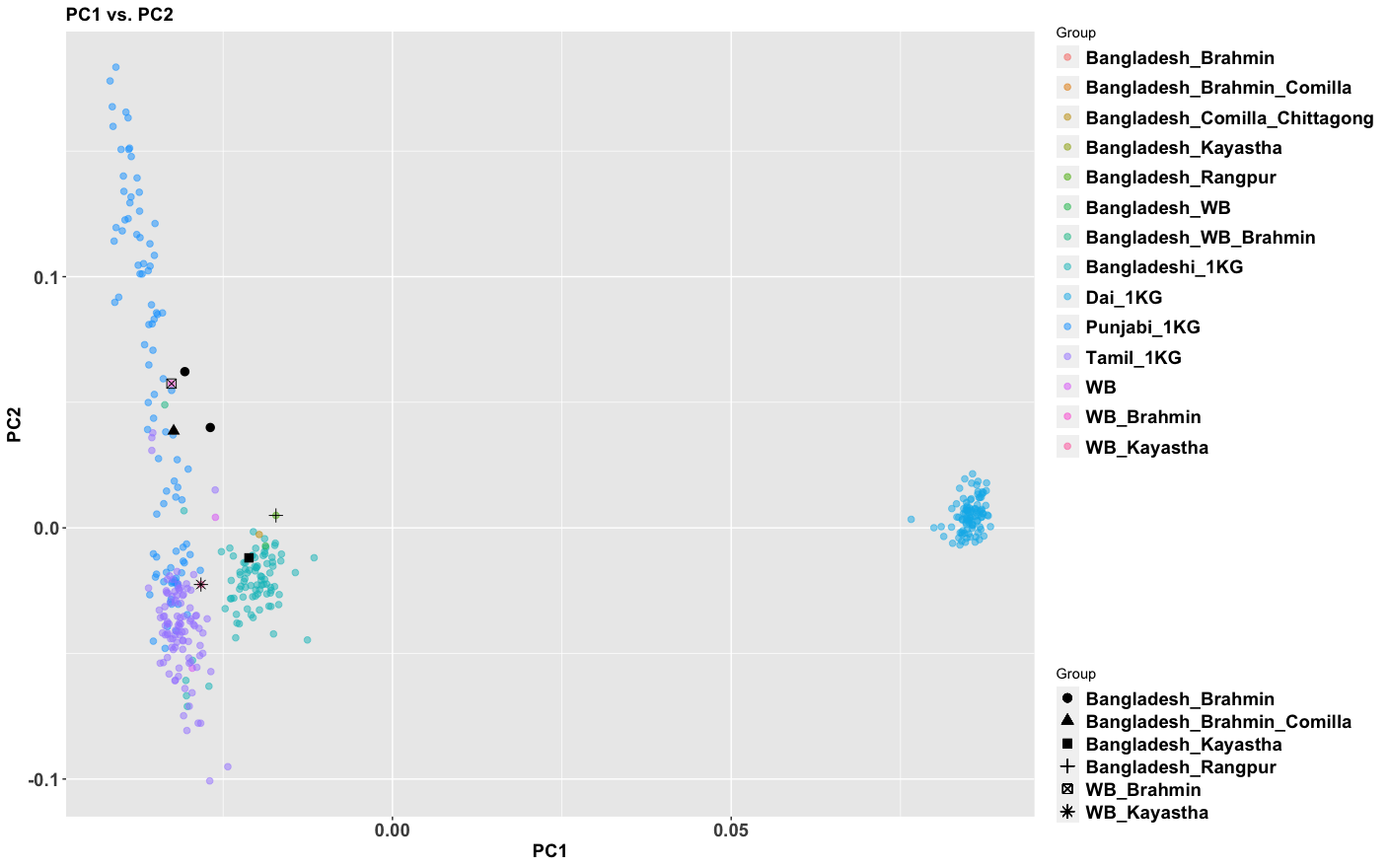
I got a few more samples with provenance. The Bengali Brahmins are shifte the way you would expect. The Bangladesh Kayastha (someone from a Hindu background) is in the cluster with generic Bangladeshis from Dhaka. The West Bengali Kayastha is far less East Asian. My current model right now is that the Kayasthas are basically peasants that engaged in uplift, as in general they don’t seem so genetically distinct from other Bengalis, in contrast with Brahmmins. Though Bengali Brahmins do exhibit admixture with Bengalis with East Asian ancestry, they are very different overall.

Usha Vance “hit piece”


The New York Times has a quasi-hit piece out on Usha Vance, From Yale to Newsmax, Usha Vance Has Helped J.D. Vance Chart His Path – The Ohio Senate candidate’s wife, an accomplished lawyer, remains ensconced in the milieu he now rails against. I say quasi because there’s nothing bad they could really find except that she’s helped her husband along on his political career, and seems to have tacitly shifted her own views.

This part about untouchability was pretty amusing:

That world has, in turn, started to reject Mr. Vance. Ahead of the September 2021 wedding of Sophia Chua-Rubenfeld — a daughter of Ms. Chua — multiple guests requested not to be seated next to the Vances, according to two people who attended the wedding. (The couple did not attend, in the end, because their children had the flu and Ms. Vance was soon to deliver their third child, according to two people close to the Vance family.)

I guess they were worried about losing caste!

Omer Ghazi-An Advaitin Drummer talks about Adi Shankara & Rendering his Shlokas to Modern Beats

Omer Ghazi an expert drummer and exponent of multiple percussion instruments across the world, talks about his exploration of the Advaita Philosophy of Adi Shankaracharya.

He also talks about how he overcame mainstream cultural conditioning, to eventually discover his Indic cultural roots. He had a lot to say about Science and its compatibility with Indic Philosophy.

The highlight of the discussion was in the beginning, where we open the show with Omer playing the drums on the Nirvana Shatakam Shloka written by Adi Shankara. He talks extensively during the show about rendering Ancient Sanskrit Shlokas to a modern beat and the challenges in executing them without affecting their original intention and flow.

The Indic Explorer channel is a platform to explore different facets of Indic Culture and its relationship with modernity. On our show ā€˜The Indic Underground’ we speak to newer & younger people from different spheres of cultural life that represent less known aspects of Indic culture. If you are tired of the same folks & are looking for fresh voices, then this is the place for it.

Our endeavor is to reach out to culturally conscious younger people who are deeply tied to the values of Indian culture while still embracing modernity. We will soon be bringing interesting discussions on different topics ranging from culture, civilizational issues, history, geopolitics, philosophy, music, literature dance, art and architecture.

Do subscribe to the channel at https://www.youtube.com/theindicexplorer

and follow me here

Twitter- https://twitter.com/theindicexplor1

Instagram- https://www.instagram.com/theindicexplorer/

Substack-https://digitaldharma.substack.com/

Suneet Kumbhat on doing Mahabharata Recitals in Cafes for the Youth

Suneet Kumbhat talks about doing Mahabharata discussions and recitals in chic cafes and eateries in Urban India focusing on bringing the great epic to a newer generation in a fun and casual environment filled with great values and learnings.

The Indic Explorer channel is a platform to explore different facets of Indic Culture and its relationship with modernity. On our show ā€˜The Indic Underground’ we speak to newer & younger people from different spheres of cultural life that represent less known aspects of Indic culture. If you are tired of the same folks & are looking for fresh voices, then this is the place for it.

Our endeavor is to reach out to culturally conscious younger people who are deeply tied to the values of Indian culture while still embracing modernity. We will soon be bringing interesting discussions on different topics ranging from culture, civilizational issues, history, geopolitics, philosophy, music, literature dance, art and architecture.

Do subscribe to the channel at https://www.youtube.com/theindicexplorer

and follow me here

Twitter- https://twitter.com/theindicexplor1

Instagram- https://www.instagram.com/theindicexplorer/

Substack-https://digitaldharma.substack.com/

Udaya Shreyas of The Sanskrit Channel talks about the Challenges with Learning the Language in India

Udaya Shreyas of The Sanskrit Channel talks about his journey into the beautiful world of the Sanskrit language, his transition from being an atheist into spirituality.

We also talk about

1 Difference between Vedic Sanskrit, Panninian Sanskrit and conversational Sanskrit

2 Learning language through speech or grammar? Initiatives taken by Samskruta Bharati

3 How Sanskrit can be revived on a mass scale via both govt and private initiatives

4 Qualities of Sanskrit as a scientifically suitable language for computer programming

5 The poetic qualities of Sanskrit, the different poetic meters, same words having different meanings

6 Future outlook of Sanskrit

7 Future goals for The Sanskrit Channel

The Indic Explorer channel is a platform to explore different facets of Indic Culture and its relationship with modernity. On our show ā€˜The Indic Underground’ we speak to newer & younger people from different spheres of cultural life that represent less known aspects of Indic culture. If you are tired of the same folks & are looking for fresh voices, then this is the place for it.

Our endeavor is to reach out to culturally conscious younger people who are deeply tied to the values of Indian culture while still embracing modernity. We will soon be bringing interesting discussions on different topics ranging from culture, civilizational issues, history, geopolitics, philosophy, music, literature dance, art and architecture.

Do subscribe to the channel at https://www.youtube.com/theindicexplorer

and follow me here

Twitter- https://twitter.com/theindicexplor1

Instagram- https://www.instagram.com/theindicexplorer/

Substack-https://digitaldharma.substack.com/

Ari Jayaprakash talks about the Indian Underground Art Scene, Analyzing Art & AI Art of the Future

On the 1st Episode of my weekly podcast The Indic Underground on The Indic Explorer YouTube channel, I chat with artist Ari Jayaprakash.

We discuss modern Indian Underground art, its roots in Indic cultural values, his artistic influences, the development of the artistic aesthetic, the interpretation of some of his curated artworks (yes, we analyze artworks on the show) and the evolution of art with the advent of AI.

Ari Jayaprakash is an internationally acclaimed Indian artist and musician born in Wellington, India. He belongs to the Badaga tribe, who inhabit the Nilgiris. Having worked and showcased all over the world, his work is a confluence of influences that are constantly being explored and realized through art, photography and music. His work incorporates relevant global themes of alienation, isolation, identity, corruption, oppression, urban seclusion and other social commentary.

The Indic Explorer channel is a platform to explore different facets of Indic Culture and its relationship with modernity. On our show ‘The Indic Underground’ we speak to newer & younger people from different spheres of cultural life that represent less known aspects of Indic culture. If you are tired of the same folks & are looking for fresh voices, then this is the place for it.

Our endeavor is to reach out to culturally conscious younger people who are deeply tied to the values of Indian culture while still embracing modernity. We will soon be bringing interesting discussions on different topics ranging from culture, civilizational issues, history, geopolitics, philosophy, music, literature dance, art and architecture.

Do subscribe to the channel at https://www.youtube.com/theindicexplorer

and follow me here

Twitter- https://twitter.com/theindicexplor1

Instagram- https://www.instagram.com/theindicexplorer/

Substack-https://digitaldharma.substack.com/

Being anti-Brown is anti-Hindu

In one section of the Washington Post piece Cal State banned caste discrimination. Two Hindu professors sued an activist professor states:

Sundaram, who supports making caste a protected characteristic, said critiquing Hinduism — even in a country where Hindus are a minority — is not akin to promoting Hinduphobia. She said most discrimination against Hindus is based on the fact that many are South Asian, rather than on their religion, and that Hinduphobia is not a widespread problem.

There are two issues I have with this assertion.

As a person of non-Hindu background and upbringing, I can tell you that prejudice against the Hindu religion is tightly coupled with “anti-South Asian” bigotry. The number of times people made fun of me for “worshipping cows” or “elephants” and “monkeys” was frequent. I actually learned about Ganesh and Hanuman due to this mockery as I had to look up what people were making fun of.

If someone screams “go back to Mecca” at a bunch of Hindu Indian Americans is that not Islamophobia because they’re not Muslim and they are being targeted for being vaguely brown? Similarly, non-Hindu brown people are bracketed into the same category and subject to discrimination because of widespread prejudices against Hinduism. In fact, despite my clear Bengali non-ashraf appearance online Indian Leftists now call me an “upper caste Muslim” to insult me. Bangladesh, unlike Pakistan, does not have caste-like stratification (look at my genetics, my ancestors were clearly from many castes), so that’s wrong, and I’m not a Muslim by belief or frankly even much upbringing (I’ve always been an atheist or agnostic and was not raised in a Musim community). But even these secular online Indian Leftists deploy tropes and insults that draw on our South Asian ancestral culture, which is broadly Hindu, even if not always orthodox Brahmanically sanctioned Hinduism.

Second, it’s pretty apparent there is an anti-Hindu streak in American society simply because of its Christian (and Abrahamic)Ā  cultural basis. Sometimes it is hateful, sometimes it is mean. Many conservative Christians, including some Hindu converts to Christianity, believe that Hindu gods do exist, but that they’re devils and demons. I once asked a friend who is from a Hindu background but converted to Christianity in college if he believed his ancestors worshipped the devil, and he pretty much admitted he believed this to be the case. Some of the same apply to Islam, but most Christians outside of the fundamentalist fringe generally concede that Allah (Arab Christians use this word for God) is the same God that they worship.

This Hinduphobia is broad, but shallow. It doesn’t effect most peoples’ lives deeply, but that doesn’t mean it doesn’t exist. Many, though not all, Indian American Hindus are clearly embarrassed by their religion because of the mockery. This is obvious when I hear young Indian Americans emphasize that “actually our religion is monotheistic just like yours.” This is the Hindu version of Muslims saying “actually Jesus is a prophet.” Both of these assertions might be true, but the impulse behind them is to mitigate marginalization and pull themselves back to the center and normalcy.

Note: I dislike terms like “Hindophobia” and “Islamophobia,” and the stance of becoming a victim to win an argument. But this is how the game is played in America now.

Caste and California: the lawsuits are in!

Cal State banned caste discrimination. Two Hindu professors sued:

Two Hindu professors are suing the head of their university system to oppose the addition of caste to an anti-discrimination policy amid a broader battle over whether colleges should explicitly call out caste-based bias.

The California State University System professors argue that naming caste as a protected characteristic unfairly targets Hindus and wrongly suggests that oppression and discrimination are among Hinduism’s core tenets. Sunil Kumar and Praveen Sinha contend in the complaint, filed Monday, that Hinduism is about compassion and equanimity — principles directly opposed to a discriminatory caste system.

Here are some things I believe

– This law is impractical and wrongheaded. There are very few Dalits in the US, so there is by definition very little discrimination against Dalits (even if you grant that individual Dalits experience pervasive discrimination, which I honestly do not grant). Additionally, most Americans cannot tell different types of brown people apart, so its impact is not religious-cultural but racial.

– Hinduism has a strong connection with the caste system because Hinduism, as it exists today, developed out of the indigenous religious systems of the Indian subcontinent, and those religious systems are inextricably connected to Indian culture, which is riven with caste.

– Caste consciousness also seems pretty pervasive among many Christians and Muslims in the subcontinent.

– If you view religion as a bundle of characteristics that change over time, there’s nothing fundamental to Hinduism, or any other religion. This is my personal belief. For most of its history, Islam and slavery were closely connected because slavery is addressed in the sharia. That ended in the 20th century for historically contingent reasons. Though some level of varna awareness seems to exist in Bali and among the Chams of Vietnam, the elaborate jati system does not. Probably because here Hinduism is unmoored from its Indian matrix.

Some interesting quotes…

Ā But Sundaram said many younger Hindus have formed alliances with other affinity groups, such as Black Lives Matter, and are more inclined to call out caste discrimination.

Young American Hindus are the least likely to care, or even know, much about caste. But they are the ones worried about it and engaging in activism. This is performative because they are progressives searching for a problem that is fading and diminishing before their eyes.

Most importantly, she said, she disagrees with the Hindu American Foundation’s argument that caste is not foundational to Hinduism.

ā€œYou absolutely can acknowledge this as part of the tradition and fight back against it, but to argue that it doesn’t exist in the tradition, it’s just false,ā€ Sundaram said. ā€œThere’s just no way to really make that case.ā€

Foundational and traditional are distinct. Is the reporter engaging in manipulation, or did the activist professor consciously misunderstand?

Brown Pundits