M.J. Akbar’s Tinderbox & Aag ko Pani Ka Bhay: Thoughts on Indian Sub-continent.

A close childhood friend, a passionate and active supporter of Aam Aadmi Party-whilst he retains his deep personal and family linkages with the Congress party- his grandfather served as a minister in a Congress run Madhya Pradesh government in the 70s, is a regular sparring partner on arguments around ideological moorings of Modi Sarkar and its performance.

A comment he made in a recent argument, he was explaining to me why the opposition in India behaves the way it behaves and what is the opposition’s role, quoted a famous Hindi adage- Aag ko Pani ka bhay (The fear of water should be inculcated in every fire). Coming from someone who has been extensively involved in political mobilization and has had a close view of governance in this country, the comment is a remarkable summary of the sub-continent’s politics over the last 100 years.

The comment made me once again read M. J. Akbar’s seminal work on Pakistan- Tinderbox the Past and Future of Pakistan, relook at the structure of modern Indian state, its institutions and the incentives that drive the political parties in India.

Akbar’s book presents the intellectual foundation of the idea of Pakistan, the political land scape that nurtured the idea making the idea a potent force, eventually leading to the partition on the sub-continent on religious grounds and founding of an Islamic nation.

Akbar submits that the fall of Mughal empire and with the emergence of British as the de-facto rulers of the sub-continent, the Muslim elite that that ruled for over five hundred years felt politically disenfranchised and powerless.

One of the ways in which the elite responded to this defeat was by nurturing the idea that Akbar calls- Theory of Distance.  He credits the origin of this theory to Shah Walliullah a pre-eminent Islamic theological intellectual of 18th century. The theory claimed that the Muslims were suffering, because the difference between believers (the Muslims) and infidels (the Hindus) had blurred in India. They had abandoned the purity of their faith and forgotten they were a distinct entity.

As the British consolidated their rule over India in the late 18th and the 19th century, their policies encouraged this distinction and the Muslims increasingly felt the British were discriminating them vis-à-vis Hindus.

The British on their part, during the years in power, saw the Indian sub-continent not as one Nation but an amalgamation of multiple groups each with its own sectarian identity.

Their experience of 1857 made them consider Muslims as a political force that posed the gravest threat to their rule.

In the first half of the 20th century, they used the force of Muslim identity as a counter-weight to the nationalist movement which was primarily led by Hindu leaders.

The British stoked the fear of a numerically dominant Hindus will deprive Muslims of any power sharing. Starting with separate electoral colleges for Muslims, British support for ‘Theory of Distance’ culminated in Two Nations theory with partition and creation of Pakistan.

The British Raj ruled by the principles of pitting caste and sectarian identities against each other and using these identities bulwark against the freedom movement. Their encouragement and support of the Two Nations Theory has left a lasting legacy in the sub-continent.

Post 1947, the two nations have followed different trajectories.

Pakistan has slowly, steadily and surely moved in the direction that was envisioned for it, by founders of its idea. A state founded, as Akbar writes in his book- not only as a separate nation from Hindu India but also a laboratory and fortress of Islamic faith.

It’s laws today discriminate its citizens on religious grounds- only a Muslim by law can become its Prime Minister or President. It has enshrined Islamic practices in its constitution and its once Westernized Army, its most dominant institution, now has Faith, piety, Jihad for the sake of Allah, as its motto.

Although Islam could not hold the country together, its eastern wing seceded in 1971 to become Bangladesh, it has continued it march towards a homogenous Islamic country. Religious minorities made up for 31 % of Pakistan’s population in 1947, today they make for 4% of it’s population. Its current prime minister aspires to make Pakistan a modern-day version of Riyasat e Medina.

Akbar’s book introduces us to actors who gave birth to the ideas of Muslims as a separate nation, the need for an Islamic republic in the sub-continent and those who fought- politically and violently for fulfilment of these ideas.

It is unfortunate that we don’t read about these men- they are all men, in our school text books. Ideas of Walliullah, the Ulemas of Deoband, Maulana Madudi and Zia ul Haq have shaped the destiny of the sub-continent and continue to drive the actions of those running the countries in the sub-continent.

The book, well researched and mercifully does not read like a Phd thesis, fills this space remarkably. My one quibble with the book would be that it does cover the role played by Hindus in the emergence of two nations theory. The most towering leaders of the freedom movement were Hindus but they were avowedly secular and considered Muslims as equal stakeholders. Where and why did they fail in garnering mass support for their ideas of United Secular India.

India inherited the Raj in 1947. It opted for the Westminster style, first past the post model for it legislative function. Its bureaucratic service is modelled on the lines of British era Indian Civil Service and its police force even after 75 years of Independence follows the procedural manual laid down by the British. The Indian state continues to enforce The Indian Penal Code, enacted by the British in 1860 and India’s Supreme Court functions in English. Its successive governments not only inherited, and have largely preserved the British era state structure, they also inherited India’s sectarian fault lines.

Setting it up as a multi-party democracy, the founders of the modern Indian republic continued to see India the way British saw it- a union comprising of multiple religious and geographical identities. Shashi Tharoor captured the idea of the Indian Republic pithily when he compared India with a traditional Indian meal called –Thali.

A Thali is a traditional India meal comprising of an array of dishes in uneven quantity with each dish bringing its own distinct taste and flavor; a sum of its parts a Thali makes for a delicious wholesome meal with each dish contributing to the culinary experience.

The problem with looking and treating a country like a Thali whilst governing it as boisterous electoral democracy is that sooner than later politics of identity will kick in. Each sub-group will look to the trump its own interests over the interests of the larger group as a whole. Its design will make sure that the incentives of the politicians representing each sub-group, will always be aligned with achieving optimum output for the sub-group that they represent even if those goals are achieved at cost of the largest group- the nation state. While there is merit in the arrangement, why should the size of the largest group be allowed to dominate the smaller units, a side effect of this approach is that it leads to the politics of – Aag ko Pani ka Bhay.

In the absence of a unified Indian identity, crafted in a melting pot with its religious and geographical diversity as ingredients, we as a nation always end up playing the balancing act. Let us guard against the majoritarian tendencies of its majority community by vesting its religious and cultural institutions in the hands of a secular state. Let the dominant religious minority have its own personal laws otherwise it will feel alienated. Let us split the state purse on religious lines as a mark of our commitment to building a nation that treats all religions equally. Let us ride roughshod over rights of the real minority- the individual for the sake of a group’s sentiment. We have ingrained in our laws all these principles.

Design a state structure that looks as Indians first on what are their religious beliefs and then their caste denomination. Give them a polity that will thrive on amplifying their differences and pitting the fear of one identity against the other. Fail to build state capacity that can be a neutral arbitrator of conflicts between these identities or can forcefully maintain law and order and you will end up with the polity thriving, on politics of ‘otherization’ of the ideological and political opponents; and one that challenges state’s monopoly over violence repeatedly. Instead of supremacy of the law performing the role of Pani  to the Aag of anarchy or the will of the people acting as the Pani to the Aag of governments not delivering, politicians get to play one identity against the other.

The Indian sub-continent has been carved into three separate nations in the last 75 years in an attempt to balance Aag and Pani. While two of three nations are forging common national identity, for a better or for worse time will tell, the largest of three continues to stumble along. How soon its people come together and forge an identity that subsumes their smaller group identities- one wonder if its citizens even want to do that, will shape the destiny of the sub-continent in this century.
 

Open Thread – 09/17/2021

I’ll probably be writing a piece (free) for my Substack on caste so that people can use it for a reference. The lie that it was “invented by the British” seems pretty pervasive and will spread in the next few years for various ideological reasons, so it is useful to always remember the truth even as the lie becomes regnant. Falsity always collapses, but it takes a while.

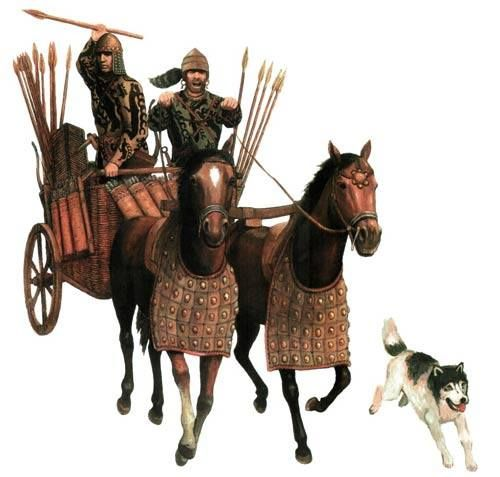
Hayagriva was a Sintashta!


The paper is not out, but since the data has been uploaded they posted the abstract for the world to see, Project: PRJEB44430:

Horse domestication fundamentally transformed long-range mobility and warfare. However, modern domesticates do not descend from the earliest domestic horse lineage associated with archaeological evidence of bridling, milking and corralling at Botai, Central Asia ~3,500 BCE (Before Common Era). Other long-standing candidate regions for horse domestication, such as Iberia and Anatolia, were also recently challenged. Therefore, the genetic, geographic and temporal origins of modern domestic horses remained unknown. Here, we pinpoint the Western Eurasian steppes, especially the lower Volga-Don region, as the homeland of modern domestic horses. Furthermore, we map the population changes accompanying domestication from 273 ancient horse genomes. This reveals that modern domestic horses ultimately replaced almost all other local populations as they rapidly expanded across Eurasia from ~2,000 BCE, synchronously with equestrian material culture, including Sintashta spoke-wheeled chariots. We find that equestrianism involved strong selection for critical locomotor and behavioral adaptations at the GSDMC and ZFPM1 genes. Our results reject the commonly held association between horseback riding and the massive expansion of Yamnaya steppe pastoralists into Europe ~3,000 BCE driving the spread of Indo-European languages. This contrasts with the situation in Asia where Indo-Iranian languages, chariots and horses spread together, following the early second millennium BCE Sintashta culture.

If you ever inspect the domestic horse lineages you will note that they’re a monophyletic clade. They are recently descended from a common ancestor. Additionally, there is a massive skew in stallion lineages toward a few breeders. Ancient DNA has now solved the question of which prehistoric horse population the modern domestic breeds descend from: the horses from the eastern edge of the post-Yamnaya cultural zone.

Agriculture and the Indo-Europeans – Steppe and South Asia

Proto-Indo-Europeans were farmers and not pastoralists

It is interesting to note that while a couple of decades ago and perhaps more, agriculture was not considered a part of Proto-Indo-European culture, it is now no longer the case. It was mistakenly believed that the Indo-Iranians must not have practiced agriculture because apparently the Indo-Iranians did not share an agricultural vocabulary with the rest of the Indo-Europeans (i.e. the European IE). However, more recent research has clearly shown this to be an error and it is now well accepted that the Indo-Iranians shared quite a significant amount of agricultural vocabulary with the other Indo-Europeans, sufficient enough to posit agriculture at the Proto-Indo-European stage.

The overall pattern of agricultural terms has been a persistent topic in IE studies, much of which has been stimulated by the observation that while stockbreeding terms appear to be widespread across the entire range of IE stocks, agricultural terms tend to be confined more closely among the European stocks and are, from a traditional point of view at least, scarce in the Indo-Iranian languages

However,

there is no case whatsoever for assuming that the ancestors of all the Indo-European stocks did not know cereal agriculture. While there may have been speculation in the past as to whether some terms might have applied originally to the gathering and processing of wild plants, terms for the plow, cultivated field, and techniques appropriate to the processing of domesticated cereals whose home range lay outside of most of Europe, suggest that all the earliest Indo-Europeans knew agriculture before their dispersals. (Encyclopedia of Indo-European Culture. Mallory & Adams, 1997).

The term that is cited as the major culprit for this error denotes a cultivated field in European languages while in Sanskrit it simply means a plain.

The second term (*haegˆros) has caused much discussion as the European cognates indicate a cultivated field (e.g. Lat ager, OE æcer [> NE acre], Grk agro´s, Arm art, all ‘field’) while the Skt a´jra- means simply ‘plain’ with no indication of agriculture. This divergence of meaning led to the proposal that the Indo-Iranians separated from the Europeans before they had gained agriculture so that we might posit a pastoral Indo-Iranian world and an agricultural European. Such a distinction is not borne out by the abundant evidence that Indo-Iranians also shared in an agricultural vocabulary… (The Oxford Introduction to Proto-Indo-European and the Proto-Indo-European World. Mallory & Adams, 2006).

the Proto-Indo-Europeans possessed an economy based on domesticated livestock and domestic cereals. Earlier models such as those developed in detail by Wilhelm Brandenstein (1936) that suggested a marked dichotomy between arable Europeans and pastoral Indo-Iranians (or Tokharians) cannot really be sustained (Mallory 1997b) and despite a considerable number of differences there is still a substantial amount of shared agricultural vocabulary between European and Asian languages (Table 1 and 2). While the lists of cognates can certainly be criticized in certain specifics and they may well be an over-optimistic summary, I fear that there would still be a sufficient assemblage of words to indicate that both Europeans and Asiatic Indo-Europeans shared inherited words for both livestock and arable agriculture… (Twenty-first century clouds over Indo-European Homelands. Mallory 2012).

Continue reading Agriculture and the Indo-Europeans – Steppe and South Asia

Hinduism in Afghanistan

An argument has been made that there was no Hindu Afghanistan. This is unfortunately wide off the mark. Afghanistan was not just Buddhist but Hindu and Buddhist and Hinduism was the other major religion of the region besides Buddhism.

The evidence of Hinduism in Afghanistan is quite overwhelming and it begins to appear already during the Indo-Greek period, and continues during the Kushan period, the Kidara, the Hephthalite and the Kabul Shahi period.

The earliest evidence of Hinduism in Afghanistan among the Indo-Greeks is as old as 180 BCE and it comes north of the Hindu Kush for good measure.

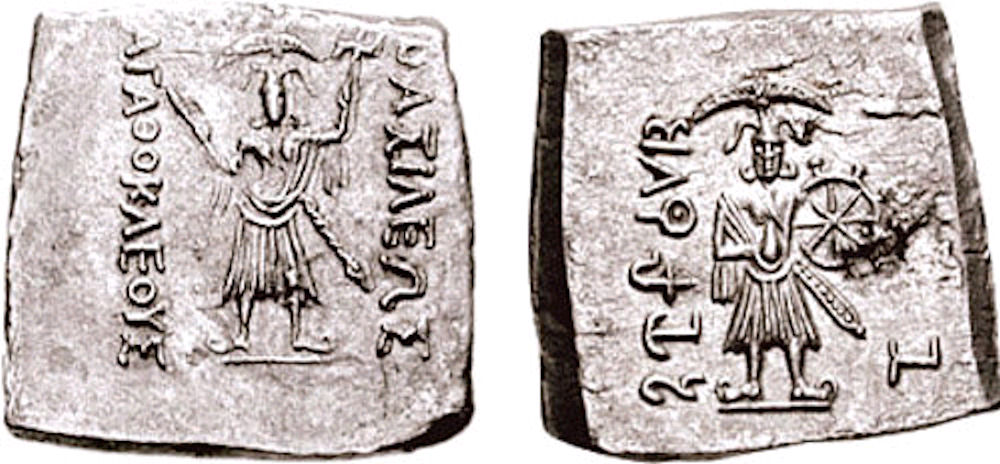
The first known bilingual coins of the Indo-Greeks were issued by Agathocles around 180 BCE. These coins were found in Ai-Khanoum, the great Greco-Bactrian city in northeastern Afghanistan, but introduce for the first time an Indian script (the Brahmi script which had been in use under the Mauryan empire). The coinage depict various Indian iconography: KrishnaVasudeva, with his large wheel with six spokes (chakra) and conch (shanka), and his brother SankarshanBalarama, with his plough (hala) and pestle (masala), both early avatars of Vishnu.[22] The square coins, instead of the usual Greek round coins, also followed the Indian standard for coinage. The dancing girls on some of the coins of Agathocles and Pantaleon are also sometimes considered as representations of Subhadra, Krishna’s sister.

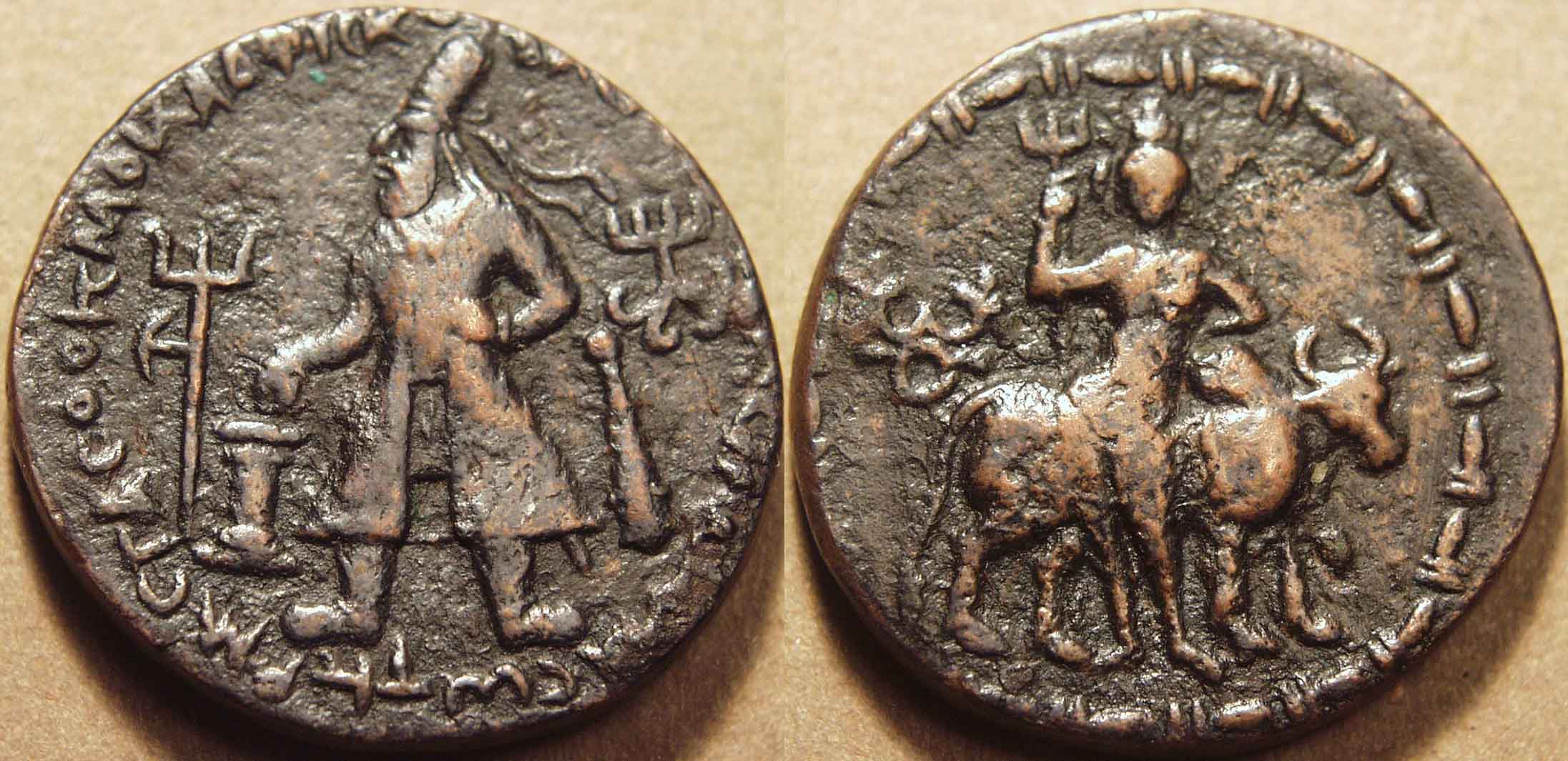
Hinduism is also evident in Afghanistan during the Kushan period. The first great Kushan king or emperor was Kujula Kadphises and he never ruled any territory east of the Indus. Yet he is already shown on his coins as a devotee of Shiva.

Contrary to earlier assumptions, which regarded Kujula Kadphises as Buddhist on the basis of the epithet of the ‘satyadharmasthita’ epithet, it is now clear from the wording of a Mathura inscription, in which Huvishka bears the same epithet satyadharmasthita , that the kingdom was conferred upon him by Sarva (Shiva) and Scamdavira (Candavlra), that is, he was a devotee of the Hindu God Siva. It is striking to see that Kujula Kadphises has already adopted the worship of Siva and the use of Kharosthï script at such an early date.

A coin of Vima Kadphises with Shiva standing before a Nandi on the reverse.


Hinduism was either practiced or patronised by all later Kushan emperors but then they were also rulers of much of North India in addition to Afghanistan and parts of Central Asia. The last of the Great Kushans was named Vasudeva. This is as Hindu as it can get.

The Kushans were succeeded by the Kidarites, after a brief interlude when Sassanians captured Kushan homeland Balkh, who claimed descent from the Great Kushans. The Kidarite or the Lesser Kushans, had little political control beyond Indus or Punjab. But they are credited with spread of Hinduism in Sogdiana no less. Have a look at this –

https://sogdians.si.edu/dancing-shiva/

Although largely faded, the once–bright blue colors used to depict the body of the Hindu deity Shiva still dominate this image. Framed by a decorated arch supported by two half-columns, this complex representation of Shiva depicts the deity with a halo, poised in what some scholars believe is either a dancing or an alidhasana stance, with one leg bent at the knee and the other stretched forcefully to the side.

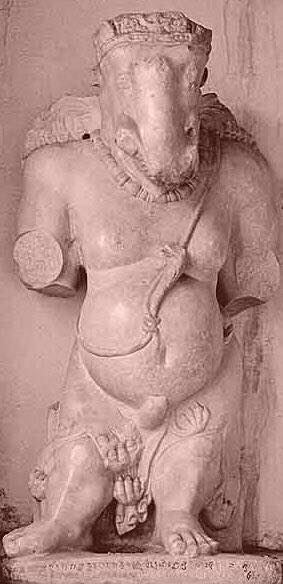
This is a Ganesha statue from Afghanistan which was installed by a king known as Khingila, whose identity is a matter of debate. Scholars speculate that he may have been from the Turki Shahi dynasty but the dating is uncertain and therefore the statue or Murti is dated anywhere between 6th to 8th century CE.

Hinduism lasted in Afghanistan as a major religion right upto the conquests of Mahmud of Ghazni.

The Zunbil and Kabul Shahis were connected with the Indian subcontinent through common Buddhism and Zun religions. The Zunbil kings worshipped a sun god by the name of Zunfrom which they derived their name. André Wink writes that “the cult of Zun was primarily Hindu, not Buddhist or Zoroastrian”, nonetheless he still mentions them having parallels with Tibetan Buddhism and Zoroastrianism in their rituals.

“During the 8th and 9th centuries AD the eastern terroritries of modern Afghanistan were still in the hands of non-Muslim rulers. The Muslims tended to regard them as Indians (Hindus), although many of the local rulers and people were apparently of Hunnic or Turkic descent. Yet, the Muslims were right in so far as the non-Muslim population of eastern Afghanistan was, culturally linked to the Indian sub-continent. Most of them were either Hindus or Buddhists.”

I think this brief information should be sufficient for understanding that Hinduism was a major religion in Afghanistan for at least a 1000 years before the coming of Islam. It is only natural to expect this as Afghanistan south and east of Hindu Kush was always a part of the Indian subcontinent geographically, culturally, politically and genetically.


Afghanistan was never “Hindu”


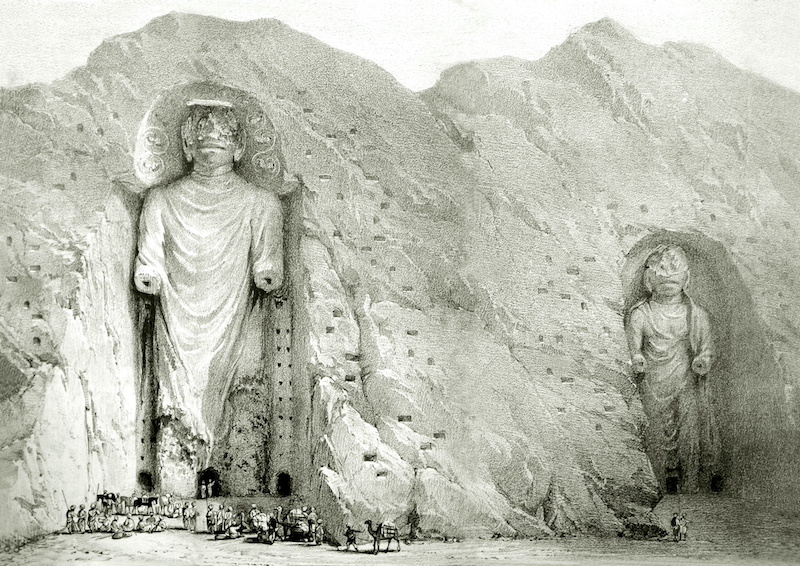
Buddhism and Islam on the Silk Road has an extensive section on Afghanistan. The Bamiyan Buddhas reminds us what the texts make clear: up until 900 AD the highlands in an around modern Afghanistan were heavily Buddhist. The Turki Shahi kings of Kabul seem to have patronized Buddhism. In contrast, their successors, the Hindu Shahi kings, seem to have tilted toward what we would call Hinduism.

Because I’m posting a Substack on Afghanistan soon the civilizational and cultural identity of Afghanistan is on my mind. After my reading and reflection, I’ve come to the conclusion that the area and the people can be thought of as a crossroads between Persian, Central Asian, and Indian. Central Asia includes both Iranic and later Turkic cultures, while the Persian influence reflects a deeply west Iranic sensibility. Finally, it has hard to deny that India and much of southern and western Afghanistan are deeply connected geographically, biologically, and culturally.

And yet some Indians keep claiming that “actually Afghanistan use to be Hindu…” This is false. At least by any comprehensible definition of “Hindu.” It is true that Afghanistan was once heavily Buddhist, but Buddhism is not Hinduism. It is true that there have long been Indians in Afghanistan, but there have been Indians in Southeast Asia as well. It is true that the Iranian pagans, like the Nuristanis, worshipped gods and practiced traditions that descend from one’s affinal to the Vedic Aryans, but the pre-Vedic religion of the Indo-Aryans was not Hinduism as we’d understand it.

To a great extent, this sort of cultural imperialism is harmless and cringe. But it’s a bit on the insensitive side given what’s going on in Afghanistan, where ironically Indian-origin Deobandi Islam is is reigning supreme…

Nepali Brahmins tend to have Tibeto-Burman ancestry


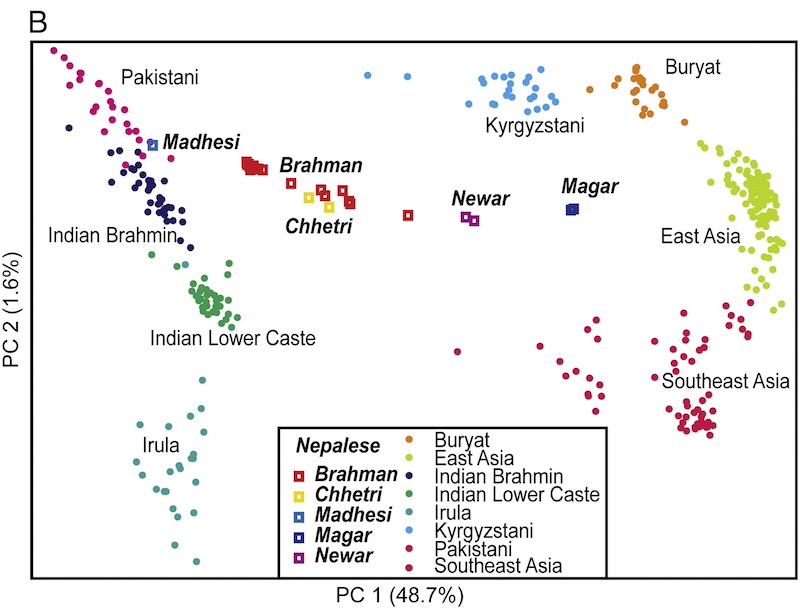
I ran a Clubhouse last night on Nepalese genetics. I said something to the effect that most Nepalese Brahmins have Tibetan admixture. A Nepalese Brahmin came up on stage to tell me this was inaccurate, and that they did not intermarry with native people.

To give the benefit of the doubt I went back and double-checked, and Toward a more uniform sampling of human genetic diversity: A survey of worldwide populations by high-density genotyping, which has a diverse set of Nepalese. What you see on the PCA is pretty straightforward. Except for the Madeshi, who is presumed to descend from recent migrants from India, all the Nepalese are Tibetan shifted.

The rank order is what you’d expect, with the Magar being mostly Tibetan, and the Brahmins being mostly non-Tibetan. But the Nepalese guy was totally full of shit. I’m sick of listening to people contradict genetics when it’s so clear.

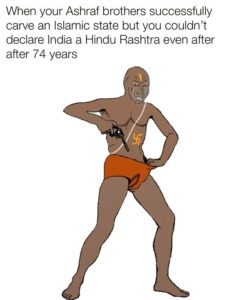
What do Hindu nationalists think of the Taliban? Do they envy them?

I saw theses on some Instagram political meme pages (don’t ask, Herald and Newsline aren’t around and this is how satire gets passed around once the world and the economy make magazines un-viable) and I was left with some questions.

My query was:

Are Hindu nationalists jealous of the Taliban’s success?

How do they really feel about the Taliban taking over Afghanistan?

Brown Pundits