
GoFundMe for Uber Eats Driver Allegedly Murdered by 13- and 15-Year-Old Girls Surpasses $1M. It feels like the 1980s.
Category: Uncategorized
Monkey and the Indo-Europeans
??????? ??? ??? ????-?????????

??? ?????????? ????????
Gamkrelidze and Ivanov, two major linguists hailing from the former Soviet Union, came out with a major book in the 1980s in Russian, where they proposed the Armenian homeland theory for the origins of Indo-Europeans. They made several arguments to support their theory. Many of these arguments incidentally better support an Indian homeland for Proto-Indo-European. One such argument was their proposal that the Proto-Indo-Europeans were aware of the monkey before they dispersed i.e. they knew of the monkey in their homeland.
To put it in their own words –
?????? ??????????? ??????? ????? ??? ‘??????, ???’ ?? ??? ??????? ????-???????? ???????? ???? ?? ???????? ?? ????? ? ????-??????? ????????? ?? ??? ?????-????-???????? ???? ?????. ??? ???????? ???? ???? ??? ?????? ????, ??? ???? ??????? ?- ??? ??? ??????? ??. ???. ????- ‘??????’ … ??. ????? – ????? ‘????-?????? ??????’… ?????. ???, ?? ??? (????. ???), ??? ???? (???. ????), ?????? ???????… ?????. ????? (??????), ????? ‘??????, ???’… ????. ????? (?5?? ???????), ??. ?????, ?????. ??????, ?????. ???, ?????-??. ?????. ??????? ?????.
So we have the cognate word for monkey in Sanskrit, Greek, Germanic, Celtic and Slavic languages of Indo-European.
Gamkrelidze & Ivanov, though arguing that the word for monkey was already known to the Indo-Europeans in their homeland, insist that this word has come into Indo-European languages through their contact with Southwest Asian or Near Eastern languages. They cite Akkadian ukupu, Hebrew kop, Aramaic kopa and Egyptian gjf – monkey, ape as the early examples.
Yet the problem with this theory, as we shall come to it again, is that monkeys are not native to any place in the Near East. The standard theory so far has been that it is through contact with the Egyptians that the Near Eastern civilizations of Mesopotamia, Anatolia, Levant and the Aegean came to know of the monkeys. Therefore, it is from the Egyptian word that the word for monkey in Indo-European and other Near Eastern languages should derive. Yet as can be seen, the Egyptian word is ouite different and looks unlikely to have been the source word for the other languages. Moreover, it now appears that even in Egypt, the monkey may have gone long extinct and was likely imported via the Horn of Africa, southeast of Egypt.
This leaves us with only the Harappan or Sarasvati Sindhu Civilization which is the only Bronze Age civilization whose geography indeed overlapped with the natural habitat of monkeys. So provisionally, it maybe argued that the word for monkey could have come into the Indo-European and the Near Eastern languages from the Harappan language or languages, whatever they may have been.
Digging into the linguistic aspect of this, we find that as per the Practical Sanskrit English Dictionary, the word kapi, usually referring to ‘monkey’ can also mean an ‘elephant’, the ‘sun’, ‘impure benzoin’, ‘incense’, a ‘species of the karanja tree’ etc. kapiloham means ‘brass’, kapishak means ‘cabbage’, kapila/kapisa means ‘tawny, brownish or reddish’ colour, kapana is a ‘worm’ or ‘caterpilar’, kapota is a ‘pigeon’ and so on. As per the Sanskrit Etymological Dictionary, the word kapi is said to derive from the root word *kamp which means ‘to tremble’ or ‘shake’. A derivative word kampra means ‘trembling’ or ‘shaken’ but also ‘movable’, ‘agile’ & ‘ouick’. A likely derivative of *kamp is kap which means ‘to move’. Therefore kapi, in the context of a monkey, may plausibly mean ‘one who moves ouickly’, an apt description.
Looking for the Proto-Indo-European root, we come across a root *kap or *kehp, meaning to ‘seize or grasp or hold’. Possible derivatives of this root include Greek kapane – ‘wagon’, kope – ‘grip,handle’, kapos – ‘garden,orchard’, latin captus – ‘captured, seized, taken’.
It is also said to be the root for the English words ‘hawk’ and ‘captive’ among many others. While the Proto-Indo-European root and its meaning fail to adeouately explain all the myriad different ways in which the derived words are used in various IE languages, for our purpose it is ouite adeouate. kapi may thus be derived from PIE root *kap – ‘to seize, hold’ to mean as one who grasps or can grasp. Monkeys, ouite uniouely among animals, have the ability to grasp things or objects with their forelimbs and this would not have gone unnoticed to the ancient people. This may also explain the name of kapi for elephant since it can also grasp with its trunk, as also the hawk in English since the hawk has a habit to grasp its prey in its sharp talons.
It may therefore be argued that the Proto-Indo-European word for monkey, as argued by Gamkrelidze and Ivanov, is not a loan word but derives from a sound PIE root. We already noted earlier that the word for monkey in the Near East may have been a loanword from the Sarasvati Sindhu Civilization and now we can see that this word is of likely Indo-European origin.
Does this mean, that Indo-European languages were spoken in the Sarasvati Sindhu Civilization ?
??? ?????????????? ????????
Turning to the archaeological evidence, monkeys were depicted on frescoes and seals and objects, accessories were often fashioned in the shape of monkeys. The inspiration for this in Near Eastern art is usually considered to have come from ancient Egypt.
But, it has now become increasingly clear, as this recent study shows, that monkeys or baboons were not native to Egypt either and the ancient Egyptians themselves imported their monkeys from much further south and east, mostly from the fabled land of punt, which is the eastern African coast, and from where incidentally, objects of Harappan origin also reached Egypt.
Viktor Sarianidi, was an archaeologist credited with the discovery of the Bronze Age civilization of BMAC, also known today as the Oxus civilization. He was an ardent supporter of Gamkrelidze and Ivanov’s theory and argued for an archaeological evidence of Syro-Anatolian influence on the Oxus civilization. He believed the Oxus civilization to be Indo-Iranian speaking and therefore interpreted the perceived Syro-Anatolian influence on Oxus in terms of Indo-Iranian migrations from that region, which during that period had various Indo-European groups such as the Mitanni, Hittites and Mycenaeans dominating the landscape.
He also interpreted the depiction of monkeys on Oxus seals as yet another evidence of Near Eastern Indo-Europeans.As per Sarianidi,
?????????? ?? ??????? ??? ????? ?? ????? ???? ???????, ????? ???? ?????????? ??? ? ?????? ????????????…?? ?? ????? ???? ?? ???? ???????? ??? ??????? ??????? ?????? ??? ???? ?? ??????? ?????????? ?? ????????? ?????????? ????????? ?????????. ??????? ???? ??????? ?? ????? ????? ??? ???????? ?? ??? ???? ?? ????????, ?????, ??????????? ??? ????? ??? ?????? ??? ???????? ??? ?????????? ?????? ?? ????? ???? ????? ?? ??????? ?? ????????? ?????????? ?????????? ??? ?????? ?? ????? ?????? ????? ?????? ?? ??? ???? ?? ??????? ??? ??????? ????????.
Sarianidi admits that none of these parallels in the Near East could be dated to earlier than the beginning of the 2nd millennium BC. Sarianidi believed in a lower chronology of the Oxus civilization and therefore found nothing out of place in this. Nevertheless, we now know that the Oxus civilization began as early as 2400 BCE i.e. hundreds of years before the Indo-Europeans begin showing up in the Near East.
Yet if we were to hold onto the parallels Sarianidi draws between the culture of the Oxus and the 2nd millenium BC IE groups in Syria, Anatolia and the Aegean, we have to wonder – is this evidence of Oxus influence on the IE groups of the Near East ? And if so, was Oxus an Indo-European civilization ?
In this context, the monkey iconography also assumes significance. The Near Eastern monkey iconography is unlikely to have influenced the parallel iconography in Oxus since the Oxus dates from an earlier period but also because, the Oxus was culturally close to the Sarasvati Sindhu Civilization where monkeys were found in their natural habitat.
Rather, it is more likely that the monkey iconography of the Oxus influenced the Indo-European groups of the 2nd millennium BCE Near East. Also important to note in this respect is that the monkeys were depicted in religious and sacred imagery both in the Oxus and in the Indo-European Near East which demonstrates the importance that monkeys held for them.
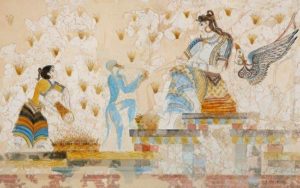
More recently, archaeologists of the Aegean Bronze Age, managed to conduct a multi-disciplinary study of the Minoan frescoes and were pleasantly surprised to find that the uptailed blue colored monkeys were Hanuman langurs of Indian origin. Not only that, these Indian monkeys were found playing an important role in an iconic Minoan frescoes fundamental in the understanding of Minoan religious beliefs and practices. In that fresco, a female attendant in shown giving a flower to the Hanuman langur who in turn in shown giving to a seated goddess.
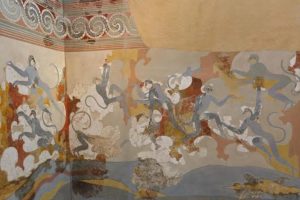
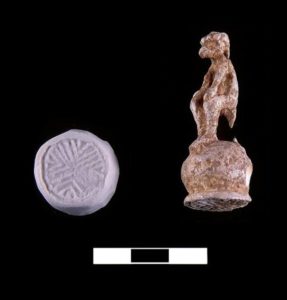
Pareja et al also show that Indian monkeys are also depicted in some other objects found among the Minoans such as a seal made from carnelian, a stone of Harappan origin and also an ivory stamp seal with a typical Harappan cross and chevron motif. The depiction of monkeys on Minoan frescoes is so realistic that Pareja et al argue that the Minoan artist must have seen a real Hanuman langur.
Here we may note that monkeys have been found buried at the site of Shahr-i-Sokhta in Iran, far away from its Indian homeland. Shahr-i-Sokhta is the site from which the majority of Harappan ‘migrant’ samples were published by Narasimhan et al. Thus, Harappan monkeys could well be travelling long distances with their human masters.
We can see that monkeys from Sarasvati Sindhu Civilization went on to become important players in sacred and religious iconography of the Oxus civilization and likely in Eastern Iran and subseouently in the Syrian, Anatolian and Aegean world of the 2nd millennium BCE, in a period when that region was dominated by several Indo-European groups.
??????????
We have seen that the Indo-Europeans knew of the monkey in their homeland and had a word for it directly derived from a proto-Indo-European root and not borrowed from another language group. This would mean that the Proto-Indo-European homeland had direct contacts with the monkeys and not secondary via a non-Indo-European group. This would imply the presence of monkeys in Proto-Indo-European homeland. The only Bronze Age civilization whose geography overlaps with the natural habitat of monkeys was the Sarasvati Sindhu Civilization.
Similarly, we can also see that it is the monkeys from the Sarasvati Sindhu Civilization that likely inspired and played an important role in the religious and cultic beliefs of the Oxus civilization and the Near Eastern civilizations, several of which were Indo-Europeans such as the Mitanni, Hittites and the Mycenaeans.
Therefore, there is strong evidence that it is from the Sarasvati Sindhu Civilization that the monkeys and the word of it became known in the Bronze Age Near East. The sacred role of monkeys is also worthy of note and may have also derived from the Harappans since in Hinduism, a religion majorly derived from the Bronze age civilization of Harappans, monkeys continue to hold a sacred significance.
Since this word for monkey is clearly of Indo-European origin, how does one explain it if the Sarasvati Sindhu Civilization was not an Indo-European civilization ?
Open Thread – 03/27/2021 – Brown Pundits
Been quiet on this blog for a while. Hope the world is quiet?
Did people forget the BP Reddit?
Book Review- Sanghi Who Never Went to a Shakha: Anatomy of Polarization
Rahul Roushan’s book traces his journey from his indifference towards his Hindu religious identity, to his wholesale acceptance of it and his subsequent paranoia of how his religious identity and his way of life are being threatened by forces he believes are inimical to both.
The book, a memoir, recounts his life starting from growing up in small town Bihar, graduating from Patna University, years he spent studying in Delhi and Ahmedabad, working first in the main stream media and then as an entrepreneur.
He employs this re-telling as a vehicle to mark milestones that led to the evolution of his present ideological mooring.
The reader gets a head start on the book from its title.
It uses the words associated with the Rashrtiya Swayamsewak Sangh (RSS), the umbrella organization that’s nurtured the party currently running the central government in India- Bhartiya Janta Party (BJP), Shakha- the smallest unit/meeting of RSS volunteers and Sanghi- a term mostly used as a pejorative in online discourse, to describe people considered radical supporters of the RSS and the BJP.
Growing up in a family with no strongly held religious or political beliefs, Roushan’s religious views were shaped by religiosity displayed by his parents, he describes this as limited to celebrating Hindu festivals, and his understanding of polity and management of religious fault lines via subscription to stories of religious harmony.
Growing up in the Bihar of 1990s, he writes that the prevailing political narrative was of caste and he remained ambivalent of his religious identity. This indifference was never disturbed, although he went to schools run and owned by Hindus.
This was the India of 90s and a middle-class boy was focused on building a career and attaining financial independence.
His views on what each political party stood for shaped by what he read and saw in the mainstream media.
There was no inkling or the mental bandwidth to question the prevalent wisdom of secular and communal credentials of political parties. BJP is communal because the newspaper I read says so.
Roushan writes he was a- Congressi Hindu.
He defines Congressi Hindu as one who notionally religious and accommodative/indifferent to government largess and special rights for religious minorities.
In 2001, Roushan moves to Delhi to study communication at India’s premier Mass Communication institute, Indian Institute of Mass Communication (IIMC).
Here he is exposed to a cross-section of people.
Some of whom are unlike him.
They are deeply invested in their religious identity and hold strong views that are left leaning.
He is also exposed to behind the screen working of main stream media, its ideological biases and how the media uses its power to shape a particular narrative.
He finds a culture, that he claims underplays the role played by Muslim Fundamentalism in fomenting fault lines while exaggerating the role that Hindu fundamentalism plays.
He finds the same pattern playing out once he starts working with a main stream news channel.
This is a decade that sees 9/11, 2002 Godhara carnage and the subsequent riots in Gujarat, UPA coming to power at the Centre and 26/11.
Roushan’s experience of working with a news channel in this decade, studying in Gujrat, Roushan is a MBA from IIM Ahemdabad-closest India has to offering an equivalent of a Harvard MBA, and his stint as a media entrepreneur, Roushan founded the satirical news website Faking News which he sold to one of India’s leading media houses and worked for the media house for a while; shaped his firmly held view that the main stream media, specially the English language, in India for ideological and commercial reasons is deeply biased and staunchly anti-Hindu.
His reading of the manner in which this cohort of media has always covered India and continues to cover it post 2014 election of Narendra Modi, leaves him with no choice but consider them an extension of an establishment.
An establishment Roushan claims that is the inheritor of the British Raj, filled with a set of people who believe in civilizing the native Hindus, is indulgent to Muslim fundamentalists and continues to appease religious minorities at the cost of Hindu and national unity.
The incumbents of this establishment occupy prime positions in and use the institutions of judiciary and media to subvert the elected government and unlike the elected government are permanently entrenched.
By the turn of this decade, like most Indians he discovers social media.
It is here that he finds people who like him have started to question the received wisdom.
He discovers that there are more like him who increasingly challenge the veracity of news reports, what is printed and what is left out of them.
He has a ringside view as leading editors and anchors are found embroiled in cash for votes scam and ‘Radia Gate’ controversies.
The timing of main stream media starting to lose credibility coincides with advent and astronomical growth of social media.
Roushan finds that although grandees that of the old establishment continue to dominate conversation, it is no more a one-way street.
Their bias, incompetence and double standards are called out and their condescending attitude, hypocrisies pointed out.
It is also a place that’s increasingly full of rancor, name calling and deeply polarized on ideological lines.
It is this crowd, of mostly unknown to him participants, he finds fellow travelers, who come together to propel his journey to the corner of Sanghis although he has never been to an RSS Shakha in his life.
The writing is lucid and the book reads like Roushan is in a conversation describing his journey.
For those who follow him on twitter and have read his blog posts and commentary, his ability to explain the underpinnings of ideological stand in simple and easy to understand language should not come as a surprise.
Where the book misses out his lack of any mention of opposite currents.
Surely Roushan met someone in his journey who made a compelling case for why the ‘establishment’ exists and why some one like him should be a part of it.
After all, Roushan went to an institute and worked in a profession that he claims is a happy hunting ground for the establishment.
Then there is the larger point of his book, his commentary on Twitter and through the website he runs.
He blames the establishment for being fundamentalist and a closed shop driven by its hatred for all things Hindu.
How does contributing to an eco-system that is as fundamentalist and as much a closed shop help.
Surely, he does not believe demography can be wished away.
To his credit he has taken the next steps via his work on a Hindu Charter and his writing on a possible way forward.
He does not cover those in this book. Perhaps there is a sequel to this book in works, where Roushan lays out his ideas on role and place of Non-Hindus in India.
In his seminal book Creating A New Medina, Venkat Dhulipala credits the role played by Urdu news media as one of the factors that solidified the idea of two nation theory and helped build the groundswell of support amongst the Muslim population that finally led to partition of the Indian sub-continent on religious lines.
As I read the book, I could not help but wonder if a century later, social media and online journalism is playing a similar role in amplifying and consolidating religious identities, both amongst Hindus and Muslims.
Rahul’s book is a must read for anyone interested in getting a sense of how one side of the ideological divide sees and reads India. With over three hundred thousand followers on Twitter and as a CEO of popular new portal opindia, Rahul’s is significant voice.
It is also a brave voice, for having taken a side this openly and running a news platform he is taking on the political opposition and burning all bridges within the media fraternity. I for one do not rule out the possibility of an Arnab redux happening to him if the present government is voted out.
Through the book Rahul also brings out the story of how India is changing.
Not too far ago, a boy from small town India would have found it virtually impossible to make a career in media without being employed by one of the bigger media houses, let alone being a meaningful influencer, MBA from IIM Ahmedabad notwithstanding.
They may still not easily get to write for columns for foreign newspapers, work for think tanks, participate in track 2 diplomacy or teach at liberal campuses, but they are shaping the discourse and our politics far more easily and more effectively.
Open Thread – 03/20/2021 – Brown Pundits
What’s going on? Lots of “brown” chat on Clubhouse.
Musings of a Shinto Rishi
I came across this wonderful interview with Florian Wiltschko, an Austrian Shinto negi (priest) based in Japan courtesy Akshay Alladi. I was struck by some of the similarities in Wiltschoko’s worldview and my own sanskaras- the approach to life I was taught by my elders, particularly my mother.

“[Japan] is rich and the seasons colour the natural landscape in beautiful ways. Maybe that’s why a monotheistic belief system did not evolve here,” he says. “The bounties of nature, on the other hand, were seen as being the workings of divine forces that needed to be respected and cared for.” This struck a chord. It’s a very Dharmic sensibility and worldview.
There’s also the challenge of adaptation and change, without losing the essence. Incorporating good ideas, discarding the bad ones, but all the while maintaining the core spirit. Wiltschko’s observations are based on the interactions between Shinto and Buddhism, but the same would seem to apply to modern Hinduism, which has over the centuries blended Vedantic and Shramanic metaphysics with folk tales and traditions. It’s a complex mélange and trying to describe it precisely to non-Indians reminds me of the parable of the blind men and an elephant.
What is noteworthy about Wiltschko is that he is a priest by profession. In my compartmentalised mind, there are gurus/yogis and then there are pujaris/purohits/archakas. The former are philosophers and the latter are pedants. There is some experiential basis for this, but perhaps some of it is also a function of my own biases. I “lost” religion in my teenage years through my twenties and identified as an agnostic classical liberal, only to “rediscover” it in my thirties. The religion that interests me is still quite rationalistic: a Vendantic Monism based principally on the Upanishads and the Bhagavad Gita, with an interest in Buddhism, Kashmiri Shaivism and Yoga. It is certainly not ritualistic. Temple visits are only to admire the architecture. The privileging, as it were, of jnana marga (the path of knowledge) over bhakti marga (the path of devotion).
But perhaps there is wisdom in customs and rituals too. There need not be a neat bifurcation between the high philosophy and the riti-riwaj. Jnana marga and bhakti marga are not mutually exclusive.
“It’s very important to maintain a positive inner spirit,” Wiltschko signs off. “You might say that it’s my mission or my calling to contribute to maintaining this spirit.” The words of a modern Rishi.
[The writer tweets @paragsayta]
Caste in America!?!?! Don’t believe the hype
Everyone is talking about this piece from Bloomberg, How Big Tech Is Importing India’s Caste Legacy to Silicon Valley Graduates from the Indian Institutes of Technology are highly sought after by employers. They can also bring problems from home. If you are not a Bloomberg subscriber using “incognito mode” in your browser should allow you to read it. Two comments:
– The piece is mostly about India. Not the USA or Silicon Valley. To me, this indicates there wasn’t much real material in Silicon Valley to report on
– It seems that the American press is recycling the same incidents and quoting the same experts. There’s no deep scholarly analysis, just anecdotes and assertions
Overall, I think there really isn’t much of an issue around “caste” in the USA. Part of it is the fact that Americans of Indian origin are not representative of the demographics of India. 25% are Brahmin, but for the other groups, there is no variation in income education and income (or not much). I’ve seen the data that consulting firms use that is not widely shared. The selective sieve is strong. There are very few self-identified Dalits. About 1%. It could be these Dalits are on the receiving end of prejudice, but there aren’t that many of them for this to be pervasive.
This is not to deny that there aren’t issues with the Indian American community, which is mostly immigrant and dates to after the year 2000. But it’s not a simple and easy morality story that the media and social justice activists want. So they are manufacturing this, and that really angers me, because I dislike lying and propaganda.
Open Thread – 03/13/2021 – Brown Pundits
A long (paid) piece on Substack, They came, they saw, they left no trace…
except for all of Western Civilization. This is about the genetics of Italy.
My usual 7 PM PDT Friday night chat on Clubhouse will be about the genetics of Italy (Saturday morning India time). this link should work (if you are on an iPhone click it).
What Can Biden’s Plan Do for Poverty? Look to Bangladesh. The usual Nicholas Kristof thing. That being said it is interesting that when there is talk about Bangladesh’s economic success (relative), a fair number of Indians point out major issues (reliance on the single sector for export). This is all fine…but honestly, it feels l ike sour grapes. In 2020, a horrible year, Bangladesh was #3 in growth in the world (and the fastest large nation).
Going to do an interview with a linguist who studies Proto-Indo-European for my podcast. Interesting how his papers suggest Indo-Iranian and Balto-Slavic are a clade. R1a FTW!
Update: Someone on the Subreddit found the archives of the original BP site from 2011/2012 (I have the archives in MySQL but haven’t loaded them; we suffered intense hacks from Hindutva in 2012/2013 so moved to blogspot for a while).
Also, BP got a Clubhouse Club! So we’ll do chats there soon.
Political correctness is “just politeness” (for your friends)
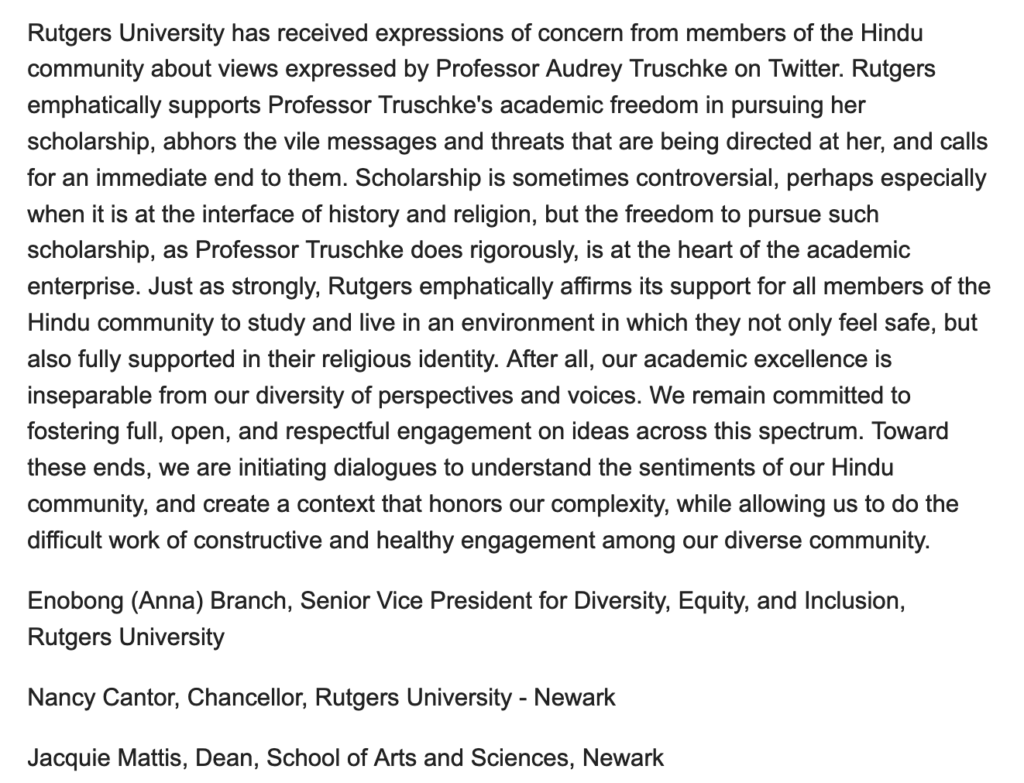
Audrey Truschke is mixing it up again with the vilest dregs of “Hindu Twitter”. In response, I tweeted “For my friends everything, for my enemies the law.” What did I mean here? Rutger’s unequivocal defense of academic freedom, even unto trolling, shows their hand in terms of whose feelings they value.
You can go to the FIRE website, but if you know modern American academia you know that the administration does not care about academic freedom when push comes to shove. The regnant ideology in modern left cultural discourse is that “the feelings of marginalized people/communities” trump “objectivity” and “truth.” Rutgers’ general statement is one I agree with, but I’m a 20th century “liberal.” Rutgers is not a place for 20th century liberals, nor is academia in general.
What this illustrates is that the American left does not think it needs to be “polite” to Hindus. Their feelings don’t matter. Perhaps the Central Committee of the Inner Party has a list of marginalized communities, and Hindus were left off. I don’t know.
Suffice it to say this is total hypocrisy. If Truschke’s career involved wrestling with Muslim trolls online they’d find something more ambivalent to say. Even with tenure universities can fire professors on pretexts as well. They choose not to. They choose the law. Because Hindus are not their friends.
Addendum: The fact that many “internet Hindus” behave like vile cretins with subnormal IQs does not help. But I don’t think this is the main cause. First, many people who are “against” “internet Hindus” who are Indian are quite vile and exhibit subnormal IQ online (my experience with Jat Sikh anti-Hindutva racists is the exact same as with Hindutva trolls; Indians online tend toward troll behavior more than other groups). Also, Truschke offends many more conventional and humane Hindus, but their feelings do not warrant obsequious submission.
West Asian ancestry in South Asian Muslims
Recently a Bohra Patel emailed me to express some exasperation that people are quoting me saying that the ancestry of South Asian Muslims is almost all from Hindus (or non-Muslims). Basically, I say things like this “99% of the ancestry of South Asian Muslims is indigenous.” This means some people are going to be 75% indigenous, but the majority probably have no West Asian segments of DNA. This does not mean they don’t have a genealogical line of descent. I myself am ~100% South Asian if you look at my genes…but my maternal grandmother’s father was from a lineage that had migrated to Bengal in the 19th century from Delhi. Before they were in Delhi they had left Persia in the 17th century with the forced conversion of the whole religious class to Shia Islam. This is validated through a Koran with all direct male line descendants listened. I am not one of those descendants (my maternal grandmother is not “in the book”), but I’m pretty sure my distant cousins who are paternal descendants no longer have any detectable Iranian ancestry either. Why?
The reason is that eight generations back there is only a 50% chance that you will any segment of identifiable DNA from an ancestor. Another way to say this is that 200 years ago you had many ancestors, but there’s only a 1 out of 2 probability that you will have identifiable DNA passed down through the generations from that person. Since my Iranian lineage (a man who left Iran, settled in South Asia, and married into the South Asian Muslim community) dates back 350 years, it’s totally unsurprising that there’s no evidence that isn’t documentary at this point.
In any case, I’m looking more closely at the assertion I made above. I ran a supervised analysis on some samples. You can see the results below. I’ll probably do f-stats too…but that takes a while to run. I may ‘update’ my estimate from 1% to closer to 5%, though I’m not convinced. The Bohra Patel is in the sample, it’s clear they are enriched for “Yemenite Jewish” ancestry. But, even with 200,000 markers, there are Hindu individuals that are 1-2% (Tamil Brahmin) because of the way the model is set up.
Really what’s needed are huge Y chromosome panels. Since that’s an unbroken lineage, and the gene flow is mostly through men from everything we know.
But the real problem is Iranian ancestry because there is something of a “cline” in the northwest of the subcontinent. How exactly are we supposed to detect Iranian ancestry in Punjabis that is recent? Ultimately it’s going to have to be IBD segments in large panels.
That being said, there is an indirect way to detect Muslim West Asian ancestry: look for Turkic and African segments. These come from Muslims, and so can serve as a tracer that is much more distinct from the Indian genetic landscape.
Finally, the flip side of these comments about the minimal impact of West Asians on the genes of South Asian Muslims is that it should make us more skeptical of the arguments of some Hindu nationalists and Muslim fundamentalists about how brutal the Turks were. I’m sure they were brutal…but they didn’t leave much of a genetic impact on Muslims, let alone Hindus. Most people were likely pretty insulated from the predations, probably because cities were demographic sinks anyhow.