Browncast – Cliff Smith and Sam Westrop: The Origins of South Asian Islamism

Another BP Podcast is up. You can listen on LibsynAppleSpotify,  and Stitcher (and a variety of other platforms). Probably the easiest way to keep up the podcast since we don’t have a regular schedule is to subscribe to one of the links above!

You can also support the podcast as a patron. The primary benefit now is that you get the podcasts considerably earlier than everyone else. This website isn’t about shaking the cup, but I have noticed that the number of patrons plateaued a long time ago.

This episode features Akshar and Mukunda talking to Cliff Smith and Sam Westrop of the Middle East Forum. We get into topics surrounding the relevance of the Deobandi movement, how Islamism percolates between South Asia and the West, and the political ramifications of Islamism in the US and the UK.

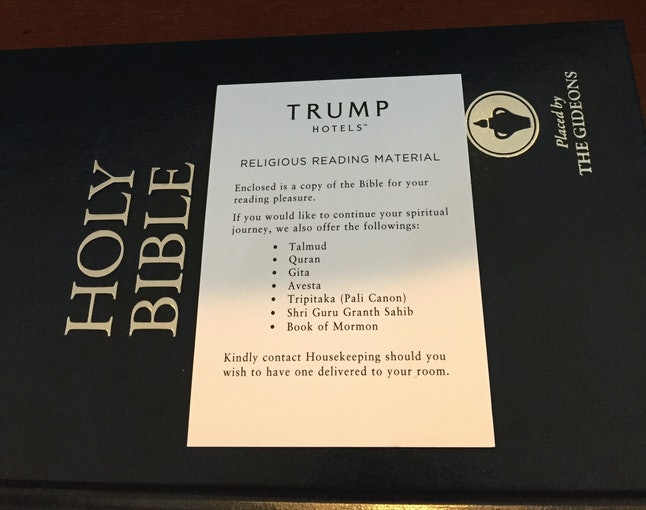
Religious books in Hotel rooms

Going through my photo archives for a photo blog I plan to start, I remembered a thing which had struck me as weird during my travels in Kenya. Being interested in travel and wildlife, I have stayed a lot across hotels and resorts in India. Outside India I have been to Singapore, Bhutan and Kenya. But only in the resorts in Kenya did I find religious books in hotel rooms. I found the Bibles/Quran placed in the top drawers of the bedside table extremely funny, surprising and slightly unpalatable. I did some reading – here here and was surprised to find this being a norm in United states. I still cant understand the reasoning behind placing religious books in hotels – especially wildlife resorts like Serene Lodge in Maasai Mara (which had Quran as well as Bible I guess).

Serena Lodge in Maasai Mara

Funnily the top drawer often reserved for these religious books (based on my experience in Kenya) is the best place for keeping your condoms IMO (next to the books which are clearly anti contraceptive). Apart from that why would holidayers who cant spend a day without their scriptures travel without them? I suppose for people who are this religious, there would also be an emotional connection to one’s one set of scriptures and they wont feel the same way about some other copy (my presumption). In India most you find in Indian resorts are religious symbols like Om and Shree and even they are extremely rare (non existent in nature and wildlife resorts). Finding copies of Vedas or Bhagwat Gita in hotel rooms seems incredibly funny almost unimaginable to me. Even in the pretty catholic goa, none of hotels I have stayed in (even in Portuguese Goa) had bibles in rooms. Why would someone going to the top wildlife destination in the world spend time reading scriptures instead of enjoying the resort is something beyond my humble irreligious (and Indian) mind to fathom. I don’t necessarily put the blame of this practice on the evangelical zeal as many hotels claim to provide most popular religious scriptures.

This brings me to a larger point about lack of understanding of other cultures and histories (which Razib likes to point) in Indians (as well as all other cultures). If understanding of different cultures is so poor even in the internet age, during the age of exploration there would have been a far greater gap which is clearly visible in most colonial literature. This makes the criticism faced today by sincere western scholars like Asko Parpola and Sheldon Pollock (who do have understanding of the Indian culture) inevitable. Example of similar things are even visible when English speaking journalists from India make televised journeys into the hinterlands. Here I come to some questions for the readers.

How should people foreign to cultures they’re studying, view them? and Is the criticism of them as ignorant of culture and hence partial in their scholarship fair? (Despite them being scholars of lets say Sanskrit and History in Indian context)

What could be a logical explanation for the practice of keeping religious books in hotels (apart from evangelical zeal) ? Some people have made argument of loneliness and suicide but I find those extremely tenuous.

What are some of the other practices prevalent in foreign cultures that can be unfathomable to an outsider ?

Pakistan and India: Why Did They Diverge?

@FrankBullit67 is a well-read Rajput from India, and an active presence on Twitter. He composed a thread on partition and his view of why India and Pakistan have diverged in many ways since independence. I tweeted it with the comment that it was interesting, but I may not agree with all of it. Which led to several people asking me “what do you disagree with?”. I had not really thought it through, but here is what I came up with; Frank’s tweets are combined into paragraphs and any comment I may have is under the tweet in red. (1. that India and Pakistan have not diverged as advertised here is another possible argument, I skipped that for now, and 2. everybody forgets Bangladesh, which fact was nicely summarized by @shivamsethi01 and i have attached a screenshot at the end of this post).

Frank: I was going to do a thread on Partition in the form of a historical chronology – I think that can wait. I’ve decided to do a thread which is more “philosophical” and on “principles” about Partition. So here goes. As we know, “partition” carved two countries out of one in 1947. One with a Hindu majority (~85% Hindu in 1947 but now 79%). The other with a Muslim majority (over 90% Muslim in 1947 – even more skewed now).

The process was extremely bloody resulting in over a million deaths (some think the figure could be two million).

For those who are unfamiliar with the scale of the carnage, it is worth Googling Margaret Burke-White’s pictures of partition for LIFE Magazine (see here).

Indians, Pakistanis and Brits can keep arguing for centuries about who was responsible for what but that’s another subject. The purpose of this thread is to concentrate on what I think is the key philosophical divergence between Hinduism and Islam which made violent conflict or a “partition” unavoidable. Although one can write an encyclopaedia on the theological differences between the two Faiths, the key difference to me is on the question of “Blasphemy”. Broadly, Hinduism has had atheists in the mix for millennia (or those with a weak adherence to faith or those who have created new sects). This was never punished. As a result, Hinduism, Jainism, Buddhism and later Sikhism lived next to each other for millennia or centuries despite enormous theological differences. Continue reading Pakistan and India: Why Did They Diverge?

Troubles and politics of the billionaire author

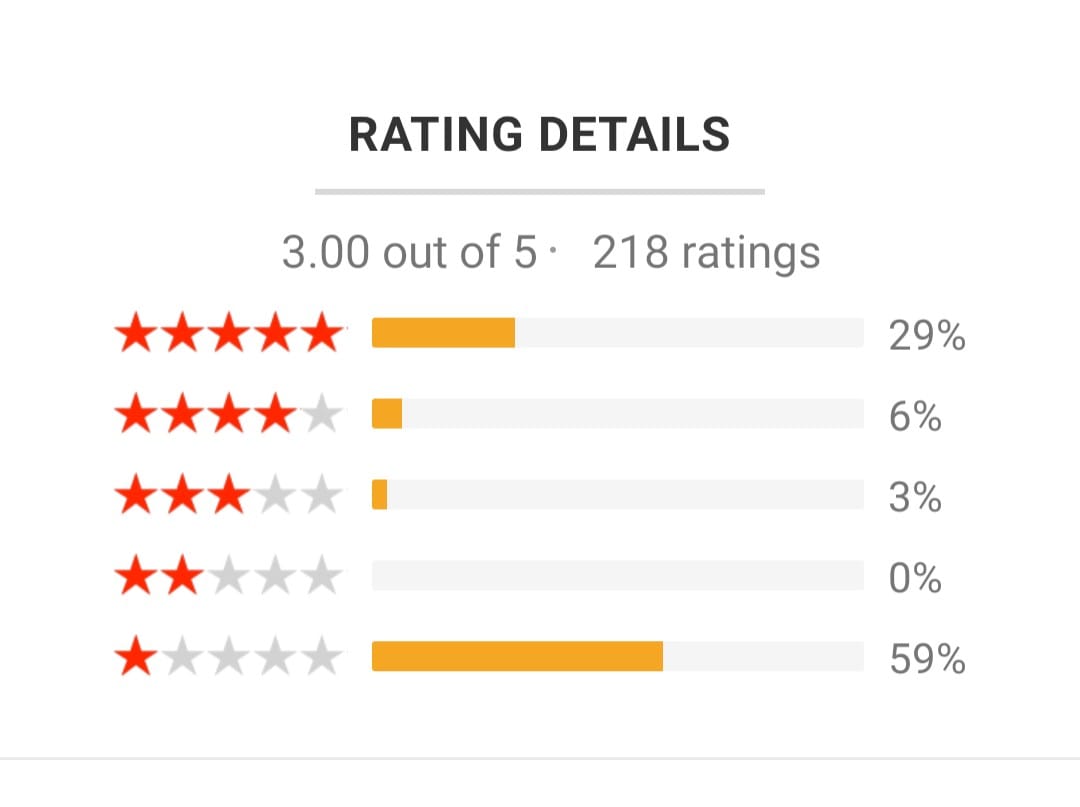
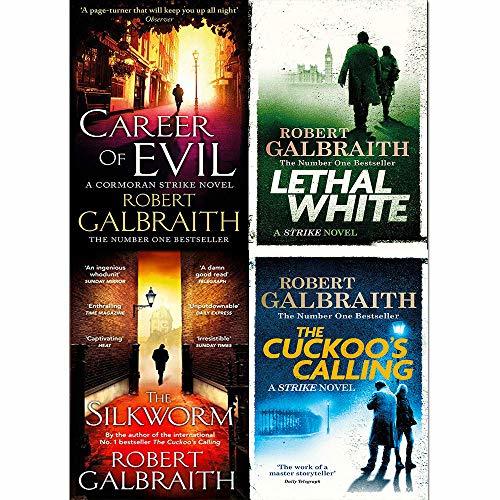
The current outrage storm over JK Rowling’s latest book – the Troubled Blood is not unexpected given the trans-related controversies that have surrounded JK Rowling since December last year. For more on the issue, these pieces on Quillete are good. Link Link. Unwilling to back down in the face of abuse, threats of canceling, Rowling stood firm and wrote a long essay explaining her position here. (I strongly recommend this essay). As expected after the publication of Troubled blood, there was a social media storm with #RIPJKRowling. trending. Prima Facie I was sure that people who had been trolling and attacking the billionaire author were doing so ad hominem without reading the book. Being a fan of Rowling, I was going to eventually read the book (i have read all the earlier four Strike books) but this whole storm made me buy and read the book before commenting on the issue. When I started reading the 888-page book the Good Reads reviews of the book on the day of its release stood as follows

Troubled blood is a long mystery/romance/drama book that runs considerably longer than the average book. While the book isn’t what I would call flawless, but if you are invested in the primary characters by now – you will love the book. The core of the book is an almost impossible cold case (a 40-year-old case of a missing Feminist General Physician), the detectives – Strike and Robin are trying to solve. The issue the trans activists seem to have taken up is that a serial killer suspect in the book is known to disguise himself as a woman to get close to his targets (who were all women). The character of this serial killer is based on 2 real-life serial killers as posted by Rowling herself on her Robert Galbraith website.

 a sadistic serial killer active in the 60s and 70s, who was loosely based on real-life killers Jerry Brudos and Russell Williams – both master manipulators who took trophies from their victims.

This character is not a Transsexual. Even his cross-dressing is not given as his only tactic for appearing harmless. Aside from this, the serial killer himself is not the primary focus of the book, but a specter who looms behind the narrative due to his psychopathy not his occasional passing off as a woman. There is no trans character in the book – may be in near future even that will be called transphobia. Additionally, the only Trans character in the Strike series was a character named “Pippa” in the second book of the series – The Silkworm. That character has been dealt with very sympathetically on that occasion with her abuse at hands of men not trivialized or brushed aside. How JK Rowling gets to be a Trans-Phobe after this, this points to the deeper problem in the SJW activism – the tendency to self cannibalize. Examples like these (attacks on Steven Pinker, JK Rowling, Green Greenwald) appear eerily similar to what happened in Pakistan these last 70 years (From Hindus to Ahmadis to Shias). If societies are formed on such principles – shifting goalposts appear a natural outcome.

The Strike Series has always had political commentary in the background – but these things hardly got any attention in the first three books. The Second book – The Silkworm is getting panned retrospectively for being Islamophobic after the publication of the 5th book. This seems really funny because Rowling has been fairly active on twitter against what she herself perceives as Islamophobia. Maybe it is her consistent stance when it comes to calling out Corbyn for Labour’s Anti-Semitism that has taken away her brownie points for calling out Anti-Muslim bigotry. Her fourth book of the series was particularly political – as Rowling caricatured both the right and the left equally in the Lethal White. She appeared pretty harsh on Antifa type protestors/activists in the Lethal White. Troubled Blood has certainly got a lot of politics in it. The book references the bloody Partition of India from an Indian POV with references to Suhawarty being complicit in the 1946 carnage. The book also touches Scottish and Welsh nationalism (Rowling a Scot, was a strong Remain in the UK advocate and well as Remain in Europe advocate) and manages to humanize the nationalism of the Scots and the Welsh while critiquing it. However, the strongest political message of this book has to be its argument in favor of the 20th-century Feminism. Both the protagonists are feminist in the older definition of the word, which at times seems to be at odds with the 21st-century feminism. Rowling’s feminism which comes across in the book is much more focused on

  • fighting for female safety from sexual and violent crimes.
  • fighting for female control over reproduction and sex
  • fighting misogyny faced by career-oriented women

Rowling like her protagonist, Robin Ellacott is a survivor for violent and sexual crimes. Her psyche and motivations are mirrored a lot in Robin, which has especially come to the fore in the last three books. Of all the characters Rowling has brought to life, Robin Ellacott is the closest to her- an intelligent and independent feminist who is slightly left of center politically. Rowling like Robin continues to be influenced by the violence faced decades ago. It’s this experience and consequent political priorities that have led Rowling to champion physically safe spaces for women (bathrooms and changing rooms). Western Left must decide which TRENCH they are willing to die in. When most polls show that the overwhelming public is not comfortable with transwomen using women bathrooms, taking a radical stance will be laughable and outright stupid.

From India, at least this debate appears a non-starter in the priorities plaguing India – but that hasn’t prevented Indian Left jumping on the AntiRowling bandwagon on twitter with Varun Grover calling her a Prisoner of Patriarchy. I guess Grover feels he has some stake in the debate after him helping bring Kukoo to life in Sacred Games. Would “Gaitonde being able to transcend Kukoo’s biology for love” be something that’s expected from every heterosexual man or a lesbian woman? According to Rowling and other Gender critical folks, that’s already the case in the west :

However, as Magdalen was a great believer in the importance of biological sex, and didn’t believe lesbians should be called bigots for not dating trans women with penises,

In this woke world view, even a sexual/physical assault survivor is lower down the oppression hierarchy and hence a TERF as they simply can’t put their own priorities above the rapidly changing commandments of the woke mob. All the prior brownie points Rowling had earned on the left due to her politics, philanthropy, and personal story are annulled when Rowling came out as Gender critical. If a person with as liberal credentials as Rowling can be hounded or canceled like this then I shudder to think what conservatives must be thinking in the west.

By virtue of her previous success and fan following, JK Rowling is a type specimen of what one could call Un-cancellable. But by the avalanche of the attacks she has faced (even from people who owe their careers to her), it is fair to say the position of lesser writers would be extremely tenuous if they choose to be non-conformist. Most of the criticism of Rowling is so stupid and spurious it is not even a classic strawman in my view.

All biological interventions like Breast enlargements, Botox, or Transitioning Sex are not interventions anyone should rush into. Isn’t it fair to raise the point that the Ease with which Sex change is offered to impressionable teenagers is risky? Are these activists sure these teenagers won’t regret these changes which in many cases have a long term effect on one’s body? There has been a lot of research that can make a lot of Woke activists uncomfortable. Should we just sweep that under the rug or make it the elephant in the room? There have been dozens of instances of de- transitioning and a lot more where people continue to regret transition. I expect this debate to continue violently as parents will not want to take chances when it comes to their kids – even under the pressure of the woke people.

This discussion comes to something I discussed with Omar and Mukunda when we talked. For long I have loudly wondered whether it’s Islam the Rock that has broken liberalism as our own Dr. Omar as put so eloquently. Now it seems the Trans-debate and other Woke Dogmas have surpassed the challenge to liberalism posed by Islam. It can even be speculated that the liberal order itself without emphasis on its core tenets was never robust internally and was bound to fail especially after the vacuum left by the withdrawal of religion and nationalism.

Post Script:

I have been a huge fan of JK Rowling for 2 decades. It was her writings that introduced a video game & television addicted 11 year old to the pleasures of the written world. It wouldn’t be a stretch to say that Rowling has changed the lives of thousands of other kids like me. 

a few links about detransitioning: Link Link Link


Open Thread – 09/19/2020 – Brown Pundits

The comments are open(ish).

Finished India in the Persianate Age. This was a much more fluidly written book from Eaton than other stuff I’ve read from him, probably because the Mughal narrative “writes itself.” Recommended.

Probably will take reader advice and focus more on “primary sources” from now on. Though finding good translations is always an issue then…

Also, check out the podcast with Matt Yglesias. And another one with Anand Kadali on hunger in India.

America has been good to immigrants and we should be honest about who we are

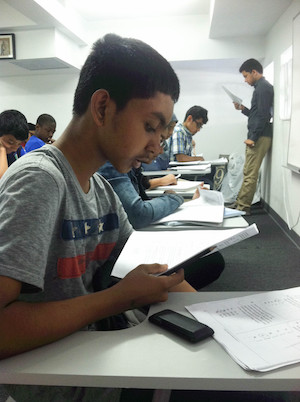
Bangladeshi American teens preparing for NYC selective school admissions exam

Since there has been rather persistent confusion about my Unherd piece I will clear up a few things. I am rather tired of talking about it now, as I “said my piece”, but sometimes things need to be done.

First, for many months (years), friends of various backgrounds (brown and non-brown) have been speaking to me of the issue of very self-righteous South Asian American (Indian, Pakistani, and Bangladeshi) “social justice warriors.” There’s nothing wrong as such being a social justice warrior and brown, but, the problem is that these individuals often accrue to themselves the full-weight of colonialism and centuries of oppression to add to their credibility and authority.  The reason I finally punched out the Unherd piece is that an Indian scientist who I am familiar with made a reference to trauma and oppression on Twitter. This resulted in many “likes” and praiseworthy comments. It was a vague and amorphous statement and could mean anything, but the response made it clear that most people took it to be that they were alluding to the weight of colonialism and racism.

The problem I had with this is I know that this individual, a Brahmin raised in India, is from a literally rich family. Rich enough to pay undergraduate American tuition for international students in full. And, rich enough to pay graduate school tuition when otherwise this person would have to take up a teaching assistantship. This is not a person who is well-off in the Indian context. They’re well off in the American context.

This is an extreme case. But it illustrates a more general problem. People who by dint of their brown skin claim to be, or allow people to believe they are, marginalized and oppressed. The vast majority of brown Americans can tell you stories of racial discrimination and prejudice. That is true. But are these experiences determinative in their lives? Does their race define and limit them in a deep and powerful manner?

I would argue not. Today the Americans of brown background are flourishing. Indian Americans in particular are socioeconomically advanced, and now, becoming culturally prominent. Just like their white upper-middle-class peer, Indian Americans are benefiting from the system, and flourishing within it. Their realized outcomes are very different from African and Latino Americans. Some of the same is also applicable to poorer newer ethnic groups, such as Bangladeshis, who begin much lower on the socioeconomic ladder but are placing their children into elite public schools like Stuyvesant.

Second, selective immigration from India has resulted in a very atypical Diaspora. Many who responded to my piece argue that selective immigration is the whole story, so why bring caste into it? Because the criteria used have skewed the India Amerian community in a way where it is not representative of India at all. I am personally not bothered by this. But again, when issues such as caste oppression come up in the USA, non-Indians may not realize when talking to Indian Americans that they will almost never interact with a Dalit, who are 15% of India’s population (one could argue that except for Gujarat the “Cow Belt” is also totally underrepresented due to the way immigration has worked). Many Brahmin Indian Americans I know are vociferously against caste (sincerely, and in their actions!). But to me, this is a laudable idealism, not something that comes out of historical brutality, because their ancestors were willing executors of the system. In this way, they are like upper-class white people who wish for a more egalitarian economic system. Their views are sincere, but it comes from idealism, not trauma.

As a brown person from Bangladesh people who knew where I was from would always make assumptions about my background, as Bangladesh was the byword for incredible poverty for the second half of the 20th century. Those that did not know my family was of professional background would ask naive questions, such as “did you grow up in a hut?” I found it amusing, but I did make it clear that I couldn’t personally speak to the poverty and deprivation which were such serious concerns for everyone about the country of my birth. In Bangladesh, I was a very privileged person. In my day to day life in the USA, this was irrelevant, but I wasn’t going to go around speaking with authority about how horrible grinding Third World poverty was. It was just in many ways just as abstract for me as it was for my white classmates. Honestly, if I did grow up in a hut I’d probably brag about it since it would make my Horatio Alger story so much more inspiring.

Overall, the point of the piece is that when you make identity so important to the content of someone’s arguments and the force of their views, it creates a massive incentive for individuals to cultivate and shade their identity to add credibility. Ergo, a Nigerian American whose family is wealthy from brutal oil extraction which results in human rights violations and crimes in their ancestral homeland will likely not expose this fact when castigating a middle-class white American about their “white skin privilege.”

Brown American should just accept what they are in the main: a relatively privileged people from whom America works, who have to deal with some incidents of racism in their lives.

About Brahmin Privilege: Education, Brits and Chitpavans

This post is result of some comments in the Open thread in response to Razib’s piece in Unherd. While i agree with core of Razib’s argument & and some comments, i feel there isnt enough nuance about Brahmin privilege that comes out in discussion these days. Some assertions of comparing Brahmins to White slave-owners  are too simplistic and even terribly wrong. (I dont imply Razib or others on BP made those)

The problem with simplistic narrative of Brahmin “privilege” is that it focuses on caste as a privilege while not focusing on concrete privileges which are often correlated with Varna in India. Following are the salient privileges of Indian public life

  • WEALTH including Lands – Moderately correlated with caste but with some mismatch. Most Brahmins who had lands, lost them in the Land reforms of 20th century though. (even though one supports the land reforms in principle the confiscation of land cannot be brushed aside)
  • EDUCATION – highly correlated with caste ; Brahmins score considerably higher on educational parameters for centuries. This post focuses on Education as a historic and inherited privilege.
  • CONNECTIONS – related to politics – here ordinary Brahmins aren’t necessary up in the top percentile.
  • URBAN BACKGROUND – (more Brahmins/UC are urban dweller though some continue living in rural backgrounds).
  • GENDER.

This post focuses on Educational attainments of Brahmins (particularly Chitpavans) in Pune region. The quotes and tables are from a booklet A survey of the Chitpavan Community in the pre colonial state

For the British, Education was an instrument of efficient colonization as seen from the words of Sir Erskine Perry,  the Governor of Bombay Province subsequent to Lord Elphinstone. He maintained

“Only the higher castes should be educated because of the limited facilities, therefore only limited members could be educated. These higher castes through their natural influence would affect an elevation of mental and moral condition of the masses. Four groups were identified under this category of high castes the military and administrative class of Landowners, Jagirdars, Chieftains, petty nobility and feudatories, wealthy traders and other commercial men; government employees; and Brahmins and other
higher writer castes”.’

The Maratha empire employed a number of upper castes (Brahmins, Kayasthas and some Marathas) in positions of administration and accounting. On arrival, the Brits picked these up as administrators, teachers, clerks etc. The literacy of the males of these subcastes in Bombay presidency was extremely high. Chitapavan males in a Pune Taluka are reported to have 90% literacy in late 19th century as compared to 11.9% in average males. This extreme bias cannot be explained without the Peshwai & the privileges the Chitpavans enjoyed because of it. 

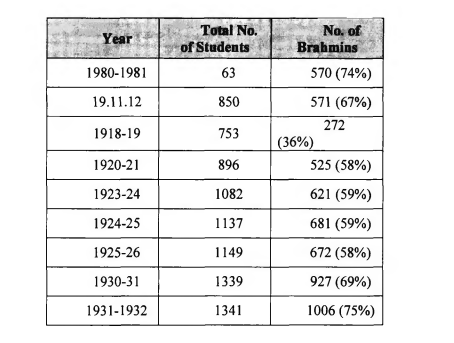
A variety of education institutes like Maharashtra education society, Deccan Education society started in Pune in the 19th century. Brahmins were the prime movers as well as the overwhelming beneficiaries of these institutions. Lets see a few examples:

Reports of the Poona Native Institution published from 1881 to 1933.

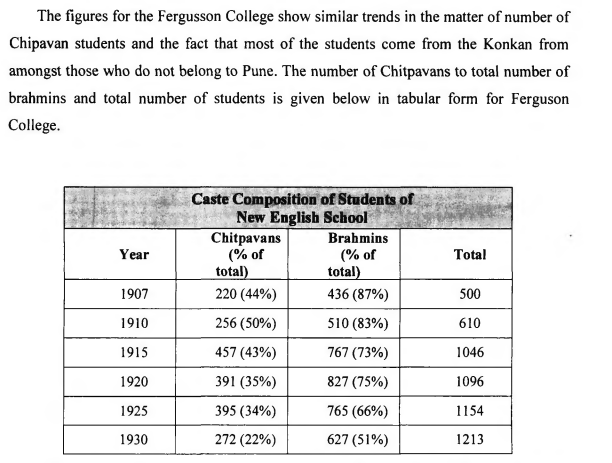
The data from Deccan Education society started by Tilak and Agarkar isnt much different. The report quotes

The annual report published in 1883 acknowledges the preponderence of brahmins amongst the students as well. “The characteristic feature of the school is that the largest number of boys belong to the higher and intelligent classes of the community.’When deposing before the Hunter Commission Annual Report of 1883,Deccan Education Society,Poona,1884 on Education, the representative of the society acknowledged that only 17 out of 582
students were nonbrahmin.

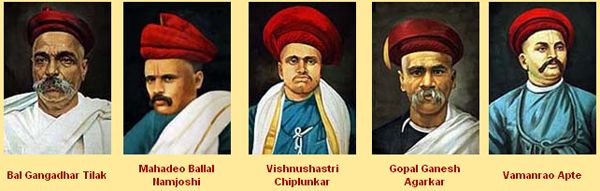
Lokmanya Tilak, the freedom fighter and founder of DES had this to say

Englishmen are and were averse to imparting any knowledge of a practical nature to subject races, they found that philosophy and theoretical science were  the safest subjects. It is hopeless to expect the artisan or the agriculturist to evince an interest in a form of education so far removed from his way of life, i.e is profession decided on the basis of caste for thousands of years. It is we think beyond the power of a dozen Educational Directors of the type of Mr. Lee Warner with all the encouragement by way of free studentships and scholarships which they can command, to infuse a love of western learning into the hearts of men who find themselves better off without knowing anything that our schools and colleges teach, than with it. If the brahmin under all kinds of difficulties strives to surpass his brethren of lower castes in intellectual attainments and tries to take up all the advantages and honours and emoluments to which these attainments qualify him, it is owing to the fact that the very traditions and obligations of his caste and the predispositions and capacities of his mind lead him in that direction. The very spirit of the caste system, the precarious conditions of life under a foreign rule, the indolent characteristic of the tropical world and the spirit of contentment infused into the heart of the Hindu by his religious faith all contribute towards the position of the Brahmin

My Two Cents:

Its fair to say that being born a Brahmin in India distinguishes you as a recipient of certain privileges. However we cant firmly gauge today how much those privileges

  • are the indirect result of ChaturVarna
  • are the result of amplification by the British (for their own colonial ends)
  • are direct result of active oppression of the subalterns
  • or something else entirely

While granting that these privileges exist and shape Indian life considerably, one mustn’t fall into the trap of seeing Brahmin privilege as the overwhelming or even the most consequential privilege of Indian society. Instances like the 1948 Anti Brahmin riots – typically underplayed in the Brahmin privilege narratives are still fresh in mind of thousands. Anti Brahmin rhetoric by political parties like NCP, DMK though not as viscous as rhetoric against some other communities is nonetheless non trivial.

There are and have been many other forces of nature and economy at work for centuries though it is fair to assume that these forces interacted with caste & varna.


History beyond the screaming

Last night I realized I’m not going to weigh in on history discussions on Twitter if they pertain to the Indian subcontinent. Even people who I know are not 13-year old incels behave totally emotionally and engage in shitposting posturing constantly. It’s really impossible to get a signal out of the discussion.

Indians and Pakistanis seem so intensively invested in various topics that it is literally and seriously impossible to get value out of any exchange, the swell of stupidity and bad faith (on all sides!) is so intense. There is a reality out there. There is a true history. But this is not what most of you really care about it, is it?

For example, reading India in the Persianate Age: 1000–1765 gives a nuanced and fully textured picture in outlines of the subcontinental elite in the premodern period. It aligns in broad sketches with what I know about human psychology and history elsewhere. But attempting to bring nuance seems like a fool’s errand in most of these debates.

Understanding the history of the Indian subcontinent is rewarding to me because there are comments here on the general human condition. I will not turn away from that. But, I do need to reflect on whether that is best done in solitude rather than engaging with the world “out here.”

Note: I don’t mind or care too much if particular truths are leveraged in some ideological manner. Rather, my suggestion is ideological priors are doing all the sifting of which truths are correct or not.

Revoking 13th Amendment in Sri Lanka and Elections in the US.

Abstract: A centralized govt in Sri Lanka is necessary maintain Law and order. Devolution of power to provinces may be stepping stone to de facto Federalism and a client Federal state to India. The cautionary example is the US and its separation of Federal and State powers. The separation of US and State power has lead to inconsistent implementation of law and order, including even minor issues, such as wearing of masks.

In 1987 under duress from India under Rajiv Gandhi, the Indo-Sri Lanka Accord was signed.  Part of  the accord was the Devolution of land, the police and financial powers to the Provinces.   This pretty much de facto  Federalism was incorporated as the 13th Amendment (13A) into the Sri Lankan  Constitution.
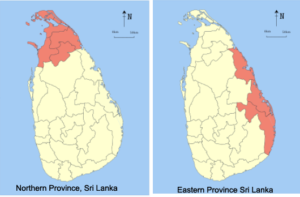
The main issue with de facto Federalism is that it might be either a stepping stone for separate North and East state and or a client state/province of India.  As if to prove that fear in February 2016, the Chief Minister of Sri Lanka’s Northern Province, C.V. Wigneswaran sought India’s direct intervention in the complete implementation of the amendment.

There is a call from some of the minority Tamil population (12% of Total) to merge the North and East Provinces creating a province that would encompass 28.78% of Sri Lankas land area and 11.9% of the total population.  The minority Tamil population in this merged province would be 1,597,276 ( 987,692 + 609,584).   That is a 7% Tamil population of all of  Sri Lanka.   The two merged provinces have total population of 2,610,143 (1,058,762+1,551,381), making the Tamil minority 61%.

Land Area and Population North and East Provinces
Northern Province Land Area 8,884 km2 (3,430 sq mi) (13.54% of total area),
Population 1,058,762 ((5.22% of total pop.)
Tamil Population: 987,692 (93.29%)
Eastern Province: Land: 9,996 km2 (3,859 sq mi) (15.24% of total area)
Population:
1,551,381 (7.66% of total pop)
Tamil Population: 609,584 (39.29%)


Cautionary Example: The US

In the US, excess Police Brutality on Black and Hispanics has resulted in protests,  some peaceful and some marred by violence and looting.  There is circumstantial evidence that Black Lives Matter (BLM) protests have been co-opted for political purposed.   CIA manual psychological regime change and Color revolution tactics are permeating into US politics.

Prominent opinion makers like David Brooks in a NY Times opinion piece advocates a color revolution if Trump wins. .

It turns out, amid the existential crisis, there really is a group of sober people who are militant about America, who can see reality unblinkered by the lens of partisanship, and who are finally compelled to organize.

If Trump claims a victory that is not rightly his, a few marches in the streets will not be an adequate response. There may have to be a sustained campaign of civic action, as in Hong Kong and Belarus, to rally the majority that wants to preserve democracy, that isolates those who would undo it.

Even some immigrant Sri Lankans, are inciting violence. A Sri Lankan, who works at the Pentagon and should know better as minority Tamil in SL says

against Trump is so high that many of us feel like physically beating up any Trump supporter we come across.
Imagine the energy on the far left then. The Trump enabling mafia is going to learn a painful lesson; for the unpardonable sin of foisting Trump on the country.

Some other Sri Lankans may not advocate violence, but

If people want to be relevant how about striving to  be the largest tax paying ethnicity? Betcha your lives will matter then.

Me: As usual you make supercilious, new immigrant, they as in Black and Hispanic are “looser” type remarks. When were you and yours ever in the forefront defending the US, other than as an armchair warrior.
Me: I guess you dont think Black and Hispanic are part of the “Brave” (as in Land of the Free and Brave) who have been in forefront of the right or wrong wars the US has been fighting.

Obviously, there is potential for color revolution type protests, violence, riots after elections.  Will the federal govt be able to maintain law and order.  From what is happening now in the US now it is extremely doubtful.  Because of the division of power between the Federal Govt and State governments there is no consistent implementation of Law and order, even a simple issue as such as wearing a mask.

Accusations of Democrat vs Republican  Governors and their ability to keep Law and order are flying around.  Post elections in the US, is it the Federal Government or the State Governments that are going to be responsible for  “Law and order”.

I think many are avoiding an issue as to why the current Fed govt is reluctant to get the military out. Because they are not sure which side they (as in the foot soldiers) will decide to support. 40% of the military is minority and very likely much higher at the rank and file level.

Relevance to Sri Lanka: Federal vs State law

My opinion:
Advantages of  Central Govt vs Devolution/Province is going to be very obvious after US elections.


*Side Comment:  My great Grandparents converted to Christianity because of of Americans.

References
https://www.colombotelegraph.com/index.php/kamala-harris-the-dems-and-sri-lanka/comment-page-1/?unapproved=2357187&moderation-hash=a64098635d4feaf243a934669388d65f#comment-2357187

https://www.rt.com/op-ed/499857-trump-biden-campaigns-mirror-cia/

The religion of Hindus before Hinduism

India in the Persianate Age: 1000–1765 is a good read and I recommend it. But the author, Richard Eaton, is not a guru or a sheikh, and should not be taken as such.

A comment Eaton makes offhand several times is that the conflict between Turks and Indians should not be understood in confessional terms. This is a commonly asserted, and on some level, it reflects elements of the truth. Hindu Rajputs served under Muslims, and Turkic soldiers served under Hindus. You can’t reduce everything to confession.

But, it is clear that confession and civilizational identity did exist, and it was robust. Going from the specific to the general.

  1. A great deal of text given over to Man Singh’s glorification of his conquests as an Indian warrior, and his patronage of Indian religion, in particular Vaishnavism.
  2. Eaton highlights the rapid Indianization of practices and hegemonic motifs present among the Turks and Afghans who were born and raised in India. And yet despite the syncretistic tendencies which occurred, ultimately these ashraf elites remained identified as Muslims and often were pulled back to world-normative Islam over the generations.
  3. Vijayanagara persisted as a Hindu polity for three centuries. The cross-cultural analysis shows that recalcitrant pagan powers always convert to the religion of their enemies eventually. The leader of the pagan resistance in Saxony became a Christian. Pagan resistance to Christianity in Sweden, Lithuania, and ancient Rome were only temporary, as resistant lineages eventually were assimilated into the new order. Resistance to Buddhism in Japan and Tibet was initially violent, but futile. In iterative games, paganism is the eternal ‘beatable’ strategy.

The only point to posting this is that there is a common assertion that Hinduism as a religion or identity only emerged in the 19th century. I am now convinced that this confuses the name of the phenomenon for the phenomenon. The Indian religion of the Hindus was clearly bundled together in a way that allowed for their elite deployment as a meta-ethnic identity that separated them from the Turks and Afghans who ruled them. Similarly, the Islam of the Turks and Afghans (and variegated Ethiopians, Arabs, and Persians), separated them from the Indians whom they conquered to prevent full assimilation as an Indian elite with popular roots in early modernity.

There is a major issue where our conception of religion qua religion is conditioned on an intellectual revolution rooted in the Second Reformation of the Calvinists. But, I think it is important not to get carried away with this construct, and assert that Calvinist religion is qualitatively different from pre-Calvinist religion. I don’t think it is. Rather, it simply shifts some of the parameter values within the model. Similarly, the identity of a coherent Hindu Rashtra with a post-caste socio-religious identity is an invention of modernity, but its roots are ancient and indigenous, and not postcolonial fictions.

Brown Pundits