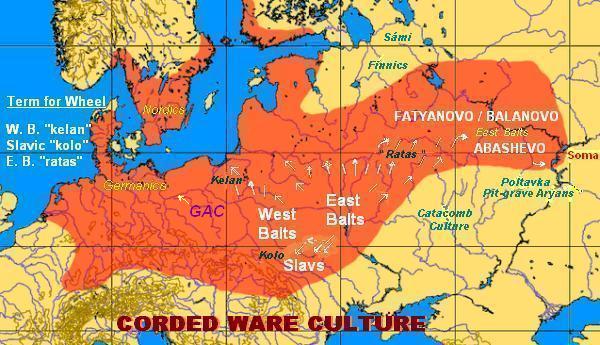
The Fatyanovo culture flourished between 2800 and 1900 BC. It seems they were part of a Central European “reflux” migration. That is, their forebears were related Yamna agro-pastoralists who migrated west out of the steppe and mixed with Central European farmers. Eventually, some of these people moved back east along the edge of the forest-steppe boundary.
The Fatyanovo is the name for a group of people who seem to have introduced agro-pastoralism to the region nearly up to the Urals in northeastern European Russia. A new preprint, Genetic ancestry changes in Stone to Bronze Age transition in the East European plain, confirms what we assumed:
Transition from the Stone to the Bronze Age in Central and Western Europe was a period of major population movements originating from the Ponto-Caspian Steppe. Here, we report new genome-wide sequence data from 28 individuals from the territory north of this source area – from the under-studied Western part of present-day Russia, including Stone Age hunter-gatherers (10,800-4,250 cal BC) and Bronze Age farmers from the Corded Ware complex called Fatyanovo Culture (2,900-2,050 cal BC). We show that Eastern hunter-gatherer ancestry was present in Northwestern Russia already from around 10,000 BC. Furthermore, we see a clear change in ancestry with the arrival of farming – the Fatyanovo Culture individuals were genetically similar to other Corded Ware cultures, carrying a mixture of Steppe and European early farmer ancestry and thus likely originating from a fast migration towards the northeast from somewhere in the vicinity of modern-day Ukraine, which is the closest area where these ancestries coexisted from around 3,000 BC.
The Fatyanovo culture seems to have given rise to the rival and later successor Abashevo culture, which flourished a bit further east (beyond the Urals in part). The Abashevo in their turn gave rise to the Sintashta culture, which flourished even further east, and somewhat south.
There are two things I want to highlight. First, the Y chromosome:
Then, we turned to the Bronze Age Fatyanovo Culture individuals and determined that their maternal (subclades of mtDNA hg U5, U4, U2e, H, T, W, J, K, I and N1a) and paternal (chrY hg R1a-M417) lineages…were ones characteristic of CWC individuals elsewhere in Europe…Interestingly, in all individuals for which the chrY hg could be determined with more depth (n=6), it was R1a2-Z93…a lineage now spread in Central and South Asia, rather than the R1a1-Z283 lineage that is common in Europe.
Here is the modern distribution of Z-93:
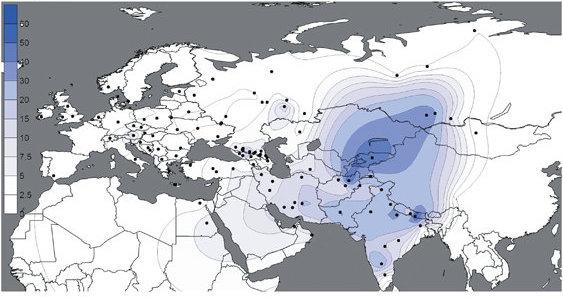
The reason Z283 is found where in ancient times Z93 was found is that over the past 500 years ethnic Russians have expanded eastward, retracing the biogeographic route of the earlier peoples along the forest-steppe frontier.
The steppe people seem to be highly patriarchal. Though there are some non-modal lineages, samples from a specific location are often dominated by a single haplogroup, indicative of a broader kinship-based society focused around descent from an ancestor. In contrast, the origins of females as evidenced by mtDNA, diversity seems to be rather catholic. Some of the mtDNA lineages above, and later in the Sintashta, seem to derive from farmer populations in Europe whose ultimate origins were in Anatolia.
Let me define gotra from Wikipedia:
In Hindu culture, the term gotra (Sanskrit: गोत्र) is considered to be equivalent to lineage. It broadly refers to people who are descendants in an unbroken male line from a common male ancestor or patriline. Generally the gotra forms an exogamous unit, with the marriage within the same gotra being prohibited by custom, being regarded as incest…The name of the gotra can be used as a surname, but it is different from a surname and is strictly maintained because of its importance in marriages among Hindus, especially among the higher castes
The second point is to show this table:
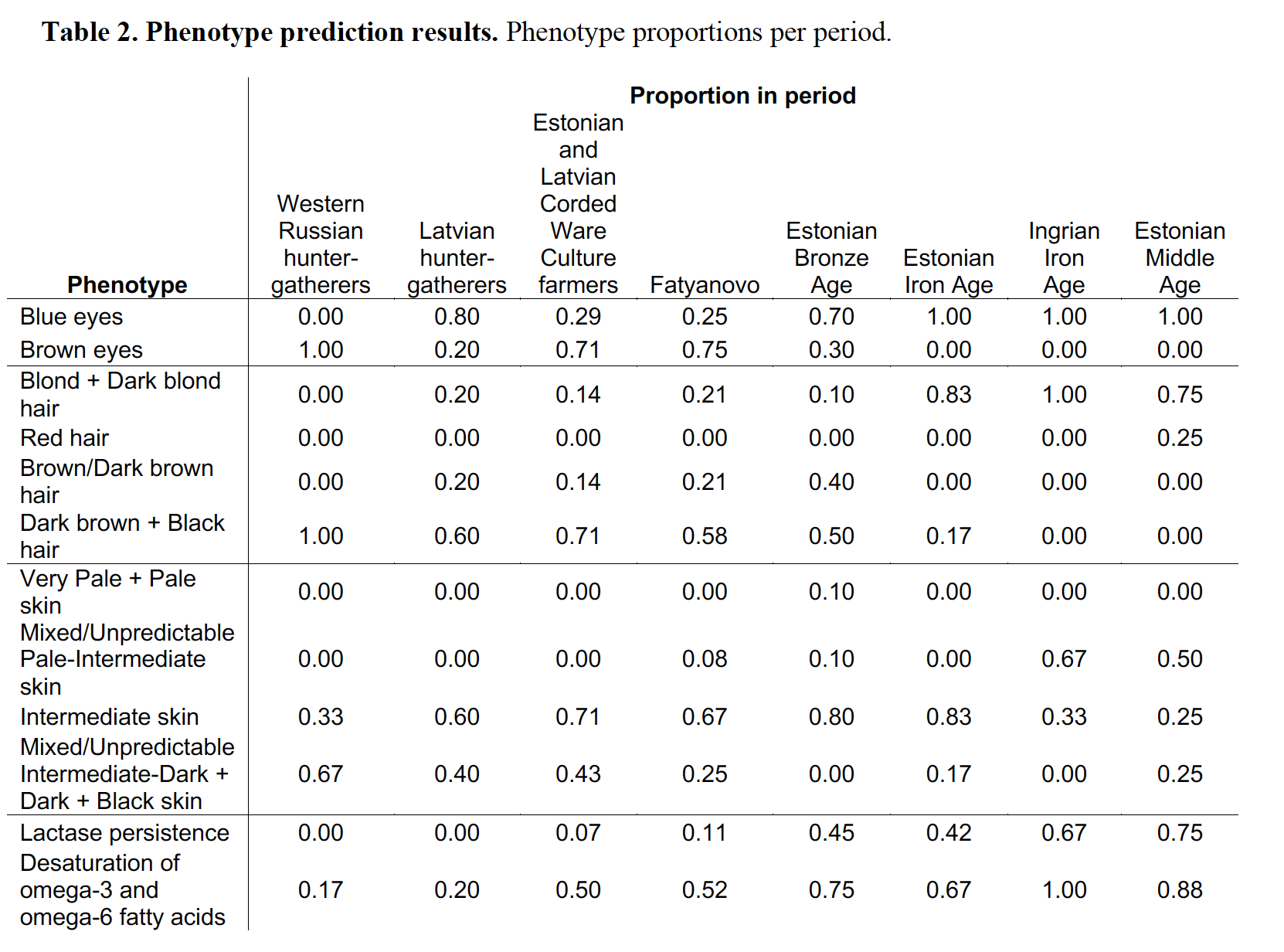
This group has been assembling a lot of data on phenotypic SNPs over time transects in Northeast Europe. One has to take these results with a grain of salt because the predictions are trained on modern samples. I do not think, for example, that European hunter-gatherers had “black skin.” I suspect that the Mesolithic populations were genetically different enough that their “light alleles” may not be in our panels, though my suspicion is that they’d be of darker hue as Inuit people are. That being said, selection work aligns with these results that Europeans, in particular, seem to have been getting lighter in many areas down to the present.
The eye color prediction I somewhat trust since it’s quasi-Mendelian (~75% of the variance is due to one genetic location in Europeans). For the pigmentation, I would focus on the trend, not the absolute value. Anyone who has been to the Northeast Baltic (I have) knows that these are amongst the fairest people in the world. It is very unsurprising that these people have been getting paler over time.
There have been various arguments on this blog and elsewhere as to what the Sintashta people would look like. I’ve posted the Narasimhan et al. data before. The results are broadly similar to the ones above for the Fataynovo.
The Fataynovo do not have the pigmentation genetic architecture that is similar to Nordic people. But, neither are they out of keeping with some European peoples. The Sintashta would be ~25% blue-eyed according to Narasimhan et al.’s data. In the 1000 Genomes about 10% of the alleles in Punjabis, Gujaratis, and Bengalis is the derived variant so common in Northern Europe, giving a recessive frequency ~1% of so blue-eyed, which is too high since other genes have an influence in these cases (though this allele is found in West Asia at appreciable frequencies, including in very old ancient DNA).
On the whole, these results confirm that the Aryans when they arrived in India were fair-skinned people. But, they were likely not as rosy-cheeked as the English who arrived thousands of years later, nor were their eyes quite often pale.