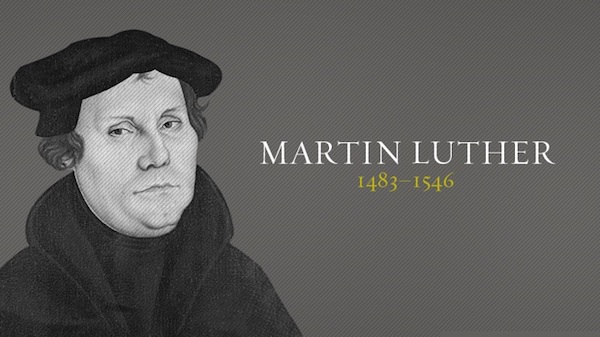
Martin Luther was the key figure in the precipitation of the Reformation.
The name Martin:
Martin may either be a surname or given name. Martin is a common given and family name in many languages and cultures. It comes from the Latin name Martinus, which is a late derived form of the name of the Roman god Mars, the protective godhead of the Latins, and therefore the god of war….
And Luther:
As a German surname, Luther is derived from a Germanic personal name compounded from the words liut, “people”, and heri, “army”. As a rare English surname, it means “lute player” (Hanks and Hodges 1988). Luther is also derived from the Greek name Eleutherius. Eleutherius is a cognate of the Greek word eleutheros (έλεύθερος) which means “free.”
I bring this up because it is curious and notable to me that apparently is common for converts to Christianity in India (I’m setting aside traditionally Christian groups such as Nasranis) to take a “Christian name”. One of the arguments is that you shouldn’t have names which refer to a pagan god. Someone should have told Martin Luther. The Anglo-Saxon kings retained the myth of descending from pagan German gods long after their Christianization (they obviously didn’t believe it literally, though they still refused to let go for the prestige).
About ten years ago I read a book about the Islamicization of the core Muslim world. In particular, there was a curious feature of the process that occurred over three centuries in Iran. There was a chart of the form:
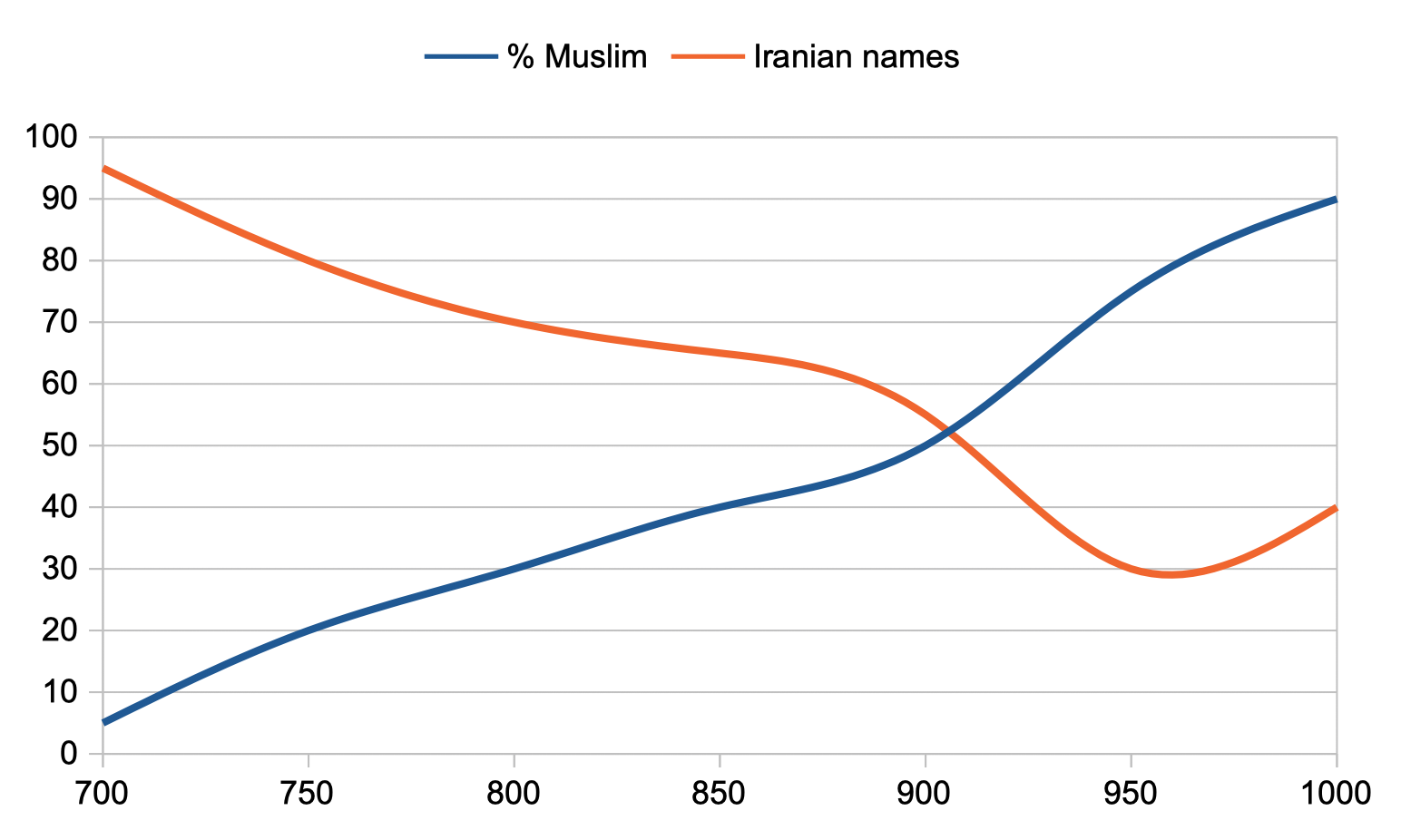
The records were clearly from sub-elite individuals. People from whom records remained due to their service or taxes paid. What one sees is that for several centuries the proportion of classical Iranian names drops as the number of local landlords who are non-Muslim drop….and then as the Muslims become overwhelming, there are individuals who are known to be Muslim who are being given classical Iranian names all of a sudden.
The link between being non-Muslim (generally Zoroastrian) in rural Iran among sub-elites and having an Iranian name disappeared when the number of non-Muslims declined to the point where they were not a major community (outside of isolated areas such as Yazd).
In a similar manner, Bangladeshi Muslims often have more ostentatiously Arabic names than Pakistani Muslims, who reflect more Iranian and Central Asian influence. The Bengali Muslim intelligentsia is a recent creation of late modernity, balancing its sincere religious beliefs with an ethnic identity distinct from the post-Mughal Islamicate culture further up the Gangetic plain and into Punjab (the Muslim elites of Mughal era Bengal did not speak Bengali as their high language, and the early Bengal Rennaissance was due to Hindu gentry). The extremely Arabic names are probably one way to emphasize one’s Muslim bonafide in a cheap manner.
My own children have conventionally Western forenames (though not generic ones). The reasoning is straightforward: they are being raised in a conventional white American milieu. I have no religious attachments obviously, nor am I passionately ethnic, outside of some food preferences. Their South Asian heritage is part of their past through me, but the future is different, and the names reflect that.
Going back to names…it’s ridiculous to say that they don’t indicate deep culture dynamics. The hyper-Muslim people in my family don’t make recourse to Bengali pet names. My father, whose father was an ulem, did not have such a pet name. As the lineage secularized, with my father, pet names in Bengali reappeared.
Since I am not a believer and am unlikely to passionately convert to some religion, I don’t know the motivations and psychology. And people are free to do what they want. But the idea that conversion to Christianity necessitates a name change seems ridiculous to me. The first Christian king of Sweden was Olof Skötkonung. The first Christian Roman Emperor was named Flavius Valerius Aurelius Constantinus Augustus from birth to death. Could think of a name more Scandinavian or Latin Classical?
Though it is common in the Islamic world to have distinct names rooted back to the Middle East (Indonesian Muslims being an exception), there is far less uniformity in Christianity. And yet many Christians adopt this pattern. Why? Similarly, white converts to Hinduism sometimes adopt Indian names. Why?
The post is not so much an argument for anything. But an observation that opens up a discussion….


 In this episode Razib and Omar move away from politics and culture to talk about the science (and non-science) of nutrition, lifestyle, obesity and fatness, especially as it relates to South Asians. As some readers may know, I am an endocrinologist with a research interest in obesity and insulin resistance and Razib is a geneticist with a personal interest in health, nutrition and lifestyle, so I hope listeners will find it useful. Comments welcome.
 Another BP Podcast is up. You can listen on