Kerala, Floods and Aid

Excepts from a FirstPost article.

Described as one of the worst since 1924 by Chief Minister Pinarayi Vijayan, the rains in Kerala have left over 350 dead and rendered thousands of people homeless. According to the latest tally, 80,000 have been rescued so far. Over 1,500 relief camps have been set up across the state that currently house at least 2,23,139 people.

Now as India struggles with the catastrophic floods in Kerala, foreign disaster aid has again become an issue with India unwilling to accept the help it then gave. In 2005, as countries across the region struggled to cope with the Indian Ocean tsunami, India declined aid.

Prime Minister Narendra Modi initially welcomed the United Arab Emirates offer of $100 million in emergency aid for Kerala — a state whose workers have helped author that country’s economic success story. Foreign ministry officials, however, pushed back and India instructed its diplomats to politely decline foreign governmental aid.

Kerala has a relatively small public sector. The state’s economic review records that the government employs some 2,75,000 people and another 1,25,000 are with quasi-public institutions, to serve a population of 34.8 million. The state police, notably, has just 39,159 members of personnel — 113 for every lakh persons — or less than half the United Nations-recommended 250 per lakh.

Following the destruction of New Orleans by Hurricane Katrina in 2005, a staggering 90 countries held out offers worth a combined $854 million. The United Arab Emirates alone pledged $100 million in cash and another $400 million in oil. Bangladesh promised $1 million. Thailand, which lost 8,150 people in the previous year’s tsunami, offered a team of 60 doctors and nurses. Even Cuba — subjected to sanctions by the superpower for decades — said it was willing to send 1,100 doctors.

There’s little doubt the foreign aid refused by the US could have improved the lives of tens of thousands of people, many of whom remained homeless years after the hurricane. The money could, for example, have paid for the construction of an estimated 8,500 homes, or substantially helped rebuild the $1 billion worth of transport infrastructure claimed by the hurricane.

“In all humanitarian crisis,” says former diplomat Vivek Katju, “the criteria for accepting aid should be whether it’s needed to alleviate suffering, not some false pride or national ego”. Every rich country — from Japan to the United States — has accepted aid where its own resources were wanting.

But truly great nations, it is time India’s leaders realise, don’t just know how to give but also to receive.

https://www.firstpost.com/india/kerala-after-the-flood-pragmatism-not-false-pride-should-govern-indias-stand-on-foreign-aid-5087411.html

The last comment about give and receive, I really believe/practice as a person.  One should have the humility to accept and give back.  I  do not (necessarily) have to give back to the same person who gave me.   Neither should I want to some one who I gave, to give back.  If whom I give, gives back thats just so much pleasure.

Review: Directorate S: The CIA and America’s Secret Wars in Afghanistan and Pakistan

The following is a review by Dr Hamid Hussain.

Book Review – Directorate S: The CIA and America’s Secret Wars in Afghanistan and Pakistan by Steve Coll.

 Hamid Hussain

 Steve Coll’s new book is an excellent account of events of the last two decades in Afghanistan-Pakistan region.  Steve has all the credentials to embark on this project.  He is one of the best and well-informed journalist and his previous book Ghost Wars is the most authentic work of the history of Central Intelligence Agency’s (CIA’s) war in Afghanistan in 1980s.  For his new book, he has used important American sources from different departments of US government engaged with Afghanistan and Pakistan. He has also used some Afghan and few Pakistani sources, but it is mainly an American perspective of the events. There is need for work on Pakistani and Afghan perspective which is a far more difficult task. Continue reading Review: Directorate S: The CIA and America’s Secret Wars in Afghanistan and Pakistan

Takeaways from the golden age of Indian population genetics

There are lots of strange takes on the India Today piece, 4500-year-old DNA from Rakhigarhi reveals evidence that will unsettle Hindutva nationalists. I’m friendly with the author and saw an early draft. So I’m going to address a few things.

The genetic results are becoming more and more clear. A scaffold is building and becoming very firm. In the 2020s there will be a lot of medical genomics in India. But before that, there will be population genetics. Ancient DNA will be the cherry on the cake.

Here’s what genetics tells us. First, a component of South Asian ancestry, especially in North India, and especially in North Indian upper caste groups, seems to be the same as ancient agro-pastoralists who ranged between modern Ukraine and modern Tajikistan. Genetically, these people are very similar to certain peoples of Central and Eastern Europe of this time, though there is a varied dynamic of uptake of local Central Eurasian elements as they ranged eastward.

This ancestral component is often called “steppe.” This ancestral component is a synthesis of ancient European hunter-gatherer, Siberian, and West Asian. The steppe component seems to arrive in Central and South Asia after 2000 BC.

Second, another component of South Asian ancestry is very distinctive to the region. It is deeply but distantly related to branches of humanity which dominate Melanesia and eastern Eurasia, up into Siberia. The magnitude of the distance probably dates to ~50 thousand years ago, when the dominant element of modern humans expanded outward from West Asia, east, north, and west. These people are called “Ancient Ancestral South Indians,” or AASI. Their closest relatives today may be the natives of the Andaman Islands, but this is a very distant relationship.

AASI is the dominant component of what was once called “Ancestral South Indians,” or ASI. It turns out that “ASI” themselves were a compound synthetic population. This was long suspected by many (e.g., David W.). What was ASI a compound of? About ~75 percent of its ancestry was AASI, but the balance seems to have been a West Eurasian component related to farmers from western Iran. We can call this group “farmers.”
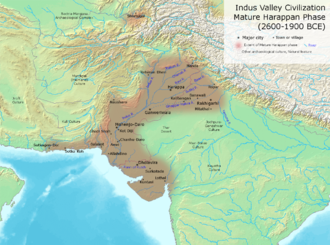
With a few samples from outside of the IVC region, and one (or two) samples from within the IVC region, geneticists are converging upon the likelihood that the profile in the greater IVC region before 2000 BC was a compound of these farmers with the AASI. But even within the IVC region, there seems to have been a range of variation in ancestry. The IVC was a huge zone. It may not have been dominated by a single ethnolinguistic group (even today there is the Burusho linguistic isolate in northern Pakistan). Note that the much smaller Mesopotamian civilization was multiethnic, with a  non-Semitic south and a Semitic north (Sumer and Akkad).

The key point is that it is very likely the IVC lacked the steppe ancestral component. That it did have AASI component. And, it did have a farmer component with likely ultimate provenance in western Iran. Additionally, there were smaller components derived from pre-steppe Central Eurasian people.

While the steppe people arrived in the last 4,000 years, and at least some of the ancestors of the AASI are likely to have been in South Asia for 40,000 years, the presence of the AASI-farmer synthesis genetically is conditional on when a massive presence of western farmers came to affect the northwestern quarter of South Asia. It seems unlikely to have been before Mehrgarh was settled 8,500 years ago. The genetic inferences to estimate the time of admixture between AASI and farmer are currently imprecise, but it seems likely to have begun at least a few thousand years before 2000 BC.  range of 8,500 and 6,000 years ago seems reasonable.

So 4,000 years ago the expanse of the IVC was dominated by a variable mix of farmer and AASI. One can call this “Indus Valley Indian” (IVI).

Just like ASI, there was an earlier abstract construct, “Ancestral North Indian” (ANI). Today it seems that that too was a compound. To be concise, ANI is a synthesis of steppe with IVI. The Kalash of northern Pakistan are very close genetically to ANI. This means that while ASI had West Eurasian ancestry, albeit to a minor extent. And ANI had AASI ancestry, albeit to a minor extent. The main qualitative difference is that ANI had a substantial minority of steppe ancestry.

To a great extent, the algebra of genetic composition across South Asia can be thought of as modulating these three components, farmer, steppe, and AASI.* Consider:

  • Bhumihar people in Bihar tend to have more steppe than typical, but not more farmer than typical, and average amounts of AASI.
  • Sindhi people in Pakistan tend to have lots of farmer, some steppe, and not much AASI.
  • Reddy people in South India have lots of farmer, very little steppe, and average amounts of AASI.
  • Kallar people in South India have some farmer, very little steppe, and lots of AASI.

For details of where I’m getting this, you can look at The Genomic Formation of South and Central Asia for quantities. But as a stylized fact farmer ancestry tends to peak around the Sindh. In Pakistan steppe ancestry increases as you go north. As you go east and south AASI increases pretty steadily, but there are groups further east, such as Jatts and Brahmins, who have a lot of steppe, almost as much as northern Pakistani groups. And curiously you get a pattern where some groups have more steppe and AASI, and less farmer, than is the case to the west (you see this in the Swat valley transect, as steppe & AASI increase in concert).

Going back to the history, by the time the steppe people arrived in South Asia, in the period between 2000 BC and 1000 BC, it may be that the IVI ancestry is what they mixed with predominantly. Though it is likely that the southern and eastern peripheries had “pure” AASI, by the time steppe people spread their culture to these fringes they were already thoroughly mixed with IVI populations, and so already had some AASI ancestry.

In contrast, the farmer populations likely mixed extensively with AASI in situations where the two populations were initially quite distinct.

Please note I have not used the words “Aryan” or “Dravidian.” The reason is that these are modern ethnolinguistic terms. Genetics is arriving at certain truths about population changes and connections, but we don’t have a time machine to go back to the past and determine what language people were speaking 4,000 years ago.

Our inferences rest on supposition, and a shaky synthesis of historical linguistics and archaeology and genetic demography, a synthesis which is unlikely to ever be brought together in one person due to vast chasm of disciplinary method and means.

It is highly likely that the steppe component is associated with Indo-European speaking peoples. Probably Indo-Aryan speaking peoples. The reason is that by historical time, the period after 1000 BC, Iran and Turan seem to already have been dominated by Indo-Iranian peoples. But, in the period around 2000 BC, western Iran was not Indo-Iranian. People like the Guti and the Elamites were not Indo-European, and they were not Semitic. We have some genetic transects which show that steppe ancestry did arrive in parts of Turan and Iran in the period after 2000 BC.

Where did the Dravidian languages come from? We don’t know. They could have been spoken by an AASI group. Or, they could be associated with farmers from the west. We don’t know. Ultimately, we may never know. Unlike Indo-European languages, there are no Dravidian languages outside of South Asia.

Various toponymic evidence indicates that Dravidian languages were spoken at least as far north and west as Gujurat. And Brahui exists today in Balochistan. Though I don’t have strong opinions, I think Dravidian languages probably are descended from a group of extinct languages that were present in Neolithic Iran.

Though unlike Indo-Aryan languages, Dravidian exploded onto the scene after a long period of incubation within South Asia, as part of at least one of the language groups dominant with the IVC and pre-IVC societies.

At least that’s my general assessment. I have strong opinions about the genetics. But am much more curious about what others have to say about linguistics and archaeology.

* Some groups, such as Munda and Indo-Aryan groups in Northeast India, have East Asian ancestry. Some groups in coastal Pakistan have African ancestry.


Review: General Shahid Aziz’s Memoir Yeh Khamoshi Kahan Tak

Shahid Aziz retired from the Pakistan army after a long and successful career, reaching the rank of Lieutenant General (3 star general) and serving as DG analysis wing of the ISI, DGMO (director general military operations), CGS (chief of general staff) and corps commander (commanding 4 corps in Lahore). After retirement, he served as chairman of the powerful National Accountability Bureau (NAB), the main anti-corruption watchdog in Pakistan. In spite of having been one of General Musharraf’s closest associates (and related to him by marriage; the daughter of one of Shahid Aziz’s cousins is married to Musharraf’s son) he became increasingly critical of Musharraf after retirement and in 2013 he wrote a book that was highly critical of Musharraf and of Pakistan’s supposedly pro-US policies at that time.

In May 2018 there were several news reports claiming that General Shahid Aziz had left his home last year (or even earlier) to join the Jihad against the West and had been killed, either in Syria or in Afghanistan (General Musharraf was the one who claimed he was killed in Syria, most other reports said Afghanistan). While his family has denied these reports, they have not been able to produce any explanation about where he is if he has not actually died on Jihad. So I decided to read the book. Having read it, I think the combination of naive idealism and PMA-level Islamism found in his book makes it very likely that these reports are true. My review follows (please also read this review by Abdul Majeed Abid as a complementary piece) Continue reading Review: General Shahid Aziz’s Memoir Yeh Khamoshi Kahan Tak

Why this kolaveri di on Indian genetics

I perused through the article linked in Razib’s previous post. I stumbled on this caption embedded in the beginning of the article:

NOT THE SAME: The Indus Valley people lacked the steppe and ancestry that marks many North Indian high castes today (Photograph by Bandeep Singh, for representational purpose only)
I find the association that the prototypical Indian is a high-caste Hindu to be in poor taste.

Genetics stories in India Today

4500-year-old DNA from Rakhigarhi reveals evidence that will unsettle Hindutva nationalists:

The ‘petrous bone’ is an inelegant but useful chunk of the human skull — basically it protects your inner ear. But that’s not all it protects. In recent years, genetic scientists working to extract DNA from ancient skeletons have discovered that, thanks to the extreme density of a particular region of the petrous bone (the bit shielding the cochlea, since you ask), they could sometimes harvest 100 times more DNA from it than from any other remaining tissue.

Now this somewhat macabre innovation may well resolve one of the most heated debates about the history of India.

And, from me, 3 strands of ancestry.

Nothing new for close readers. I would caution

1) Many Hindu nationalists really don’t care and are not perturbed by these findings. I know, because I know them.

2) I don’t know if the paper is going to be published soon. It may, but we’ve been waiting two years now.

The passing

In 1998 Bill Clinton stated:

Today, largely because of immigration, there is no majority race in Hawaii or Houston or New York City. Within five years, there will be no majority race in our largest state, California. In a little more than 50 years, there will be no majority race in the United States. No other nation in history has gone through demographic change of this magnitude in so short a time … [These immigrants] are energizing our culture and broadening our vision of the world. They are renewing our most basic values and reminding us all of what it truly means to be American.

The year 2050, or whatever date you want, is when “whites” will become a “minority.” Both words are in quotes, since what counts as “white” and “minority” matter a great deal in terms of these quantities. Clinton, like many liberal(ish) white Americans, did not look upon that future with dread or anxiety. Rather, he was, and presumably is, hopeful. At the time many people asserted that Bill Clinton was arguably the first American president who was personally comfortable with nonwhites. After all, Vernon Jordan was one of his closest friends.

And yet here are the demographics of the town where Bill & Hillary chose to settle down after the 1990s:

. The racial makeup of the CDP was 91.80% White, 0.94% African American, 0.03% Native American, 5.62% Asian, 0.02% Pacific Islander, 0.52% from other races, and 1.07% from two or more races. Hispanic or Latino of any race were 2.55% of the population.

Bill may look forward to our bright diverse future of 2050, but he lives socially and demographically in 1950. And he’s not alone.

To me, this is the important lacunae left out in Panjak Mishra’s op-ed in The New York Times, The Religion of Whiteness Becomes a Suicide Cult. The op-ed is a testament to the fact that even a sophist must speak the truth now and then. It is certainly true that there is a discomfort and disquiet in the world as the long centuries of white supremacy, in the most literal and descriptive sense, slowly come to a close. Naturally, Mishra points the finger at figures from the past, who can’t dispute his disdain, as well as those individuals such as Donald Trump, whom the readers of The New York Times see as heralds of reaction and regression.

But the truth is that as the “the rising tide of color against white world-supremacy” begins to crest even the “good whites,” the “progressive whites,” will begin to become uncomfortable and unmoored. The noblesse oblige of progressive whites is predicated on the reality and fact of their privilege, of their dominion over the colored races. And yet the reality is that many of these progressive whites show revealed preferences which are not much different than non-progressive whites. On the whole, they live amongst other whites, socialize with other whites, and marry other whites.

Having lived in California, around white people who are politically far more liberal than I am, I have a bit of personal experience with how these “revealed preferences” work. Rather than anecdotes, I’ll just point to this article, Ghosts of white people past: witnessing the white flight from an Asian ethnoburb.

The “passing of the great race” is a far bigger story than nationalism, racial or otherwise. It is the expiration of a whole Weltanschauung. An undermining of assumptions. The death of a world civilization, and the birth of a new one.

Sikh-American President?

https://www.facebook.com/NowThisOpinions/videos/vb.301565040380161/2139764439614338/?type=2&theater

Razib mentioned that different generations of immigrant-Americans had different experiences. When I hear the chap above and his Obamaesque accent (plus level of eloquence); it’s difficult to find the parallel in Britain.

The immigration and diaspora experience in Britain is more similar to the 1920’s Eastern and Southern European immigrants. To give a more precise analogy; post 1965 most Indian Americans immigrated as individuals or as families (except maybe the Patels) however in Britain it was almost communal immigration.

My friend’s father (who is a Sikh) moved to Britain in the 50’s/60’s from the Punjab. He was a civil servant in India and it was actually Enoch Powell who thought Indian civil servants could fill the labour gap in post-war Britain. He immigrated with less than 5 pounds (that was the limit they were allowed to bring) and his children are particularly British (half of them have white British spouses which is uncommon for that cohort, even now intermarriage is sub 10%). Even though he immigrated as a young man his friends had also moved and they had essentially formed a friendship cluster. So even though my friend grew up in a very white area she does remember that the family’s social grouping was still fairly Sikh (and competitive as all the parents had started with the same 5 pounds so the competition was on).

The British Asian experience is almost sui generis. For instance Asian-Americans usually denotes East Asians whereas British Asians immediately signified Desis (Orientals was apparently the term used for our more Far Eastern cousins).

As a final note Britain is an extraordinarily class-obsessed society and aesthetics is usually correlated with class. America, at least from this side of the Atlantic, seems a much more balanced society and the aesthetics of the immigrant populations are usually more pleasing. Americans are probably the best-groomed people in the world, on the whole (notwithstanding notable exceptions) and prosperity is linked to beauty.

Mr. Grewal cuts a very impressive profile both with his mannerisms and profile. He really reminds me of a Sikh Obama. Maybe he will run for President since he really does Brown Proud.

Brown Pundits