Caste in Buddhist Monastic Orders of Sri Lanka

Excerpts from an an article
https://www.colombotelegraph.com/index.php/sketches-from-the-south-the-rise-fall-of-amarapura/

The history of the Buddhist clergy, in this country, has largely been a history of schisms, splits, and amalgamations. Over the centuries, certain points have been inferred with respect to this process. First and foremost among them, that the breakdown of Buddhist monastic orders in response to growing caste militancy was only a partial, and not complete, consequence of the political games played by the British. Insignificant though this may be, it is nevertheless important in that certain writers paint a rosy picture of caste-ism while forgetting that the rifts between different castes were exacerbated once the British realised it could harness them to its advantage. Caste-ism was, in other words, waiting to be harnessed by external forces.

When the annexation of Kandy was complete, assurances were made by the Colonial Office that steps would be taken to preserve the privileges of the traditional elite, which obviously included the monastic orders (the Siyam Nikaya). Until then, the politics of the Kandyan Kingdom had followed a largely cyclical process, with shifting loyalties and shifts in the regime (particularly after the Nayakkars began their reign). But with the advent of the outsider, this was destined to be succeeded by a largely linear process, in which that outsider, the imperialist, managed to concentrate hitherto traditional privileges within his bureaucracy. The traditional elite, naturally anxious to preserve those privileges, sought to preserve them through their faith. It was in this context that the Siyam Nikaya was guaranteed the continuation of its practices, in part through the much vilified, controversial Kandyan Convention.

The two (Governor of Ceylon, Robert Brownrigg and John D’Oyly, Chief Translator and later Baronet of Kandy) promised to undertake three practices which had been the duty of the King: providing food to the temples from the Maha Gabadawa, holding the pageant of the Tooth Relic in Kandy, and maintaining the Dalada Maligawa.

Of the three, the first is the most interesting, since the adherence to and the abrogation of its practice is for me a good indicator of how the Colonial Office affirmed, and later derogated from, the practices of the traditional Kandyan elite. It took several decades for the British to abscond from taking part in the ceremonies of traditional society in India, and that was a consequence of the Mutiny, which took place in 1857. In other words, it took an entire Mutiny to turn the British away from Indian life and culture. In Sri Lanka, by contrast, only 17 years were needed for them to renege on their promises regarding that life and culture; by 1832, contrary to the provisions in the Convention, the Colonial Office had elected to do away with the provision of food to the monks, and instead replaced it with a scheme whereby an annual stipend of 310 pounds (or about 30,000 pounds, when adjusted for inflation) would be paid to the temples. This was an uneasy proposition from the start, and was doomed to stall.

those rebel sects were quickly coming up. Their emergence was conditioned by the regions they originated from. In the hill country, the dominant caste was Govigama; in the low country, the dominant castes were Salagama, Karawa, and Durawa. The Siyam Nikaya yielded to the pressures this soon necessitated, and years after its founding by Welivita Saranankara, it yielded to the dominant caste. Upasampada was restricted to this caste (which was not dominant in the low country, or along the coastal belt). This was true especially when considering how power was distributed in the bureaucracy, prior to the British annexation, between the different castes: while in Kandy the non-Govigama castes had their own headmen, the departments to which they were attached were overseen by Govigama chieftains.


In 1799, therefore, Ambagahapitiya Nanavimala, a Salagama monk who resided in Welitara (a Salagama stronghold), went to Burma with a contingent of five samaneras and three lay devotees. They stopped at Amarapura, where they were duly ordained in 1800, and from where they returned in 1803 to inaugurate the new sect at Balapitiya (another Salagama stronghold, in many ways more so than Welitara). This was the Amarapura Nikaya, and their trek to Burma was financed by a leading (Salagama) entrepreneur from the region, Dines de Zoysa Jayatilaka Sirivardana, most likely an ancestor of Cyril de Zoysa, who would lead the Buddhist revival in the 20th century.

It is a mistake to suggest that the British did away with feudal structures in the societies they colonised. Far from it. In societies advancing towards capitalism, as Marx correctly surmised, such archaic structures would give way to an industrial class, which is why and how the Tories yielded to the Whigs. Such a transformation did not come about in the colonies. The reason is obvious. The British did not want to be the catalyst for the sort of change that would empower a nationalist bourgeoisie in the countries they had conquered. The one link with the past that those countries had which would hold back such a transformation was those feudal structures. In India, Africa, and of course Sri Lanka, the conqueror resorted to them, and in resorting to them, he found the perfect way of keeping us locked in the past. Those who believe that feudalism is retrogressive would be surprised to learn that the British didn’t really combat it. Instead, they encouraged it. That was their game, after all. Divide and rule.

This is where we must credit the Amarapura Nikaya, because for the first time in the history of the Buddhist order, it brought forth (as Professor Malalgoda observes) “closer cooperation between the monks and their devotees.” This had less to do with an overt objective by those monks to erase caste distinctions than with the fact of their own meagre historical condition: given that it had no royal patronage, the Amarapura Nikaya was compelled to rely on the lay devotee. As an anthropologist once wrote, moreover, this had an impact on the way even the Govigamas saw it: “I know many villagers of the Govigama caste who prefer to give alms to monks of the Amarapura or Ramanya Nikaya rather than those of the Siyam Nikaya because they believe that the former are less worldly.” Here, then, was a Buddhism that promised people salvation in this present birth, as opposed to the more conservative Buddhism which gained prominence among urban followers in the latter part of the 19th century.

Bana shalawa or Prayer Hall of the main Temple of Amarapura Nikaya, at Balapitiya.  Most likely a church originally.   Quite a few Buddhist Temples down south that have Church buildings (eg. Dodanduwa/Kumarakanda Temple  and Shailabimbaramaya Temple, Dodanduwa; note Unicorns)

.

http://trips.lakdasun.org/visit-ancient-temples-at-kataluwa-totagamuwa-and-balapitiya.htm


An Interview on Bangladesh Street Protests

I think this short interview about Bangladesh Street protests pretty much sums up what is going on in Bangladesh. The interview led to predictable and dire consequences for the person foolish enough to speak his mind about Bangladesh to the foreign media while living within Bangladesh! I am posting the transcript of the interview and then posting the video.

Q: These protests were sparked by two teens who were killed in a road accident but is this all about road safety or is there something larger going on?

A: Very much larger. This has been going on for a very very long time. It is an unelected government so they do not really have a mandate to rule, But they have been clinging on by brute force. The looting of banks, the gagging of the media. You mentioned just now the mobile internet is currently switched off, the extra-judicial killings, the disappearances, the need to give protection money at all levels, bribery at all levels, corruption in education. It is a never ending list. It has been huge.

So it really it is that pent up energy, emotion, anger, that has been let lose. This particular incident, sad as it is, really is the valve that has allowed things to go through. Very recently there was another very big protest about the quota because the quota system is rigged in such a way that only people close to the party in power get to get government jobs and there is a disproportionate amount of jobs going to them so ordinary people protested. And that was very brutally brought down.

Under pressure the prime minister offered reforms but them reneged on them. So that is also part of the reason. So this time when students did go on protests, again it went to a situation where they could not control it and the Prime minister has promised that she will cede to their demands, but of course people no longer believe. She has no credibility. She has made promises before, it has not been accepted, so now they don’t do it.

But I think what we need is to look at is what is happening in the streets today. The police specifically asked for help from these armed goons to combat unarmed students demanding safe roads. I mean now ridiculous is that. Today I was in the street and there are people with machetes in their hands chasing unarmed students and the police are standing by watching it happen. In some cases they are actually helping it out. I mean 
. this morning, there was tear-gassing and I saw the police ganging up trying to catch these un-armed students, whereas these armed goons, are going out, wielding sticks and machetes, are walking past and they [the police] are just standing by.

Q: So where do you think these things are going to go from here? These protests appear to have spread across the country quite spontaneously and without any kind of central leadership here. This is part of the challenge the government is dealing with, in that it is so grass-roots in the way that it has spread.

A: I think the Government has miscalculated. It certainly felt that fear was enough, repression would have been enough, but I think you cannot tame an entire nation in this manner. And of course they are approaching elections, so the nearer it gets to elections, the more sensitive they are. They know that if there is a fair and free election, they will lose. But they haven’t got an exit plan as they have misruled for so long so that if they do lose, they will be torn apart. So they have to hang on by any means, so that is exactly what they are doing. They are clinging on using the entire might of the system plus the armed goons at their disposal.


Short Thoughts –

White people are not gods, they bleed: Razib makes important points about class and race.

In contrast, even South Asians who grow up poor in the United States, usually have an ancestral class background which is somewhat elite. While black Americans and South Asians may share common physical features as dark-skinned people of color, most black Americans descend from slaves, while most South Asian Americans are more likely to either be the scions of a genuinely elite family or a prosperous lineage from a rural backwater. If you buy Greg Clark’s argument in The Son Also Rises: Surnames and the History of Social Mobility, then you know that he makes the case that social status is highly heritable when you look across many generations, as opposed to focusing on single generation correlations.

The Universal Law that differentiates an Immigrant from an Expat. An Immigrant goes one social class lower when moving to a new country and an Expat goes one social class higher upon moving to a new country.

So an office worker in the US will be an office manager in Uganda. An office manager from South Asia won’t hold the same position upon emigrating to the US because the cultural adjustment will have to take place (unless it’s Facebook or Googles which is essentially Indian).

At BP our world is very narrowed back to the Desh but Diaspora issues are extraordinarily important. Race intersects with class and the non-Muslim Asian minority is rapidly ascending the ranks. Even among the Muslims one can distinguish certain sub-ethnicites (Mirpuri, Sylethi) as being the more backward variants.

As a final thought privilege can have a deadening effect on the soul. When I contrast myself to my white friends of a similar background; I notice the speed, grit and alacrity which I have is a gift of my immigrant background. The 9-5 paradigm and pub after work paradigm simply does not apply to my life and that’s a big asset. I’m constantly “on” all the time as opposed to alot of my white friends who seem addicted to leisure..

Mind you I don’t know if it’s a good thing that I don’t have an off button.

Other Links: Continue reading Short Thoughts –

The Story Of A Tamil Boy’s Revenge

https://www.colombotelegraph.com/index.php/the-story-of-a-tamil-boys-revenge/

Excerpt

Crinkle-Bottom gives him a few coins which Kanthan receives with both hands outstretched and a bow at about 45 degrees to the direction of gravity.

“Did you see what happened there putha (son)?” the father said to young Thevaram. “Uncle is a rice trader. Rice is the staple food around here. Uncle sets the price of rice. He is also higher in the hierarchy of clusters in our society. So he sets the price of fish also!

“What would happen if there is a hotel here? Kanthan will sell his fish to the hotel at a higher price, wouldn’t he? And uncle Crinkle will lose the economic power he wields over Kanthan. So, he needs the social hierarchy, he needs the God, he need the rituals of the God having a bath once a year, this place has to be declared sacred and the hotel project blocked.”

Such social clustering and hierarchy carries to this day, we ought to note with a sense of shame. It was reported a couple of months ago, in a village neighbouring Couragenagar, when there weren’t enough young people of one cluster to take God to his bath, instead of letting those from other clusters to participate, temple management hired a JCB earthmover!

[ God being taken for a ride: photograph via newjaffna.com ]

Genetics is not about “dunking” on Hindu nationalists

I need to weigh in real quick about something I’ve been noticing: geneticists don’t do genetics because they are excited about debunking views promoted by some Hindu nationalists and other Indians of a variety of political stripes. In fact, most non-Indian scientists (as in people who don’t live in India) are not totally savvy to the political and social context in South Asia, and so are not aware of how their results may be taken.

Unlike some scientists, I tend to take a dim view of those who assert we need to be careful about how results are going to be interpreted. Science is science. Interpretation is society. Therefore, I don’t particularly care if someone’s cherished views are refuted.

That being said, I have seen on Twitter and elsewhere exultation by anti-Hindu nationalists about new genetic findings, where individuals are wrong in many details of the implications. In the general broad sketch, they understand some implications, but they clearly haven’t paid attention to the science closely, nor do they comprehend it.

There are many examples of confusions and misimpressions. Here is one: the idea that “Vedic civilization” is exogenous to South Asia. I think we need to be very careful about this because I think one can make the case (and this is my position) that by the time most of the archaic mythos of the Indian Aryans crystallized these people were already highly Indianized. To put the political implications on the table, they were much more assimilated in their elite culture than the Muslim rulers of India or the British ever were (and let’s be honest, these are the comparisons people care about).

Rough back-of-the-envelope calculations on my part suggest that ~15% of the total ancestry of all South Asians is steppe derived. That is, about 50% ANI, which is 30% steppe (70% Indus Periphery). Is this a lot? Or not a lot?

Interpretations differ.

Sons of Pakistani Bus Drivers

How ‘ministerial flop’ became favourite to succeed Theresa May as PM

It’s an interesting article about Sajid Javed and the fact that he is the favorite to succeed TM as PM.

Of course I’m dismissing the hype but the battle between the sons of the Pakistani Bus Drivers is going to be an interesting feature in British Politics. Even though my politics are quite Tory I’m quite sympathetic to Sadiq Khan as I find him more “authentic” than Sajid Javid.

I am of course at risk of hypocrisy because I’m suspect of assimilation while I welcome integration.

As an aside both Sadiq Khan and Sajid Javed were favourites of the Chancellors, Brown and Osborne. Sajid Javed was arm-twisted by David Cameron and George Osborne into supporting the Remain while he was a Eurosceptic but they guilted him into the fact that he owed his political career to them. Mind you Sajid Javed’s last paycheck in the private sector was apparently ÂŁ3mn and he is self-made (unlike most Tory Politicians) so he’s probably talented than most but there is this earnestness to fit in that is very typical of coloured Tories (to be whiter than white).

They deeply relied on the patronage of wily white men to get through the party and the dramatic ethnic shifts we are seeing in the West must seem like something out of the Roman Empire.

I do remember that there were an astonishing high number of Pakistanis who were interested in politics (both parties). It does make sense Pakistani culture is very extroverted, loves to network and we are usually able to do it without drinking (heavily). Not drinking in a culture drenched in alcohol has distinct advantages..

Why I don’t accept the para-Munda hypothesis


There has been a discussion of Michael Witzel’s ideas in the comments below. Long familiar with his thesis that a Munda-like language was dominant in the northern Indus valley and in the Gangetic plain, I have also been long skeptical of it.

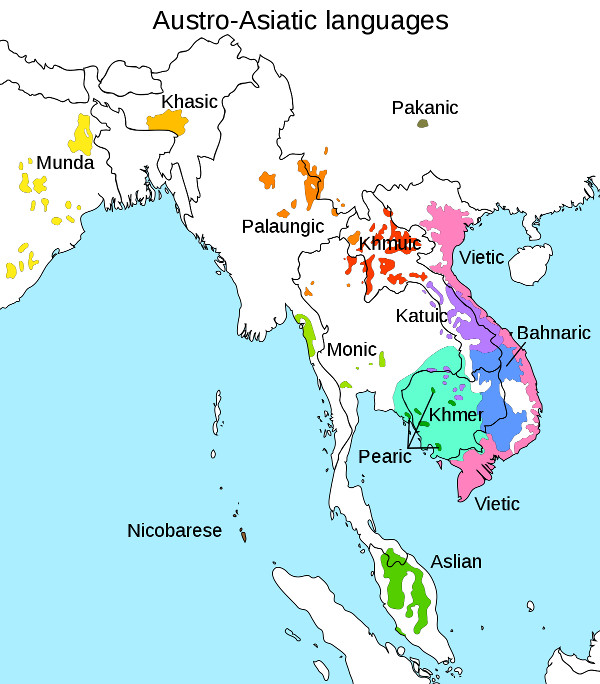
The reason for me is simple: I have leaned to the position that Munda are intrusive from Southeast Asia. Over the past 10 years my confidence in this proposition as grown. Let’s review

1) They speak an Austro-Asiatic language. Most Austro-Asiatic languages are in Southeast Asia and seem to have spread from the north to the south

2) The Munda have genetic signatures on the Y chromosome and some of their traits which are distinctive to East Asians and totally unrelated to any other South Asians. These genetic signatures are not found in South Asia outside of the Munda areas, and northeast India (i.e., they are not present in the Indus or Gangetic plains).

3) The most common Y chromosome of the Munda seems to be from Southeast Asia. That is, Southeast Asian lineages are basal and more diverse than the ones in India.

4) Genetic data from ancient DNA indicate that Austro-Asiatic people did not arrive in northern Vietnam until 4,000 years ago. To me this, this implies they arrived in India well after 4,000 years ago.

5) We now suspect that Indo-Aryans arrived well after 4,000 years ago to the Indus valley. The Munda and Indo-Aryans could not have met in that region 3,500 years ago in any reasonable scenario.

Let’s assume that Witzel and others are correct that the early Indo-Aryans and the languages/toponyms of the Gangetic plains do not show Dravidian influence. How could that be? It could be that in the northern Indus valley a non-Dravidian language was dominant. Consider Burusho, a linguistic isolate. Mesopotamia was long divided between a Semitic north and a Sumerian south.

Second, the genetic data seem to suggest that some Indo-Aryan groups have more AASI and more steppe than groups to their west. North Indian Brahmins vs. Sindhis are an example. To me, this is indicative of the possibility that the Indo-Aryans pushed past areas where Dravidian languages were dominant, and only AASI hunter-gatherers were flourishing. The lack of a Dravidian substrate is because the AASI groups the Indo-Aryans encountered were not Dravidian speakers.


Lawyer Asama Javed is ‘fixer for forced marriage’

Lawyer Asama Javed is ‘fixer for forced marriage’

The video in the link is 5 minutes long and worth seeing. This is pretty shocking since the lawyer, Asma Javed, is (and I’m excerpting):

On the surface Asma Javed 44, appears to be an upstanding member of her community, a political career with the Labour Party, now a partner in a law firm, a governor at a local primary school and on the fostering panel at Bradford Council. Yet her ‘marital advice’ exposes a complete disregard for basic human rights and utter contempt for British values.

What struck me is that Ms. Javed is obviously British born & bred since she easily slips into the Bradistani patois. But her Punjabi/Mirpuri is at native levels; this wasn’t supposed to happen after so many generations in the UK.

Since I’m a BritPak I’m quite the integrationist but in this case something’s got to give.  My thoughts on integration versus assimilation are mainly concerned with High Culture; even though I can understand Shakespeare and actually like it, I’ll ultimately still identify with Ferdowsi & Ghalib (probably the two poster boys for Turanistan)

The Augean Stables that is the British Muslim community needs to be cleansed. This is not a “Pakistani” issue but a Muslim one as we can see in this bit of news as well. Teenager jailed for life over British Museum bomb plot. When did Muslim culture in Europe become so degenerate?


Rakhigarhi sneak-peaks

Over at my other weblog, noting that the Indian press is finally starting to simply report the substantive contents of the Rakhigarhi results. As we all know the media can distort and misrepresent, so we need to be cautious and wait on the final paper, mostly because with that the authors can speak freely and without intermediation. But, I have heard through the grapevine the general results, and the results are exactly what Outlook India is currently reporting.

The Rakhigarhi samples themselves aren’t that interesting to me. But, Niraj Rai seems to be pushing the admixture event with IndoA-Aryans after 1500 BC. This could be a misquote, or, it could be that the researchers from various groups now have enough data to fine-tune their parameters so as to narrow down various admixture timing events.

Brown Pundits